





Abstract
Various explanations have been offered for the commanding electoral support that has been enjoyed by the Belarusian president Alyaksandr Lukashenka since his original election in 1994. On the evidence of the authors’ surveys, in particular post-election opinion surveys conducted in 2006 and 2011, there is an association between social structural variables and electoral support, and between perceptions of government economic performance and electoral support, but both largely disappear when appropriate controls are introduced. It is personal approval of Lukashenka on the part of voters, over and above these other circumstances, that makes by far the largest contribution.
Alyaksandr Lukashenka is not only one of world’s longest-serving political leaders but also one of its most enigmatic. Part of the explanation is related to the restrictions that apply to the domestic media, and the limited exposure he has received in foreign capitals—itself a consequence of his limited ability to visit them. 1 For this and other reasons, there are many aspects of his biography and political career that are still obscure, more than twenty years since his first election: for instance, the status of his marriage (his estranged wife is “believed [to live] on a cattle farm in rural Belarus”); the identity of the mother of his youngest son Kolya (which has “never been made public”); 2 even his date of birth. 3 His personal wealth has been another subject of speculation—he was “alleged to have large sums of money in the Lebanon, Austria and elsewhere,” or perhaps Venezuela. 4 And the disappearance of four of his political opponents (and of his former official cameraman) in 1999 and 2000, all of them abducted in mysterious circumstances, remains unresolved. 5
But for political scientists, it is the nature of the Lukashenka leadership that has been the more intriguing. For Freedom House, Belarus in 2014 was “not free” with scores for political rights and civil liberties that placed it among the world’s most repressive regimes, below Afghanistan and just above North Korea and Uzbekistan; for Freedom House’s Nations in Transit, in the same year, it was a “consolidated authoritarian regime.” 6 In another exercise, Polity IV, Belarus was a “constitutional autocracy” in which Lukashenka had “systematically consolidated virtually all political power within his hands”; opposition was allowed to exist, but it was limited by “government intimidation and coercion, state control of the media, widespread distribution of patronage to Lukashenko supporters, and factional splits within the opposition movement itself.” 7 At the same time, there was general agreement that its long-standing president would be likely to win a genuine contest for the presidency, if one took place, and even Polity IV conceded that he enjoyed “widespread popular support.” 8
An authoritarian leadership that could all the same draw on the support of a popular consensus raised larger questions about the origins of that consensus. For some, it was the leadership itself that was of decisive importance, and Lukashenka’s personal qualities in particular. Others pointed to a “Belarusian model” in which many of the social guarantees of the Soviet period had been retained, including full employment and affordable housing. 9 Even the economic difficulties that led to a run on the currency in 2011, it was argued, should not be allowed to obscure the success of the authorities over the longer term in sustaining a relatively high rate of economic growth and an equitable distribution of its benefits of a kind that appeared to be capable of supporting a continuing accommodation between regime and society. 10 The United Nations Human Development Index, which brings together life expectancy, per capita GDP, and educational enrolments, had Belarus in first place among the CIS member states in 2014 (53 out of 187), just ahead of Russia (57) and still further ahead of Ukraine (83) and the other post-Soviet republics. 11
Explanations of either kind themselves raised further questions. Support, for a start, among whom? Was it evenly distributed throughout the society, as appeared to be the case with Vladimir Putin in Russia? 12 Or was it concentrated among particular groups, such as older voters, perhaps nostalgic about the Soviet past and more dependent on public spending, or rural voters, responding to a style of leadership that was reminiscent of the state farm chairmanship that Lukashenka had occupied before he became President? Indeed, were social structural factors of this kind the primary explanation, and leadership and government performance incidental? We focus directly on these issues in the discussion that follows, drawing on nationally representative post-election surveys conducted for the authors in 2006 and 2011 as well as focus group and other evidence. 13 We look first at the nature of presidential power within an authoritarian system of the Belarusian kind, and then review rival explanations of Lukashenka’s electoral support; the following section tests their respective explanatory power, and a conclusion develops the implications of our findings.
Presidential Power and the Belarusian System
Under its 1994 Constitution, as amended, the President is the “head of state [and] guarantor of the Constitution of the Republic of Belarus [and of the] rights and freedoms of the person and the citizen” (art. 79). His powers are very extensive, including the exclusive right to nominate the prime minister and to appoint and dismiss deputy premiers and government ministers. He presents an annual address to parliament and can reject draft legislation (although his veto can in turn be overridden: art. 100); he heads the armed forces, and represents the state internationally. The President is also empowered to issue decrees and directives whose implementation is obligatory throughout the national territory (art. 85). The President may be impeached, on grounds of ill health or anti-state crime, but with considerable difficulty (art. 88). Powers of this far-reaching kind are strongly reminiscent of those of the Russian President, but go beyond them in certain respects (such as the right to suspend strike action for up to three months: art. 84:23).
Candidates in a Belarusian presidential election are nominated on the basis of the signatures of at least one hundred thousand registered electors (art. 81); the election is valid if more than half of the electorate takes part, and the winner is the candidate who secures more than half of the votes cast (art. 82). In the first of these elections, in 1994, there were two rounds of voting and Lukashenka won more than 80 percent in the second round run-off against the then prime minister, Vyacheslav Kebich. Since then, all of the country’s presidential elections have been resolved on the first ballot and by an equally decisive majority (see Figure 1). The powers of the presidency itself have steadily expanded over the same period. A referendum in 1995 allowed the President to suspend parliament if he judged it was acting unconstitutionally; another referendum in 1996 extended presidential powers still further, including the right to dissolve parliament, to overrule the decisions of government, and to appoint members of the upper house and the constitutional court in a manner that was scarcely consistent with the separation of powers. A further referendum, in 2004, removed the requirement that (as in Russia) a President serve no more than two consecutive terms, allowing Lukashenka—if he wished—to serve indefinitely. 14
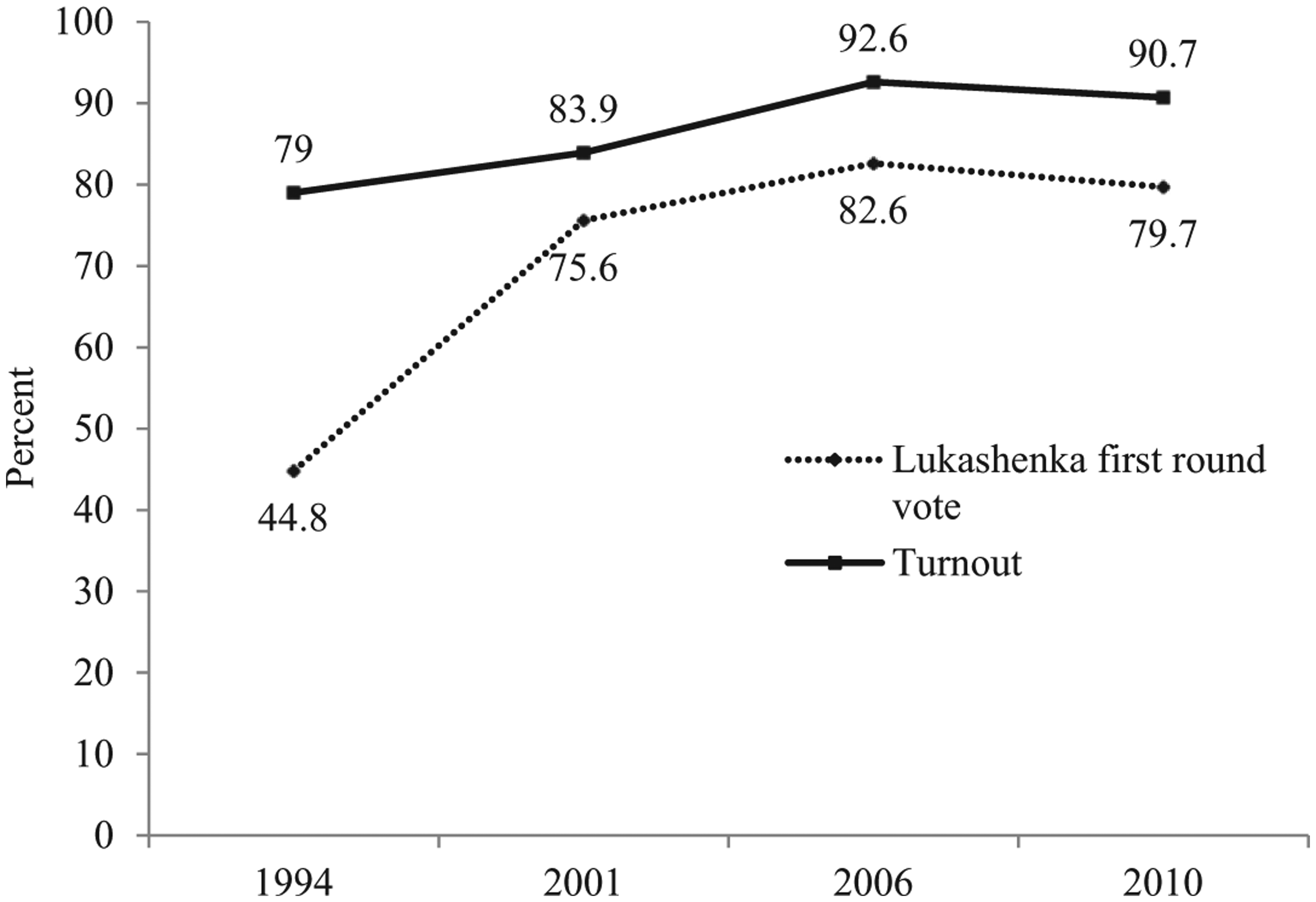
Turnout and Lukashenka vote at the presidential elections, 1994–2010
The Belarusian presidency has not normally been included in the attempts that have periodically been made to assess the strength of presidential authority on a crossnational basis. 15 When they did so, it was generally agreed that Belarus was at the most strongly presidential end of the spectrum, 16 and that its post-1996 constitution could perhaps most aptly be described as “super-presidential.” 17 The most elaborate study of this kind that has so far been conducted across the post-Soviet republics, based on a weighted version of the Shugart and Carey checklist, found that the weakest presidencies were in the Baltic republics and Moldova, which had moved from a semi-presidential to a parliamentary system in 2000. Ukraine and Georgia had “moderate” presidencies, and so did Kyrgyzstan and Tajikistan, although their constitutions simply omitted some of the relevant provisions. The others, including Belarus, were classified as “superpresidencies” because of the “enormous concentration of power in the president’s hands,” including “almost uncontrolled executive powers.” Belarus, indeed, was second only to Turkmenistan in the degree to which political power was concentrated in its presidency, a result that was consistent with its ranking in other surveys. 18
Formal rules of this kind were obviously important; in weakly institutionalised regimes of the Belarusian kind, however, they might often be less important than the political agency that could be exercised in other ways. Authoritarian forms of politics, indeed, had emerged in Belarus before Lukashenka’s accession, and before his establishment of a dominant presidency. But once he had been elected Lukashenka closed the country’s only independent radio station, restricted street protest, and used the 1996 referendum to replace the existing parliament with an entirely subordinate House of Representatives. By the mid-2000s, after term limits had been removed and Lukashenka had been re-elected by overwhelming majorities, the regime could be described as “hegemonic,” with a political opposition that had been “effectively silenced” and left without any representation in the Belarusian parliament. Unlike Ukraine, Belarus had no semi-autonomous business elite that might have funded a political alternative, and it was also important that Russia was able to provide economic and diplomatic support that countered Western pressure for more far-reaching change. 19
The Belarusian system, some suggested, could best be seen as an example of “competitive authoritarianism”—a type of political system that allowed competition, and occasionally an opposition victory, but in which “electoral manipulation, unfair media access, abuse of state resources, and varying degrees of harassment and violence skewed the playing field in favor of incumbents.” Some of these countries had democratised (like Mexico and Slovakia), but others remained the same, or became more authoritarian (such as Belarus and Russia). Indeed there were cases of reverse transition, such as Georgia and Zambia, in which democratic regimes had been replaced by authoritarian ones. As of 2010, more than a dozen competitive authoritarian regimes had persisted for fifteen years or more. Rather than “incomplete” or “partial” democracies, argued Levitsky and Way, they had to be categorised as a “distinct, nondemocratic regime type,” with their own, particular characteristics. 20 Others conceptualised the Belarusian regime as “authoritarianism with elections,” which was in fact the “modal form of autocracy,” 21 or simply “dictatorship”; 22 some even described it as a “presidential monarchy.” 23
The Support Bases of the Lukashenka Leadership
Explanations of the support of the Lukashenka leadership, and of his electoral support in particular, can very broadly be divided into three categories: social structural, performance-based, and leadership-based.
Social structural explanations have typically used nationally representative surveys to identify the extent to which Lukashenka’s support is drawn disproportionately from particular segments of the electorate. The survey evidence that was collected at the time of Lukashenka’s re-election in 2001, for instance, suggested that his support was lowest of all among entrepreneurs (4 percent of those who were polled) and highest among pensioners (62 percent)—a significant electoral force, as they represented more than 35 percent of the electorate. Collective or state farm workers (48 percent) were also supportive, and represented another substantial electoral force in a society in which 31 percent lived in the countryside. 24 Other surveys conducted in the early years of his second presidential term confirmed that Lukashenka voters were more common among those who were over 60, with lower levels of education, who lived in small towns and villages. His core voters, it was suggested, could “best be characterized as the ‘socially vulnerable’—that is, those who believe[d] they need[ed] the protection of the state and look[ed] to a politician like Lukashenko to be their guardian.” 25
At least to begin with, the Lukashenka vote was also distributed unevenly across the country. The east, including the Vitsebsk region in which he was born and the Mahilew region in which he had worked as a state farm chairman, was the most strongly supportive throughout; the Mahilew region provided the largest share of the Lukashenka vote in two of the four presidential elections between 1994 and 2010, and Homel the largest share of the vote in the other two. The lowest level of support, in every case, was from the city of Minsk. 26 But as Lukashenka extended his authority throughout the country, the wider disparities disappeared and there was “no longer much of an east-west split.” 27 More important, in the view of the Independent Institute of Socio-Economic and Political Studies (IISEPS), were the demographics that had figured in other analyses, particularly the differences between town and country (where his support was much greater), between the generations (support was particularly high among pensioners), between the genders (women were much more likely to be Lukashenka supporters than their male counterparts), and between the various levels of education (with the strongest support of all among those who had no more than a primary education). 28
Interpretations of this kind have not gone unchallenged, and other researchers, using more elaborate statistical techniques, have reached rather different conclusions. Lukashenka supporters, it emerged, were no more likely to be old, or less well educated than others, or resident in the countryside, once other circumstances had been taken into account. In fact it was “mostly a coincidence” that older people were more supportive of the existing government; it was not age that made the difference, but other factors that were associated with it. Similarly, education mattered, but in a manner that was exactly the opposite of what the existing literature had predicted: all other things being equal, “better-educated people [had] more positive attitudes towards the regime than those with a lower level of education.” Putting all the variables together, it emerged that a positive view of the previous communist regime was of some importance, but that a positive evaluation of the current regime was “mainly driven by the current economic situation in the country.” 29
As these conclusions suggested, there was every reason to look to government performance, particularly in economic matters, as an alternative explanation of Lukashenka’s persisting electoral success. It was certainly a regime that pursued a distinctive policy among the post-Soviet republics, by deliberately prioritising the role of the state in providing a framework for economic development. As the “main principles” of government policy made clear, a strong and effective state was an essential precondition for the “gradual development of the national economy,” and for the steady improvement of living standards. Belarus, for this reason, had rejected the prescriptions of the International Monetary Fund, and the “shock therapy and wholesale privatisation” with which they were associated. A rather different model of economic management had been developed, one that combined the “advantages of the planned economy with effective social security”; it was a model of this kind that had allowed Belarus to be the first of the post-Soviet republics to return to the levels of output of earlier years, and to achieve a high level of human development. 30
Policies of this kind, in the official view, had also allowed Belarus to avoid the “oligarchical structures” that had become dominant in the other post-Soviet republics, and to avoid mass unemployment and poverty. Social policy was based on the “employment in new conditions of the principle of social justice,” including forms of support that were particularly directed towards young people, the elderly, and those who lived on the territories that had suffered from the Chernobyl disaster. The state itself took responsibility for the provision of adequate levels of food, heating, communications, transport and household services. And there was a parallel commitment to the “fair allocation of rewards for labour,” with particular measures for the support of the less prosperous. 31 There was of course no reason to take such professions at face value, still more so after the collapse of the currency that took place in 2011. All the same, these were declared objectives that differed substantially from those of other post-Soviet leaderships, and they were reflected in better life expectancies and lower levels of income inequality than those that prevailed elsewhere in the region. 32
Closely related to economic performance was the question of corruption. Transparency International’s annual survey, in 2014, placed Belarus at 119 out of the 175 countries that were surveyed, but all the same ahead of Russia (136) and Ukraine (142). 33 Domestic perceptions were rather more positive, if the survey evidence is accurate: exactly half of our Belarusian respondents thought there was “hardly any” corruption among state officials in 2011 or that it affected no more than “a few,” twice as many as took this view in the survey we conducted in Russia in 2010 (25 percent) and more than three times as many as in Ukraine the same year (15 percent). Similarly, no more than a third (37 percent) thought there had been an increase in corruption since Soviet times, which was about half as many as took this view in Russia (72 percent) and Ukraine (75 percent). Indeed, more than a quarter (27 percent) thought there had actually been a reduction in corruption since Soviet times; only 4 percent of our Russian and 3 percent of our Ukrainian respondents had the same opinion.
A third form of explanation, which we have called “leadership-based,” drew more heavily although not exclusively on qualitative evidence. Focus groups conducted in the early years of the new leadership, at any rate, suggested a head of state with whom there was a close and even personal association. “I believe our President is a most exceptional leader,” declared Vasilii Ivanovich, in his mid-seventies.
I voted for him in the first election, and will vote again, if necessary. My sons, and my grandsons, are all in his favour. I have relatives in Siberia who say that, if Alexander Grigor’evich were to run for election in Russia, they would support him without any doubts. He is an outstanding man.
The Belarusian leader had “managed to touch something deep inside me, some kind of sacred chord in my soul, which I could not resist,” observed Alla Ivanovna, in her late forties. There were even comparisons with Don Quixote and Joan of Arc. And if there were any problems, they could be attributed to the President’s unreliable associates, who were “always playing dirty tricks on him”). 34
There were also more pragmatic assessments that associated the Lukashenka leadership with particular spheres of policy. “He promised to raise pensions, and what is more important, to keep higher education free,” remarked Svetlana, in her mid-thirties; he had inherited a “ruined economy,” but all the same he had “managed to put it together and make it work for his people!” Lukashenka had “made our normal life possible,” added Dima, a student in his twenties; “he reduced crime and gave us the opportunity to work.” Just “look how multinational our country is. And we all live in peace and there are no humiliations,” observed seventy-year-old Polina Mikhailovna. “He was the only one to stand up against the dissolution of the USSR. They threatened him, but he fears no one!” added Alla Ivanovna. “I grew up on ballet and opera, and free access to culture—I want my children to have this too,” commented Anna Vladimirovna, in her late forties. Others remembered the attack on corruption that had brought Lukashenka to national attention, and supported his resistance to the “interference of all those OSCEs, UNs and Americas in the life of our nation!” 35
An attempt to quantify these personal factors was made by a group of Belarusian scholars at the start of the new President’s second term. In 1994, they argued, there had been a “sort of vacuum” in Belarusian politics, in which the charisma of a pretender to the position of head of state could play a “decisive role.” This allowed Lukashenka, who had by far the highest charisma rating of the various contenders, to secure victory: not so much because the majority had rejected the incumbent government and its representative, prime minister Kebich, as because he had “unique leadership qualities [and] a rather striking ‘charismatic presence.’” Indeed, how otherwise could a young outsider have hoped to defeat a regime-sponsored candidate who could count on the resources of the state itself? 36 By the time of the second presidential election in 2001 Lukashenka’s charisma rating had increased still further, to a point that was far above that of all the other candidates; and in spite of the serious difficulties that had confronted his administration, it was personal charisma that had once again played a “positive role” in securing his victory. 37
Testing the Explanations
Survey evidence that is collected under authoritarian circumstances raises a number of difficult methodological issues. In particular, there is every reason to expect that responses will be heavily biased by the nature of the regime itself, predisposing respondents to provide what they may think are the “expected” responses. 38 Interviewer effects are of course a familiar issue in other settings: for instance, the “acquiescence effect” (in which respondents agree or disagree consistently with a series of items that may themselves be contradictory) or the “social desirability bias” (in which respondents answer questions in a manner that is influenced by the conscious or unconscious desire to do so in a way that will be viewed favourably by others). 39 Effects of this kind, we may reasonably assume, will tend to be greater where opposition to the current regime is not regarded as legitimate and where respondents may have reason to believe that the expression of such opinions could have unfortunate consequences. Even if overt repression may have diminished over the post-Soviet period, as a study of Russian political values has reminded us, the “habits of hiding truth may not have entirely disappeared.” 40
In our view, issues of this kind make it important to take particular care in such exercises and ideally “triangulate” them with evidence from other sources. In the first instance, we have made consistent use of the same survey agency, minimising changes in the sampling frame or question wording that might in themselves distort our findings. The agency that undertook our fieldwork is attached to the Belarusian State University, regularly takes part in the World Values Survey and other crossnational exercises, and adheres to the relevant professional conventions. But not only this: we were also able to check our findings against those of other agencies, and official data. On our own evidence, for instance, turnout in the December 2010 presidential election had been 88.1 percent. According to the IISEPS, based in Lithuania and generally seen as unsympathetic to the regime, turnout had been an almost identical 87.6 percent. 41 The official figure, calculated as votes cast as a percentage of the electorate and not simply ballots distributed, was a very comparable 89.8 percent (discrepancies of this kind are well within the range that is normally encountered in the Western democracies). 42
We could also compare results for the individual candidates in the 2010 election (Table 1). On our own evidence, 66.0 percent of the voters had supported Lukashenka, which was very similar to the 65.3 percent that had done so according to the IISEPS (both of these figures were somewhat below the official communique, which gave the Belarusian president 79.7 percent of the total). 43 The next most popular choice was “against all” the candidates, accounting for 7.0 percent of the valid vote in our own survey, it was 6.0 percent for the IISEPS, and 6.5 percent according to the official communique. And as far as the general conduct of the election was concerned, 55.6 percent of those who took part in our survey thought it had been conducted “honestly and fairly” (combining the fourth and fifth points on a five-point scale); the IISEPS found that a very similar 54.4 percent thought it had been conducted “freely and fairly.” 44 Whenever their results were unwelcome to the Belarusian authorities, commented the IISEPS director, Oleg Manaev, it complained they had been “paid for by the West”; but whenever the opposition found them unwelcome, they were told instead that the Institute had “either been bought up by the regime or intimidated, or had simply been unprofessional.” The real explanation was that “politicians see things very differently than scholars do.” 45
The Presidential Vote, 2006 and 2011 (Survey Estimates)

Source: Authors’ surveys (see note 13).
Note: Actual results in parentheses exclude invalid votes.
Drawing on survey evidence of this kind, we move on in what follows to test these rival explanations individually, and then in combination, in order to establish which effects are genuine and persist even when account is taken of contextual variables.
Table 2 shows that men were less likely to vote for Lukashenka than women, and that younger voters were also less likely to support him. Other social structural effects were consistent with the existing literature: Voters with a higher education were less likely to support Lukashenka, and so were urban residents. 46 Perhaps surprisingly, regular church attenders were somewhat more likely to be Lukashenka voters in 2011, but not in 2006. These were strong effects, of a kind we could reasonably have expected; but they might be spurious, in that (for instance) urban residents were more likely to have a higher education, which might be the variable that made the difference; and rural residents might have lower incomes, such that it might not be residence in itself that contributed to a Lukashenka vote so much as the social characteristics that happened to coincide with it.
Social Structure and the Vote for Lukashenka, 2006 and 2011

Source: Authors’ surveys (see note 13).
Note: Regular church attender is defined as attending church at least once per month.
There were also associations between government performance and a propensity to vote for Lukashenka (Table 3). Those who had a positive view of the country’s economic situation, not surprisingly, were more likely to vote for the incumbent President, and by a considerable margin. So were those who thought there had been improvements in the country’s economic situation over the previous twelve months. There was also an association between an improvement in the respondent’s own family circumstances and a Lukashenka vote, although it had less statistical significance. There were further associations between a Lukashenka vote and the belief that corruption had not extended widely among state officials, and between a Lukashenka vote and the belief that corruption had actually diminished since the Soviet period.
Performance and the Vote for Lukashenka, 2006 and 2011

Source: Authors’ surveys (see note 13).
Note: The three economic measures combine “much better” and “better.” Few officials corrupt combines “not very widespread” and “not widespread at all.” Corruption since Soviet times combines “reduced a little” and “reduced significantly.”
There were more striking effects when we tested for an association between a vote for Lukashenka and support for the view that “a strong, powerful leader can give our country more than any laws,” and still more so between a vote for Lukashenka and trust in the presidency as a political institution (Table 4). The strongest associations of all, predictably, were between a vote for Lukashenka and personal approval of the President in the 2011 survey (the question was not asked in 2006). However, the differences between the two groups of voters in their degree of trust in the President were almost as substantial, and increased still further between 2006 and 2011. There were less striking disparities between the two groups of voters when we asked if a powerful leader could “give our country more than any laws,” but they remained statistically significant and were also increasing. In whatever way it was measured it was clear that Lukashenka voters had very different views about the role of leadership than their counterparts who had voted for other candidates.
Leadership and the Vote for Lukashenka, 2006 and 2011

Source: Authors’ surveys (see note 13).
Note: Powerful leader combines “agree” and “strongly agree.” Trusts the president combines codes 5, 6, and 7 on a seven-point scale. Approves of Lukashenka combines “approve” and “strongly approve.”
Finally, in Table 5, we test the relative strength of these associations, taking account of a range of contextual variables. We have data for personal approval of Lukashenka in 2011, but not in 2006, and so we have run the regression analysis in two ways: in model 1, with personal approval of Lukashenka omitted (so that the results between the two surveys are directly comparable), and in model 2, where it is included. Both models have considerable statistical power, explaining between one-third and almost one-half of the variance in his support. What the results show is that in 2006, it was trusting the president that mattered. In 2011, in the first model, this was also important, along with the belief that a powerful leader “could give our country more than any laws.” But in the second model, which included approval of Lukashenka, it was this single factor that mattered more than any other. The conclusion follows that it is approval of Lukashenka himself that most directly explains his electoral support, rather than a belief in strong leadership, approval of government performance or the social characteristics of the respondent.
Evaluating the Social Structural, Performance, and Leadership Explanations, 2006 and 2011

p < .01, *p < .05.
Source: Authors’ surveys (see note 13).
The Future of the Lukashenka Presidency
Presidential leaderships in the post-Soviet republics had a number of common characteristics. 47 Typically, they were directly elected. They had wide-ranging, even “superpresidential” powers. And sometimes (as in Belarus itself, after 2004, or Kazakhstan, after 2007) there were no constitutional limitations on their period of office; in Turkmenistan, Saparmurad Niyazov was spared the need for even the nominal renewal of his mandate when he was declared president for life in 1999, and became the centre of a bizarre personality cult that lasted up to his death in 2006. 48 The overwhelming power of the presidency in Belarus was at first sight compatible with this larger picture; it was, of course, also compatible with the dominance of a single leader in the communist period, and much older patterns of autocratic rule, “I don’t deny that the powers of the president in the draft constitution are considerable,” Boris Yeltsin told journalists in 1993 as his favoured text was placed before the Russian people for their approval, “but what do you expect in a country that’s used to tsars and strong leaders?” 49
Defining the new regimes as superpresidential, however, was no more than the start of an adequate analysis. The powers of the presidency, for instance, might be formidable on paper. But in practice, it was difficult to separate the office itself from the particular qualities of the “exceptional personalities” that had held it over the “relatively short period of postcommunist rule.” 50 Even the remarkable personal ascendancy of Vladimir Putin in Russia required some deconstruction. Within just a couple of years of his first election, there were pilgrimages to the town in the Pskov region where “Putin [had] touched a tree and made a wish”; there were tours of the back streets of St Petersburg where the future president had grown up; and Putin himself appeared in a series of “action man” events over the three terms of his presidency that emphasised the contrast with his ailing predecessor. 51 Individual-level analysis suggested that the “Putin phenomenon,” in fact, had little to do with Putin himself: it was rather that a “high value [was] placed on economic prosperity, which [was] itself associated with Putin’s leadership.” 52
On the evidence we have considered, it was less clear that the Lukashenka leadership depended quite so heavily on its economic performance. As we have seen, it was approval of Lukashenka personally that was most closely associated with a vote in his favour, rather than approval of government performance, a belief in strong leadership, or the social characteristics of the respondent. But the Belarusian President could also claim to have helped his country to surmount the challenge of the international financial crisis of 2008–2009, even if it was only through an “inter-temporal redistribution of output losses.” 53 Delivering his parliamentary address in 2013, he acknowledged that it had been a difficult period; there was no escaping a financial crisis that was global in its scale and significance, and current developments in Greece and Cyprus offered few grounds for optimism. But stability had been restored, incomes had risen, and Belarus was now among the top fifty countries worldwide in terms of its human development, as measured by the United Nations; this was the best performance of all the members of the Commonwealth of Independent States. 54
It was also a mistake to see the Lukashenka leadership as lacking in the support that might otherwise have been conferred by competitive elections. Outsiders, certainly, were very sceptical about the quality of the Belarusian electoral process. The OSCE report on the 2010 presidential election insisted that the country had a “considerable way to go in meeting its OSCE commitments for democratic elections”; there was a “lack of independence and impartiality of the election administration, an uneven playing field and a restrictive media environment, as well as a continuous lack of transparency at key stages of the electoral process,” and the vote count had been “bad or very bad in almost half of all observed polling stations.” 55 The election itself was followed by a massive public demonstration that was brutally suppressed, and prison sentences that removed most of Lukashenka’s potential challengers from the political arena. 56 The US Secretary of State, Hillary Clinton, and the EU’s foreign policy head, Catherine Ashton, issued a joint declaration deploring the violence and describing the election itself as an “unfortunate step backwards in the development of democratic governance and respect for human rights in Belarus.” 57
Belarusians themselves, on the survey evidence, were less dismissive. About half of our respondents (51 percent), for instance, thought national elections gave “an opportunity for people like [me] to influence the governing of the country,” slightly more than took this view in Russia and Ukraine (about 47 percent in both cases). Very similar numbers thought elections could “definitely or probably change the course of events in our country” (58 percent took this view in Belarus, 52 percent in Russia and 59 percent in Ukraine). Nearly two-thirds (65 percent) thought the presidential election had been “largely” or “entirely fair” in respect of the composition of the ballot paper and the counting of the vote, which was substantially more than the 52 percent that took this view in Russia and the 48 percent that did so in Ukraine. The same was true of the conduct of the election campaign “in your local area,” and of the fairness of television coverage. Overall, 56 percent of our Belarusian respondents thought the presidential election had been conducted “honestly and fairly”; once again, this was a much more positive verdict than in Ukraine (where just 35 percent took the same view of their own presidential contest) or in Russia (31 percent).
There was equally little reason to believe, on the same evidence, that Belarusians were particularly dissatisfied or that they felt particularly lacking in political influence (Figure 2). They took a modest view, on the evidence of successive surveys, of the influence they could bring to bear on their own national government. They thought their ability to influence government was rather less than that of their counterparts in the Western democracies, where 36 percent thought ordinary citizens had at least “some” influence. But on the same evidence, Belarusians were more satisfied with their own life, and with the state of their country, than their counterparts in Ukraine or Russia. Surprisingly, in the context of most Western assessments, they were more satisfied with what they understood as its “level of democracy” than their counterparts in Ukraine and Russia. They were two or three times more likely than their counterparts elsewhere to believe that human rights were respected, and twice as likely to believe that government treated ordinary citizens “equally.” And they were more likely to trust their civic institutions—not just the government, but also the courts, the political parties and trade unions, police and army, the media and their local council.
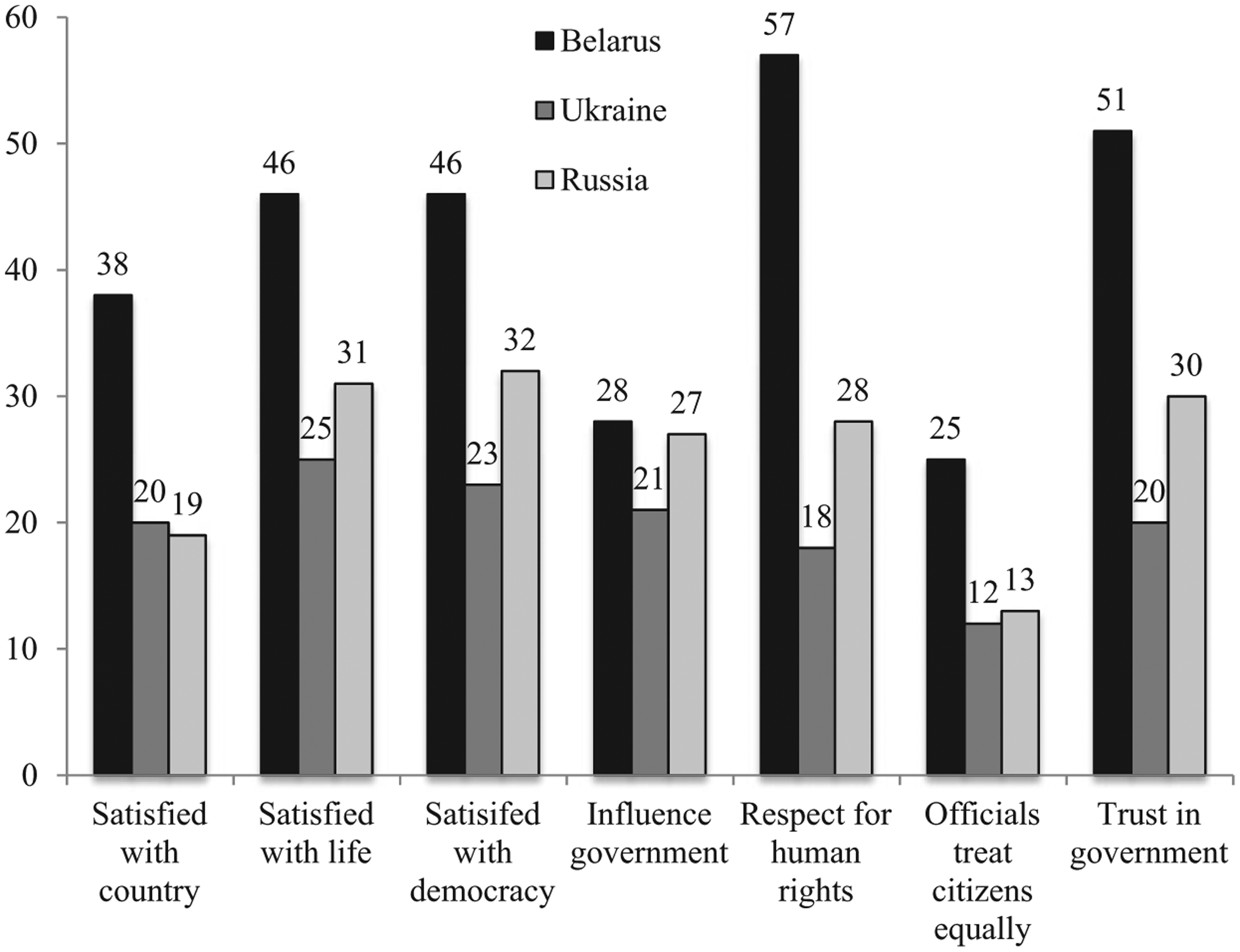
Measures of satisfaction and political influence, Belarus, Ukraine, and Russia, 2011–2012
It is, of course, one of the defining features of an authoritarian regime that it manipulates the flow of information, within and particularly across national frontiers. In Belarus, state television has always been an extension of the regime itself, and independent media have operated, if at all, in difficult circumstances. But governments everywhere have much less ability to control the flow of information than they did before the invention of the electronic media. Belarusians can access Russian and Ukrainian television, directly or via the Internet, and Western channels via satellite such as Cosmos TV and Euronews. And they can travel abroad and experience Western political practice at first hand. On our survey evidence, for instance, 36 percent of Belarusians had visited at least one of the Baltic republics (in Russia just 18 percent had done so, and in Ukraine 14 percent). And nearly a million Schengen visas allowing unrestricted travel throughout the EU were issued to Belarusians in 2014, more per head of population than in any other country in the world. 58 There was certainly little reason to believe that Lukashenka’s ability to maintain his dominant position across a series of elections had anything particularly to do with his ability to control the flow of people and political ideas.
Indeed, the fact that Lukashenka had spent so long in power was itself a factor that contributed to the security of his position. The passage of time, as Rose, Mishler, and Munro have noted, “slowly pushes people to adapt to new institutions.” And once a new regime has demonstrated it can persist, “support is increased by political inertia. . . . . The persistence of a regime also lowers expectations that another regime change is possible, encouraging resigned acceptance of the status quo.” 59 Many of the former Soviet republics had successfully maintained authoritarian rule for more than two decades. Regimes of this kind, it appeared, would often be able to sustain their position by a form of “soft authoritarianism.” Letters to the national media helped them to remove the incompetent and corrupt as well as the politically independent; a limited rule of law helped them to restrict the abuse of office; regime-friendly parties could be allowed to compete for parliamentary seats, or even invented. 60 If a new regime could survive the challenges of the first few years, “with the passage of time an autocratic regime can accumulate sufficient popular support to become the only game in town.” 61
Political leaders, in circumstances of this kind, had a whole series of mechanisms that helped them to continue in office without overt resort to violence. In the Belarusian case there was some evidence that an authoritarian but at the same time widely supported president could seek to broaden his political base by reforming political institutions themselves. When leading officials were outside the capital, Lukashenka insisted in his 2011 presidential address, they should hold more face-to-face meetings with ordinary people in factories and workplaces: “People should see us!” 62 His 2012 address extended this emphasis on the “further development of the political system” and looked forward to a “normal civilised party system” that would play a greater part in the electoral process in the future (otherwise it was the President who would continue to be held responsible for everything). 63 His 2015 address to the National Assembly emphasised the importance of direct communication, such as the weekly telephone call-ins that were increasingly being organised by regional officials (more than ten thousand had taken place over the two previous months). And elected bodies at all levels should make every effort to ensure that they represented the entire range of national opinion: it was “better to discuss these problems in Parliament than on the streets.” 64
This was perhaps the largest conundrum that was raised by the Lukashenka leadership: supposedly the “last dictatorship in Europe,” all the same it was generally accepted that its controversial leader would win a genuine contest if it were ever to take place. It also made clear that the perceived ability to influence government (which was greater in Belarus than in Russia or Ukraine) did not necessarily require the presence of competitive elections; it could take place in other ways. Perhaps it was easier to find alternatives to competitive elections in a relatively small and cohesive country with a unitary system of government than in much larger federations spread across several time zones and a variety of cultures. Perhaps authoritarian forms of politics had held in check the oligarchic power that in other post-Soviet republics had left ordinary citizens outside the political process itself. Either way, the evidence suggested a President who was less dependent on continued economic success than his counterparts elsewhere in post-Soviet space and who might accordingly look forward to a more extended period of office.