






Abstract
This study challenges a well-supported institutionalist theory in comparative politics that links democracy with higher levels of redistribution as well as studies that link authoritarianism with welfare state liberalization. Using pooled cross-sectional data for ten post-communist countries spanning twenty-five years and a dynamic model specification, the study shows that, contrary to what the institutionalist theory predicts, post-communist democratic governments redistribute about 0.6 percent less of their GDP on social protection in the short term and 1.3 percent less in the long term than post-communist autocrats do. However, consistent with the cultural legacies hypothesis, there are no differences when it comes to redistribution of life chances through health care and education. I attribute the finding that post-communist autocracies redistribute more via social spending and are reluctant to liberalize their welfare states to their need to maintain popular legitimacy in a region where citizens are accustomed to high levels of redistribution and popular protests often lead to regime turnover. I argue that post-communist democracies have other available mechanisms to maintain their legitimacy, namely, free and fair elections, while post-communist autocratic governments have to rely on redistribution to do so. The findings have implications for our understanding of authoritarian resilience in the region.
Introduction
Numerous cross-national studies have found that democratic regimes redistribute more than their autocratic counterparts. 1 These findings have been explained by institutionalist theory as stemming from the existence of effective institutions of contestation and representation that translate median voter preferences for redistribution into redistributive policies in democracies 2 and the absence or ineffectiveness of these institutions in autocracies. 3 But what happens if cultural legacies intervene in this model? What if both democratic and autocratic governments have reasons to redistribute more? To answer these questions, this study uses the post-communist region as a crucial case to disentangle the effects of institutions and legacies on redistribution.
The post-communist region 4 presents an excellent crucial case test 5 for the cultural legacy theory that links democracy with redistribution because of its shared history of communism and the negative impact of political and economic transitions on economic security, which have reinforced a highly redistributive ideology that continues to shape public attitudes for high levels of redistribution, 6 even among generations that have no direct experience with communism. 7 High levels of redistribution were the keystones of the communist “social contract” that sustained the legitimacy of these authoritarian regimes, 8 and post-communist governments, both autocratic and democratic, had to take them into account during social policy reforms. 9
If, as institutionalist theory posits, it is democratic institutions of free and fair elections and interest group pluralism that shape levels of redistribution and not a nation’s cultural legacy, I expect to find notable differences between post-communist democratic and autocratic governments when it comes to the levels of redistribution, with democracies redistributing more, regardless of the area of social spending. If the past cultural legacies approach to social policy development is correct, then there should be no notable differences in the levels of redistribution between post-communist democratic and autocratic governments. What is more, if the “social contract” theory of authoritarian resilience is correct, one should find that post-communist autocrats redistribute more.
Three bodies of literature have studied redistribution and social policy reforms in the region and beyond, with some studies specifically accounting for the role of regime in their analysis. The first body of literature, institutionalist, systematically tests the link between democracy and redistribution cross-nationally but rarely includes post-communist states in the sample. This stream of scholarship operationalizes redistribution as government spending on various welfare programs. Scholars working in this tradition argue that the link between democracy and redistribution operates through institutions of contestation and representation, namely, free and fair elections and interest group pluralism. With the exception of Profeta, Puglisci, and Scabrosetti who do not find evidence in support of the institutionalist hypothesis that higher levels of democracy are associated with higher levels of redistribution between 1990 and 2005, 10 this literature has produced consistent results that democracies redistribute more. For example, democracy has been found to be associated with higher levels of redistribution in the developing countries between 1960 and 1990, 11 in Latin American countries between 1970 and 2000, 12 in East Asian countries between 1980 and 2000, 13 and in developed nations between 1970 and 1999. 14 Though the link between democracy and redistribution has been found to be a robust one, these studies rarely include any number of post-communist countries in the sample and therefore overlook the importance of cultural legacies that generate pressure for redistribution on both types of governments. What is more, these studies employ static models with lagged independent variables that can potentially serve as a source of biased results because of the incorrect model specification. 15 This is why the present study tests the link between democracy and redistribution not only through subjecting it to the test by the crucial case research design with post-communist countries but also uses a dynamic model specification.
Another body of literature relevant to the exploration of the link between democracy and redistribution examines social policy reforms, in the post-communist region and beyond. However, with the exception of Cook, 16 this literature does not explicitly address the impact of political regime on welfare state development. Rather, it investigates how welfare institutionalist legacies shaped social policy development after the transition, 17 debates the convergence of the post-communist welfare regime to the European model, 18 examines the role of party ideology in redistributive policies and spending, 19 or combines the analysis of institutionalist past-legacies approach with the examination of relevant actors and interest groups in the social policy development process. 20 Inevitably, these studies focus only on post-communist democracies, with Višegrád democracies receiving the majority of attention in the literature. 21 With the exception of some studies that systematically test the effect of party ideology on social spending, most studies in this tradition are small and medium-N qualitative case studies. While these research designs are excellent at capturing the key players in reforms and detailing the complexity of the institutional legacies as well as the variation in state responses to interest group pressures, they tend to overemphasize the importance of observed relations, thus leading to conclusions that are highly dependent on the case selection. 22 These studies also assume the existence of democratic institutions, as a given; thus, they are unable to test systematically the impact of regime on social policy reform because of the absence of the variation in the regime variable. However, even if regime is accounted for, it is post-communist autocracies, not post-communist democracies, that are found to have liberalized their welfare states, as Cook concludes after qualitative analysis of two post-communist democracies and three post-Soviet autocracies. The absence of effective electoral institutions and unchecked power of authoritarian executives allowed the autocratic governments to more readily engage in unpopular reforms, according to Cook. 23 Studies that focus on pension reform in Latin America corroborate this claim by showing that extreme pension system privatization was undertaken by authoritarian governments in the region. 24
The third body of literature seeks to account for authoritarian resilience in the region. This broader literature links authoritarian survival to patronage, 25 coercive organizational capacity of autocrats and weak international linkages, 26 patriarchal gender norms, 27 as well as to the existence of legislature, 28 strong presidency, 29 and elections. 30 Some qualitative studies, particularly of Belarus 31 and, more recently, of Russia and China, 32 describe the role generous social programs play in regime survival, but they fail to explicitly account for why these leaders are particularly sensitive to the redistributive pressures. I argue that while post-communist democracies have other legitimacy-building mechanisms, namely, free and fair elections, post-communist autocratic governments rely on redistribution to maintain their popular legitimacy in the region with a legacy of high levels of redistribution and where popular protest is the most common mode of regime change. 33 Therefore, the key contributions of the present study lie in the theoretical clarification of the mechanism behind the sensitivity of post-communist authoritarian governments to redistributional pressures that the communist legacy generates as well as in systematic tests of the competing propositions generated by these literatures that rarely engage in a conversation with one another.
This study finds that past legacies trump institutions in post-communist countries. Namely, there is no difference in spending on education and health care between post-communist democratic and autocratic governments. However, regime matters when it comes to direct redistribution through pensions and unemployment benefits, and the effects of the regime change linger for about five years. Contrary to the expectations of institutionalist theory, post-communist democracies redistribute less than post-communist autocracies when it comes to social transfers, which I attribute to the need of the authoritarian governments to maintain legitimacy in the region where most regime turnovers are results of post-electoral protests, as discussed above. While post-communist democratic governments rely on democratic procedures to solidify their claims to legitimacy, post-communist autocracies are left with redistribution to maintain it.
The article proceeds as follows: the next section contains a theoretical discussion and presents the hypotheses; the third section discusses research design and the next one outlines the analytic strategy; the fifth section presents and discusses the findings that emerge from the analysis. The conclusion details the implications of these findings for authoritarian resilience.
Who Redistributes and Why Would They Redistribute?
An ongoing debate about the link between political regimes and levels of redistribution exists in the field of comparative political economy. While institutionalist theorists argue that democracies redistribute more than autocracies, social contract theorists argue that authoritarian regimes provide broader redistribution. Autocracies, according to social contract theorists, redistribute to maintain the support of target groups who are necessary for the survival of the regime. 34 They redistribute to quell public discontent with the lack of freedom and civil liberties, thus entering into “social contract” with their citizens. “In these fairly equal societies, the citizens are already benefitting from the productive resources of the economy . . . and social unrest are not sufficiently attractive for the citizens.” 35 While any authoritarian regime may choose to redistribute to broader categories of citizens to survive, post-communist autocracies likely have a particular sensitivity to issues of redistribution and welfare state liberalization given the legacy of communist welfare states and the public expectations for high levels of redistribution that it created. 36 In fact, “simply living in a post-communist country is associated with a shift of almost one-third of a standard deviation of the distribution of the attitudes on the state’s role in providing for social welfare.” 37
The existence of a long-standing tradition of high levels of redistribution shaped an attitudinal reliance on government for the provision of social welfare. Therefore, declining levels of redistribution in those countries is expected to lead to an acutely felt “relative deprivation,” defined by Todd Gurr as a “perceived discrepancy between men’s value expectations and value capabilities.” 38 Thus, high levels of “relative deprivation” may threaten the stability of an authoritarian regime, as it happened, for example, in Kyrgyzstan in 2005 39 or in Russia in 2004 when widespread protests broke out as a reaction to the government’s plan to monetize social benefits. In fact, regime turnover through electoral protests is the most common mode of regime change in post-communist autocracies. 40 What follows from this theoretical discussion is that post-communist autocracies have strong reasons to redistribute; thus, there should not be any significant differences between post-communist democracies and post-communist autocracies when it comes to redistribution, according to this line of thinking. If anything, they should redistribute more. Thus, the “social contract” hypothesis can now be formally stated.
Hypothesis H: Post-communist autocratic governments redistribute as much or more than post-communist democratic governments.
Alternatively, institutionalist theorists may argue that despite the strong reasons post-communist autocracies have for redistribution, they lack effective institutional mechanisms that translate public preferences for redistribution into redistributive policies, leading post-communist democracies to redistribute more. 41 These institutions include free and fair elections, constraints on the executive, and meaningful competition of policy ideas in the electoral marketplace. Acemoglu and Robinson provide an extensive explanation of why this is the case. 42 According to them, democratic institutions ensure longevity for the credible commitment on behalf of the elites to establish pro-majority redistributive policies. Historical evidence from the advanced democracies supports this line of reasoning. Once the workers were enfranchised and social-democratic parties started winning the elections, the expansion of social programs signaled increased redistribution. 43 When it comes to the developing countries, with the exception of the study by Profeta and coauthors, democracy time and again has been found to be associated with higher levels of government spending on social protection. 44 Further, examined cross-regionally, the degree of welfare state liberalization in post-communist democracies was limited in comparison to Latin American countries because of the universalist legacies of the communist welfare state and the constituents it created that were able to influence the politics of welfare reform precisely because of the existence of democratic institutions of elections and interest group pluralism. 45 Therefore, the existence of effective democratic institutions that channel public preferences for redistribution, the inability of post-communist democracies to employ coercion and the need to account for the interests of broad groups of constituents leads to the formulation of an alternative institutionalist hypothesis.
Hypothesis Ha: Post-communist democracies redistribute more than post-communist autocracies.
The next section presents my research design and empirical test of these hypotheses.
Research Design
To test these competing hypotheses, I built a new data set that spans ten post-communist countries during the 1991–2015 time period. Two criteria guided my sampling strategy—a country had to experience a regime change during the time of observation for the model to pick up its effect and the data on social spending had to be available. The countries, thus, include Russia, Belarus, Ukraine, Moldova, Georgia, Lithuania, Latvia, Estonia, Slovak Republic, and Hungary. All countries share the legacy of the comprehensive communist welfare state and public expectations for high levels of redistribution. All, with the exception of Moldova, belong to the middle-income nations. All experienced a regime change during the observation period, and some more than once, that is, Ukraine and Moldova.
Dependent Variables
I operationalize distribution as public spending on social insurance programs that seek to directly replace one’s income (retirement and unemployment benefits) and spending on programs that seek to redistribute life chances by investments in human capital, such as spending on public education and health care. 46 Therefore, three dependent variables enter the analysis: government spending on social protection, which includes retirement and unemployment benefits measured as percentage of GDP, and government spending on public health care and education, also measured as percentage of GDP. 47 The data for government spending on health care and social protection comes from the IMF Government Finance Statistics Database 48 and for educational expenditure from the World Bank World Development Indicators Database. 49
Post-communist countries in the sample exhibit variation when it comes to government spending across various categories of social policies. Overall, post-communist countries, on average, spend 10.7 percent of their GDP on social protection, 5 percent on education, and 4.5 percent on health care. If analyzed by regime type, democratic governments appear to spend, on average, 3.4 percent of their GDP more on social protection than autocratic governments. The average differences in government expenditure on health care and education are less pronounced, and equal 0.7 percent and 0.3 percent, respectively. Figure 1 graphically presents these differences.

Average government spending by regime type, 1991–2015
Independent Variables
The theory that links democracy and redistribution makes a distinction between democracies and autocracies but remains silent on how different levels of democracy are expected to affect levels of redistribution; therefore, a dichotomous variable is appropriate for the purposes of the current study. 50 A dichotomous operationalization of the regime variable makes the comparison between the two types of regimes easier and more meaningful as well as allows one to capture the long-term effect of a regime transition. In order to get a dichotomous variable, I recode Lührmann and her colleagues’ regimes in the world ordinal variable that comes from the Varieties of Democracy data set. 51 The original variable measures the degree of competitiveness of access to power as well as liberal principles that exist in a given polity in a given year. The original variable has four categories: closed autocracies, measured as 0; electoral autocracies, measured as 1; electoral democracy, measured as 2; and liberal democracies, measured as 3. 52 I recode closed autocracies and electoral autocracies as 0 and electoral democracies and liberal democracies as 1. 53 Appendix A further details the coding for each country.
Control Variables
The following socioeconomic factors have been found in the literature to independently affect redistribution, and thus they enter the analysis as control variables. Among economic factors that affect redistribution, one can identify domestic and international factors. Whereas a democratic regime signifies the commitment of governments to redistribution, as the institutionalist theory predicts, economic growth signals the government’s capacity for redistribution. Wealthier countries and countries whose economy is growing have more expandable resources to redistribute. 54
Traditionally, economic growth is measured as a percentage of the annual change in the GDP per capita. This measure comes from the World Bank World Development Indicators Database. I expect economic growth to be positively and significantly associated with levels of redistribution, regardless of the social policy area. On the other hand, higher levels of unemployment (measured as percentage of the total population) 55 are expected to increase the size of the target recipient group for the unemployment benefits, thus leading to the independent increase in government spending on social protection. 56 A similar line of reasoning applies to controlling for the population share of retired persons, measured as the share of the population above the age of sixty-five years and the share of the school-age population measured as percentage of the population between the ages of zero and fourteen years. 57 The sheer increase in the size of the target groups is hypothesized to be associated with increases in government spending in the relevant category. 58 Finally, any government that wrestles with the decision to increase redistribution also considers possible trade-offs, namely, the classic guns-versus-butter dilemma that all governments face when deciding on how to allocate government resources, as theorized by Carr. 59 Therefore, I expect increases in government spending on defense, measured as percentage of the GDP, to be negatively associated with the increases in other categories of government spending. This variable comes from the World Bank’s World Development Indicators Database. A few missing data points are supplemented by IMF data.
When it comes to the effects of the global economy on government social spending, the story is less straightforward. The domestic economy can be integrated into the international economy through trade and through capital. To measure the degree of trade integration, I use trade openness, which is the sum of total exports and imports over GDP. 60 To account for the degree of the level of financial integration into the global economy, I use a World Bank measure of net FDI inflows as a percentage of GDP. According to the compensation hypothesis, governments are expected to compensate the categories of citizens who lose from greater economic integration into the world economy through increasing government expenditure on unemployment benefits, which are part of the government expenditure on social protection. 61 The governments whose economies are more integrated into the global economy should also invest more into human capital development to increase their competitiveness. 62 Therefore, trade openness is expected to be positively associated with government spending on social protection, education, and health care.
When it comes to the effect of financial globalization, measured as the net FDI inflows, Rudra and Haggard report no significant effect of capital flows on education expenditure and a positive effect for social spending and health care. 63 Careja and Emmenegger find a positive association between net FDI inflow and government social spending and no effect on education. 64 The theoretical mechanism that links FDI inflows with government spending is expected to be similar to the one explaining the effects of trade openness. With increased financial globalization, governments need to compensate losers by increasing spending on social protection and by investing in the competitiveness of the labor force by increasing spending on education and health care. Therefore, I expect a positive association between net FDI inflows and government spending on social protection, education, and health care.
Analytic Strategy
To recall, I test my argument, using time-series cross-sectional data. Time-series cross-sectional data analysis presents some unique challenges that stem from its cross-sectional and time-series character. First of all, while modeling budgetary changes that are usually incremental, 65 analysists need to account for the dynamic nature of the data. This requires the use of one of the dynamic panel models. 66 Two such models exist as possible candidates to adequately model the dynamic nature of stationary data 67 —error correction model and auto distributed lag model. The difference between them lies in what kind of effects the researcher is interested in. Because the “short-run effects of X on Y are immediately available through the coefficients in the auto distributed lag model (ADL)” and long-run effects are easy to calculate, the auto distributed lag model is my model of choice. 68 Theoretically, the independent variables should occur before the dependent variables, so all the independent variables enter the model lagged by one year. The formal model takes the following form.

where Y represents annual government social spending on education, health, and social protection, as percentage of GDP. Regime stands for democracy if 1 and 0 otherwise. Controls are the percentage of the unemployed, GDP per capita growth, and the percentage of the population between 0 and 14 years of age, trade openness, net inflow of the FDI, government expenditure on defense, and the first difference of the percentage of the population older than 65.
Having discussed the model, I now turn to the discussion of the estimation technique. Panel data and dynamic models often violate the assumptions of the ordinary least squares regression, such as independence of the error terms that stem from the cross-sectional and time-series nature of the data. Lagged dependent variable is correlated with the residual by design. Nevertheless, GMM remains controversial because of the challenges of finding good instruments, thus not being an appropriate solution, either. Given that we know that the degree of bias decreases as T increases 69 and that one can test for the remaining residual autocorrelation with a Lagrange-multiplier test, ordinary least squares remains a preferred estimation technique in time-series cross-section data if the process is very dynamic and the degree of the remaining residual serial correlation remains low 70 as well as when T roughly equals 20. 71 The average T equals 18 years in the sample and no remaining residual correlation has been detected, so I proceed with the LSDV estimation. 72
Discussion of Results
Table 1 reports the results of the analysis. To recall, the coefficients in the auto distributed lag model show the short-term effect of the independent variable at time t and allow for the calculation of the long-term effects to estimate the total effect of the independent variable on the dependent variable for the variables of interest. The institutionalist hypothesis contends that post-communist democratic governments redistribute more than post-communist autocrats. The data offer no support for this hypothesis. Although the regime has no effect (short- or long-term) on redistribution of life chances via spending on education and health care, it turns out that it is post-communist autocrats who redistribute more when it comes to social insurance. Post-communist democratic governments, on average, spend about 0.6 percent of their GDP less than autocratic governments on social transfers in the short term (a year following the transition) and 1.3 percent less in the long term. Figure 2 details the distribution of the long-term effect of regime change on social spending. It shows that spending on social protection decreases an additional 0.27 percent in two years and 0.13 percent in three years after the transition.
Effects of Regime on Redistribution
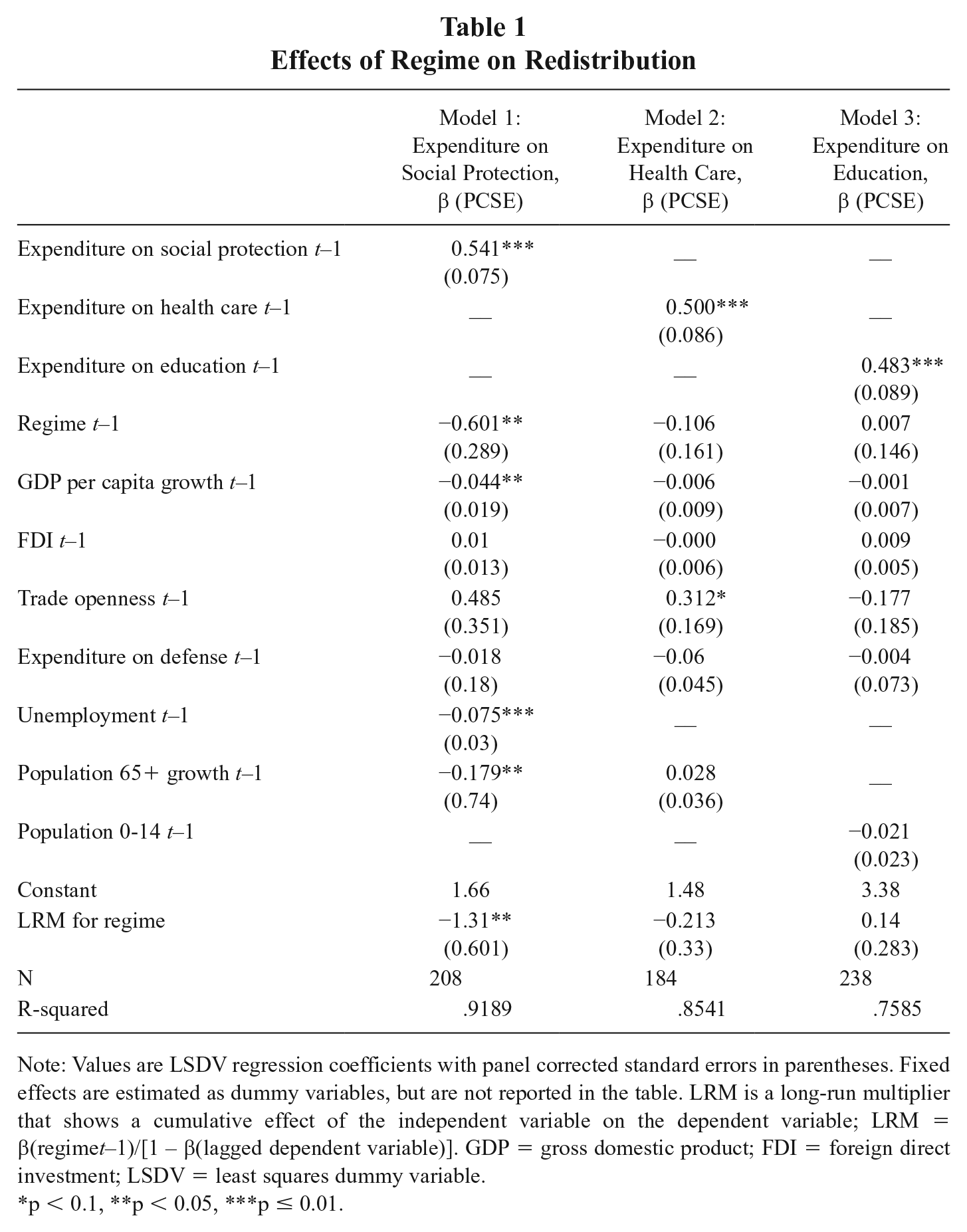
Note: Values are LSDV regression coefficients with panel corrected standard errors in parentheses. Fixed effects are estimated as dummy variables, but are not reported in the table. LRM is a long-run multiplier that shows a cumulative effect of the independent variable on the dependent variable; LRM = β(regimet–1)/[1 – β(lagged dependent variable)]. GDP = gross domestic product; FDI = foreign direct investment; LSDV = least squares dummy variable.
p < 0.1, **p < 0.05, ***p ≤ 0.01.

Long-term effect of regime change on social protection spending
I suggest that what the data capture here is pension system liberalization undertaken by many democratic governments in the region, namely, Lithuania, Slovakia, Estonia, Hungary, and Latvia. 73 Among autocratic governments, only Russia liberalized its pension system in 2001, but this was later reversed in 2012. 74 Contrary to the findings on Latin America and early findings on Eastern Europe, 75 it was democratic governments in the sample that engaged in pension system liberalization. I suggest that the reforms were possible precisely because of the existence of alternative appeals to legitimacy in these countries, namely, the real possibility of voting the unpopular government out of office, or the combining of appeals to democracy with appeals to nationalism, as happened in the Baltics. 76
When it comes to the other factors in the literature hypothesized to independently affect government spending on redistribution, the varying effect of the GDP per capita growth on the redistributive government spending stands out. It appears that post-communist governments tend not to immediately increase social spending when their economies are growing. Quite the opposite, they tend to decrease their spending on social protection by 0.04 percent of the GDP with each percentage of the GDP per capita growth. The negative association between GDP per capita growth and spending on social protection is possibly capturing the employment expansion that this economic growth delivers. This means that fewer workers require unemployment benefits, leading to the decreases in social spending. On the other hand, GDP per capita growth has no effect on health care and educational spending, which means that post-communist governments are not immediately expanding their spending on these areas. Russia serves as an illustrative case in point. When Russia started experiencing economic growth in 2000s and increased rents from high oil prices, the Russian government made a decision to create a stabilization fund instead of spending the extra revenue on health care and education. 77 The World Bank and the IMF who continuously pressured the governments in the region to maintain fiscal health is another driver behind this finding. 78
Trade integration into the global economy has a positive effect on investments in human capital when it comes to increases in government spending on health care, but has no such effect on social spending or educational expenditure. This means, contrary to the predictions of the compensation hypothesis, 79 that post-communist countries do not compensate their losers for increased vulnerability because of the deeper integration into the world economy 80 but are willing to invest into human capital by maintaining the health of their labor force. Whereas the quality of education in the communist states has always been a comparative advantage that many countries capitalized on at the time of integration into the global economy, 81 health care systems remained among the weakest areas of welfare provision. The systems were highly centralized, inefficient, and provided services of extremely poor quality. Further, spending on communist health care systems were below OECD average at the time of transition. 82 Therefore, this finding likely captures these much required increases on health care spending. 83 Financial globalization, on the other hand, has no effect on any type of social spending in the region, despite earlier findings establishing a positive association between FDI and spending on social protection 84 and health care. 85
Conclusion
In conclusion, the finding that post-communist democracies do not redistribute more life chances through education and health care and spend less on social protection indicates that the institutionalist theory that links democracy with higher levels of redistribution does not fully withstand the test by the crucial case. Redistribution through social transfers remains an important mechanism for the autocratic regimes in the region to sustain their support, thus preventing them from pension system liberalization, contrary to what some studies predict. 86 It has been previously argued that authoritarian governments rely on targeted redistribution, while democratic governments are pressured to redistribute to broader population groups. 87 My findings show that both post-communist autocratic and democratic governments continue to redistribute to broad categories of population, with autocratic governments also relying on broader targeted redistribution through pensions and unemployment transfers, in line with the social contract hypothesis. These findings contribute to the growing literature on authoritarian resilience. While previous studies linked authoritarian survival to patronage, coercive organizational capacity of the autocrats and weak international linkages, patriarchal gender norms as well as to the existence of legislature, strong presidency, and elections, 88 the present study offers systematic evidence in support of the “social contract” theory that was advanced by qualitative studies not only for the Soviet Union 89 and post-Soviet states 90 but for some Asian countries. 91 Thus, the study returns attention of the subfield to political economy of authoritarian resilience. I link the importance of economic redistribution for the post-communist regime survival with the operation of two mechanisms: expectations for redistribution remain high among the citizens within the region 92 and there exists an ongoing credible threat of protests that may lead to regime turnover. 93 If one examines the history of Russian protests, for example, with the exception of Bolotnaya protests in 2011–2013 and protests in 2019, other protests in Russia were responses to government attempts to liberalize welfare programs. Miller’s study further substantiates the existence of such claims by demonstrating that authoritarian governments in competitive authoritarian regimes increase post-election spending on education and social transfers if their electoral support drops at the time of elections. 94
This finding also has implications for the politics of sanctions that both the EU and the United States implement in the region: once post-communist autocracies are deprived of the sufficient resources to redistribute, they will lose some leverage against their own populations. It is not surprising then that post-communist autocracies are seeking and implementing other legitimacy-building mechanisms outside redistribution. The rise of Putin’s cult, the building of dominant parties, and intensified nationalism are cases in point. Further research should systematically examine whether trade-offs exist between redistribution and nationalism (as well as redistribution and right-wing populism, currently on the rise in the region) because of nationalism serving as an alternative mechanism of regime legitimation. Further qualitative investigation is also required to deepen our understanding of the conditions that would compel authoritarian governments in the region to engage in more coercion over benefit expansion. What is more, we also need to revisit the role left parties play in social spending allocation in democracies to examine if stronger party system institutionalization in the region translates into more ideologically consistent social policies as well as the role left parties play in the reversal of pension privatization in many countries in the region. 95
The study is not free from limitations. Though no significant differences are recorded when it comes to education and health care expenditures between post-communist democratic and autocratic governments, current research design can potentially mask important variations in target groups, comprehensiveness, and quality of delivery of these services. Its small sample and unique post-communist legacy also limits its generalizability to other regions. Nevertheless, its limitations notwithstanding, the study provides systematic tests of the role political regime plays in the politics of distribution and welfare state liberalization in the region. Whether these results hold in regard to tax policies remains an empirical question to investigate.
