






Abstract
During the long nineteenth century, Poland was divided among the Russian, Habsburg, and Prussian empires. The partition produced regional diversity in political culture and in institutional and economic development. We examine how the cultural legacies of the empires have influenced the propensity of Poles to cast a ballot in parliamentary elections since 1989. Polish National Election Study individual-level data are used to assess whether higher levels of electoral turnout in Galicia are indeed a legacy of the Habsburg rule. Our results confirm that, even after controlling for socio-demographic factors, there is a positive, substantive, and significant effect on turnout of living in the ex-Habsburg part of Poland. This effect can be explained by the frequency of religious service attendance and by ideology. Inhabitants of Galicia not only attend religious services more frequently and are more conservative than their counterparts in the rest of Poland, but also the more frequently they attend church and the closer to the radical right they place themselves, the more mobilized they are to vote. The impact of the legacies of the empires on political behavior in Poland seems persistent.
On 19 June 1911, a contested election took place in the Habsburg Empire. In only the second election after the introduction of universal manhood suffrage, an impressive 80 percent of the enfranchised turned out to vote. 1 Twenty-six inhabitants of the Galician town of Drohobycz even had to pay the ultimate price for queuing up to cast a ballot. 2 Most of them were shot dead fleeing from the town square where local authorities prevented supporters of the challenger from entering the poll station. Why would people be willing to risk their lives in order to exercise their right to vote?
According to Judson, 3 rather than a story of corrupted officials willing to maintain their power whatever the cost, this was a sign of “the sheer intensity with which people in an industrial town far from Vienna and Budapest engaged politically and emotionally with their empire” and of how high the political stakes were both for the incumbent groups and for the challengers. If we agree that the Habsburg Empire promoted such a vibrant political culture and elections were so significant for its citizens, it would not be that farfetched to think that this democratic experience might have left a footprint on the political behavior of the population living in the areas once ruled by the Habsburgs.
Measuring legacies of the past is not a straightforward task, because a lot of confounding variables—both contemporary and historical—blur the picture. Nevertheless, Poland provides almost a natural experimental setting, optimal for testing hypotheses on the long-lasting legacies of the past. From 1795 to 1918, Poland was divided among three empires: the Russian, the Prussian (later renamed German), and the Habsburg Empires. 4 Hence, for more than a century, Poland’s territory was divided by borders imposed exogenously by the empires. Greater Poland and Pomerania were incorporated into Prussia, the largest part of Poland with the capital in Warsaw fell under the rule of the Russian Empire, whereas the Austrian part of the Habsburg Empire picked up a large territory in the southeastern part of the country, later named as the Kingdom of Galicia (Figure 1 shows which regions of today’s Poland formed part of the three partitions).
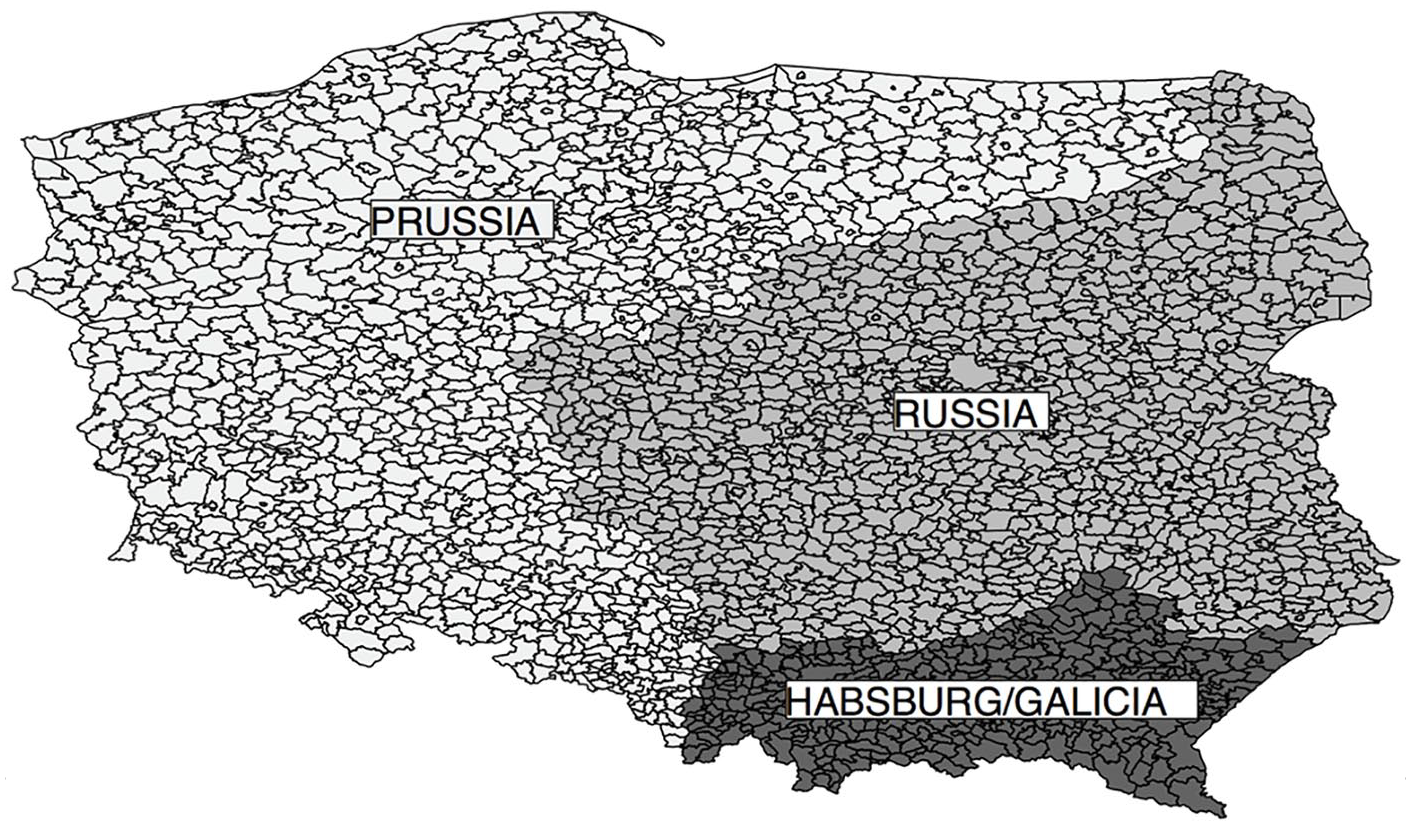
Partitions after the Congress of Vienna, 1815 (map of Poland today)
By all means, the features of each of the regimes had their impact on the development of the partitioned Polish territories. In the Prussian partition, the rule of law was respected and a process of rapid modernization followed, whereas in the Russian part widespread corruption reigned, leading to demoralized public life and underdevelopment of that part of Poland. The Austrian partition was by far the most liberal. 5 Under the rule of the Habsburg Empire, an archetype of the multinational state, Poles living in Galicia gained both cultural autonomy and political rights, as they had representatives in the parliament in Vienna, as well as seats in the local government bodies. Table 1 gathers the political differences among the three partitions. It shows that under Habsburg rule people enjoyed greater freedom and participated more than in the other partitions. The overall democratic experience of that time was the longest and the most meaningful in Galicia.
Political Differences Across Partitions of Poland, 1795-1918

Source: Own elaboration based on M. Coppedge, J. Gerring, C. H. Knutsen, S. I. Lindberg, S. Skaaning, J. Teorell, D. Altman, M. Bernhard, M. S. Fish, A. Glynn et al., “V-Dem [Country-Year/Country-Date] Dataset v9,” Varieties of Democracy (V-Dem) Project (2019), https://doi.org/10.23696/vdemcy19; D. Nohlen and P. Stöver, Elections in Europe: A Data Handbook (Baden-Baden, Germany: Nomos, 2010); and J. Jędruch, Constitutions, Elections, and Legislatures of Poland, 1493-1993: A Guide to Their History (New York: Hippocrene Books, 1998).
Although the Duchy of Warsaw was established by Napoleon I, most of its territory fell under Russian rule after 1815.
Civil liberties, Civil society participation, and Local government indexes are elaborated by V-Dem and run from 0 (worst score) to 1 (best).
Percentage of population with suffrage is taken from V-Dem for the Austrian and Russian partitions and from Ritter and Niehuss for the Prussian one (G. A. Ritter and M. Niehuss, Wahlgeschichtliches Arbeitsbuch. Materialien zur Statistik des Kaiserreich 1871-1918 [Election History Workbook. Materials on Statistics from the Kaiserreich 1871-1918] [Munich: C.H. Beck, 1980], http://germanhistorydocs.ghi-dc.org/docpage.cfm?docpage_id=3215 (accessed 17 May 2019). Data from V-Dem covers legal (de jure) restrictions while Ritter and Niehuss show the de facto share.
First direct elections to Reichsrat took place in 1873.
Although the Sejm continued its sessions until 1918, the year 1848 marks the end of the period when it can be considered the Polish representative body. Jędruch, Constitutions, Elections, and Legislatures of Poland, 1493-1993, 235.
Male citizens of the German Empire were, de jure, eligible to vote from 1871. However, their impact on elections was reduced to a de facto virtual vote. J. Retallack and M. A. Dufour, “The Non-Voter—Rethinking the Category,” in Parlamentarismuskritik und Antiparlamentarismus in Europa, ed. M. L. Recker and A. Schulz (Düsseldorf, Germany: Droste Verlag, 2018), 235–52.
Soon after 1989, observers of Polish political life came to realize that the ancient borders of the empires seemed to be driving some of the variance in political behavior among Poles. Old borders proved to be quite decent explanations of geographical patterns of both turnout and vote choice. Broadly speaking, people living in the western parts of Poland were more prone to support the liberal parties, whereas those from the eastern parts voted more for the conservative. 6 Another recurring theme is that citizens from Galicia are more engaged politically, compared to their counterparts from other regions. In a predominantly low-turnout country, the propensity to cast a ballot in the ex-Habsburg area is on average over 5 percent (for reported) and nearly 3 percent (for official turnout rates) higher than in other regions of Poland (see Table 2). What is puzzling about that difference is that, according to theory, Galicians—slightly less educated and with lower income—should be more prone to abstain. Searching for reasons behind this particular political mobilization researchers point, in the first place, towards higher levels of religiosity in Galicia and, secondly, towards the legacies of the Habsburg Empire. The fairly liberal and democratic character of the Habsburg Empire is said to have created a culture of political participation. 7
Turnout in parliamentary elections in the ex-Habsburg part of Poland and in other territories, 1997–2015

Source: Own compilation based on Polish National Election Study ([PGSW] for reported; data available at the Polish Social Data Archive: http://www.ads.org.pl) and Państwowa Komisja Wyborcza (National Electoral Commission, for official; data available at https://pkw.gov.pl/315_Wybory_do_Sejmu_i_do_Senatu and for the 1997 elections, http://prawo.sejm.gov.pl/isap.nsf/download.xsp/WMP19970640620/O/M19970620.pdf [accessed 16 December 2018]) 1997, 2001, 2005, 2007, 2011, and 2015.
The goal of this study is to assess whether higher levels of electoral turnout in parliamentary elections after 1989 in Galicia are indeed a legacy of the Habsburg rule. Why is Galicia “a high turnout right-wing fortress?” 8 And, more precisely, what kind of legacies of Habsburg rule heighten the propensity of today’s Galicians to cast their ballots?
We hypothesize that religiosity, right-wing ideology, social rooting in the local community, and experience of democratic responsiveness are behind the higher propensity to turn out in Galicia. In the first place, structural differences in the distribution of these variables might help in explaining higher turnout in the ex-Habsburg area; that is, Galicians attend church more frequently and thus they have higher propensity to cast a ballot. The effect of churchgoing here is the same for all Poles, but simply because there are more churchgoers in Galicia, the turnout rates are higher in that region. Secondly, these variables might have distinct effects in Galicia, and in this case, we expect, for instance, that religiosity has a stronger effect on turnout in the ex-Habsburg part of Poland. Focusing on both differences—in level and in kind—allows us to assess the possible mechanisms behind the long-lasting cultural legacies of the Habsburg Empire. We also test for political representation as an alternative explanation, in order to account for the characteristics of the Polish party system after 1989.
We use individual-level data from all Polish National Election Study (PNES) waves. The reason for this is to offer insight into the microfoundations of the mechanisms behind the higher turnout in Galicia, rather than tracing the aggregate-level path dependence of the historical institutions. 9 According to Kitschelt, 10 good explanations should involve both causal mechanisms and causal depth. A deep historical version of causal analysis should not lose sight of social mechanisms, such as informal institutions, political culture, communities and social capital, families, and socialization processes. 11 Thus, we rely on survey data instead of ecological analysis. 12
In addition to providing an almost experimental setting, Poland’s disturbing history and short democratic experience allow for an individual-level study of cultural norms and their vertical transmission through various generations even in very adverse conditions. If our expectations find empirical support, it will mean that even short periods of democratic experience can have long-lasting legacies on political attitudes and behavior, regardless of—or precisely because of—the countless discontinuities in the history of Central and Eastern Europe (CEE). 13
Historical Legacies
Scholars go further and further back into history in order to search for answers to the question — Do past experiences matter for present political behavior? A growing body of literature explains the political behavior and attitudes of the citizens of post-communist countries by focusing on the exposure to communist regimes. 14 Wittenberg showed that even the earlier (interwar) religious voting patterns have an effect on voting in parts of Hungary until today. 15 Darden and Grzymała-Busse searched for an explanation of the different ways in which communism collapsed in CEE in the mass literacy rates from before World War II, 16 whereas, according to Charnysh, the levels of support for EU accession in Poland seem to have been driven by historically distant interethnic competition. 17
We focus mainly on the political culture, which is of crucial importance for the performance of democracy. 18 Political changes can be abrupt, economic ones take some time, but cultural changes are gradual and usually quite slow. Cultural habits, codes, and frames are transmitted vertically across generations through family upbringing and further reinforced horizontally by other socialization agents such as schools or peers. Hence, it should not come as a surprise that scholars find the cultural legacies to be the most long-lasting.
Some research on historical legacies has exploited the extinct borders of the empires using regression discontinuity models to find that attitudes toward democracy 19 and student performance 20 are different across the border between the former Russian and Austrian territories of Poland, and to prove that even today people living in the ex-Habsburg ruled areas have higher trust in courts and the police. 21 Grosfeld and Zhuravskaya found a partially significant discontinuity in turnout between the Russian and Austrian parts of Poland, even in spite of putting focus only on the exceptionally high-turnout elections of 2007. 22 Bukowski confirmed this discontinuity for parliamentary elections (2015), presidential ones (2000, 2005, 2010), and the EU referendum in 2003. 23 On the contrary, Levkin did not encounter any significant jump in turnout at the former Habsburg–Ottoman border. 24 However, given that Transylvania formed part of the Kingdom of Hungary, this frontier hardly resembles the one between the Austrian and the Russian parts of Poland. Either way, these findings suggest that the effects of partitions of Poland are far more persistent in the form of cultural legacies rather than economic outcomes.
Focusing on Galicia, Roper and Fesnic argued that voting patterns in the western regions of Ukraine—which also formed part of the Kingdom of Galicia—are more pro-democratic and pro-European because of long-lasting historical legacies of the Habsburg Empire. 25 Drummond and Lubecki searched for reasons behind Galicians being more likely to vote in their higher religiosity. 26 They found a strong association between the frequency of church attendance and the propensity to vote in Galicia, both in the Polish part as well as in the Ukrainian one. However, they did not find support for the thesis claiming that churchgoing has stronger effects in Galicia (at least for the Polish 1997 election, the one under scrutiny in their study). This article aims at broadening the scope of their inquiry, by including all Polish parliamentary elections that followed, and also by assessing other possible explanations behind the long-lasting cultural legacies of the Habsburg Empire on turning out to vote in the regions of today’s Poland that once formed part of Galicia.
Arguments and Hypotheses
Scholars disagree whether there is such a thing as “the spirit of Galicia” flying over the south-eastern part of Poland and making people behave and think differently because this partition was under Habsburg rule. Furthermore, although the Austrian rule in this region lasted for more than a century—from its “invention” in 1772 27 till its end in 1918, there is no single narrative on Habsburg Galicia. In fact, there are two contradictory interpretations of the historical heritage of that region, often reflecting the symbolic conflicts over identity politics between the political right and left. 28
On the one hand, there is the myth of Galician Arcadia, land of milk and honey (and oil), 29 liberalism, multiculturalism, spontaneous celebrations of imperial victories, and portraits of Francis Joseph still hanging in today’s Cracow. On the other, Galicia is described as the land of misery and pauperism, 30 very low literacy rates, 31 “Eastern backwardness,” and pathologies such as the factories of angels (women who would starve children to death for a small reward from parents who were not able to feed their offspring). Table 3 gathers socio-economic data from 1888 on Galicia, the other partitions, and England, France, and Hungary for comparison. 32 It shows Galicia as an overpopulated, rural, low-efficiency, and poor region. It is the least developed partition of Poland, and it does not stand any comparison with industrialized England—three times more efficient in agriculture and almost ten times wealthier. Even neighboring Hungary scores better on most of the economic indicators.
Socio-economic Data on Galicia and Other Territories/Countries in 1888

Source: Own compilation after S. Szczepanowski, Nędza Galicyi w cyfrach i program energicznego rozwoju gospodarstwa krajowego (Lviv, Galicia: Gubrynowicz i Schmidt, 1888); N. Davis, God’s Playground. A History of Poland. 1795 to the Present, Volume II (New York: Columbia University Press, 2005).
Per capita production of potatoes, corn, and meat expressed as metric centals of corn;
Per capita bank deposits, insurance and savings accounts, in złotys.
Nonetheless, the nostalgic view of Galicia is the dominant one, especially for the Polish right. On this bright side, it is beyond doubt that the Austrian partition was by far the most liberal. The state was “not (or not primarily) an apparatus of repression, but a vibrant entity commanding strong attachments, a broker among manifold social, economic and cultural interests.” 33 Needless to say, the Russian Empire was quite the opposite. The Habsburg Empire was more tolerant toward distinct cultures and religions than the Russian or Prussian rule. It allowed the national cultures to develop, improved the education of Galicians, and reconceptualized them from subjects into citizens (mainly through the introduction of the General Civil Law Code [ABGB] in 1811). The Habsburgs also introduced elections quite early and allowed locals to run local policies and send their representatives to Vienna. The Diet of the Kingdom of Galicia and Lodomeria was the only regional assembly in the partitioned country to truly serve as a representative body for Poles. Universal male suffrage was introduced in 1896, and it was not only eligibility de jure, as in the German Empire, but it was also a de facto participation in a representative democracy (see notes in Table 1). For Judson, “parliamentary elections held immense cultural and social significance to people across the empire,” and they were a “political, cultural, civic, and often celebratory ritual that brought thousands of people together, connecting their community to the rest of the empire.” 34
Importantly, quite early on also the peasants enjoyed growing civil and political rights as the landed nobility’s claims on them became limited. 35 In contrast to the harsh serfdom in the Russian Empire, the Habsburgs realized that a productive system in which landowners claimed such amounts of cash, products, and labor from peasants, that it almost made it impossible for them to work their own plot and to pay their dues, was not a proper one. It should be noted however that the enlightening efforts of the Habsburgs had limited success in Galicia, because of the exceptionally low literacy rate, lack of local allies, and a powerful nobility opposing any reform. On the whole, Galician peasants enjoyed more freedom, at least de jure, than their counterparts from other regions of Poland. Thus, they had motives to become politically active and attached to the imperial rule. 36
However, some researchers are skeptical about the legacies of Habsburg rule affecting the political behavior of Galicians in a distinctive way. Rather, they explain the regional differences in the political behavior of Poles from that region by focusing on their socio-demographic characteristics. In order to rule out this line of argument, the first hypothesis we propose is:
Hypothesis 1: The effect of the Habsburg Empire on the propensity to cast a ballot will not disappear after controlling for such socio-demographic variables as age, gender, education, place of residence, and income (Habsburg effect hypothesis).
Religiosity
Since 1989, many scholars have pointed out that, rather than class cleavage, it was religiosity that determined voting behavior in Poland. 37 This is particularly true for the ex-Habsburg area of Poland, as inhabitants of Galicia were—and still are—avid churchgoers. Jasiewicz, after examining the relationship between historical territories and vote choice, concludes that “religiosity remains at least as good as the structural variables as a predictor of political preferences.” 38 With regard to turnout, it has been widely proven that the frequency of religious service attendance is positively related to the propensity for casting a ballot, as it is a sign of social integration and it helps in developing civic skills. 39
Focusing on Galicia, Drummond and Lubecki show that religion is a crucial variable in explaining the high levels of turnout in that region. 40 In comparison to the other occupants of Poland during partitions, the Habsburg Empire was quite tolerant of religions and allowed locals to enjoy religious freedom. It also clearly privileged the Catholic Church. 41 The close symbiosis of the Church and the State in the Habsburg Empire can be traced back to the crusades against the threatening infidels of the Ottoman Empire. 42 Crucially, the Austrian partition of Poland was the only one in which the religious denomination of the occupier and of the inhabitants matched. We argue that this is one of the reasons behind higher levels of both religiosity and of turnout in that region, because “families that attend church pass on a legacy of community attachment as well as church involvement, offering an alternative path to activity” such as turning out to vote. 43 Parents are usually successful in transmitting their religious orientations to offspring, 44 particularly so if families remain embedded within like-minded communities. 45 This is the case of Galicia, where strong family networks organize the social life of the region and mobilize politically. Thus, we expect that
Hypothesis 2a: Religiosity is partially responsible for the Habsburg effect on turnout (Religion level hypothesis).
Furthermore, Verba et al. distinguished two possible ways in which involvement in a religious institution might augment the individual’s potential for political activity: “by providing opportunities to practice civic skills and by providing exposure to political stimuli, either explicit political messages or requests to become politically active.” 46 Hypothesis 2a follows the former: Churchgoers have higher civic skills in all parts of Poland and, as there are more churchgoers in Galicia, the turnout is higher in that region. However, in consonance with the latter way, we have reasons to believe that churchgoing might have a stronger effect on the propensity to turn out in Galicia than elsewhere in Poland. As Anderson puts it, “Politics, which distributes power, and religion, which provides meaning for communities, inevitably came together wherever extensions of the suffrage gave communities access to power and the means for validating their own meanings against those of others.” 47 This was particularly true in the Catholic and fairly liberal Austrian partition.
Moreover, it is important to acknowledge that imperial legacies may interact with communist ones. 48 The Church proved to be a crucial factor in building resistance to the communist rule. 49 In Poland, because of the greater autonomy of the Church, and the low interference with religious practice by the communist rulers, the cognitions transmitted through family upbringing should have a stronger persistence compared with other CEE countries. 50 This should be particularly so in Galicia, where the Polish-Catholic syndrome—the inseparability of Polish nationalism and the Catholic Church—is especially strong. The clergy is a vital part of the local elite in most of Poland, but it is especially so in that region, where the structure of local networks was not disrupted by communist rule. The opposition to the regime was deeper in Galicia than in other regions (although it did not translate into anti-communist action as often as on the north coast of Poland). Religiosity served as a virtue opposed to the ideology of Stalinism and to the mentalities of subsequent authoritarian rule. Without doubt, the Church was an important institutional expression of Polish nationality and it fostered anti-communism in other parts of Poland too, but “the true difference is that Galicians are such avid churchgoers, in part because they always have been, but also partly because this is where they could most effectively practice their opposition to the state.” 51 We argue that the Habsburg rule created a breeding ground for strong, traditional, and Catholic communities and that the higher levels of community attachment and church involvement in Galicia were further reinforced by the opposition to the communist state apparatus. All in all, this translates into not only higher levels of civic skills in the region but also stronger politicization of church involvement in the ex-Habsburg area of Poland. 52 Accordingly, the next hypothesis will take the following form:
Hypothesis 2b: Religiosity fosters the propensity to cast a ballot in Galicia to a greater degree than elsewhere in Poland and it is partially responsible for the Habsburg effect (Religion effect hypothesis).
Ideology
Another possible explanation of the geographical differences in the propensity of Poles to cast a ballot lies in ideology. Galicians are more conservative (see Table A1 in the Appendix), and as such, they tend to be traditionalistic, averse to change, and distrustful toward the new. This conservatism, together with the sense of belonging and high religiosity we discussed in the previous paragraphs, translates into a strong national-Catholic ideology. In a broader perspective, it has been put forward that citizens placing themselves on the right side of the ideological scale tend to participate in higher proportions than those who place themselves on the left side of the political spectrum. Be it due to a higher tendency to perceive voting as a civic duty or to their socio-demographic characteristics (conservatives tend to be older, better educated, and have higher income—all variables related to higher turnout), it seems reasonable to think that they will have a higher propensity to vote. However, in their meta-analysis, Smets and van Ham confirmed that only 30 percent of studies found the predicted effect of ideological self-placement on turnout. 53 Moreover, although some studies do confirm that American nonvoters are more Democratic, 54 Campbell et al. showed that political preferences of those who do not vote shift, and that they are more prone to jump on the winner’s bandwagon than those with clearer political preferences. 55
Thus, it is safer to assume that people placing themselves on the extremes of the ideological spectrum are more prone to turn out because having a clear political preference is as a driving force for them to cast a ballot. Given that the Polish party system for the most part of the last thirty years has been skewed to the right (both due to communist legacies and to the power of the Catholic Church), we might expect that those with a clear preference for the right-wing will turn out at higher rates. Once again, the family would be the environment for the transmission of political orientations, as parents pass along their general partisan orientations to their children. 56 As citizens in Galicia tend to lean more toward the right wing of the political spectrum, we hypothesize that:
Hypothesis 3a: Right-wing ideology is partially responsible for the Habsburg effect on turnout (Ideology level hypothesis).
In line with the arguments explaining the complex interplay between the legacies of the Habsburg Empire and of the opposition to the communist rule with religion (presented above), we claim that conservatism will relatedly have a stronger effect on turnout in Galicia. If we take into account the particularity of the experience of liberal Habsburg rule together with the hostility of the communist state toward the traditionalistic Catholic communities in Galicia, paradoxically, they favored the conversion of this part of Poland into a stronghold of conservatism, which might be one of the reasons for higher turnout in the ex-Habsburg area. Hence, the following hypothesis is:
Hypothesis 3b: Right-wing ideology fosters turnout in Galicia to a greater degree than elsewhere in Poland and it is partially responsible for the Habsburg effect (Ideology effect hypothesis).
Social Rooting in the Local Community
By now it is common knowledge that the more integrated socially an individual is, the greater the probability that he or she will cast a ballot. 57 One of the key differences between Galicia and other parts of Poland is that in the ex-Habsburg area people have stronger ties to local communities. This lack of mobility has been associated with higher turnout rates. 58 The old rural communities in Galicia, on top of being more conservative, both socially and politically, are strongly integrated because of the social rooting of their population. 59 In this regard, Galicia is sometimes presented in complete opposition to the so-called Recovered Territories—the Eastern parts of Germany that became Poland after the Yalta agreements during the World War II. 60 According to this theory, the lasting roots of Galicians in their local community could be a determining factor explaining their greater propensity to vote. These roots in the local community are closely related to the heritage of the Habsburg Empire, as it was the imperial rule that gave to many inhabitants of Galicia the right to own land, and political and cultural rights, together with a sense of belonging. These local communities persisted, given the continuity of local elites related to the stability of property relations and the strong network of catholic parishes. Ownership transformations were least pronounced in this region of Poland, and the communist regime failed in its efforts to collectivize agriculture due to the opposition of the Church and local peasant movements. 61 As we do not have reasons to believe that this particular effect could have been reinforced by the response to the communist blueprint, the only hypothesis put forward here is:
Hypothesis 4: Social rooting in the local community is partially responsible for the Habsburg effect on turnout (Roots hypothesis).
Experience of Democratic Responsiveness
Yet another argument for the higher propensity to turn out in Galicia being a legacy of the Austrian rule is the experience of democratic responsiveness. Galician municipal councils were run by locally elected officials already in the mid-nineteenth century. That local mobilization, together with the chance to vote in regular elections for the regional Diet, as well as for the imperial parliament in Vienna, expanded the civil society and deepened local attachment. Local government was not only stronger than in other partitions, it was also more socially accepted. Two factors facilitated that outcome: it formed part of the regional autonomous rule rather than of the imposed imperial one, and it respected the “natural” local geography. Its borders were the same as those of the big rural areas, characteristic to the region, and of the parishes, which in turn allowed for the local social and political communities to flourish. 62 Once again, we do not suspect that this effect should be stronger in Galicia, because no particular reinforcement due to the response to the communist rule is at play here. Thus, we hypothesize only with regard to the differences in the level of external political efficacy (the best proxy of experience of democratic responsiveness the data offers) between Galicians and Poles living in the rest of the country. The sense of political efficacy has been consistently related in the literature to higher turnout. 63 Kostadinova and Power showed that previous democratic experience fosters turnout in CEE. 64 The underlying idea here is that Poles have very limited experience of modern democracy (the few years of the interwar period and the Third Republic after 1989), and thus the experience of democratic responsiveness under the Habsburg rule left an imprint on the way in which citizens of Galicia assess the importance of voting, making their external political efficacy stronger:
Hypothesis 5: External political efficacy is partially responsible for the Habsburg effect on turnout (Experience of democratic responsiveness hypothesis).
Alternative Explanation: Representativeness
Finally, in order to account for the possible alternative arguments related to the political system after the transition of 1989, we focus on the role of political parties’ representativeness. It might be argued that Galicians are more prone to vote simply because they feel better represented than the inhabitants of other parts of Poland by political parties they vote for, and that it has nothing to do with the legacies of the Habsburg rule. To be sure, this is just one aspect of the party system institutionalized after 1989, but representativeness is a key factor explaining the propensity to turn out. This is why the alternative hypothesis of this study will be:
Hypothesis 6: Representativeness is partially responsible for the Habsburg effect on turnout (Alternative hypothesis: representativeness).
Data and Measurement
We use the PNES individual-level data from the 1997, 2001, 2005, 2007, 2011, and 2015 postelectoral surveys, which gives us the possibility to study the reported participation in six consecutive parliamentary elections.
Participation in parliamentary elections at the individual level is the dependent variable in this study. It is a binary variable that equals 1 if the respondent reported casting a ballot in the last elections to the lower house, and 0 if nonvoting is reported. Respondents admitting not knowing whether they voted or not and those not answering the question were omitted from the analysis.
The key independent variable is a dummy of the Habsburg part of Poland (Galicia) we call Habsburg Empire. We could have run models, for instance, for Galicia vis-à-vis the Russian Empire, but as our goal is to examine the particular characteristics of the Habsburg rule that might have left a long-lasting legacy on the behavior of inhabitants of Galicia, we opted for discriminating Galicia versus other territories altogether.
The other independent variables are as follows: frequency of religious services attendance (a scale from 1 to 8, where 8 equals “several times per week”); left-right self-placement on the usual 11-point ideological scale (10 = extreme right); social rooting in local community (coded 0 for the respondent moving into the locality herself, 1 for parents living/lived in the same locality as the respondent, and 2 for grandparents living/lived in the same locality as the respondent), and external political efficacy (a 1–5 scale, where 5 means that “it makes a big difference whom people vote for”), we use as a proxy for the experience of democratic responsiveness.
In the additional models accounting for the alternative hypothesis, we use two measures of representativeness. In the first place, for the 1997 elections, we compute the subjective proximity scores of voters (distance between the voters’ positions on various issues and their beliefs of where their party stands on that issues). 65 Second, for the 2015 elections, we use a direct measure of representation: in this particular survey, respondents were asked whether they felt represented by at least one party (0-3 scale, where 3 is “definitely represented”).
Several variables traditionally associated with electoral participation are included as controls in the models. The propensity to turn out increases with age, although up to a certain point, when getting to the poll might prove to be too costly for the elderly. To account for this curvilinear relationship between age and turnout, we introduce age and age squared into the models. We also include the other socio-demographic variables conventionally used in turnout studies: gender (1 = male), education (9 categories), place of residence (1 = rural), and income (logged). For the descriptive statistics of all variables, disaggregated by the historical territories of Poland (Habsburg vs. other), see Table A1 in the Appendix.
Results
We estimate logistic regression models of pooled electoral participation in the 1997, 2001, 2005, 2007, 2011, and 2015 parliamentary elections in Poland. Because of lack of data, we lose observations from 2015 in the models testing for hypotheses 4 and 5 (social roots and democratic experience).
The Habsburg Effect
Model 1 in Table 4 regresses the propensity to turn out on the ex-Habsburg territory versus other parts of Poland, controlling for the socio-demographic variables (age, age squared, gender, education, place of residence, and logged income) and survey-level dummies for each wave of the PNES. We include both the socio-demographic controls and the survey dummies in the remaining models. The effect of living in the ex-Habsburg area on the propensity to vote is substantial and significant, even after controlling for socio-demographic variables. Thus, this positive Habsburg effect confirms the hypothesis 1. The geographic divergence in the propensity to turn out across the Polish border of the Habsburg Empire is driven by something more than just the structural socio-demographic differences among the populations of the historical territories of Poland.
Explaining the Effects of the Habsburg Empire on the Propensity to Turn Out, 1997–2015

Source: Own compilation based on Polish National Election Study (PNES) data for 1997, 2001, 2005, 2007, 2011, and 2015.
Note: logistic regression coefficients. AIC = Akaike information criterion.
p < 0.1, *p < 0.05, **p < 0.01, ***p < 0.001.
Age, age squared, gender, education, place of residence, and income (logged).
Religiosity
The frequency of religious service attendance is introduced in models 2 and 3 in Table 4. It is a strong predictor of electoral participation for all Poles. Moreover, as the positive and significant coefficient of its interaction term with the Habsburg Empire reveals (model 3), it fosters the propensity of Galicians to cast a ballot to a greater degree than elsewhere in Poland. Importantly, it also makes the Habsburg effect insignificant (the coefficient even switches to negative). Therefore, both the (hypothesis 2a) Religion level hypothesis and the (hypothesis 2b) Religion effect hypothesis find full empirical support. Religiosity explains the Habsburg effect, and it affects positively the propensity to vote to a greater degree in Galicia. It is not only that inhabitants of the ex-Habsburg part of Poland are more religious. We find that religiosity affects their propensity to cast a ballot in a more pronounced way.
Ideology
Subsequently, in models 4 and 5 in Table 4, we test for the relationship between the ideological scale self-placement and turnout in Galicia versus the rest of Poland. Left-right self-placement has a positive effect on the propensity to turn out in Poland. It also has a stronger positive impact on the propensity to vote in Galicia, as the significant interaction term confirms (model 5). Moreover, controlling for the interaction makes the direct Habsburg effect insignificant. Thus, those living in the ex-Habsburg area are not only more conservative but also the closer to the radical right they place themselves, the more mobilized they are to vote. Note that these models control for religious services attendance. Our finding on the importance of the ideological dimension in explaining the Habsburg effect is in line with Jasiewicz’s inference of the effect of the post-Austrian region on the Left–Right dimension being independent of religiosity. 66 Therefore, we find empirical support for both the (hypothesis 3a) Ideology level hypothesis and the (hypothesis 3b) Ideology effect hypothesis. Conservatism fosters turnout in Galicia to a greater degree than elsewhere in Poland, and it also makes the direct Habsburg effect on electoral participation insignificant.
Figure 2 plots the effects of religiosity and ideology on the propensity to turn out in Galicia versus the other territories of Poland. It displays in a clearer way the interaction terms from models 3 and 5 in Table 4. In both cases, the positive effect is stronger for Galicians, as the slopes are steeper for the ex-Habsburg area, with significant differences for those who declare having center-right or radical-right ideology, and for those who attend religious services at least once a week.
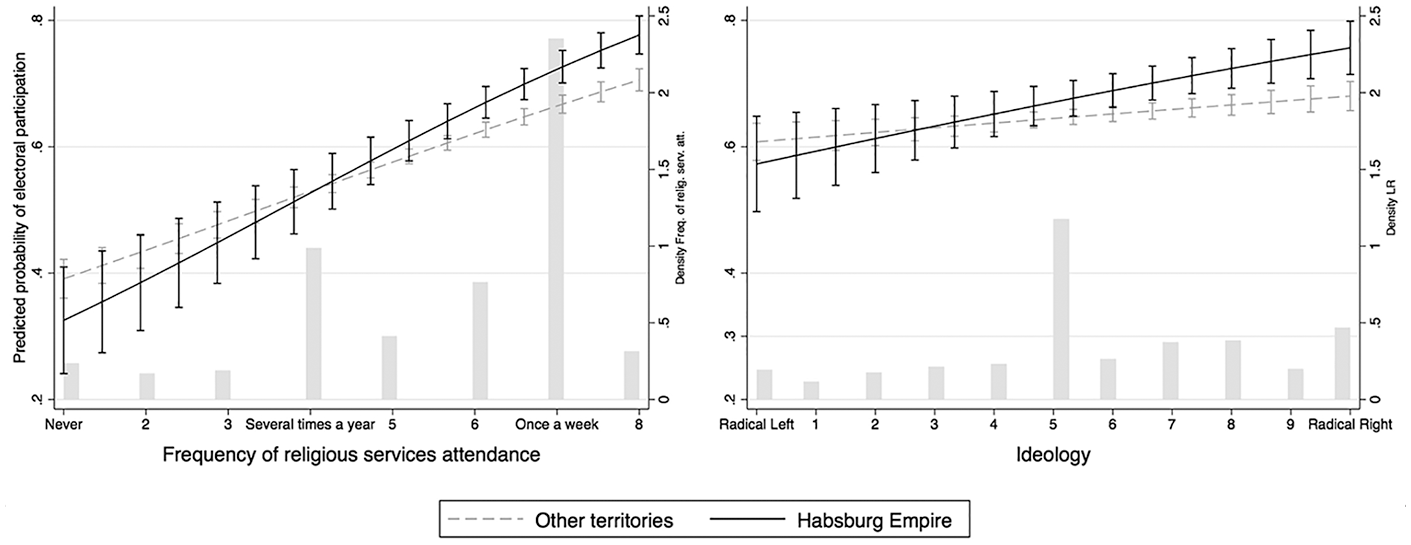
Marginal effects of the frequency of religious service attendance (left) and of the ideology (right) on the propensity to turn out in the ex-Habsburg area and in the rest of Poland, 1997–2015
Social Rooting in the Local Community
In models 6 and 7 in Table 4, we add the social rooting in the local community variable and its interaction term with the Habsburg Empire. We find a positive effect for those reporting that their grandparents live(d) in the same locality as they do. After introducing the local roots variable, the effect of the Habsburg Empire diminishes. This means that having local roots explains up to some point the particularity of Galicia with regard to higher propensity to turn out in that region. However, having local roots does not affect Galicians in any distinctive way (interaction term in model 7 is insignificant). Consequently, we confirm hypothesis 4: Having social rooting in local community fosters turnout and it partially accounts for the Habsburg effect.
Experience of Democratic Responsiveness
A measure of external political efficacy as a proxy for the experience of democratic responsiveness is included in models 8 and 9 in Table 4. We hypothesized that people with stronger democratic experience will have a higher tendency to think that “whom people vote for makes a difference,” and that although it will have a positive effect on the propensity to cast a ballot in all regions of Poland, it will also partially explain the differences in turnout between Galicia versus the rest of the country. Political efficacy is a strong positive predictor of turnout, and it also makes the Habsburg effect insignificant. Nevertheless, political efficacy does not affect Galicians in a distinctive way (interaction term is insignificant, both substantially and statistically). All in all, we confirm the “experience of democratic responsiveness” hypothesis (hypothesis 5): political efficacy partially explains the Habsburg effect on the propensity to turn out.
Alternative Explanation: Representativeness
An alternative explanation of higher turnout rates in Galicia would be that citizens of that part of Poland feel better represented by political parties and that is why they decide more frequently to cast a ballot. As anticipated in the data section, we estimate issue’s proximity scores between voters and parties for the 1997 election. In comparison to the other historical territories, inhabitants of Galicia had the highest proximity with ROP and PSL (see Table A2 in the Appendix). However, voters in other parts of Poland felt that other parties (AWS, SLD, UW, and UP) represented them better on the various issues averaged. Moreover, people in Galicia who cast a ballot for SLD, UW, and UP had the lowest proximity scores with these parties.
We also test for this hypothesis with the 2015 PNES wave, by assessing the effect of a direct measure of representativeness. Running models (see Table A3 in the Appendix) following the same pattern as models 2–9 in Table 4, we find that, while feeling represented has a positive impact on the propensity of all Poles to cast a ballot (significant effect for those that declare being moderately or definitely represented), it does not have a specific impact on Galicians (interaction term is not significant). However, it does account for the Habsburg effect (it is still positive, but not significant). Thus, for the case of the 2015 parliamentary elections, feeling represented seems to explain partially the differences between the propensity of Galicians to turn out and that of the rest of the Poles.
Finally, we also check whether Galician voters choose winning parties with higher frequency (Table A4). We consider winning voters to be the ones who voted for parties that formed the government after elections (between 1997 and 2015). As it turns out, on average, the percentage of winners is indeed slightly higher among the voters in Galicia: 53.9 percent (with a 2.9 percentage point difference with the rest of Poland), and significantly higher when we take into account all citizens (voters and nonvoters), 33.3 percent (with a difference of 4.7).
To put it all together, we do find evidence that Galicians felt better represented by political parties in the 2015 elections, and that, on average for all elections considered, they are more prone to end up on the winning side after elections. However, they do not deem parties to be closer to their position on several issues more frequently than their fellows from the rest of Poland. Moreover, we do not find evidence that feeling represented affects Galicians’ propensity to vote in any different fashion. Hence, there is mixed evidence with regard to the (hypothesis 6) alternative hypothesis of representativeness. 67 This fact does not disprove what we have found until now, but it puts some constraints on it, as it seems that what is at stake in the elections might limit the influence of legacies of the past on turnout in Poland.
Conclusions
The partition of Poland among the Prussian, Russian, and Habsburg empires at the end of the eighteenth century brought about divergent political, cultural, and economic development of the three parts of the country, divided by exogenously imposed borders. Like other scholars, we argue that the most long-lasting legacies of the empires are of a cultural nature. Here we examined whether higher turnout levels in Galicia can be explained by the legacies of the Habsburg past. With individual-level data, we tested for the hypotheses considering the influence upon turnout of religiosity, right-wing ideology, social rooting in local communities, and experience of democratic representativeness—all related to the experience of Habsburg rule.
The key findings of this study point toward the importance of the frequency of religious service attendance and of right-wing ideology in explaining the long-lasting legacy of the Habsburg Empire on the propensity to turn out in Galicia. Also, social rooting in local communities and democratic experience seem to explain at least partially the higher turnout rates in the ex-Habsburg part of Poland. More importantly, those living in the ex-Habsburg area are not only more conservative but also the closer to the radical right they place themselves, the more mobilized they are to vote. In a similar vein, Galicians not only attend church more frequently, but it also makes them more prone to cast a ballot when compared to their counterparts from other regions of Poland.
According to Peisakhin, identity will persist even after major institutional reform as a result of the stability of (1) family networks in which parents socialize offspring into previously dominant identity, (2) community (e.g., village-level network, Church) that honors old identity practices, and (3) local elites that continue to transmit old identity in exchange for status benefits. 68 All these conditions are fulfilled in the case of Galicia. Thus, because of the like-mindedness of local communities and to the persistence of the structure of local elites, dominated by the clergy and strong family networks, both religious and political orientations were passed along to the next generations. Traditional local elites in Galicia, forged under Habsburg rule, persisted in spite of the particular ambition of the communist to challenge their role, and families were successful in transmitting historical political identities.
These results defy the narrative claiming that the Catholic Church is the only transmitter of the legacies of the Habsburg past. Without neglecting the crucial role of religiosity in the political engagement of Poles, and of Galicians in particular, according to our findings, the propensity to cast a ballot in the ex-Habsburg area is also fostered by right-wing ideology. The political legacy of liberal Habsburg rule, somewhat paradoxically, led this region to be more conservative and mobilized after 1989. Possibly, the complex relations among the legacy of the Habsburg Empire, religion, and the experience of communist rule might help to explain this puzzle, but further research is needed in order to establish the causal mechanisms at play.
Footnotes
Appendix
Voting for the Winning Parties by Historical Territories: Percentages of Voters (Left) and of All Citizens (Right), 1997–2015

| Election | Winners (% of Voters) | Winners (% of All) | ||||
|---|---|---|---|---|---|---|
| Other Territories | Habsburg Empire | Difference | Other Territories | Habsburg Empire | Difference | |
| 1997 | 48.8 | 65.9 | 17.1 | 26.4 | 40.7 | 14.3 |
| 2001 | 53.1 | 48.5 | −4.7 | 28.5 | 29.6 | 1.1 |
| 2005 | 51.0 | 58.9 | 7.9 | 24.9 | 30.9 | 6.0 |
| 2007 | 61.6 | 46.4 | −15.2 | 41.0 | 34.1 | −6.9 |
| 2011 | 53.4 | 48.4 | −5.0 | 29.3 | 28.1 | −1.2 |
| 2015 | 39.0 | 51.1 | 12.1 | 24.0 | 35.1 | 11.1 |
| Total | 51.1 | 53.9 | 2.9 | 28.6 | 33.3 | 4.7 |
Source: Own compilation based on Polish National Election Study (PNES) data for 1997–2015.
Acknowledgements
Preliminary versions of this paper were presented at the SIF seminar at the Autonomous University of Madrid in June 2018 and at the 5th Leuven-Montréal Winterschool at the University of Leuven (Belgium) in March 2019. We would like to thank Ed Fieldhouse, Santiago Pérez-Nievas, and Jose Rama for their helpful comments on earlier versions of this paper. We are also grateful to the anonymous reviewers for their insightful comments and to José Ramón Montero and Andrés Santana for their continuous advice.
