







Abstract
This article belongs to the special cluster, “Here to Stay: The Politics of History in Eastern Europe”, guest-edited by Félix Krawatzek & George Soroka.
With reference to the Hungarian minority’s overarching concern over its declining population in Slovakia, this article reveals how different elements of the past are activated, remembered, and renegotiated to ensure the minority’s cultural survival. Using elite interviews, party documents, and a detailed analysis of two local newspaper archives in Hungarian, I unpack how memory and politics interact in the post-EU accession period. First, I uncover how political and civil society actors use acts of commemoration as a conduit to circulate certain narratives of the Hungarian minority identity. Through remembering historic Hungarian leaders and events, elites affirm and construct the minority identity, thus enabling its cultural reproduction. The Habsburg and Austro-Hungarian Monarchy period is referred to most frequently with the celebration of national heroes. Events spanning the twentieth century are generally mourned as painful and detrimental for the Hungarian minority. While the acts of commemoration are “soft” measures to ensure cultural survival, Hungarian political actors also desire “hard” guarantees through institutional measures, best encapsulated by their desire for autonomy arrangements. However, the Slovak nation’s own past of claiming autonomy and their eventual secession from Czechoslovakia in 1939 conditions the cultural rules around language and the appropriate vocabulary that Hungarian elites can use. Consequently, Hungarian minority elites appropriate the past strategically in two ways. They readjust their tactics through using different vocabulary to claim autonomy and second, they pursue policy reforms across areas such as education and regional development, thus making the de facto possibility of autonomy more palatable to their Slovak counterparts.
Introduction
One landmark event that all countries in East-Central Europe share—as highlighted in the Introduction to this Special Section—is the disintegration of multi-ethnic empires following World War I. 1 This greatly affected the ethnic landscape of the newly created states: as a result of treaty revisions, between 20.1 and 29.2 per cent of the population counted as a national minority, with many simply “ending up” on the wrong side of the border. 2 Today, we find ethnic minorities across the region often fighting to ensure their survival and the ability to reproduce their culture and identity. Unlike many Western European countries, ethnic minorities may not be recognised in the constitution or may have weak institutional provisions to guarantee cultural reproduction. Some minorities, such as the Jewish, because of the atrocities of World War II, are not present in numbers large enough to challenge the narratives about them, 3 whilst the Russian minority in Finland is able to challenge Finnish national narratives about World War II through the support of the kin-state of Russia. 4 With limited guarantees of domestic state support for cultural reproduction, therefore, how do ethnic minorities ensure their survival in East-Central Europe? More specifically, how does the past figure in the minorities’ present-day quests for survival? Which past is used, by whom and how?
I follow the conceptualisation found in the Special Section’s Introduction of the three inter-related arenas in which memory and politics interact (the circulation of memories, conditioning factors, and actors and their mnemonic claims) to analyze the politics of historical memory through an examination of the Hungarian ethnic minority in Slovakia. The Hungarian minority was much shaped by the Trianon agreement in 1920, which gave the land north of the Danube to Czechoslovakia. The Hungarian population in Slovakia is declining, with “an overarching fear of dying out like the dinosaurs” 5 and Hungarian elites wondering how to preserve the minority’s identity and ensure its survival. Focusing on the post-EU accession period from 2004 to 2017, I draw on elite interviews, policy documents, and party platforms, as well as detailed analysis of two local newspaper archives in Hungarian to unpack the interaction between history and politics. Analysis of these data sources illustrate which eras of the past are activated, how this is done, and how particular contentious pasts can condition the Hungarian elite’s political strategy to ensure its survival.
I argue that the past affects the Hungarian minority elite’s strategy of survival in two main ways. First, tying to the first arena of the circulation of memories and their conflictive constellations, I unpack how public acts of commemoration—comprising the remembering of important national events and national heroes either through public gatherings or the erection of monuments—serve as a conduit to activate particular memories of the Hungarian past. Making direct reference to historic Hungarian leaders and to national events serve to uphold a certain narrative of the Hungarian minority identity, thus enabling its cultural reproduction. I find the Habsburg Monarchy and Austro-Hungarian period is referred to most frequently whilst events spanning the twentieth century are generally mourned as painful and detrimental for the Hungarian minority. Moreover, events of commemoration are often accompanied by visits from the kin-state (Hungary) or other ethnic minority leaders, highlighting a transnational dimension. 6 Such commemorations are most often led by political elites or by civil society actors. I unpack the nature of their memory claims, thus also addressing the Introduction’s third arena of actors and their mnemonic claims.
The second way the past affects the Hungarian minority’s efforts to ensure its survival is found in the examination of the second arena of conditioning factors. A significant constraint the Hungarian minority faces is a cultural regime which conditions linguistic conventions and shapes how the Hungarians make their demands for institutional arrangements to promote their survival. The main institutional arrangement the Hungarian minority would like to claim is autonomy, which it sees as a suitable institutional solution enabling themselves to govern their own affairs. However, in the domestic Slovak context, the term is historically conditioned and fraught with associations of secession and independence. Consequently, aware of the historical connotation in the Slovak mindset equating autonomy with secession, Hungarian minority elites react and appropriate the past strategically in two ways. First, they readjust their tactics through using different vocabulary to claim autonomy and, second, they pursue policy reforms across areas such as education and culture. These two tactics aim to make the de facto possibility of autonomy more palatable to their Slovak counterparts. The discussion, therefore, highlights how a sensitive cultural context with particular linguistic constraints conditioned by the Slovak past define Hungarian elites’ behaviour and own usage of language. A similar dynamic is also found in Krawatzek’s article in this Special Section. 7
After providing a short contextual background and methodology, I analyze acts of commemoration based on the two local newspaper archives of Komáromi Lapok and Gömöri Hírlap. I then move to discuss how Hungarian minority political elites distance themselves from the historical concept of autonomy and strategically re-create the concept both in a play on words and through policy area reforms. The article demonstrates how different elements of the past are activated, remembered, and renegotiated in order to ensure the cultural survival of the Hungarian ethnic minority in Slovakia. It complements other articles in this Special Section by highlighting how selective memories are diffused, how the kin-state and transnational actors play a role in supporting the commemoration of the past, and how minority–majority relations need to be continuously negotiated and navigated amidst what is often a historical minefield.
The Hungarian Minority in Slovakia
From the perspective of ethnic Hungarians in Slovakia, a major turning point in their history is the border revisions following World War I in the 1920 Treaty of Trianon. The Treaty reduced the territory of Hungary—or the Kingdom of Hungary as it was known then—by two-thirds and resulted in 3.5 million ethnic Hungarians finding themselves in a new state, whether it be Czechoslovakia, Romania, Yugoslavia, Austria, or Ukraine. 8 The consequences of the Treaty were lamented repeatedly by ethnic Hungarian minorities as well as the Hungarian government (and lamentations continue to this day). Reuniting with their lost kin motivated Hungary to side with the Axis Powers during World War II, during which some of its land was recovered in the First and Second Vienna Award in 1938 and 1940. 9 Unsurprisingly, following the end of World War II and the defeat of the Axis Powers, the original Trianon borders were reinstated; however, the memories of Hungarian irredentism were now stamped on the minds of neighbouring countries. 10
Hungarians living in Slovakia face distinct problems linked to their own well-being and cultural survival. The prime concern, mentioned in policy documents as well as in elite interviews, is the declining population. Demographically speaking, according to the 2011 census there were 458,000 Hungarians living in Slovakia (8.5 per cent of the population) which was a decline of 110,000 compared to the 1991 census. 11 Causes of decline include emigration, a declining birth rate, and assimilation. However, migration and a declining birth rate are overshadowed by the prevalence of assimilation. In the cases of mixed marriages between Slovaks and Hungarians, for example, only 20% of their children register as Hungarian—compared to one-third in Transylvania. 12 In addition to population decline, another challenge facing the community is unemployment and poverty. Analysis done by Horbulák 13 shows that in terms of education, employment and indicators like earnings and industrial production, Hungarians in the south of Slovakia generally lag behind their Slovak counterparts. For example, between 1997 and 2014, the Hungarians in the 16 districts consistently had higher rates of unemployment than the national average. 14
These difficulties, coupled with weak institutional provisions, render ensuring the reproduction and survival of the minority identity at the forefront of the minds of many Hungarian political elites. 15 Legally speaking, there is no comprehensive law on national minorities in Slovakia and there have been heated debates about the implementation of the 2009 Amendment to the 1995 Slovak Language Law 16 and its relationship to the 1999 Law on the Use of National Minority Languages. 17 In minority education, Hungarians have the right to be educated in the minority language in elementary and secondary schools, with mandatory classes in the Slovak language and literature. 18 There are challenges relating to the provision of education in the minority language that revolve around geographic names in textbooks and educational materials, how to teach Slovak to Hungarian students, and the threat of school closures with dwindling student numbers. 19 Lastly, it was only in 2017 that the Law on the Fund to Support the Culture of National Minorities 20 was passed, guaranteeing the Hungarian minority with €4 million per year for cultural projects. However, the Fund only supports short-term projects rather than covering costs such as administration that would provide a long-term stability for cultural institutions. Moreover, the Act does not grant the Hungarian minority full oversight for funding decisions, with two out of five members of the decision-making council coming from the government. 21
Finally, a further issue is the lack of a unified political voice on the part of the Hungarian community. There was a major split within the main political party, Magyar Koalíció Párt (MKP; Party of the Hungarian Coalition), 22 in 2009, resulting in the emergence of Most-Híd, or Bridge party. Most-Híd is an inter-ethnic party with Slovaks and Hungarians. With these two Hungarian political parties and a 5% threshold to get into Parliament, Most-Híd has outperformed MKP in the national elections since 2010. Most-Híd gained seats in Parliament in the 2010, 2012, and 2016 elections, serving in coalition in 2010–2012 and 2016–2020 whilst MKP has yet to make it into Parliament since its loss in 2010. MKP, however, remains powerful at the regional and local levels. With these many challenges across socio-economic, demographic, and institutional dimensions, Hungarian minority elites need to find ways to encourage the cultural survival of their community.
Methodology
To examine how the past and which past figures in the Hungarian minority’s quest for survival in the post-EU accession period, I draw on newspaper archives, party programmes and elite interviews. To analyse the dimension of the circulation of memories through acts of commemoration, I draw primarily from two local newspaper archives over two time periods. The first newspaper is Komáromi Lapok from the city of Komárno/Komárom located just north of the Slovak-Hungarian border in the south-west. Historically, Komárom was one city spanning two sides of the Danube, but the Treaty of Trianon split it in two, with the northern half going to Czechoslovakia and the southern half remaining in Hungary. According to figures collected in 2017, the city is composed of 62 per cent self-identifying ethnic Hungarians and 36 per cent self-identifying ethnic Slovaks. 23 The second newspaper is Gömöri Hírlap from the city of Rimavská Sobota/Rimaszombat, located in south-central Slovakia. The population profile is the reverse of Komárom, where Hungarians make up 36 per cent of the self-identifying population and ethnic Slovaks approximately 62 per cent, as of 2017. 24 This population difference, as well as the different proximity in location to Hungary, makes the two cities interesting to include.
Regarding the time period under study, given the immensity of data to be analysed in each year alongside practical reasons (i.e., Gömöri Hírlap was out of print for almost three years), I chose two three-year time periods after EU accession: 2009–2011 and 2015–2017. The time periods are not compared as such, but rather allow for an overview of the post-accession period. Many different events occurred throughout these years, but for contextual purposes, the first time period includes the “earthquake” in minority politics when MKP underwent a split that saw the formation of Most-Híd and the latter’s entrance into parliament at the expense of MKP in the 2010 elections. During the second time period, the two parties had their most comprehensive policy platforms for the Hungarian minority articulated. Discussion of the results of data analysis draw on typical examples and illustrations found in the archives. The newspaper archives were coded using Qualitative Content Analysis 25 in NVivo. The coding frame is provided in the Methodological Appendix.
The examination of the conditioning role of the past in the Hungarian elites’ strategy for survival was gained first through elite interviews. I carried out eleven semi-structured interviews with political elites and civil society activists in 2017. The sample reached saturation and provides a fair representation of the different viewpoints within Slovakia. The amount of extra and novel information gleaned from additional interviews would have been minimal. Following these discussions and the findings around the importance of autonomy and the related linguistic conventions and tactics of policy area reforms, I moved to analyze policy documents from the post-EU accession period until 2017 and the same newspaper archives as mentioned above. These data sources further unpacked how Hungarian elites adapted to the linguistic and cultural conventions around autonomy and how they pursued autonomy through policy area reforms. The simple coding frame used for the newspaper archives is also in the Methodological Appendix.
A Past That Is Celebrated and Mourned
Acts of commemoration serve as the conduit for the circulation of memories and particular mnemonic narratives to uphold the Hungarian minority identity. The selective usage and activation of the past through public commemoration is one way elites pass on and strengthen the minority identity. Commemoration of the past ensures the perpetuation of the minority’s identity and its history. This process, however, is not apolitical: the collective remembering of the past is a political process. 26 Given the emergence over the last century of the Hungarian Slovak community as a distinct community separated from most of its ethnic kin by a new border, remembering historical events and historical figures becomes a way to cement identity. Commemorations of identity and affirmation of a “historical memory” provide an avenue for creating a political community with a “shared past” and a “perception of unity.” 27 The role of commemorations to pass on identity becomes all the more important in the Hungarian Slovak context where the Hungarian minority does not have, for example, institutional provisions guaranteeing full oversight of minority reproduction of culture in the fields of education and language use (as discussed in the second section). Acts of commemoration are detailed below by first examining public gatherings for acts of commemoration and then discussing how monuments are used for commemorating the past.
Gathering the Public to Commemorate the Past
Commemorations of the past can be of either a person (such as poet or soldier) or an event (such as a nationalist uprising, the passing of a treaty, or founding of a city). To determine which particular pasts were being commemorated in the Hungarian newspaper archival coverage, I first coded all the articles mentioning commemorations using Qualitative Content Analysis (as detailed in the third section). I then compiled a simple database categorising the commemorations along two lines. First, I categorised the commemoration according to the era in which the event occurred and/or the era in which the person being commemorated existed. Second, I categorised the ethnic group that the event or person was relevant for such as ethnic Hungarian, ethnic Slovak, Roma, Jewish, etc. As expected, most of the coverage in the Hungarian newspapers was related to the ethnic Hungarian identity, although the inclusion of other identities also shows how other national narratives can coexist. Figure 1 shows the results.
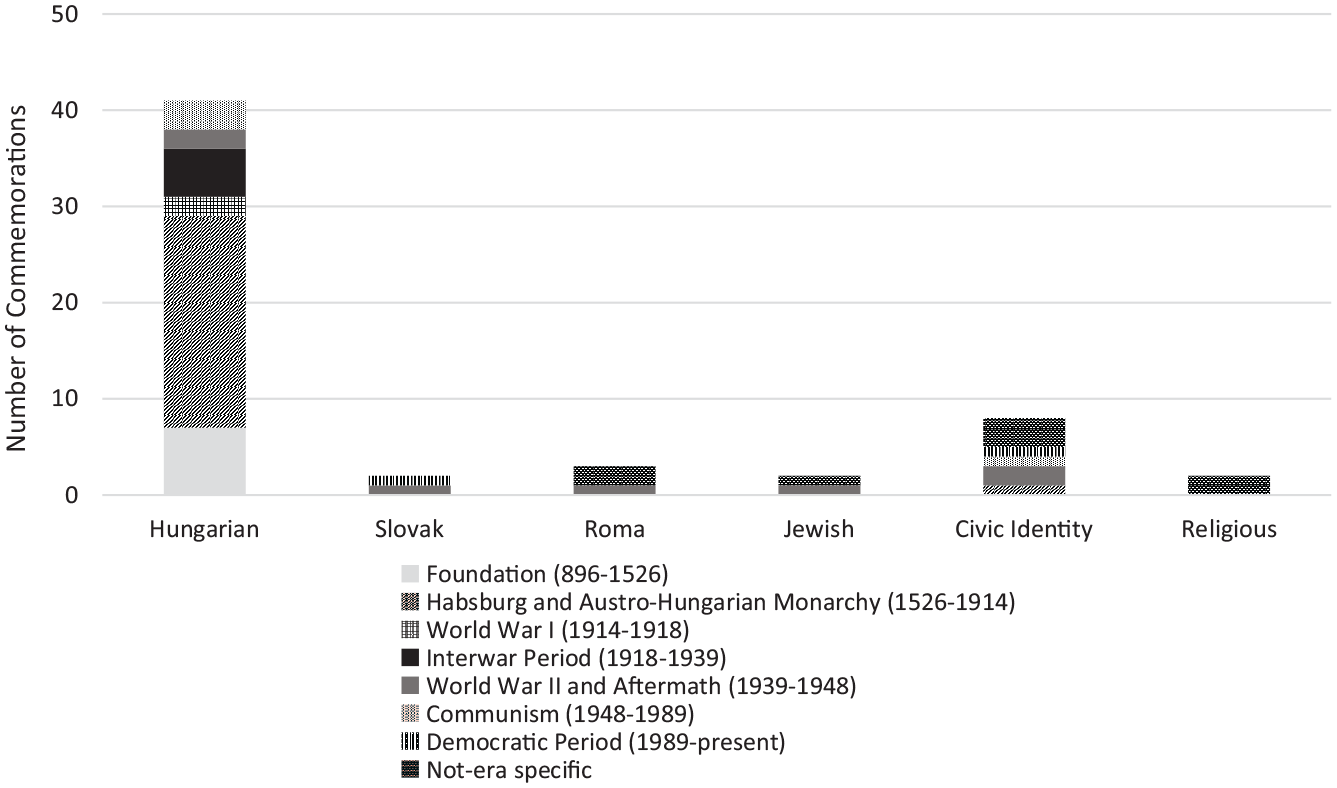
Commemorations of the Past by Identity and Era, 2009–2011 and 2015–2017.
What emerges is that the Hungarian minority disproportionately commemorates its past linked to the Habsburg Monarchy and Austro-Hungarian period (1526–1918) compared to other eras of its history. Moreover, it looks to its past from Habsburg rule nostalgically, while the twentieth-century events that are recalled are generally ones of mourning and loss. Regarding the former, many cultural figures are celebrated (such as writer Mór Jókai, composer Ferenc Liszt, composer Ferenc Erkel, statesman István Széchényi, and writer János Arany). Some commemorated figures were also revolutionaries in the 1848–1849 national uprising, such as Mór Jókai. The main event that is remembered during the Habsburg period is the 1848–1849 national uprising and is commemorated every 15 March. Besides this era, another period that is celebrated is of the initial founding of Hungary and its kings. For example, the founder of the Hungarian state, King Saint Stephen, is celebrated on 20 August, which is a national holiday in Hungary. When looking at other time periods subdivided across the twentieth century, the events commemorated are generally ones of mourning for the ethnic Hungarian community. These include the Komárom uprising that in 1919 failed to prevent the Czechoslovaks from splitting the city, the Trianon Treaty of 1920 that partitioned the Kingdom of Hungary, the controversial deportation of Hungarians from what was then Czechoslovakia following World War II, and the unsuccessful 1956 uprising against communism in Hungary.
There were other commemorations that did not focus on the ethnic Hungarian identity. For example, commemorations for ethnic Slovaks ranged from important national leaders during the 1848 uprising or cultural/political figures, the Slovak National Uprising in 1944, and the celebration of the Slovak constitution as an important event for the Slovak nation. There were also a small proportion of commemorations that appealed to a civic identity, such as marking the end of World War II and the victory over fascism, remembering those lost in a major flood in 1965, and recalling the fall of communism (which could be celebrated by both Slovaks and Hungarians together). Other ethnic groups such as the Roma and the Jewish community also had events they recalled publicly, such as Holocaust Remembrance Day, Jewish Cultural Days, as well as Roma National Day and remembrance of the Roma killed in the Holocaust. The different coverage of events of commemoration by ethnic group highlights the delicate coexistence of different national narratives—a coexistence that in other cases is sometimes not always feasible. 28
There are differences in coverage between the cities that tie into their geographical location, local history, and particular demographic composition. The first is the difference in ethnic coverage of events. For the town of Rimaszombat, where Hungarians comprise a minority of about 36 per cent and the Roma are the next biggest ethnic group, the coverage of different events included more Roma and Slovak commemorations as well as more commemorations of civic identity. For example, Gömöri Hírlap covered the twentieth anniversary of the fall of communism (civic identity), as well as a celebration of worker’s rights (1 May), and International Children’s Day. Ethnic Slovak events included the 1944 Slovak National Uprising as well as the Slovak Constitution. This is in contrast to Komáromi Lapok, which did not cover ethnic Slovak or Roma commemorations. Moreover, while the two cities have similar heroes and historical events that they both remember—such as writer János Arany, King Saint Stephen, the 1848–1849 national uprising, Trianon, and the deportation following World War II—they also celebrate their local Hungarian heroes. For example, actress Lujza Blaha and mathematician István Hatvani are remembered in Rimaszombat whilst the famous writer Mór Jókai and composer Ferenc Lehár are celebrated in Komárom. Interestingly, despite the smaller size of the Hungarian population in Rimaszombat compared to Komárom, many more commemorations of Hungarian historical events and personages are recorded in the newspaper.
A closer examination of the coverage of key historical events across both newspapers highlights the difficult plight of the Hungarian minority in terms of their population decline and the usage of history to craft a stronger minority identity and sense of belonging. For example, in his speech remembering the events of 15 March 1848, professor and politician Alajos Mészáros emphasised that the threat facing Hungarian identity today, particularly due to Prime Minister Fico’s policies, is just as menacing to the Hungarian nation as the threat 150 years ago, which led him to call for greater unity within the community. 29 A similar angle was taken by the keynote speaker Balázs Veszelovszki in Rimaszombat, where he asked whether, despite the similarities between the present and the circumstances of 1848, the Hungarian community would have its own Sándor Petőfi. Petőfi was a poet but also revolutionary and freedom fighter in the 1848 uprising and was killed in Sighișoara, Romania. The parallel between the threat to the Hungarian national community in 1848 and the present was clearly stated: “We are living historical times, from both the inside and the outside they would like to remove us, and the freedom heroes tell us that no one can be idle.” 30
Different events of commemoration, such as the deportation after World War II, Trianon, or the 750th anniversary of the founding of Komárom, link the past struggles of the Hungarians to the present with a message for the future. Komárom mayor László Stupendek, speaking at the 750th anniversary of the founding of Komárom, stated, “Our city’s historic flag proclaims the proud past, the struggles of the present, and a future full of hope.” 31 However, not all speeches were optimistic for the future, with many mentioning the threat to the survival of the Hungarians unless more rights were given, such as improvements in the educational system, freedom to use the Hungarian language, and support for Hungarian culture. 32 Another common theme was the importance of unity amongst the Hungarian minority, which emphasised that together they stand stronger than apart. (This led some to bewail the political split that resulted in two ethnic Hungarian political parties, MKP and Most-Híd.) Finally, the theme of peaceful coexistence also arose, with references to the past made to show that the Hungarians have lived side-by-side with other ethnic groups (such as Slovaks, Serbs, Jews, and Roma) and called the same place home for many centuries, and still desired to live peacefully together. 33 In this case, reference to peaceful coexistence resonated with the Hungarian Slovak population whereas the peaceful narrative given by elites in Yugoslavia did not resonate with its own population. 28
Across the commemorations—and also linked to the discussion on monuments below—the main actors involved are political elites as well as leaders of civil society organizations. Examples of civil society organizations organizing or partaking in the commemorations range from Csemadok—an important cultural organization formed after World War II—to Te Ügyed Kör (Your Issue Circle), Egy Jobb Komáromért (For a Better Komárom), and Deportálások Áldozataink és Leszármazottaiknak Szövetsége (Association for the Victims and Descendents of the Deportation). Political representatives are in attendance and often keynote speakers, such as local council representatives and mayors. Kin-state officials are frequently present amongst the list of attendees and speakers, such as Hungarian MP László Medgyasszay, the Hungarian Defence Minister Csaba Hende, and Hungary’s ambassador to Bratislava Zsolt Harmati.
Telling a Tale with Monuments and Tombstones
Events of commemoration often involve meeting at, or processing to, a monument to lay a wreath, recite a poem, or make a speech. For this reason, public monuments and the politics behind them are also worthy of further examination, as they are a “tangible manifestation of some ‘memory work’ process.” 34 Similarly, public institutions like museums are also examples of memory work in progress. When examining the local newspaper archives, similar emphases are put on statues of events or personages from the Habsburg-Austro-Hungarian period, as well as symbols of Hungary’s foundation like the Turul bird, which is a national symbol and mythic legend dating back to the arrival of the Magyars in the Carpathian Basin. While still present, there was less coverage of statues and monuments linked to the ethnic Slovaks, Roma, or Jewish populations.
Importantly, statues tell a tale not just of the person or event they commemorate, but also of the statue itself, such as when and how it came to be erected or renovated. One serious controversy that arose in Komárom was linked to the installation of a statue of King Saint Stephen in 2009. The statue was commissioned with the support of the local authority. However, on the day of the unveiling, Prime Minister Robert Fico banned Hungarian President László Solyom from entering Slovakia to make his appearance at the ceremony. Despite this diplomatic incident, the ceremony went on, and mayor Tibor Bastrnák emphasised that the foundation of the Hungarian state by King Saint Stephen one thousand years ago was based on the idea of unity and cohesion, and the recognition of the role that other nations could play in the Hungarian state. He highlighted that King Saint Stephen’s message of inclusion was an important one for those currently in Europe who prefer policies of exclusion and xenophobia. 35 Soon after the King Saint Stephen statue controversy, Prime Minister Fico confronted the city of Komárom over the placement of the statues of Saints Cyril and Methodius—two religious figures important to the Slavic nation and called “Apostles to the Slavs”—which were originally on the facade of the Matica Slovenská cultural institute. He argued this was not a prominent enough placement for these two key figures. Following debates between Fico and the mayor of Komárom about the legality of moving the statues—the latter arguing that permission was not sought from the local council to move the statue—in 2010 Saints Cyril and Methodius were moved to a roundabout next to Kossuth Square. 36
The battle between the prominence of statues of key figures of national identity in the multicultural town of Komárom highlights the importance of control over space and asserting the narrative of which identity that territory belongs to. 37 A similar dynamic arose in the town of Rimaszombat in 2016–2017, where renovations made to the central Tompa Square caused arguments amongst local council representatives about which statues to erect and their location in the square and linked them to questions about the past and the identity of the town. Debates about where to put Tompa Mihály’s statue (Mihály was a famous Hungarian poet local to Rimaszombat), along with the possible statue of Hungarian poet and revolutionary Sándor Petőfi and the creation of a prospective third statue, occupied the local council for more than one year. Accusations of re-Slovakization and Magyarization surfaced. In the end, the council narrowly agreed to place a statue of János Arany—a famous Hungarian writer—in the square alongside those of Petőfi and Tompa. Other prospective statues discussed were of Slovak writer and politician Janko Jesenský and Hungarian writer and politician Kálmán Mikszáth. 38 The statues were ceremoniously unveiled on the two-hundredth anniversary of Tompa’s birth in September 2017, with keynote speakers including the Deputy Secretary for Culture from the Hungarian Human Resources Ministry. 39 While the King Saint Stephen statue debacle reaches back to the founding of the Hungarian state, the Tompa Square controversy highlights the important role of the national heroes from the Habsburg past and their link to Hungarian identity more than 150 years later.
Another way to revitalise the past and reinforce a sense of identity is found in the initiative of Via Nova, the youth wing of MKP, called “Saving our Ancestors’ Tombstones,” whose goal was to clean up the tombstones of deceased Hungarians. This initiative was undertaken in reaction to a 2005 law that would clear away tombstones that had not paid the cemetery fee after a five-year notice period. One notable tombstone Via Nova renovated was of József Törköly, a Czechoslovak Senator representing the Hungarian minority. He was born in 1878 in Rimaszombat and played a key role in the politics of the interwar period, representing the Hungarians but also focusing on their peaceful coexistence with Slovaks. 40 Linked to a respect for ancestors, in 2017 the idea of taking care of tombstones was taken up by a group of volunteers in Komárom, where 3,500 Hungarian tombstones were documented. It was seen as a best practice to be spread to other Hungarian towns in the Carpathian Basin to better protect cemeteries. The Hungarian government was also open to funding some of the costs of the venture. 41 This activity highlights a clever way of bringing historically well-known national figures—as well as the broader national ancestral community—into the consciousness of Hungarians living in present-day Slovakia and connecting them to the past of a cross-border nation. A similar phenomenon of uniting a cross-border nation is found in the Immortal Regiment march by the Russians. 42
Indeed, the example of these tombstones shows that the role of the kin-state cannot be understated. During the time periods under study, connections between the Hungarian minority and its motherland emerge on several occasions. This is particularly the case in the divided city of Komárom, where some events—including the commemoration of 15 March 1848 and 20 August—were jointly organised. Moreover, Komárom compared to Rimaszombat had more kin-state visits, most likely owing to proximity. For example, in the commemoration of the 1945–1948 deportation, Komárom welcomed Hungarian Parliament President László Kövér and State Secretary Árpád Potápi. 43 Other events included the visit of Hungarian ambassador Éva Czimbalmos and, as mentioned above, the aborted visit of Hungarian President László Solyom. Rimaszombat had less high-profile visits but it did welcome other Hungarian kin such as Romanian-Hungarian leader and MEP László Tőkés. Across the different visits and speeches, Hungarian co-ethnics offer their support—both financially and morally—and emphasise the unity of the Hungarian nation, which historically had co-existed with other national groups such as the Slovaks, Roma, Serbs, and Roma. 44
The different dynamics surrounding these commemorations highlight how seemingly innocuous events can become politically charged and controversial, in the process implicating local, national, and kin-state actors. The selection of the types of events to be commemorated, as well as the particular statues to be put up or renovated, bring with them their own narratives of identity and history. With the threat of a diminishing population and lack of institutional guarantees for the reproduction of identity, reminiscing about the beginning of the Hungarian state and the heroes of the Habsburg-Austro-Hungarian era, whilst mourning various injustices of the twentieth century, brings a narrative unity for the Hungarian minority but also can ruffle the feathers of the Slovak majority.
The Spectre of the Past on Claims to Autonomy
Events of commemoration are only a “soft” means to ensure cultural reproduction. Without “hard” guarantees through legislation and institutions, the future of the ethnic minority cannot be assured. In this regard, minority elites view autonomy as one important way to guarantee the future of their community. Several elite interviews mentioned how autonomy is a way to ensure the growth and sustenance of the Hungarian community. However, in the Slovak context, the spectre of the Slovak past creeps in to influence the autonomy claims of the Hungarian minority. The Slovak nation’s own past of claiming autonomy conditions the cultural rules around language and the appropriate vocabulary to use for claiming “autonomy.” This importantly ties into the discussion of the second arena of conditioning factors through which historical memory and politics interact, as discussed in the Introduction to the Special Section. Hungarian political actors must be sensitive to the conditioning factors of culturally and linguistically appropriate rules linked to autonomy that consequently affect how Hungarian elites claim for greater institutional guarantees for survival.
From the Slovak perspective, an examination of history reaching to the nineteenth century, and including episodes before World War I and World War II, shows that in the Slovak mind the term autonomy connotes a future plan for independence. Following the 1848 Revolution and after the 1867 Compromise, the Slovaks sought autonomy (unsuccessfully) in the Kingdom of Hungary, the understanding being that autonomy would mean becoming free from Hungary. 45 From 1918, the Slovaks claimed autonomy within Czechoslovakia; this was in theory granted in the 1918 Pittsburgh Agreement and then openly declared by Hlinka’s Slovak People’s Party in October 1938. Once the Slovaks received autonomy in 1938, Slovakia then declared independence from Czechoslovakia in March 1939. This independence was short-lived as Czechoslovakia was then reunited in 1945, but the link between autonomy and the desire for eventual secession is drawn quite strongly in the Slovak mind. 46 Indeed, in several elite interviews, and usually unprompted, interviewees would quickly say that “autonomy” is “impolite” and has negative political connotations. 47 As a result, Hungarian minority elites have had to work within the historical constraints to make the claiming of autonomy palatable to their Slovak counterparts.
The Early Years: Cultural Rules and Linguistic Conventions
Understanding the power of the linguistic conventions and cultural norms around autonomy must begin with the landmark Komárom Meeting in January 1994. It is frequently mentioned as one of the key moments in the Hungarian autonomy struggle, and also as a missed opportunity. 48 Following the failed efforts of the Hungarian minority to be recognised as a “partner-nation” in the Slovak constitution, autonomy was seen as a viable institutional solution to recognise and protect the historical Hungarian minority. 49 In the context of proposed administrative reforms by the Slovak government and concern over the future of the Hungarian community in a newly independent Slovakia, Hungarian leaders in the southwestern Slovakian region of Csallóköz/Žitný Ostrov made a declaration in 6 December 1993 and planned a meeting in Komárom on the 8th of January 1994 to ratify their plan. The December plan called for an assembly made up of one hundred members that would represent the Hungarian community. It also included the formation of a Hungarian province with a “self-administration and special status.” 50
The atmosphere leading up to the event was tense, with Slovak opposition to the meeting. Days before the conference, what emerged was a play on words: Miklós Duray, the leader of Együttélés (Coexistence), one of the main Hungarian political parties at the time, and a supporter of territorial autonomy, stated that Hungarian parties were not talking about autonomy (autonómia) but rather self-government (önkormányzatiság). 51 A later report defended this change of vocabulary by stating that the two words are identical but that self-government is “more politically admissible.” 52 The finalised Komárom document was a watered-down version of the December proposal. It did not mention territorial autonomy, but rather featured two proposals for new administrative units. In the end, nothing came of the declaration. There has never again been such a strong call to territorial autonomy as the 1993 December plan. Moreover, and most importantly for the purposes of this article, we can see the beginning of the movement away from calls for “autonomy” to the play on words to “self-governance.”
What difference does a word make? The fact that political actors go so far out of their way to avoid the word “autonomy” is remarkable in itself. For example, in 2007–2008 local Komárom mayoral candidate János Bósza’s civil society organization went through different names—Southern Slovakia Self-Determination Council and Southern Slovakia Autonomy Council—which were banned because the organization was deemed a threat to the territorial unity of Slovakia. The final version of his organization, Movement for Regionalism, was approved, but later banned because of its website being a Hungarian (country) portal.
53
Words matter. As the spokesman of the Roundtable of the Hungarians in Slovakia—a major civil society organization—put it in an interview with the author: Autonomy is impolite, it shouldn’t be discussed. It means dissolution of the state in general. That’s the reason why MKP is talking about self-governance and why parties are not talking directly about autonomy.
In the Hungarian–Slovak context, therefore, the autonomy debate is in essence couched in a language that uses “self-governance” (önkormányzatiság) instead of “autonomy” (autonómia). If the latter is used instead of the former, it is often for purposes of confrontation rather than difference in meaning. Interviewees across political parties and civil society made the same point: the two words are synonyms and mean the same thing. The essence of what elites are demanding is the ability to have control over the institutions making decisions about issues that concern the life of the minority. Autonomy, or self-governance, is seen as a way to encourage the self-sustainability of the Hungarian minority and to fight against the trends of assimilation and emigration (as mentioned in the second section).
Analysis of the Post-EU Accession Period (2004–2017)
The claiming of “autonomy,” therefore, is conditioned by culturally and linguistically acceptable rules related to the Slovak nation’s own past experience. Hungarian elites have responded through a substitution of “self-governance.” This substitution strategy continues throughout the post-EU accession period, regardless of the changing surrounding political context. Indeed, despite the different political party governing coalitions in Slovakia during 2004–2017, the formalisation of a strategy for neighbouring Hungarian kin by the Orbán government in Hungary only in 2011 54 and a more divided political scene for the ethnic Hungarian minority in Slovakia, Hungarian minority actors consistently claim “self-governance” rather than “autonomy.” This is found across political documents and is further unpacked by an examination of how Hungarian elites pursue policy area reforms that would provide them increased self-governance.
An examination of key party documents over the time period confirms how actors have moved away from “autonomy” to the entrenchment of “self-governance.” This applies to the two main political parties in the period—MKP and Most-Híd—as well as to the Roundtable of Hungarians in Slovakia. The Roundtable is a civil-society umbrella organization that also provides legal opinions and promotes coordination between the different political parties. In this vein, it put together the Minimum document agreed to by both political parties and the Roundtable in 2012. 55 This document claimed the need for cultural and educational self-governance, as well as better regional economic development and the formation of regional administrative units that align with Slovakia’s “natural” cultural and economic regions.
When examining major political documents by MKP and Most-Híd, each has a major document on its idea of “self-governance.” In 2014, MKP launched its own proposal officially titled “The Institutional Requirements for the Slovak-Hungarian Community’s Preservation, Growth and South-Slovakia’s Economic Development.” 56 The document itself speaks not of “autonomy” but of self-governance on both the personal dimension and regional level. When MKP politicians were interviewed, they stood by this document as exactly what the party thinks of autonomy. Meanwhile, the policy document referenced by Most-Híd politicians is their 2016 Civic Vision, which encourages the development of a regional identity called “Southern Slovakian” (Dél-Szlovákia, as compared to the more used term Felvidék) and advocates support for educational and cultural self-governance. 57 Therefore, these different documents—as well as other election manifestos during the period—demonstrate the usage of the “self-governance” terminology across major national political actors and a general awareness of the taboo connotation of the “autonomy” term because of the Slovak association of autonomy with independence. In contrast to Poland, Ukraine, and Russia where speech about the past is controlled through memory laws, 58 the taboo on the term autonomy is in the air and political culture for the Hungarians in Slovakia.
With cultural conditioning around the language and vocabulary of what can actually be claimed by the Hungarian minority, the Hungarian minority needs to find alternative ways to achieve institutional control over cultural reproduction and to achieve autonomy in practice. Elite interviews highlighted how Hungarian minority elites have altered their strategy by focusing on claims across a range of policy areas which would encourage the economic and cultural survival of their community. Further analysis of the local newspaper archives unpacks how this happens, with claims across a range of policy areas such as education, language, and culture. Moreover, regional development focusing on infrastructure and economic development is a catchy theme and targeted policy area amongst Hungarian minority political actors, especially given that some regions with a large proportion of ethnic Hungarians are amongst the least developed and face high unemployment, as discussed in the second section. The following analysis highlights how policy reforms are claimed in practice through analysis of such claims in the newspaper archives.
First, unpacking the theme of regional development and its subcomponents, one way to promote greater de facto autonomy and control over the governance of their own affairs has been through promoting infrastructure development. Whether protesting the closure of the railroad lines that have kept the region connected—as in Rimaszombat in 2011—or clamouring for motorways (such as the R2) to be extended, developing infrastructure to further transportation links is a key claim area found across years and newspapers. Improved infrastructure serves two purposes. The first is to bring members of the Hungarian community into closer contact with each other. However, the planned R2 route connecting Kočice with Zvolen, running through Rimaszombat, began in 2007 and still has not been completed. The other expressway, the R7, which would connect Bratislava with Hungarian-populated towns along the southern section of Slovakia, also does not yet exist. Difficulty reaching each other undermines a common sense of regional identity. Yet whilst development has been slow on the R2 motorway completion, cross-border infrastructure connections between Hungary (in particular its own town of Komárom) and its sister city of Komárom in Slovakia have powered ahead. In 2017, the Elisabeth bridge (which united the sister cities across the Danube) was finished, unveiled during a visit by Prime Ministers Robert Fico and Viktor Orbán. The latter emphasised that the Danube did not divide but rather united the two countries whilst Fico highlighted the success of the Slovak–Hungarian relationship. 59
The second function of infrastructure is that it promotes economic development. As one expert put it, “investment goes where the infrastructure is good.” 60 Across the political spectrum, Hungarian actors agree on the importance of infrastructure. One MKP politician claimed, “We need to recognise that where infrastructure is missing, investment will not go there. Our goal is to make the underdeveloped parts of southern Slovakia reach the Slovak average in the near future.” 61 One Hungarian Most-Híd politician said, “We need to create an economically strong and self-aware community because that will be the pulling force . . . which will keep us together and bring home those who are searching for happiness abroad.” 62 Economic development and investment in the region are seen as solutions to the dilemma of young people emigrating to Hungary or moving to Bratislava, and also as a way of reducing unemployment. Debates surrounding economic development were heated at times, with the mayor of Rimaszombat even issuing an open letter to Prime Minister Fico criticising the lack of adequate government aid and investment in agriculture and job creation. 63 The economic dilemmas facing Rimaszombat are especially frustrating given that the region was one of the wealthiest in the Kingdom of Hungary during the early twentieth century, yet by 2011 it was facing one of the highest rates of unemployment in the country (almost 35 per cent). 64
To get around the absence of territorial autonomy and institutionalised cultural autonomy, the Hungarian minority has also focused on policy areas such as education, culture, and language use to gain as much leverage as possible over the reproduction of its own identity. The choice of words used by the different political actors has been education “self-governance,” cultural “self-governance,” and language rights, while the term “autonomy” has been assiduously avoided. Different civil society groups and political leaders have emphasised the importance of using the mother tongue since it “it is one of the cornerstones of our identity.” 65 Whether in schools and reading updated Hungarian textbooks, speaking Hungarian in public administration, or seeing signs in Hungarian, there are many practical challenges in using the minority language. For example, road signs in the minority language usually have the Hungarian language underneath in a smaller text size than the Slovak text above. The “KétNyelvű DélSzlovákia”—Bilingual Southern Slovakia—movement has taken up enforcing the bilingual railroad signs and announcing railway stops in Hungarian across southern Slovakia.
In the quest for more control over different institutions—without making an outright demand for autonomy—one common theme that arose in the archival analysis was the frequent claim to financial support. Money is the necessary enabler to guarantee an institution will function. Whilst some financing does come from the domestic government, other sources include the kin-state and the European Union. The kin-state acts through its different foundations—such as the Bethlen Gábor Foundation—as well as the Ministry for Education and Culture. As one minority rights activist said, “If Hungarian support did not come, then the civil sphere would not be possible to be active. The Slovak system only gives money to projects, nothing to support the upkeep of institutions.” 66 Another minority researcher confirmed, “The cultural organizations receive greater support from Hungary than they do from Slovakia. Without it, they could not function.” 67 Indeed, Hungary supports its co-ethnics not just in Slovakia but in neighbouring countries such as Romania, Serbia, and the Ukraine. 68 One political forum is the Autonomy Council of the Carpathian Basin (KMAT)—Kárpát-medencei Autonómia Tanács. The historical references to Trianon cannot be underplayed, as the solution of autonomy is seen as the way forward. With the upcoming one-hundredth anniversary of Trianon, Hungarian Romanian minority leader László Tőkés argued that “Autonomy is the solution to Trianon, without it any minority politics would be self-deception.” 69
In Slovakia, the sources of kin-state support are several. The Baross Gábor Plan provides money for economic development from the Hungarian government. It focuses primarily on small and medium enterprises, offering as much as 5 billion forints (approximately €15.5 million) in funds. 70 The goal of the Plan is to encourage the preservation of the Hungarian minority community through strengthened economic development. 71 At a joint meeting between kin-state officials from Hungary and the MKP party to discuss the Plan, MKP President József Menyhárt noted, “If there is work, then young people will stay in the region, there will be children, education, culture and life . . . this economic plan plays a huge role in encouraging this.” 72 Moreover, the kin-state has different outreach activities aimed at supporting business investment. In 2016, it was to support Hungarian young people from leaving Slovakia through supporting their local start-ups. 73 Further links were strengthened when the Hungarian Trading House (Magyar Nemzeti Kereskedőház) opened up seven offices in Slovakia to develop better trading contacts. 74
There is an important difference between the two ethnic Hungarian political parties regarding the support they receive from their the kin-state and their choice of political partners. MKP has promoted good ties with Hungary and has had the backing of the FIDESZ government. Meanwhile, FIDESZ refuses to acknowledge Most-Híd as a Hungarian party since it is composed of both Slovaks and Hungarians, although Most-Híd would think of itself as a Hungarian party. 75 For important meetings with other Hungarian minority parties in the region, such as through KMAT, FIDESZ will invite MKP but will not invite Most-Híd. On the other hand, from Most-Híd’s point of view, focusing on domestic politics and domestic partners is the preferred approach rather than hoping for support from neighbouring Hungary: “We perceive that MKP tries to find help in Hungary and beyond, and we are trying to find partners at home.” 76 MKP argues, however, that not much help will come from the Slovaks themselves: “Slovakia will give wider minority rights provisions once we will be only a few in the country.” 77 As a result, strong claims or ‘big steps’ in the form of administrative reforms such as those laid out in the MKP’s 2014 policy document is seen as the way forward. Most-Híd, on the other hand, emphasises small steps and believes that big claims will alienate domestic partners. 78 These divergent viewpoints and strategies illustrate the tension between overlapping layers of history and how the consequences of Trianon are lived. Both actors accept the status quo but to move ahead MKP looks towards its long-term connection with Hungary to draw on as support while Most-Híd focuses on adapting to a new set of domestic partners and allies.
The Hungarian minority does not have de jure autonomy and cannot claim it as such—due to the negative historical connotations discussed previously. Nevertheless, despite the constraining linguistic rules around claiming “autonomy,” political elites have gone out of their way to creatively target relevant policy areas and institutions that could provide for the well-being and economic survival of the community. This has occurred across areas such as regional development, education, and culture. Moreover, their demands are also aimed at different actors. Claims for financial resources from the domestic, kin-state, and also European levels provide a way to continue the minority identity’s survival. Whilst accepting the historical significance and irreversibility of the Treaty of Trianon, segments of the Hungarian minority political elite, led particularly by MKP, cling to the relationship with the kin-state whilst Most-Hid takes a more domestic approach to finding partners.
Conclusion
As the Introduction to the Special Section highlighted, the distinctive imperial past of East-Central Europe (compared to Western Europe’s more stable state system), the monumental ramifications of the dismemberment of three multi-ethnic empires following World War I and the East’s history of communism make it all the more important to understand how the past is activated in the present. 79 As János remarks, East Europeans “are inclined to seek solace in the past” rather than look towards the future. 80 The Introduction highlights three inter-related arenas in which historical memory and politics interact: the circulation of memories of historic narratives, conditioning factors such as political or cultural regimes, and finally, the actors involved. I examined how these three arenas apply to the Hungarian minority in Slovakia and how the past figures in their quest for survival.
Through an analysis of two Hungarian newspaper archives, I have unpacked how and which historic memories are circulated and by whom. Acts of commemoration of the past is the conduit for historic memories to be relived and serves to cement a Hungarian identity. They include the participation of mainly political and civil society actors who remember a range of events and people from the Hungarian past. Moreover, commemorations often involve meeting at, renovating, or putting up monuments that bring alive certain elements of the past. The Habsburg era is celebrated as well as the foundation of the Hungarian state, while the events of the twentieth century are generally mourned.
The second half of this article illustrated the linguistic and cultural rules which condition the vocabulary and tactics of the Hungarian minority in their desire to have better institutional guarantees for cultural reproduction. In other contexts, this would be claimed as “autonomy”; however, the negative historical connotation of “autonomy” in the Slovak mindset has led Hungarian elites to claim “self-governance” rather than “autonomy.” In addition to this linguistic strategy, elites have also pursued policy reforms in a range of areas such as education and regional development that would help them achieve de facto autonomy. Whilst this is relatively unsuccessful as yet, it is a manner more palatable than the outright claiming of “autonomy.” Indeed, the different articles in this Special Section highlight how contentious finding an acceptable and palatable version of history can be, whether for different ethnic groups within a country or across different countries. 81
In the face of a declining population, rising unemployment, and emigration and assimilation, whether or not these tactics will prove sufficient to sustain the Hungarian minority as an identifiable community remains to be seen. Fruitful avenues of future research could compare different Hungarian minorities in the surrounding region—such as in Romania or Serbia—and their usage of the past in minority politics, as well as memory politics in the kin-state. The transnational dimension of memory politics can also be further elaborated, in a similar vein to Davydova-Minguet. 82 Moreover, this analysis focussed explicitly on the past from the perspective of the Hungarian minority without detailed coverage of the Slovak perspective, which could show interesting dynamics at play. Whilst my methods were elite interviews and qualitative content analysis, a more detailed process tracing method could also uncover different causal mechanisms allowing for minority identity to be reproduced within the community. As this current article shows, the past is never too far away to be remembered, whether activated directly to commemorate identity or by conditioning the strategies of political actors.
Supplemental Material
Divald_Methodological_Appendix_July2020_FINAL – Supplemental material for Looking to the Past to Survive the Future: The Hungarian Minority in Slovakia
Supplemental material, Divald_Methodological_Appendix_July2020_FINAL for Looking to the Past to Survive the Future: The Hungarian Minority in Slovakia by Susan Divald in East European Politics & Societies and Cultures
Footnotes

Supplemental Material
Supplemental material for this article is available online.
Notes
Supplementary Material
Please find the following supplemental material available below.
For Open Access articles published under a Creative Commons License, all supplemental material carries the same license as the article it is associated with.
For non-Open Access articles published, all supplemental material carries a non-exclusive license, and permission requests for re-use of supplemental material or any part of supplemental material shall be sent directly to the copyright owner as specified in the copyright notice associated with the article.
