







Abstract
This article focuses on a cluster of institutions rooted in Polish rural life that were co-opted by the German authorities into the lowest level of rule in occupied Poland from 1939-1945. It identifies these institutions as key meso-level structures that shaped the behavior of individuals on the ground. Specifically, it places the axis of analysis on the figure of the village head (sołtys). It argues that the village security system, combined with the introduction of collective responsibility and imminent violence, was at the heart of a process of community-making, in which village heads inescapably played an important role. In this new dynamic of accountability, notions of “community” and “belonging” evolved relative to notions of “security” and “self-preservation” in the changing circumstances of life under occupation. The reimagined community forged in this wartime crucible was one of transformed identities, ingrained ethnic categories, new lines of solidarity, and new antagonisms. A collective biographical approach to village heads in this period culminates in the collective ethical dilemma as a category of historical analysis. The article draws primarily on testimonies found in postwar August Decree trials of individuals tried for collaboration in historic Western Galicia or District Krakow of the General Government. It employs a thick description of the subject to map personal narratives onto the broader social processes under examination.
Man’s capacity to dig himself in, to secrete a shell, to build around himself a tenuous barrier of defense, even in apparently desperate circumstances, is astonishing and merits a serious study.
Toward a Collective Biography of a Moral Dilemma
Tadeusz Józef Juszczyk, an assimilated Jewish youth from the town of Jasło in southeastern Poland, survived the German occupation by hiding “on the surface” as a Polish forester in the nearby village of Święcany. One Saturday morning sometime in 1943, the commandant of the Polish “Blue” Police (Polnische Polizei) in Szerzyny, Koralczyk, appeared at his door. He asked Juszczyk to accompany him and another policeman in the capture of a Jewish fugitive, Leon Kranz. The latter was a village Jew from Święcany, who had never reported to the Jasło ghetto, instead going into hiding with his aging mother, whose limbs were paralyzed. He had carried her on his back the entire time in hiding. Now surrounded, Kranz was ordered to come out of the barn with his hands up. He emerged from the hay with his frightened mother in his arms. “It was a shocking scene, simply indescribable,” recalled Juszczyk. 1 Half an hour later, Kranz and his mother were escorted by a policeman to the Jasło Gestapo. In order not to endanger his own life, all that Juszczyk could do in those dire circumstances was to offer a human gesture by giving Kranz a pack of cigarettes for the road.
Some 30 km southwest of Szerzyny, Szmulek Oliner, a twelve-year-old Jewish boy under an assumed identity as Józek Polewski, found himself in a similar dilemma. Oliner was working as a farmhand for the Padworski family in the village of Bieśnik, when an “order came through from the Nazis” for villagers to participate in a search for escaped Jews: “The sołtys, the mayor [village head], set up posses for house-to-house searches and required one male from each household in Bieśnik for that. The Padworskis sent me: and I, a Jew, ended up searching for other Jews who were no more fugitives than myself. In groups of two and four we searched houses, sheds, and cellars for the escapees.” 2 In all likelihood, Oliner was drawn into the search party as what was known as a “hostage” (zakładnik), assigned by the village head to ensure, on pain of death, that a given area of jurisdiction was free of fugitives from German law. Yet the moral dilemma that Oliner experienced was short-lived: “Much to my relief the fugitives were not found.” 3
All of the above-mentioned positions—foresters, village heads, hostages, and the local non-German police—represented institutional roles that were co-opted by the German occupation authorities into a surveillance system of the Polish countryside. Those who found themselves within these rural structures had an obligation to enforce the German order and play the role of participant, including the rare instance of Jewish fugitives like Juszczyk and Oliner.
Prior to the outbreak of the Second World War, “the great majority of the Jews in Poland defined themselves and were regarded by the population as a separate national group,” in the words of historian Antony Polonsky. 4 Few “organic ties” had bound Poles with the Jewish minority during the multiethnic Second Polish Republic (1918–1939). 5 As a consequence, relations between both groups were largely characterized by mutual separation and self-isolation. In addition, Polish–Jewish relations deteriorated significantly in the prewar period, especially in response to the growing anti-Jewish hostility of the late 1930s. The dominant cultural hierarchy and ethnic cleavages that emerged from these circumstances made it relatively easy to separate Poles and Jews even more during the war. The situation turned lethal when these factors began to map onto the racial hierarchy of life under German rule and the “identity politics” that emerged from it in daily life, in which questions of identity rapidly transformed into markers of life and death.
This study is concerned with the transformation of social relations in Poland among civilians during the Second World War, under duress and in a period of extreme violence. In his study of the Bosnian town of Kulen Vakuf during World War II, Max Bergholz described violence as a “generative force” and a “community-making power” in producing “far-reaching transformation in social relations, forms of categorization, configurations of power” and newly perceived “groups.” 6 This article seeks to extend Bergholz’s insights into the context of rural Poland under German occupation, specifically historic Western Galicia or District Krakow of the General Government. In this article, I argue that the above-mentioned village surveillance system, combined with the introduction of collective responsibility and imminent violence into human affairs, was the driver of a transformation that redefined social relations on the local level in wartime Poland. In this new dynamic of accountability, notions of “community” and “belonging” evolved relative to notions of “security” and “self-preservation” in the changing circumstances of life under occupation.
The specific focus here is the functioning of the village head, a pillar of local authority, within the nexus of local structures that are understood here as representing the “meso level” of the Holocaust in the General Government. Drawing on Robert K. Merton’s theory of individual choice and social structures, 7 the meso level is understood as the main source of structurally induced motives. By virtue of their central position in these meso-level structures, village heads inescapably presided over a community-making process, one in which villages, especially in moments of communal crisis, emerged as sites of negotiation of identity. In effect, the dynamics examined here helped to transform persecution driven largely by existential fears and dilemmas into acts of political violence. The process strengthened the ethnic identity of some groups and produced the social death of others.
The analysis reflects on the challenge of writing the biography of historical subjects, who found themselves not only at the “periphery of the Holocaust,” 8 but at the periphery of mainstream history. The attempt faces an inherent problem of a lack of the kinds of intimate and multi-perspectival sources relating to a single individual or village collective that would make a conventional biographical or microhistorical account possible. Village heads make a sudden appearance in the postwar trial record, only to vanish from view shortly after. To address this challenge, I employ a thick description of the subject by drawing primarily on the depositions and interrogations of the accused and witnesses found in the postwar trial material, across cases that pertained not only to the persecution of Jews but other victim groups. The analysis maps onto the personal narratives of village heads to capture the large-scale social processes of community-making and unmaking on a human scale. Such a collective biography, I suggest, culminates in the study of a collective ethical dilemma and the emergence of a persona adapted to the needs of self-preservation under occupation—not unlike those of Juszczyk and Oliner, noted at the outset.
Microhistory, Biography, Empathy—amid Historiographical Turning Points
Historian John Brewer divides historical writing in the last forty years between “prospect” history, or macrohistory, and “refuge” history, essentially the domain of microhistory and other accounts of everyday life. In refuge history, “historical figures are actors and have agency, motives, feeling and consciousness. They are the subjects not the objects of history”; the pleasures of refuge history derive from “a sense of belonging, of connectedness” of the reader with persons and events of the past by virtue of a common humanity—a type of history that “sees sympathy and understanding . . . as essential to historical knowledge and insight.” 9 Brewer thus sees in the historiographical trend of “history from below” focused on the recovery of ordinary individuals “hidden” from view “a commitment to a humanist tradition which places human agency and historical meaning in the realm of day-to-day transactions and which sees social reality as grounded in the quotidian,” one that rejects the skeptical anti-humanism of structuralist, poststructuralist, and postmodernist accounts. 10
In writing about Polish village heads under German occupation, this article grapples with the challenges of putting a new historical subject on the disciplinary map of microhistory and the Holocaust, combined with a commitment to the humanist agenda as set out by Brewer and in light of various turns effecting Holocaust studies. On the one hand, village heads would seem an ideal subject for the kind of bottom-up history in the tradition of Edward P. Thompson’s The Making of the English Working Class (1963). As with most subjects in histories from below, village heads make a sudden appearance in the archival record—catapulted into view during a period of war, occupation, and social breakdown—only to largely disappear shortly after. As with many classic works in microhistory, the primary sources consist chiefly of trials and investigations, which record things that cannot be found elsewhere.
The court proceedings used in this analysis were based on the Decree of 31 August 1944 issued by the new pro-Soviet Polish government, which became the principal legal tool for the prosecution of war crimes in Poland. Emulating similar Soviet decrees, the Decree was formulated to serve as a flexible tool of political justice in interpreting guilt for “fascist-Hitlerite criminals” and “traitors to the Polish nation,” in which the phrase “assisting the German occupation authorities,” in Article 1 of the Decree, functioned as a catch-all term for broad categories of crimes. 11 The August Decree proceedings (sierpniówki) thus took place in the politically loaded context of Soviet-dominated Eastern Europe and Poland’s Stalinist period (1948–1956). The sources are therefore not without their interpretive challenges, as the truth claims found in the depositions often introduce an element of epistemological uncertainty. 12 Yet the sources permit opening a relatively obscure social world during the occupation that reveals more accurately the process of anti-Jewish persecution and genocide at the grassroots level. Importantly, the historical reconstruction on the basis of these sources allows historians to transcend the established strictures of “perpetrators,” “victims,” and “bystanders” specific to the field of Holocaust studies in favor of a meso-level institutional baseline, which gives us a more precise understanding of the participants and would-be participants in persecution and violence on the local level. 13
On the other hand, the subject faces the challenge of extending the hermeneutic of historical empathy toward subjects that have inadvertently begun their slide from the category of “bystanders” to “perpetrators” since the turn in scholarship inaugurated by Jan T. Gross’s Neighbors in 2000–2001. 14 In doing so, the shift appears to have transferred the “moral constraint” characteristic of German historiography on perpetrators 15 onto the already ambiguous category of bystanders in the Eastern European context. 16 Needless to say, writing the biographies of victims faces a different set of challenges. 17 But as will be immediately recognized, village heads as a collective were neither bystanders, perpetrators, nor victims. As individuals, they could, and often did, play multiple roles in a moral universe that was not primarily set against the horizon of the Holocaust.
In addition to introducing a paradigm shift regarding ordinary non-Jewish Eastern Europeans, the publication of Gross’s Neighbors fostered a microhistorical turn in the historiography of the Holocaust, 18 which appears to have straddled yet another—the voluntarist turn. 19 Arguably, this was partly a function of the gradual abandonment of the “totalitarian” framework in studies of Nazism and the Soviet Union, which first entered academic debates in the 1940s and 1950s and waned after the de-escalation of the Cold War and the final collapse of the Soviet Union in the 1990s. 20 Timothy Snyder, for example, has noted that the shift from a “totalitarian framework” has opened the way to a “moralizing framework in which the structural power of Nazi Germany and the Soviet Union is marginalized,” adding that “a coherent account of structural power must precede any factual or moral account of the possibilities for individual choice.” He points out that Gross’s study of Jedwabne, which set the tone for subsequent studies, involves a marginalization of “structural significance,” leading to “agency inflation.” 21
The de-emphasis on structures combined with notions of agency shorn of context in the wide space between the micro and the macro has often left unmoored discussions of voluntarism. The result has been a reinsertion of ideology and personal conviction into the center of explanations for participation in genocide in contrast to a more “functionalist” account of everyday processes in a pressurized context of war and occupation, highlighted in this article, in which genocide writ large emerges as a series of accelerated homicides. 22 Given the absence of a core examination of agency within a spectrum of available choices, the temptation is often to fill the void by importing anti-peasant stereotypes and class biases into the study of the Holocaust in Poland. 23
Village Heads as the Meso Level
To address some of the above challenges, this analysis is harnessed to a meso-level understanding of village structures. The first historian to draw attention to these structures in relation to the Holocaust is Jan Grabowski in his pioneering study of the “hunt for Jews” (Judenjagd) in Dąbrowa Tarnowska and District Krakow. 24 However, the study of local violence and genocide in East Central Europe, especially Poland, remains virtually untouched by a robust meso-level analysis. The exception are studies either coming from the social sciences or informed by its literature. 25 What is the meso level? Political scientists Evgeny Finkel and Scott Straus define the meso level as “the space between national- or international-level factors and individual-level ones”; more specifically, the meso level places focus on “subnational regions and communities (provinces, towns, and villages) or on specific institutions.” 26
The authors identify four key reasons for why the meso level is crucial to the study of genocide. First, meso-level actors are “essential” to the “process of genocide” in coordinating between micro- and macro-level actors, often shaped by a rudimentary or temporary organizational structure. Second, meso-level actors “can shape, amplify, and inhibit agency and victimization.” In general, they have more agency in shaping the course of violence in more decentralized states, whereas in “highly centralized and coercive states, meso-level actors might enjoy comparatively little autonomy in substantially changing or altering the trajectory of mass violence.” Third, argue Finkel and Straus, an examination of the meso level can lead to a “richer understanding of the dynamics of violence and generate evidence by which to evaluate competing hypotheses,” thereby allowing for “grounded theorization into the causal dynamics at hand” and arguably greater explanatory potential. Fourth, a focus on “meso-level institutions” enables incorporating variation into the research design, thereby allowing us to better understand “how and why violence unfolds at different levels or in different ways.” Importantly, the “dynamics at the local level are often not derivative of the broader or ‘master’ cleavages at the national level.” Finkel and Straus note that “meso-level analysis is the least developed among the three prongs of research, and the field of genocide studies would benefit from greater attention to this level of analysis.” 27
A postwar judgment of an accused village head expressed their fundamental dilemma in the following way: “During the occupation, village heads, because of their position, oscillated between the interests of the occupier and the interests of the civilian population of the village. The absence of any authority that would defend the Polish population and protect it from repressions by the occupier forced village heads, as well as the population, to carry out unlawful regulations in order to avoid even worse consequences.” 28 Such a characterization places the entire village security apparatus—with the village head at the center—firmly at the meso level.
Village Heads and the Architecture of Choice under German Occupation
The appearance of the village head in Polish lands harkens back to the Middle Ages, a position that has since constituted one of the most characteristic institutions of organized village life. Its historical roots can be traced back to the feudalism of the time, specifically the internal settler colonialism based in “German law” (ius theutonicum). 29 It is no surprise then that the Polish sołtys (Latinized as scultetus) is a Polonization of the German Schultheiß (alternately, Schulze or Dorfschulze), at the time referring to a juror, which would return in its German variants eight centuries later in the nomenclature of the Nazi German occupation.
After enduring centuries under serfdom, the post-emancipation peasant of the mid nineteenth century became a citizen and a political subject of his own state only in the Second Polish Republic (1918–1939). Of major importance to the evolution of the figure of the village head in the interwar period was the passing of an act in 23 March 1933 by the Polish parliament to establish a new system of local self-government, replacing the administrative legacy of Poland’s partitioning powers. The new act introduced a hierarchical structure of rule, in which an elected sołtys had authority over a village (gromada), the mayor (wójt) over a commune (gmina), and the starosta over a county (powiat). The sołtys was voted in after election by a village council, the mayor by a communal council (each council composed of twelve to thirty members, depending on the size of the population), for a five-year term and subject to confirmation by the starosta. These structures were applied uniformly across the Polish state, which resulted in 611 urban communes and 3,195 rural communes—of the latter, a total of 40,533 villages, with as many village heads. 30
One of the first blows to the system of local self-rule by the German occupation was dealt to its democratic character. On 18 November 1939—on the same day that he passed a regulation for the establishment of Jewish councils (Judenräte)—Hans Frank, the Governor of a new territory labeled the General Government, issued a decree abolishing village and communal councils, giving direct authority over a commune to a nominated wójt, which placed the sołtys in a subservient position, and replaced the councils with “briefings” (sesje sołtysów) attended by members of the German administration. 31 In the annexed territories (with a population of more than ten million), Poles were pushed out of local administrative positions, which were then filled with ethnic Germans and members of the NSDAP. In the General Government (with a population of twelve million in 1939), the Germans could not afford such a massive administrative sweep because of a shortage of manpower. The removal of ethnic Poles from their posts as mayors was carried out only partly. For example, in District Krakow, although the Germans replaced some mayors they deemed to be insufficiently loyal, even as late as January 1944 more than half of the mayors were ethnic Poles. 32 Village heads were ordered to remain at their posts, and attempts to step down were regarded as a form of sabotage. 33 Short of illness, it was rare for a sołtys to step down from his post during the war.
The generation of village heads elected in the spring of 1939 was placed in a fundamentally compromised situation, suspended as they were between the interests of their constituents from below and the new German masters from above. By the same token, in terms of the former, less accountability to a representative body opened the way for abuse of power and opportunism. The service fees paid to village heads by the German administration were negligible. For example, in May 1940, the Kreishauptmann of Puławy noted that village heads in his county were compensated between 50 and 290 zł per year. 34 In the period prior to the German attack on the Soviet Union, the chief tasks of village heads included securing housing for new arrivals resettled from the annexed territories of western Poland, the distribution of ration cards (Bezugsscheine), the confiscation of millstones (used for grinding wheat or other grain), the collection of food quotas (kontyngenty), and, with the shortage of voluntary laborers for the Reich by spring 1940, the forced collection of human quotas. The last responsibility generated the greatest level of conflict within local communities, as in practice it meant organizing manhunts for Polish workers to fill the quota. After the invasion of the Soviet Union, added to their growing responsibilities was reporting or apprehending escaped Soviet POWs held in captivity in the General Government after the fall of 1941. 35 With the commencement of Operation Reinhard in spring and summer of 1942, the occupation authorities required village heads to capture Jews escaping ghettos and trains and deliver them to the local gendarmerie or Polish Police post. By the end of the war, virtually every category of outsider without proper identification (Kennkarte) was drawn into the net that village heads were to maintain around their collectives, including partisans and Roma. 36
To support the sołtys in his growing functions, the Germans built up the prewar institution of village guards (samoobrona chłopska), headed by a commander and sometimes referred to as the Ortschutz during the war, especially important in their capacity as night guards. The village head was also empowered to mobilize members of the Voluntary Fire Service (Ochotnicza Straż Pożarna, OSP), which, on the basis of a decree passed by Hans Frank on 22 April 1941, was militarized into a “German technical unit of the police support service” of the Reich. 37 All fire departments were thus “voluntary” in name only, as they were subordinate to district governors, county chiefs (Kreishauptmänner), or the Order Police. Some villages, depending on their size, contained more than one guard unit, each with its own commander, that operated on a rotating basis. 38 In this regard, the Germans co-opted prewar institutions of the village head, guards, and firemen, turning them into forms of indirect rule of the newly occupied country (see Figure 1).
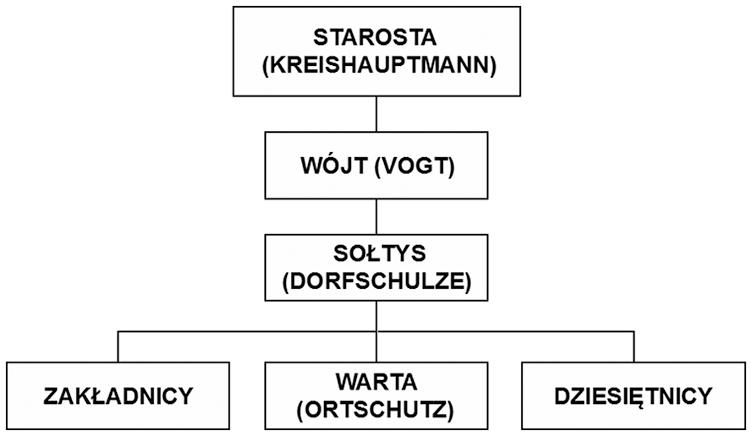
Hierarchy of civilian authority under German occupation
The system of “hostages” (zakładnicy, dziesiętnicy), however, was entirely new. Selected by the sołtys or the local police, a hostage was tasked with maintaining surveillance over a section of village or hamlet. The system of hostages often overlapped with the village guard system. Though the period of service for hostages could be brief—ranging anywhere from twenty-four hours, two weeks, or longer periods 39 —its assignment on a rotating and randomized basis suggests that a significant number of villagers had the experience of monitoring their neighbors. Hostage service could also be given official imprimatur when the German police designated specific individuals in writing. For instance, in 26 September 1942, the gendarmerie post of Dąbrowa Tarnowska designated three hostages from the village of Wólka Grądzka in Mędrzechów commune for around-the-clock guard duty of grain gathered in quota collections. 40 The hostages were under the direct authority of the gendarmerie. In the event of an act of “sabotage” against the grain, “the hostages would be shot.” The ever-present prospect of the death penalty (threatened on a collective basis) for failure to enforce German regulations set in motion patterns of anticipatory obedience, or the process of adapting to German demands in light of the repressive potential of the occupation, even in the absence of the German police. 41 In August 1942, Kazimierz Wyka, arguably the greatest diagnostician of the German occupation, was pressed into service as a hostage in the town of Krzeszowice (Kressendorf), incidentally the summer resort of Hans Frank. Using a formerly Jewish bakery as a base, after curfew each night a party of hostages, armed with canes, walked a beat around the town, rotating with a new party every hour and reporting to the mayor in the morning. “The institution of hostages,” wrote Wyka at the time, “It’s worth recording, because they won’t believe us later.” 42
Other roles drawn into the architecture of this broader apparatus included village messengers, foresters, gamekeepers, and members of quota commissions. Over time, collective actions were increasingly synchronized by this entire meso-level system. In some places, guards or villagers would alert the village by ringing a bell or banging on a drum. 43 Not surprisingly, when a young Jewish fugitive fell into its clutches sometime in 1943, he identified his captors as a “village militia.” 44
Such was the institutional baseline of the meso-level apparatus and the choice architecture that arose from it. Added to this was a reward and punishment system, in which participants in manhunts were often rewarded with modest spoils, such as the clothing of the victims, while those denouncing Jews were frequently given a small quantity of sugar or vodka. Hans Frank’s oft-cited decree of 15 October 1941, which issued the death penalty not only to all Jews who left their “designated districts” without authorization but persons who consciously gave them shelter, was subsequently repeated many times over by county governors and local authorities. Importantly, punishment was possible for failure to report and apprehend various fugitives. The sense of collective responsibility was therefore quite acute in the village collective (gromada). In some instances, members of the village guard were issued identity cards that obligated them to participate in searches and roundups. 45 In terms of Jewish fugitives, village heads were made to sign official monthly statements, in which they declared full responsibility for the presence of any Jews in the area under their jurisdiction. A blank form issued in District Lublin, written in German, Polish, and Ukrainian, has been preserved. It required the Dorfschulz to sign an “Obligation” (Verplichtungs-Erklärung) with the following stipulations:
No Jews are to be found within my jurisdiction [Dienstbereich]
I will order that in the future all Jews within my jurisdiction be held and brought to the nearest gendarmerie station, police station, or SS base of operations [Stützpunkt]
I am aware that I am responsible for the full implementation of this obligation, and that I bear full responsibility for its improper implementation. 46
The signed document was to be returned to the SS Police Leader of Lublin. The starosta in Reichskommissariat Ukraine faced similar threats. 47 In essence, villages were now weaponized against outsiders, and the whole system was held in place by draconian threats at each level of authority.
“We All Agreed in One Voice”: Patterns of Community Making and Unmaking
The new constellation of pressures shaped the internal dynamics of villages. German pressure from above was the most immediate concern that shaped the actions of village heads. The threat of German repressions was not a distant prospect, but a tangible reality. In his interviews with the children of village heads who attended the mandatory briefings, historian Jan Hebda learned that their fathers always said goodbye to their families in light of the possibility that they could be arrested and placed in prison or a concentration camp, never to return. 48 The postwar trial and investigation record substantiates such fears. Antoni Kłoda of Jaślany, accused after the war for threatening villagers with deportations if they did not obey German regulations, stated in his defense that the Mielec Landrat considered his failure to meet food quotas as an act of sabotage and threatened him with prison. 49 After the village head of Radomyśl Wielki fell ill, his deputy Mieczysław Kowalik was appointed in his place from 1941 to July 1944. When the community failed to submit a full quota of grain and cattle under his watch, Kowalik paid the price by spending two months in a penal camp in Janów Lubelski. 50 Such dramatic anecdotes likely went quickly into circulation. A witness in another trial stated that the home of a villager in Malinin who refused to take part in a manhunt for Polish laborers was burned down, its owner beaten up, and the village head sent to Pustków concentration camp for a period of four months. 51 Many village heads had ties to the Polish underground, which further exposed them to danger. As late as August 1944, with the advance of the eastern front, the sołtys of Zagorzyce, Franciszek Siwiec, was arrested by the Gestapo and placed in Płaszów concentration camp under suspicion of involvement in partisan activity. 52
Village heads served as the first point of contact for local police forces following any suspicious reports or local disturbance. In an underground report for the Tarnów region in the months of June–August 1942, we read of five German policemen who appeared at the home of the village head of Zalasowa at 4:30 in the morning, forcing him to accompany them in a search for two Russian deserters among villagers. When the search failed to turn up any results, the sołtys was told that he was to find them under the threat of death and report to the German police. 53 As their homes carried an official capacity, village heads were often exposed to many forms of violence, especially as they became the gathering point for many expeditions and manhunts. 54 Even in their absence, the village head’s home could become a site of violence. In a dramatic demonstration, sometime in 1944 locals brought a Jewish woman to the home of Jan Chmura in Brzeziny in his absence. By the time Chmura arrived on the scene, a ditch had been dug behind his building, where German policemen shot the woman. When they inquired about other Jews in the village, he explained that he did not know, as locals were afraid to tell him for fear of the consequences. One of the Germans then “took me [Chmura] by force to the place where the Jewish woman was shot and told me that [henceforward] the Jews who were shot are to lie under my office (kancelaria) so that the sołtys knows that Jews are hiding in the village of Brzeziny, but he is failing to report this to German authorities.” 55 How such episodes served as a catalyst for anticipatory obedience once put into circulation is not hard to imagine.
At the same time, the changed circumstances generated new pressures from below. Cases of village heads who found themselves before prosecutors and judges after the war reveal a frequent exposure to conflict with subordinates. In his self-justification for handing over a woman with her infant child in the summer of 1943—whom some night guards claimed was a Jew, others a Roma, and others a wandering beggar—the village head of Wola Wielka, Andrzej Zuziak, claimed that he was pressured by members of the night guard, who threatened to report him to the German police if he failed to deliver the woman and child. 56 Likewise, on Good Friday, 23 April 1943, when night guards brought a man they claimed was a Jew to the village head of Chrząstów, but the sołtys did not issue an order to deliver the man to the police, the night guards responded that they would report the matter, so that “the sołtys and the commander of the guard would also be taken away.” 57
Of course, the village head could issue similar threats against subordinates or fellow villagers. For example, Andrzej Cygan, the sołtys of Ulanica, ordered his dziesiętnik, 58 Antoni Bednarczyk, to deliver an alleged escaped Soviet POW to the gendarmerie; otherwise they would deliver Bednarczyk himself to the police. 59 Here, as elsewhere, gender and age were of little consequence when it came to a village head bent on implementing German regulations. A more extreme exercise of the village head’s authority took place in the village of Wiewiórka, where Helena Maroń, together with her mother, were sheltering a Jewish woman with two children and a non-Jewish man and woman (hiding for unknown reasons). Both Maroń and her mother had to flee after the five individuals being hidden were discovered and shot by a patrol of the gendarmerie and Polish Police. “Immediately after the people who were hiding with us were shot, I heard that sołtys [Władysław] Kizior called a meeting in which he warned everyone that whoever gave shelter to me or my mother would be shot,” she recalled. 60 She went into hiding for the remainder of the occupation, at times together with a Jewish woman whom she had once sheltered. In another instance, Anna Buława, a Pole selected from the village of Szafranów for deportation to Germany did not escape the reach of village head Michał Kokoszka. The sołtys captured her twice in 1943. The first time, he escorted her, bound in horse reins, through the village to the Gestapo post in the neighboring Volksdeutsche (ethnic German) village of Czermin (Hohenbach). After she managed to escape, Kokoszka returned reinforced with a group of armed Germans, who shot her several times, killing her on the spot. 61
Internal tensions within villages generated by these new obligations created a dynamic of mutual suspicion and a denounce-or-be-denounced mindset. When an inhabitant of Borek Wielki reported a stranger (who appeared to be a Ukrainian) to village head Władysław Marchut, the latter stated that he feared that the same villager would denounce him if he failed to act on this information. 62 In the most dramatic cases, the capture of an outsider generated a communal crisis, as subsequent capture of the same fugitive by the German police could result in the exposure of those who gave him or her shelter, leading to further violence against locals. On 24 June 1943, the night guards of Grabiny brought Lejba Roch, who once lived in a neighboring village, to sołtys Józef Piątek. The village head was said to have been torn, especially as Lejba was a prewar acquaintance, and meditated aloud, “not knowing what to do with him, whether to get rid of him (sprzątnąć), let him go, or telephone the Gestapo so that they would come pick him up.” 63 Piątek decided to bring him to the authorities. The Dębica Gestapo arrived at the Grabiny train station where Roch was held and promptly shot him on the spot. As a result of pressures from above and below, every village collective had the potential of functioning as a self-surveilling panopticon.
How did village heads respond to these circumstances? The trial record points to a number of strategies of accommodation. First, the circumstances led village heads, as well as mayors, to become acutely aware of their area of jurisdiction. The response was to adopt a territorial mindset and to carefully police the boundaries of their village or commune. Two examples can demonstrate this point. According to an underground report from mid-1944, as a result of damage done to an electrical transformer in Staroniwa (on the outskirts of Rzeszów), German policemen appeared at night and reportedly shot a total of 12 guards and 41 men who were unknown to the village head after they were made to dig their own ditches. 64 The message brought home to many village heads after years of occupation was that safety from repressions lay in providing no visible evidence of disobedience to German regulations within the boundaries of the gromada.
One way to solve this “problem” and evade responsibility was to simply push wanted fugitives beyond the boundaries of the village or commune. A vivid example of this approach took place in Jarosław county. In the fall of 1942, the wójt of Jarocin commune, Aleksander Bieńko, found himself on the receiving end of a complaint from a German policeman, who stated that he had received notice of Jews hiding in the village of Borki. Bieńko informed its sołtys, Józef Karkut, and ordered him to gather a group of men to escort the Jews—a group of 17 hiding in an empty manor house—across the San River bridge into Jarocin county (District Lublin). Once there, they were told to “let the Jews go wherever they please,” which they allegedly did. 65 The prosecutor accepted this version of events, regarding the actions of the nine accused men as a form of “sabotage” of German regulations, as they did not deliver the Jews to the German police, and dropped the investigation. 66
Occupational Personas?
Such accounts found in postwar proceedings open the question of the extent to which locals, especially those with institutional ties to the German administration, adopted various personas and postures for the ‘gaze’ of the village. They recast, in another form, the fundamental question posed by Kazimierz Wyka regarding the challenge of deducing human nature on the basis of perceptions generated under occupation—here, in the shadow of genocide. “They [human beings] all divide their existence into the apparent and the real,” wrote Wyka. “In fulfilling the basic duties of their profession and working within the framework of officially existing society—they live by putting on an act [żyją na niby]; behind closed doors among their own—they live true to themselves [żyją naprawdę].” 67
For the historian, these cases, refracted through postwar trials created under Stalinism in Poland, add another layer to the challenge. Let us examine other examples. In 1950, the sołtys of Lubzina, Jan Dreszer, and others were accused of collaboration with the Germans in delivering a Jewish woman by the name of Dora and her ten-year-old son to the Dębica Gestapo in the spring of 1943. In the version of events accepted by the court, the accused men put on an act for the village by playing their assigned institutional roles. They captured the woman and child and escorted them outside of the village, but released them once they crossed the village boundary, never delivering them to the police. 68
Such motifs in the trial record call for skepticism on the part of the historian and questioning the narrative accepted by the court. Yet the picture of sołtys Dreszer that emerges from the file is of a man who was consistently dedicated to protecting the welfare of both his villagers and outsiders. 69 For example, the witnesses who came forward spoke of Dreszer taking into his home three Soviet women, who had escaped from forced labor in Germany; giving shelter on his own property to fugitive Soviet POWs, who had escaped from the Pustków concentration camp, at a time when they were being killed and when other villagers were too afraid to help; and refused to cave in to beatings by the Germans to identify specific villagers as communists, instead giving them the best opinion and in this way saving their lives. In terms of Jewish fugitives, he continually helped Juda Baum, whose lodging among villagers he coordinated, providing him with food and giving him advance warnings, which allowed Baum to survive the war. 70 When it came to Dora and her child, she was apprehended by a member of a road construction crew (dróżnik), Jan Knych, who brought them to the village head and insisted that the latter deliver them to the Germans. 71 The sołtys allegedly settled on a compromise by agreeing to the Jews’ removal from the communal space, with the caveat that they be released beyond the village. 72
Similarly, in the case of the above-mentioned village head of Wola Wielka, Andrzej Zuziak, the accused members of the night guard claimed to have taken a different road and released the captured woman and child against the orders of the village head and in fear of its inhabitants. “During the occupation we came to an agreement that we would tell people that we delivered that woman to the [Polish Police] station [in Straszęcin], as we were afraid that we would be punished for not carrying out the order,” explained one of the accused. 73 The court accepted this version of events in the 1952 trial and subsequent retrial in 1953. 74
The court documents point to the challenge of determining historical truth on the basis of depositions found in the trial proceedings. On the one hand, we see a noticeable change in narrative between the early depositions given before the prosecutor and subsequent accounts during the main hearing before judges and jurors. On the other hand, the accused often reported experiencing pressure from the prosecutor during interrogations as the reason for the discrepancy. Were the variations in testimony part of a postwar strategy to protect the accused and the broader community?
The question of the reliability of locals’ depositions points to the challenge of historical interpretation. The August Decree was an extraordinary wartime measure. The wide latitude of the term “assisting the German occupation authorities” in Article 1 of the Decree allowed postwar authorities to go far beyond the prosecution of “war crimes.” All crimes adjudicated under its Article 1 were punishable by death, and judges would not have to differentiate between murder, manslaughter, and accessory to murder. 75 For village heads, this was all the more reason to present their wartime behavior as coerced, downplaying any autonomy.
Roman Gieroń’s study of the functioning of the system of justice on the basis of the August Decree is one of the few to offer insights into the reliability of the court documents as historical sources. He suggests that materials gathered in preparation for trial by the prosecution should be approached with caution, as opposed to those generated in the course of the hearing. 76 Such prosecutorial investigations constitute a minority of sources used in this article. Gieroń also examined the full gamut of lines of defense used by peasants accused of anti-Jewish activities in District Krakow. 77 He found that the primary explanation given was one based on the danger posed by German repressions and fear. The picture that emerges is one of “the Polish province overcome by a psychosis of fear brought about by German terror.” 78 Gieroń notes that this way of framing the issue might have been influenced by the fact that every form of pressure exerted on the perpetrator could have been regarded as a mitigating factor by the court. Like any body of sources, the court proceedings therefore do not reveal the full picture but a limited perspective framed around the interests of the prosecution, the accused, and the court. In the end, the challenge of reproducing the full range of motivations on the basis of court testimony may prove insurmountable. In the absence of outside corroborating evidence in every case, it is hard to draw final conclusions. The historian can only form a picture by a close internal reading of individual cases and by proceeding with caution.
What is less ambiguous for our purpose, however, is the fact that the new web of accountability produced undeniable dilemmas that gave rise to new antagonisms as well as new lines of solidarity. Communities that experienced German violence appeared particularly volatile. The village of Pogwizdów was a site where, according to the trial documents, as many as 25 Jews and some Soviet POWs had taken shelter. When German authorities discovered this fact, likely through a denunciation, they carried out a “pacification” of the village in April 1943, during which twelve people were shot, sixty deported to labor camps, and several properties burned down. 79 One of its inhabitants, Agnieszka Wos, continued to shelter two Jewish brothers in her attic. However, after the death of her daughter due to typhus in May 1943, a sanitary commission from Łańcut appeared in her home, accompanied by the village head. When members of the commission mentioned “fire” in reference to the need to burn hay that they believed might be contaminated with typhus, the Jewish men hiding in the attic were certain this meant that the house was about to be burned down for sheltering them, so they jumped down and tried to escape. 80 Exposed before the commission and his own villagers, the sołtys ordered the men to apprehend the Jews. “We all agreed in one voice that we have to hand them over to Łańcut, because we were afraid of the German authorities and had clear orders to hand over every little Jew,” testified the sołtys. 81
A Clash of Strategies: Communal Self-Preservation versus Jewish Survival
The occupation fueled a logic of self-preservation that compelled a closing of ranks among village collectives when outsiders appeared in their midst. In late 1942, a teenage Jewish boy and his mother triggered such anxieties when they spent the night in a farmer’s barn near Mielec without the owner’s knowledge. They were awoken in the morning by a panicked villager: “When we became short of breath and slowed down, we looked back and saw the villagers standing by the fence and looking at us. The villagers were not only from the farm we had just left, but from other neighboring farms as well. They were hooting at us like a mother bear and her cub running from danger. . . . It was like we were robbers or bandits who came to harm them.” 82
In most cases, villages were left to their own devices in developing communal strategies of accommodation to German demands, which sometimes collided with Jewish survival strategies. Such dynamics led a search for Polish laborers to transform into a search for fugitive Jews in the village of Chorzelów. In December of 1943, the sołtys, Michał Gesing, learned that his village was among those targeted for labor roundups. He responded by holding a meeting with trusted locals to devise a strategy. The plan was to select those with work cards (i.e., were already legally employed in the region), the physically weak, and those “without ties to the community.” The idea was that those with work cards and the physically weak would be returned from the Mielec Arbeitsamt, while the community would have nominally fulfilled its quota.
At the same time, Chorzelów and neighboring Malinie were giving shelter to a number of Jews, many hidden among workers residing on the grounds of a manor owned by the Tarnowski family of aristocratic lineage. 83 Armed with advance knowledge of the search, the Poles who sought to avoid capture for forced labor went into hiding for the night, while those sheltering Jews advised their charges to temporarily move to a different location. To ease the tense atmosphere, the village head served alcohol to all participants. Search parties of five were formed, all drawn from among the village hostage system and members of the Voluntary Fire Service. However, when a group appeared at the home of Aniela Kędzior to take away two of her nieces, Kędzior did not act according to plan. Likely not privy to the planned strategy of the village head, she attempted to protect the two young women from deportation, exclaiming, “You came for them, because they’re poor, but there are Jews with [Katarzyna] Szyfner, yet you don’t go there.” 84 With these words, the now half-drunken search party for Polish laborers had partly turned into a search for Jews. Some believed that their capture would help fulfill the labor quota. 85 The incident resulted in two Jewish casualties: a mother and daughter of the Haller family, who were brought to the village of Malinie, which served as a gathering point for Polish workers, and were subsequently shot by the gendarmerie. 86
Locals could therefore weaponize German regulations by deflecting actions directed at them toward other victim groups. In another example, when a labor quota commission, composed of sołtys Andrzej Zboch and two other members, appeared at the home of Rozalia Wężyńska to take away her son, she “told them to go to hell, because they were hiding a Jewish woman,” threatening to denounce them to the Gestapo. This was certainly effective, as the committee members rushed back to relocate the Jewish woman in question to another peasant home to prevent her capture. 87 Jewish survival was entangled with Polish individual and communal self-preservation on an institutional course set by the Germans and mediated by cultural hierarchies and cleavages based in the prewar period.
For Whom the Bell Tolls? The Case of Wiktor Czekaj
The meso-level system functioned in such a way that once a certain threshold had been crossed, even the most well-meaning village head could do little to prevent the inevitable domino effect. The case of sołtys Wiktor Czekaj in Podleszany is instructive. 88 In the winter of 1942, fifty-six-year-old Ludwika Kolisz (Kolis) discovered two Jewish women hiding in a haystack inside her barn, unbeknownst to her. Kolisz, in a state of panic, made her way to the home of the village head. By the time Czekaj arrived on the scene, the commotion had attracted a crowd of villagers, quickly turning into something of a spectacle. Czekaj was unsure how to proceed. It was daytime and many villagers had now become witnesses to the presence of fugitive Jews. He ordered the village guards to bring the Jewish women into Kolisz’s barn, with the hope that the crowd would disperse by nightfall.
But the crowd grew more intense. Czekaj was later shown a hole in the roof of the barn made by the two women, who had removed the shingles and tried to escape. However, the crowd kept repelling them back. One of the women approached him and asked him to bring them to Mielec, where they believed their family was. He told them to try to escape instead. The younger woman responded that her sister was too sick and she could not leave her behind. She would rather die with her.
Czekaj was fifty years old at the time. He had known the two Jewish sisters, Chana and Małka Keil from the town of Mielec. They had been hiding in the village since March of 1942, when the Jewish population of Mielec was deported to District Lublin. Czekaj was aware of their presence in the village and actively helped them hide. In fact, he knew the Keil family since 1919, when “bandits” attacked the home of a Jewish widow and her six children—most likely, a reference to anti-Jewish violence that swept the town in the aftermath of World War I. He had intervened and protected the family from the attackers. During the war, after the “liquidation” of the Jews of Mielec, he and a Catholic priest, Rev. Jan Terlaga, gathered Jewish books thrown out of the synagogue into the streets of the town and hid them in the attic of the priest’s home in the village. 89 He had also been active in helping other Jews hide in the village and had procured “Aryan” papers for others, enabling them to relocate to other parts of the country.
On that fateful day, Czekaj had stared down a set of socially structured alternatives, manifested here in its most drastic form, that constrained the choices of all villages heads. He laid out different scenarios in his mind. “I saw a hopeless state of affairs, I realized that the crowd would not disperse,” he stated after the war. “I didn’t want to take responsibility for the fate of the village and its inhabitants.” He laid out his dilemma in the following way: “I was convinced that people would betray me, especially as the village was inhabited by Volksdeutsche in a few places and the Germans were always hanging around the village. I was looking for help, [to find a way] to save the life of both the Jewish women and the village, so that the village would not be burned down. . . . Even if the Germans had learned that [Ludwika] Kolisz was hiding Jews, at most they might burn down her property, but Koziara [a Volksdeutsch in a neighboring village] will defend the rest of us.” 90
Finally, a patrol of two German gendarmes and a Polish policeman appeared. They placed the two women on a horse-drawn cart. The Germans stated that they would proceed to “shoot all of the inhabitants and burn down the village.” The village head was threatened at gunpoint for allowing Jews to be sheltered in his village. In the end, they left in the direction of Mielec and shot the two women in a forest brush along the way.
Four years after the war, Czekaj stood accused of “collaboration” with the Germans by members of his own community, which he sought to protect in ways that were not always obvious to local villagers. Most peasants and village heads were simple people who were often not able to give clear expression to their dilemmas. They stood accused of crimes before a legal system they did not fully understand. The testimony of Czekaj is rare for its ability to articulate the human drama that arose from these conditions. In a more bitter formulation, he stated: “My fault lay in the fact that in the moment that I had served as a village head for ten years [1934–1944], that in that moment, when Ludwika Kolisz reported the Jewish women in the haystack, I should have run for the woods, leaving behind my family, wife and children. Whether they would have burned down the village or murdered my family, that crowd would at any rate not have let the Jewish women go, because I knew well its inhabitants and their attitude toward the Jews. I knew my village very well and its population—terrified and made savage by the sight of Kolisz screaming.” 91
In almost all of the examined cases, village heads were involved in various forms of protecting fugitive Jews, Soviet POWs, members of the underground, and others. But the crucible of the occupation generated unprecedented “choiceless choices.” And as with all calls of conscience, evasion was a major response. Four years after the fact, Czekaj believed that he should have run for the woods. In another case, when night guards brought a captured Jewish woman to Stanisław Biduś, the sołtys of Nagoszyn, “upon hearing this, [the village head] lay down on his bed, pretending to be drunk. The Jewish woman stood at the doorstep for some time, his wife and others jostled him to wake up (though he wasn’t sleeping, only pretending), saying, ‘There’s a Jew, why is he not listening and pretending to be drunk and asleep?’” 92 The moment of indecision allowed the young woman to escape, curiously allowing the village head to rise out of bed.
Elsewhere, when night guards brought Lejba Roch before the village head, who had known Roch from before the war, the sołtys is reported to have “meditated aloud about what he is to do about the captive,” cursing loudly at Roch: “Why did you come here, what am I to do with you, I am not here alone [to be in a position] to let you go, because tomorrow the Germans will put a bullet in my head.” 93 In the most dramatic cases, elements of Greek tragedy emerged from within Polish–Jewish relations in the crucible of the occupation. These moral dilemmas were at the heart of the process of community-making that village heads inadvertently presided over.
The Man Farthest Down
Observing the immediate postwar months, Kazimierz Wyka, to cite the literary critic once more, noted that the “human communities” [gromady] returning to the territory of the former General Government from Germany and other parts of Europe were “free of the contamination typical of the occupation, and are much healthier in terms of the norms of collective life.” He believed that “the whole range of issues” bound up with this subject awaited its writer. 94 Similarly, drawing on Wyka’s diagnosis, Anna Cichopek-Gajraj found that the greatest damage done to “Poles as a community of citizens” by the German occupation lay in the fact that it “completely undermined the notion of morality in daily life.” 95
This study has sought to capture a fragment of this transformation in communal relations resulting from the “contamination” of the occupation in the context of rural regions of the General Government. In effect, I suggest that the Germans had unleashed a countrywide “Lucifer Effect” 96 on Polish society, which multiplied across thousands of villages, tearing at the social fabric of local communities. It was one in which everyday processes were accelerated in a pressurized context of war, occupation, genocide, and social breakdown. The study has touched on a universal theme: what unites us as human beings versus what divides us as groups. The power of microhistory resides in its ability to depict social relations at a personal, human level, quite different from relations at an ethnic or political level. The fallacy is taking a very select group of people to be representative of Poles, Jews, and Germans generally. Microhistory is thus an antidote to categorical thinking. However, capturing the social dynamics involved in this process unleashed by the Lucifer Effect among ordinary people at the level of the individual poses a challenge to both microhistorical and biographical approaches to the writing of history, particularly in terms of reproducing a measured understanding of a subject’s spectrum of agency.
Navigating a path that avoids both individualism and sociologism, this article has sought to address these challenges by harnessing the historical reconstruction to a meso-level analysis, commonly used in the social sciences but underutilized in historical writing. The institutions identified here represented the key meso-level structures that mediated individual behavior on the micro level, specifically the figure of the village head. The space between the micro and meso level emerges as the site of situational factors. Further, the analysis suggests that the meso level may be critical to the social history of the General Government, as the occupation authorities had dismantled the Second Polish Republic from the center, replacing the upper-level infrastructure with Nazi institutions. Meso-level structures were essential to the process of genocide, or the “third phase” of the Holocaust, from mid-1942 to early 1945.
In terms of agency, individuals who found themselves within these constraining social structures were acting under duress and in the belief that punishment for noncompliance was death. As Finkel and Straus point out, highly centralized and coercive states leave little autonomy for meso-level actors. With each turn of the screw, the system became increasingly synchronized and self-regulating, and its functioning did not require the presence of the uniformed police. The dynamics that emerged from pressures from above and below took place in a context of mutually reinforcing fears. In-group policing before the gaze of the village, especially among those in the village security system, was a major factor. These conditions lowered the threshold for participation in persecution and violence against targeted groups.
In terms of village heads, their actions were mainly shaped by structurally induced motives. Their self-preservation required the assimilation of institutional demands. Dispositional factors or ideological leanings, insofar as they can even be established on the basis of the available documentation, tell us little about the behavior of village heads under occupation. These, at any rate, were largely over-ridden by the sheer scale of German terror and the drive for communal self-preservation. Victims of circumstance, village heads had little room for maneuver. Their landscape of choices was shaped primarily by the dilemma of satisfying German regulations from above and communal pressures from below. The story of every sołtys is some variation on the theme of navigating a precarious path that balanced these interests while ensuring his own survival. Democratically elected by their rural constituents prior to the war, they were reduced to the role of middlemen between German power and their communities in the refashioned social reality of the German occupation. At bottom, the sołtys was an institutional entity, who operated primarily within the boundaries assigned to him by the Germans.
By the same token, though village heads had very little agency, they nonetheless faced a dynamic social situation within their communities. By virtue of their central position in the meso-level structures, village heads inescapably presided over a community-making process. The new web of accountability produced dilemmas that gave rise to new antagonisms as well as new lines of solidarity. In moments of communal crisis, the village emerged as a site of negotiation of identity. The underground movement also contributed to the community-making process by deciding whose presence was beneficial or detrimental to the collective. The process strengthened the ethnic identity of some groups and produced the social death of others. The local dynamics described here in effect transformed violence driven by existential fears and dilemmas into political violence. While Polish communities were being fragmented and reconstituted along these lines, ethnic German communities were being consolidated and homogenized along principles of Gemeinschaft.
The absence of intimate sources pertaining to subjects “hidden” from history, such as village heads, especially those that span the prewar, wartime, and postwar periods, does not allow for a robust biographical approach. However, an outline of a collective biography in light of the thick description applied here suggests a collective ethical dilemma as something close to a category of historical analysis. Though village heads never faced down a genocidal assault as Jewish councils did in ghettos, the nature of the impossible moral dilemmas facing them was similar. The German-imposed framework that village heads operated in brings to mind Hannah Arendt’s observation that totalitarian regimes developed a unique capacity of making victims cooperate in their own destruction. The findings presented here suggest that our understanding of Primo Levi’s “gray zone” or Tadeusz Borowski’s perspective on the morally numbing effect of everyday terror in Auschwitz be expanded outside of the concentration camp universe to everyday life in the General Government more broadly. Such a research agenda might elicit a comprehensive map of a complex ecosystem of violence, of which the story of the village head is only an indication.
Footnotes
Acknowledgements
The author thanks the two guest editors Hana Kubátová and Natalia Aleksiun, Elena Hoffenberg and the two anonymous reviewers for providing critical feedback on drafts of this article.
