







Abstract
Recent literature on globalizing Eastern Europe dedicates much attention to the relationship between ideological commitments (socialist internationalism) and economic interests in the countries’ outreach activities toward various regions of the Global South. This article zooms in on one such aspect of Poland’s engagement, as it offers an analysis of Polish propaganda outreach through the publications of a major publishing house, with readerships in various Asian and African settings. The Polonia publishing house was one of the most important institutions that disseminated Polish foreign propaganda in the 1960s, closely following the institutionalization of the Non-Aligned Movement. It published various journals in foreign languages, including the Polish Review/La Revue Polonaise. The journal was distributed for about a decade in Asia (1961–1972) and Africa (1962–1972). Drawing on the journal’s content but also the letters to editors, contributions to various competitions organized by the journal, and internal communication, the article interprets the desired image of Poland in Africa and Asia in the 1960s as it was being transmitted in these platforms. Furthermore, the article also focuses on the readership: assessing their social status and beliefs, identifying the issues that were meant to resonate with them, as well as analyzing their composition and motivations. Thus, the analysis situates the Polish propaganda efforts within the global discussion on print culture, cultural wars, and decolonization. The inclusion of issues targeting audiences in these different geographies opens up the opportunity to compare the African and Asian cases.
“I am very glad to write you these few words to inform you that I received many copies of the Polish Review magazines which are beautifully printed and I myself and many of my friends enjoyed them and we have learnt many things of your country, agriculture, cultural affairs, trade, etc.” 1 This is what a reader from Sri Lanka (then Ceylon) wrote in 1963 to the editors of the journal affiliated with the Polonia publishing house, a state-owned entity in Poland. This communication illustrates communist Poland’s global involvement and proactive initiatives in Africa and Asia.
The 1960s were a transformative period in global geopolitics, with Central and Eastern European nations trying to balance ideological commitments and economic interests in their outreach to the Global South. 2 This article offers an in-depth analysis of Polish foreign propaganda at the time, with a focus on the Polish Review/La Revue Polonaise. 3 This periodical, distributed for about a decade in Asia (1961–1972) and Africa (1962–1972), helps us to understand Poland’s aspirations and engagements on the global stage. The analysis draws extensively on the journal content, letters to editors, contributions to competitions, and internal communications to reconstruct and interpret the nuanced image of Poland as it was strategically projected in Africa and Asia during the 1960s.
The use of the term “propaganda” to describe these efforts requires clarification. While often associated with manipulation and disinformation, propaganda during the Cold War was not merely about ideological imposition but functioned as an institutionalized form of global engagement. As Nicholas J. Cull demonstrates in his study of the United States Information Agency, propaganda was a tool for transmitting ideology and a mechanism through which states constructed narratives about themselves and their global role. 4 Similarly, Poland’s Polish Review/La Revue Polonaise was a medium for countering Western stances and an active instrument for shaping perceptions of Poland’s place within the socialist world and engaging with audiences in Africa and Asia in a structured and strategic manner.
The broader context of cultural diplomacy during the Cold War further illuminates these processes. As Giles Scott-Smith has demonstrated, cultural diplomacy was a fundamental international relations tool used by both the Eastern and Western blocs to cultivate influence abroad. The United States, for instance, leveraged the Foreign Leader Program to forge ties with elite figures in Europe and beyond, and promote a vision of liberal democracy and capitalist modernity. 5 Similarly, the communist states, including Poland, used cultural diplomacy as a means of ideological dissemination and a way to position themselves as allies of decolonizing nations, offering an alternative to Western cultural and economic dominance.
This article also examines the periodical’s readership, offering insights into the social status, beliefs, and motivations of readers in Asia and Africa. Through this exploration, it sheds light on how Polish propaganda was perceived and understood in a range of cultural and geopolitical contexts. Two interrelated questions guide this inquiry: To what extent did the messages disseminated globally through the Polish Review/La Revue Polonaise echo those circulated domestically? Did these narratives evolve over time in response to shifting geopolitical and ideological currents? This study is grounded in archival sources, including publishing-house documents, and correspondence between editors and readers, offering a multi-layered perspective on how Polish foreign propaganda operated.
Recent scholarship has examined the ideological engagements of Central and Eastern European states in the Global South, and efforts to expand their influence outside of the Soviet sphere . 6 Studies on Poland’s efforts—including those of Przemysław Gasztold and Piotr Puchalski on Polish policies in decolonial Africa, of Jan Kozdra on Polish involvement in Nigeria, and of Christopher Lash on Poland’s engagement with Mali—reveal that Polish outreach was not dictated by Moscow but shaped by its own diplomatic and economic goals. 7 By analyzing the strategic goals and editorial practices of the Polish Review/La Revue Polonaise, as well as reader interactions with it, this article contributes to the broader discussion about Eastern European states’ participation in Cold War propaganda and ideological engagement. It positions Poland within the broader networks of socialist outreach to the Global South, showing that a medium-sized socialist state sought to exert influence beyond the confines of Soviet foreign policy, and it engages with broader historiographical debates on socialist internationalism, demonstrating that Poland’s engagement remained a complex, multi-directional process while also being shaped by Cold War rivalries.
The Creation of Dedicated Magazines
The genesis of Poland’s foreign propaganda apparatus can be traced to the 1940s and 1950s, when press agencies and publishing houses tasked with projecting a positive image of the country abroad were established. These institutions, including the Polonia publishing house (Wydawnictwo Polonia), the Western Press Agency (Zachodnia Agencja Prasowa), and AR-Press (Agencja Robotnicza), operated within the framework of socialist propaganda, aiming at countering accusations of authoritarianism and Soviet influence while promoting the legitimacy of Poland’s western borders. The Polonia press evolved from a modest enterprise into a prominent, specialist publishing entity. Its growth was evidenced by the expansion of its activities, acquisition of new magazines, and a notable increase in foreign-language publications. It became a platform for disseminating materials that promoted contemporary Poland to both Polish diaspora communities and international audiences.
The Polish project was integral to the broader socialist propaganda initiatives during that period. In 1960, the Soviets established Agentstvo Pechati Novosti (APN) in the Soviet Union, a publishing agency focused on shaping opinions in foreign countries. Its primary objective was to disseminate materials that would influence public opinion abroad. Officially founded by the Soviet Union of Journalists, the APN was ostensibly independent of the Soviet central government. The involvement of the Soviet Union of Journalists sought to deflect accusations of propaganda, as the Soviets could claim that APN represented the views of the Soviet journalist community not of the central government. In practice, APN reported directly to the Central Committee of the Communist Party of the Soviet Union. The agency published a monthly called The Soviet Land in many local, foreign language variations and distributed it though subscriptions. The same model was later adopted by Polish Review/La Revue Polonaise. 8
In 1949, the magazine Jugoslavija, and its English-equivalent Yugoslavia: Illustrated Magazine, was established in Yugoslavia by the renowned artist and intellectual Oto Bihalji-Merin, who served as their editor until 1959 when the magazines were discontinued. Initially released biannually in Serbo-Croat, English, and German, the magazine later expanded its reach to five languages by adding French and Russian. As a multifaceted combination of propaganda, travel guide, and art periodical, it incorporated artistic and advertising photography meant to champion the country as a distinctive entity, akin to a newly discovered “continent.” The inaugural edition provided an insightful portrayal of the country under Tito’s leadership, depicting it as a unique amalgamation of nations, landscapes, and cultural traditions—a “mosaic country.” The magazine wanted to captivate foreign readers with a plethora of visual content and photographs. 9
China’s publication of China Pictorial also exemplified propaganda efforts because it targeted Africa and presented an alternative depiction of the continent outside the confines of the colonial perspective. The magazine contributed to an expanded understanding of visual art through its distinctive socialist realist aesthetic. In contrast to the colonial viewpoint, which delineated and affirmed difference, the socialist angle sought to dismantle and redefine these conceptualizations, to disrupt established discourses on Africa perpetuated by the colonial gaze and create a platform for visual interaction and solidarity between the Chinese and African populations. 10
The extensive engagement of socialist countries in propaganda efforts in Asia and Africa took place within the context of the Cold War competition for influence. The struggle for Asia and Africa lay at the heart of the conflict between the capitalist West and the socialist East, and the Cold War was primarily driven by competition for political, military, and economic influence in former colonial countries that gained independence after World War II. These newly independent nations became battlegrounds for ideological struggles between the capitalist and socialist blocs, with both sides seeking to assert dominance and expand their spheres of influence. 11 This competition was also waged within the socialist camp itself, particularly between the Soviet Union and China. While the Soviet model emphasized centralized modernization and state-led economic planning, China positioned itself as the true revolutionary force, advocating for a more radical, anti-imperialist struggle that resonated strongly with many postcolonial leaders. 12 Many postcolonial elites in Asia and Africa were less concerned with ideological loyalty and more interested in pragmatic economic models that could accelerate modernization. A 1962 survey of African students in Parisian universities found that enthusiasm for the Soviet Union stemmed less from ideological alignment and more from admiration for its rapid industrialization and scientific progress. The former Soviet Union often failed to capitalize on this interest due to its bureaucratic inefficiencies and a lack of accessible material on Soviet economic planning in languages widely spoken in Africa and Asia. 13 This intra-socialist rivalry often forced individual Central and Eastern European countries to navigate between these competing visions, adjusting their own propaganda strategies accordingly. Despite their collaboration with the Soviet propaganda apparatus, countries like Poland sought to carve out their own identities and promote their national interests within the broader socialist framework, sometimes emphasizing themes that aligned with either the Soviet or the Chinese narratives, depending on the geopolitical circumstances. 14
Following the period of Stalinist isolation, Poland embarked on a proactive quest for contacts and markets in other regions. This marked a strategic shift in the country’s foreign policy that sought to diversify its economic and diplomatic engagements. Poland sought new partnerships, accessed untapped markets, and cultivated diplomatic ties with countries in these regions. To this end, in the early 1960s, Polonia initiated a specialized monthly journal catering to readers in Asian (1961) and African countries (1962). This new publication built on the journal Polska (Poland), established in 1954. Until 1958, the illustrated Polska was distributed on both sides of the Iron Curtain, but afterwards it was divided into “East” and “West” editions.
15
The new journal, published in English and French, was titled The Polish Review/La Revue Polonaise (editorial documents referring to it as “Polish Monthly”
16
). While the Africa and Asia editions sometimes overlapped in content, they also featured articles specific to the two audiences, including distinct cultural events and diplomatic meetings. A note from 11 February 1961 created before the release of the Asian edition, states
The magazine should be intended primarily for the nation states of Asia with a serious role on the international arena, maintaining more or less lively contacts with Poland, and pursuing a neutralist policy (India, Indonesia, Burma, Ceylon); the magazine should be edited so that it also finds outlets in such countries as Japan, Pakistan, and if possible, Siam, the Philippines, etc. At present, the group of countries mentioned in the introduction is seemingly characterized by the following balance of power: The bourgeoisie of these countries, which assumed power following a liberation struggle carried out by one means or another, has consolidated its position both internally and internationally. As such, the policy of imperialism towards these countries has partly softened, but as the euphoria of the initial period of freedom subsides, class contradictions within these countries are becoming more pronounced.
17
That same month, the editors debated the creation of an African version:
some of the program assumptions and technical aspects of publishing for Asian countries could also be applied to publishing for African countries [. . .] there is a fundamental political difference due to the different situation of the nation states of Africa. In these countries, a national bourgeoisie either does not exist at all or is extremely weak. Liberation from the rule of imperialism is a very recent phenomenon—unfinished in places. As a result, and in connection with neo-colonialist coups and the situation in the Congo, anti-imperialist sentiment is currently much stronger in these countries than in Asia. African countries are also economically much weaker than Asian countries. We mean, of course, the black African countries. For the Arab countries, in our opinion, we must create either a special edition in Arabic or, until such is compiled, a magazine intended for Asia should preferably be directed there.
18
As these quotations indicate, political nuances informed the editorial decisions to establish editions for Asian and African readers in the 1960s. According to the editors, the specter of anti-imperialist sentiment was stronger in Africa than in Asia. Economic disparities were also acknowledged, as sub-Saharan African countries were seen as economically weaker than Asia.
The Polish magazine, like its foreign counterparts, envisioned a significant role for the visual aspect: “The graphic form should be legible, and retain a Polish national character, while considering the interests and habits of the reader. For its final development, the editors should study the best publications of the countries we are to reach.”
19
Another internal document explicitly read
Since our magazine is an illustrated magazine and we presume that its impact will largely be exerted through photography—which predominates over text—we are forced to operate with shorter textual material than in Poland (East) and Poland (West), but with a more accurate, more typologically varied journalistic genre.
20
This strategy proved successful, since in letters to the editors, readers compared the magazine with other illustrated popular magazines available in the target markets, such as Paris Match or L’illustre.
21
The photographers working for the Polish magazine, like Jan Morek, were committed to producing high-quality work which Morek later compared to American propaganda:
I took this job because I felt that I could take nice photos although I was going to work for a propaganda apparatus. It was an enclave back then, the monthly magazine America was already fashionable. Poland was similar, only poorer.
22
Contemporary photographers and curators, such as Marta Przybyło and Bartosz Nowicki, highlighted the key role of photography in Polish Review/La Revue Polonaise. Images served to promote Poland as a racism-free state. At times, the manner in which these images were used deliberately countered official socialist ideological rhetoric—such as prominently featuring large crowds attending a mixed-marriage church wedding ceremony in Warsaw, thereby implicitly endorsing religious practices in opposition to the state’s official stance, subtly adjusting the socialist narrative to better align with the perceptions or expectations of the intended readers. 23
The magazine had a separate editorial board from the other Polska editions, based in the Blue Palace in Warsaw, near the Polish-Chinese Friendship Society (Towarzystwo Przyjaźni Polsko-Chińskiej). This was not a coincidence, since its main editors also worked for the monthly China (Chiny), published during 1959–1964, and a prime source of knowledge on China in Polish society. The editor-in-chief of China at the time, Izolda Kowalska-Kiryluk, also took up the chief editorial post for The Polish Review/La Revue Polonaise. She had been an active communist since the interwar period, and held several roles within the Polish United Workers’ Party. From May 1945 to May 1950, she served as the secretary general of the Women’s League, and later became the deputy head of the Women’s Department of the Central Committee of the Polish Workers’ Party. In 1948, she married Stanisław Kiryluk, a communist activist who later became Poland’s ambassador to China. From 1952 to 1959, the couple lived in Beijing, and upon their return, she became a journalist. 24 Another person who worked alongside her on the new magazine was her deputy, Jerzy Lobman, editor-in-chief of The Polish Review/La Revue Polonaise from 1964. Lobman, a sinologist by profession and a press journalist and publicist by choice, had a multifaceted background that uniquely equipped him for various roles. After his Chinese studies in Paris, during World War II he was first interned, and then imprisoned in the Riga ghetto and concentration camps. Upon returning to Poland after the war, Lobman turned journalist and worked in the Propaganda Department of the Polish-Soviet Friendship Society’s central executive bureau, and was then employed as a dispatcher and publicist in the foreign departments of the domestic Polish dailies Głos Ludu and later Trybuna Ludu. He also served as secretary to the ambassador in Laos and press attaché at Poland’s Embassy in Beijing. 25
In addition to these two, the editorial board of The Polish Review/La Revue Polonaise included creative directors who shaped the publication’s artistic direction: Roman Artymowski (1961–1963), Jerzy Srokowski (1963–1965), Bohdan Bocianowski (1965–1966), Waldemar Żaczek (1966), and Julian Pałka (1966–1969). Prior to his involvement with the magazine, Artymowski had established himself as an outstanding Polish painter and educator, having taught at the Academy of Fine Arts in Baghdad during 1953–1960. His extensive experience in the Middle East and North Africa, and travels to Arab countries, equipped him with valuable cultural knowledge that informed the magazine’s content and artistic direction. The editorial team consisted of Helena Adamczewska (editorial secretary), Kazimierz Błahij, Bożena Henel, Stanisław Kazimierczyk, Irena Rawicz, Elżbieta Strzałecka, and Bohdan Żochowski. 26
During the early 1960s in Poland, there was a growing interest in Africa, given the independence movements that gained a foothold on the continent. The establishment of the African edition coincided with the formation of the Polish-African Friendship Society, which was acknowledged in the editorial footer as a contributing entity or patron involved in the publication of the magazine. 27 The editors recognized the challenges of producing an African publication, and highlighted the lack of understanding of African issues in Poland and their intention to establish communication with individuals experienced in African affairs, whether in politics or journalism, to ensure accuracy and relevance of the magazine content. 28
The magazine was initially conceived with a political and propagandistic agenda, but tactical considerations led to the establishment of pricing structures for both individual copies and annual subscriptions. Despite these efforts, the magazine remained relatively unpopular, as indicated in a report dated 18 March 1962, which noted its limited recognition and reach within the intended target population, distribution issues and printing delays that reduced the intended circulation from 20,000 to 12,500 copies. This decision, taken in mid-1962 without consultation with the editorial team, undermined the magazine’s impact in terms of propaganda and political discourse. 29 In fact, reduced circulation recurred throughout the magazine’s history, as evidenced by the numerous complaints of the editorial staff. These circulation problems stemmed from the insufficient paper allocation for the magazine. The scarcity of paper restricted the production capacity. 30 Despite efforts to win new subscribers, the editorial team of The Polish Review/La Revue Polonaise encountered resistance when attempting to expand circulation, which in turn undermined the magazine’s goals. 31 Distribution primarily centered on Indonesia, India, Morocco, and Senegal (Table 1). 32 The periodical was disseminated through channels endorsed by commercial advisory bodies in local Polish embassies, while individual recipients received free copies via the Ruch agency. 33
Polish Review and La Revue Polonaise Distribution in May 1962
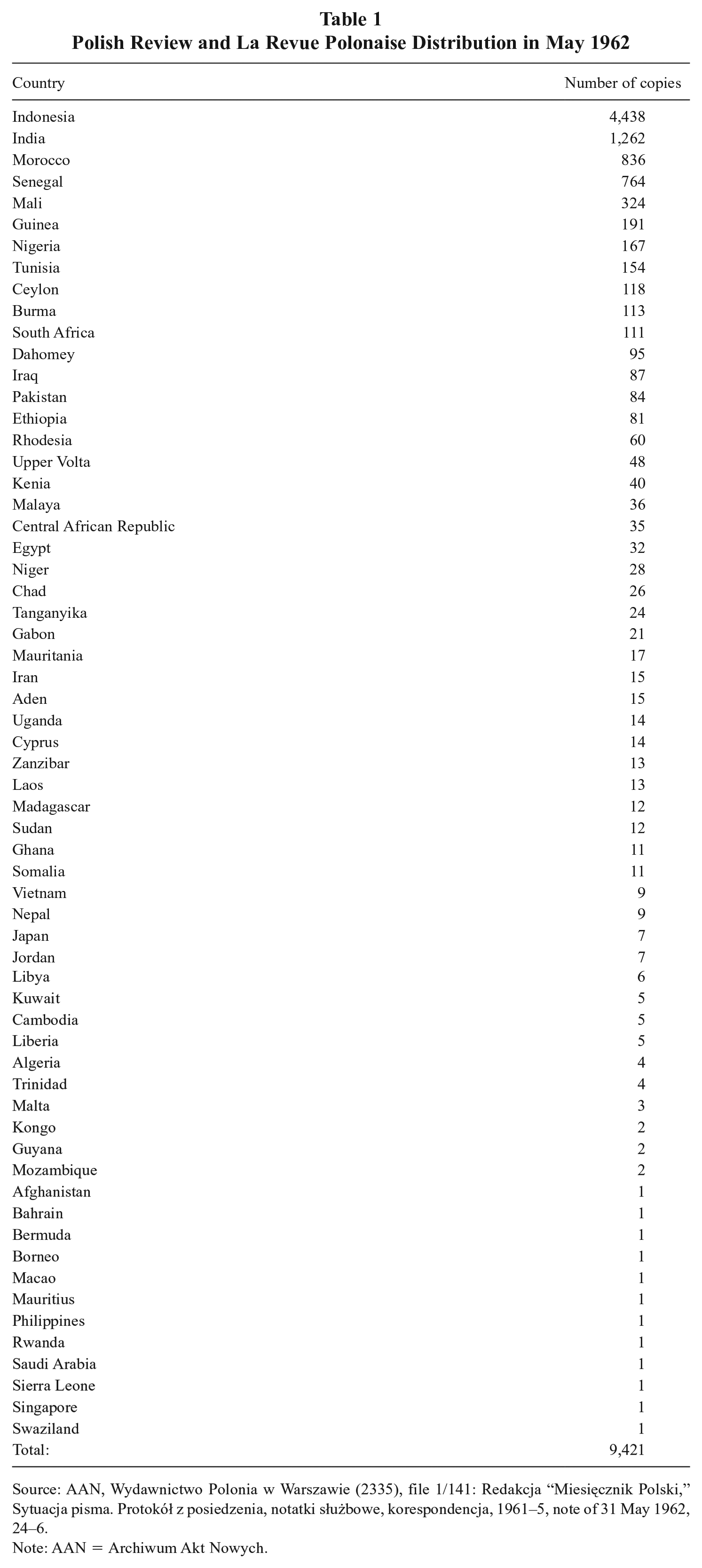
Source: AAN, Wydawnictwo Polonia w Warszawie (2335), file 1/141: Redakcja “Miesięcznik Polski,” Sytuacja pisma. Protokół z posiedzenia, notatki służbowe, korespondencja, 1961–5, note of 31 May 1962, 24–6.
Note: AAN = Archiwum Akt Nowych.
The editors constantly complained that the Ministries of Foreign Affairs and Foreign Trade failed to acknowledge the magazine’s significance, which they argued was crucial and impactful. 34 In 1962, the magazine received an exceptional volume of correspondence relative to its circulation, indicating significant engagement from its audience. The following year saw an increase in letters received, and a response to competition. The magazine’s influence extended beyond its readership, with reprints in various press outlets in Morocco, Tunisia, Mali, Tanganyika, India, and Iraq, and acknowledgment of its significance by other publications: “magazines such as The Northern News in Rhodesia and Journal in Côte d’Ivoire published extensive articles emphasizing the high standard of the magazine and the ‘danger’ our publications pose in those countries.” 35
In terms of its readership, the magazine targeted intellectuals and the bourgeoisie, university circles, and clergy to tap the anti-imperialist sentiment prevalent in these regions. The editorial directives emphasized a communicative but not oversimplified style, concentrating on economic issues, social and cultural affairs, and the massification of culture. This was due to language constraints: since the magazine was printed in English and French, it could not reach broader local audiences.
A (Shifting) Message
The Polish Review/La Revue Polonaise was carefully crafted to appeal to readers in Asia and Africa, reflecting not only ideological imperatives, such as the pursuit of “global socialism,” but also clear economic motives. The intention was to shape perceptions, cultivate new markets, secure industrial projects, and establish contracts in these regions.
The content of the magazine evolved. The editors initially devised two language iterations, English and French, and identical content. As this framework proved untenable, starting with the twelfth issue the editors opted for distinct versions tailored to Africa (in both French and English) and Asia (solely in English). 36 The editorial team expressed a desire for additional language variations (Arabic and Swahili) or, alternatively, supplying the magazine for the Asian market to the Arab region until the former was feasible: “For Arab countries, in our opinion, either a special edition in Arabic should be created or, until this comes together, a magazine intended for Asian countries should rather be directed there.” 37 Resource constraints ultimately precluded the publication of these linguistic adaptations. 38
The magazine was organized into 40 columns, 32 of which were extensively illustrated so as to cater to a broader readership, reserving the remaining eight for more intellectually demanding and literary content designed for the “more serious reader.” 39 Founded to devise a unique form of Polish propaganda tailored for the “third world,” 40 the magazine emphasized the inclusion of substantial information and socio-economic arguments not typically found in publications targeting readers from developed capitalist nations. It also eschewed the use of terminology common in socialist countries to ensure accessibility to its African and Asian readership. Although aligned with other publications produced by the Polonia press in terms of external design, the magazine was distinct in content.
In the first editorial, Izolda Kowalska-Kiryluk wrote, “We are fully convinced that, despite the distance between us and the differences in our climates, we can learn much from one another.” 41 The statement conveys a commitment to fostering dialogue and knowledge exchange, but in fact the magazine primarily served as a platform for Polish perspectives. Its creators saw Poland as an agent of modernity in postcolonial nations, especially in technological and industrial development. In an early edition dedicated to Africa, they highlighted the significant contribution of Polish experts constructing the infrastructure and technological foundations of recently decolonized nations in Africa and Asia. 42 Industrial photography took precedence over other topics, suggesting a focus on reportages that served economic purposes more than Poland’s cultural diplomacy. Alongside industrial themes, the magazine featured presentations by specialists such as scientists and doctors. 43 It presented Poland not only as a friend, mentor, and economic partner, but also as a model of strength and self-assurance, embodied by male miners and steelworkers placed in the industrial landscape. 44 The editors claimed that this message was successful, since their office received not only reader inquiries and recommendations, but also proposals of economic collaboration with Poland, which it forwarded to the Foreign Trade Center and other relevant institutions. 45 The correspondence reveals instances where companies such as Kirloskar Brothers Limited, an Indian pump manufacturing company with a focus on engineering, expressed interest in specific articles on the Polish light cement. Additionally, the editors of publications such as the Who’s who of Zanzibar (which became part of Tanzania) sought assistance from the magazine in contacting Polish businesses. 46
The magazine was created during a period of Sino-Soviet ideological tensions, which centered around China’s rejection of Soviet policies and belligerent stance toward the West. Mao Zedong denounced Soviet policies as revisionist, publicly rejected peaceful coexistence, and expressed resentment of Soviet ties with India. 47 China’s position in Asia forced the Polish editors to think about these events and adopt a diplomatic approach, refraining from direct attacks on Chinese comrades and avoiding public polemics. Instead, they emphasized themes of peace, disarmament, and harmonious coexistence in a format appropriate for their audience, underscoring the magazine’s commitment to promoting constructive dialogue and international cooperation amidst ideological discord. They espoused a strongly anti-imperialist and anti-colonial position, strengthened by Poland’s positive image as a country with no colonial past. 48 “Never in the course of her history has Poland possessed any overseas territories. Never has she conquered foreign lands or ruled over foreign peoples,” wrote the editors. 49
After his trip to West Africa in 1964, Krzysztof Wolicki, a journalist and former Polish correspondent at the United Nations, reflected on the limited economic and political influence of Poland and other Central and Eastern European countries in the region compared to their Western counterparts. He acknowledged that until these nations became significant recipients of West African products, they would not be able to counter the influence of the West with comparable economic leverage. Wolicki underscored the importance of engaging in propaganda and educational activities in the region, noting the active presence of Chinese publishing houses distributing political literature in various countries: “From Morocco to Cameroon, I found Chinese publishing houses in almost every bookshop, with almost no Soviet ones; of the Eastern European ones, the most numerous was Polska/Polish Review—La Revue Polonaise.” He described the extensive reach of Chinese propaganda efforts, which included supplying nationalist and communist groups with literature to shape ideologies and perceptions in West Africa. The strategic competition for influence in the region during the Cold War-era was a fact, and Poland was competing in this field with many countries, especially China, whose proactive approach was very visible in the region. 50
Wolicki highlighted the challenges and opportunities faced by La Revue Polonaise in reaching a wider audience, particularly in Africa, and the lack of understanding of the cultural and contextual nuances of its readership among Polish officials. Although praised by a diverse range of readers, the magazine was rarely purchased due to its limited availability and high cost (in comparison with the most popular entertaining, illustrated weekly, Drum). 51 Distribution was limited because most copies were sent to institutions, not individuals. The reluctance of Ruch agency to engage in large-scale deals in the absence of appropriate guarantees further reflected the unique business environment in Nigeria. For Wolicki, the magazine’s focus on Poland had ensured a continued readership, but there was a need to expand its entertainment and informational content to better cater to African readers. Unlike in Europe, where specialized interests prevailed, African readers were seeking a broad range of information and saw periodicals like La Revue Polonaise as sources of knowledge akin to libraries or encyclopedias. “Interests can be, and are, primitive and curious. However, there is enormous respect for the printed word and the lack of developed specialized interests allows the magazine to have a direct influence to an extent unimaginable in Europe,” he wrote. 52
Editorial documents show that conveying messages was sometimes problematic due to the lack of assistance from Polish foreign embassies in better understanding and engaging with target audiences by obtaining information about various institutions, compiling lists of relevant contacts, and highlighting topics of interest for these institutions. There was also a need for visual materials, such as photographs, to illustrate Poland’s collaborations and activities in different regions, including Polish delegations, industrial projects, and Polish goods and vehicles. For instance, the editorial team could not obtain relevant visual content showing the deputy prime minister who supervised the magazine, Eugeniusz Szyr, in Kenya. 53 This highlights a gap in available resources and shows the poor collaboration between the magazine and diplomatic channels. 54
Moreover, the editorial decision-making needed cultural sensitivity and adaptability. The publication had to balance editorial content, diplomatic considerations, and audience expectations. 55 The quest to engage diverse global audiences while navigating diplomatic intricacies was difficult: “This means not only simplicity and illustrations, but also avoiding the numerous moral and civil taboos in the countries,” wrote Lobman. In a note to his supervisors, Lobman wrote that ambassador Skuratowicz, an Arabist, told the editors that Poland’s diplomatic missions had to retain many copies of Poland (West), which was also sent to the embassies even though dedicated editions were printed for Africa and Asia, or even tear out pages containing material that could strain relations with Middle Eastern countries. 56 Editing and conveying the country’s message was thus hard, because the editors did not know Asia and Africa well. Notwithstanding their relative unfamiliarity, the core editorial team possessed certain advantages over other journalists, having lived in at least one Asian country. Kowalska-Kiryluk suggested sending two or three journalists from the magazine to visit these regions annually. Such firsthand experience and on-the-ground research could help to understand better the cultural nuances, interests, and concerns of the readership. Strategic planning, financial support and the establishment of a foreign exchange fund for business travel were required for such trips, but it is not clear whether these proposals were ever followed up. 57 Another issue raised in internal documents related to constraints on the translation capabilities of Polonia’s foreign-language editorial offices. The increased workload placed considerable strain on those responsible for translating magazines and books. 58
Initially decentralized, the Polish propaganda efforts underwent centralization in 1967 with the creation of the Polish Interpress Agency, mirroring the Soviet model and consolidating control under the Ministry of Foreign Affairs and the Central Committee of the Polish United Workers’ Party. The Interpress Agency became instrumental in disseminating directives to varying target audiences, illustrating the centralization of Poland’s foreign propaganda strategy. The year 1968 was a historical turning point for the magazine. The publisher changed, precipitating the reorganization of the editorial office. The vision of the magazine had to match the Interpress priorities and directions:
1) presenting the position of the Polish People’s Republic towards crucial international problems—exposing the origins, assumptions and argumentation of Polish policy on German issues; 2) presentation—against the background of Poland’s social and economic problems—of the effectiveness of the socialist political model; 3) presenting a contemporary image of Poland—as a country of modernity, dynamic development, and multilateral creative exploration in all areas of social life; 4) counteracting old and new stereotypes in Poland’s reputation that shape a false or distorted image of our country; 5) fighting against anti-Poland propaganda; 6) propaganda support for Polish exports—in economy and culture.
59
The magazine appeared as a smaller insert of the Poland (West) magazine in 1971, on thinner paper, but eventually was discontinued in 1972. The decision to turn the magazine into a supplement was ironic given its previous unsuitability for Asian and African readers. This also contradicts the earlier recognition of the cultural and contextual mismatch between the content of Poland (West) and the country’s interests in Asia and Africa.
The production of The Polish Review/La Revue Polonaise underwent significant ruptures that reflected shifts in editorial strategy, resource constraints, and geopolitical dynamics. Initially conceived to promote Polish interests and ideologies in emerging regions, the magazine found it challenging to balance ideological imperatives with economic objectives while also cultivating new markets and securing industrial projects abroad. The editorial team tailored content to diverse linguistic and cultural contexts, leading to divergent language iterations and thematic adaptations for different regions. Despite efforts to expand its reach, resource limitations prevented the publication of dedicated Arabic or Swahili editions. The editorial team’s limited cultural understanding and collaboration with diplomatic channels hindered an effective engagement with the target demographic, as made it difficult to obtain visual materials. Challenges in distribution and engagement with diplomatic channels further showed gaps in resources and coordination.
The Response
In their reports to the authorities, the editors frequently highlighted the large numbers of letters they received (2,207 in 1962; 2,063 in 1963; and 2,971 in 1964) and the active readership participation in competitions about Polish history and culture. They thus suggested that these metrics indicated the magazine’s popularity and effectiveness. 60 Such metrics might reflect public engagement with the magazine, but do not provide conclusive evidence of the editors’ intentions. On the contrary, they often indicate that readers approached the magazine with pragmatic or consumerist intentions in mind or interpreted the propaganda content in ways that diverged from the official Polish party line of the time.
Readers often requested to have their names printed in the magazine to gain pen pals or to receive stamps to enhance their collection. Thus, the magazine served as a platform for social interaction and hobbyist pursuits: “I am a youth of 20 having my education up to inter-science only. I am much interested in the collection of stamps of various countries and also fond of reading different kind of foreign magazines, playing hockey, collecting photographs. At present, I have entered into my business which is export of hemp.” 61 wrote Shree Ram Agrawali from India. This was a typical note received by the editors. Some readers even asked for material help: “I am a boy of 19 years old. I am a student of senior. My father is a poor man and has a large family to support and cannot afford the expenses of sending me to college. So I leave my studies for a moment and hope to continue it again. It is therefore Sir necessary for me to ask for some financial help from you by supporting me with a number of books and magazines etc. which I think can help me,” wrote Hassan Ben Bella from Indonesia. 62
For readers seeking educational opportunities, the magazine served as a potential gateway to accessing information and resources for studying in Poland. This was a broader strategy within socialist countries, which saw education as a means of influencing future elites in the Global South, and provided scholarships and vocational training to compete with Western (and Chinese efforts) in the region. 63 Numerous articles reported on the presence and experiences of foreigners in Poland, both temporary visitors and permanent residents. In the journal archives, we find a note from a Filipino student: “Formerly, I was study at Economics faculty of the Serwidjaja’s University at Palombang. With the blessing of god, I hope my idea for prepare my own self to Government programmes especially to real what so called: The message of the suffering people, will be resolve. Friends, would you show this letter to any students of the Warszawski University, please? And if you don’t mind, would you tell me how can I study here?” 64
The journal was read by members of the intelligentsia and aspiring journalists. Sometimes readers tried to pitch their own pieces; a journalist from India expressed admiration for the progressive nature of Poland, manifested not in its advanced industry but in its lack of arranged marriages: “By going through your periodical, I came to the conclusion that yours is a forward country, after taking into consideration the way how marriages are arranged in your country. In our country the marriages are held according to the wishes of parents. Neither the bride groom nor the bride can raise over her voice in the match. My question is: wouldn’t you like to change the way of life of your country having many religions? Wouldn’t you like to mold all these religions into one or into no religion for the sake of unity?” 65 Later, he attached his own piece titled “Religion,” with the request to be considered for publication. In it, he called for an overthrow of religions. The editors were not interested in publishing the piece. Some readers also offered information on their professions, probably in an attempt to establish professional contacts and explore potential collaborations: “I am an editor-reporter of a local weekly VARIA,” wrote an Indonesian, Goei Tek Tjiang, who adorned the letter with cartoons. 66
What many readers looked for in the magazine did not necessarily align with the editors’ goals. The feedback from the readership sampled above shows that readers did treat the magazine as a source of knowledge, but the issues they desired to learn about were practical and related to daily life not politics. As Agayrko Poku from Ghana wrote
I have [to] suggest some few additions to the magazine, if it can be helped. This would as I think add pages to the magazine but I hope you would give it a thought. My reasons for suggestion is that some of my friends think that the magazine is too “serious.” That is the articles in are only about Polish-African friendship and Poland. They think there should be more additions of interest to young people, such as that of a stamp column. I do understand them. This would gain some more readers. 1. There should be a page for discussion of kinds diseases commonly found in the tropics and advice of a medical expert — only in this case by reading we may save some lives of people 2. We have read about the performances of athletes and their good world champions but heve not seen a report on it in “The Polish Review”, secondly there should be for giving simple instructions of Polish games or international sport, for example (high jump) how it is done and simple illustration to explain it—and a picture gallery: Polish sports man 3. There should be a page on discussion as Polish arts are getting. That is to discuss one film in Europe. 4. Occasional interview with African studying in Poland would do 5. Lastly, there should be elementary study lessons in Polish or Russian in the issues so that those involved [who] want to study Poland in future may have some sort of start and some discussion on elementary science The readers column in which who would like to write article, drawings, and puzzles may have where to put it as the stamp page.
67
Readers’ interpretations of Polish history, particularly sensitive topics such as the Holocaust, sometimes diverged from the narrative presented in Polish sources at the time. These historical discussions also intersected with broader Polish diplomatic concerns, particularly regarding its postwar relations with Germany. A key foreign policy objective of Poland was to secure international recognition of the Oder-Neisse border in the Global South, where diplomatic alliances were just forming. As Piotr Puchalski argued, Polish officials worked to associate West Germany with the legacy of imperialism, drawing parallels between its postwar economic activities in Africa and its historical aggression toward Poland.
68
Despite the portrayal of the Holocaust as part of Polish suffering without differentiation,
69
readers used alternative sources of information and their own experiences to form their understanding. For instance, a person from India participating in a competition expressed initial curiosity about Poland’s history of conflict with Germany, which led to further exploration of the topic:
One question really troubled me very much to find the answer. That is the battle between Poland and Germany. This question made me realize that there must have been many battles in Polish history. The geographical location of Poland made Poland a victim of war from both East and West. Until now I was knowing that World War II started with invasion of Poland and the reason, I thought was the usual bickering and petty quarrels among neighboring countries. But the fact that Poland became the victim of German aggression many times in history made me go deeper into this subject. I bought William Shirer’s book The Rise and Fall of the Third Reich and was horrified to learn the details. This was the first time that I became aware of the German race policy and the concentration camps. I then began reading eye-witness accounts of life in these concentration camps. Horrible to think that humanity could sink so low. I read books about the Nuremberg trials and watched the American film “The Nuremberg Trials.” I also read Leon Uris’s book Mila 18. I am astonished to know that many Nazis are still in good positions in Germany to-day. I wonder if human forgiveness can reach such level as to allow these criminals to go free. I can now fully appreciate the foreign policy of Poland and its wish for peace and freedom for all peoples of the Earth. All this knowledge became possible for me with the single question in your competition for which I am very grateful to you. I personaly feel that the battle of Grunwald was the biggest and most memorable since it was here that all of Poland showed their courage and wish for national independence and fought for it. The Warsaw Ghetto Uprising is memorable too and will go down in history as an example for freedom from tyranny.
70
Note that neither Shirer’s nor Uris’ books were available in Poland before 1989. Similarly, Hilda Bernstein, a British-born Jewish author and activist against apartheid and for women’s rights in South Africa, shared a reflective account of her brief visit to Warsaw:
I visited Warsaw once, briefly, more than sixteen years ago. That is all I knew of Poland. Yet that visit provided one of these moments of illumination that remain for a lifetime. I had been to Prague to a conference, and now with a few days to spare before catching a plane from London back to South Africa, I went to Warsaw at the request of two Polish friends in Johannesburg who had asked me to trace any surviving relatives of theirs. I did meet an American woman who told me that of a Polish family of 63, she found just one alive, a young girl who had gone away with a Russian guerilla. Far away, at the southern end of the great African continent we had read of the destruction, the death camps, the fate of millions of peoples. We had wept over it, too, but the scale of it was beyond comprehensions and the reality beyond conception. . . . I asked to see the ghetto. “There is nothing to see,” my guide told me, but I persisted. So we drove out on icy afternoon to what seemed to be an open field, only sparsely sprinkled with the snow of that late, hard winter, only lightly scattered here and there with lumps and mounds of stones and bricks. Beneath there, they told me, half a million people still lay buried. I had expected to be moved, distressed. But this was something else, a draining of all emotion, leaving one empty and blank, like this field that had once been the sparkling commercial of the city.
71
Titled “What I Know about Poland,” Bernstein’s composition was awarded a prize by the editors, despite not necessarily aligning with the official Polish narrative. It is possible that the editors’ Jewish backgrounds may have played a role in the decision to recognize her piece. While Poland acknowledged Nazi crimes and positioned itself as a victim of German aggression, the Holocaust was often framed within a broader discourse of Polish suffering, with little room for distinct Jewish remembrance. After the war, Jewish memory was shaped by competing pressures—on one hand, survivors sought to rebuild their lives in a Polish state that recognized their victimhood, but on the other, state narratives minimized Jewish distinctiveness by subsuming the Holocaust under a more general national trauma. 72 Bernstein’s emphasis on the absence of Jewish life, her encounter with a survivor who escaped by joining Soviet partisans, and her description of the Warsaw Ghetto as an erasure rather than a memorialized space, all subtly challenged this official framing. In postwar Poland, Jewish sites were often left integrated into narratives of broader wartime destruction, a reality that Bernstein’s reaction—the “draining of all emotion”—captured vividly. Her account drew attention to the void left by the Jewish absence more than to recounting a shared history of suffering.
Despite the magazine’s propagandistic objectives, the varied responses from readers highlight its role as a starting point for exploration of diverse perspectives. This nuanced understanding sheds light on the interplay between propaganda, readership engagement, and the construction of historical narratives in the context of Cold War-era cultural diplomacy.
Conclusion
The evolution and reception of The Polish Review/La Revue Polonaise provide a fascinating glimpse into the complexities of cultural diplomacy, propaganda dissemination, and readership engagement during the Cold War. Through its shifting editorial strategies, linguistic adaptations, and thematic content, the magazine sought to promote Polish interests and ideologies in emerging regions, while navigating geopolitical tensions and resource constraints. Its editorial team struggled to align its content with the ideological imperatives of the Polish state while also catering to the practical and diverse interests of its readership base in Asia and Africa. A key question raised in this study was to what extent the magazine’s narratives reflected those circulated in Poland. The core ideological framework—emphasizing Poland’s anti-imperialistic stance, economic development, and cultural achievements—aligned with the state discourse, but The Polish Review/La Revue Polonaise adapted its messaging to appeal to its diverse foreign readership. It tried to avoid overtly ideological language, presenting Poland as a modern, technologically advanced, neutral partner for postcolonial states. Its focus on industrial cooperation and cultural exchange demonstrated a pragmatic approach to propaganda. Still, the tension between its messages and reader expectations manifested in various ways, including divergent interpretations of Polish history, pragmatic requests for material assistance, and suggestions for more accessible and diverse content. The editors had to appeal to diverse linguistic and cultural contexts, often without understanding and effectively engaging with its target audiences. Despite efforts to expand its reach and engage with readers in Africa and Asia, logistic hurdles such as distribution challenges and frictions with diplomatic channels hindered the magazine’s impact. Resource constraints, including limitations on translation capabilities, exacerbated these difficulties, hindering the magazine’s ability to convey its intended narratives. Ultimately, the production and reception of The Polish Review/La Revue Polonaise reflected a complex interplay between editorial strategies, reader engagement, and geopolitical dynamics.
