







Abstract
This article examines globalization in Hungary and Austria, two equal-sized, landlocked Central European countries without an overseas colonial past, and their relationship with the Global South from the 1960s until the 1990s. Recent literature assumes that belonging to the Eastern Bloc gave the socialist countries an advantage in terms of their presence in the Global South. However, a comparison of their relations with the Global South shows that Austria, a non-communist country, had a wider diplomatic room and broader, better structured, and more durable economic, cultural, and political relations with the Global South than the socialist Hungary. Therefore, the article shows that the present day tendency of Central and Eastern European countries—Hungary in particular—to diverge from Western institutions cannot be considered as continuation of their communist-era weak global positioning, which also opposed the West.
For a long time, the smaller countries of Central and Eastern Europe were not considered noteworthy global players. In the late twentieth century, the Western countries on both sides of the Atlantic, the Soviet Union, the rising Far East, and even the oil-producing countries were seen as centers shaping globalization. The smaller countries of Central and Eastern Europe appeared for most of the period to be dependent on the Soviet Union from a global perspective. Recent research significantly changed this picture by showing that the European socialist countries were much more open to the world during the Cold War, and the Iron Curtain was much more permeable than previously assumed—not only in economic and cultural terms but also in terms of contacts with networks of expertise. 1 The most important insight that led to the new results was that the place these countries occupied in global processes was not assigned to them solely by external forces. These countries’ elites developed projects that fitted well into global processes. Through their foreign policy relations, the international activities of their companies, and the creation of knowledge and cultural transfer channels, they were present in globalizing processes as relatively autonomous agents which shaped their own place in the world. 2 They not only built links with the West across the Iron Curtain but also developed partnerships with the Global South by building an independent position vis-à-vis the West, and widening the room for maneuver vis-à-vis the Soviet Union. 3
Today, the place of Central and Eastern Europe in global relations is once again questioned. The way in which they understand their own place and position themselves in Europe and globally is an essential problem even without Moscow’s imperialist ambitions, which led to the war in Ukraine in February 2022. In the wake of 1989–1990, it seemed that after their forced integration into the Eastern Bloc under the power of Moscow the countries of the region would integrate economically, politically, and culturally into Western Europe. 4 Although integration into the European Union remains essential from an economic and political point of view, today the region also seeks to pursue independence in terms of cultural and political value choices, even economically, and position itself in the global space with relations outside the framework defined by Western Europe. While in some countries this remains one option among many, in others it is a coherent political stance, and in Hungary it enjoys the support of a significant majority. To some observers, the quest of some countries to position themselves globally and define themselves in opposition to Western Europe or the Euro-Atlantic center continues—or renews—the ties that linked between the East-Central and Eastern Europe and the Third World before 1989–1990. 5 At that time, these countries were collectively referred to as the Third World, to distinguish them from the Western and Eastern blocs, which were ranked first and second. This inherently hierarchical designation was replaced by the term Global South, which defines the formerly colonized territories in contrast to the North. In this article, I use the term Third World in accordance with the terminology of the time when referring to the relationship between the Eastern Bloc countries and these countries, and refer to the Global South in other contexts.
During the Cold War, the countries of the region sought to position themselves against the “West” and to build global networks independent from it. Historians recently rediscovered the attempts of the Soviet Union and its subordinated allies to build a multitude of political, cultural, and economic connections in the Third World, which were then reassessed in the last decade as an attempt to create an alternative space for globalization centered on Moscow and the Eastern Bloc. 6 While the region’s opening up to Africa, Asia, and Latin America was motivated by Moscow’s desire to gain influence over the South against the West, purely economic considerations also influenced Soviet Third World policy. In seeking to build their own economic and cultural connections with newly independent countries, the Soviet Union’s satellite states, like Hungary, followed their own agenda that diverged from Eastern Bloc’s policy. 7 Their aim was to relieve themselves from their double dependence on the Soviet Union and, in terms of technology and capital, on the West, with the further objective of carving out some room for maneuver and gaining hard currency, much needed due to their unbalanced economic relationships with the West. 8
What created the opportunity for outreach from the Eastern Bloc to the Third World and what the actual weight of these connections was remained unclear. From the idea of alternative globalization around the Eastern Bloc arises a questioning of the relevance of the system changes in 1989. If the links between the Eastern Bloc and the Global South were robust enough to sustain an alternative form of globalization divergent from that of the West, then, when these links were disrupted around 1989, globalization took a step backward: This loss not only represented the confirmation of Eastern Europe’s journey towards a western-led globalization and European politics, but also as a process of de-internationalisation from a world which had opened up through the decolonialisation of Western European empires. Its elites no longer asserted the importance of their region as a leading representative of an alternative modernity, but rather accepted a new status as integrated adjunct on the periphery of a Euro-Atlantic World.
9
This approach assumed that the opportunity to foster relationships between Central and Eastern European countries and the Global South arose as a result of the very existence of the Eastern Bloc. Without this framework, Hungary would have been either incapable of establishing connections in the Global South or severely limited in its capacity to do so. This description of the pre-1989 international relations suggests that the way to success in Hungary’s global positioning today is to turn away from Western Europe and to strengthen relations with the East and the South.
Other researchers doubt that the Soviet Union—or the Eastern Bloc—was striving to become an alternative center of globalization and assist the development of newly independent countries while promoting its own model at the same time. 10 The Soviet Union and the Eastern Bloc were economically too integrated into the world economy and faced too unfavorable conditions to become the center of an alternative globalization space. 11 It is also questionable whether the elites of the Eastern Bloc genuinely championed the pursuit of an alternative modernity. 12 When working on projects for the future, Eastern Bloc planners were really looking at the past of industrial capitalism. The socialist system’s capacity for innovation was insufficient to construct an alternative modernity. 13 In response to criticisms from economic historians, some authors acknowledged the Eastern Bloc’s economic inadequacy to constitute an alternative global space but stressed the importance of pretense, the perception of the Eastern Bloc’s relations to the Southern countries. The global networking of the Eastern Bloc viewed as an opportunity or as a threat determined the behavior of the elites in the East, in the South, and in the West alike, regardless of how realistic their specific perception was. 14 Other researchers have stressed the importance of solidarity between the Central or Eastern European socialist countries and the decolonizing countries in culture and identity formation. 15
This article compares the globalization processes of socialist Hungary and non-socialist Austria with the Third World. Such a comparison is unconventional because even today, research tends to see the former Iron Curtain as a regional border. Some analyses of Central and Eastern Europe are confined to the former socialist countries and disregard the other countries located in the region. The geographical delimitation of the areas studied by academic institutions still often follows the line of the Iron Curtain. 16 In this respect, the “Cold War is over but Cold War thinking survives.” 17 Before the Iron Curtain, the histories of Austria, Hungary, and the Czech Republic were closely intertwined within the Habsburg Empire. Between the two World Wars, the three countries still shared some common features: they are all land-locked, Hungary and Austria had authoritarian political establishments, and Austria and the Czech Republic had similar industrialization levels. After World War II, Austria did not join the Eastern Bloc, despite the Soviet military presence on its territory until 1955, while Hungary and the Czech Republic found themselves east of the Iron Curtain. The fact that Prague is geographically further west than Vienna challenges the notion that the Czech Republic is an “Eastern” country while Austria is not. Their geographical locations correspond to the features of their societies on an east–west scale in terms of industrialization and urbanization. Yet, the entrenchment of Cold War thinking means that the Czech Republic and Hungary are still placed in the East, with Bulgaria, Lithuania, or Georgia, rather than together with Austria. 18
The comparative method allows me to evaluate the processes of globalization within the Eastern Bloc, and its relations with the Third World. The comparison can shed light on the specificities of a development path. 19 The connections of Eastern Bloc countries with the Global South can be evaluated by comparing them to nations outside the Eastern Bloc. Neither the weight of economic relations nor the importance of cultural and political orientations can be assessed without such comparison. A comparative study of the extent, nature and outcomes of these connections can tell us more about the potential of alternative globalization than source texts on the intentions of policy makers in socialist capitals. Austria, Hungary, and the Czech Republic are well placed for such a comparison because of their similar sizes, landlocked nature, the absence of overseas colonial past in all three cases, and neighboring location. Due to the dissolution of Czechoslovakia in 1993, it is not possible to document all of its relations with the Global South for long-term comparison. For this reason and space constraints, I compare Austria and Hungary to elucidate the implications of Hungary’s affiliation with the socialist bloc. 20
My central question is: Did Hungary’s membership in the Soviet Bloc afford it greater opportunities to participate in globalization or to establish international relationships with overseas countries, compared to the opportunities available to Austria, positioned as “the easternmost Western state” during the Cold War? The question is not only about the extent of these relations but also whether Hungary’s relations with the Third World were of a different nature than those of Austria’s. I briefly discuss the nature of these relations, since research to date stresses that the relations between the socialist East and the Third World created a global system of connections alternative to Western-centered globalization. First, by relying on indices of economic, political, and interpersonal globalization I examine the extent to which the two countries were globalized. I then comparatively overview the international relations of Austria and Hungary, and their relations with the Global South. The analysis focuses on the extent of globalization and the links with the Global South, not the ideology or the intentions of policy makers, but the extent and characteristics of the emerging relations.
The Globalization of Austria and Hungary from 1970 until the Collapse of the Eastern Bloc
Measuring and comparing the globalization of countries is central to globalization research. Increasingly sophisticated and complex indices can measure and compare levels of globalization. The frequently used KOF Swiss Economic Institute index captures the political, economic, and cultural dimensions of globalization. 21 Here, I compare the level of globalization of Austria and Hungary during 1970–1995.
The most common measure of the openness of a country’s economy, and thus of the economic dimension of globalization, is the ratio of foreign trade volume (the volume of the export and import of goods and services) to gross domestic product. This index shows that the economies of the small countries of Austria and Hungary were highly open with a high share of foreign trade, regardless of whether they were capitalist or socialist (Graph 1). This openness is key for small economies with very limited raw materials and energy resources. 22 However, the direction and nature of foreign trade relations differed between the two countries. In 1960, the European partners of the COMECON accounted for 70 percent of Hungary’s foreign trade, and still reached 50 percent in the late 1980s after continuous decline. Thus, the Hungarian economy was initially less open to the global market, and more limited to the surrounding Eastern Bloc. 23
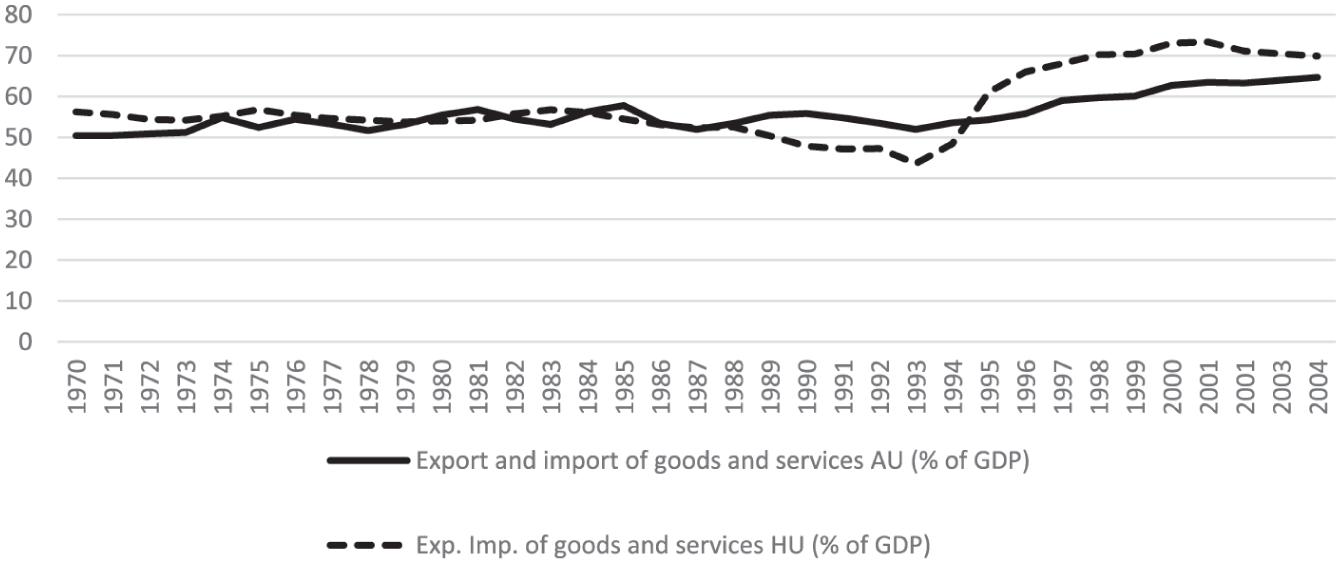
Economic globalization of Austria and Hungary (1970–2004). Export and import of goods and services (% of GDP).
But economic openness did not mean that the level of globalization of the two countries was the same in other respects. Individuals had different opportunities to establish international connections. Socialist passport regulations restricted travel for Hungarian citizens, whereas Austrians did not face such restrictions. 24 An index of telephone subscriptions (calculated as percentage of the total population), the percentage of countries whose nationals had to present a visa when visiting, and the number of airports that offered at least one international flight connection, shows that Hungary was much less globalized than Austria (Graph 2). The data concern opportunities for individual, personal contact and interaction. Hungary inched closer to Austria only in the late 1980s. Other analyses based on telephone call traffic data confirm that Austria was much more directly connected to global communication networks in the 1980s—and even more so in the preceding decades—than socialist countries. 25 Clearly, the socialist regime closed Hungary at a time when Austria was an inter-bloc, neutral state that maintained stronger ties with the West.
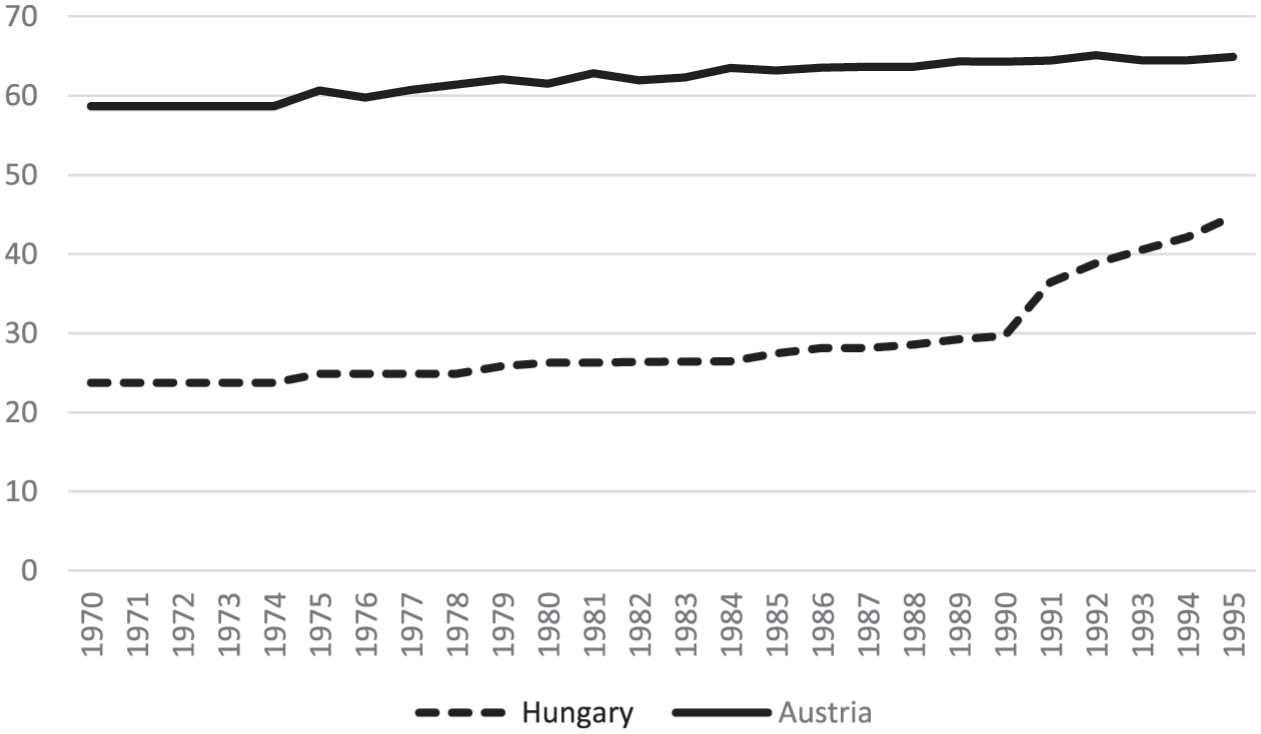
Interpersonal globalization in Hungary and Austria (1970–1995).
Interpersonal Globalization index based on telephone subscription (% of population), percentage of countries for which a country requires a visa from foreign visitors, number of airports that offers at least one international flight connection. Source: Index of KOF Swiss Economic Institute, https://kof.ethz.ch/en/forecasts-and-indicators/indicators/kof-globalization-index.html, accessed 25 February 2024.
In addition to the openness of the economy and the opportunities for cross-border interpersonal contact, another important aspect is the international embeddedness of states. The KOF index measures embeddedness by quantifying the countries’ membership in transnational organizations and international conventions. Hungary lagged behind Austria in terms of its membership in international organizations and the number of international treaties it ratified (Graph 3). A rapprochement between the two countries was observed by the 1980s, when the policy of opening up to the Global South was already on the decline in the Eastern Bloc.
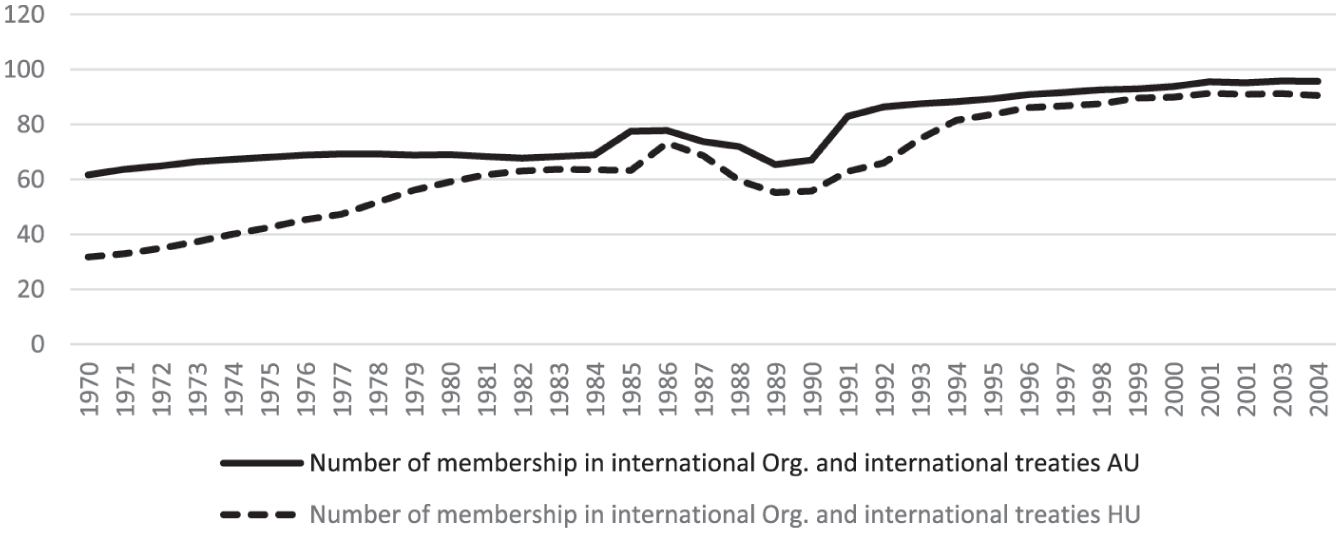
Political globalization of Austria and Hungary – international organizations (1970–2004).
The international embeddedness of countries can also be assessed in more practical terms of embassies and numbers of people with international activity. Hungary was much less globalized than Austria in the number of diplomatic relations with other sovereign states, the number of staff working in the United Nations and related international organizations, and the number of non-governmental organizations (NGOs) active in the country (Graph 4). Again, Hungary only came closer to Austria after 1989.
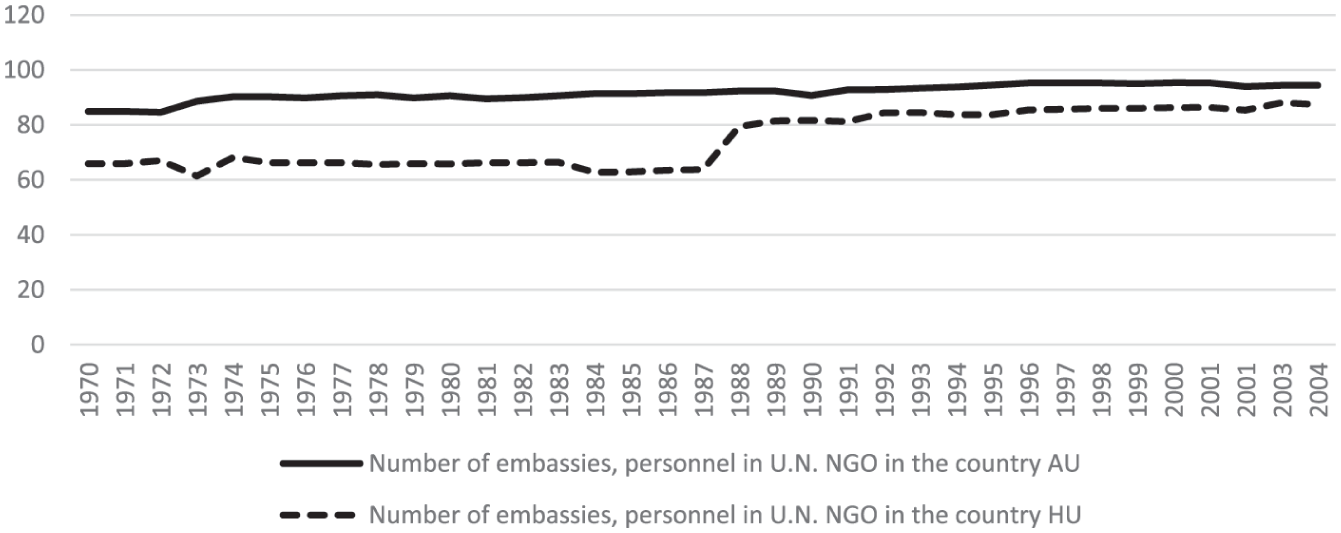
Political globalization of Austria and Hungary – embassies (1970–2004).
Hungary and Austria were equally globalized in terms of the openness of their economies, a consequence of their structural characteristics. But in aspects of globalization determined by their respective political systems, Austria, a country outside the Eastern Bloc, had an enormous advantage over Hungary, and probably also over Eastern Europe. This finding echoes Tomka, who also found that the socialist Central and Eastern Europe was relatively less globalized. 26 However, the nature and functioning of the two countries’ international relations—and their integration into larger global networks—were not a direct consequence of these structural features. Below I outline of Austrian and Hungarian international relations during the Cold War, looking for traces of how belonging to the socialist bloc gave Hungary the opportunity to build relations with the Third World, compared to the development of similar relations of Austria.
The Transnational Embeddedness of Austria and Hungary during the Cold War
After the restoration of its sovereignty in 1955, Austria’s foreign policy sought to take advantage of its internationally guaranteed neutrality. Its international relations during the Cold War took distance from the Western institutional system and, frequently, the geopolitical strategies determined by the United States. 27 In 1960, Soviet leader Nikhita Khrushchev made a week-long visit to Austria, and in a series of statements, including a TV speech, he sharply criticized the United States, standing alongside Austrian government politicians who did not express disagreement. The constant attention Austria paid to Soviet demands made it impossible for the country to become a member of the European Economic Community, only an external treaty linked Austria to the EEC at the early 1970s. 28 However, Austrian governments of all ideological persuasions considered it necessary to integrate the country into the Western European economic area in order to avoid economic isolation while maintaining neutrality. 29 The combination of full membership into the European Union and neutrality became possible only at the end of the Cold War.
During the Cold War, some Austrian foreign policies resulted in frictions with Washington. For example, Austria recognized the Palestine Liberation Organization (1980), did not align with the U.S. sanctions against Iran, and did not boycott the 1980 Moscow Olympics. 30 An anti-American political group protested against the U.S. involvement in the Vietnam War in 1972. The group was led by Peter Kreisky, the son of the Chancellor, at the time of Nixon’s visit to Austria on his way to the Soviet Union. 31 Austria’s relations with Israel, a privileged ally of the United States in the Middle East, were mostly tense, often conflict-ridden, for example over the 1973 attacks on Jews on Austrian soil. At the same time, relations with the non-aligned countries were particularly good, and Austrian diplomacy was generally active in the Middle East.
Austria was also regularly involved in peacekeeping operations in the Global South since the 1960 Congo mission. The Social Democrat Bruno Kreisky, first as Foreign Minister (1959–1966) and then as Chancellor (1970–1983), attached particular importance to these missions. In some cases, Austria contributed whole battalions to UN-approved peace-keeping operations (in Cyprus from 1972 onward, Sinai Peninsula 1973, and the Golan Heights from 1974 onward). 32 By 1998, more than 40,000 Austrian soldiers and gendarmes had taken part in peacekeeping missions, which combined its pacifism and foreign policy interests. Such involvement was hoped to raise Austria’s international standing and increase its diplomatic room for maneuver. This was particularly necessary until 1970, when a treaty with Italy settled the issue of South Tyrol, a region with a German-speaking population that had been part of Austria until 1918. Until 1992, Austria kept the South Tyrol issue open at the United Nations, where it needed the potential support of the Global South. 33 The protection of the German-speaking minority was strengthened by the expansion of Austria’s international scope of action and authority. Its international prestige was reflected in the election of Foreign Minister Kurt Waldheim as UN Secretary General, which the government fully supported although Waldheim and Chancellor Kreisky belonged to different parties (Waldheim’s World War II past had not yet been raised). 34 The result of what Kreisky called the policy of active neutrality was that Austria, a small country, played a significant role in the Helsinki process, and Middle East politics. Kreisky, along with Olof Palme of Sweden and Willy Brandt of the German Federal Republic, was an advocate of North–South dialogue. In addition to formal interstate relations, Austria’s international contacts featured links between parties and international party alliances. From the point of view of relations with the Third World, this was particularly important in the case of the Socialist Party, whose counterparts constantly kept Third World development issues on the agenda and tried to shape international policy in this respect. 35
Hungary was admitted to the UN in December 1955, together with other smaller socialist countries, through agreements negotiated by the great powers in relation to the Austrian State Treaty and Austria’s neutrality. Afterward, Hungary’s foreign policy priority was to settle its relations with the West, as it had no diplomatic relations—or its relations were not maintained at the ambassadorial level—with several countries, including the German Federal Republic. At the time, Soviet foreign policy supported the activity of small socialist countries as quasi-independent actors toward the West, because it was hoped that this would increase the diplomatic room for maneuvering of the entire bloc. However, Hungary’s international room for maneuver was limited by the fact that the question of the oppression of 1956 revolution remained on the UN agenda from the revolution of 1956 until December 1962. This was a consequence of U.S. policy, because Washington wanted to demonstrate to the growing number of newly independent UN members that the Soviet Union was an aggressive power, threatening the independence and interfering in the internal affairs of other countries. The credentials of the Hungarian delegation to the UN were not accepted, but diplomatic relations between the Kádár government and the United States were maintained. The Hungarian question was finally taken off the UN agenda at the end of 1962; in return, the Kádár government—acting on the basis of a secret agreement with the U.S. government—issued a wide-ranging amnesty in spring 1963 of those still in prison for their participation in the revolution. 36 This deal enabled Hungary to develop a more active international presence. For example, in late 1965, encouraged by the Soviets, Hungary tried to mediate in the Vietnam conflict to a surprisingly warm reception in the West, although the Chinese-influenced Vietnamese leadership was reluctant to take steps toward a diplomatic settlement. Hungary maintained its foreign policy interest in the war, and represented the Eastern Bloc, alongside Poland, in monitoring the final ceasefire in 1973. The activities of the International Commission of Control and Supervision in Vietnam were accompanied by incidents, scandals, and controversies. It was ultimately unable to fulfill its mandate and there is a strong suspicion that the Hungarian mission also helped the North to bring about the collapse of South Vietnam. 37 This was the only time when socialist Hungary participated in a peacekeeping mission under the auspices of the UN or under some other international agreement.
Hungarian foreign policy was closely tailored to Soviet needs, with the intention that in return the Soviet Union would tolerate Hungary’s relative economic opening to the West unfolding since the early 1960s, and first its moderate inclination to economic reforms, deviating from a strict command economy. In the Middle East, Hungarian foreign policy aligned with Soviet policy, but Hungary had no substantial initiatives or the same presence as in Vietnam. In the Middle East, Hungarian diplomacy was much less active than the Austrian diplomacy. 38 Within the Eastern Bloc, Hungarian foreign policy could not advocate for Hungarian minorities living outside Hungary’s borders in the same way as Austria could in South Tyrol, although this perhaps could have been expected on occasion, as in the case of the abolition of the Hungarian Autonomous Territory in Romania in 1968. 39 Eventually, the hopes for establishing economic relations with the West proved illusory. Neither did the Hungarian economy gain market opportunities in the European Economic Community, nor did technology imports from the West contribute to its development. 40 By the late 1970s, these efforts indebted the country. 41 In addition, in East–West economic relations following the establishment of the European Economic Community, the Western side gradually adopted a more closed stance, prioritizing the protection of its own markets. This trend posed escalating challenges for the economies of Eastern Bloc states. 42
In sum, Hungary’s international maneuvers were much narrower than those of Austria. Hungary was often unable to express its own interests openly or at all. Its international diplomatic and economic relations were in line with the expectations of the Soviet Union, while Austria, a neutral state in Central Europe, moved much more freely, and its international role was incomparably more manifold than that of its eastern neighbor, even though its size was comparable to that of Hungary. The question arises whether, regardless of the much narrower scope of Hungarian foreign policy, socialist Hungary could have had closer and broader links with the Third World than Austria, which belonged to the West economically. These ties may have been of a different nature than those of Austria’s. They may have been intended for the implementation of alternative globalization projects centered on the Eastern Bloc, or they may have been integrated into such a pattern without any explicit ambition. Below briefly outline the nature of the relations Austria and Hungary maintained outside Europe.
Austria and Hungary’s Relations with the Third World
Both countries started building relations with the countries freed from colonial rule at the end of the 1950s, and established regular, institutionalized relations in the Third World in the mid-1960s. In Hungary, the Kádár regime used these relations to improve its international prestige, which suffered because of the suppression of the 1956 uprising. Austria followed its economic interests but also considered gaining supporters in the UN General Assembly in the matter of its conflict with Italy regarding South Tyrol. Austrian foreign policy lobbied for the development of a new Marshall Aid concept for the Third World, a personal idea of Foreign Minister Kreisky. This was not achieved, but keeping the subject on the agenda was a way of raising interest in Austria among the elites of the newly liberated countries. The Austrian representatives were present at several political ceremonies that marked the founding of African states and their declaration of independence. Austrian public supported solidarity with the Third World countries, as the country had no colonial past and was itself, according to a wide used historical narrative, at the disposition of oppressive powers between 1938 and 1955. Without being completely true, that claim was an important element of Austria’s political identity. The discourse of solidarity with the countries emerging from colonial rule was not devoid of shades of European supremacism but Austrian governments, especially under Kreisky, were able to build on it to pursue a policy of opening up to the Third World. 43
Hungary’s interest in the Third World manifested in the establishment of a Center for Afro-Asian Research in Budapest in 1963, preceded by a visit to Hungary of President Nkrumah of Ghana during his trip to Central and Eastern Europe. Nkrumah invited József Bognár, a Hungarian politician and economist, to help develop central planning in Ghana. Bognár and his team worked for months in the African country. Upon returning home, they set up the Center within the Hungarian Academy of Sciences to make use of the accumulated expertise. In the early 1970s, the Center was transformed into the World Economic Research Institute, which became a participant in international networks of expertise on the Third World. 44 Hungary’s growing interest in Africa was marked by the fact that in 1962 a government delegation made an extended tour in West Africa. 45 The publications devoted to these contacts fail to indicate that during his European tour, Nkrumah did not only participate in the 1961 conference of non-aligned countries in Belgrade and visit the socialist countries, but he also made a stop in Austria. 46 The Austrian Foreign Ministry also set up a research institute to study development in the Third World, a topic of interest for it too. 47 The analyses produced by the two centers were based on very similar theoretical foundations. Following Gunnar Myrdal, Bognár treated the development of Third World countries not only as an economic issue but also as a fabric of intertwined social and political problems. 48
In Austria, aid to the Global South started as early as the late 1950s and involved the government, NGOs and the church. 49 The motivation was humanitarian but also to contain communist movements. These efforts were less about development than about reducing poverty and, in some places, fighting famine. In the 1960s, Austria disbursed regular development aid to the Third World both through multilateral organizations and on a bilateral basis. After the 1960s, humanitarian considerations and foreign policy and economic interests became intertwined in the motivation for aid. In general, Austria endeavored to align the bilateral development aid it provided with its own economic interests. 50 Technical assistance was first provided in 1963 under the coordination of a special government committee. Funded by the state, the program was carried out by private companies. 51 In 1964, Austria became a member of the Organization for Economic and Co-operation Development [OECD], and since then has been participating in development policy through the Development Assistance Committee of the OECD. Austria’s participation remained modest in terms of expenditure compared with other OECD members and as a proportion of its own GDP even after it had significantly increased its spending in the early 1970s. It was a deliberate policy of Chancellor Kreisky to involve Austria in shaping policy toward developing countries not so much through financial contributions as through the political and policy-making discourse on the Third World. 52
Hungary also disbursed concessional loans in the 1960s and early 1970s, only on bilateral basis. In exchange, economic benefits were expected except from Cuba and North Vietnam, which were subject to distinct treatment on political grounds. The acquisition of hard currency was the primary objective for establishing relations with the Third World. Hungarian exports were more competitive there than in the West, and foreign currency was urgently needed for funding economic links with the West. 53 Hungarian links with the Global South were bilateral, with the exception of some expert advisory work performed under the auspices of the UN in a multilateral framework. In addition to Hungarian experts working overseas, the country accepted foreign students in high schools and university programs. While learning skills, these students occasionally encountered racist or dismissive attitudes from Hungarian society. 54
The evolution of the relations with Third World countries was similar in the two countries for a while. Relations began around 1960 and were the most intensive and broadest in the 1970s, when the world market prices for energy and raw materials were higher, and therefore Third World countries generated a solvent demand for manufacturing goods and services originating from Austria and Hungary, which primarily meant technological planning. Austria, like Hungary and other socialist countries, sought to contribute to the development of Third World countries through technical assistance, knowledge, and technology transfer. 55 In 1975, a peak of 16.5 percent of Austrian exports were directed to the Third World, but the percentage began to decline as lower prices of energy and raw materials diminished the solvent demand for Austrian exports in the developing countries. In 1985, only 12 percent of all Austrian exports went to the Third World; in the early 1990s only 8 percent. 56 The Hungarian data were very similar, only on a lower level. The Third World always accounted for a smaller proportion of Hungary’s total foreign trade than in Austria. During the peak period, in the middle of the 1970s, 12 percent of all Hungarian exports were directed to these countries; by 1985, this figure decreased to 10.5 percent. After 1989, Hungarian exports to the Third World collapsed; in 1994, they accounted for only 3.9 percent of its exports. 57
Third World policy making was institutionalized in Austria in the 1970s. In 1970, a Government Commission on Development Aid was set up, consisting of representatives of several ministries. In 1971, a new advisory board brought together delegates from organizations dealing with the Third World. On its recommendation, a separate Development Aid Act was passed in 1974, which codified the principles of Austrian development aid policy and established the bodies responsible for its implementation. In 1985, a dedicated department was set up within the Ministry of Foreign Affairs. This consolidation brought together responsibilities previously dispersed among various ministries. The department managed aids disbursed in the multilateral framework and provided technical and bilateral financial assistance. 58 In Hungary, relations with the Global South were never institutionalized in government structures or codified in law. The Hungarian company Tesco (Technical Scientific Cooperation) was responsible to obtain hard currency through the export of technology and technical and health services to the Third World. 59 The lack of institutionalization indicates that the Hungarian political leadership was primarily driven by direct economic interests and was not interested in building other links with the Third World.
This comparison of Austria and Hungary’s relations with the Third World indicates that Hungary, as a member of the Eastern Bloc, was no more open to Third World countries than Austria, a similarly landlocked country of comparable size outside the Eastern Bloc. On the contrary, developing economic relations with, or humanitarian aid to, the Third World were proportionally more important for Austria than for Hungary. Moreover, Austria’s development aid, as well as its political and cultural relations with Third World countries, were comparable to, or even stronger than, those of Hungary.
Note that the share of the Third World in Austrian exports declined in the 1990s, a continuation of the downward trend seen in the 1980s explained by structural changes in the world economy, but there was no sudden disruption like in Hungary. Given their institutionalization, Austria’s economic, cultural, and political ties with the Third World continued despite changing economic circumstances. In contrast, the collapse of state socialism in Hungary made it impossible to resume relations with the Global South. Moreover, Austria had provided development aid to the Third World since the late 1950s, and did not discontinue this practice in the 1990s. The amount of the aid fluctuated strongly, with higher values at around 0.3–0.33 percent of the Austrian GDP per year even in 1990. 60 Hungary had much less opportunity to disburse development aid. It was only in 2017 that its government launched a global aid program similar to that of Western countries. Called Hungary Helps, it focuses on supporting persecuted Christians, an idea alien to the ideology of the socialist era. 61 Most recently, this program was complemented by a seemingly adventurous and totally unprecedented military mission to Chad, the aspects of which the Hungarian government is vague about.
Conclusion
A comparison of Austria and Hungary’s relations with Third World countries does not support the assumption that the relations formed—either as a result of Moscow’s intentions or independently of them—between the Eastern Bloc and the Global South suggest the existence of any alternative form of globalization. Nor does it confirm that the influence or appeal of the Eastern Bloc facilitated the establishment of relations with the Third World for Central European socialist countries. Austria’s relations with the Third World surpassed those of Hungary, a member of the Eastern Bloc, in volume and scope. From the outset, socialist Hungary’s interest in Third World countries was driven by economic considerations, and when falling raw material prices in the world economy diminished the solvent demand for Hungarian goods and services, those relations immediately began to shrink. 62 By contrast, economic interest also determined Third World policy in Austria, but such relations proved to be more durable because of their deeper transnational embeddedness and domestic institutionalization. Contrary to other studies, socialist Hungary did not develop an internationalist culture to sustain a political orientation toward the Third World. 63 These concepts do not take into account the actual characteristics of state socialist systems or their very limited capacity to perform. 64 In contrast, in Austria, many actors—from churches to social movements and from market-driven companies to political parties—were involved in activities related to the Third World, each following its own agenda. All these actors created a culture more open to transnationality than the mediatized picture of the Third World in Hungary, which had a relatively narrow social reach, was determined by political considerations, and left no space for the spontaneous activity of any actors concerned by Third World issues.
While decolonization may have expanded opportunities for the relatively small Central and Eastern European countries to establish relations with the Third World, the comparison between Austria and Hungary does not confirm that Hungary’s membership in the Eastern Bloc facilitated the development of its Third World connections. On the contrary, being outside the Eastern Bloc allowed Austria to build overseas relations more freely and more broadly. This was also true of political ties, as a number of African partner countries, such as Ethiopia and Burkina Faso, remain priority countries for Vienna, and of economic relations, which proved more stable on a market basis than for state-owned enterprises. Small states may have had room for maneuver in the globalization processes in Central Europe, but regimes based on democracy and market economy made greater use of this room for maneuver as they are more flexible, responsive, and time-stable structures for policy-making than state socialist regimes with their rigid internal structures. 65
If Hungary were to become a neutral country as a result of the 1956 uprising and start to develop a competitive market economy as Austria, which regained its sovereignty in 1955, such a turn would have helped Hungary to build stronger connections with the Third World. This would likely apply not only to companies but also to spontaneous social activities associated with the Third World. The existence of the Eastern Bloc not only failed to facilitate but hindered the globalization efforts of Central and Eastern European countries, particularly in their attempts to establish connections with the Global South. Communist Hungary’s relations with the Third World provide little historical basis for the Hungarian global engagement observed in the 2010s. Nor does Hungary’s global opening, emphasized by the Fidesz government, seem very global when compared to Austria’s current global policy, as it is no more than an attempt to strengthen economic ties with a select few Asian countries perceived to be emerging and seeking short-term diplomatic advantages. Just as under state socialism, a durable and resilient global structure was not formed by the intertwining of the socialist “East” and the Third World, which would have integrated Hungary, so it is doubtful whether the shift away from the West, regardless the governments’ intentions, would be possible today for Hungary, a country which is largely oriented toward Western Europe in its economic and cultural connections. 66
Footnotes
Declaration of Conflicting Interests
The author declared no potential conflicts of interest with respect to the research, authorship, and/or publication of this article.
Funding
The authors disclosed receipt of the following financial support for the research, authorship, and/or publication of this article: The author is grateful to the Leibniz Center for Contemporary History in Potsdam for the fellowship that made in the summer of 2024 this research possible.
