







Abstract
Special educators face numerous challenges as their roles change, evidence-based practices increase, educational priorities shift, and accountability grows. How can teacher education for special educators prepare candidates for the realities of practice and promote professional commitment to continuous learning? This article reviews the literature on adaptive expertise, proposes a conceptual framework, and presents implications for special educator preparation to promote cognitive and metacognitve skills and adaptive dispositions that are critical to professional growth and effectiveness.
Introduction
Leaders in the field of special educator preparation identify the need for “improved conceptions of teacher quality and theoretical frameworks to guide the study of SET [special education teacher] development” (Sindelar, Brownell, & Billingsley, 2010, p. 9). Specifically, Sindelar and colleagues (2010) highlighted the need for teacher preparation models built on theories of change that guide evaluation of teacher candidates’ knowledge and performance, and overall program effectiveness. In the broader field of teacher education, similar concerns focus on the changing realities of practice for new and continuing teachers, and the need for a conceptual framework that embraces those realities as the impetus for deepening knowledge, developing adaptive expertise, and sustaining commitment to the profession (Darling-Hammond & Bransford, 2005). Adaptive expertise, or the interaction of efficient and innovative uses of knowledge, is described as the “gold standard for becoming a professional” (Hammerness, Darling-Hammond, & Bransford, 2005, p. 360). While the development of routine expertise is valuable for standard situations, innovative problem solving based on novel aspects of the learning context and learners’ characteristics is essential for effective instruction. As innovation and problem solving about individual–environment interactions is a hallmark of special education, the development of adaptive expertise is an important concept to understand and incorporate in the design of special education teacher (SET) preparation programs.
To promote the development of adaptive expertise within novice SET, it is necessary to consider what is known about learning and teaching. Building on 30 years of learning science, the How People Learn (HPL) framework lays the foundation for effective teaching, with relevant applications to teacher development (National Research Council [NRC], 2000). Key components of the framework focus on the characteristics of learners, the acquisition and transfer of knowledge, the critical role of environments, and the role of assessment in guiding learning. Understanding this complex process is a challenge for all developing teachers, especially as they confront three major problems in learning to teach: (a) the tendency to assume that they know how to teach based on their experience as learners, (b) the difficulty of using their content knowledge and acting on their pedagogical knowledge, and (c) the problem of thinking about the complexities of teaching to improve practice (Hammerness et al., 2005). Darling-Hammond and Bransford (2005) pointed to the importance of coherent program design that helps teacher candidates develop cognitive maps of content and pedagogical knowledge linked to their students’ learning and that challenges and builds on their understanding of the teaching and learning process while helping them acquire the tools of practice. Furthermore, program design should provide a context for learning to teach that promotes the development of adaptive expertise through interaction with practitioners about actual teaching, beliefs, and knowledge (Darling-Hammond & Bransford, 2005).
Relevance of Adaptive Expertise to Special Educators
While the primary tenet of special education is individualizing educational plans based on the learner in context, changes in the field have also increased the need for SET to build their content knowledge, apply pedagogical knowledge in varied situations, and increase their collaboration with general education teachers and administrators. As the emphasis on evidence-based practices has increased, special educators need to learn and stay abreast of current research and understand how to incorporate new methods and conceptual tools into their teaching repertoires (Brownell, Sindelar, Kiely, & Danielson, 2010). Thus, SET need to understand pedagogical routines that promote learning in the general curriculum and under typical situations; however, their expertise in adapting environments, instruction, and support also requires them to problem solve, experiment, analyze results, and reflect on those adaptations with colleagues and families.
Billingsley, Griffin, Smith, Kamman, and Israel (2009) reviewed the challenges that new special educators face, and the primary concerns include the traditional pedagogical roles of special educators as well as the expanded roles of collaborative teaching. Specific challenges are as follows: (a) collaboration with teachers, parents, paraprofessionals, and administrators in inclusive educational settings; (b) teaching in multiple content areas, accessing instructional materials, conducting appropriate assessments; (c) addressing student behavior; and (d) understanding and managing their complex roles that require legal and procedural knowledge, time management, and flexibility. Given the high expectations for novice SET, teacher preparation programs need to reexamine their primary goals, pedagogical content, and processes, as well as formative and summative assessments to ensure that SET candidates are prepared to begin their practice with a coherent framework that incorporates the routine expertise of teaching as well as the adaptive expertise that is needed to match the complexity of their roles.
The purpose of this article is to review the literature about adaptive expertise development to explore the conceptual landscape and operational definitions and to summarize applications to professional preparation across diverse fields. Given that context, implications for designing SET preparation to promote adaptive expertise are discussed to establish a common conceptual framework for SET preparation programs and their evaluation.
Review of Adaptive Expertise Literature
What Is Adaptive Expertise?
First conceptualized in 1986, Hatano and Inagaki (1986) distinguished adaptive expertise from routine expertise. Routine experts are lifelong learners who increasingly become adept at performing a specific set of skills in response to familiar challenges (Bransford, Derry, Berliner, & Hammerness, 2005; Hatano & Inagaki, 1986; Inagaki & Miyake, 2007). Efficiency, made possible by situational characteristics with little to no variability, allows routine experts to function at a high level in a stable environment (Bransford, 2004); however, routine experts can be limited by inflexibility, overconfidence, bias, and the context of their particular domains (Crawford & Brophy, 2006).
In contrast to routine expertise, individuals with adaptive expertise can not only work efficiently but also demonstrate the ability to be flexible and innovative in their application of procedural knowledge (Hatano & Inagaki, 1986). The NRC (2000) explained, “Experts have varying levels of flexibility in their approach to new situations” (p. 31). An adaptive expert presents a more flexible orientation to problem solving and knowledge construction; whereas, a routine expert tends toward familiar approaches to new situations. Oft cited across the literature, Bransford, Derry, et al., (2005) framed adaptive expertise as a balance between the efficiency and innovation (Schwartz, Bransford, & Sears, 2005). Depicted graphically with efficiency along the x-axis and innovation along the y-axis (see Figure 1), the trajectory toward becoming an adaptive expert lies within the “optimal adaptability corridor” whereby innovation and efficiency have a positive relationship and roughly an equally important presence in learning. In this view, a routine expert is high in the efficiency dimension but low in the innovation dimension, and an adaptive expert is high in both dimensions, able to select between routine and adaptive approaches, and explain and justify those decisions (Bransford, 2004; Crawford, Schlager, Toyama, Riel, & Vahey, 2005; Hatano & Inagaki, 1986; Inagaki & Miyake, 2007).
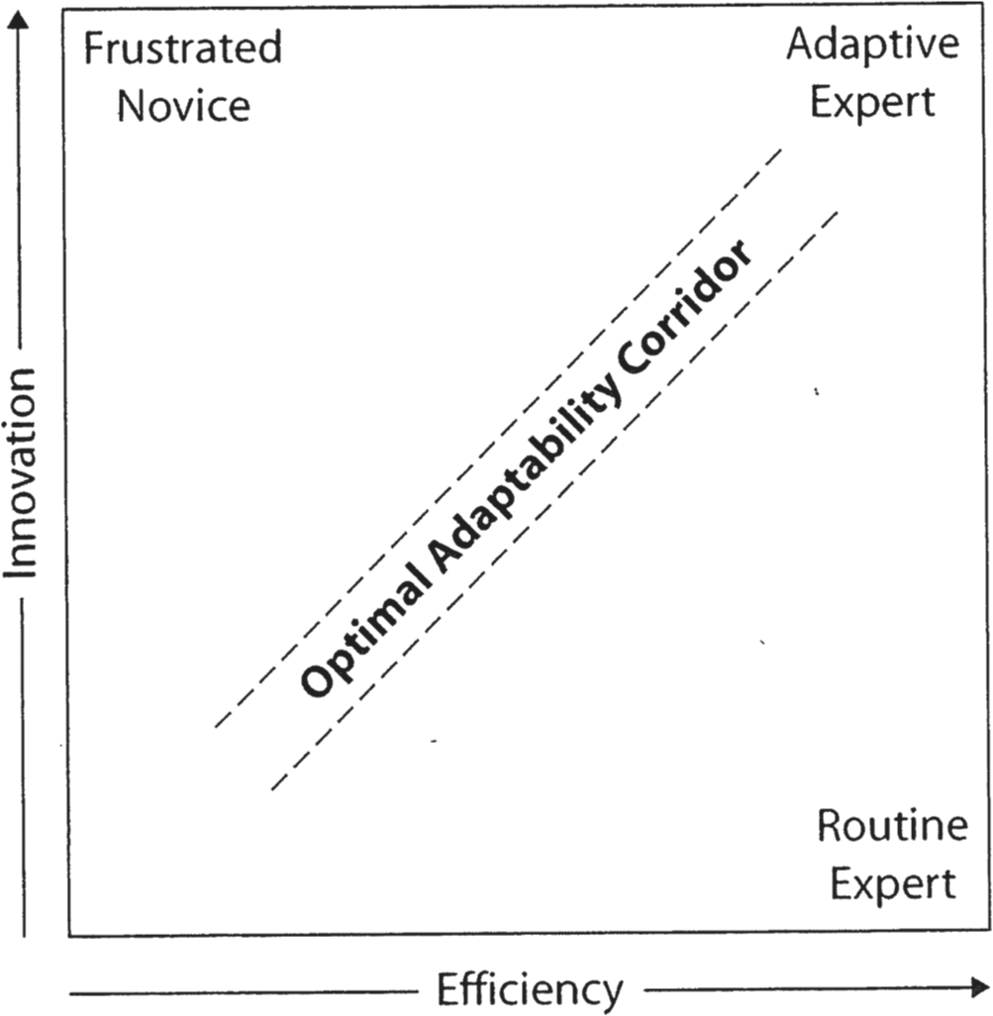
The trajectory toward adaptive expertise balances efficiency and innovation via the optimal adaptability corridor.
In addition to the balancing act between efficiency and innovation, adaptive expertise entails critical cognitive skills. Recently, Bell, Horton, Blashki, and Seidel (2012), citing the work of Lin, Schwartz, & Hatano (2005), described adaptive expertise as “higher order problem-solving involving knowledge transfer across the disciplines” (p. 217). More specifically, by responding flexibly to variable contexts, adaptive experts know how to constructively consider and account for multiple perspectives and potential solutions and modify their existing procedural skills or invent new procedures (Goodnow, Peterson, & Lawrence, 2007; Hatano & Oura, 2003) to meet challenges or problems of practice. Yet, adaptive experts may tend to miss details (Crawford & Brophy, 2006).
Metacognitive awareness is another important dimension of adaptive expertise whereby individuals actively consider the benefits and drawbacks of efficiency and innovation for a given situation (Bransford, Derry, et al., 2005). Lin, Schwartz, and Hatano (2005) discussed the importance of “adaptive metacognition” in teachers who can respond flexibly to the ever-present variability they encounter in the classroom. For adaptive experts, metacognition plays a role in their ability to self-assess and judge when their current levels of understanding are not adequate (NRC, 2000) and in their ability to know when to select an efficient procedure or an innovative one (Crawford & Brophy, 2006). Metacognitive practice also allows for learning to occur during the process of problem solving (Crawford & Brophy, 2006) as learners actively engage with and assess their own thinking and comprehension.
Finally, dispositional characteristics are thought to play a role in adaptive expertise as well. Adaptive experts understand that knowledge can be “messy and irregular” (Crawford et al., 2005) and that discomfort may arise through the course of problem solving, due to having to abandon previously held understandings (Bransford, Derry, et al., 2005). Accordingly, adaptive experts “hold [their] theories lightly” (Crawford & Brophy, 2006, p. 14) and ask questions as they seek new information with a willingness to replace prior assumptions if necessary (Schwartz et al., 2005). Hatano believed certain individual characteristics, such as curiosity, may influence the development of adaptive expertise (Crawford & Brophy, 2006). Bell et al. (2012) echoed this stating that students who are to become adaptive experts must possess innate motivation to solve problems through innovative means. Bransford (2004) explained that adaptive experts enjoy challenges and have “a systematic understanding of themselves as learners and problem solvers” (p. 6). Other dispositional features of adaptive expertise are thought to be a willingness to think things through and change, a degree of comfort with taking managed risks that may result in mistakes, and the tendency to seek out feedback from others who may not share similar views (Crawford & Brophy, 2006). Some have described adaptive experts as being “more prepared to learn from new situations” (Lin, Schwartz, & Bransford, 2007, p. 62) than routine experts and as being willing to ask questions to increase their understanding (Bransford, 2004; Schwartz et al., 2005). Like routine experts, adaptive experts are lifelong learners, but unlike routine experts, adaptive experts are never satisfied with their current levels of understanding and strive not only to work more efficiently but also to work better (Bransford, Derry, et al., 2005; Crawford et al., 2005; NRC, 2000).
Adaptive expertise has relevance across a variety of disciplines, including medicine, engineering, business, and education (e.g., Bell et al., 2012; Bransford, 2007). Adaptive expertise is of particular importance to the development of teaching professionals who face unpredictable and varied circumstances in their daily work with students (Lin et al., 2005). As noted by the NRC (2000), “Teachers are learners and the principles of learning and transfer for student learners apply to teachers” (p. 242). Adaptive expert teachers improve in teaching by adapting their known routines to find better solutions to problems of practice (Hammerness et al., 2005). Teachers also need to capitalize on metacognitive strategies to help them cope with the ongoing variability they encounter in their work with students (Lin et al., 2005). Adaptability is thus a survival skill for teachers who know there is no one right way to approach all of the challenges each instructional day.
Crawford et al. (2005) considered the implications of adaptive expertise for teachers and teaching, conceptualizing adaptive expertise in terms of “adaptive practice”:
Instructional practice that is a site of knowledge construction . . . characterized by a stance toward knowledge-building rather that maximizing efficiency in such a way that productive problems and opportunities for knowledge construction are overlooked, removed, or avoided. (p. 4)
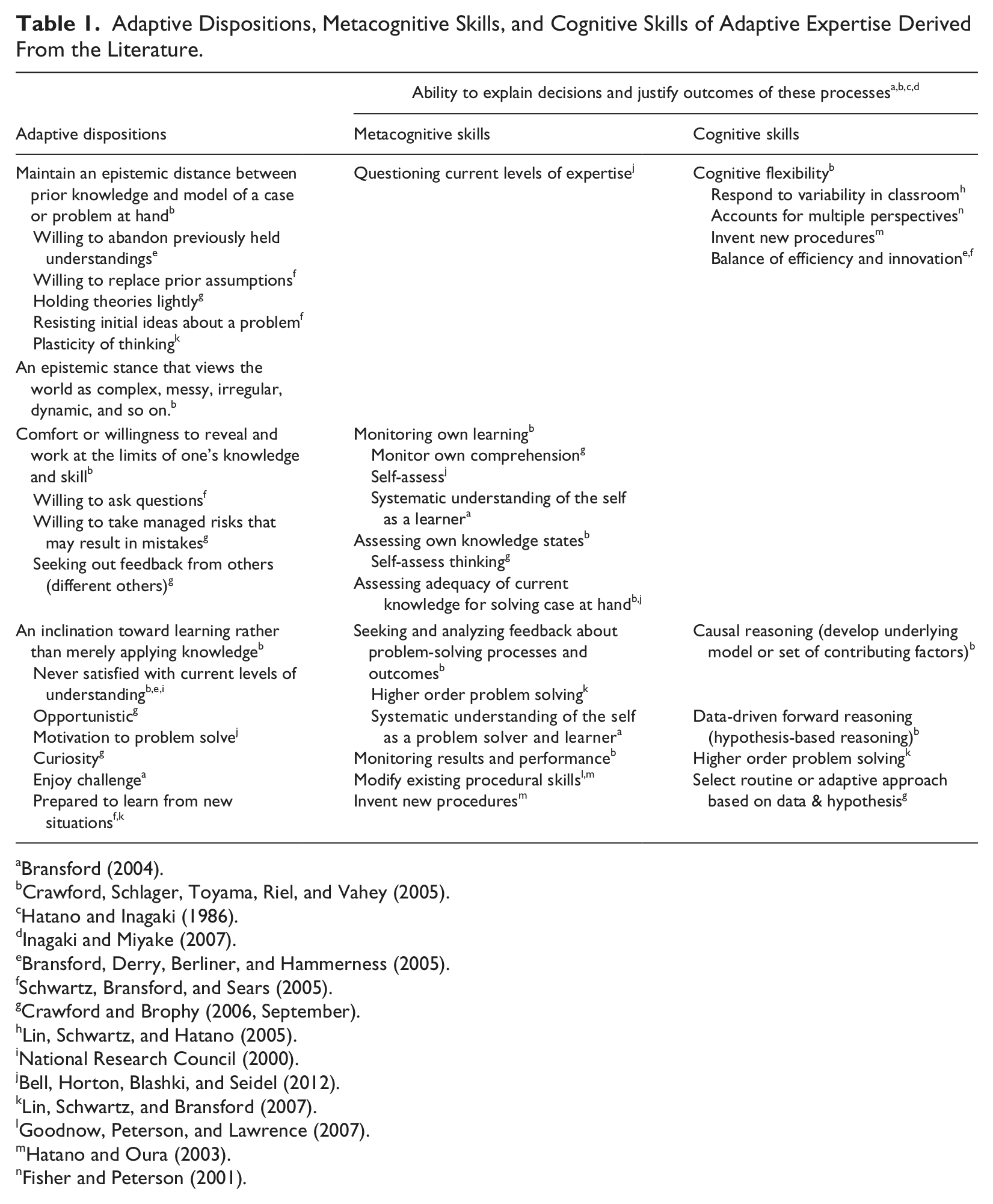
Crawford et al. (2005) described a theoretical framework for adaptive expertise comprised of dispositional characteristics (i.e., understanding the teacher’s epistemic orientation and disposition) and cognitive/metacognitive skills (i.e., understanding the teacher’s cognitive and metacognitive processes in dealing with problems associated with teaching). Specifically, adaptive dispositions entail keeping an epistemic distance between prior knowledge and a current problem of practice, understanding the world as complex without tidy procedures and conclusions, feeling comfortable acknowledging limits of one’s knowledge, and wanting to learn, not just apply, knowledge. From a cognitive/metacognitive perspective, Crawford et al. explained adaptive expertise involves the processes of data-driven forward reasoning, causal reasoning, cognitive flexibility, and self-regulation.
To construct operational definitions and assessment of adaptive expertise in SET preparation, we built on the framework of Crawford et al. (2005) by parsing out adaptive dispositions, cognitive, and metacognitive skills. Table 1 summarizes the adaptive expertise literature related to these three dimensions.
Adaptive Dispositions, Metacognitive Skills, and Cognitive Skills of Adaptive Expertise Derived From the Literature.
Crawford and Brophy (2006, September).
How Does Adaptive Expertise Develop?
Understanding how to foster development of adaptive expertise is important to the construct’s value as a tool for promoting growth in learners. Researchers do not yet know for certain when the optimal time is to begin fostering adaptive expertise within a learner. Although some consider adaptive expertise as a step after mastery of content knowledge associated with routine expertise, most researchers in the field think adaptive expertise can and should develop alongside routine expertise (Crawford & Brophy, 2006). Thus, while learners master content information, they can, and arguably should, develop the dispositions, cognitive, and metacognitive skills that accompany adaptive expertise. Within the context of SET preparation, for example, teacher educators can engage in a deliberate process of scaffolding SET reflective practice while providing instruction that addresses the “how-to” of routine practice. Thus, faculty create space for novice SET to develop adaptive expertise alongside their acquisition of routine expertise. Bransford (2004), noting that developing adaptive expertise is not a quick process, suggested it might be more difficult to teach a routine expert who is set in his ways how to be adaptive than to foster adaptive expertise from the outset of learning within a domain. His advice was to help learners understand themselves as thinkers, problem solvers, and lifelong learners. Teacher educators have the opportunity to set aspiring SET along the trajectory toward adaptive expertise early in their practice by promoting these adaptive habits of mind.
Previous cross-sectional research in medicine, education, business, and engineering supports a model for the potential development of adaptive expertise along the trajectory from novice to expert (Barnett & Koslawski, 2002; Crawford, 2007; Fisher & Peterson, 2001; Varpio, Schryer, & Lingard, 2009); yet, we lack longitudinal empirical studies to demonstrate the process of development along this trajectory from routine to adaptive expert behaviors (Martin, Petrosino, Rivale, & Diller, 2006). An exception includes Martin and colleagues’ (2006) longitudinal development model for adaptive expertise with undergraduate biomedical engineering students (n = 54). Martin and colleagues (2006) examined change in pre- or post-data on an adaptive beliefs survey in relation to performance on adaptive expertise exam outcomes. Each of three course exams included knowledge, innovation, and adaptive expertise items, where adaptive expertise items required students to transfer existing knowledge to a novel problem that was not directly taught in the course. The adaptive beliefs survey items relate to four constructs of adaptive expertise (i.e., multiple perspectives, metacognition, goals and beliefs, and epistemology) derived from a review of the literature (Fisher & Peterson, 2001). Results of repeated measures ANOVA indicate knowledge, innovation, and adaptive expertise improved from Exam 1 to Exam 3, and gains in adaptive expertise were preceded by gains in knowledge and innovation. Adaptive beliefs survey scores remained stable across the course, and higher pre-survey scores were related to higher adaptive expertise performance on Exam 1. Yet, those students with lower scores on the adaptive beliefs pre-survey demonstrated the greatest improvement on the adaptive expertise items from Exam 1 to Exam 3 emphasizing the potential for development of adaptiveness. Further investigations to understand how to promote and assess for routine and adaptive expertise synchronously throughout a program are needed.
Role of the learning environment for promoting adaptive expertise
Cited and elaborated upon by others, Hatano and Inagaki (1986) first proposed three learning environment factors that contribute to the development of adaptive expertise. First, learners must encounter variability (i.e., applying a procedure repeatedly with variations, building in randomness that prompts variations, having to meet changing demands, and applying knowledge flexibly across varied contexts; Bell et al., 2012; Goodnow et al., 2007; Hatano & Inagaki, 1986; Hatano & Oura, 2003). The remaining two factors highlight the importance of considering the influence of the sociocultural context of learning environments, specifically the culture and context in which learners work. Learners will risk applying adaptive strategies rather than a “safe” strategy when the context does not exert pressure for speedy and correct performance (Hatano & Inagaki, 1986). Furthermore, in a culture that values understanding over performance, learners are more likely to vary their procedures because active experimentation, explanation, and elaboration are encouraged (Lin et al., 2007). Within this type of learning community, learners may collaborate, learn from one another, and discover innovative approaches that would not otherwise be considered, what Bransford (2004) discussed as “distributed expertise.”
Lin et al. (2007) reframed Hatano and Inagaki’s three variability factors as “tiers of variability.” In the first tier, learners must encounter variability in their environments and be guided to identify the variations. The second tier of variability is related to how the learner applies a procedure with variation. Through exposure to an initial problem followed by various “what if” scenarios, Lin et al. (2007) suggested learners can develop “smart tools” they can then use to generalize across situations. Finally, in the third tier, learners encounter variability of explanation by participating in the sharing of varied peer and expert perspectives.
Investigations comparing novices and experts do indicate key differences in the variability of professional experience and thought processes that differentiate between not only novices and experts but also routine and adaptive experts (Barnett & Koslawski, 2002; Crawford, 2007). For example, using a think-aloud interview approach, business consultant experts (n = 12), restaurant managers/owners (n = 12), and undergraduate, nonbusiness students (n = 12) provided plans of action to address a novel problem scenario. Despite no restaurant experience, business consultants produced significantly more optimal answers for each question, demonstrated more theory-based reasoning, and more often considered multiple perspectives compared with the restaurant managers and students, who did not differ significantly. Using a similar think-aloud approach, Crawford (2007) investigated the task orientation, efficiency orientation, or innovation orientation, applied by veteran and novice high school biology teachers (n = 13) when presented a hypothetical instructional problem-solving task. Mean percentages of innovation orientation and efficiency orientation codes were compared across veteran teachers with routine expertise, veteran teachers with adaptive expertise (i.e., previous education or experience with educational theory and/or research methods and instructional leadership experience), and novice teachers with two to three years teaching experience. Trends in the data indicate routine and adaptive expert veteran teachers demonstrated a similar percentage of efficiency, or routine, oriented comments; however, adaptive expert teachers expressed more innovation task orientation, including high-level analysis and deeper consideration of the provided student data. Evidence suggests the skills learned in the varied professional experience of the consultants and veteran adaptive expert teachers may explain these group differences (Barnett & Koslawski, 2002; Crawford, 2000).
Within thoughtfully designed learning environments, teachers can implement instructional techniques to foster adaptive expertise. Schwartz et al. (2005) discussed implications for instruction that leads to adaptive expertise through the lens of three types of knowing (Broudy, 1977). They explained that replicative and applicative types of knowing contribute to the development of routine expertise as learners are assessed based on their ability to transfer knowledge through recall of facts and application of knowledge to familiar circumstances. Through instructor emphasis on interpretive knowing, however, learners are oriented toward “preparation for future learning” (Schwartz et al., 2005, p. 11). Furthermore, learners need to engage in activities that promote reflection and metacognitive thinking (Bransford, 2007), and by emphasizing theory and concepts over specific procedures, instructors can promote innovation backed by justification (Bransford, 2004; Bransford, Derry, et al., 2005). Not only do learners need to be innovative but they also need to understand the reasons behind and circumstances for their innovation.
Complementary to the Hatano-based factors and tiers discussed above, the HPL framework describes the design of learning environments to promote adaptive expertise (Bransford, Darling-Hammond, & LePage, 2005; NRC, 2000). As illustrated in Figure 2, this framework situates learning as taking place within a system of four overlapping environments. The learner-centered environment focuses on what learners bring to the educational setting from their past experience and existing knowledge. Within the knowledge-centered environment, learners work to develop new knowledge within a domain through sense-making activities that lead to understanding and future transfer. The assessment-centered environment gives learners opportunities for feedback and revision in their learning development. Finally, the community-centered environment provides a foundation for understanding and learning from the perspectives of others. Taken together, these learning environment design considerations help ensure learners capitalize on learning that leads to innovative practice beyond the routine.
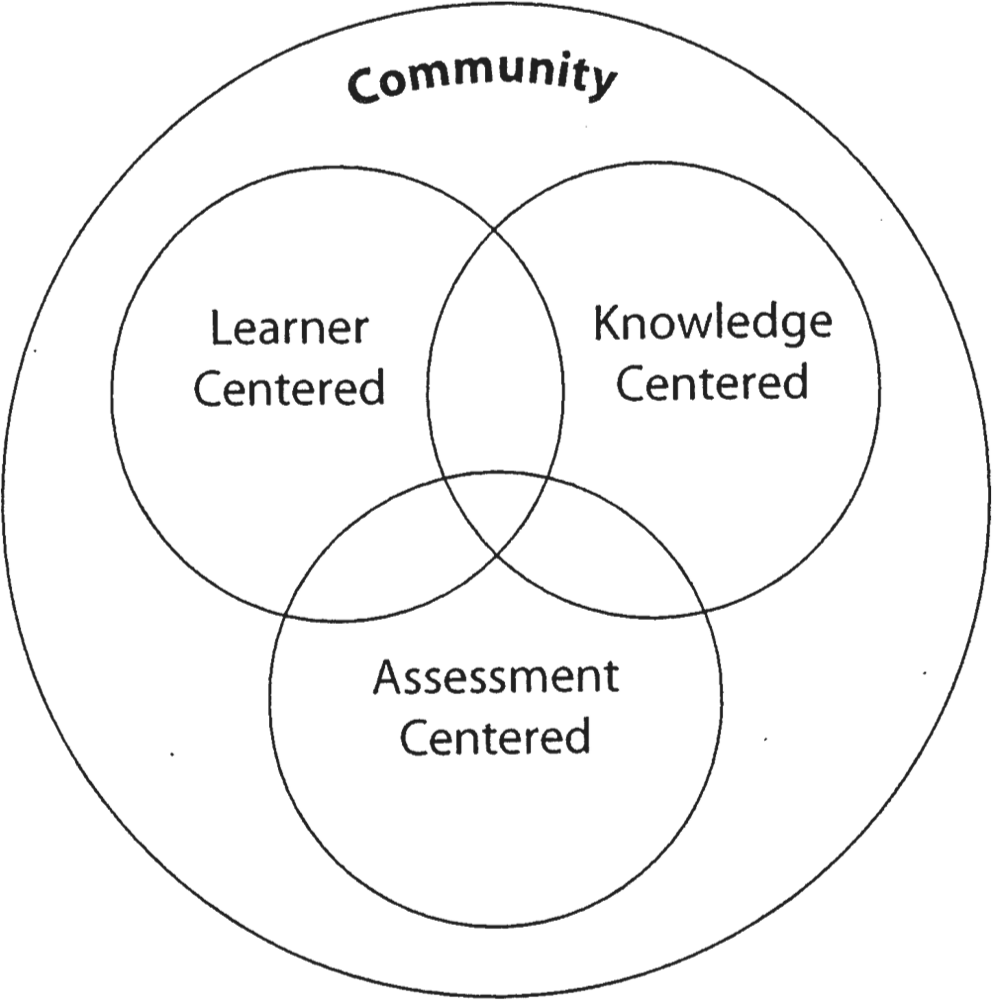
The How People Learn framework.
Research in undergraduate engineering programs supports the application of the HPL framework to create for students critical learning experiences that target the development of adaptive expertise skills and behaviors during the educational program (Martin et al., 2006; Martin, Rayne, Kemp, Hart, & Diller, 2005; Pandy, Petrosino, Austin, & Barr, 2004). Common to these studies is use of the Star Legacy Cycle (Schwartz, Brophy, Lin, & Bransford, 1999) that involves an engaging challenge-based approach requiring students to (a) review their existing knowledge and generate their own ideas; (b) consider multiple perspectives of experts in the relevant field; (c) consult resources, incorporate new knowledge, and revise initial ideas; (d) incorporate formative feedback from peers and instructors; and (e) present the final product. Pandy and colleagues (2004), seeking to increase senior undergraduate engineering student (n = 25) adaptive expertise, applied a pretest–posttest experimental design and compared students’ factual, conceptual, and transfer of knowledge outcomes and adaptive expertise scores. Students randomly assigned to an HPL group experienced a multimedia-based learning module on biomechanics using the Star Legacy Cycle were compared with those students assigned to the standard lecture group. A calculation of the sum of weighted scores for transfer of knowledge (50%), conceptual knowledge (40%), and factual knowledge (10%) served as the operational definition for adaptive expertise. Similarly, Martin and colleagues (2005) applied an HPL approach using the Star Legacy Cycle to teach and assess one tenet of adaptive expertise—the practice of consulting and evaluating multiple expert viewpoints—for undergraduate bioengineering students (n = 30). In this experimental design, the pretest and posttest included factual knowledge items, assessment of ethical decision making, and an item to measure adaptive expertise where students created and justified a plan of action to address a problem within a novel situation. For both studies, standard lecture students and HPL students demonstrated a similar increase in factual/conceptual knowledge; however, students participating in the HPL learning module significantly increased on measures of adaptive expertise compared with those in the traditional lecture model (Martin et al., 2005; Pandy et al., 2004). Similarly, findings from Martin and colleagues’ (2006) longitudinal study of an HPL-based course using Star Legacy Cycle modules indicated improvement on adaptive expertise learning outcomes.
Promotion of adaptive expertise in teacher education
The IRIS (IDEA and Research for Inclusive Settings) Center for Faculty Enhancement provides publicly available IRIS modules (http://iris.peabody.vanderbilt.edu), based on the Star Legacy Cycle, to help prepare general and special educators and other school personnel for practice with students with disabilities (Smith, et al., 2005). Yet, limited empirical evidence in the literature examines the promotion of adaptive expertise specifically in teacher education (Janssen, de Hullu, & Tigelaar, 2008; Soslau, 2012). Janssen et al. (2008) compared the outcomes from interviews of 16 biology student teachers’ reflections on positive and negative teaching experiences, including (a) the content of action plans derived from the reflection, (b) teacher motivation to implement the action plan, and (c) teacher emotions occurring during the reflection. Self-selected positive experiences for reflection more often involved innovative instructional methods, which led to more innovative plans of action when compared with reflection on negative experiences. Furthermore, positive reflections led to greater self-reported motivation to implement action plans and more overall positive emotions. These results support the use of reflective prompts on positive teaching experiences to promote adaptive expertise as innovation seems to lead to further innovation with teachers motivated to act. Soslau (2012) conducted a multiple case study exploring opportunities to promote adaptive teaching expertise through discourse and supervisory styles during conferences following student teaching field experiences. Participants included three undergraduate elementary teacher education students and three university supervisors each with varied supervision styles based on preassessment inventories. During each of two 8-week field experience placements, the researcher observed two student–supervisor conferences for each student participant, totaling to 12 conferences. Follow-up one-on-one interviews were conducted with the student and supervisor after each conference. Results of qualitative analysis of interview data suggest a guiding and reflecting supervision style, when compared with a telling supervision style, elicit more discussions of novice problems (i.e., unquestioned familiarity, dual purpose, context) that hinder the development of adaptive teaching expertise. Yet, supervisors missed 11 of 31 opportunities to use these discussions to promote adaptive expertise by requiring students to discuss and justify the routine elements of teaching practice. These findings have implications for the design and content of reflection and feedback in SET education.
In summary, these investigations suggest educators can help students improve their adaptiveness by providing learning experiences that require students to practice the cognitive and metacognitive skills and dispositions for adaptive expertise (Janssen et al., 2008; Martin et al., 2005; Martin et al., 2006; Pandy et al., 2004; Soslau, 2012), even when initial adaptive beliefs are low (Martin et al., 2006). Specifically, the HPL-based Star Legacy Cycle includes opportunities for students to innovate and be efficient. For example, generating ideas based on prior knowledge requires a self-assessment of current understanding of a topic and innovative problem solving; refining initial ideas based on a review of multiple perspectives and resources allows students to be more efficient in the final outcome. Furthermore, reflection on positive teaching experiences promotes adaptive dispositions, such as motivation and the cognitive and metacognitive skills required to develop innovative new procedures (Janssen et al., 2008). Finally, educators can use feedback structures as opportunities for students to become more adept in the cognitive and metacognitive skills of adaptive expertise through discourse and reflection on the routine and variable, contextual aspects of the teaching field experience (Soslau, 2012).
Implications for SET Education
We propose several steps in the application of this conceptual framework to the design and evaluation of SET preparation programs. First, adaptive expertise constructs can be used to examine the congruence, gaps, and relationships among the knowledge, skills, and dispositions within professional standards. For example, to what extent does a Council for Exceptional Children (CEC, 2008) knowledge standard provide the critical foundation for related skills and dispositions that are congruent with adaptive expertise? Next, we need to identify instructional opportunities throughout SET programs for scaffolding adaptive expertise. As we teach core knowledge, do we use the Star Legacy model to ensure engagement, assessment, reflection, and deep understanding? Within traditional classroom and fieldwork experiences, how well do we emphasize the variability in students’ learning, families’ priorities, instructional settings, and team functioning? Do we provide a safe learning environment for experimenting with new methods and examining their effectiveness? When we teach evidence-based practices, how are we emphasizing context, decision making, and understanding as well as technical performance? Do we provide effective structures for SET candidates to appraise and reflect on the relationships between program standards and their learning experiences? Are we promoting collaboration through direct and supported team learning activities? A final critical step is developing measures of adaptive expertise to support feedback to candidates and faculty and to inform overall program evaluation. To date, the impact of curricular interventions on adaptive expertise has been isolated to the unit or course level; longitudinal program-level effects on adaptive expertise have not yet been reported. Particularly important in an era of increasing teacher accountability, assessment for longitudinal growth must be carefully scaffolded for learners at different stages of a program of study.
Hammerness and colleagues (2005) described adaptive expertise in teaching as creating a balance between efficient use of specific classroom techniques and innovative approaches to instruction. A solid base of efficient teaching practices allows teachers to enact innovative approaches that more effectively respond to unexpected classroom circumstances or to the unique needs of students who do not respond to routine instruction. Striking a balance between these two dimensions has the potential to improve teacher effectiveness and, in turn, student learning outcomes as teachers find successful ways to address day-to-day challenges they encounter.
Learning the efficiency–innovation balancing act of an effective teacher is no simple task, however. As teacher educators, we must be deliberate in planning for the promotion of adaptive expertise. Prospective teachers need guidance in evaluating their preconceptions about teaching in light of the pedagogical knowledge and skills imparted by their teacher education programs (Hammerness et al., 2005). Experiences embedded in frequent, authentic teaching contexts and opportunities to collaborate with and seek feedback from others can help novice teachers reconcile these competing notions (Darling-Hammond & Hammerness, 2005). Field experiences should be extensive, present throughout coursework, and carefully selected based on relationships developed with schools that share the program’s vision of good teaching (Hammerness et al., 2005). Despite acquiring the requisite knowledge, learners do not consistently apply that existing knowledge in novel practice-based situations (Atman, Kilgore, & McKenna, 2008; Greer, De Bock, & Van Dooren, 2009). Beginning teachers must learn how to overcome familiar tendencies and put new knowledge and skills into action in their teaching practice (Hammerness et al., 2005). Furthermore, they need to develop a deep understanding of the complexity and nonroutine nature of teaching, and with that, a commitment to self-assessment through metacognitive reflection (Hammerness et al., 2005). Case study methods and the development of teaching portfolios can facilitate critical connections between theory and practice and help aspiring teachers gain a strong sense of themselves as learners and problem solvers. In particular, case studies provide preservice SET with the opportunity to assess variability across instructional contexts and seek the perspectives of others in a way that allows them to test ideas and evaluate response in a risk-free, supportive environment. Furthermore, portfolios give teacher candidates structure and space for critical reflection, justification, and evaluation across the preservice program. As teacher educators, we must be accountable for instruction and assessment that emphasize knowledge/efficiency and innovation throughout the educational program and challenge students to reflect on and justify their routine knowledge and practice (Atman et al., 2008; Greer et al., 2009; Mylopoulos & Regehr, 2009). Teacher preparation rooted in these principles of learning can pave the way for the development of adaptive expertise and thus instill the critical skills and dispositions novice SET need to address the inevitable challenges of their future teaching practice.
Heeding the call of Darling-Hammond and Hammerness (2005) for coherence within teacher education programs, we argue that a conceptual framework of adaptive expertise should be the backbone that undergirds and unifies all aspects of the design, delivery, and study of teacher preparation in special education. Whereas the CEC (2008) standards guide the knowledge and skills special educators should possess, adaptive expertise can, and should, be the common thread woven throughout teacher preparation across the coursework and clinical experiences that target particular knowledge and skills. Teacher educators can create this coherence by making the conceptual framework explicit to all teacher candidates within the program (Darling-Hammond & Hammerness, 2005). In so doing, novice teachers can gain a clear understanding of the broader purpose of the preparation program that links their programwide learning experiences beyond the mere acquisition of knowledge and skills. Through consistent, thoughtfully planned activities targeting the development of adaptive expertise such as those outlined above, teacher educators may cultivate within preservice special educators the adaptive dispositions and metacognitive and cognitive skills that lead to successful teaching. Moreover, the value of developing a teaching practice that successfully balances efficiency and innovation will be made salient for novice special educators. With cohesion and salience, we can avoid sending beginning SETs into the field who feel only comfortable with the routine and are unprepared for the realities and challenges of practice.
Footnotes
Declaration of Conflicting Interests
The author(s) declared no potential conflicts of interest with respect to the research, authorship, and/or publication of this article.
Funding
The author(s) received no financial support for the research, authorship, and/or publication of this article.