







Abstract
The chronically high rate of special educator attrition across U.S. schools creates a dilemma for educational leaders because special educators provide direct services to students with special needs. Attrition exacerbates already high special educator shortages reported in most districts, and nearly one million schoolchildren with disabilities receive fewer or no services as a result. Given this dilemma, the purpose of this article is to advance a research-based model to provide guidance for school administrators and researchers. Adapted from previous conceptual models and perspectives, the proposed model combines five thematic, contributing factors and a sixth, relatively understudied factor, workplace decision-making, to illustrate factor effects on special educators’ perceptions of job satisfaction and, ultimately, career decisions.
The chronically high rate of special educator attrition across U.S. schools creates a dilemma for educational leaders because special educators provide direct services to students with special needs. Attrition exacerbates already high special educator shortages reported in most school districts, with the result that nearly one million U.S. schoolchildren with special needs either receive services from untrained or inadequately trained personnel, or receive no services whatsoever. Given this dilemma, the purpose of this article is to advance a research-based model to provide guidance for school administrators and researchers. Adapted from previous conceptual models and perspectives, the proposed model combines five thematic, contributing, literature-based factors and a sixth, relatively understudied factor, workplace decision-making, to illustrate the effects of these factors on special educators’ perceptions of job satisfaction and, ultimately, their career decisions to remain in the special education classroom or depart. To address this purpose, the article includes six sections: (a) Background of the Problem, (b) Significance of the Problem, (c) Factors of Attrition, (d) Models/Perspectives From Previous Research, (e) A Model of Special Educator Attrition, and (f) Implications of the Model.
Background of the Problem
To begin, scholars offer similar definitions of attrition. For example, Boe, Cook, and Sunderland (2008) referred to attrition as “leaving teaching employment” (p. 8), while Dove (2004) defined it as “premature and voluntary departure” (p. 9). To bracket the scope of this article, the broad and complex topic of teacher attrition is defined as early and/or voluntary teacher resignation and does not include teachers who depart because of involuntary employment termination. This section addresses (a) General Educator Attrition, (b) Special Educator Attrition, and (c) Comparing General and Special Educator Attrition.
General Educator Attrition
Certainly, several educational researchers (e.g., Billingsley, Israel, & Smith, 2011; Boe & Cook, 2006; Ingersoll, 2001; Leko & Smith, 2010; McLeskey & Billingsley, 2008; Prather-Jones, 2011; Thornton, Peltier, & Medina, 2007; Vannest, Soares, Harrison, Brown, & Parker, 2010; Whitaker, 2003), and media reports (Kaiser, 2011; Kozleski, Mainzer, & Deshler, 2000; McGuire & Meitrodt, 2013; Merrow, 1999), explain that the general teacher attrition rate in U.S. public schools is unacceptably high. Some scholars indicate that the attrition rate, which includes all content areas, including special education, is approximately 30% of the nation’s teachers in the first 5 years of teaching (Boe & Bobbitt, 1997; Darling-Hammond, 2003; Nelson, 2004). Higher attrition rates are reported in some states. For example, Greiner and Smith’s (2009) study of Texas public schoolteacher attrition found that Texas teachers leave at a rate of 50% in the first 5 teaching years. In response to general teacher attrition, increasing student enrollments, and veteran teachers’ retirements, districts across the states often struggle to recruit new teachers to fill available positions (Boe, 2006; Greiner & Smith, 2009; Ingersoll, 2001; Ingersoll & Smith, 2003; Shen, Leslie, Spybrook, & Ma, 2012).
General educator attrition is not reported across all subject areas, however. Instead, high teacher turnover is associated with particular academic subjects such as mathematics, science, and world languages sporadically across the United States as teachers accept positions in government or private industries (Boe & Cook, 2006; Connelly & Graham, 2009; McLeskey, Tyler, & Flippin, 2004; Occupational Outlook Handbook, 2014; Otto & Arnold, 2005). Interestingly, the teacher attrition rate in the fields of math and science did not increase more rapidly than rates in other fields excluding special education (Ingersoll & May, 2012). Therefore, although still a concern, the average rate of general teacher attrition is not considered as severe across the nation as the average rate of special educator attrition (Boe, 2006).
Special Educator Attrition
The national average rate of special educator attrition is estimated at approximately 50% of special educators in the first 5 years of teaching (Edgar & Pair, 2005; Fore, Martin, & Bender, 2002; Kaff, 2004; Menlove, Garnes, & Salzberg, 2004; Mitchell & Arnold, 2004; Plash & Piotrowski, 2006; Whitaker, 2003). Special educators leave the field at 1.33 times the rate of teachers in so-called “low attrition” curricular fields such as English/Language Arts (Kelly, 2004). Special educators of students with certain categorical disabilities, however, depart at still higher rates (Albrecht, Johns, Mounsteven, & Olorunda, 2009; Kaff, 2004; Prather-Jones, 2011). For example, special educators of students with emotional/behavioral disorders are reported to leave special education more rapidly than teachers of students with learning disabilities or mild mental impairments (Albrecht et al., 2009; Gable, 2004; Kaff, 2004; McLeskey et al., 2004; Sutherland, Denny, & Gunter, 2005). Special educators who choose not to continue in special education generally leave within the initial (first through fifth) teaching years (Boe & Cook, 2006; Ingersoll, 2001; Ingersoll & Smith, 2003; McLeskey & Billingsley, 2008; McLeskey et al., 2004).
Comparing General and Special Educator Attrition
When general and special educator attrition rates are compared, the national special educator attrition rate is consistently higher than the general educator attrition rate, a phenomenon that has persisted since the 1980s (Nichols, Bicard, Bicard, & Casey, 2008). In fact, despite annual variation, at times the special education attrition rate was almost double the general education attrition rate, on average. To illustrate, in 1999, the special educator attrition rate was reported to be 14% as compared with the general educator attrition rate of 8% (U.S. Department of Education, 1999; Skrtic, Harris, & Shriner, 2005). Similar to general educators who leave, special educators generally leave within the initial (first through fifth) teaching years (Boe & Cook, 2006; Ingersoll, 2001; Ingersoll & Smith, 2003; McLeskey & Billingsley, 2008; McLeskey et al., 2004; Skrtic et al., 2005). In sum, special education teachers leave more quickly than general educators due to several contributing factors, and the inadequate supply of these teachers leads to ongoing national special educator shortages that are in turn exacerbated by the relatively high attrition rate (Boe & Cook, 2006; Boe et al., 2008).
Significance of the Problem
Two key reasons both general and special educator attrition are problematic at a national level are (a) teacher shortage and (b) high teacher turnover costs. First, because teacher shortage affects, and is affected, by attrition, shortage is an important related educational problem. Second, high teacher turnover incurs high costs to districts. These costs are not trivial: According to some scholars, billions of dollars are lost to teacher attrition every year (Watlington, Shockley, Guglielmino, & Felsher, 2010). This section discusses the significance of attrition shortage and costs in three subsections: (a) General Educator Shortage, (b) Special Educator Shortage, and (c) Attrition Costs.
General Educator Shortage
Briefly, educator shortages in schools are subject to teacher supply and demand forces (Boe, 2006; Ingersoll, 2001). Supply and demand in turn depend on demographics, governmental policies, and numerous other situational factors, such as declining enrollments, class sizes, number of prepared qualified teachers available, and/or district restructuring. Some research indicates that shortages are more likely to occur in “hard-to-fill” content areas, such as math (Ingersoll & Perda, 2010) and science (The New Teacher Project [TNPT], 2012). In fact, certifications that rank in the top 15 shortage areas include mathematics education (6th tied), physics (8th tied), bilingual education (9th tied), chemistry (12th), and computer science education (13th tied; McLeskey et al., 2004). Other research emphasizes socioeconomic considerations and “areas of need” that include teaching positions in low socioeconomic geographical areas, particularly rural and urban communities (Sindelar, Bishop, Gill, Connelly, & Rosenberg, 2007). In sum, the magnitude of general educator shortage depends on multiple factors. Analysis of national data trends (i.e., Schools and Staffing Survey, 1987-1988, 1990-1991, and 1993-1994), however, indicates that general educator shortages are exceeded by special educator shortages (Boe, 2006; Cook & Boe, 2007).
Special Educator Shortage
Special educator shortage is widespread and chronic in U.S. schools. For example, 98% of the nation’s school districts report shortages of trained teaching staff for children with special needs (Henley et al., 2010; Kaufman & Ring, 2011; Presidential Commission on Excellence in Special Education, 2002). Moreover, special educator shortages increase as the numbers of special needs children increase. For example, from 1993 to 2003, the national special educator shortage increased from 7.4% to 13.4% (Boe, 2006). In fact, of the population of approximately 6.5 million disabled children served under the Individuals With Disabilities Education Act (IDEA) in 2002 to 2003 (Cook & Boe, 2007; Office of Special Education Programs, 2004), approximately 830,000 disabled children were served by individuals without adequate preparation or training (Billingsley & McLeskey, 2004). Furthermore, special educator shortages are projected to increase unless changes are made to address the issue (Boe, 2006; Cook & Boe, 2007; Gehrke & Murri, 2006; McLeskey & Billingsley, 2008; McLeskey et al., 2004; Nichols et al., 2008; Olivarez & Arnold, 2006; Otto & Arnold, 2005; Thornton et al., 2007).
In addition, the magnitude of special educator shortage tends to increase over time. To illustrate, in 2001, an estimated 39,000 special education positions were filled by “uncertified personnel”—a shortage of about 10% (Cook & Boe, 2007, p. 218). In 2002 to 2003, the quantity of special education positions created and funded (demand) was 403,000. The quantity of filled positions (supply), however, fell short: Approximately 54,200 individuals without adequate training, preparation, or certification, including substitute teachers, were hired due to unavailability of fully certified special educators (Boe, 2006). McLeskey and Billingsley (2008) analyzed some of the same data sets to report that in 2002 to 2003, due to shortage conditions, more than 49,000 individuals not fully certified were hired to fill special education teaching/case management positions.
Attrition Costs
When teachers leave classrooms, costs to districts are substantial whether related to general or special educator attrition. Costs are both direct, measurable in dollars, and indirect, not easily calculated monetarily but of concern to districts nonetheless. This section discusses the significance of direct and indirect attrition costs in, first, general education and, second, special education.
First, direct general teacher attrition costs include investment costs incurred by states and districts (McLeskey & Billingsley, 2008) such as recruitment, hiring, induction, professional development, and tuition and tax support for teacher preparation. 1 Although each state’s attrition-related costs vary, one district’s losses due to overall teacher attrition can amount to between US$8,000 and US$48,000 per beginning teacher who departs (McLeskey & Billingsley, 2008). According to Darling-Hammond (2003), states incur roughly US$8,000 per recruit who leaves the field in the first few years of teaching, a conservative estimate that totals several hundred thousand dollars annually—money that could be spent more productively elsewhere.
Indirect costs associated with general educator attrition are no less disconcerting than direct costs. When districts experience high teacher turnover, indirect costs can include (a) low teacher quality, (b) waste of human resource talent, (c) inability to sustain instructional programs, and (d) decreased student achievement (McLeskey & Billingsley, 2008). Costs related to teacher turnover also impact school environments in terms of loss of personnel expertise and employee commitment (Watlington et al., 2010). Furthermore, high rates of educator attrition can impede school reform efforts (McLeskey & Billingsley, 2008).
Second, direct costs for special educators who attrite are basically equivalent to costs for general educators who depart prematurely. 2 Indirect costs of special educator attrition, however, are more frequently reported by scholars because of the special programs and modified curriculum required by schoolchildren with disabilities. Special educator attrition negatively affects these programs (Brownell, Smith, McNellis, & Miller, 1997), especially in highly urban areas (Obiakor, Beachum, & Harris, 2010) or rural areas where special education shortages can be particularly acute (Courtade & Ludlow, 2008; Courtade, Servilio, Ludlow, & Anderson, 2010; Hodge & Krumm, 2009; Johnson, Humphrey, & Allred, 2009; Therrien & Washburn-Moses, 2009; Watlington et al., 2010). Researchers note, for example, that “the loss of even one special educator may result in the loss of an entire program and all services for students with disabilities in small rural communities” (Menlove et al., 2004, p. 378). In effect, just as attrition affects general education programs, rapid turnover of special education teachers likewise affects special education; the difference is magnitude, however. As special educators are roughly twice as likely to depart from classrooms, special education programs are influenced more severely.
Factors of Attrition
To review, special education attrition in the United States aggravates already high shortages of special educators and increases district costs. To unpack this persistent problem, several researchers (e.g., Billingsley et al., 2011; Boe & Cook, 2006; Leko & Smith, 2010; McLeskey & Billingsley, 2008; Prather-Jones, 2011; Stephens & Fish, 2010; Thornton et al., 2007; Vannest et al., 2010; Whitaker, 2003) identified various contributing factors. A thorough review of literature about special education attrition revealed that these multiple factors could be categorized into six primary, thematic factors. In particular, we suggest that workplace decision-making, broadly defined as teachers’ individual or collaborative participation in decisions about relevant and substantive workplace issues, is of particular importance because this factor is understudied and overlooked. In this section, the six primary, thematic factors are described in the following order: (a) Workplace Conditions, (b) Administrative Support, (c) Professional Development, (d) Teacher Mentorship/Induction, (e) Teacher Preparation, and (f) Workplace Decision-Making.
Workplace Conditions
The first and arguably most prevalent primary factor found in literature about special educator attrition involves workplace conditions. Workplace conditions include a broad variety of special educators’ workplace circumstances—such as caseload size, due process compliance paperwork, and compliance-related meetings. Workplace conditions also include access to work-related resources such as time, space, materials, and technology. According to researchers, adverse workplace conditions are most often blamed for special educator dissatisfaction and attrition (Chang, 2009; Fish & Stephens, 2010; Ingersoll & May, 2012; Leko & Smith, 2010; McLeskey & Billingsley, 2008; Nance & Calabrese, 2009; Vannest et al., 2010).
Administrative Support
The second primary factor is administrative support for teachers. Administrative support is variously defined in literature, but most definitions include similar characteristics. Ingersoll’s (2001) description of adequate administrative support captured many aspects that affected teacher turnover and general stability among teaching staffs. In general, teachers reported the need for school leaders to (a) share leadership’s vision of the school with staff, (b) let staff members know what is expected, (c) speak with teachers frequently about instructional practices, (d) recognize staff for doing good work, (e) enforce rules for student conduct, and (f) vocalize appreciation and encouragement.
Administrative support is also defined to include support from other teachers and school staff because school leaders “play a significant role related to the support” special educators need from general education teachers (Prather-Jones, 2011, p. 6). Although definitions vary, researchers indicate that a relationship between administrative support and educator attrition exists (Fish & Stephens, 2010; Henley et al., 2010; Leko & Smith, 2010). These researchers claim that administrative support is perceived to be insufficient by many special educators. Furthermore, this lack of perceived support can contribute to special educator attrition (Billingsley, 2004b).
Professional Development
The third primary factor related to special educator attrition is professional development. Defined variously by schools/districts, professional development refers to ongoing education, training, workshops, seminars, and conferences. Professional development can also include various other activities that facilitate professional growth and provide educational enrichment to teachers related to educational service delivery. In addition, professional development can facilitate teacher mentoring and/or collaboration with colleagues about student and school achievement. Prior research indicates that professional development, broadly speaking, is positively associated with special educator retention (Darling-Hammond, 2004, 2007; Kaufman & Ring, 2011; Leko & Smith, 2010; Stephens & Fish, 2010; Yost, Vogel, & Liang, 2009).
Teacher Mentorship/Induction
The fourth primary factor is special educator mentorship/induction. Mentorship, broadly defined, is the assignment of experienced colleagues or collegial teams to novice teachers for guidance and support over an extended period of time (Barrera, Braley, & Slate, 2010), generally during the first years in the classroom (Leko & Smith, 2010; Smith, 2007). Induction refers to a variety of new teacher supports that include “workshops, collaboration, orientation seminars, and especially mentoring” (Smith, 2007, p. 273). Evidence from literature supports educators’ beliefs that new special educators experience higher workplace satisfaction when mentoring and/or induction is available (Barrera et al., 2010; Billingsley et al., 2011; Brownell, Hirsch, & Seo, 2004; Gehrke & McCoy, 2007; Henley et al., 2010; White & Mason, 2006).
Teacher Preparation
The fifth primary, thematic factor is teacher preparation. Because the quality of teacher preparation is related to attrition, literature focused on teacher preparation is noteworthy. For example, some researchers found that special educators began teaching without sufficient preparation (Billingsley, 2004a, 2004b; Billingsley et al., 2011; Henley et al., 2010; Leko & Brownell, 2009). For example, researchers questioned whether traditional special educator preparation programs offer sufficient instruction in classroom skills and strategies (Boe & Cook, 2006). Furthermore, debate continues about whether traditional programs, especially programs without a pre-service teaching component, are superior to nontraditional, or alternative, programs (Bouck, 2005; Connelly & Graham, 2009; Tissington & Grow, 2007). Apart from program type, however, researchers concur that insufficient teacher preparation contributes to frustration and dissatisfaction that can ultimately lead to attrition.
Workplace Decision-Making
The sixth, and less-studied, factor associated with special educator attrition is special educators’ perceptions about workplace decision-making. Teacher decision-making is defined variously in scholarly literature. For example, some scholars (e.g., Conderman & Johnston-Rodriguez, 2009; LHospital & Gregory, 2009; Skrtic et al., 2005) defined teacher decision-making as a group activity, an act of collaboration or teamwork among teachers and/or school staff to attain goals and solve problems. Other researchers (e.g., Boscardin, 2007; Conderman & Johnston-Rodriguez, 2009; Prather-Jones, 2011; Yost et al., 2009) perceived teacher decision-making to include any substantive teacher involvement in school or district leadership decisions. Still others employed multiple indices of decision-making participation in teacher attrition studies, including teacher decision-making autonomy within schools and classrooms (Ingersoll & May, 2012).
For the article’s purpose, teacher decision-making is broadly defined to include any type of workplace decision-making, that is, any school-related act at any organizational level, either performed singly or in a group, in which the teacher (with or without others) (a) considers available options, (b) chooses from among the options, and (c) commits to a course of action based on a particular choice (Nickols, 2010). Furthermore, according to many scholars, decision-making can significantly enhance teacher satisfaction when teachers are interested in making changes in the work environment, and/or when teachers prefer relative autonomy to decide issues that affect schoolchildren (Boe, 2006; Boscardin, 2007; Boyer, 2005; Brownell & Smith, 1993; Chang, 2009; Conderman & Johnston-Rodriguez, 2009; Griffin et al., 2009; Ingersoll, 2001; Ingersoll & May, 2012; Ingersoll & Smith, 2003; Kaff, 2004; Kelly, 2004; McLeskey & Billingsley, 2008; Miller, Brownell, & Smith, 1999; Prather-Jones, 2011; Ryan, Healy, & Sullivan, 2012; Westling, Herzog, Cooper-Duffy, Prohn, & Ray, 2006; Whitaker, 2000, 2003; Yost et al., 2009).
Models/Perspectives From Previous Research
For the most part, previous attrition studies conducted in both general and special education focused on educators’ demographic characteristics and factors that contributed to workplace stress, frustration, and dissatisfaction (Billingsley, 1993; Boe, 2006; Boyer, 2005; Ingersoll & Smith, 2003; McLeskey & Billingsley, 2008). Theoretical perspectives were also employed to conceptualize educator attrition. For example, some researchers utilized an ecological approach to explore teacher satisfaction and other attitudes that resulted from interactions between educators and school/district workplace variables (Brownell & Smith, 1993; Miller et al., 1999). Others focused on employee workplace attitudes that result from organizational structures (Skrtic, 1991, 1995) and decision-making practices within organizational systems (Ryan et al., 2012).
To be sure, studies that utilized these models and perspectives focused, either wholly or in part, on general educator attrition, whereas other studies exclusively addressed special educator attrition. Studies, however, generally shared two common investigative purposes. First, studies investigated contributing factors to increase understanding of why educator attrition occurs. Second, models and perspectives employed in these studies lent insight into potential means for attrition amelioration. Although certainly not an exhaustive review, the next section includes relevant (a) Attrition Models and (b) Organizational Perspectives. 3
Attrition Models
This section briefly illustrates two models employed in educator attrition studies that offer insights into previous theoretical groundings. With a common purpose to increase understanding of the attrition phenomenon, the models were developed by Bronfenbrenner (1976, 1979) and Miller et al. (1999).
Bronfenbrenner’s (1976, 1979) model
Developed from the fields of biology and developmental psychology, this model offers scholars a broad perspective that depicts the complex environmental system of general education. Inside this system is a structure of three, smaller and nested subsystems. The subsystems represent levels of interaction between individuals who work in the educational environment. Each subsystem not only interconnects with the other subsystems but is also encompassed by higher systems in hierarchical fashion.
The most basic subsystem in Bronfenbrenner’s original model, the microsystem, represents the individual’s immediate setting in the educational environment. The setting is defined as “a place in which [individuals] engage in particular activities in particular roles . . . for particular periods of time” (Bronfenbrenner, 1976, p. 12). The next highest subsystem, the mesosystem, represents the “interrelations among the major settings . . . at a particular point . . . in life” (Bronfenbrenner, 1976, p. 13). The mesosystem includes each microsystem setting that individuals experience, as well as the individual’s interactions across the various microsystem settings. The next highest subsystem, the exosystem, extends the mesosystem but also includes formal and informal social structures that refer to the individual’s neighborhood, government agencies, workplace, media, and social networks, all of which interact and interrelate with each other in the exosystem. The highest system, the macrosystem, is the “overarching institution . . . of the [environment’s] culture or subculture, such as the economic, social, educational, legal, and political systems” (Bronfenbrenner, 1976, p. 14) in which individuals work and live. The macrosystem, as conceived in the model, lends meaning and importance to individuals and “of especial importance . . . to how [individuals] are treated and interact with each other in different types of educational settings” (Bronfenbrenner, 1976, p. 14). A rendering derived from Bronfenbrenner’s description is presented in Figure 1.
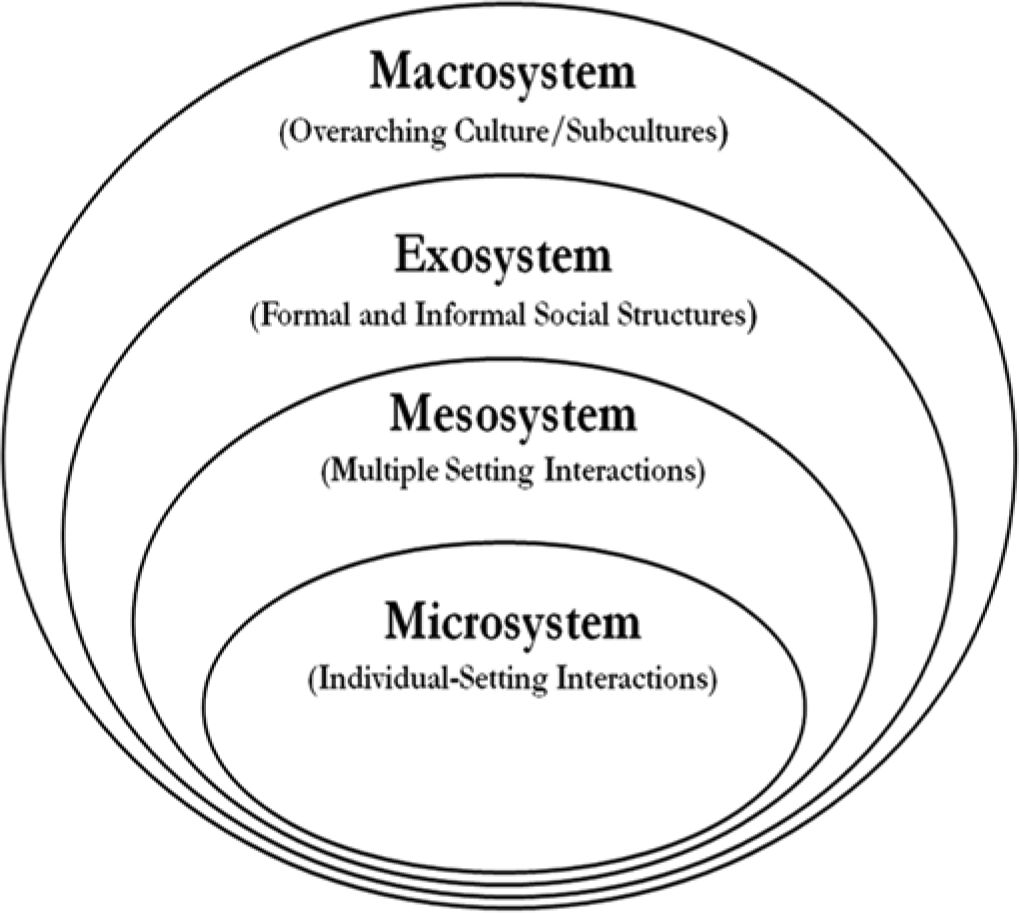
Rendered from Bronfenbrenner’s (1976, 1979) ecological model description.
Miller et al’s (1999) model
Bronfenbrenner’s (1976, 1979) ecological model was modified specifically to study special educator dissatisfaction and attrition (Brownell & Smith, 1993; Miller et al., 1999). The modifications lent insight into individuals’ (teachers’) interactions with variables across multiple, interconnected systems in relatively complex educational environments. For example, the four systems were utilized for special educator attrition research by Brownell and Smith (1993).
Later, Miller et al. (1999) further modified Brownell and Smith’s model and collapsed the original four systems into three interactive systems of variables for further attrition research as (a) microsystem variables, (b) mesosystem variables, and (c) exosystem variables. In this model, the inner system (microsystem) represents special educators’ interactions with classroom variables in the most basic school setting, the classroom. Special educators interact with classroom variables that contribute either positively or negatively to special educators’ perceptions of overall workplace satisfaction. Specifically, when special educators perceive microsystem demands as excessive, such as high class/caseload sizes or lack of sufficient resources, special educator dissatisfaction is likely to result, and special educators are more likely to leave positions (Miller et al., 1999). Microsystem variables include factors that are typically associated with the classroom setting, although the researchers recognized that many variables are located across systems. Not all-inclusive, a few classroom/microsystem variables noted by Miller et al. include (a) caseload size, (b) student needs, (c) student diversity, (d) classroom technology, (e) student contact time/quality, and (f) tangible resources.
Mesosystem variables refer to a larger system of the school environment. The system encompasses microsystem variables and includes not only special educators’ interactions with classroom factors but also special educators’ schoolwide interactions. Because the systems are interconnected, special educators’ mesosystem-level interactions are regarded as more complex than simpler microsystem-level interactions. Mesosystem variables also interact with special educators’ affective responses and perceptions of overall workplace satisfaction or dissatisfaction and ultimately to decisions to stay or leave. Although many mesosystem variables are also experienced in higher or lower systems, Miller et al.’s mesosystem variables include (a) collegial support, (b) administrative support, (c) overall stress, (d) group collaboration, (e) teacher isolation, (f) job design, (g) professional development, (h) classroom assistance (paraprofessionals), and (i) class schedules.
In the model, exosystem variables represent the school district, state and federal governments, laws, statutes, policies, and guidelines that regulate education. The exosystem encompasses both classrooms/caseloads and schools and also mediates special educators’ interactions across the mesosystem and microsystem (Brownell & Smith, 1993). In addition, the exosystem represents special educators’ interactions with district, state, and federal entities, as well as interactions with other exosystem variables. Miller et al. (1999) identified exosystem variables as (a) district resources (such as professional development), (b) district policies, (c) contracts, (d) rules, (e) guidelines, (f) laws, (g) salary, (h) due process paperwork, (i) meetings, and (j) curriculum and instruction. A rendering of the model is presented in Figure 2.
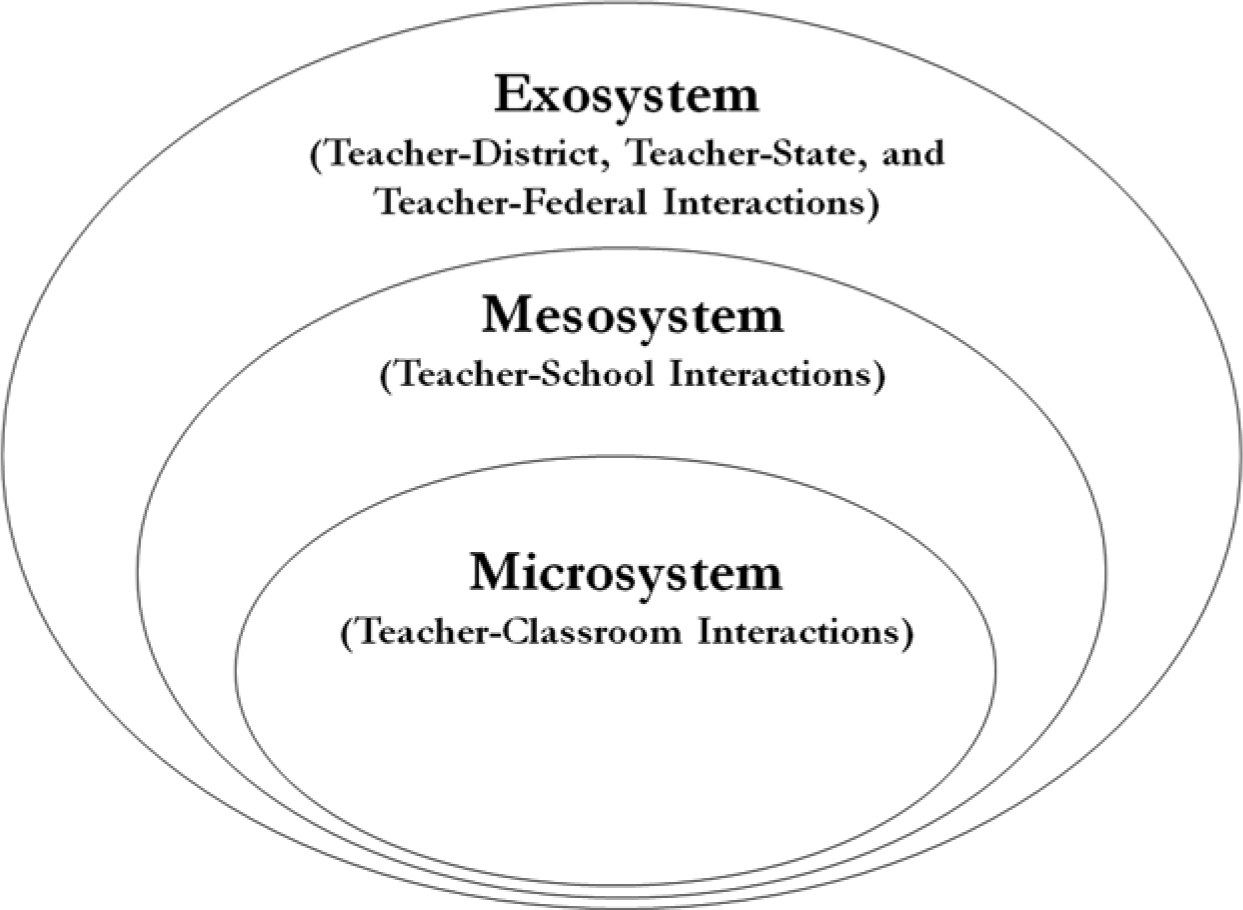
Miller, Brownell, and Smith’s (1999) modification of Brownell and Smith’s (1993) model, re-conceptualized from Bronfenbrenner’s (1979) ecological model for educational research.
Organizational Perspectives
Previous conceptual models to research educator attrition offered a view of special educators’ interactions with individual variables from the standpoint of education’s environmental systems. Schools, however, are formal, goal-oriented, political organizations. Furthermore, schoolteachers, special educators in particular, can experience varying degrees of workplace satisfaction due to organizational structure. Indeed, apart from scrutiny of individual factors that can contribute to teacher attrition, research also draws upon broad organizational perspectives that can lend insight into employee perceptions of decision-making in schools. Research can also inform how teachers’ perceptions can then contribute to workplace satisfaction. This section extends the discussion of previously utilized satisfaction/attrition conceptual models to broaden the view of special educator attrition to include formal organizational perspectives. The first perspective is a landmark study about the effects of workplace decision-making on general employee satisfaction and retention/attrition (Vroom, 1959). This study can be employed to model special educators’ and disabled children’s requirements in educational organizations. The second perspective, specific to special education and organizational factors that contribute to attrition, can also be employed to model special educators’ and disabled children’s requirements in school organizations. The section thus includes Vroom’s (1959) organizational perspective and Skrtic’s (1991, 1995) organizational perspective.
Vroom’s (1959) organizational perspective
Derived from psychological studies conducted with industry supervisors and employees, a perspective about decision-making, as an employee satisfaction contributor in an industrial organization, guided a landmark study conducted by Victor Vroom (1959). The findings of the study suggested that employee attitudes such as satisfaction were explainable and predictable from employees’ perceptions of their decision-making ability in organizations (Vroom & Maier, 1961). Vroom employed theoretical assumptions from social psychology to investigate decision-making’s effects on employee satisfaction and other factors related to workplace attitudes. Decision-making was defined as a
process of joint decision-making by two or more parties in which the decisions have future effects on those making them . . . [where] the amount of participation of any individual will be the amount of influence [s/he] has on the decisions and plans agreed upon. (Vroom, 1959, p. 9)
According to Vroom, individuals’ perceptions typically motivate behavioral responses. For example, decision-making satisfies when individuals who make decisions are permitted more freedom to further goals, enhance social experience, and increase opportunities to improve the work situation (Vroom, 1959). Vroom hypothesized that, in general, employees’ (teachers’) workplace satisfaction increases with relatively higher amounts of decision-making and decreases with relatively lower amounts of decision-making. In fact, if research findings reflect Vroom’s results, special educators’ perceptions of workplace decision-making levels can explain and/or predict job satisfaction levels. A rendering of Vroom’s hypothetical process is presented in Figure 3.
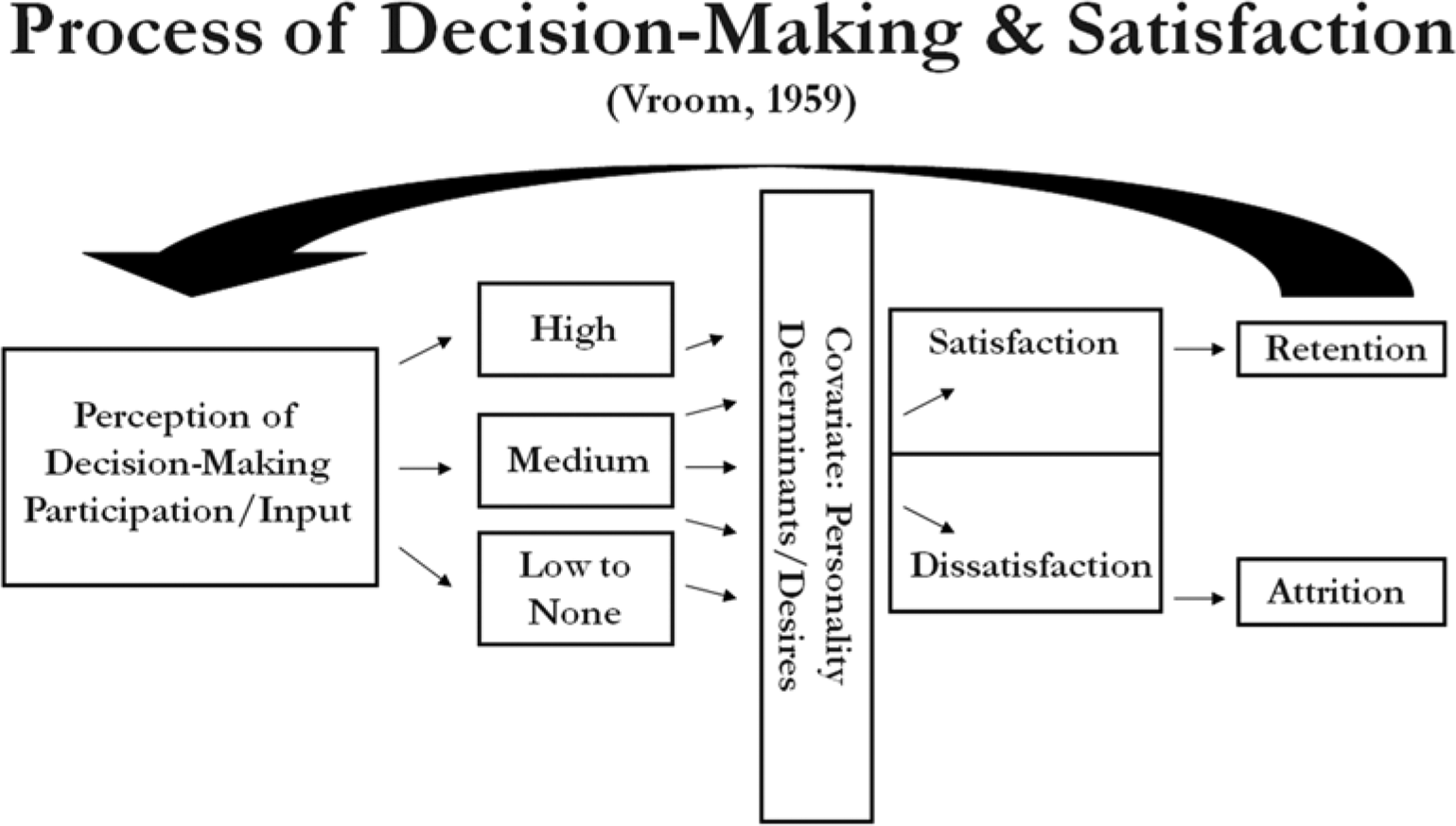
Rendering of Vroom’s (1959) organizational perspective.
Direct linear relationships seldom occur between attitudinal factors in social science research: “Many researchers and practitioners assume a somewhat linear relationship between increased participation in organizational decision making and [other] valued system outcomes . . . Yet, distinguishing pure decisional participation is a complex task” (Alutto & Belasco, 1972, p. 118). Decision-making’s contribution to employee satisfaction can depend on many other variables. Vroom and others pointed out that personality traits and contextual issues sometimes confounded relationships. In part to control for other variables, Vroom’s (1959) research approach included personality determinants, while other researchers constructed “decisional condition” continuums in study designs (Alutto & Belasco, 1972). Building on Vroom’s organizational perspective about personality determinants’ influence on decision-making and satisfaction, several researchers categorized decision-making willingness, interest, and contextual need and/or developed typologies to scale decision-making in the same way levels of job satisfaction, commitment, and performance were measured (Alutto & Acito, 1974; Alutto & Belasco, 1972; Alutto & Vredenburgh, 1977; Driscoll, 1978; Lowin, 1968; Morse & Reimer, 1956; Parasuraman & Alutto, 1984; Ryan, Healy, & Sullivan, 2012)
Skrtic’s (1991, 1995) organizational perspective
A well-recognized perspective, specific to special education in the general education organization, was developed by Skrtic (1991, 1995). Skrtic theorized that school organizations can be perceived as two organizational structures that typically coexist within an overarching education organization. Briefly, the first structure, machine bureaucracy, is the dominant organizational form in school organizations (Skrtic, 1991, 1995). The second organizational structure, professional bureaucracy, developed in schools as a subordinate form because task division, coordination, and technical demands in complex work environments required a new organizational format apart from machine bureaucracy (Meyen & Skrtic, 1995; Skrtic, 1991, 1995). Each structure retains separate ideals and practices, and consequently, each structure coexists uneasily with the other (Skrtic, 1991, 1995).
Yet a third organizational structure is possible in school organizations, an egalitarian adhocracy that is based on individual and group innovation and collaborative problem-solving. According to Skrtic (1991, 1995), in adhocratic working conditions, professionals on multidisciplinary teams, such as Individualized Education Plan (IEP) and evaluation teams, assume joint responsibility for project completion. Team members maintain essentially egalitarian viewpoints toward each other, make mutual adjustments through project stages, and communicate continually within teams. By means of mutual adjustment and informal, continual communication, team members achieve task/activity coordination “as they invent and reinvent novel problem solutions on an ad hoc basis, a process that requires them to adapt, adjust, and revise their conventional theories and practices” (Skrtic, 1991, p. 183). In fact, adhocracies depend on uncertainty and team member adaptability amid ambiguous working conditions.
Furthermore, special education laws force special education teams to function as adhocracies because laws require teams to “become problem-solving organizations in which teams of professionals collaborate among themselves and with their clients to invent personalized practices” (Skrtic, 1995, p. 216) within rigid machine and professional bureaucracy structures. The adhocratic structure—that is, the employees’ requirement to collaborate and solve unique problems for clients (children with disabilities)—is not consistent with machine bureaucracy, wherein worker behaviors are controlled through formalization and subject to hierarchical (top-down) control. Moreover, adhocratic principles and needs are not consistent with employees’ behaviors in a professional bureaucracy because, in professional bureaucracies, professionals “work alone to perfect the standard practices in their repertoire” (Skrtic, 1995, p. 217).
Because of mutually exclusive aims, expectations, and ideals of the three organizational structures, contradictions and political conflicts result. One of the most notable contradictions is that, although special educators are required by law to collaborate and participate in decision-making with other professionals, including administrators and general educators, in teams to individualize instruction and programming for clients (children with disabilities), special educators rarely experience the opportunity to collaborate with other educators or participate in making decisions (Henley et al., 2010). According to Skrtic (1995), “In practice, if it occurs at all in schools, collaboration . . . is at best rare, fleeting, and idiosyncratic” (p. 218). Indeed, special educators practice in an isolated system, despite IEP teams’ requirements to include other school professionals. Special education can therefore be perceived as a separate entity from other school organizational structures (T. Skrtic, personal communication, April 14, 2012). A rendering from Skrtic’s description is provided in Figure 4.
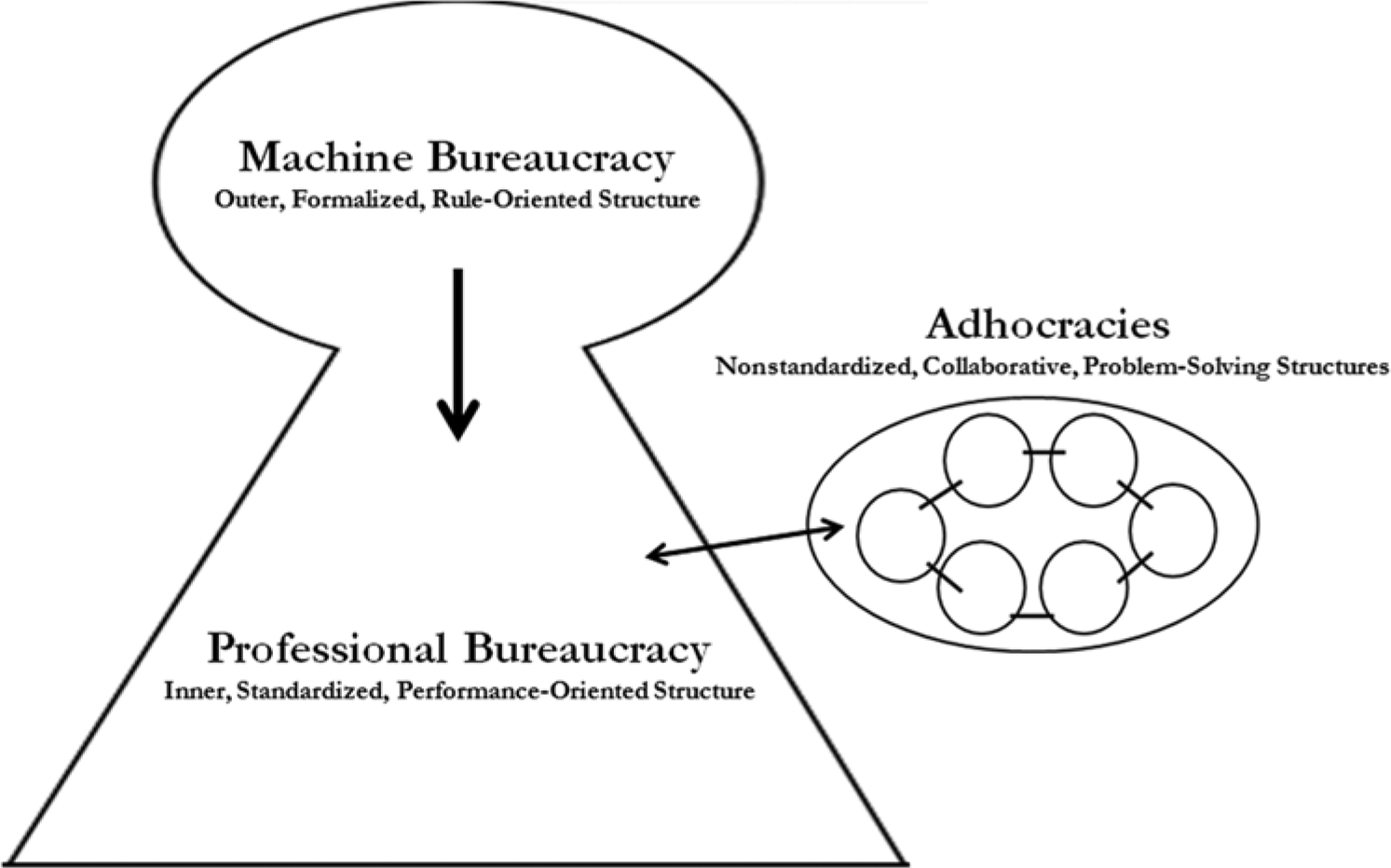
Rendering of Skrtic’s (1991, 1995, 2012) organizational structures.
A Model of Special Educator Attrition
This section describes a newly developed special educator attrition model that aggregates and adapts previously conceived models and organizational perspectives that guided attrition research. In so doing, the section interweaves an attrition model, developed by Miller et al. (1999), and two organizational perspectives, conceived by Skrtic (1991, 1995) and Vroom (1959), respectively, to guide and support a new model to explicate special educator attrition. The model can be perceived as a multilayered composite of these previous theoretical works. To explain the resulting aggregated and adapted model, this section discusses the model layers interwoven by a theoretical process.
The first model layer is composed of Miller et al.’s (1999) re-conceptualization of Bronfenbrenner’s (1976, 1979) ecological model. The second layer, Skrtic’s (1991, 1995) organizational perspective, is superimposed on the first to apply an organizational, structural lens to the ecological systems provided by the first layer. Vroom’s (1959) organizational perspective, a theoretical process that associates workplace decision-making and satisfaction, is then interwoven into the first two layers to complete the model. Although the alignment of layers is not exact, that is, the model is conceptual and abstract, not concrete, to allow for some interplay and movement of variables within layer systems and structures, the models and perspectives chosen were effectively utilized in previous attrition research studies. When aggregated and adapted, the model can be used to understand, guide, and support further attrition research. The next section describes the model’s (a) First Layer of Miller et al.’s System Variables; (b) Second Layer of Skrtic’s Organizational Structures; and (c) Interwoven Process Within Layers.
First Layer of Miller et al.’s System Variables
The first layer of the aggregated and adapted model features Brownell and Smith’s (1993) and Miller et al.’s (1999) related modifications of Bronfenbrenner’s (1976, 1979) ecological model for educational research. In Miller et al.’s model, several literature-identified variables contribute to special educator satisfaction/dissatisfaction. In fact, Miller et al. identified the location of many variables in particular ecological systems. For example, microsystem variables at the classroom/caseload level, identified by the following scholars as dissatisfaction contributors, include (a) insufficient student contact time (Kozleski, Mainzer, & Deshler, 2000; Vannest et al., 2010), (b) inadequate instructional technology (Boyer, 2005; Fratt, 2005; Kaufhold, Alverez, & Arnold, 2006; Payne, 2005), (c) insufficient classroom resources (Brownell, Smith, & McNellis, 1997; Brownell, Smith, McNellis, & Miller, 1997; Ingersoll & Smith, 2003; Kaff, 2004; Kaufhold et al., 2006; Westling et al., 2006; Whitaker, 2003), and (d) caseload size (Billingsley, 2004b; Ingersoll & Smith, 2003; Kaufhold et al., 2006; Kozleski, Mainzer, & Deshler, 2000; McCrea, 1996; McLeskey & Billingsley, 2008; Menlove et al., 2004; Russ, Chiang, Rylance, & Bongers, 2001).
Mesosystem variables, at the higher level of school environment, were identified by the following researchers as dissatisfaction contributors, and include (a) lack of administrative support related to scheduling students (Boyer, 2005; Brownell, Smith, McNellis, & Miller, 1997; Kozleski, Mainzer, & Deshler, 2000), (b) inadequate provision of educational assistants when needed (Brownell, Smith, McNellis, & Miller, 1997; Kaff, 2004), and (c) insufficient consultation/collaboration time with other educators (Billingsley, 2004a;Conderman & Johnston-Rodriguez, 2009; DeMik, 2008; Earley & Brazer, 2005; Kelly, 2004; Kozleski, Mainzer, & Deshler, 2000; LHospital & Gregory, 2009; Quigney, 2009; Whitaker, 2003; York-Barr, Sommerness, Duke, & Ghere, 2005).
Exosystem variables, at the highest system of school/district organizations, were identified by the following scholars as dissatisfaction contributors and consist of (a) policies governing professional development (Billingsley, 2004a; Boe & Bobbitt, 1997; Brownell, Smith, McNellis, & Miller, 1997; Darling-Hammond, 2003; Fennick, 2003; Gersten, Keating, Yovanoff, & Harniss, 2001; McLeskey & Billingsley, 2008; Skrtic, Harris, & Shriner, 2005; Thornton et al., 2007), (b) due process paperwork overload (Fratt, 2005; Kaff, 2004; Kozleski, Mainzer, & Deshler, 2000; Menlove et al., 2004; Nance & Calabrese, 2009; Plash & Piotrowski, 2006; Skrtic et al., 2005), and (c) insufficient curriculum/instruction (Brownell & Smith, 1993; Brownell, Smith, McNellis, & Miller, 1997; Kozleski, Mainzer, & Deshler, 2000; Miller et al., 1999; Nelson, 2004). A conceptual illustration is presented in Figure 5. Although not inclusive of every special educator dissatisfaction and attrition contributor, the variables were identified as significant contributors across studies.
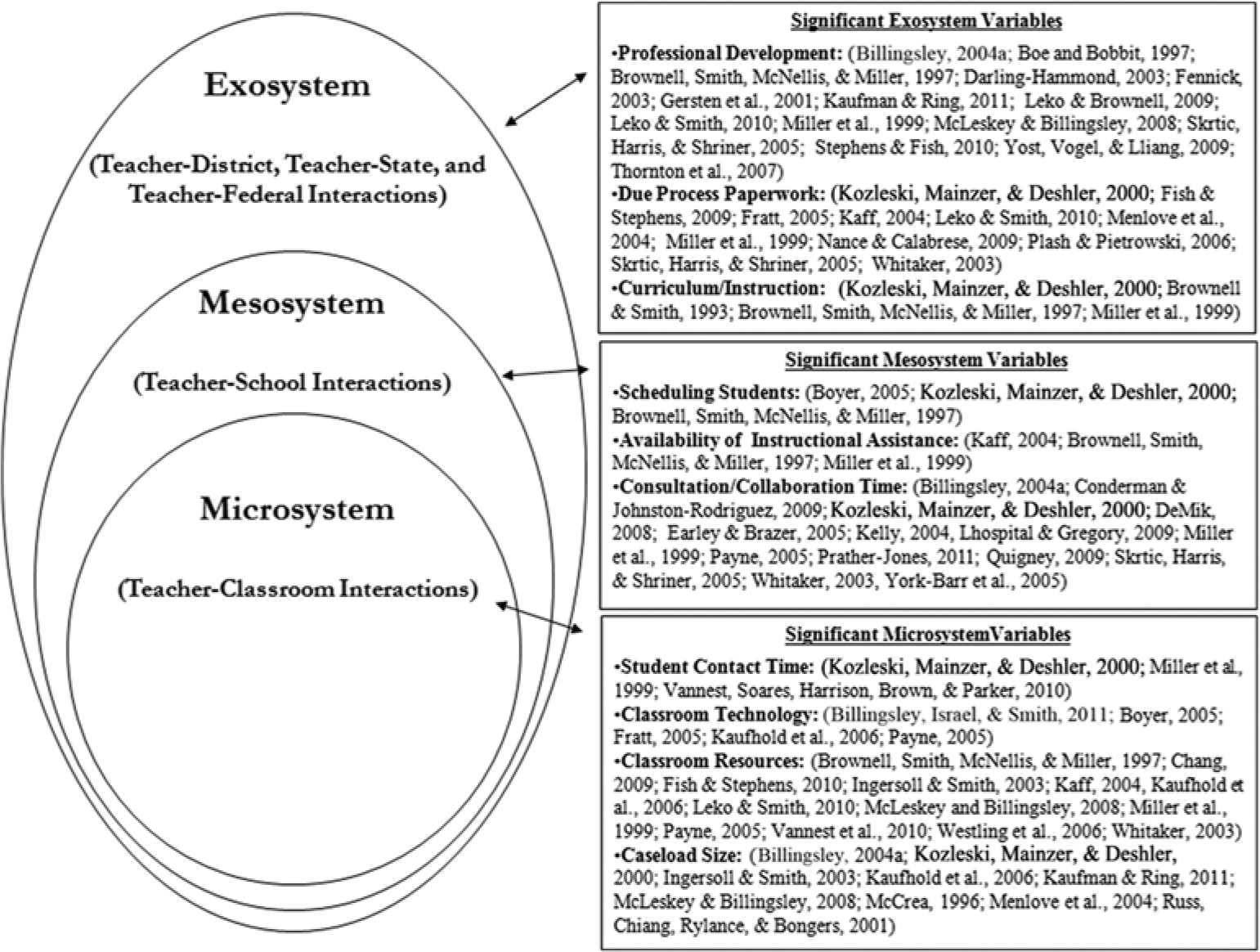
Tyler’s (2012) aggregated and adapted model first layer with system-associated variables.
Second Layer of Skrtic’s Organizational Structures
The second layer of the conceptual model superimposes Skrtic’s (1991, 1995) organizational structures onto Miller et al.’s (1999) modified ecological systems model. The second layer, however, is adapted from Skrtic’s original conception that, for the most part, excludes special education professionals from the dual bureaucracies of school organizations (T. Skrtic, personal communication, April 14, 2012). Instead, the layer includes special educators within the professional bureaucracy structure, albeit with the understanding that special education requires a high degree of collaboration about due process documentation that is unique to special educators. These legal requirements, in particular, set special educators apart from their regular educator counterparts, who are not legally mandated to work in teams. Skrtic’s structures are superimposed on the systems layer not only to provide an organizational perspective to the model but also describe a conceptualized pattern of special educators’ decision-making practices in each system/structure. The section addresses the model’s second layer structures and decision-making patterns.
When the organizational structures are adapted to coexist, each structure from Skrtic’s (1991, 1995, 2012) theory can be perceived to align, in an abstract rather than concrete fashion, with a corresponding system from Miller et al.’s modified ecological model to form an aggregated and adapted model. Although the alignment is not exact, Miller et al.’s systems and Skrtic’s organizational structures are strikingly similar. When viewed from an ecological perspective, Miller et al.’s model permits an investigation of teachers’ affective responses to specific variables in system locations. When viewed from the perspective of organizational structures, Skrtic’s structures permit the same investigation with the added organizational perspective of decision-making requirements and practices.
For example, in the first of Miller et al.’s (1999) systems, microsystem-level interactions (classroom and/or caseload setting interactions) can be viewed to align with an adhocratic organizational structure. Variables identified at the microsystem level can be perceived to exist simultaneously as variables in an adhocracy structure. Indeed, certain variables identified in literature and practice lend themselves to relatively more collaborative decision-making by special educator/teacher teams than others at higher system levels (such as the mesosystem or exosystem). Furthermore, case management variables such as (a) student contact time, (b) technology, (c) instructional materials and supplies, and (d) caseload/classroom size, identified at the microsystem level, can be simultaneously considered adhocratic structure variables. Special educators in personal/team-oriented organizational settings (or team/classroom microsystems) must, by law and practice, participate in decision-making activities to serve caseload clients (Skrtic, 1995).
Collaborative practices, however, are not uniformly encouraged in the overarching bureaucratic organizational structures. Although collaborative decision-making in adhocracies is based on professional, specialized knowledge, adhocracies uniquely depend on innovative, collaborative input from various sources that can emerge from inside as well as outside of adhocratic teams. In fact, adhocratic decision-makers typically reach out in various directions as they seek resources for problem-solving. This decision-making pattern can be conceptualized to originate within adhocratic groups and flow outward across other structures and systems in attempts to collaborate with any groups that can offer assistance with the problem at hand. Machine and professional bureaucracies do not always support adhocracies in schools, however. Special educators’ decision-making practices and needs can therefore be frustrated in the microsystem/adhocratic structure (Miller et al., 1999; Skrtic, 1995).
In the second of Miller et al.’s systems, mesosystem schoolwide interactions can be viewed to align with the professional bureaucracy structure. For example, special educators, like other teachers in the school setting (mesosystem), participate in specialized activities to meet rational/technical demands of the teaching profession (Skrtic, 1995). Decision-making in the professional bureaucracy structure is highly specialized, performance-oriented, rational/technical, and isolated within professional (specialized) groups or departments (1995). Decision-making practices in the professional bureaucracy structure can be conceptualized as a pattern that originates and remains in the professional bureaucracy.
Many case management tasks and duties can be perceived within the rational/technical category, such as eligibility testing and progress monitoring. The individualized needs of clients/schoolchildren with disabilities, as these needs relate to IEPs and programs, however, often demand innovative approaches and team-oriented decision-making practices. In fact, variables in the mesosystem/professional bureaucracy structure are identifiable in literature and practice, about which special educators need to collaborate in decision-making. The variables include (a) consultation/collaboration time with other educators, (b) scheduling students, and (c) availability of educational assistants when needed. Yet, adhocratic team approaches in mesosystem/professional bureaucracy are not pursued or generally supported in schools (Skrtic, 1991, 1995, 2012). Special educators’ decision-making practices and needs can therefore be frustrated in the mesosystem/professional bureaucracy structure (Miller et al., 1999; Skrtic, 1991, 1995, 2012).
In the third of Miller et al.’s systems, exosystem interactions (teachers in districts and state/federal governments) can be perceived to align with the outer machine bureaucracy structure. More so than in the micro- and mesosystems, in the exosystem, special educators carry out decisions of superordinates because of scientific management principles predominant in the machine bureaucracy of American schools (Skrtic, 1995). The decisions generally relate to district, state, and federal policies, rules, and guidelines promulgated by educational authorities in the broadest system of educators’ workplace experiences. Variables in the exosystem/machine bureaucracy structure are relatively difficult for individual teachers/special educators to control because the variables are subject to higher authorities and various governmental policies and mandates. In essence, bureaucratic structures in education conflict with special educators’ adhocratic needs and desires. Tension and resulting stress contribute to dissatisfaction and, ultimately, to special educator attrition.
To illustrate, special educators need decision-making input about some exosystem/machine bureaucracy structure variables, such as (a) due process paperwork/meetings, (b) policies governing professional development, and (c) practices related to curriculum and/or instruction. The predominant pattern of decision-making in a machine bureaucracy, however, is hierarchical, from the top-down: Decisions are most often made among organizational leaders and are followed by employees at lower organizational levels. Special educators who need adhocratic team approaches to decision-making are more likely to face frustration, stress, and dissatisfaction in the exosystem/machine bureaucracy structure due to system/structural clash. This clash occurs because the adhocratic structure preferred (and needed) by special educators does not serve the bureaucratic needs of typical school governance systems (Skrtic, Horn, & Clark, 2009). Therefore, special educators’ decision-making practices and needs are often frustrated in the exosystem/machine bureaucracy structure.
Interwoven Process Within Layers
To incorporate educators’ perceptions about workplace decision-making, the aggregated and adapted model highlighted in this article includes Vroom’s (1959) organizational perspective, a theoretical process about workplace decision-making and satisfaction that is grounded in social psychology. To review, Vroom associated perceptions of decision-making and personality determinants with workplace satisfaction. Vroom found that the higher the level of employees’ perceived decision-making, the higher the level of employees’ job satisfaction, on average. The model described in this article borrows Vroom’s decision-making hypothesis and employs a similar conceptual process.
When Vroom’s perspective is woven into the first two model layers, the result is a multilayered, aggregated, and adapted model. One can perceive special educator (or other employee) decision-making input as a continuous process within the educational organization that consists of complex, interacting systems and structures. The first layer of the model, from Miller et al.’s (1999) systems, is combined with the second layer, Skrtic’s (1991, 1995) organizational structures. Vroom’s perspective, the process of workplace decision-making’s positive relationship with satisfaction, is interwoven in the layers to complete the model. The hypothesized effect of the decision-making/satisfaction process on special educators is various levels of satisfaction and/or dissatisfaction that lead either to satisfaction and probable career decisions to remain in current special education positions, or dissatisfaction and probable career decisions to depart. A conceptual illustration of the aggregated and adapted model is provided in Figure 6.
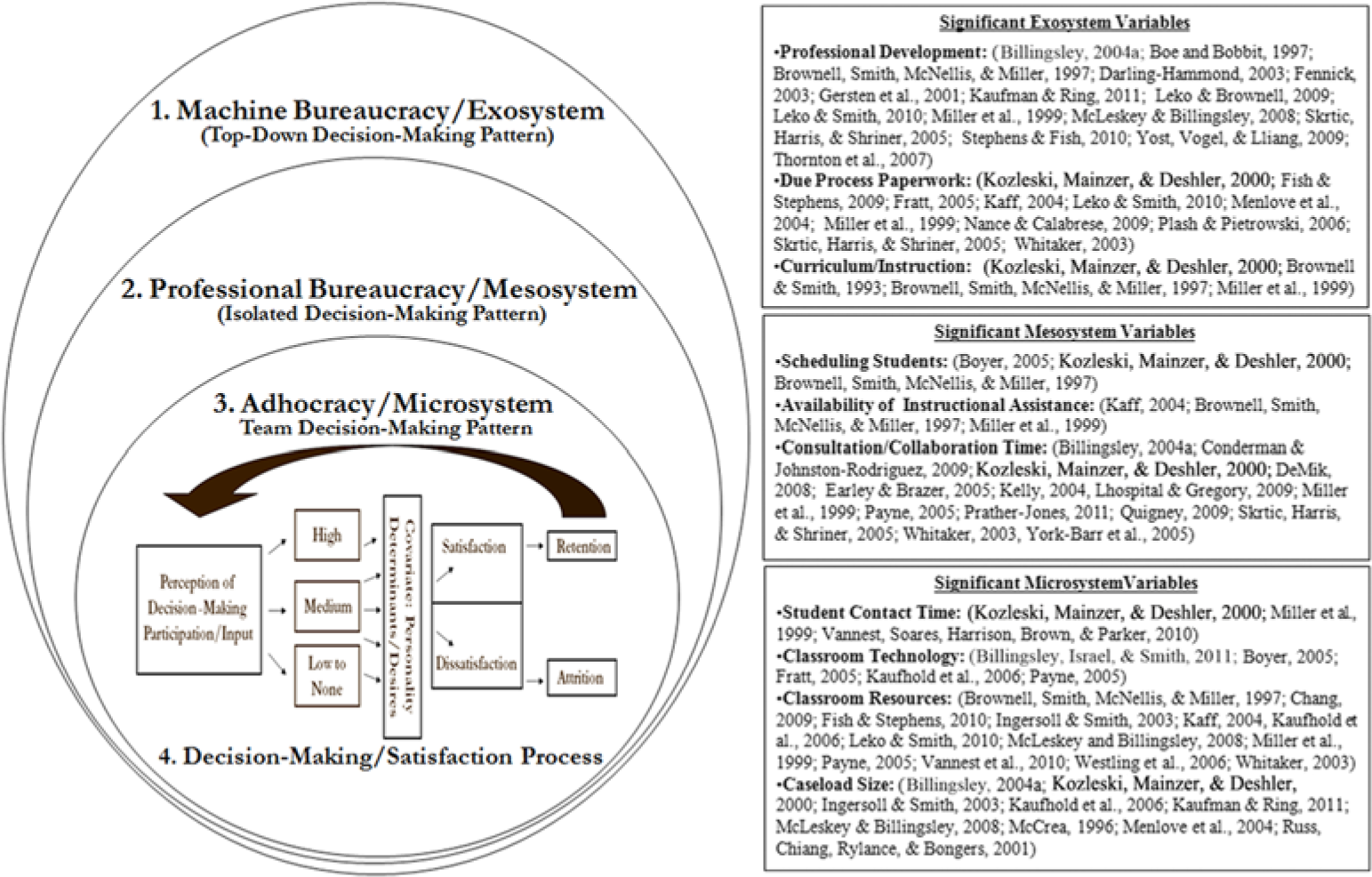
Tyler’s (2012) aggregated and adapted model layers with interwoven decision-making/satisfaction process.
Implications of the Model
In this article, an aggregated and adapted model of special educator attrition is advanced to highlight workplace decision-making. The model has the potential to provide guidance to educational administrators. We suggest two broad implications for school/district leaders who are concerned about special educator attrition. In addition, we suggest three implications for researchers who are interested in further investigation of the topic. A discussion of the model’s usefulness for these groups is discussed in the next two subsections: (a) Guidance for School Administrators and (b) Guidance for Researchers.
Guidance for School Administrators
The first implication for administrators is that priority should be given to teacher decision-making participation in schools. Simply stated, administrators need to understand the importance of decision-making’s role in special educators’ perceptions of job satisfaction. In general, if special educator attrition minimization is an important organizational goal in schools/districts, administrators should not only increase decision-making participation by special educators in a broad sense but also give high(er) priority to teacher collaborative work. Indeed, school/district leaders who are aware of teachers’ decision-making preferences are more likely to meet teachers’ needs and desires for workplace decision-making participation, and thereby increase special educator job satisfaction and lower attrition, than leaders who lack this awareness.
In fact, because of the nature of special education legal requirements for special educators to work collaboratively on IEP and evaluation teams, administrators should be especially aware of the universality of special educators’ experienced needs to make substantive workplace decisions. Therefore, educational administrators should expect special educators to decide relevant work issues and advocate for special educators to problem-solve, not only at lower system/organization levels but also at all school district levels. In other words, administrators should understand the adhocratic structural requirements, that is, the mandated teamwork, that is inherent in special educators’ highly individualized, focused work with students who have disabilities. Indeed, administrators should not only support and advocate for adhocratic working environments for special education teams but should also become an integral part of the special educators’ decision-making processes. Indeed, each IEP team is mandated to include an administrator; therefore, administrators need to attend not only to the letter of the law but also to the individual needs of special education teams. After all, these teams, by the very nature of special educators’ work, function as adhocracies (Skrtic, 1991, 1995), groups that come together to solve the unique problems of individual clients. Administrators can view special education adhocracies as an opportunity to build stronger schools, not as a burden that must be tolerated.
In sum, when administrators understand the need for adhocracy in special education and become advocates for teacher decision-making, administrators can begin to experience better special educator satisfaction and retention. Furthermore, increased teacher decision-making should cost little to schools, other than time and training. Moreover, increased teacher decision-making can probably increase teacher satisfaction and retention significantly at relatively low cost to schools and districts.
The second implication is articulated as a set of practical suggestions to guide educational administrators. Examples given are not exhaustive. Certainly, administrators who desire to increase teacher decision-making participation should inquire into the needs and preferences of individual teachers and divisions in schools. Included here are but a few literature-identified suggestions from the model: (a) Classroom Adhocracy/Microsystem, (b) School Professional Bureaucracy/Mesosystem, and (c) District Machine Bureaucracy/Exosystem.
Classroom adhocracy/microsystem
At the classroom level (adhocracy/microsystem), teachers’ interactions occur within the classroom among teachers and students, for the most part. Variables such as student contact time, classroom technology, classroom resources, and caseload size (see Model Section 3, Figure 6) should be subject to special educator decision-making. For example, at this level, administrators should advocate for special education decision-making participation about frequency and duration of student–teacher contact time, because special educators are generally most knowledgeable about individual student needs to provide educational benefit and maximize student achievement. Administrators should also expect, and provide support for, special educator decision-making participation about classroom technology needs, not only for special education classrooms but also for students’ individual, assistive-technology needs. These needs should include professional development/training for existing and emerging technologies, the implementation and/or most effective uses of which special educators may not be knowledgeable. Similarly, administrators should support increased special educator decision-making participation about basic resources needed in classrooms, such as materials, equipment, and supplies. In the same vein, administrators should encourage special education teams to make decisions about equitable caseload and class sizes to avoid perceived work overload.
School professional bureaucracy/mesosystem
At the school level (professional bureaucracy/mesosystem), teachers’ interactions occur mostly between classrooms and other support facilities within the larger school setting. Variables such as scheduling of students, availability of instructional assistance, and collaboration/consultation between special educators are included at this level (see Model Section 2, Figure 6), and special educator decision-making participation should be given priority and supported in the broader school setting. For example, administrators should expect and support increased special educator decision-making input about student scheduling. Although group and class scheduling is generally an administrative task, students with special needs oftentimes need careful scheduling, placement in smaller groups, and/or protected school/classroom environments, depending on individual requirements. Because special educators usually possess the most in-depth knowledge in the school setting about these students, special educator participation in scheduling will most likely maximize benefits to these students. Administrators should also encourage special education teams to participate in discussion and decision-making about para-educator/teaching assistant placement for the greatest benefit of disabled students. Furthermore, increased collaboration and group decision-making among teachers necessitate sufficient time resources, another significant variable located at this model level. Administrators should therefore support special educator team consultation and collaboration time during the professional day, that is also preferably subject to special educator team decision-making.
District machine bureaucracy/exosystem
At the district level (machine bureaucracy/exosystem), teachers’ interactions occur mostly between schools within the district, community, and state/federal setting. These level variables include professional development, due process paperwork, and curriculum/instruction (see Model Section 1, Figure 6). As at other model levels, special educator decision-making participation should also be increased for these variables within the school district. For example, administrators who are concerned about special educator job satisfaction should advocate for special educator decision-making input about the provision of professional development to enhance special educators’ classroom practices and remain current in changing legal standards. Administrators should also seek special educator decision-making participation about due process paperwork, including special educators’ ability to delegate evaluations and individual education plans to trained professionals to increase student–teacher contact time. Similarly, administrators should request decision-making participation from special educators about general and specialized curriculum and instructional methods utilized in classrooms.
Although educational administrators can encourage decision-making at all model levels, the process is arguably more difficult to enact at the machine bureaucracy/exosystem level because of state and federal political and governmental mandates at that level (Skrtic, cited in Skrtic et al., 2005; see Model Section 1, Figure 6). For example, the federal law, Individuals With Disabilities Education Act (IDEA), mandates Child Find, eligibility testing, and IEP writing, among other educational obligations that are not usually subject to district control. Yet, administrators need not be prevented from encouraging participative methods to meet the mandates. For example, administrators can and should seek out the creativity and ingenuity of special educators, who are most knowledgeable about due process paperwork and case management for innovative ways to meet these responsibilities. Administrators can permit the delegation of many due process tasks to trained personnel other than special educators, including clerical assistance with paperwork (Billingsley, 1993), and balanced and shared responsibilities among special educators for more manageable workloads (Gersten et al., 2001).
To illustrate, in some state school districts, special educators are encouraged to make decisions about time allocation for student evaluations, due process paperwork, and other compliance-related tasks among teams instead of within caseloads. When responsibilities are perceived as equally divided among team members who collaborate, the perception of work overload can decrease (Fennick, 2003; Skrtic, Harris, & Shriner, 2005; York-Barr, Sommerness, Duke, and Ghere, 2005). Furthermore, although austere school district budgets constrain professional development, inexpensive training can be designed and disseminated by special educators as part of collegial learning communities (Miller et al., 1999). In sum, although some variables seem intractable at the district and state/federal level, special educator decision-making should be promoted to manage them. Administrators who do so are likely to maximize on-the-job satisfaction of these educators and therefore minimize the incidence of special educators attrition in schools.
Guidance for Researchers
To review, workplace decision-making repeatedly surfaced in previous educator attrition studies (Billingsley, 1993; Ingersoll, 2001; Miller et al., 1999; Skrtic et al., 2005). Although less researched because of the difficulty of isolation from other variables in complex workplace systems, among other reasons, decision-making as an independent variable interested researchers from other social science fields apart from education (Alutto & Vredenburgh, 1977; Morse & Reimer, 1956). Significant results of these studies implied that employee satisfaction is an attitude/construct that can be explained by employees’ workplace decision-making perceptions that can also depend on individuals’ desires and needs (Alutto & Acito, 1974; Alutto & Belasco, 1972; Driscoll, 1978; Lowin, 1968; Morse & Reimer, 1956; Parasuraman & Alutto, 1984; see Model Section 4, Figure 6).
With the guiding model in mind, we suggest three broad implications for researchers. First, apart from the studies just mentioned, little exists in the literature that pertains to workplace decision-making’s contribution to teacher satisfaction when decision-making is applied to other primary thematic factors. The aggregated and adapted model holds promise for the explanation and support of this contribution and is yet to be studied. For example, we know that due process paperwork overload and insufficient professional development are variables that contribute to special educators’ perceptions of dissatisfaction, and then to increased attrition (Nance & Calabrese, 2009; Prather-Jones, 2011). We do not know to what extent perceptions might alter if we apply workplace decision-making to these, or other, variables. The aggregated and adapted model provides a conceptual framework for this process at any level where the decision-making process is applied to level variables. For example, if perceptions of teacher satisfaction were to be measured with, and then without, decision-making about level variables, would a significant difference in job satisfaction result? To be sure, whether and to what extent decision-making (about these variables) correlates with job satisfaction and decreased attrition remains to be studied. The aggregated and adapted model offers a framework for future research.
Second, the model’s interwoven decision-making process is designed to permit individual variation. The process implies that, although certain variables are related to satisfaction and attrition, teacher/employee satisfaction is further influenced (moderated or mediated) by individuals’ personality traits, needs, and/or preferences. In effect, workplace decision-making promises to explain job satisfaction, in general, but the degree of this relationship might depend on personality determinants, requirements, and/or desires. For example, research points to paperwork overload, insufficient professional development opportunities, and inadequate classroom resources as three primary factors that contribute to dissatisfaction, in general. Despite the adhocratic nature of special education positions, not all special educators need or prefer to make decisions about these (or other) variables. Internal influences, such as personality determinants (Vroom, 1959) and contextual (specific job) requirements and preferences (Driscoll, 1978; Morse & Reimer, 1956; Parasuraman & Alutto, 1984), can also affect job satisfaction. In fact, those researchers who included individuals’ decision-making inclinations in studies (e.g., Alutto & Acito, 1974; Alutto & Belasco, 1972) suggested that satisfaction measurement should include both contextual (job) requirements and individual preferences for precision and reliability. In effect, the model’s decision-making process is designed to support research that focuses on both general decision-making propensities and individual variation.
Third, the model is potentially useful for researchers across sectors, apart from K-12 education. Based on organizational perspectives grounded in social psychology, workplace decision-making’s relationship with employee satisfaction, motivation, and work performance was investigated in other organizational settings (Alutto & Vredenburgh, 1977; Driscoll, 1978; Vroom, 1959) with significant results. Conceivably, the model’s decision-making process is applicable to other fields where factors that contribute to workplace satisfaction and attrition are evident, such as business/industry, nursing, and higher education.
The aggregated and adapted model represents a relatively complex educational system. In the model, teachers’ affective responses depend on the extent to which teachers perceive the ability to make decisions about work setting variables. In summary, the more teachers perceive the ability to make decisions, the higher their satisfaction level will be, on average. Teachers’ decision-making level ultimately depends on administrators’ openness, willingness, advocacy, support, and encouragement. The hiring of administrators with these noted predispositions appears to be an important factor in the retention of special educators. Without a doubt, the hiring implications for district-level administration and leadership are clear.
Footnotes
Declaration of Conflicting Interests
The author(s) declared no potential conflicts of interest with respect to the research, authorship, and/or publication of this article.
Funding
The author(s) received no financial support for the research, authorship, and/or publication of this article.