






Abstract
Intended as professional development for both new and experienced special educators, this article provides both the basic requirements and nuanced issues for foundational, successive, and overlapping key components under the Individuals With Disabilities Education Act (IDEA): (a) child find, (b) eligibility, and (c) free appropriate public education (FAPE). The introductory section identifies ensuing IDEA components along with relatively recent references for each of them. Next, the section for each component includes the pertinent IDEA statutory provisions or regulations, the basic criteria, one or more nuanced issues, and illustrative court decisions of recent vintage. This treatment shows that the key components are not mutually exclusive, scientifically or professionally precise, or clearly uniform in their case law interpretations and applications. The concluding section offers suggestions for teacher educators for improving the relevant and useful legal knowledge of future special educators. It also provides the culminating message that maintaining current legal literacy is challenging but useful within the larger context and primary purpose of achieving effective results for students with disabilities via communication and collaboration with parents.
Keywords
Special education is the most legalized segment of P-12 schooling. The Individuals With Disabilities Education Act (IDEA; 2013), originally traceable to funding legislation in 1975, has become increasingly detailed and prescriptive based on successive reauthorizations, with the latest being the 2004 amendments. The IDEA regulations (2014), with the latest version issued in 2006, number more than 200 pages, along with extensive accompanying commentary. Based on the concept of “cooperative federalism” (Schaffer v. Weast, 2006, p. 52), which provides for state variations above? the federal foundation, state special education statutes and regulations fill out the framework. Finally, built on this framework, is the pyramid, or “iceberg” (Zirkel & Machin, 2012, p. 486), of hearing/review officer and court decisions that interpret and apply the statutory and regulatory rules. At a time when overall education litigation has largely leveled off, the special education segment has continued its upward trajectory (Karanxha & Zirkel, 2014; Zirkel & Johnson, 2011). The recent reduction in the national number of adjudicated due process hearings (Zirkel, 2014b), however, suggests a possible stabilizing maturation.
The purpose of this article is to provide an organized overview of key components of special education law, along with a sampling of their litigation interrelationships and intricacies, for teacher educators in special education. It is intended as an educational tool in the context of either self-review or group instruction. The coverage is limited to the three initial and successive building blocks culminating in the main floor of the IDEA—(a) child find, (b) eligibility, and (c) free appropriate public education (FAPE). Thus, it serves as the foundation for other significant components, such as least restrictive environment (LRE) and remedies. Moreover, it does not include the more specialized issues under the IDEA, such as burden of proof (Conroy, Yell, & Katsiyannis, 2008; Zirkel, 2013i), finality (Zirkel, 2013d), functional behavioral assessments (Losinski, Katsiyannis, & Ryan, 2014; Zirkel, 2011a), independent educational evaluations (Zirkel, 2009), manifestation determinations (Zirkel, 2010), response to intervention (RTI; Zirkel & Thomas, 2010), and stay-put (Zirkel, 2013h). Finally, it does not extend to the overlapping but distinguishable coverage of Section 504 of the Rehabilitation Act and its sister statute, the Americans With Disabilities Act (e.g., Zirkel, 2012a).
Special education teachers need legal literacy in each of these three building blocks due to their key role in implementing the IDEA. For example, teachers serve as not only primary informants but also as initial gatekeepers in the child find process, which starts with reasonable suspicion that a child may qualify under the eligibility standards of the IDEA. They are the source or screener of several of the potential “red flags” of reasonable suspicion, such as the child’s behavior, academic performance, attendance, and classroom interventions (Zirkel, in press). Effective teacher education with regard to scope and sequence of child find, eligibility, and FAPE may mean the significant difference between prophylactic practice and losing litigation.
Figure 1 shows the framework for this article. Serving as the culminating hub of the figure, “the central pillar of the IDEA” (Sytsema v. Academy School District, 2008, p. 1312) is the statutory obligation to provide each eligible student with a “free appropriate public education” (FAPE). Leading up to this pillar are the overlapping components of child find and eligibility, interconnected by evaluation. On the other side and covered elsewhere are subordinate IDEA components that interlock with FAPE (e.g., Zirkel, 2014a), such as the statutory preference for the LRE (e.g., Bon, 2009; Diaz, 2013-2014), or that flow from denials of FAPE, such as the primary remedies for denials for FAPE—tuition reimbursement (e.g., Zirkel, 2012b) and compensatory education (e.g., Seligmann & Zirkel, 2013). Each of the remaining parts of this article explains each of these successive components and identifies illustrative interconnections and nuances.
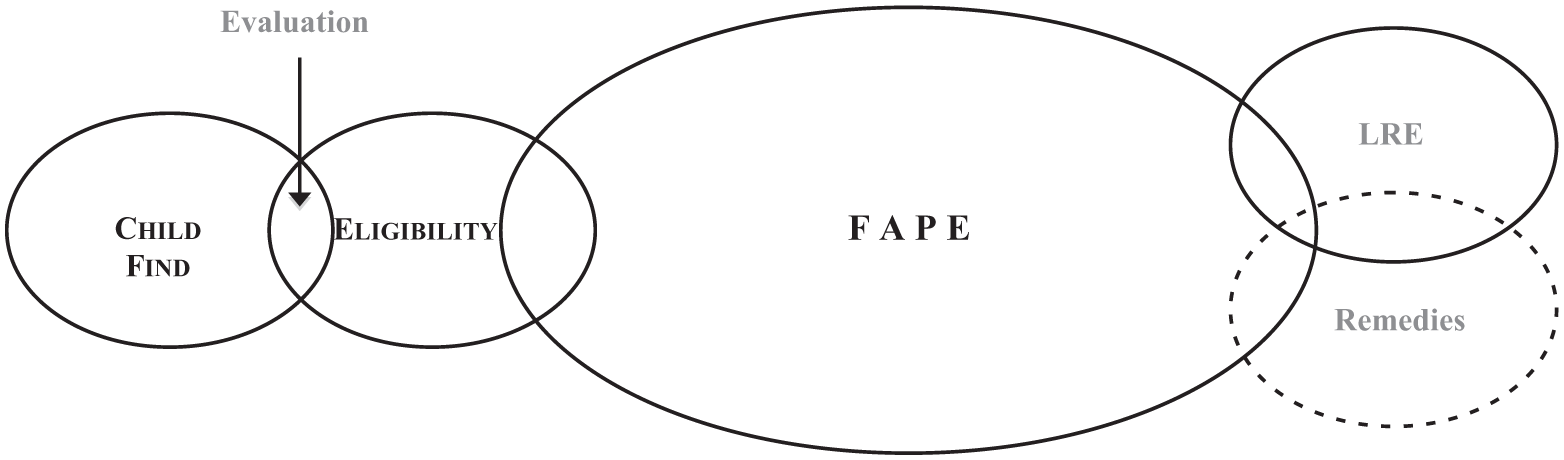
Key components of special education litigation.
Child Find
Unlike the original collective child find obligation of the IDEA, which is expressly part of the statute (§ 14112[a][e]) and which is aimed at identifying, locating, and evaluating eligible students generally, the modern meaning of child find has a judicially refined individual focus. More specifically, the child find litigation in recent years has focused on two successive issues, as shown in Figure 2: (a) Did the district have reason to suspect that the child may be eligible? and, if so, (b) Did the district fulfill its IDEA evaluation obligation within a reasonable period of time?
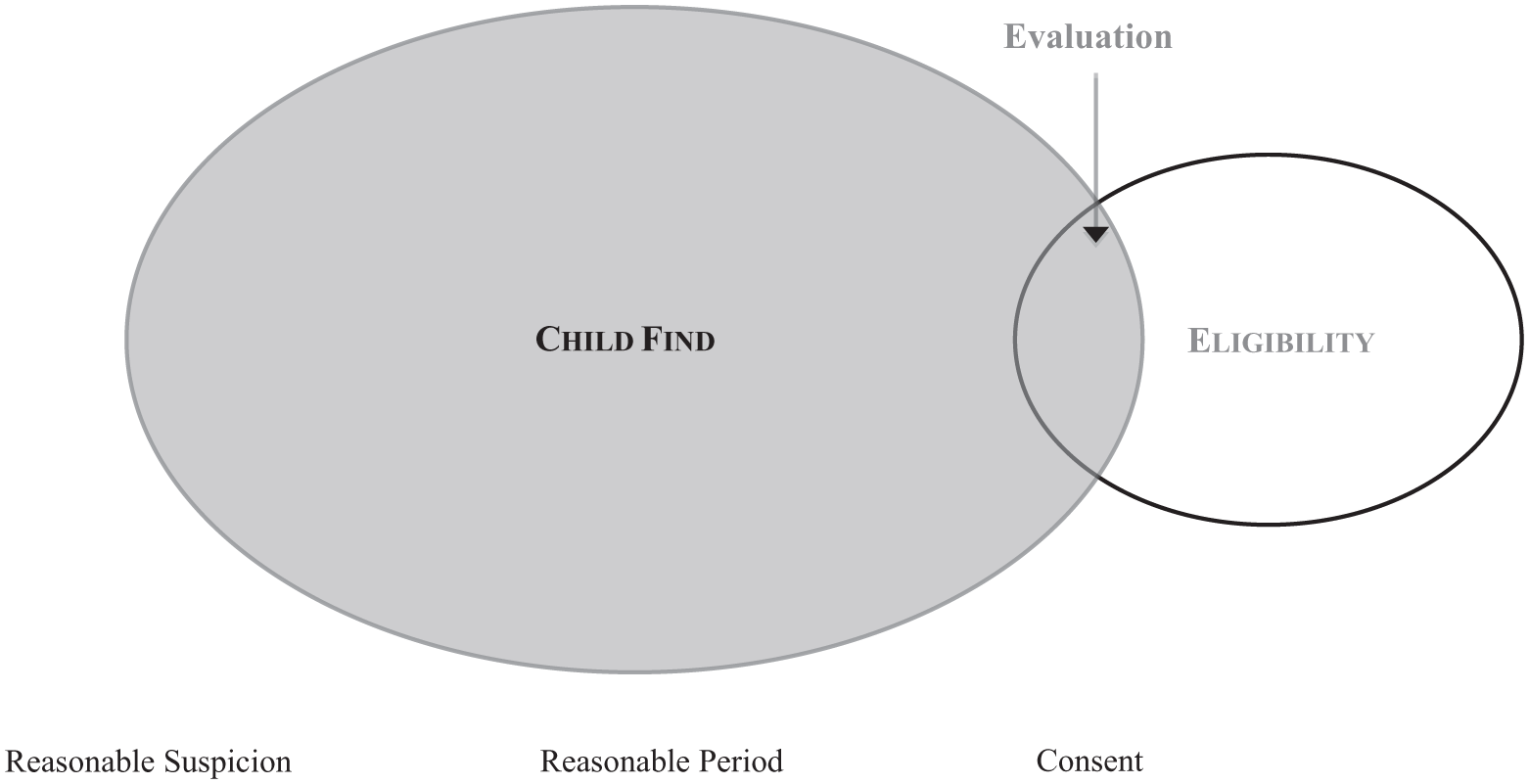
Focus on child find.
The intertwined next step and, thus, the typical remedy is an evaluation, which is a legal issue itself (Etscheidt, 2003; Zirkel, 2013f). Depending on the scope of the case, however, the components of the adequacy of the evaluation, the eligibility of the child, and the possible denial of FAPE may come into play.
Basic Example
An illustrative case in Pennsylvania presented the following facts within the 2-year statutory limitations period:
January of Grade 1: Teacher placed the student in a social skills group in response to his behavioral problems.
April of Grade 1: District conducted an evaluation at parental request, determining the child not to be eligible.
Grade 2: Student received extra help in reading and math with generally positive but not optimal results.
March of Grade 2: Student’s therapist, who had started treating the student 3 months earlier due to continued behavioral issues, provided school personnel with her recommendation for special education services but did not press further after district provided her with Grade 1 evaluation report.
June of Grade 2: Parent informed school personnel of diagnoses of auditory processing disorder and sensory stimulation problems.
September of Grade 3: Parents provided school with private pediatric neurological evaluation of attention deficit hyperactivity disorder (ADHD).
November of Grade 3: District conducted evaluation that found the student eligible as other health impaired, leading promptly to an Individualized Education Program (IEP).
In response to the parents’ child find claim for compensatory education, the Third Circuit Court of Appeals upheld the hearing officer and lower court’s decisions in favor of the district (D.K. v. Abington School District, 2012). First, the Third Circuit concluded that in January of Grade 1, the district did not have the requisite reasonable suspicion in light of the behavioral norms associated with early primary grades and the student’s inconsistent but overall academic progress. Second, the appellate court ruled that the subsequent evaluation in Grade 1 was appropriate under the IDEA, because (a) it used multiple measures to assess discrepant skill sets, (b) the IDEA did not require it to include a functional behavioral assessment, and (c) the opposite outcome of the evaluation in Grade 3 was not necessarily determinative on a retrospective basis. Third, the D.K. court viewed the district’s actions in the interim between the two evaluations as “proactive” (the D.K. v. Abington p. 252), thus, disproving not only violation of the reasonable suspicion and reasonable time criteria but also the alleged denial of FAPE. Other courts have reached different conclusions on these reasonableness standards based on various factors, including the specific factual nuances of the case, the deference to lower adjudicatory levels, and the particular disposition of the judge(s), although the clear majority have an outcome—contrary to best practice, proactive standards—in favor of the defendant districts (Zirkel, in press). In any event, the case illustrates the flexible contours of child find and their overlap with other, subsequent components.
Complex Example
Another relatively recent federal appeals court decision illustrates a more perplexing twist of child find and its interrelationships. Here are the key facts:
October of Grade 9: District assigned student to its alternative school based on recent behavioral incidents (e.g., stealing cafeteria food and skipping class).
November of Grade 9: Parent shared with district private diagnosis of ADHD originally issued in Grade 5 and requested Section 504 accommodations.
January of Grade 9: District team determined that student was eligible under Section 504 and, after receiving a current private psychological evaluation, issued a 504 plan that provided various accommodations, including return to main campus, regular counseling, and shortened assignments.
March of Grade 9: District team reassigned student to the alternative school, after determining that his continued truancy and disruptive behavior were not a manifestation of his disability.
April of Grade 9: Parent obtained private neurological diagnosis of Tourette syndrome.
Late April in Grade 9: Parent filed for a due process hearing under the IDEA, claiming a child find violation resulting in the denial of FAPE.
Early May of Grade 9: District requested parental consent for an evaluation.
Mid-August of Grade 10: Parent signed the evaluation consent form.
November of Grade 10: District concluded, after post-evaluation extension, that the student was not eligible under the IDEA.
Early January of Grade 10: Hearing officer issued decision that student was not eligible.
Late January of Grade 10: Parent provided district with recent diagnosis from student’s physician of rheumatoid arthritis, resulting in IEP that included adaptive PE and shortened school day.
June of Grade 11: Federal trial court concluded that district had violated child find, ordering it to provide 1 year of compensatory education for denial of FAPE (from November in Grade 9 to November in Grade 10) and US$50,000 in attorneys’ fees.
On appeal, the Fifth Circuit reversed the orders for compensatory education and attorneys’ fees (D.G. v. Flour Bluff Independent School District, 2012). The key was the appellate court’s ruling that district’s evaluation in November of Grade 10 had appropriately determined that the student was not then eligible—in contrast with the more recent diagnosis of rheumatoid arthritis—under the IDEA. Although finding that the trial court’s clearly erroneous findings that the ADHD diagnosis was in Grade 9 and that the district’s evaluation was late may have contributed to its child find conclusion, the Fifth Circuit ruled, “In any event, IDEA does not penalize districts for not timely evaluating students who do not need special education” (p. 893).
This logic, although fitting with the nominal coverage of the IDEA, leaves in question districts’ liability for child find violations, when the overlapping issue of eligibility is not in favor of the child.
Eligibility
The Basics
In any event, the two foregoing child find cases illustrate that eligibility under the IDEA is a two-part test, as shown in Figure 3: (a) Does the child meet the criteria of one or more of the recognized classifications under the IDEA? (b) If so, does the child have a resulting need for special education? Most of the recognized classifications, such as emotional disturbance (ED), intellectual disability (ID), or other health impairment (OHI), expressly include adverse effect on educational performance as one of the definitional elements, although it is inferable for all of them. Thus, most courts treat this adverse-impact element as, in effect, the bridge between the two key criteria, reinforcing the causal connection and setting the stage for the extent of impact via the need for special education. Within this overall framework, courts may focus on any of these essential elements, depending on which one is at issue for eligibility.
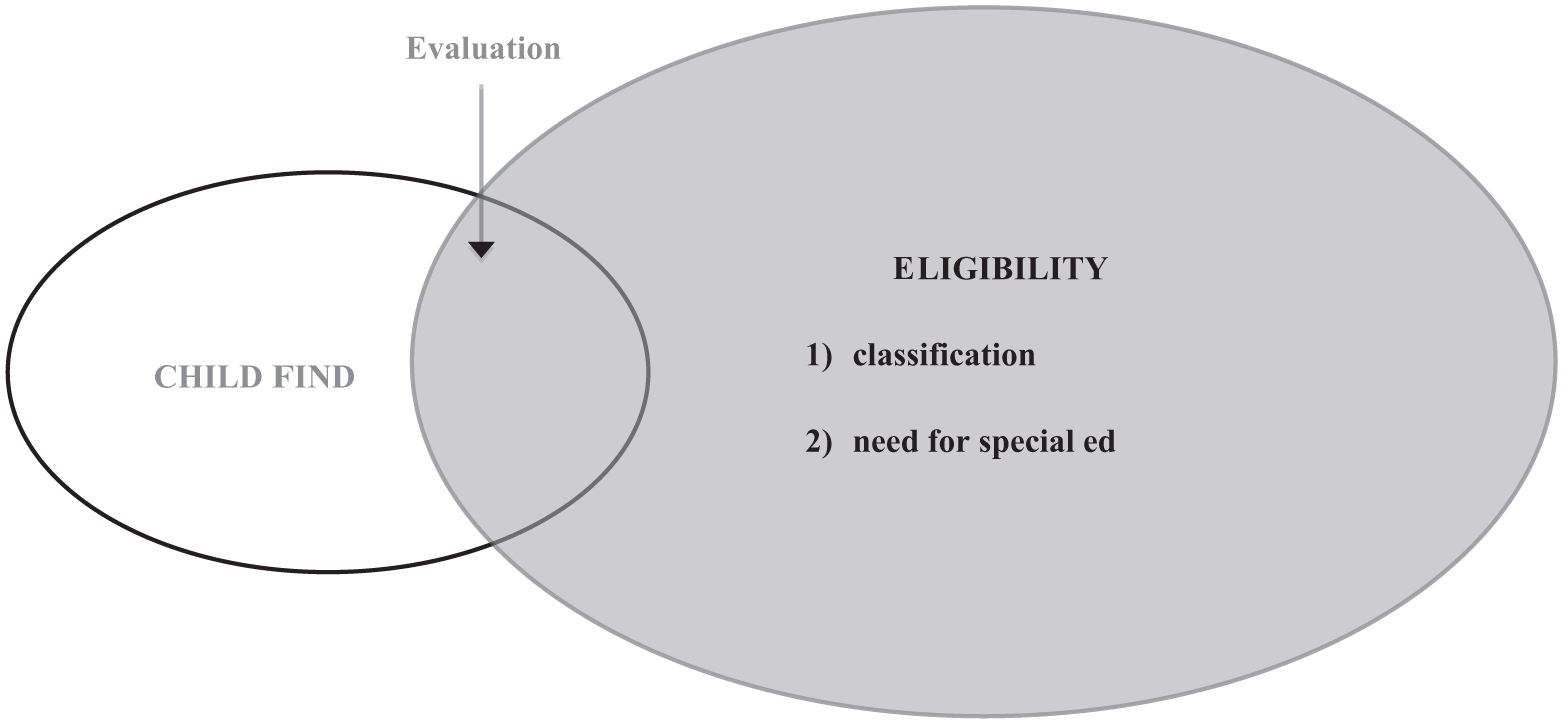
Focus on eligibility.
For the most frequent classification, specific learning disability (SLD), districts that have evaluated children as not qualifying for coverage under the IDEA have won the vast majority of the court decisions concerning SLD eligibility (Zirkel, 2013g). The crux of these cases has most often been whether the child has evidenced a severe discrepancy between ability and achievement in at least one of the eight enumerated areas in the IDEA definition of SLD; however, the change in the 2006 amendments to the IDEA and its 2006 regulations has led to some states requiring and other states permitting a RTI approach to SLD identification (Zirkel & Thomas, 2010). The case law concerning RTI has been negligible thus far (Zirkel, 2013c), but the predictable key criterion is whether the individual child at issue needs special education. This ultimate criterion has been the second most frequent in the SLD eligibility cases overall and the most frequent basis for the other leading areas of eligibility litigation, which have tended to be in favor of school districts—OHI based on ADHD (Zirkel, 2013a) and ED (Zirkel, 2013b).
The Unsettled
The unsettled issue in such cases has been the specific meaning of special education. For example, where the child’s educational performance has been at least marginally successful with the support of Section 504 plans and other accommodations or interventions in general education, their role has varied in eligibility cases, depending on the courts’ general conception of special education. Some courts regard such supports as evidencing the need for special education, viewing these individual adjustments as being in line with its general meaning. Others have taken the opposite view, concluding that if the child’s performance in general education was satisfactory, regardless of such supports, the child did not need special education. Similarly, the courts have varied as to whether educational performance, and thus the need for special education, refers only to academics or also social behavior.
As an example of the role of supports in general education, consider C.M. v. Department of Education, State of Hawaii (9th Cir. 2012). Based on diagnoses of ADHD and central auditory processing disorder, the student has a 504 plan that included various accommodations, including the READ 180 program and a small pre-algebra course with a math lab. Upholding the finding that these reading and math sections were “regular education classes with small enrollments designed to provide additional support and . . . open to many types of students who needed additional help”(p. 677), the Ninth Circuit concluded that the child did not receive or need special education, thus not qualifying under this second essential element of IDEA eligibility.
Further exemplifying the unsettled scope of special education, compare the outcomes of the First Circuit’s decision in Mr. I. v. Maine School Administrative District No. 55 (2007) and the Second Circuit’s decision in C.B. v. Department of Education of City of New York (2009). These two decisions focused on the bridging ingredient of adverse affect on educational performance. In Mr. I, the student was a sixth grader in Maine with diagnoses of Asperger syndrome and adjustment disorder with depressed mood. In the wake of her attempted suicide and resulting private school placement, the district offered her a 504 plan that included instruction in social pragmatics, access to the gifted and talented program, and add additional, consultant-provided programming. The parents refused and kept her at the private school, where she did well academically but had notable problems in terms of peer relationships. The First Circuit concluded that she was eligible under the IDEA because (a) Maine’s state law defined educational performance broadly and (b) the IDEA regulations define special education to include social skills and pragmatic-language instruction. In reaching this broad conclusion about the scope of education generally and special education specifically, the court emphatically rejected the academic standard of doing well in school. Yet, in C.B., the Second Circuit reached the opposite outcome based on a narrower, academic scope. Specifically, this appeals court ruled that a child with bipolar disorder and ADHD was not eligible under the IDEA because her “grades and test results demonstrate that she continuously performed well” in school before and after these diagnoses (p. 22).
Finally, the Fifth Circuit Court of Appeals decision in Alvin Independent School District v. A.D. (2007), instead, addressed eligibility under the final, need element. Reasoning that the adverse effect of this middle school child’s ADHD on educational performance only established OHI and, thus, was not sufficient for eligibility, the Fifth Circuit upheld the determination that he did not qualify based on the lack of a resulting need for special education. The court identified three supporting sources for this determination regarding need: (a) his passing grades and No Child Left Behind (NCLB) test scores; (b) the teachers’ judgment that, despite his behavioral issues, he was achieving social success in school; and (c) the cause of his behavioral problems was non-ADHD-related issues, such as major family stressors and the student’s alcohol abuse.
FAPE
As observed in the introductory section, FAPE is the central pillar of the IDEA. It accounts for the vast majority of the IDEA litigation, especially given its interlocking position with LRE, tuition reimbursement, and compensatory education (e.g., Zirkel, 2014a). In its landmark decision in Board of Education v. Rowley (1982), the Supreme Court interpreted the original version of the IDEA to provide for a two-pronged standard of FAPE. Viewing Congress as emphasizing access via procedures, the Rowley Court concluded that the two respective standards for FAPE were the following: (a) Did the school district comply with the various applicable procedures? and (b) Is the IEP “reasonably calculated to enable the child to receive educational benefits?” (pp. 206-207). The substantive standard was relatively low; indeed, as the dissent pointed out, a district could apparently meet it by providing a teacher with a loud voice to Amy Rowley, whose disability was deafness. Figure 4 illustrates these basic standards.
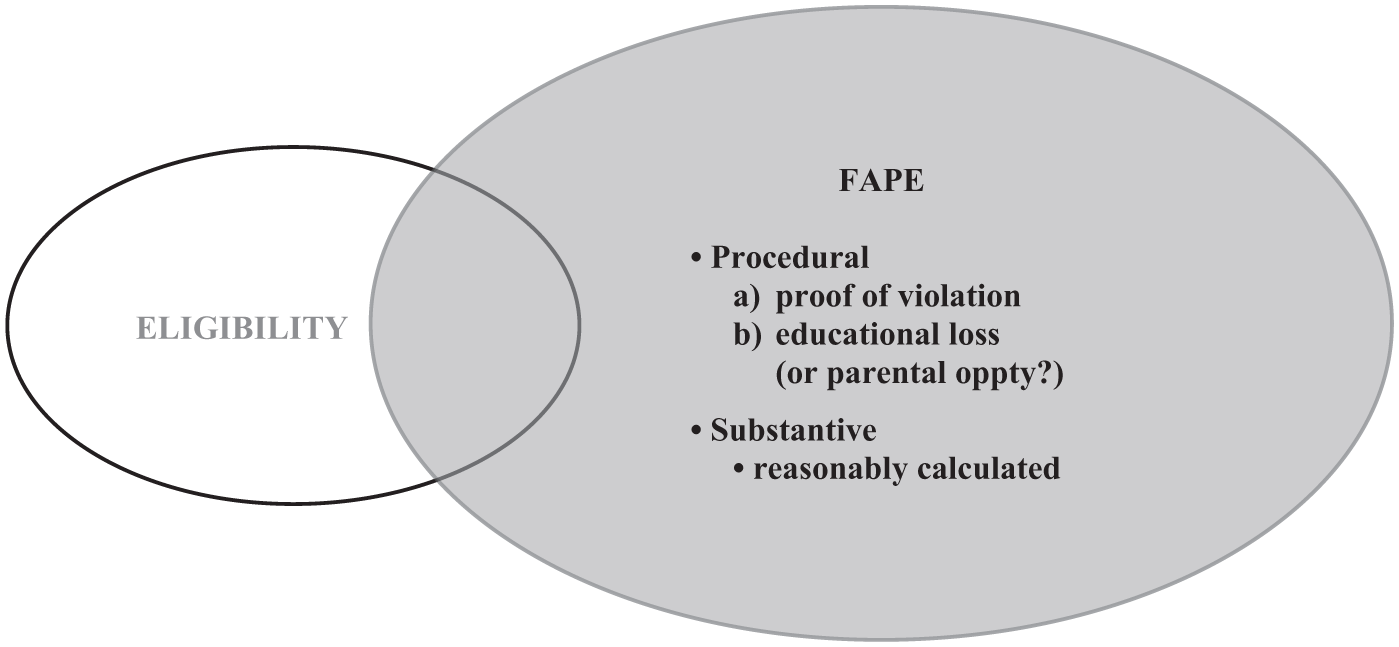
Focus on FAPE.
Procedural FAPE
On the procedural side, Congress, in the 2004 amendments to the IDEA, codified the lower court progeny of Rowley to add a harmless-error approach. More specifically, procedural denials of FAPE require a two-step adjudicative analysis: (a) Was the proof preponderant that the district violated one or more procedural requirements of the IDEA? and, if so, (b) Did this procedural violation “impede[impede] the child’s right to a [FAPE],” “cause[cause] a deprivation of educational benefits,” or “significantly impede[] the parents’ opportunity to participate in the decisionmaking process regarding the provision of a [FAPE]”? (IDEA, 20 U.S.C. § 1415[f][3][E]).
Basic approach
The first two of the three alternatives at the second step, especially in light of the lower court case law both before and after the 2004 amendments, seem to connect with the substantive standard, requiring the procedural violation(s). For example, in A.G. v. Paso Robles Joint Unified School District (2013), the parents of a child with autism claimed that the defendant district had denied FAPE to their child by (a) proposing an IEP that lacked measurable present levels of educational performance, (b) not having a general education teacher at the IEP meeting, and (c) failing to comply with the state law requirement for a functional behavioral assessment and behavior intervention plan. The Ninth Circuit ruled in favor of the district, rejecting the first claim at the first step, concluding that the IDEA does not require quantifiable baselines. Then the court summarily disposed of the other two claims by concluding that those violations were “harmless” (p. 643). More specifically, the court concluded even though the parents clearly had proven the second violation and—alternative to their failure to show the requisite severity of behavior problems—even if the parents had proven the third violation, the child had made progress toward his IEP goals.
Unsettled aspect
The third alternative, however, arguably provides for a per se, or automatic, violation for the stated denial with regard to parental participation, without the necessity of showing a loss to the child under the relatively relaxed substantive standard for the child. Instead, the majority of the courts have avoided this issue by ruling, based on either the burden of proof being on the parents or the more general posture of judicial deference to school authorities, that the district did not commit this violation or by indiscriminately applying the second step. For example, in R.P. v. Alamo Heights Independent School District (2012), the parents claimed that the district denied them the opportunity for meaningful participation by predetermining the IEP contents, not seriously considering their opinions at the IEP meetings, using voting rather than consensus for IEP approval, and prematurely terminating IEP meetings. The Fifth Circuit Court of Appeals found the parent’s evidence unpersuasive for all four items, alternatively reasoning that “if any defects did exist, we conclude that they did not rise to the level of denying [the child] a lost educational opportunity” (p. 811).
The limited exceptions that support the per se interpretation have been relatively few thus far. The appellate courts have provided two brief recent examples. First, in D.B. v. Gloucester Township School District (2012), the Third Circuit Court of Appeals upheld, in the absence of pertinent factual findings at the hearing officer level, the lower court’s conclusion that the school district had predetermined the placement of the child, thus significantly impeding the parents’ opportunity for participation in the IEP process. In response to the district’s argument that the lower court should have considered the substantive appropriateness of the IEP, the Third Circuit cited the aforementioned three alternatives for fatal procedural violations without further explanation. Second, in Doug C. v. Hawaii Department of Education (2013), in one of the relatively few court decisions where the parents won based on the parental participation standard, the Ninth Circuit ruled that the defendant district’s action in holding the IEP meeting in the absence of the parent under the specific circumstances of the case, which included two earlier failed dates for the meeting, significantly impeded the parent’s opportunity to participate in the decision-making process. The court commented that that reason alone was sufficient for finding a denial for FAPE. Alternatively, the court concluded that the absence of the parent in this case resulted in an educational loss to the child, because if the parent had participated, the IEP team likely would have more thoroughly considered the benefits of continuing the child’s private placement rather than changing it for the first time in 6 years.
In each of two cases, the implication was that the district’s proposed IEP was not appropriate, even though the court did not find it necessary to determine this issue. If so, the court in the first case noted that compensatory education would be the likely remedy, and the court in the second case similarly suggested continued private placement would serve this purpose. What is the remedy under a per se approach, where the district has complied with the other applicable procedures and has generated an IEP that meets the substantive standard for appropriateness? Other than attorneys’ fees, the answer would appear to be exercising the broad remedial authority of the hearing officer or court under the IDEA (2012, § 1415[i][2][C][iii]) to order compensatory education in the form of staff training, which the Ninth Circuit upheld in a different FAPE context (Park v. Anaheim Union High School District, 2006). Here, the training would be in effectively facilitating parental participation in the IEP process.
Substantive FAPE
Basic standard
On the substantive side, as explained in detail elsewhere (e.g., Zirkel, 2013e), the courts have steadfastly refused to raise the Rowley reasonably calculated standard despite shifts in the more recent IDEA amendments to an outcome-based approach, the addition in IDEA 2004 of a qualified “peer reviewed research” (PRR) basis for FAPE, and more than 30 years of funded research and experience. Thus, for example, in applying the IDEA’s PRR provision (§1414[d][1][A][i][IV]) in favor of the defendant district, the Third Circuit Court of Appeals identified the following two guiding principles: First, although schools should strive to base a student’s specially designed instruction on [PRR] to the maximum extent possible, the student’s IEP team retains flexibility to devise an appropriate program, in light of the available research. . . . Second, under the IDEA, courts must accord significant deference to the choices made by school officials as to what constitutes an appropriate program for each student. (Ridley School District v. M.R., 2012, p. 277)
Similarly, exemplifying the low threshold level for Rowley’s substantive standard, the Fifth Circuit Court of Appeals reasoned: [A]lthough positive educational outcomes can signal that an IEP is appropriate under the IDEA, the appropriateness of [the child’s] IEP ultimately turns on whether it was reasonably calculated to provide an educational benefit and does not hinge on the showing of an actual positive outcome. (S.H. v. Plano Independent School District, 2012, p. 859)
Adjudicative complications
Evidentiary doctrines in the adjudication process complicate the application of the reasonably calculated standard. First, various jurisdictions have adopted the so-called “snapshot approach” to evaluate substantive FAPE (Zirkel, 2011b). The First Circuit’s initial formulation of this test for pinpointing the time for applying the substantive standard was as follows: An IEP is a snapshot, not a retrospective. In striving for “appropriateness,” an IEP must take into account what was, and was not, objectively reasonable when the snapshot was taken, that is, at the time the IEP was promulgated. (Roland M. v. Concord School District, 1990, p. 992)
Although this photographic metaphor theoretically seems fair in its formulation, the time-consuming process of adjudication may pose a practical problem in its application. By the time that the precedential cases reach the final decision, 2 or more years may have passed since the issuance of the disputed IEP. Thus, evidence of progress or lack thereof that was prospective for the IEP team is retrospective for the court. One resulting difficulty is determining among this post-IEP evidence that which was objectively reasonable, in other words, the information the IEP should have expected. The other and even more problematic result as a matter of fairness is that post-IEP progress counts but post-IEP lack of progress does not count. The First Circuit added this elaboration as follows: Actual educational progress can (and sometimes will) demonstrate that an IEP provides a FAPE . . . But to impose the inverse of this rule—that a lack of progress necessarily betokens an IEP’s inadequacy—would contradict the fundamental concept that “[a]n IEP is a snapshot, not a retrospective.” (Lessard v. Wilton Lyndeborough Cooperative School District, 2008, p. 29)
The other complicating evidentiary doctrine is the so-called “four corners” rule. This standard, which is borrowed from contract law, exclusively restricts the court’s consideration to the final version of the IEP that the school system offered during the IEP process. Various courts have adopted this approach for determining FAPE but often with limitations or exceptions that make its application even more problematic in terms of practicality and predictability. For example, the Second Circuit Court of Appeals adopted a modified version that is limited to what is within the four corners of the written IEP except for testimony that explains or justifies its contents (R.E. v. New York City Department of Education, 2012). The unmodified version of the rule invites impractically long IEPs, along with the transaction costs of their formulation and implementation. The Second Circuit’s modification, or exception, invites more ponderous litigation rather than returning the focus to education. Consider, for example, two of the Second Circuit’s subsequent applications of its modified approach. In the first, which was issued more than 4 years after the IEP at issue, the Second Circuit affirmed an adjudication in favor of the defendant district despite allowing prohibited testimony; the reasoning was that, in this case, the permissible evidence met the reasonably calculated standard (K.L. v. New York City Department of Education, 2013). In another case, the Second Circuit remanded for further proceedings the determination of the substantive appropriateness of an IEP issued more than 5 years earlier, because the reviewed adjudication had relied on testimony that was beyond what the IEP stated. In doing so, the court explained its choice of sending the case back for further proceedings as follows: We certainly appreciate [the parties’] desire to resolve this case now without further litigation, with its attendant delays and costs. But we must decline this invitation. It would be imprudent for this panel, without any educational expertise, to decide the merits of [the child’s] claim on a cold record. . . . We are simply not in a position to cull from this testimony the evidence that R.E. permits us to consider and then determine whether that testimony is credible and persuasive, particularly when the [hearing officer] did not address those questions at all. . . . [The lower] court might, in its discretion, either decide the merits of the IEP claim, or, perhaps more profitably, remand the matter to [the hearing officer] for a complete reexamination in light of our [modified four-corners rule]. (E.M. v. New York City Department of Education, 2014, p. 463)
Conclusion
The basic legal obligations under the IDEA for child find, eligibility, and FAPE are rather simple and sensible. Upon having reason to suspect that the child may be eligible, secure the parents’ consent in a reasonable period of time and complete the evaluation within the state’s applicable timeline. For eligibility, the requisite team must determine, based on the variety of sources in the evaluation, whether the individual child meets the criteria for one or more of the IDEA’s specified classifications and, if so, whether the individual child has a resulting need for special education. Finally, the IEP team must develop an IEP that is appropriate for the individual child in accordance with the prescribed procedures and, ultimately, that is reasonably calculated to provide meaningful benefit to the child.
Despite the relatively detailed prescriptions in the IDEA legislation and regulations, plus the requirements of state special education laws, the specific application of these three successive and overlapping obligations in terms of current case law is a complicated and costly matter in light of (a) the individualized nature of the legal framework, (b) the fact-intensive character of the cases, (c) the ponderous nature of the multi-level adjudication process, and (d) the repeating key of reasonableness, which differs not only between the parties to the litigation but also among the adjudicators based on their particular perspectives, values, and experience. The world of education and the world of litigation are not the same. What may appear to be “profitably” prudent (E.M. v. New York City Department of Education, 2014, p. 463) to a judge in terms of arriving at a final, just decision may be dramatically different than that from the viewpoint of a parent or educator.
Thus, maintaining legal literacy about the applicable case law is one part of a large and complex endeavor to achieve a common goal—providing individually appropriate programs for individual children with disabilities within the larger environment of limited resources, expanded expectations, and specialized professionals within public schools. The general lesson in instances of initial disagreement about these basic IDEA obligations is for all interested individuals to think twice before looking to litigation for the solution. Wherever possible, using communication, compromise, creativity, and other skills that build mutual trust may be more effective than entrusting the matter to our congested and complicated courts.
In light of the crammed curriculum of teacher education in special education and the specialized nature of the legal material, treatment of litigation issues must be selective and efficient. A problem-based approach in response to naturally arising legal questions and carefully inserted case scenarios and visual organizers, such as those illustrated in this article, is generally advisable, with ample supplementary readings available for both the faculty and students. In addition to articles in the professional literature starting but not ending at the basic level (e.g., Zirkel, 2005), the available relevant resources include the free and low-cost downloads from the websites of respected mainstream organizations, such as the U.S. Department of Education (http://idea.ed.gov) and National Association of State Directors of Special Education (www.nasdse.org); the information sources of nonpartisan organizations, such as the Education Law Association and the Council for Exceptional Children (CEC); and the many text and reference books in special education law. When legal issues arise in the course of the teacher education program, including the potentially legal-laden culminating experience of student teaching (e.g., Zirkel & Karanxha, 2009), students should be encouraged to use the literature and the Internet for research to find accurate answers, sharing their fostered assessment of partisan and outdated sources and their particular recommendation for effective search techniques. Furthermore, specialized conference opportunities, such as the Lehigh Special Education Law Symposium, the Tri-State Regional Special Education Law Conference, and the Pacific Northwest Institute on Special Education Law, serve as opportunities for both faculty and students to update their knowledge and network with colleagues for pertinent, current legal issues. Finally, Teacher Education and Special Education (TESE)’s parent organization, the CEC’s Teacher Education Division can serve as a hub for the effective marshaling of sources and techniques to improve the legal literacy, along with best practice, of its constituent community.
Footnotes
Declaration of Conflicting Interests
The author(s) declared no potential conflicts of interest with respect to the research, authorship, and/or publication of this article.
Funding
The author(s) received no financial support for the research, authorship, and/or publication of this article.