







Abstract
Special education professionals serve as facilitators of Individualized Education Plan (IEP) team meetings. As special educators serve on many IEP teams during the course of an academic year, and as the member composition for each team varies, facilitators are confronted with a unique set of challenges to managing successful meetings. In this study, the authors investigate the specific types of problems and facilitator techniques occurring in IEP meetings. Findings suggest that facilitation issues and techniques are varied across special education professionals. In addition, facilitator training is needed to review and introduce facilitation techniques that may improve meeting member contributions.
According to the U.S. Department of Education, National Center for Education Statistics (2016), the number of students receiving special education services nationwide has nearly doubled from 3,694,000 in 1976-1977 to 6,555,000 in 2014-2015 (U.S. Department of Education, National Center for Education Statistics, 2018). As the number of students with special needs in public school systems increases (Christensen et al., 2016; Kogan et al., 2009; Roan, 2011), public schools continue to struggle to meet legislative demands requiring each student who is served by an Individualized Education Plan (IEP) be provided an equitable and accessible education (Boroson, 2017). Currently, legislative mandates (i.e., Individuals With Disabilities Education Improvement Act) require schools to serve students with special needs through a team process. The composition of the team is determined by the needs explicated in a student’s IEP (Huefner, 2000). Required members of IEP teams include parents, at least one administrator who can make funding decisions, a regular education teacher, a special education teacher, and an interpreter of evaluation results (often the school psychologist or special education teacher). Each IEP team, however, may be composed of other members (e.g., speech-language pathologist, social worker) based on individual student needs. The team approach requires that multiple members from a variety of specializations provide services to and teach students with special needs following an agreed upon plan. The IEP is central to policy and legislation involving students with special needs (Huefner, 2000; Patti, 2016).
The purpose of the IEP is to outline the child’s present level of education performance and to use this metric as a way to develop necessary accommodations and modifications, annual and short-term goals, and services (Bateman & Linden, 2006; Kaye & Aserlind, 1979). The IEP process requires that all needs identified by the IEP team be addressed in some fashion through instruction, relevant and targeted classroom accommodations and/or modifications, related services, or supplementary aids and supports. Consequently, a variety of specialists, including classroom teachers who can provide expert recommendations related to instructional accommodations and modifications, are often involved in trying to meet all the different needs of a student. IEP teams are required to meet and review each student’s IEP at least annually, but meetings to amend IEPs may occur throughout the school year if adjustments to services, goals, or instruction are needed. This process encourages collaboration among individuals with a variety of different special education perspectives, potentially producing a more holistic approach to address student needs.
Although there are many benefits to IEP teams, they also bring with them a host of challenges unique to the group type. One of the biggest challenges is that classroom teachers, special education teachers, speech therapists, occupational therapists, and other professionals are often on many different teams, each one situated around the needs of an individual child. Caseload size for special education professionals has been increasing (Dewey et al., 2017) with numbers expected to continue rising. These large caseloads require professionals to work with a variety of different special education professionals and teachers. Due to team composition differences, it may be very difficult for teachers to find consistency across IEP team meetings, which can be frustrating for all involved. Heavy caseloads and differing team dynamics may also be a factor contributing to the high rate of special education teacher turnover (Chandler, 2009).
Given the complexities of navigating IEP teams, the role of a facilitator is of paramount importance. Traditionally, in special education literature, the term IEP facilitation has been used to refer to a process for problem-solving once conflict has occurred. Mueller (2009) stated facilitated IEPs should use a neutral, outside facilitator to administer the IEP meeting. The main rationale cited for utilizing facilitated IEPs relates to providing a lower cost alternative to dispute resolution (Mueller, 2009); in this study, we focused, however, on meeting facilitation as a process in which an individual manages the meeting and participants toward a specific meeting goal. In general, research on meetings has outlined many important characteristics associated with good facilitation, including the ability to establish facilitative norms, develop a cohesive group climate, and assess group processes (Anderson & Robertson, 1985). These characteristics are similar to previous recommendations for IEP facilitators, which include establishing ground rules and an environment that encourages collaboration (Mueller, 2009). In IEP teams, the facilitator must bring deeply committed educators from a variety of professional backgrounds, including parents and sometimes the student herself or himself, together in an effort to have frank, multifaceted, and sometimes difficult conversations about the future of the student. The facilitator must negotiate various professional identities and opinions, with the probability that some approaches will fail, all while dealing with a potentially unique group membership for each student team. The success of the IEP teams may depend on the skill of the facilitator to run effective meetings.
Meeting Facilitation
IEP Meeting Facilitation Research
The majority of IEP meeting research is based on parent perspective data, although there are a few exceptions. One example is a study by Fish (2009), who sought to understand how IEP meeting effectiveness could be improved. Obtaining data from 274 educators, the following suggestions were offered: Having “adequate preparation, establishing open communication with parents and making sure that parents understand the IEP process” (Fish, 2009). Further educator suggestions included having an open mind during discussion, coming prepared with helpful documentation such as grades and examples of modified assignments, and asking parents questions and providing adequate time for discussion during the meeting (Fish, 2009).
In other research designed to gauge the involvement of transition age students in their IEP meetings, Martin et al. (2006) concluded that “in the spirit of group decision making, special education teachers need to learn to engage others in conversations and decision making, and to disengage themselves in favor of their students assuming a greater leadership role” (p. 197). Although Martin et al.’s study was specifically focused on student engagement in the IEP process, the results suggest an increased training need for special education teachers, specifically in terms of meeting facilitation techniques. Supporting these conclusions, a recent mixed-methods study of 142 parents of children ages 4 to 8 years with autism spectrum disorder revealed that 40% of the parents reported feeling their child’s IEP team was somewhat effective or ineffective while only 20% of parents reported feeling their child’s IEP team was effective (Slade, Eisenhower, Carter, & Blacher, 2018).
Facilitating effective special education team meetings can be a challenge. As a result, school districts have used a variety of different approaches to facilitate IEP team meetings, including designating a special education professional as facilitator or having certain individuals hired solely for the purpose of facilitating these meetings throughout the district. Yet, meeting facilitation training varies across facilitators. Professional publications provide tips and strategies for successfully conducting IEP team meetings (e.g., Dilberto & Brewer, 2014; Fialka & Fialka-Feldman, 2017; Patti, 2016) while academic web pages and blogs have devoted space to the issue (e.g., https://www.gse.harvard.edu/news/uk/17/09/how-have-successful-iep-meeting). Such publications typically focus on the tasks of completing the IEP while encouraging parental input throughout the process. As previous research indicates, however, academic scholarship dedicated to collecting data and examining how IEP meetings are facilitated is also needed in addition to these best practice recommendations. Not only may research in other disciplines (e.g., communication, social psychology, management, sociology) shed insight on effective meeting facilitation, but an interdisciplinary effort may also portray how IEP meetings are unique from past facilitation studies. As the ability to effectively facilitate IEP meeting interaction is paramount, facilitation approaches prevalent in the communication discipline are considered.
Meeting Facilitation Procedures
The importance of well-run meetings has led facilitators to create a host of different facilitation techniques. Of course, context plays an important role in determining which approach to use. For example, in social support groups, the group purpose is to create social support through interaction, and thus encouraging interaction from all group members is emphasized (Beck & Keyton, 2014). In other groups, the purpose of facilitation is to help the public feel like it has been heard; such approaches are often viewed with a cynical eye as a charade for the purpose of government credibility (McComas, 2001, 2003). In other situations, the purpose is to reach a decision; in these circumstances, the hope is to set up a situation where decision-making procedures can be implemented (e.g., ranking, voting). Of possible facilitation approaches, some are directed toward all group interaction while others isolate a specific group role for the benefit of collaboration (e.g., assigning a devil’s advocate).
In Frey’s (2006) volume on facilitation, he lists several group facilitation procedures, including assigning a devil’s advocate, brainstorming, Robert’s Rules of Order, Delphi technique, interactive management, nominal group technique, System for the Multiple Level Observation of Groups, focus groups, reflective thinking, kinetic exercises, idea writing, interpretive structural modeling, and group decision support systems, among others. Some of the procedures are task oriented, while others focus on the social fabric of the group (Sunwolf & Frey, 2005). The overarching assumption is that structured facilitation will improve group process and output and minimize dysfunction (Frey, 2006). Of course, the success of a facilitation approach depends on the type of group and its context (Pavitt, 1993). For example, some groups rely on an informal interaction approach, and applying a structured procedure may change the dynamics of interaction and lead to defensiveness.
A variety of facilitation approaches may prove useful in special education teams, as long as the main focus of facilitation is the student and his or her IEP. Certainly, some discussion will not be reflected on the final IEP document, but that of most importance will be, in addition to required metrics that will gauge student progress. As a result, certain task-oriented facilitation procedures may be helpful, such as nominal group technique, interactive management, and brainstorming. As scholars have not directly investigated facilitation procedures in IEP teams, it is unknown what techniques are most fruitful.
Rationale for Study
Facilitation and teamwork skills are desired in most jobs, including being flexible and adaptable; expressing an orientation toward the team; giving, seeking, and receiving feedback; leading and motivating others; maintaining relationships; coordinating and planning activities; communicating and listening effectively; decision making; and accomplishing group goals (Bonito, 2004; Cannon-Bowers, Tannenbaum, Salas, & Volpe, 1995; Stevens & Campion, 1994). The training of facilitation and teamwork skills specifically in special education undergraduate and graduate programs, however, may vary. Teacher preparation programs for special education teachers sometimes require a course on collaboration and consultation. If a specific facilitation course is not required, content may be embedded across courses related to IEP development or methods for serving students with special needs. Often programs follow the guidance of the Council for Exceptional Children (CEC) through the standards they provide for initial and advanced programs. In each set of standards, collaboration is recognized as an essential skill for special education professionals. For example, one of the initial preparation standards states, Beginning special education professionals collaborate with families, other educators, related service providers, individuals with exceptionalities, and personnel from community agencies in culturally responsive ways to address the needs of individuals with exceptionalities across a range of learning experiences. (CEC, 2016)
As a means of providing important instruction for facilitators, course instructors may employ a variety of techniques. In addition, perhaps the most important training on facilitation comes through practicum and student-teaching experiences. Witnessing, participating, and debriefing in these interactions provide insight for future teaching professionals. This “learning through experience” approach, especially as it takes place outside of the college classroom, however, makes it difficult to gauge which facilitation approaches are actually used and whether they are effective or not. The practicum experience is fluid and contextual and thus will be reflective of the situations that emerge, for better or for worse.
Facilitators in special education teams have an important, yet complex, task ahead of them. The changing group compositions, the lack of uniform facilitation curriculum, and the complexity of it all suggest that simply applying universal facilitation procedures to the problem, or worse yet, not training future teachers in any facilitation procedures, may be hindering education efforts for students in special education. A better understanding of the current state of IEP facilitation is needed, and an interdisciplinary approach to IEP meetings (e.g., Mueller, Massafra, Robinson, & Peterson, 2018) provides a platform for special education and communication scholars to mutually benefit either other. The purpose of this study was to investigate how facilitators of special education teams view their facilitation training, explore unique difficulties that confront special education facilitators, and uncover approaches facilitators use to overcome challenging moments in meetings. Thus, we posed the following research questions:
Method
Participants
Special education professionals responsible for facilitating IEP team meetings employed at three upper Midwest school districts were invited to participate in the study. The three school districts vary in size with the smallest district serving approximately 6,000 students and the largest district serving more than 11,000 students. The districts report between 12% and 16% of their K-12 enrollment is served under one of the 13 Individuals With Disabilities Education Act categories. Participants were recruited via email invitation after permission from each school district. In total, 19 interviews involving 20 special education facilitators were completed, as one uninvited participant asked to join an interview midway through. Of the 20 participants, 19 were female. Participants varied widely in terms of time in their current position (M = 4.38 years) and experience in special education (M = 11.12 years). Participants were employed across elementary, middle, and high school settings. Table 1 provides additional demographic information for each participant.
Participant Gender, Professional Experience, and District Affiliations.
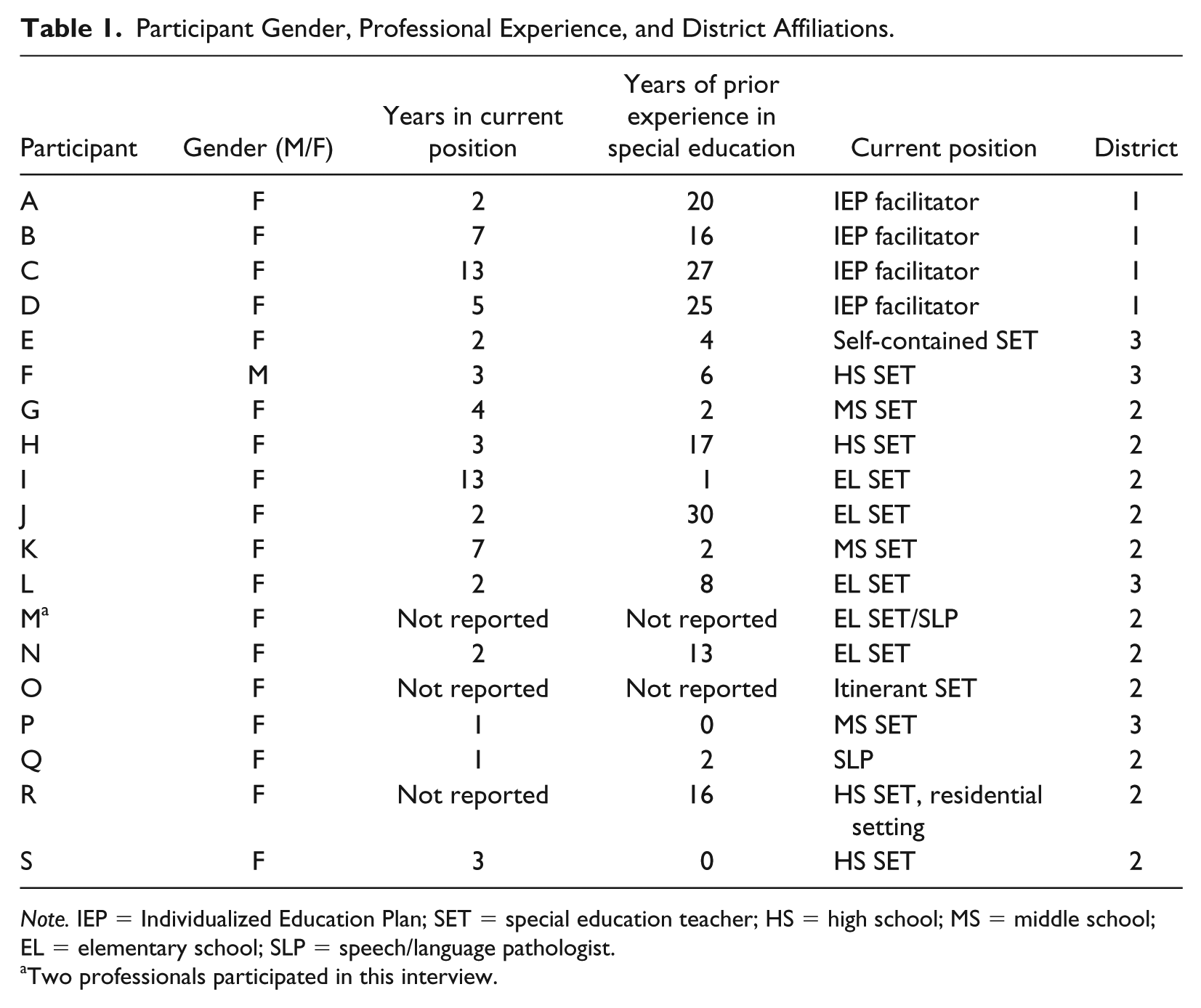
Note. IEP = Individualized Education Plan; SET = special education teacher; HS = high school; MS = middle school; EL = elementary school; SLP = speech/language pathologist.
Two professionals participated in this interview.
Procedures
Semi-structured interviews were conducted to investigate facilitator experiences in special education meetings. The semi-structured interview approach allowed interviewers to ask necessary follow-up questions to participants. As participants may prefer to discuss such issues off school grounds, lab space at a local university was made available. Given the safe environment, it was appropriate to ask straightforward questions that directly related to the research questions. This resulted in 11 hours, 20 minutes of total interview time (maximum = 45:02, minimum = 26:57, M = 35:48). The interview protocol is included in Figure 1.
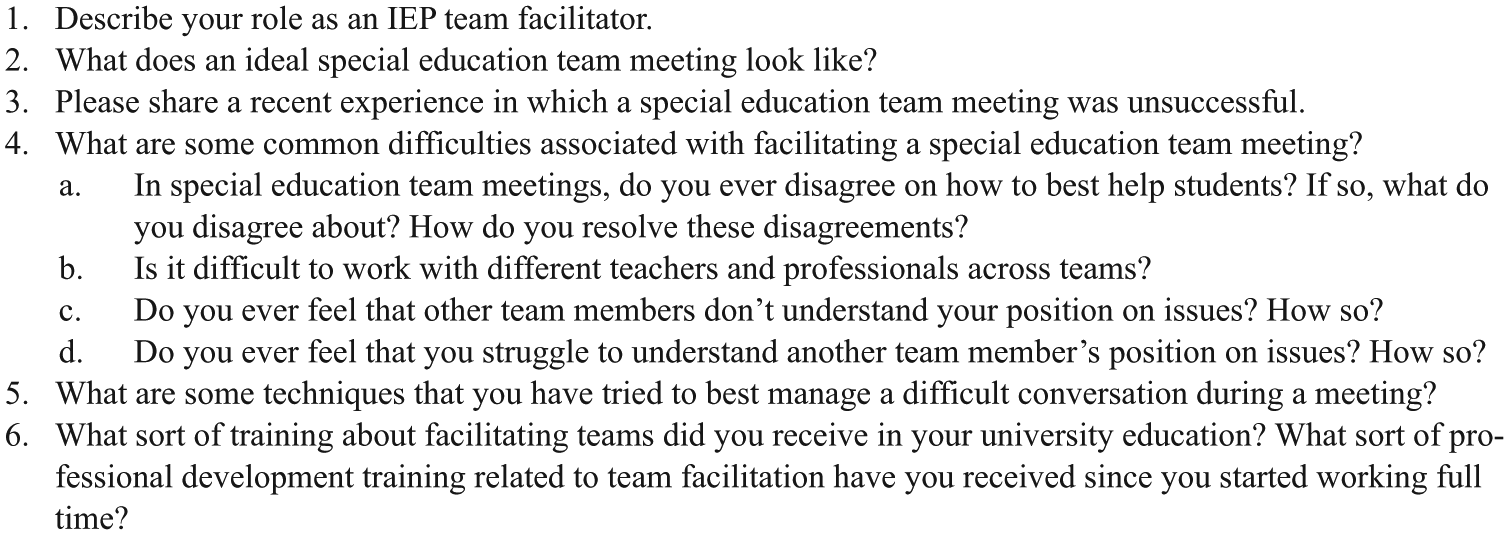
Interview protocol.
Both authors served as interviewers; for training and consistency, the first two interviews were conducted jointly. Following these interviews, each author conducted half of the one-on-one interviews. All interviews were audio recorded. An audit trail was used as authors had prolonged engagement with participants (Brantlinger, Jimenez, Klingner, Pugach, & Richardson, 2005) and a professional and institutional review board–trained transcriptionist was used to prepare the data for analysis. Once transcription was completed, names and identifiers were changed to pseudonyms, thus ensuring confidentiality. The interviews produced 252 pages of transcript.
Analysis
As this was an exploratory study, a descriptive qualitative analysis approach was used to answer RQ2 and RQ3, which generally followed many of the elements of Straus and Corbin’s (1998) open coding process. First, to become familiar with the data, both authors read through all the transcripts in their entirety. This step helped ensure researchers were able to frame findings holistically, within the entire scope of the data. Second, researchers independently created preliminary themes based on recurring elements in the data. Researchers marked individual themes in their respective copies of the transcripts. Third, researchers compared themes across coders. Commonalities were identified and further defined. The purpose was to create themes that were well developed, nuanced, and representative of the data. Analysis continued until new data became repetitive to the existing representative categories, a state known as theoretical saturation (Strauss & Corbin, 1998). Owen (1984) suggested that three qualifications for viable and representative themes are recurrence, repetition, and forcefulness. Keeping these three qualifications in mind helped ensure that researchers were consistently focusing on themes. In addition, a qualitative approach often necessitates that interpretation “is infused with” descriptions of findings and analysis (Brantlinger et al., 2005, p. 200). Subsequently, the writing style used in the “Analysis” section includes direct participant excerpts and paraphrased descriptions to best illustrate authentic participant voice.
As a way to ensure a credible analytical approach, collaborative work and member checks were used (Brantlinger et al., 2005). The collaborative work involved one researcher gathering earlier discussions and memos and creating a narrative description of each theme. This description serves as the substance of the findings presented below. The other researcher identified interview excerpts that best illustrated each theme. The narrative description and excerpts were compared to ensure clarity of themes. This collaborative process served to confirm and verify conclusions presented in the analysis. As a final step, member checks were conducted. The themes were presented to 11 participants to ensure that the themes were consistent with interviewee perceptions. Participants who responded affirmed the themes discovered. In addition, for RQ3, it was helpful to categorize the findings in terms of techniques, as that was the language used by participants.
Researcher Reflexivity Statements
The first author has spent his professional career investigating meeting facilitation. Both before and during his academic career, he served as a facilitator and consultant to organizations. In addition, his research has targeted meeting facilitation in a variety of contexts, including breast cancer support groups, juries, nonprofit organization, city commissions, and first responder teams. He currently conducts workshops for public schools and government agencies in leadership and facilitation.
The second author has spent her professional career in the field of special education. She was a practicing special education teacher in K-8 and 7 to 12 settings, and as a beginning special education teacher, she was often challenged to create a team atmosphere during IEP meetings. Currently, she is a university faculty member preparing future special education teachers and is motivated to prepare beginning teachers to conduct effective and meaningful IEP meetings.
Analysis
RQ1 focused primarily on the perception of participants regarding their prior facilitation training, and findings are described below. For RQ2 and RQ3, analysis of the data led to several themes emerging for each research question. The central themes are reviewed for RQ2 and a list of techniques is provided for RQ3. Table 2 shows a summary of themes and techniques.
Findings for RQs 2 and 3.
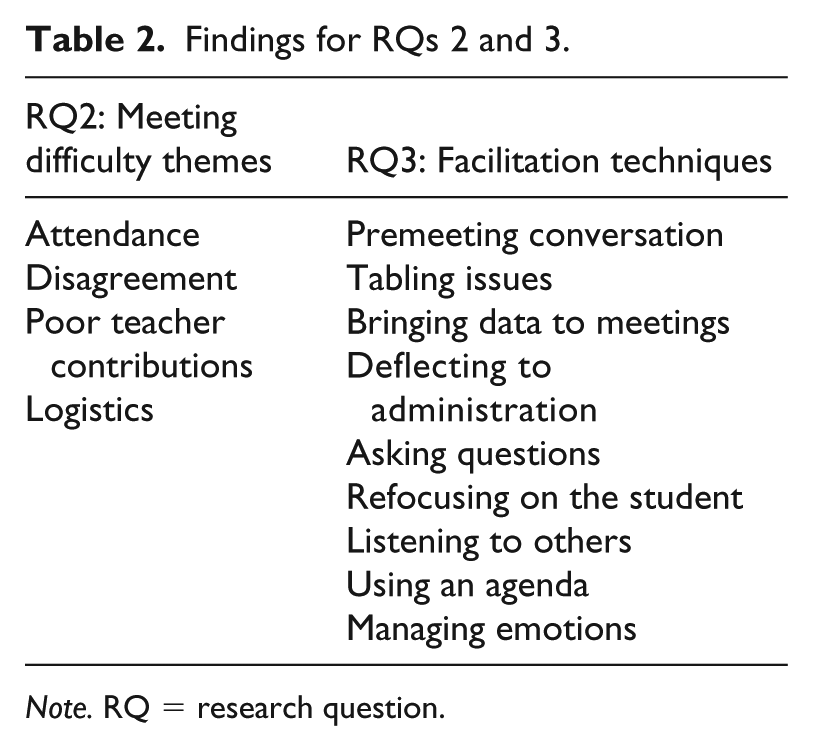
Note. RQ = research question.
RQ1: Training
The overarching claim by interview participants in the study was that they had not received training on how to facilitate IEP meetings during their university education. According to participants, the education courses they took during their degree programs did not provide group or meeting facilitation skills necessary to run high-intensity and high-stakes IEP meetings. In fact, many of the participants described their experience running such meetings as “trial by fire,” “just get thrown in there,” and “on-the-job training.”
Although participants stated their university education was not focused on meeting facilitation, several mentioned that the student-teaching experience allowed them to observe and experience how IEP meetings were facilitated. Although they were not instructed in meeting facilitation per se, several participants mentioned they were exposed to how others facilitated meetings. Additional educational opportunities may have emerged between student-teachers and teachers in relation to these experiences, resulting in tacit learning as expressed by Participant G: Mostly classroom, and then it was also in your practicum. You get in and you do it, and you sit there with somebody. And you write that up. And then you see what parts they did. And you sit in on the meetings. I did. Yeah.
Some of the participants also stated they had not received professional training while employed, although several others said they had. When pressed for clarification, participants who had received professional training said it revolved mostly around due process issues more so than facilitation issues.
When those things (procedural or form) change, those procedures or those laws, then there becomes a lot of discussion in those conversations about how to facilitate that. “Well, what if the parent questions this?” or, “What if there’s a misunderstanding?” Those conversations come into each of those trainings. I wouldn’t say that there’s a whole lot of deliberate, “Here’s how to facilitate training,” but it is involved in many of our professional development. (Participant N)
Participants gleaned information about how to facilitate meetings from a variety of different sources. Overall, however, participants reported they generally did not receive formal training on facilitation.
RQ2: Meeting Difficulties
Participants referred to several types of difficulties when discussing challenges during IEP meetings. The themes most frequently associated with meeting difficulties focused on attendance, disagreement, poor teacher contributions, and logistics. In addition, several other less frequent themes are listed.
Attendance
During interviews, participants shared many frustrations regarding team member attendance. These challenges fell into two main issues. First, it was difficult to schedule meetings that accommodated members’ schedules, both among school employees and with students’ parents. Participants shared that this often led to a variety of frustrations for all involved. Second, it was difficult encouraging attendance from school employees who were not motivated to attend or did not see the meetings as beneficial. In addition, missing meetings due to scheduling issues was sometimes construed as a lack of motivation to attend. When members had poor attendance, especially when a parent was present, participants believed it reflected poorly upon them, and they would often be forced to cover up for the missing teacher.
Sometimes, team members would not try to hide their disdain for IEP meetings or would openly acknowledge their unwillingness to attend. This could be especially disheartening for participants. Other times, team members would simply ignore invitations, requiring additional efforts by the participants to encourage attendance. This was best described by Participant F, who stated, About 50 to 60 percent of the teachers who I invite don’t even really respond to the invitation. I have to, then, follow up with the second email saying, “I haven’t heard from you. You haven’t filled out the forms. It would be really great to honor the parents and the kids and respect the process in IEP. Really great to get this information so that I can have a more robust, full, comprehensive meeting, and regardless if you can attend.” (Participant F)
In addition, team members who would attend but who had not taken time to prepare for the meeting also created difficult meeting interactions. Individuals who came unprepared for meetings would appear uncommitted to the meeting, and this could be offensive to those who had prepared and to parents. One participant compared the level of preparation required with that of a doctor: I’ll say, “go ahead you can start your . . .” She doesn’t know what to say. So then, I’m trying to look quickly to get her going with something in her present levels or her goal. . . . I hate when we look like we don’t know what we’re talking about or that we are not professional because I compare us . . . and I’ll say this to the teams, “if you went to the doctor for an appointment, you would want a doctor who looked pretty prepared to see you.” (Participant B)
Participants often felt lack of attendance and preparation decreased efficiency and productivity in meetings. It could also create resentment from other group members and suggest a lack of commitment to the special education team, student, and school. Participants also believed it reflected badly on them.
Disagreement
Naturally, another meeting difficulty was when there was a lack of agreement between school staff and parents on student issues. Given the complexity of student needs, such disagreements were not unexpected, and often participants could foresee disagreements prior to meetings. Such disagreements could threaten collaborative interactions, with the potential for team members to become defensive and parents to feel unheard or frustrated. In addition, emotions and stress of the meeting could lead to defensiveness by all parties, including the facilitator.
Participants shared a variety of topics related to disagreements during meetings. A common disagreement centered on whether or not services were needed by the student or provided by the school. For example, some parents desired more accommodations for their student than was deemed necessary by other members. Participants also shared stories about working with parents who resisted services for their child. They shared that parents often cite prior bad experiences or beliefs that recommended accommodations were excessive: The most recent difficulties that I’ve had is a student is brought forth who has had interventions and who continues to struggle. The team meets and we have shared those assessment results stating that a child does qualify for an IEP and a parent has turned down those services. In both situations . . . parents have changed their mind within a reasonable amount of time, but that initial refusal is difficult because you know your losing time with the child. (Participant N)
A complicating factor with disagreement in meetings is that it can lead team members to question their original opinions on the student. IEP decisions can be difficult and complicated, and naturally, team members want what is best for the child. When a parent pushes back against the team assessment, participants described questioning the decision being made or the process that led to those decisions: As a teacher I could see where I would have been more defensive in the sense that I am taking it as I didn’t do this right and so that’s why the parent is questioning me or not understanding what I am trying to get at. (Participant A) Plus it’s that concern of, was there something in the process that we did wrong for them to not want that service for their child. (Participant N)
Of course, reflecting and changing decisions is a normal part of any complicated decision-making process. It could also be, however, damaging and draining to teacher confidence to be questioned on professional opinions.
Poor teacher contributions
A third problem identified by participants in IEP meetings involved when meeting member contributions were unhelpful. This involved not only being unprepared as mentioned previously, but also focusing on the wrong issues or framing the issue in an unhelpful manner. For example, participants noted some meeting members focused on problems instead of solutions: I think the worst part about any of the meetings that I’ve had so far is just making statements that really don’t mean anything like, “But he has executive functioning problems.” I’ve seen his locker, we all know that but what interventions are we gonna do about it. I think people get stuck on those problems and we’re not really thinking about the solutions. . . . That’s probably the worst hardest part about it. (Participant P)
Several participants criticized discussion and teacher input that just reified the difficulties already known. This could be particularly difficult if the facilitator worked with the student on a regular basis and felt others were not aware of the student’s potential. Instead of a transition to solutions, information sharing among team members would simply reaffirm the student’s diagnosis and involve repetitious conversations about the problems: I recently held a meeting where a student had been having some behaviors in class and his grade level team was just having some trouble with him. So, we spent almost the whole half hour just rehashing all of his issues that he’d been having, everything that he had been essentially doing wrong in his classes. So that was really hard to move along from. (Participant K)
In this example Participant K understands that discussion may need to touch on behavioral issues, but the overemphasis on the problems (i.e., almost the whole half hour) and need to transition to a more productive, collaborative, solution-oriented discussion was difficult.
Another identified complication was that some team members struggled to effectively and efficiently deliver meeting contributions that were relevant to the focus of the meeting. Participants described team members who provided little to no information or provided information that was not pertinent to the current meeting topic. Participants also expressed concerns that sometimes team member input would rely on technical education jargon, which could alienate parents: I think one of the top things that can break a meeting down very quickly or even just the relationship across the board is language. Teachers, we have our own language, a high level set, a specific vocabulary that we use to talk about how we teach. Parents do not have access. . . . When teachers come to an IEP meeting, and I have seen this happen, first of all, some will come to the IEP meeting and spew out special education language. They’ll talk about testing and they’ll talk about how they did the WISC, and had to break down all of the data points. First of all, the parents are going, “What the hell is a whisk? I use a whisk. Beat, beat, beat my eggs for breakfast in the morning.” They don’t have the language. (Participant O)
Teachers may have great expertise and knowledge about a specific student situation, but this does not guarantee they have the ability to articulate solution-oriented messages in conversation with special education team members.
In addition, participants expressed that many times, team members would talk too much, making it difficult for participation equity among members. This may be due to wanting to help the student, or it may be an unawareness of how much someone is dominating discussion: It’s those complex children with complex needs that everybody wants to talk and everyone thinks their perspective or their area is the most important . . . If they’re getting ten minutes of PT (physical therapy) a week, I don’t want the PT to talk for 20 minutes and sometimes that will happen, they just keep going on and on. (Participant B)
Not only were unfocused teacher contributions frustrating, but it was also difficult for participants to know how to correct the behavior. The need to interrupt or conclude someone’s speaking turn can be problematic and awkward for all involved.
Logistics
Of course, with the growing numbers of students with special needs and larger IEP caseloads, it can be quite difficult to keep up with the monumental task of paperwork and scheduling meetings. IEPs require extensive reporting and adherence to timelines, as well as coordinating report distribution and feedback prior to meetings as shown by Participant E: I think the biggest though is just making sure the paperwork is done. Even though I know . . . especially in IEP, it’s obviously in draft form but I’m personally a perfectionist so I don’t like to show up to a meeting feeling unprepared.
To manage the heavy load, participants often developed their own approaches to managing the load before, during, and after meetings.
Often participants were also responsible for tasks like note-taking during the meeting, which would try their ability to focus on the content of the meeting while balancing required reporting policies. Balancing these additional roles with facilitation could be challenging, as expressed by Participant K: As for the facilitation of that, even just the amount of people there, that it takes time. It takes time to let everyone talk about the things that are going on and their part, whatever they’re doing with that child. So that was a learning experience.
Participants also expressed that they often felt responsible for problem-solving anything that did not go according to plans during the meeting (e.g., scheduling, attendance, report distribution). Juggling all of these responsibilities was difficult and time-consuming for many of the participants.
Other items
There were several themes mentioned by participants with less frequency, but still of importance. First, participants noted how each student meeting involved different team members. As team composition changes for each student, and the facilitator has to adapt to the different personalities and style of meeting attendees, such variation may make it difficult for group norms to emerge. Second, participants remarked they sometimes did not know the individuals around the table, especially the students and parents. Large caseloads and different facilitators’ roles across school districts meant that certain participants lacked strong relationships with parents. Third, participants sometimes had to manage teachers who did not want to accommodate curriculum for students, including items that were specified in the IEP. Teachers would have their own opinions on the student’s challenges and would doubt the need for accommodation as they felt the adaption jeopardized their course purpose. Fourth, certain IEP meetings involved parents who needed additional support beyond that which the school could provide. Last, outside professionals could also add a level of complexity to IEP meetings.
RQ3: Facilitation Techniques
In response to many of the problems listed in RQ2, participants used a variety of techniques to remedy conflict or alleviate tension in IEP meetings.
Premeeting conversation
One approach used by participants involved efforts to unite meeting members in a sense of shared understanding. These efforts could involve talking prior to meetings, where participants would try to “get everyone on the same page” to advance conversation. For example, Participant B stated, “I always ask them, ‘if you know there’s a problem, a challenge, parents are upset about something’ let me know ahead of time.” As explained by the participants, if people were aware of problems or concerns prior to meetings, then individuals could prepare and the conversation would be started at a more advanced state. In addition, if parent concerns are known prior to the meeting, accommodations may be developed. This may involve avoiding certain topics or emphasizing a particular need, or as Participant A described, it may involve simply making sure certain people are present: A lot of it you do, a lot of the teachers know that there are going to be those situations coming up, which is helpful. They usually give you a heads up that . . . even the meeting yesterday it was a heads up that this mom was kind of wants the gen ed teacher there and so I was able to work with our secretary to say “when you send the sub to the teacher please tell the teacher the parents have requested that a gen ed teacher is there.” . . . Knowing that ahead of time I could let that gen ed teacher that this (is) important. (Participant A)
The phrase “getting on the same page” usually meant some sort of premeeting conversation that led to efficiencies during the meeting itself. These conversations could take a variety of different forms, including a scheduled premeeting, an impromptu hall conversation, or email exchange.
Tabling issues
Another facilitation technique was to put off issues until a later time. If emotions were heightened or if there was a deadlock, participants would look to sideline the issue and move on with the rest of the agenda. “If we disagree and we can’t finish it in a meeting, we reschedule another meeting” (Participant C).
Other techniques shared during the interviews involved taking a break from the issue until a later time in the meeting, allowing meeting members to relax and refocus on the conversation. This option could also be used for meetings that were running long.
Bringing Data to Meetings
Participants revealed that they brought data to meetings to help answer questions and focus the conversation. The inclusion of data (“let’s take a look at what your son’s reports suggest . . .”) brought an additional dimension to conversations and could decrease defensiveness by group members. Participants shared that they would bring large amounts of data to the meeting in preparation for complicated conversations about students.
If the conversation was not going well, participants could also suggest a need for more data collection before making a decision. Such a suggestion could frame the conversation as less personal and more substantive in nature. Participants stated they could use data to strengthen their arguments, even if the data were not directly used. Participants felt that stating you had data to support your argument was a show of strength, even if not specifically discussed.
Deflecting to administration
In certain circumstances participants noted they would deflect a difficult issue to a principal or other administrator. This occurred when conversations became very difficult, or when a participant did not know how to handle an issue. A way to deflect an issue was simply to ask an administrator to weigh in on the conversation. One participant said that when her hands were tied and she could not do anything else, she would turn to the administrator for help. As administrators are required team members, this option is available in most meetings.
Asking questions
The use of questions was another important facilitation tool that emerged from the interviews. Questions could be asked for a variety of reasons, including to obtain more information, solicit opinions, or allow for the conveying of support from individuals at the meeting. Such an approach prevented the participants from having to answer all questions, especially when there was not a known answer.
Another common purpose for using questions was to encourage participation and greater understanding across meeting members: Yeah I think there are times when I’ve not quite understood a team member, but I feel I’m continuing to always work on it, is to ask questions if I’m not understanding and it’s a skill that I work on with my students. (Participant Q)
Direct follow-up questions could also be used to pinpoint the true concern on a difficult issue, including asking for examples of student behavior or data.
Of course, open-ended questions were also used when a participant wanted specific individuals to expound on their interpretation of a difficult issue. Not only would such questions procure valuable information from group members, but they could also balance participation inequalities in a subtle, unobtrusive fashion. If used correctly, questioning could prevent meeting members from becoming defensive.
Refocusing on the student
Often meetings would involve a variety of topics, with many opportunities for the meeting to go off topic and for members to be distracted. In these situations, participants stated they would try to refocus the team on the student. By refocusing on the meeting purpose, participants could end extraneous conversations and provide for a more productive path during meeting interaction. Of course, facilitators have to be sensitive when using this technique, as members could feel defensive if someone suggested their comments were off topic and not focused on what was best for the student. In addition, a facilitator message that reoriented stalemated or off-topic conversations may be an effective way to restart discussion.
Listening to others
Another facilitation technique used by the participants was to make an intentional and explicit effort to listen to others, especially parents, during meetings. Such efforts encouraged participation by group members and created expectations for attentive listening while others spoke. By emphasizing the need to listen, issues such as participation inequality could be prevented. In particular, there was great value placed on obtaining input from parents, who offered a different perspective than teachers, as indicated by Participant E: I try to hear their side. A lot of parents and families are grieving possibly the fact that their child has a disability and I have to remember too that they know their child best. As much as I’m with them, parents and grandparents, whoever it is that’s in the child’s life, they know the child best. So I try to see their perspective. . .
Interestingly, the participant in this excerpt recognized that it may require a special type of listening, one that is sensitive to the struggles of the parent and child. Being explicit about listening was important to many participants as they felt it could help others recognize the need to be sensitive to others’ perspectives. In addition, those who did not discuss listening often did emphasize the importance of nonverbal behaviors.
Using an agenda
Although IEP meetings have prescribed topics for conversation, distribution of an agenda proved helpful to certain participants. Participant M stated, “We have a written agenda that we distribute at each meeting, for whichever type of meeting it is, and follow that agenda, allowing the parent to write on that agenda as well, to take their notes.” According to participants, agendas also provided a reference point in case conversations went off topic, and allowed parents insight into meeting processes that may be well known to professionals. A clear agenda provides all members with a game plan for the entire meeting, preventing surprise topics.
Agendas can also be useful in setting ground rules. For example, to accomplish all agenda items, there may need to be brevity in speaking turns and limits to how long conversation can go on a certain topic. Facilitators may use agendas as a foundation to discuss such meeting norms at the beginning of the meeting.
Managing emotions
A common theme across participant comments was the need to control and manage emotions. For example, participants believed it was important to control emotions and suppress surprised reactions as certain issues emerged during discussion. It was also difficult but necessary to hide negativity from parents during the meetings, even when discussing challenging student problems. Participants reported that they felt it was necessary to stay calm or neutral not only in their communication, but also in terms of their facial expression and body language: I’m using my body language to show that this is a challenging conversation but I have empathy, I have sympathy, I care about the student, I care about the family on thinking particular those difficult conversations you have to have with parents about challenges, and needs, and things like that. (Participant Q)
It was also necessary, however, to prepare for emotional expressions from parents or, as one participant stated, to bring Kleenex. Although participants tried to avoid emotional displays, they had differing views of parents’ emotional expression. The unveiling of emotions by parents could potentially be a very cathartic experience, and many participants expressed a need to create an atmosphere devoid of judgment of such emotions. Being aware before discussion that conversations may be tense or heated was important to managing emotions.
Other techniques
Two additional techniques were mentioned only once or twice by participants. First, giving parents or teachers complements was considered effective communication in meetings. As meetings could involve negative conversation topics, participants who mentioned this felt that positive comments praising meeting members could create an improved interaction climate. Second, one participant suggested that asking meeting members to make “I” statements was a good way of framing conversations.
Discussion
In addition to the host of facilitation problems and techniques displayed in the findings, several overarching findings and recommendations emerged from the study. The numerous and varied results confirm that special education teams require leaders with sophisticated facilitation skills to navigate successfully. As group communication scholars have emphasized, contextual considerations are vital to understanding meeting or group interaction (Putnam & Stohl, 1990; Stohl & Putnam, 1994). As meeting members are part of many IEP groups, contextual assumptions change from IEP to IEP. Overseeing varying team compositions, student needs, and parental involvement levels requires a unique, complex set of facilitation skills. The ability to facilitate such a group dynamic has not been directly investigated by previous literature and requires researchers to embrace an interdisciplinary, longitudinal, and evolving theoretical perspective (e.g., Beck, Bourdeaux, DiTunnariello, & Paskewitz, 2016).
The findings of the study clearly indicate that an important part of the facilitator’s job occurs prior to the meeting. Facilitators are expected to not only encourage attendance at special education team meetings, but also encourage participants to be articulate, prepared, and student-centered. Thus, a major responsibility for the facilitator is to ensure individual team members are positioned in a way to represent their group role appropriately. As an IEP is developed around the needs of a student, the importance of input from all members is paramount to student success. It was clear from the participant data, however, that additional education is needed for meeting members to demonstrate communication competence (Spitzberg & Cupach, 1984, 1989) in meetings. Expertise in a specific area of special education does not directly equate to effectively participating in group discussion. As a result, teacher education should target programs that foster the development of group communication skills in IEP meetings.
According to the data, there are a variety of ways facilitators manage difficult situations in IEP meetings. Without necessary training, however, facilitators may be unaware of techniques that could resolve meeting issues or lack the training necessary to become proficient in such techniques. The addition of meeting facilitation training (as opposed to collaboration training) to university special education programs and professional development workshops may enhance facilitator awareness and capabilities. Although the majority of preparation programs provide content and practice in developing collaboration skills, meeting facilitation has its own specific set of skills. The findings suggest that participants in this study developed their own ways of managing difficult situations during IEP meetings, but there are many more facilitation techniques not identified in the data that are common in group facilitation literature (e.g., Delphi technique, interactive management, nominal group technique; Frey, 2006). These techniques may further enhance IEP meetings. Teacher educators should consider how instruction in group facilitation techniques may enhance preservice preparation.
In addition, professional training for all IEP team members may enhance their abilities to contribute meaningfully to meeting discussion. The training required for productive meetings is not isolated to facilitators, as all members need to learn not only their roles in relation to their professional identity but also as an effective team member. It can be frustrating for all team members if someone is not clear and brief in their participation, whereas substantive contributions are appreciated by team members (Bonito, 2000). Longwinded conversations are often the result of an inability to articulate clearly what one is thinking. Training future team members (i.e., preservice teachers) in their contributions can improve the communication climate for all involved. This training needs to include a thorough understanding of team members’ roles and responsibilities and should be situated in both coursework and practicum/student-teaching requirements.
Several avenues for future research emerged from the data. First, an important tension that arose was whether, during difficult conversations, the facilitator should resolve issues or refer the matter to an attending administrator. Certainly, in some instances, an administrator would be required to intervene (e.g., threatening behavior, disciplinary behavior); other issues, however, are less clear (e.g., if a parent raises her voice). Clarity in such matters may position the roles of administrator and facilitator in harmony with one another. Investigating how facilitators see their role in these circumstances may prove fruitful.
Another avenue for future research is to consider how other members could help with group facilitation. Early group research examined whether a single individual was capable of balancing the various tasks and relational leadership roles in a group (Bales & Slater, 1955). Although there are many critiques to this position (e.g., Gustafson & Harrell, 1970), it may be worth pursuing to determine whether different team configurations or responsibility distributions would benefit meeting interaction. In addition, delegating the role of certain tasks (e.g., attendance) may allow facilitators to focus on other important issues.
Finally, conducting a similar study but focusing more narrowly on grade level and school type (i.e., elementary, middle, high) may also be beneficial. Although IEPs stipulate who must attend IEP meetings, different school types may influence who and how many people should attend. In elementary schools, there is usually only one classroom teacher; in high schools, however, there may be anywhere from one to eight classroom teachers attending. As group size influences how groups function (e.g., Littlepage & Silbiger, 1992; Wheelan, 2009), effective facilitation techniques may be different across school type and grade level. In addition, older students are more likely to attend IEP meetings, which certainly adds a new dynamic to meeting conversation. By focusing specifically on school type, future researchers may discover certain techniques are more beneficial for certain grade levels.
Conclusion
Overall, special education facilitators have a mammoth responsibility, which is complex in managing not only a specific meeting or case, but also the number of different cases and meetings one must facilitate. In this study, we challenged both special education professionals and group communication scholars to unite in consideration of this unique, complex group context. As the number of individuals with special needs continues to increase (Kogan et al., 2009), an increasing number of professionals in a variety of settings may be involved in facilitating and participating in this type of group process. Equipping special education professionals with facilitation skills may help meet these needs.
Footnotes
Declaration of Conflicting Interests
The author(s) declared no potential conflicts of interest with respect to the research, authorship, and/or publication of this article.
Funding
The author(s) disclosed receipt of the following financial support for the research, authorship, and/or publication of this article: The project was supported by Research Support Funds from North Dakota State University, Research and Creative Activity office.