







Abstract
The paraeducator workforce as well as the breadth of their responsibilities to serve students in special education has increased considerably in public schools. Unfortunately, research to identify the most effective methods for training paraeducators has not kept pace. Addressing this dynamic, through an implementation science framework, requires a better understanding of contextual factors. In this study, focus groups (FGs) with paraeducators and teachers were conducted to examine (a) responsibilities, training needs, and related issues of paraprofessionals; (b) training needs and related issues of teachers as supervisors of paraeducators; and (c) factors that support or impede special educators’ self-efficacy and their perception of competence of their colleagues. Four FGs, homogeneous based on role and assignment (mild vs. moderate-to-severe disabilities), were conducted utilizing a semistructured interview protocol. Qualitative content analysis revealed important challenges and training-related deficiencies experienced by both teachers and paraeducators, as well as suggestions for addressing these issues.
Keywords
Identifying and ameliorating barriers to the implementation of effective practices in educational settings is vital to the establishment of rigorous, evidence-based programming and, subsequently, positive educational outcomes for all students, including those with disabilities (Pickett et al., 2003). Yet, few in the field of special education (SPED) would argue the presence of a divergence between research and practice (Fixsen et al., 2005). This is, in part, due to a predominant focus on participant outcomes while largely ignoring the broader impact of implementation (Bertram et al., 2015). Focus on implementation outcomes, however, is imperative as changes to established systems are necessary to ensure sustainability of evidence-based practices (EBPs), thereby increasing the likelihood that anticipated participant outcomes will be realized (Bertram et al., 2015). A primary catalyst to long-lasting implementation is a well-trained, highly qualified workforce (Forman et al., 2013).
Unfortunately, the lack of well-trained, highly skilled special educators is an ongoing obstacle to high-quality programming and implementation of EBP (e.g., Brock et al., 2017). Further compounding this issue, the number of children with disabilities attending public school has significantly increased over the last decade (Boyle et al., 2011), whereas as of 2014, there are more paraeducators than special educators (415,781 paraeducators employed full-time equivalent [FTE] to 339,833 SPED teachers employed FTE; U.S. Department of Education, 2018). Analysis of the educational workforce projects this trend will continue, with an expected 8% growth in the use of paraeducators over the next decade (U.S. Bureau of Labor Statistics, 2017).
With the increasing enrollment of students with disabilities and a shortage of certified teachers, paraeducators have taken on a critical role in the education of SPED students, especially those with autism spectrum disorder (ASD; Downing et al., 2000; Fisher & Pleasants, 2012; French & Pickett, 1997). Instead of serving in an ancillary role, as initially intended, paraeducators spend more time directly providing educational services including delivering instruction, implementing behavior intervention plans, and facilitating social supports (Carter et al., 2009; Fisher & Pleasants, 2012). Moreover, they are sometimes expected to perform a number of tasks beyond direct instruction, such as managing the curriculum and communicating with parents (Giangreco & Broer, 2005), as well as planning lessons, leading instructions, and assigning student grades (Patterson, 2006).
Unfortunately, training requirements for paraeducators have failed to keep pace with these responsibilities. Federal law obligates paraeducators to be “appropriately trained and supervised” including a minimum of a high school diploma and at least 2 years of postsecondary education in any field of study, as well as demonstrate an understanding of writing, math, and reading (Individuals with Disabilities Education Improvement Act, 2004). In addition, paraeducators must be supervised by a certified SPED teacher. Typically, paraeducators begin their role in the classroom with minimal, if any, experience (Brock & Carter, 2016) and only have access to large group in-service training (Carter et al., 2009) and on-the-job training (Capizzi & Da Fonte, 2012). In addition, supervising teachers report they are ill-prepared to effectively supervise paraeducators (Douglas et al., 2016; Wallace et al., 2001), indicating their primary training/support to paraeducators includes activities such as last-minute verbal instructions and occasional performance feedback (Capizzi & Da Fonte, 2012). Thus, many paraeducators are performing duties that are well beyond their training (Etscheidt, 2005). Research suggests that the lack of training not only affects paraeducators’ effectiveness negatively (Armstrong, 2010) but also is detrimental to SPED students’ learning outcomes (Giangreco et al., 2010).
Self-Efficacy and Perception of Competence
Teacher self-efficacy, confidence in one’s ability to affect student achievement (Tschannen-Moran et al., 1998), has been linked to overall student achievement (e.g., Cantrell et al., 2013; Klassen & Tze, 2014; Throndsen & Turmo, 2013) and more effective teaching in various ways (Martin et al., 2012; Milner & Woolfolk-Hoy, 2003; Nie et al., 2013; Thoonen et al., 2011). Although the research on the self-efficacy of paraeducators and other support personnel is limited (Stocker, 2009), some studies exploring SPED teachers’ self-efficacy have found that it directly influenced teaching decisions (Ruppar et al., 2015), that those with stronger self-efficacy spent more time and effort working with SPED students (e.g., Gibson & Dembo, 1984; Woolfolk-Hoy et al., 2009) and were overall more effective educators (e.g., Johnson-Harris & Mundschenk, 2014; Kuronja et al., 2018; Malinen et al., 2012). Researchers have argued that paraeducators do not receive the training necessary to perform assigned tasks well (Breton, 2010), and, as lack of adequate training has been found to negatively influence teacher self-efficacy (Emery & Vandenberg, 2010), one can deduct that it would have a similar impact on paraprofessionals’ self-efficacy.
One method for understanding educators’ training needs as well as the factors that affect paraeducator and teacher self-efficacy is through qualitative research that provides evidence that can be used to inform practice by examining perspectives of relevant stakeholders (Brantlinger et al., 2005), and can be a valuable tool for examining educators’ needs and perceptions. The focus group (FG) interview method, which is a popular data collection procedure in qualitative research utilized to explore the needs of educators (e.g., Kucharczyk et al., 2015; Purdy & Guckin, 2015), is useful to identify issues where there is little research (Fontana & Frey, 2005). We used FG interviews as they foster open discussion among a particular group of individuals to explore their experiences and knowledge and allow the revelation of complex forms of behavior, perspectives, and opinions (Kitzinger, 1995; Mack et al., 2005). Few FG studies have examined issues related to paraeducators (e.g., Abbott & Sanders, 2012; Tews & Lupart, 2008), and to our knowledge, no FG studies exist specifically examining paraeducators’ needs and challenges that likely affect their self-efficacy. Furthermore, this method has not been utilized to capture supervising teachers’ perspectives about their paraeducators.
The purpose of this study is to identify the needs and training-related issues of elementary SPED educators—paraeducators and teachers—as well as self-efficacy (one’s own perception of one’s competence) and perceived competence (one’s perception of another person) related to job performance and training needs. The decision to limit the scope to elementary SPED educators was based on the disparate needs and responsibilities between elementary and secondary SPED educators. The initial research questions addressed through this qualitative study were as follows:
Method
Participants
Participants were SPED teachers and paraeducators from 12 urban elementary schools in the Midwest recruited following Institutional Review Board approval. In regard to the schools’ demographics, the schools averaged 83% minority (R = 70%–94%) and 84% economically disadvantaged (R = 74%–91%). In addition, across the schools, the average percentage of students with disabilities was 14% (R = 10%–22%). The paraeducators were required to have a minimum of 20 hours of training per school year, which was typically provided in a large-group format, and all paraeducators received the same training regardless of job assignment (i.e., grade level, subject, severity of student disability).
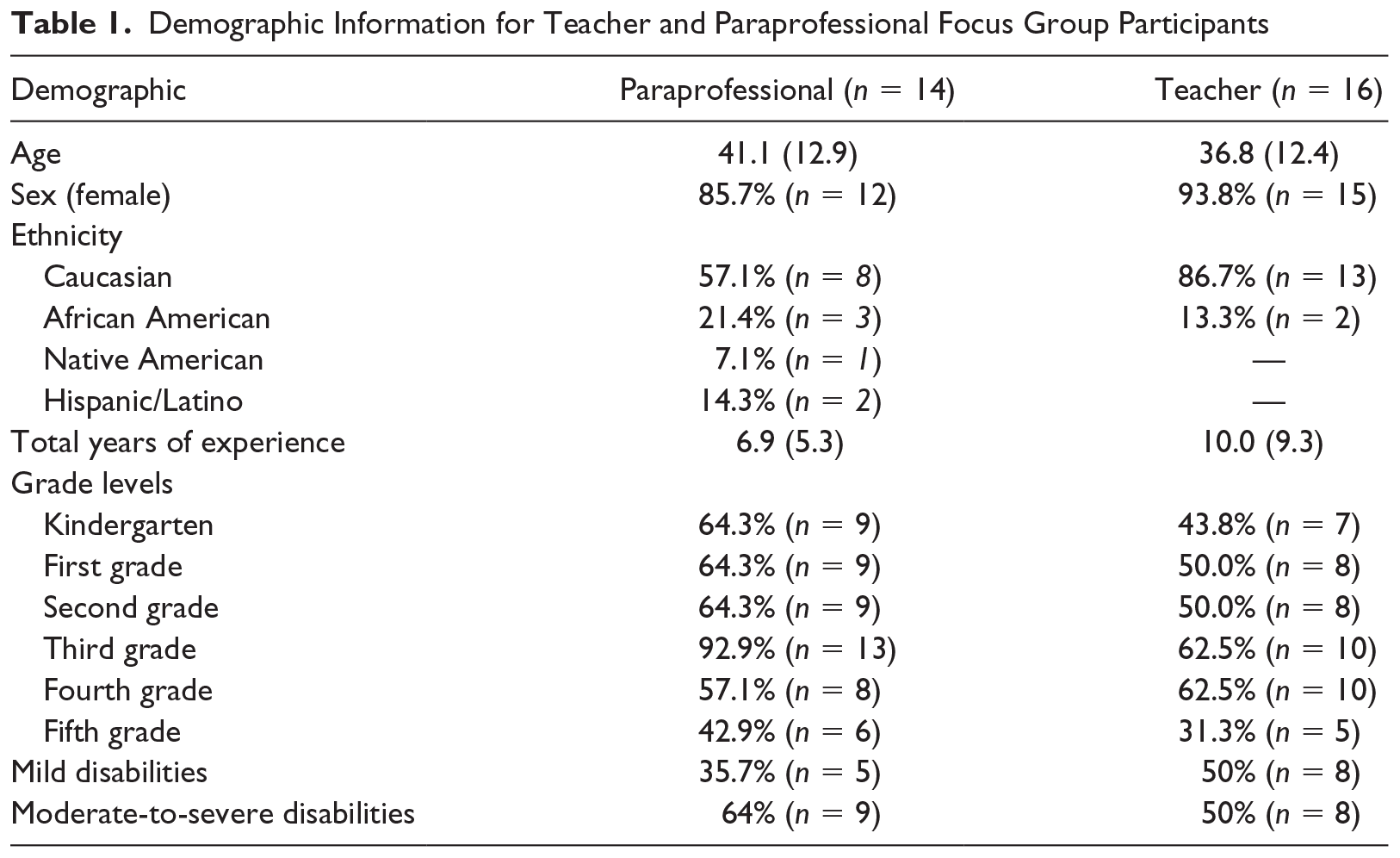
To be included in the FGs, teachers had to be in their position for a minimum of 1 year, provide services for either students with mild disabilities (MD; e.g., learning disability) or moderate-to-severe disabilities (MSD; e.g., autism spectrum disorder), and supervise at least one paraeducator. Participating paraeducators had to have at least 6 weeks of experience in their current positions and be assigned to work with students with MD or MSD. Teachers and paraeducators were invited through information provided by the researchers at school-sponsored professional development meetings and through emails sent out by the researchers. A total of 16 teachers (eight MSD, eight MD) and 14 paraeducators (nine MSD, five MD) consented to participate in the FGs (see Table 1).
Demographic Information for Teacher and Paraprofessional Focus Group Participants
Theoretical Framework
The theoretical orientation for the analysis was the grounded theory approach that emphasizes being engrossed in the data and utilizes an inductive strategy of theory development, or emergent design, in which patterns and themes emerge from the data (Lincoln & Guba, 1985).
Data Collection and Analysis
FG interview process
FGs (n = 4), which were conducted in May and June 2015 by two research team members (one faculty and one research assistant), were homogeneous based on roles and student disability level (e.g., paraeducators working with children with MD). There were two FGs with teachers (one with eight teachers of MD students—tagged as MDT—and one with eight teachers of MSD students—tagged as MSDT) and two FGs with paraeducators (one with five paraeducators of MD students—tagged as MDP—and one with nine paraeducators of MSD students—tagged as MSDP).
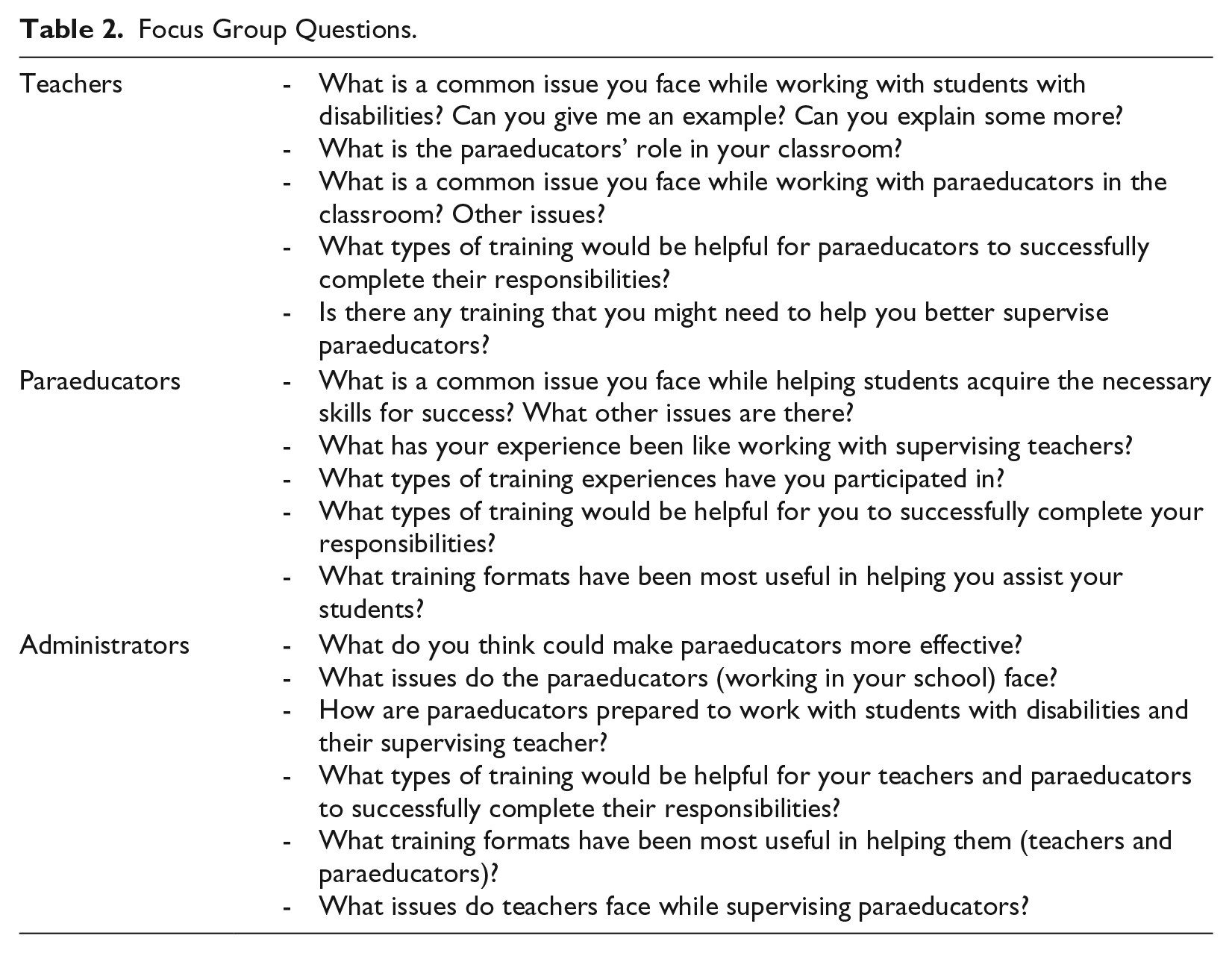
Confidentiality (Brantlinger et al., 2005) was ensured by omitting the names of participants from documents and refraining from using names during the sessions. The semistructured interview protocol contained questions targeting responsibilities, training needs, and related issues for paraeducators and teachers, followed by probing questions for clarification and further discussion (Krueger & Casey, 2000; Table 2). The facilitator consistently ensured member checking by prompting participants to rephrase, refine, and interpret their comments (Brantlinger et al., 2005; Lincoln & Guba, 1985). Sessions lasted 1 hour and were audiotaped. In addition, a research assistant took notes including nonverbal gestures and summaries of comments. After each session, the notetaker met with the facilitator to debrief and discuss notes and impressions.
Focus Group Questions.
The research team
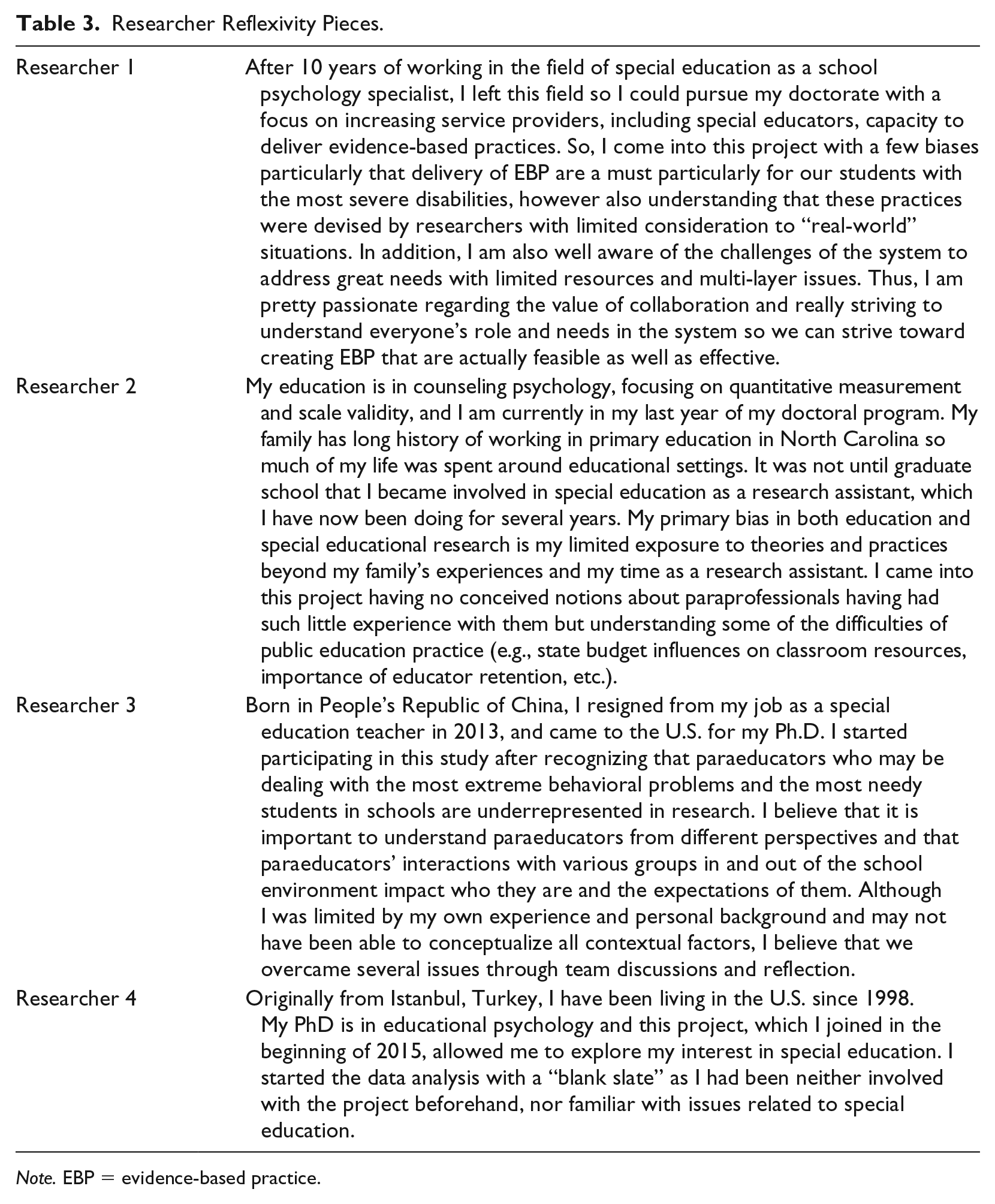
Our team was comprised of two male and three female members, including the coauthors, four of whom participated in data analysis. Two were research faculty in SPED, two were doctoral students, and one was an independent scholar. Four were White and one was Asian. The diversity of the research team members assured multiple analyst triangulation (Patton, 2002). The team members’ researcher reflexivity pieces, important points that add to the strength of a qualitative study (Brantlinger et al., 2005), are presented in Table 3.
Researcher Reflexivity Pieces.
Note. EBP = evidence-based practice.
Data analysis
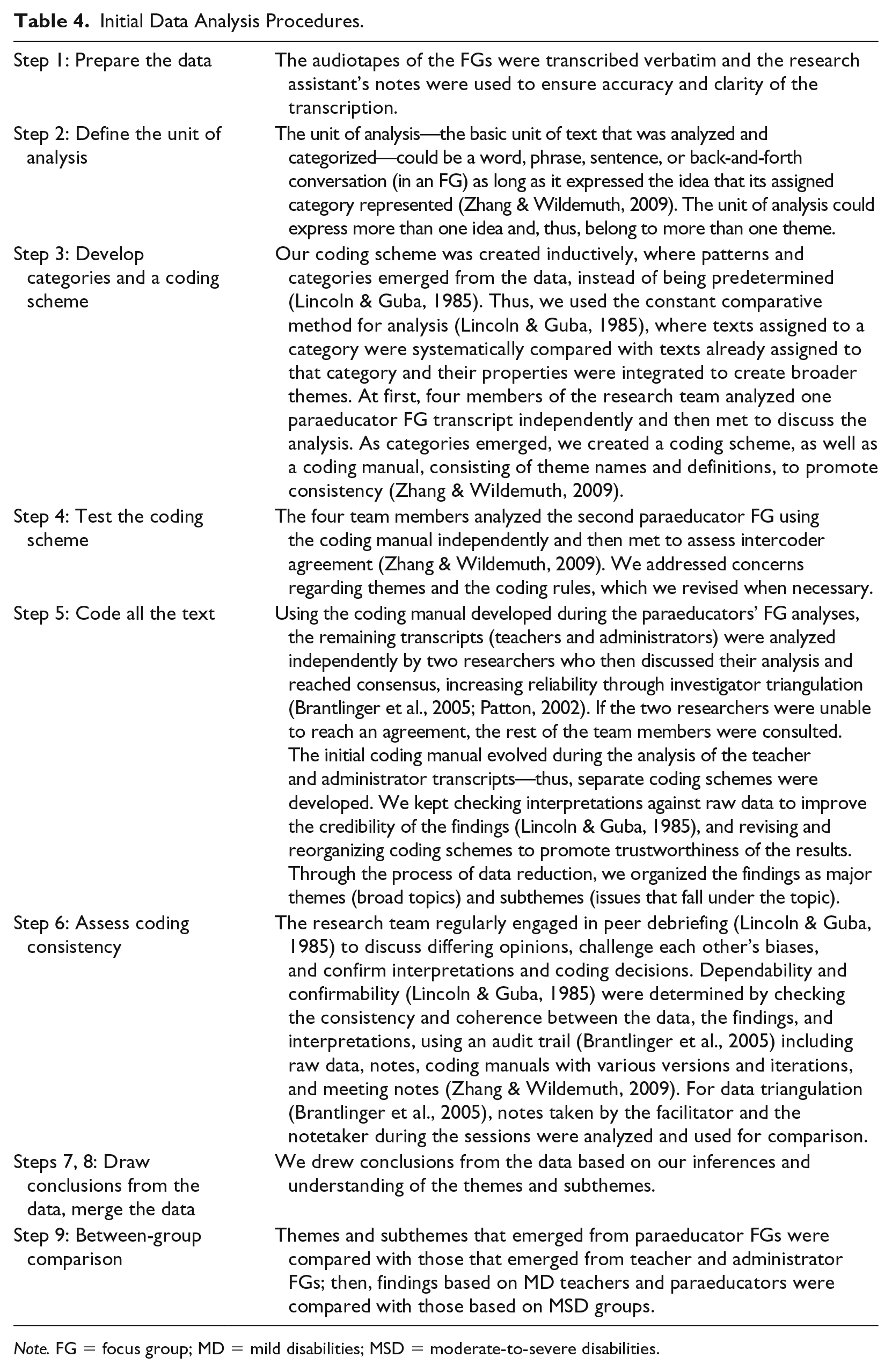
In the initial analysis, we followed an iterative process based on qualitative content analysis procedures described by Zhang and Wildemuth (2009), which is outlined in Table 4.
Initial Data Analysis Procedures.
Note. FG = focus group; MD = mild disabilities; MSD = moderate-to-severe disabilities.
Initial findings led to additional research questions:
While keeping the original coding scheme intact, two team members reread the paraeducator transcripts and identified themes related to self-efficacy, as well as perceptions of others’ competence. We discussed the analysis and grouped the various efficacy themes according to the major themes from the initial analysis. After completing paraeducators’ self-efficacy analysis, we went through the same steps for the teacher transcripts. After the transcripts were reanalyzed, we did the between-group comparison once again (paraeducators vs. teachers; MD teachers and paraeducators vs. MSD teachers and paraeducators).
Results
Initially seven major themes emerged, however, after careful analysis, four themes were included in this article to address the specific research questions. Findings common to both teachers and paraeducators are presented initially, followed by findings that emerged only among paraeducators (listed in Table 5).
Major Themes and Subthemes Resulting From the Data Analysis.
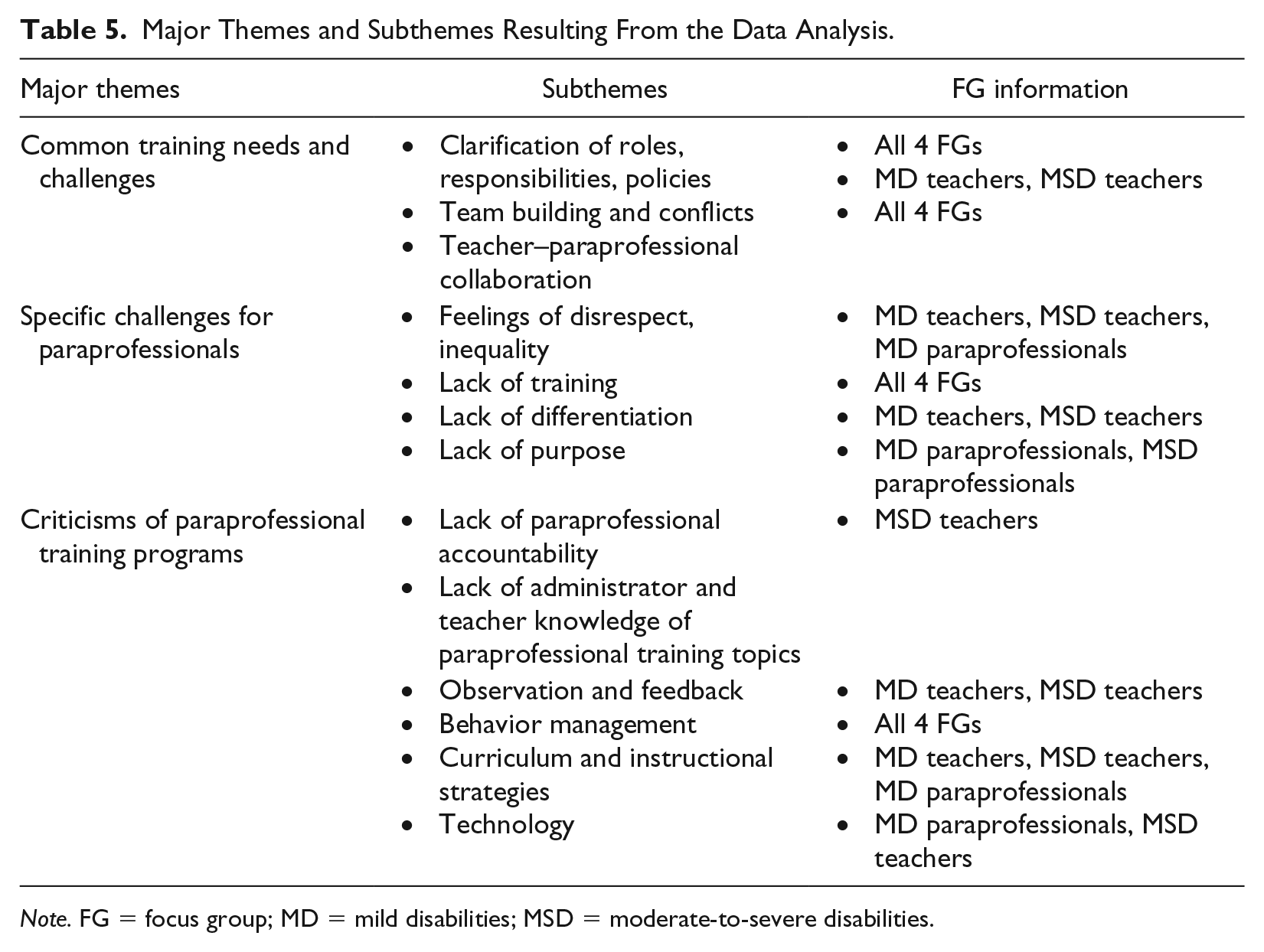
Note. FG = focus group; MD = mild disabilities; MSD = moderate-to-severe disabilities.
Common Training Needs and Challenges
Clarification of roles, responsibilities, rules, and policies
The lack of knowledge regarding this topic and its consequences emerged as a prominent challenge in all FGs. Whereas paraeducators mentioned these topics as necessary for their own professional development, teachers indicated that these topics would be beneficial for them and paraeducators.
Paraeducator roles and responsibilities
In several instances, MD and MSD teachers expressed the importance of knowing the roles and responsibilities of paraeducators and the difficulty caused by ambiguity surrounding these issues. MD teachers noted that they had to learn what they could expect from paraeducators and vice versa. Some MSD teachers focused specifically on the importance of paraeducators’ knowledge of their own role and responsibilities. MSDT3 said, I think they need to be given a very clear honest answer on what their role is because . . . when you work with some kids with some severe disabilities you sign up to be a punching bag because you can’t retaliate, you can’t react . . . So, if you’re not interested in doing the strategy for the kid that’s wanting attention and kicking your butt right now then you can’t be here . . . I just want someone to explicitly sit down and say, “you’re going to get hit, you’re going to get bit, and you can’t do anything about it except stay calm and follow the procedure . . . If you can’t do that, then this isn’t the job for you . . .”
Teachers’ authority and rules regarding supervision
MD and MSD teachers expressed the need for training on clear rules regarding responsibilities and their level of authority. MDT5 explained that despite receiving training on the roles and responsibilities of general education teachers, SPED teachers, and paraeducators, confusion still remained: “. . . but I still can’t clearly state, ‘ok, well, if they’re doing this wrong, then it’s the principal’s job to tell you’ versus what’s my job to tell you versus what’s special ed’s job to tell you.” MSDT6 expressed how the lack of clear roles and responsibilities led to conflict with paraeducators and a sense of powerlessness, leading to questioning her own self-efficacy: Well, I think for me it would be nice to know exactly how much authority I have. Because, right now, I can write down everything that goes wrong but it doesn’t matter and my paras know it doesn’t matter. And they take advantage of that I don’t have authority, so it would be nice to know, just to know what exactly I have control over . . .
General rules and policies
MD paraeducators expressed their anxiety and confusion while discussing certain school rules and policies, noting inconsistency. One dialogue suggested the uncertainty regarding “quantity vs quality”: paraeducators were not clear whether the number of minutes spent or the necessary instruction taking place was more important. MDP5 described “another uncomfortable position” where the teacher wanted to keep the student in class and she had to take this message to the Student Learning Center: “I just think that maybe I was stuck in the middle of a problem that wasn’t my problem and I was the point person. And I’m a people pleaser and it hurt my feelings!”
Team building related to weak self-efficacy and collegial conflicts
Among MD teachers, team building emerged as an important training topic that might address interpersonal issues and possibly foster a stronger self-efficacy in paraeducators. Some MD teachers noted that paraeducators felt unwelcome at times and that it was important to encourage positive collegial relationships. The importance of team building became apparent as some MD and MSD teachers explained that conflicts between paraeducators, as well as between paraeducators and students, created a challenge they frequently faced. MDT2 said that she knew the paraeducators and students would “butt heads and there is going to be a power struggle and she’s going to set them off.” When the facilitator asked for some final takeaways at the end of the FG, MDT3 expressed the importance of team building and her perception of paraeducators’ weak self-efficacy: “Helping facilitate those relationships throughout the building—my paras feel like they’re low man on a totem pole and that the staff think that they’re lower citizens . . .”
Although paraeducators mentioned some interpersonal issues with teachers, they did not mention challenges among themselves. Interestingly, paraeducators mentioned neither training needs nor challenges related to interpersonal issues.
Teacher–paraeducator collaboration
Although MD paraeducators, MD teachers, and MSD teachers specifically expressed the need to include opportunities for teacher–paraeducator collaboration during training programs, participants in each FG noted the challenges presented by the lack of systematic communication among colleagues, especially between teachers and paraeducators, and the lack of teacher–paraeducator supervision opportunities. These challenges were the most frequently emerging challenges in all FGs, especially among MSD and MD teachers. Both groups of teachers emphasized the lack of time to collaborate or communicate with paraeducators several times during the discussion (e.g., MDT1: “I just wish I had more time to communicate with my para every day and go over how I want her to achieve certain things and what I want her to do”; MDT8: “I’m lucky if I see my para a few times a day”; MSDT1: “There is no time for me to talk to them because there just isn’t. They have to be watching the kids, so even if I’m on plan time they have to stay with the kids during specials . . .”). They indicated that the lack of opportunities for them to guide paraeducators could lead to the latter feeling less supported, as well as less competent, thus influencing self-efficacy negatively; for example, MSDT8 noted, “I have new paras this year . . . only having a day, maybe, to go over students and behaviors, so that they aren’t always questioning themselves.” MSD teachers expressed a specific need for trainings to include time for SPED teachers, general education teachers, and paraeducators to simply communicate.
Both groups of paraeducators also emphasized the fact that they did not have time for collaboration, or even a 5-minute conversation with teachers (e.g., MDP1: “Maybe we could visit (the classroom, and say) ‘hey, let’s try this strategy with this kid and we’re all on the same page . . . We don’t really have time together . . .’” MSDP4: “I sometimes don’t even get to speak to our lead teacher—hardly at all”).
Specific Challenges for Paraeducators
Two elaborate subthemes that affected paraeducators negatively and were also linked to training were feelings of discord, disrespect, and inequality and lack of training.
Feelings of discord, disrespect, and inequality
Feeling disrespected and unequal was a prominent challenge that paraeducators faced and it most frequently appeared in relation to training. This subtheme emerged in all FGs, except in the one with MSD paraeducators, several times. In addition, feeling disrespected and unequal appeared as the second most frequently occurring factor (first factor was training) that either led to occupational stress or actually affected self-efficacy negatively (as reported by MD paraeducators).
While talking about the difficulty that arose from the lack of time to work with teachers, MDP4 commented, “But it’s more the teacher accepting us as equals—not someone that doesn’t know what they’re doing.” After one participant noted that different responsibilities also led to feelings of being different than teachers, MDP3 expressed how being treated differently led to her questioning her performance (a direct statement about impact on self-efficacy): “Then you can go in and feel like, ‘Okay, it’s just me; I’m doing something wrong . . . Am I doing something wrong? Yeah, I’m approaching them wrong.’” When the facilitator asked about their experiences working with supervising teachers, MDP2 response revealed the emotion that is provoked in certain situations: When I started working as a para I noticed . . . I was second class. They looked at me as if I had no common sense, that I was not capable of doing anything . . . We’re lacking—darn it—them treating us as equal human beings. That’s the problem, okay? We teach the kids like we should—as equal—Why can’t we get that from the teachers? We have to earn it . . .
One conversation revealed feelings of inferiority and inequality that arose while feeling disrespected during a training program on technology, as MD paraeducators commented on not having laptops to participate in the training: “So . . . we come to these meetings and we’re just—you’re just watching”; “It’s kind of another reminder that you’re not equal”; “We’re being babysat, that’s it basically”; “. . . We would never do that to a student . . . you would never say, ‘All the SPED students don’t have laptops, but everyone else pull out your iPad . . .’” While discussing useful training formats such as including time for discussion and collaboration, two MD paraeducators commented: “You know like she said, ‘respected’—but really just a warm body taking some oxygen”; “We’re just pickin’ up the slack that the teachers don’t want to do.”
The topic of disrespect and inequality appeared in relation to training programs also among MD and MSD teachers as well. MDT4 talked about how paraeducators were not provided technological tools: I think most of us now all have at least two iPads, if not three, as SPED teachers, but paras don’t get anything. And so—getting the training to get that iPad or how to use one of our iPads and maybe getting them, you know—and we’re going to spend the time training the paras on technology, we also need to have that backup and support so that they have the technology to be able to start using (it) . . .
MSD teachers noted, “My paras have specifically said that they hate going to them (training programs)”; “They’re put out in a backdoor random building so then they feel like . . . there’s no place for them”; “That’s their perception of how much (they are valued)”; “Yeah, ‘this is how much they care about me is that I’m sitting in this nasty facility . . .’” MSDT2 indicated how certain attitudes lead to feelings of unimportance, which could affect paraeducators’ self-efficacy negatively, thus leading to lack of motivation: Well, my principal doesn’t even know my paras’ names. She’s been there for a year and she can’t even tell you what their names are. So, it’s to a point where I feel like they (paras) don’t feel like they have a role or are a part of the school . . .
Lack of training
The lack of paraeducator training appeared as a prominent category in all FGs and was the most frequently emerging criticism. Participants noted that “any training” would be beneficial for paraeducators. This issue was expressed as either part of or the cause of various challenges for both paraeducators and teachers (in regard to their relationship with paraeducators).
Although MSD teachers commented on the lack of paraeducator training (e.g., “I think they don’t think they get enough training”; “The lack of training—I think that sometimes that is an issue”), the consequences of this situation were expressed poignantly by MD paraeducators: MDP2: There’s just, “Here you go, I know you’ve never worked with this student who has disabilities—but you seem really smart, you have a degree—even though it’s not in education, you do have this degree—associates. You know about math and all that great stuff . . .” . . . I never even worked with elementary students and there was no training period . . . Any other type of job, they go through training and you have to sit there and it’s like a week, or maybe two weeks, or maybe 90 days, depending on what kind of training you’re in. As a para there’s no training. We’re working with severe students— MDP4: —and you don’t know what to do!
At another point during the session, MDP3 said, Next year I’m going to “Life Skills . . .” But I know going in there I’ll have no training. I know that I’ll be with students who may be spitting and biting and stuff like that, and I’m thinking in my mind, “What?”
MDP1 briefly emphasized that, without training, “it’s sink or swim.” Only one set of quotes, or conversation, by MSD paraeducators indicated challenges caused by lack of training, as well as indicating weak self-efficacy, with phrases such as “there’s no way to teach . . .” MD teachers explained the difficulties caused by the lack of paraeducator training: MDT6: . . . I’m dealing with a para who—by no fault of their own—just does really not have the background knowledge to teach even most of the things that I’m asking them to teach, or is even close to deal with the behavior [issues] we have to deal with . . . I mean, no training; absolutely zero training. Teaching itself takes a little teaching bone and if you don’t even have that, it makes it pretty difficult . . . MDT3: I would say my biggest take away . . . for you guys to take away is just that these poor paras need more training to be successful at their jobs and we don’t have the time to give it to them. MDT1: I think paras are an integral part of any school and . . . they need more time and training so that they can better implement IEPs and behavior intervention plans. MDT2: Our kids deserve the best and many a times I’ll have 18 kids there and they, you know, she (the para) is basically taking care of half of my kids. Those 9 kids deserve the very best and she needs this training to be able to provide that for them.
In addition, comments indicated that paraeducators’ lack of training or prior training experience influenced teacher perceptions of paraeducator competence. For example, MSDT7 stated, “I wish mine were more competent. I think they don’t think they get enough training.”
Criticisms of Paraeducator Training Programs
Criticisms of paraeducator training programs included a lack of differentiation based on paraeducator experiences, lack of notable purpose, lack of paraeducator accountability, and lack of administrator and teacher knowledge of paraeducator training topics.
Lack of differentiation
MD and MSD teachers criticized paraeducator training programs that group people from different educational backgrounds and responsibilities in a “one-size-fits-all” approach. This is linked to a training need presented by MD paraeducators: varying training programs according to different paraeducator assignments and past training experiences. For example, MDT3 pointed out that although teachers are grouped according to responsibility and training level, paraeducators are not. As a criticism of training programs, an MSDT4 commented that various topics were grouped together and paraeducators were expected to attend these programs despite differing responsibilities.
MDP5 expressed the necessity of differentiating training programs according to educational and professional background: For INSTANCE, she (this paraeducator) has been doing it for 16 years! She shouldn’t have the same training I have when I’ve been doing it for two [years]. There is no way we need that exact same—unless it’s something that’s general, like a new concept.
Lack of purpose
MD and MSD paraeducators both expressed, pretty vehemently, how ineffective their training programs were, indicating training tended to be repetitive and overall just a “waste of time.”
The problem of too much repetition in paraeducator training programs appeared among both paraeducator FGs and MSD teachers. An MSDT3 said, There is also overkill, too, I don’t know what the paras were told this year but every Thursday they come back from PD, they always say it was about behavior again. This whole year was about behavior and it’s all they talk about. So they tune out after a while too.
MDP1 commented, “For me, I’ve been around a while and so recapping all the traits of autism and all the Asperger’s and ADHD—been through this so many times it’s really no longer beneficial for me.” Meanwhile, sample comments by MSD paraeducators were as follows: “Our (training programs) are not beneficial whatsoever”; “. . . We know every definition . . . they’re teaching us on the PowerPoint that’s repeated week after week . . .” “We have worked on the last same subject for the last five or six sessions”; “It (the training) was honestly a waste of time”; “There’s not really a ‘training.’”
Lack of paraeducator accountability
MSD teachers pointed out that lack of paraeducators’ accountability led to lack of motivation for, and participation in, training programs. For example, while talking about ineffective training formats, MSDT4 noted, I think it all comes down to no accountability or follow-through for what they are learning—or not learning—at these professional developments. Seriously, I think mine just go there and they go to clock their hours . . . once they got their 20 hours . . . they stopped going.
Lack of administrator and teacher knowledge of paraeducator training topics
MSD teachers criticized the fact that they were not informed about paraeducators’ training topics. MSDT7 noted, I’ve had lots of questions about their professional development and I can’t answer the questions because it’s over material that I don’t know or that they were taught differently than the way I was taught and it just gets very confusing.
Specific Training Needs of Paraeducators
Various other issues related to training and challenges of paraeducators appeared in each FG. The addition of observation and feedback to training was most prominent in the comments. Important topics to focus training included behavior management, curriculum and instructional strategies, technology, data collection and progress monitoring, and Individualized Education Programs (IEPs) and behavior plans.
Issues related to efficacy were closely related to training overall. The most frequently emerging efficacy-related theme was perceptions of paraeducator competence, which appeared among both teacher FGs: For teachers, training was the only factor that influenced perceptions of paraeducator competence, which they expressed in several instances. Meanwhile, MD and MSD teachers also indicated lack of training as a factor negatively influencing paraeducator self-efficacy.
Observation and feedback
The recommended training format that appeared in both teacher FGs was a “coach” attending class, observing the paraeducator, and providing feedback. MSDT2 noted, It would have to be done the right way, but it would be nice to maybe have some coaching in the classroom. They want the paras to learn these strategies, but I mean, I don’t learn things disconnected. You have to be thinking about specific kids that you have in order to connect. So to have someone come in and work with the paras in our room . . . Not someone who is like higher up than they are so they aren’t intimidated, but someone who can really say, “hey, I think that was really good, but I think with that kid, let’s try this. Maybe this would work too . . .”
In another instance, emphasizing the importance of teamwork, MSDT8 explained why teachers should also be observed along with paraeducators, to make the process less stressful on the latter: I think that it’s a good idea to have a mentor, but I think that it’s very important that the mentor would come into the classroom to help the entire classroom, the teacher included. I think if you just focus on the paras, you are never going to engage them because they are going to feel threatened . . . It’s a more threatening and intimidating process to come in and say, “I’m going to observe the para . . .” They need to come in and say, “How can we support this entire classroom? . . . How can this group of adults in this room work together to make it work for this kid?” And in that situation it’s very important that you are a unit and you are a team.
While talking about useful training formats, an MD teacher talked about her inability to observe her paraeducators and how it would be beneficial, not just for training but also for assessment of paraeducators’ performance.
Behavior management
This was the only training topic that appeared in all the FGs and that participants referred to repeatedly during each FG. For example, one MSD paraeducator suggested specifically working on “ABC” (antecedent–behavior–consequence), whereas an MSD teacher indicated the need for learning de-escalating techniques.
Curriculum, academic knowledge, and instructional strategies
These topics appeared as necessary for paraeducator training several times among MD and MSD teachers and MD paraeducators. They were linked to the challenge expressed as paraeducators’ lack of knowledge and to paraeducator self-efficacy, as well as teachers’ perceptions of paraeducator competence. MD paraeducators expressed lack of knowledge as a challenge they faced, whereas MD and MSD teachers viewed it as a difficulty for themselves during their work with paraeducators. Sample comments by MD paraeducators include: “. . . We’re helping [students] get prepared for tests and we don’t even know the [instructional] language they [teachers] use on it”; . . . since I’m not in the classroom anymore I didn’t really understand the words they were using for rounding . . . I don’t even know what words they’re using . . . I think sometimes I confuse kids ‘cause I don’t know what they’re doing in class—exactly.
Echoing what was said among MD paraeducators, a few MD teachers talked about the challenges caused by paraeducators’ lack of content knowledge, indicating a weak perception of paraeducator competence. MDT5 noted, . . . With the curriculum-based stuff, that’s just something I really struggle with. I mean, we, all of us have different expectations but . . . we’re expecting them to teach something . . . I have two kids I’m expecting to sit back there with these two adults and teach them all day long, but they don’t have any background on teaching and . . . this is more work for me. It’s almost like just to have a body . . . so it’s really making it harder for me because then I have to teach two people . . .
Another MDT6 noted how training on these topics can lead to a stronger sense of self-efficacy in paraeducators: (a paraeducator is) almost another SPED teacher except they don’t have that training, so getting them content knowledge somehow . . . and getting them trained so that they do feel like they are a part of the building . . . and that they feel confident doing whatever in the classroom or on their own . . .
MSDT2 commented that while working with a paraeducator, the latter would say, “‘you know, I don’t know how you usually do this.’ So since we don’t have the time during the day for me to teach them what to do, just some basic instructional strategies would be good.”
In addition, MSD teachers noted that paraeducators needed training on IEPs and behavior plans. MSDT3 commented that paraeducators did not “have a clue where to even start looking at” IEPs and that they did not understand the goals.
Technology
Technology appeared among MD paraeducators and MSD teachers as a necessary training topic for paraeducators and as a challenge, not only for paraeducators but also for teachers in their work with paraeducators. Lack of knowledge regarding the use of technology influenced paraeducator’s self-efficacy and teacher’s perception of paraeducator’s competence. MD paraeducators emphasized their lack of knowledge and understanding, the feeling of inability it caused, and in some cases, its influence on their job performance (e.g., “And the technology—I would also like to know how to work the smart boards . . . I think that would help—especially—I’m scared of that thing! I go running the other way!”). While talking about important training topics for paraeducators, MSDT8 noted, “For me, I think it would be technology (training) because I use it a lot in my room and my paras don’t know how to use the smartboard, use the iPad . . .”
Discussion
The increased enrollment of students with disabilities coupled with a decrease in certified SPED teachers has given rise to the number of paraeducators in our educational workforce. Relatedly, research suggests that when trained well, paraeducators can effectively perform educational tasks with a high degree of fidelity (Brock & Carter, 2016) and that further training for paraeducators is crucial to education of students with disabilities (e.g., Brown & Stanton-Chapman, 2017; Koegel et al., 2014; Walker et al., 2017). To accomplish this, a clearer understanding of the contextual factors including strengths, weaknesses, and challenges is necessary to translate research to sustainable practice. The current study explored the perceptions of key stakeholders—paraeducators and SPED teachers—in regard to paraeducators’ roles, responsibilities, and training needs, and how these subsequently affect teacher training needs, the self-efficacy of both paraeducators and supervising teachers, and ultimately job satisfaction for both parties.
Toll of Ambiguous Roles and Responsibilities
Perhaps one of the key findings of this study is that the lack of clarity regarding paraeducators’ roles and responsibilities may be the primary barrier to the development of effective training. The issue of ill-defined job roles and responsibilities has been frequently identified in the paraeducator literature base in terms of overstepping the intended bounds of the position (Giangreco et al., 2010), and former research suggests that because paraeducator roles and responsibilities are so variable based on context, it is difficult to present clear definitions or expectations (Allen & Ashbaker, 2004). Our study suggests that this ambiguity—the lack of knowledge of the extent of their own authority responsibilities—leads to the feeling that paraeducators “don’t really have control,” and thus question their self-efficacy. This issue emerged from all three groups and is likely at the core of the challenges commonly associated with paraeducators as provision of training, supervision, feedback, and performance evaluations becomes quite precarious, if not impossible, without clearly defined job descriptions and performance expectations. Interestingly, some teachers indicated this begins at the point of hire for many paraeducators who may be unaware of what the position entails, particularly given the variety of placements that might occur. Paraeducators could be placed in a position in which their primary responsibility is to provide instructional support with academics or be placed in a situation in which their role involves managing challenging, sometimes aggressive, behavior. Thus, the job requirements may fall well outside of their expectations. Furthermore, teachers indicated a lack of clarity regarding their own job responsibilities in terms of evaluating, providing corrective feedback, and directing paraeducators. Such ambiguity leads to disarray and apathy, and as noted by one teacher, to feelings of powerlessness (“it would be nice to know exactly how much authority I have . . . because I don’t really have control”). Development of well-defined expectations for paraeducators and those responsible for supervision would likely assist in the development of training that is aligned with clearly defined roles and responsibilities and provide a clearer metric by which paraeducators’ performance can be measured.
Teachers noted the importance of paraeducators and the valuable role they play in the education system; yet, both groups also noted paraeducators are often devalued. Feelings of discord, disrespect, and inequality of paraeducators were one of the prominent challenges that they faced, and it either led to occupational stress or affected self-efficacy negatively. For example, terms such as “low man on the totem pole” and “third rate citizen” were used to describe how paraeducators are treated, and both groups recognized the impact this likely has on job satisfaction, commitment, and relationships. Similarly, according to former studies, paraeducators “often feel inferior to the teacher and work to please the teacher,” yet feel “a lack of teacher recognition and appreciation” (Brown & Stanton-Chapman, 2017, pp. 25–26), and it is not uncommon for them to feel undervalued by other school staff (Fisher & Pleasants, 2012). Meanwhile, research suggests that perceived importance and social comparisons influence self-efficacy (Schunk & Pajares, 2002) and that a correlation exists between occupational stress and self-efficacy (Evers et al., 2002).
Paraeducators were very honest about feeling disrespected in numerous instances. Concrete examples shared by the groups included paraeducators not being included in building-wide meetings and not having access to technology (e.g., laptops, iPads) unlike other instructional staff. Participants across groups highlighted the discord that can occur within classrooms including poor relationships between paraeducators and SPED teachers, general education teachers, and other paraeducators. Although many noted this can be linked back to the absence of clearly defined roles and responsibilities, devaluation of the paraeducator within the classroom and building was noted to play a prominent role in this discord. In addition, lack of time specifically set aside for teacher–paraeducator collaboration was noted as a barrier to effective communication and teambuilding, both of which have been found to be of importance for supervising SPED teachers (Douglas et al., 2016). All three groups indicated time allotted specifically for the purpose of teacher–paraeducator teams to collaborate, discuss expectations, assign tasks, and problem solve would buffer the teams, decrease discord, and facilitate a sense of belonging. Not only would activities aimed at increasing team building and collaboration likely increase the sense of belonging for paraeducators but might also help facilitate more collaborative relationships among staff members.
Targeted Training
Although it was clearly expressed that effective training was a deficit and linked to the paraeducators’ feelings of disrespect and inequality, the enthusiasm for, and ideas regarding, training topics and methods are encouraging. As noted by one teacher, paraeducators “really do care about [the] kids and want to help them and they’re not getting the information that they need.” Clearly, there is an awareness of limitations and an interest in learning new skills to facilitate improved job performance and, likely, better student outcomes. The current training system provides professional development opportunities in a one-size-fits-all, large group format.
Thus, paraeducators working with students with MSD receive the same training as paraeducators working with MD. As pointed out by paraeducators and teachers alike, this is inappropriate given the vast difference in the learning needs and abilities of the students with whom they work. As a result, paraeducators do not have the skills they need to effectively perform the tasks with which they are presented and, as our findings suggest, teachers do not know when or how to provide effective supervision or even if it is their responsibility. It stands to reason that this feeling of incompetence results in the supervising teacher limiting or foregoing supervision, which further decreases paraeducators’ training opportunities and damages not only teachers’ perceptions of paraeducator competence but also paraeducators’ own self-efficacy, deepening their devaluation. Thus, effective and appropriate training for both paraeducators and teachers would likely break this cyclical pattern while also increasing the quality of services our students desperately need.
Interestingly, teachers and paraeducators both provided similar ideas for improving training, suggesting topics based on assignment with provision of hands-on activities, follow-up, and performance feedback. This is consistent with research on effective professional development, which recommends instruction, opportunities for practice, and follow-up and feedback (Conroy et al., 2015).
In addition, both teachers and paraeducators pointed out the need for their active role in decision making regarding training topics as they have firsthand knowledge of the strengths and deficits in their classroom systems. Responses from both groups, however, clearly emphasized the lack of personnel resources available to provide this type of intensive, individualized training. Mechanisms aimed at addressing this barrier to implementation are needed.
Limitations and Implications for Research and Practice
As with all studies, this one is not without limitations. First, it is plausible that we did not completely satisfy the criteria of “saturation” (Brantlinger et al., 2005, p. 198). Although the teachers and paraeducators in the current study reported similar information within and across groups, the participants were all from demographically similar schools (i.e., urban, Title 1, diverse, etc.). As the experience of paraeducators and supervising teachers differs in schools with divergent demographics (e.g., rural, suburban, high socioeconomic status [SES]), follow-up studies that address the needs and responsibilities of paraeducators in a variety of schools with differing demographics would likely provide additional information relevant to the roles and needs of paraeducators.
In addition, although this study did include paraeducators and SPED teachers, the exclusion of general education teachers is a limitation. General education teachers also have a role and responsibility for providing instructions and assigning tasks to paraeducators. Given paraeducators often are tasked with supporting students with disabilities within the general education classroom, understanding the challenges and needs of general education teachers as they relate to paraeducators would be helpful. This is particularly true as information from this study indicates additional challenges that arise as it relates to inclusion such as further ambiguity regarding who is responsible for assigning tasks and supervising paraeducators within this setting. Thus, a future replication study, with an accompanying quantitative study, that also includes general education teachers is likely to provide further insight regarding the unique challenges for paraeducators and the general education teachers working with them in inclusive settings. As the themes of self-efficacy and perceived competence emerged after the initial findings of the analysis, we were unable to conduct a formal assessment of paraeducators’ self-efficacy. A formal assessment of self-efficacy to support qualitative findings is recommended for future studies.
Clearly, additional research is needed to identify reasonable and acceptable approaches for training paraeducators to deliver effective educational services while also training teachers to provide effective supervision within the confines of schools’ available resources. Identifying mechanisms to improve paraeducator and teacher training is a high priority particularly given its influence on teacher self-efficacy (Heggestad & Kanfer, 2005), especially in SPED (Emery & Vandenberg, 2010). For example, models that train teachers to implement coaching strategies as a mechanism for training paraeducators are promising (Brock & Carter, 2016; Mason et al., 2017); yet, more research is needed to evaluate the efficacy of this model across a variety of settings and practices. In addition, development and evaluation of the effectiveness of online training models as a means to provide content instruction prior to follow-up and feedback would not only help paraeducators but also train teachers on effective supervisory techniques. Such a program could potentially decrease the need for personnel to deliver the content and provide a mechanism for administrators and teachers to individualize training content based on paraeducator assignment and experience. Teachers, trained in effective supervision and coaching, could then provide the necessary follow-up and feedback. In addition to evaluating the effectiveness of such training in terms of improving delivery of instruction, research that evaluates how it affects both paraeducator and teacher self-efficacy is warranted. As our study suggests, provision of more effective training for both teachers and paraeducators may improve self-efficacy and job performance, leading to a more positive perception of competence by others as well as more effective teamwork and job satisfaction. Experimental studies that evaluate the impact of such training on teacher and paraeducator job performance and subsequent self-efficacy would provide valuable information.
Beyond implications for research, the insight gained from this study magnifies the need to develop clearly defined roles and expectations for teachers and paraeducators as it relates to the supervision of and responsibilities of paraeducators. As was amplified by this study, lack of clearly defined job descriptions for paraeducators affects the system at all levels including building, classroom, and individual. This, unfortunately, includes the student level in which the education of the student is at risk of compromise due to this lack of clarity. Effective structures, based on information from this study, would include clear guidelines regarding who is responsible for evaluating paraeducators while ensuring the teacher has a prominent role in this evaluation. In addition, the structures would also include mechanisms that ensure teachers and paraeducators participate in decisions as it relates to choosing training topics, and that mechanisms are in place to account for follow-up and performance feedback to ensure training is implemented within intended settings. Furthermore, steps aimed at preparing teachers to take on the role of supervisor are also necessary. Although addressing this at a school level is important, inclusion of such instruction in preservice programs is also warranted. Curriculum that includes instruction on skills necessary for supervision of paraeducators and strategies for incorporating necessary skill-building activities into the supervision would better prepare educators for their role as supervisor prior to entering the classroom.
Footnotes
Acknowledgements
The information and conclusions are those of the author and should not be construed as the official position or policy of, or should any endorsements be inferred by, IES or the U.S. Government. We would like to thank the teachers, distant-level administrators, and paras who made this work possible.
Declaration of Conflicting Interests
The author(s) declared no potential conflicts of interest with respect to the research, authorship, and/or publication of this article.
Funding
The author(s) disclosed receipt of the following financial support for the research, authorship, and/or publication of this article: This work was supported by the Institute of Educational Sciences (Grant No. R305H140048).