







Abstract
Internship is a culminating student teaching experience traditionally involving sustained mentorship in the classroom of an experienced mentor teacher with some university supervision, and as such, it is a critical component in teacher preparation. When provisionally licensed teachers complete a non-traditional internship in their own classroom, however, they must rely primarily on university supervision for mentorship. We describe a study of an eCoaching model for university supervisors who were able to successfully provide sustained mentorship to these teachers through eCoaching. After completing online training modules, the participants implemented the eCoaching model that included focused goal setting and multiple feedback loops. In this study, we examined multiple data sources to describe university supervisors’ practices when enacting eCoaching and to gain a better understanding of their perspective about the use of the eCoaching model with provisionally licensed interns.
Internship is a critical component in special education teacher preparation (Nagro & deBettencourt, 2017). The practice-based learning opportunities afforded through internship allow teacher candidates to enact knowledge and skills gained in coursework and to receive feedback and coaching from expert teachers in authentic school settings, which supports their use of evidence-based and high-leverage practices (Brownell et al., 2019; Leko et al., 2015). In a traditional internship, the pre-service teacher candidate (now: intern) is placed in the classroom of a mentor teacher where they gradually take over the responsibilities of the teacher and receive feedback on their performance through coaching and observations made by a mentor teacher and an individual representing the university (hereafter: university supervisor; O’Brien et al., 2024). Whereas the literature regarding experiences of special education teachers has examined interns’ experiences and perceptions (Nagro & DeBettencourt, 2017; O’Brien et al., 2024), practices and perspectives of the university supervisor are less understood but critically important to internship success. Despite recent evidence that university supervisors can impact interns’ self-efficacy and intent to teach (Shaheen et al., 2024), we are unaware of any studies that have examined university supervisors’ practices and perspectives within special education internships. What is more, with the changing landscape in special education teacher preparation, teacher candidates in alternate route programs, such as provisionally licensed special education teachers, have a unique internship experience that varies from traditional internships (Day et al., 2024). Given the importance of internship for teacher candidate growth, it is critical to examine university supervisor practices and perspectives within these alternate route internships to better understand how to improve special education teacher candidate outcomes. In this manuscript, we describe a qualitative study of experienced university supervisors who transitioned from traditional supervision practices to an eCoaching approach to university supervision. The research questions for this study were (a) in what ways does using eCoaching impact perspectives and enhance, change, or revise the practices of three experienced university supervisors? and (b) do these revised practices sustain over time?
University Supervisor Role
The purpose of the university supervisor is to act as the link between university coursework and the internship setting. The role of the university supervisor is complex and varied based on the needs of the intern and the diverse school-based contexts. Complexity begins with this individual’s title as it varies across teacher preparation institutions, with the majority, but not all, reportedly incorporating the term “supervisor” (Parker et al., 2019; e.g., clinical supervisor, university-based teacher educator). Each intern they supervise has a range of skills, learning abilities, and experiences (i.e., geographic location, culture, race/ethnicities) that require individualization, furthering the complexity of the role. The responsibilities and roles of the university supervisor are often described in a handbook that accompanies the syllabus for the internship course. In addition, these materials provide the expectations and skills the intern should demonstrate during observations and via instructional materials. Traditionally, much of the day-to-day feedback to the intern is handled by the school-based mentor teacher, and the university supervisor reviews lesson plans and observes interns several times during the internship placement. The university supervisor also communicates and meets regularly with the intern and mentor teacher, providing support and sustaining relationships between the university supervisor, mentor teacher, and intern (Burns et al., 2016).
The university supervisor plays a key role in the internship process, providing the intern with coaching and feedback, contributing expertise complementary to the mentor teacher, and evaluating interns’ performance during the internship. The impact university supervisors can have on special education interns was recently demonstrated by Shaheen et al. (2024) in their survey of 154 pre-service special education interns from across six teacher-preparation programs. Shaheen et al. found that interns’ perceptions of university supervisors’ support, but not mentor teachers’ support, were associated with both self-efficacy and plans to teach. Despite the importance of the university supervisor, extant research on their roles and practices is very limited (Shaheen et al., 2024) and remains an area in need of investigation, particularly for non-traditional interns who are completing an alternate route to licensure and whose needs may vary greatly from pre-service interns.
The Provisionally Licensed Special Education Teacher
As the United States continues to grapple with a long-term, nationwide shortage of special education teachers (Billingsley & Bettini, 2017; McLeskey et al., 2004), alternate route programs have been established “as nontraditional and accelerated paths for individuals to obtain a state teaching license” (Day et al., 2024, p. 1). While alternate route programs may vary in the degree of similarity to traditional preparation programs, they typically include teacher candidates who are employed as teachers of record on a provisional license (Day et al., 2024). Specifically, Myers et al. (2020) reviewed state policies for alternate route programs across the United States and found that the most common conceptual model included provisionally licensed teachers completing their program while working as teachers of record. As described by Day et al. (2024), though supervision and mentorship during field experiences and internships are important for all teacher candidates, it is particularly important for provisionally licensed teachers given that they often are working as a teacher of record with their own classrooms and caseloads while completing their alternate route program. The result is that provisionally licensed special education teacher candidates do not have the same access to supervised fieldwork or mentorship as traditional teacher candidates. For example, they do not have the opportunity to observe, teach, and receive feedback alongside a mentor teacher. Thus, the nuanced profile of provisionally licensed special educators requires a unique supervisory model to meet their needs during the internship experience.
Changes in Supervision Approaches and Practices
Given the unique needs of provisionally licensed interns and the impact university supervisors can have on intern experiences and outcomes, it is critical to further examine supervision practices for non-traditional interns. Importantly, providing supervision during internship has changed over the last decade. Two highly influential factors that may be particularly important for supervision of provisionally licensed teacher interns include (a) the integration of technology and (b) the adoption of a less-evaluative approach to the learning and development of interns.
Supervision Approaches: Evaluative vs. Supportive
Internship supervision has been impacted by the changing role of the university supervisor. Historically, the university supervisor’s role during an internship experience in general education and special education teacher preparation programs has largely revolved around evaluative practices (Ibrahim, 2013; Kolman, 2018). However, there is evidence for the efficacy of coaching teacher candidates (Joyce & Showers, 2002; Knight, 2007) rather than the use of evaluative practices. According to Joyce and Showers (2002), adding some form of coaching to the instruction on theory and demonstration can effectively transfer pedagogical skills into practice. This shift to a role of support and providing feedback that moves beyond just demonstrating skills can foster long-term development of teacher candidates. For the university supervisor, this shift can be uncomfortable and cause dissonance (Weiss, Regan, & Glaser, 2020), therefore requiring professional development and support (Burns & Badiali, 2016). For example, the university supervisor may need structures, tools, or protocols to facilitate teacher candidate learning (Palmeri & Peter, 2019; Soslau, 2015) or professional development toward improving the quality of their written feedback (Flushman et al., 2019). The shifting role is arguably most relevant for university supervisors who support non-traditional interns, such as those who are teaching on a provisional license during their internship.
Influence of Technology on Supervisory Practices
Technology-enhanced supervision is a recommended practice in special education teacher education (Leko et al., 2015; Rock, 2019), highlighting its potential for university supervisor practices. Despite some logistical learning curves, leveraging technology for conducting supervisory practice at a distance is not only viable but can be equally effective and highly preferred by teacher candidates (Smith et al., 2020; Van Boxtel, 2017), particularly for those in diverse geographical locations (e.g., rural; Schmidt et al., 2015). What is more, the use of technology can maximize the time that university supervisors spend providing feedback and coaching to interns. For example, when describing a technology-enhanced supervision program, Van Boxtel (2017) reported that “travel time of over 9 hours was reinvested to provide additional candidate support through emails, phone calls, and additional observations” (p. 188). As a result, practice-based experiences involving technology have been integrated into teacher-preparation programs as a way to increase feedback provided to teacher candidates. These include the use of classroom videos (Danielowich & McCarthy, 2013), video analysis of recorded lessons with annotation (Chizhik & Chizhik, 2018) and without annotation (Nagro et al., 2017), video-conferencing observations (Heafner et al., 2012), and eCoaching in real time (Coogle et al., 2018; Rock, 2019). The use of technology may be a critical approach to supervision practices for provisionally licensed interns who are employed in a variety of school locations and completing internships in their own classrooms without a mentor teacher present throughout the day. Furthermore, university supervisors’ perspectives about how technology restructures their job for provisionally licensed special educators are needed.
eCoaching Model of Supervision: Process + Technology
Given the unique needs of provisionally licensed special educators, we developed an eCoaching model that combined the processes of repeated, targeted, constructive feedback and a variety of technologies to increase the ability of university supervisors to meet the needs of provisionally licensed teachers across the internship period. Specifically, we define eCoaching as the effective and efficient use of technology to support non-evaluative coaching for the development of interns. eCoaching allows for differentiated ways of coaching, using technology to provide sustained feedback and support from university supervisors. The eCoaching model of supervision includes three critical features: (a) a systematic process of coaching to provide frequent constructive, targeted feedback, not evaluation, to interns; (b) the use of technology to provide this feedback; and (c) professional learning. Experiential learning theory (ELT; Kolb & Kolb, 2009) provided the conceptual framework for both the process and the professional learning of eCoaching.
Theoretical/Conceptual Framework
The development of the eCoaching model for university supervisors was based on ELT by Kolb and Kolb (2009). According to ELT, learning is the process of transforming experience (Kolb & Kolb, 2009). It begins with a concrete experience or situation where the learner applies previous knowledge to understand this experience. This previous knowledge may or may not be adequate to address the experience or situation. Once the experience is completed, the learner then reflects on the experience and makes decisions about how to apply what they have learned from this experience to future experiences or how to learn more to be successful. According to Taylor and Hamdy (2013), reflection requires that the learner seek out other possible solutions or scenarios for the situation by discussing with others and/or gathering more information. In internship supervision, this is where the university supervisor is critical to learning, providing the opportunity for guided reflection and feedback. The process repeats itself (experience, previous knowledge, reflection, new ideas, test) as new information and new results are assimilated into previous understandings (Kolb & Kolb, 2009). When the learner encounters the experience again, they experiment with the new ideas and, again, receive feedback from others and reflect. The learner then consolidates the new knowledge into their experience, and the cycle continues (Taylor & Hamdy, 2013). Important to this framework is the knowledge that these cycles of learning take place within a social system, highlighting that feedback and learning are impacted by the interaction of the individual and the social environment (Lave & Wenger, 1991). In eCoaching, both the university supervisor and the intern learn through a process of experience, reflecting with feedback/coaching, new learning, and finally experimenting with the new ideas developed (Weiss, Regan, & Glaser, 2020).
The First Feature of eCoaching: Technology-Based Coaching
The first feature, technology, might include video-conferencing, email, synchronous and asynchronous video analysis, and real-time feedback using Bluetooth headsets (e.g., bug-in-ear coaching; Weiss et al., 2022). The determination of what technologies are incorporated depends on the preferences, needs, and level of knowledge of the university supervisor and the intern. Technology-based coaching is then incorporated in the second feature, a systematic process of coaching involving observation, goal setting, and targeted eCoaching feedback loops.
The Second Feature: The eCoaching Process
Each step in the eCoaching process (see Figure 1) requires specific activities and tasks of the university supervisor and intern. Step 1 is an initial conference where the university supervisor and intern meet one another to develop rapport and trust. The intern shares initial ideas about strengths and weaknesses and thoughts about areas of focus for the internship and coaching. In Step 2, the university supervisor conducts a pre-coaching observation to gain a baseline understanding of intern abilities. In step 3, the university supervisor and intern meet to discuss the observation and to develop measurable, observable goals for improvement, which are then prioritized to select an initial goal. Next, the team enters Step 4, which is a series of eCoaching activities with multiple feedback loops. The loop includes targeting one goal, completing observations related to the goal, and providing feedback and reflection on the goal. This observation and feedback process continues until the intern shows evidence of goal mastery. Once an intern reaches Step 4 of the feedback loop, the process begins again with a different goal. Finally, the university supervisor and intern complete Step 5, a culminating reflection conference, in which they discuss progress throughout the eCoaching internship and future professional learning (Weiss et al., 2022).
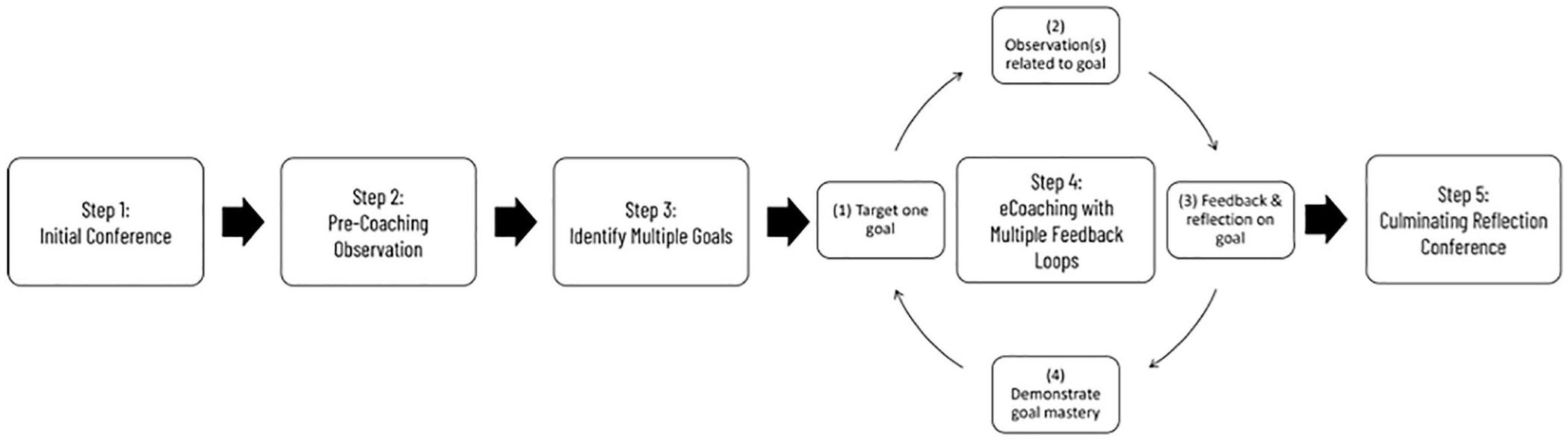
The eCoaching Process
This eCoaching model was developed and refined through a series of pilot studies beginning in 2017 (Regan et al., 2017; Weiss, Regan, & Baker, 2020). Initially, the authors completed all coaching and development with the support of state funding for provisionally licensed teachers. Results of these pilot studies demonstrated that the eCoaching model could be used to effectively provide ongoing, targeted feedback to provisionally licensed special educators during their internship. However, it was clear that this system had to be scalable across university supervisors. Therefore, we piloted a professional learning package with a fellow faculty member to better understand the training needs of those who were not involved in development. The results of this case study were also positive and provided evidence for revisions and for streamlining training (Weiss, Regan, & Glaser, 2020). For example, we learned that university supervisors who shift to eCoaching would greatly benefit from reflecting on their own actions as coaches and receiving support from an experienced coach during this time.
The Third Feature: A Professional Learning Series About the eCoaching Model
The third feature of the eCoaching model is a three-phase professional learning series for university supervisors. In the first phase, participants complete four online, asynchronous modules developed by the first two authors that provide instruction on the eCoaching model and process. In the second phase, participants receive coaching on their implementation of the eCoaching model with interns through a series of online synchronous meetings conducted by an experienced eCoach and through email, video analysis, and individual video-conferencing. Finally, in the third phase, participants complete deliverables (e.g., reflections) that include evidence of their use of each step of the eCoaching model with their interns.
Study Purpose
There is potential for eCoaching to be an effective, non-evaluative approach to university supervision for non-traditional interns, yet no studies have examined the practices of university supervisors or the impact of training on these practices when supervising provisionally licensed teachers. Thus, the purpose of our study was to examine how the eCoaching model impacted the supervision practices and perspectives of university supervisors. In this study, three university supervisors at one institution of higher education completed the eCoaching model as an approach to supervise provisionally licensed special education teachers during a semester-long internship completed “on the job” at the interns’ worksites. After acquiring an understanding of eCoaching through the professional learning series, the university supervisors implemented eCoaching with their interns and received coaching on their implementation through a full semester. A qualitative research approach aligned with the ELT framework and allowed for a detailed understanding of the university supervisors’ practices and perspectives as they applied their new understanding of the eCoaching experience. In addition, qualitative methods traditionally use smaller samples and specific populations to study. This study addressed the following questions:
In what ways does using eCoaching impact perspectives and enhance, change, or revise the practices of three experienced university supervisors?
Do these enhanced, changed, or revised supervisory practices sustain over time?
Method
A qualitative research design was appropriate for this study since our intention was to describe university supervisors’ practices when enacting eCoaching and to gain an in-depth understanding of their perspective about the eCoaching process over the course of implementation. Qualitative data were gathered over two semesters or approximately 6 months to answer both research questions. Data included audio and video recordings, a focus group interview, emails, and internship and eCoaching artifacts collected throughout the semester.
Authors’ Positionality
The research team members (authors of this study) are white female teacher educators at a large research-intensive university who each have more than 15 years of experience in special education. All three were special educators in public schools. We currently teach in a preparation program where the number of interns in a semester can range from approximately 20 to 60. All authors have served as university supervisors. Our internship experiences during our own teacher preparation programs were positive, productive placements with effective mentor teachers and little interaction or mentoring from university supervisors. Our purpose in developing and studying eCoaching is to ensure interns in our university preparation programs experience positive mentorship. Our previous work and the work of others have shown promise in the use of eCoaching.
We define coaching as a trusting relationship between an expert and a novice focused on developing effective teaching behaviors and productive reflection. We believe that coaching is an iterative process that is targeted and intentional in its focus but is not evaluative in manner. We also believe that the eCoaching model is an extension of traditional coaching practices by use of video conferencing, bug-in-ear technology, video reflection, email, and other forms of technology. When collaboratively conceptualizing this study, we expected the participants to develop goals collaboratively with interns, affirm effective practices, and encourage reflection and change in areas of need. Ideally, the coach and intern would engage with one another, exchange feedback, and incorporate new learning into everyday practice.
Participants and Setting
The study took place in the Fall 2022 semester in a large public university in a mid-Atlantic state. In Spring 2022, the team recruited three current university supervisors who were part-time faculty members in a graduate licensure program in special education for K-12 students with disabilities who access the general curriculum. We purposefully recruited three university supervisors who had supervised frequently for the program (i.e., more than 1 year), were highly engaged in program supervision activities, who excelled with technology use, and who had expressed a deep commitment to preparing special education teachers. All three participants were females over the age of 55 years, and all held professional licensure in special education with endorsements to teach K-12 students with disabilities who access the general curriculum. Each participant held at least one other advanced degree (Doctor of Jurisprudence; Education Specialist in Administration and Supervision; PhD in Education with an emphasis in Leadership, Policy, and Assistive Technology). Their selected pseudonyms were Claire, Shelby, and Charlotte. Table 1 shows the background experiences of the three participants related to coaching and areas of expertise as well as their approach to supervision. All three university supervisors were former special education teachers and then administrators in the latter part of their careers, and all reported having opportunities to coach, supervise, and provide feedback to special education teachers prior to their role as university supervisor.
Participant Backgrounds and Experiences.
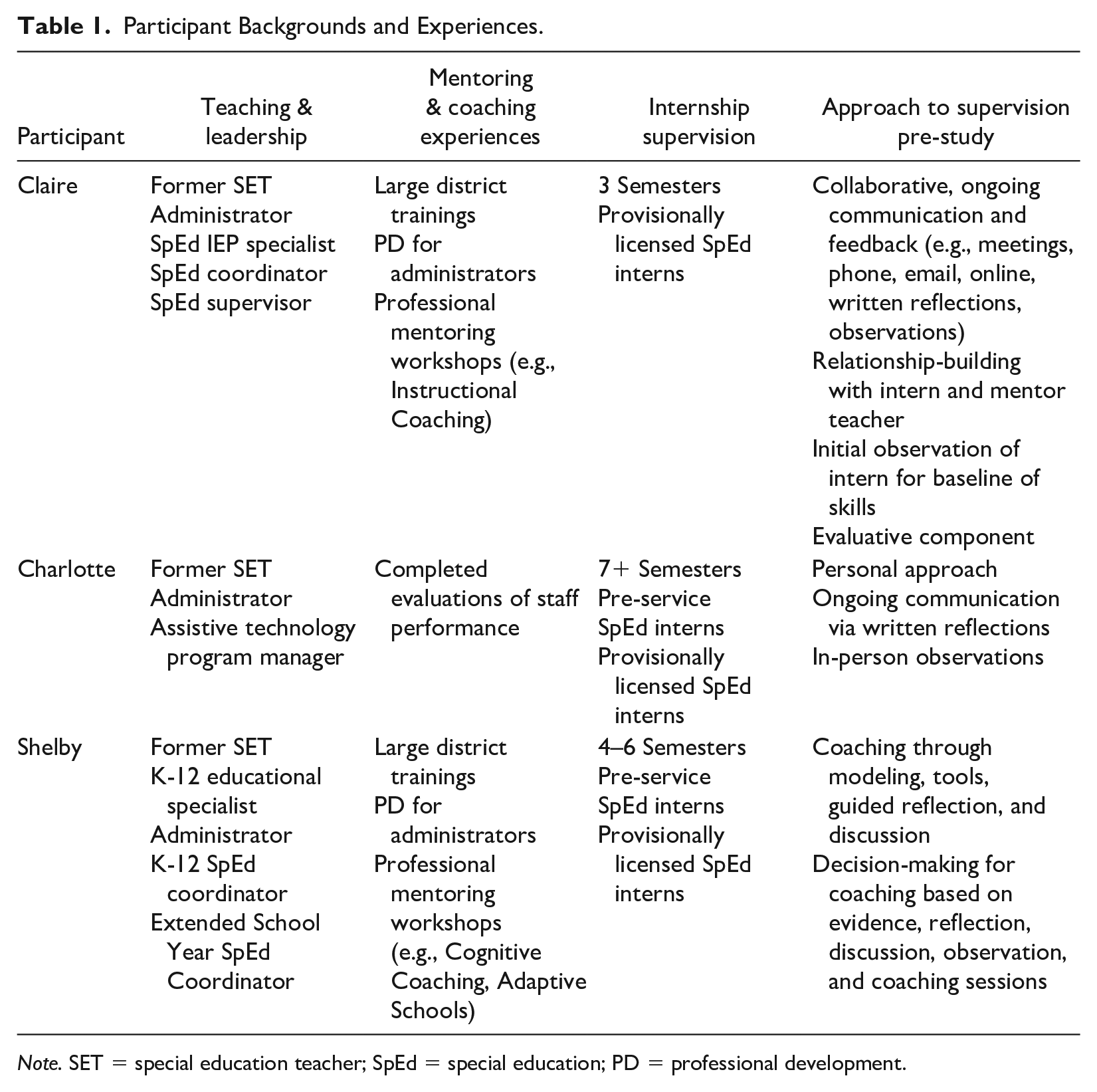
Note. SET = special education teacher; SpEd = special education; PD = professional development.
The internship supervision that all participants had participated in before this study required three evaluative observations with feedback completed by the university supervisor, two to three evaluative observations with feedback completed by the mentor teacher, weekly written reflections submitted by the intern and responded to by the university supervisor, and a final evaluation of the intern’s competence on each one of the items included in an internship rubric.
During the study, Charlotte and Shelby each supervised two interns, while Claire supervised three. All interns were provisionally licensed teachers seeking professional licensure in K-12 special education for students with mild/moderate disabilities who were accessing the general curriculum and had approval to complete the internship on the job at their worksite. Six of the seven interns were in elementary school settings, and one was in a middle school setting. The internship ran for the length of the semester, and all interns had an assigned on-site mentor teacher who had at least 3 years of teaching experience and licensure in K-12 special education for students with disabilities who were accessing the general curriculum.
eCoaching Professional Learning Series
The eCoaching professional learning series consisted of three phases: online modules, coaching sessions, and documenting eCoaching use. We describe each phase below.
Phase One: Online Modules
Participants completed four online, asynchronous modules that described the eCoaching process and included both knowledge and application quizzes throughout the material. Modules were completed sequentially. Specifically, supervisors had to complete end-of-module quizzes with a 90% score or better to access subsequent materials. The modules included (a) an overview of eCoaching, (b) getting started (Steps 1–3 in the eCoaching process), (c) eCoaching with multiple feedback loops (Step 4 in the eCoaching process), and (d) wrapping it up (Step 5 in the eCoaching process). The modules were housed in the university’s learning management system, and university supervisors were given access to the modules when they agreed to participate in the study. Each module was set up in a similar way that required the university supervisors to watch (e.g., view videos related to the topic created by the authors), read (e.g., read a related article or review materials aligned with an eCoaching step), and do (e.g., complete a quiz or activity).
Phase Two: Coaching Sessions
During the fall semester of implementation, the second author held synchronous, online “office hours” for participants. The “office hour” coaching sessions were held weekly in the first month and then every 2 weeks thereafter through the semester, resulting in eight office-hour sessions across the 15-week semester, with five of the sessions occurring in the first month. Although scheduled for 1 hour, the first five sessions lasted between 1 hour and 10 minutes and 2 hours. The office hours were optional; Claire attended six of the sessions, Shelby, four, and Charlotte, five. Of the eight sessions, there were two in which all three participants were present, and each participant had one session where they were the only attendee with the second author. During each session, participants would discuss their coaching situations, share resources with each other, ask for guidance on specific situations, and/or reflect on their experiences.
Phase Three: Documenting eCoaching Use
In the third phase, university supervisors documented their eCoaching use by providing two types of artifacts. First, artifacts from the professional learning series were assigned and completed by each of the three participants. Second, eCoaching field work artifacts that documented implementation of eCoaching with their individual interns (e.g., observations, reflections, emails, videos, etc.) were collected for study review. Both types of artifacts are detailed further in the description of the data sources.
Fidelity of Implementation
We ensured the university supervisors’ fidelity of implementation throughout the study. Prior to working with the interns in the fall semester, university supervisors completed Modules 1–4 of the professional learning series. All participants successfully completed the embedded quizzes per module, representative of learning the underpinnings of the eCoaching model of supervision. Participants also clarified expectations for the Phase 3 artifacts to be completed in the fall. Throughout implementation, ongoing support and clarification of logistical questions were provided in coaching sessions. In addition, at intermittent time points throughout the semester, the first author reviewed the Phase 3 artifacts uploaded to each university supervisor’s shared folder of evidence. Finally, the professional learning series materials to support implementation were always accessible to university supervisors for review.
Procedures
Following institutional review board (IRB) approval, recruitment, and consent from all university supervisors, each participant was asked to complete the Pre-Study Questionnaire and given access to the eCoaching professional learning series to complete before eCoaching began. Once the semester began, six of the seven interns provided full consent to allow correspondence with the university supervisor to be used in the study, and one intern provided consent without audio/video footage.
eCoaching Professional Learning Series
After completing the four modules of the eCoaching professional learning series in approximately 3 weeks, the three participants were asked to complete the pre-study questionnaire distributed by email. Just before the fall semester, the participants had a Zoom orientation with research team members for approximately 90 minutes to discuss eCoaching, to establish a regular time and day for the eCoaching “office hours” coaching sessions, and to clarify expectations of Phase 3 regarding the artifacts to gather throughout the fall semester.
An eCoaching orientation was held with the interns of participating university supervisors after their large group internship orientation. This session was facilitated by the third author. During this orientation, the third author introduced them to eCoaching, they met with their university supervisor, and were asked to provide consent to participate in the study. This consent included sharing their eCoaching field work artifacts with the research team.
eCoaching Implementation
Participants implemented eCoaching with their interns and shared eCoaching artifacts as they became available over the course of the semester. Specifically, university supervisors directly posted eCoaching artifacts to the university’s OneDrive (Microsoft cloud service) and shared them with the authors. Throughout implementation, the participants were asked to copy the research team on any email correspondence with consenting interns, reach out to the research team as needed, and come to coaching sessions with questions or discussion points, as needed. Coaches were invited to participate in “office hours” coaching sessions held weekly, but these were optional, and they were asked to reflect on their eCoaching experiences.
After eCoaching Implementation
At the end of the semester, the research team invited participants to join a Zoom session with the first author to complete the focus group interview. The first author emailed the protocol in advance of the session and recorded the session. The audio-recorded transcription was later cleaned by a graduate research assistant. The focus group lasted 82 minutes. Each participant received $500 for completing the eCoaching professional learning series and for implementing eCoaching during the fall semester. There was no obligation to continue eCoaching thereafter.
After the completion of the internship, participants invited their interns via email to participate in a post-eCoaching interview with the research team. Of the six interns eligible to participate, one provided permission to be interviewed via Zoom. This 10-minute interview was conducted by the first author via Zoom in the spring semester. It was recorded and transcribed.
The research team also asked participants at the end of the spring semester (one semester after eCoaching implementation) to describe any eCoaching practices they continued to use after the study ended. Participants responded through email or via Zoom.
Data Sources
Pre-Study Questionnaire
The Pre-study Questionnaire was a researcher-developed series of 16 questions administered through Qualtrics to gather the participants’ demographics, experiences, and supervisory approach prior to implementing the eCoaching model of supervision. Items consisted of multiple-choice or short answer. The first eight items addressed the participant’s academic experiences including licensure and K-12 teaching. The next five items asked the supervisors to identify (a) who they had typically supervised in the past (e.g., traditional, pre-service interns), (b) how long they had been supervising, including the current semester, and (c) any related training or past professional development. Finally, three open-ended questions asked each participant to describe their current approach to supervision and the process they used to provide feedback.
Audio/Videos of Coaching Sessions
Coaching sessions (i.e., office hours) were recorded and transcribed across the semester. The Zoom sessions ranged in length from 32 to 85 minutes, with an average of 53 minutes. Zoom provided an initial transcript of each session, and these were later refined for accuracy by a graduate student.
Professional Learning Series Artifacts
Phase three of the eCoaching professional learning series included six specific tasks or artifacts for the participants to complete. The tasks were completed in sequence, aligning closely to the steps of the eCoaching model. Each task resulted in a finished product to be uploaded to a OneDrive folder (i.e., an individual, online folder that was only shared between the supervisor and the research team). Apart from two tasks that followed a template developed by the authors, the tasks were written reflections about the steps of the eCoaching process and how supervision was unfolding. To complete the written reflections, the participants used structured reflective matrices that followed the describe, analyze, judge, and apply sequence of reflection (Nagro & deBettencourt, 2017).
eCoaching Field Work Artifacts
Throughout the semester, the university supervisors posted varied artifacts from the eCoaching experience to their OneDrive folders. eCoaching artifacts included recordings of individual video-conferencing sessions between the supervisor and the intern to debrief an observation or develop goals, email exchanges, support documents and professional learning materials used with interns, and intern’s digital reflections with supervisor feedback.
Post-Supervision Focus Group
All three supervisors participated in a focus group led by the first author who used a researcher-developed semi-structured protocol. The protocol consisted of six questions about (a) the supervision process used during the study timeline, (b) the preparation of eCoaching, (c) how each participant used the approach with their interns to provide feedback, (d) how the approach compared to practices prior to eCoaching, (e) the benefits and barriers of eCoaching for the coach or intern, and (f) further suggestions about future implementation of eCoaching, including resources that supported implementation.
Post-Supervision Intern Interview
The first author used a researcher-developed semi-structured protocol to interview one of the interns who received eCoaching. The protocol asked the intern to describe the eCoaching experience and to identify any benefits or challenges that stood out. In addition, the intern was asked to describe anything they would change and if they would recommend eCoaching for other interns.
Post-Study eCoaching Use
After the initial semester of eCoaching ended, each university supervisor was emailed and asked to respond to the following two questions: (a) Did you use any eCoaching in your internship supervision in Spring 2023? (b) If so, can you describe a little about what this looked like (i.e., what elements you used)? The purpose of the request was to determine if any of the practices learned were maintained, modified, or extended in any way.
Data Analysis
The primary data source for the analysis was the eight recorded coaching sessions (i.e., office hours) and the final focus group with the three participants. Secondary data sources consisted of the professional learning series artifacts as well as the field eCoaching artifacts. The secondary data sources were used to corroborate or refute any changes of practice. We used six phases of the reflexive thematic analysis as described by Braun and Clarke (2006, 2013).
During Phase 1, the authors became familiar with the data. Each of the authors was tasked with providing a chronological audit trail of data sources for one of the three participants. In doing so, the authors became more familiar with the data, identifying the date and the product available (e.g., intern reflection matrix, recording of debriefing following first observation). Finally, each author watched coaching session videos throughout the phases of analysis.
Phase 2 involved generating preliminary initial codes for the primary data, useful for addressing Research Question 1. The first author watched all eight coaching sessions and the focus group recording and reviewed all nine transcripts. Summaries of each video and notes were taken in the transcripts’ margins. The purpose of this inductive, open coding was to gain a sense of what was happening during the sessions. This served as an “initial pass” at the codes.
In Phase 3, several steps helped to generate themes from the eight coaching sessions. A key step of this phase was the iterative process of looking at the data for a deeper analysis from different perspectives and ensuring that we were answering what we wanted to learn. A graduate research assistant (not affiliated with data collection) worked with the first author to extract data from the videos and transcripts that represented university supervisor feedback (provided to an intern) and any decisions they said they made during eCoaching with and for their intern. Our rationale was that these two areas represented actionable supervisory practices. So, the research assistant was asked to look and listen for sentence starters such as “So I said . . .”; I decided to . . .”; “I plan to . . .”; “I showed her . . .; “I think I am going to . . .”; “So, I will . . ..” This phase involved an analysis of data for each participant in a progression over time. The research assistant first listened to the videos without taking notes and listened again to summarize the targeted points and to find critical quotes. Then, the research assistant used a four-column spreadsheet that identified the date, specific feedback provided by the faculty member or peer, decisions described by the university supervisor, and the context. A color-coding method was used to identify meaningful units or excerpts of data, including representative quotes. This more-targeted analysis of coaching sessions was then discussed by the three authors. The authors reviewed videos independently and made notes in the margins of the spreadsheet. The research team discussed emergent trends in the data per participant and across participants. Videos were watched as a group, as needed. Patterns of change in participants’ perspectives and practices over time were revealed. Meeting notes served to capture the collaborative data discussions with a purpose to identify “some level of patterned response or meaning within the data set” (Braun & Clarke, 2006, p. 10) that informed the research question.
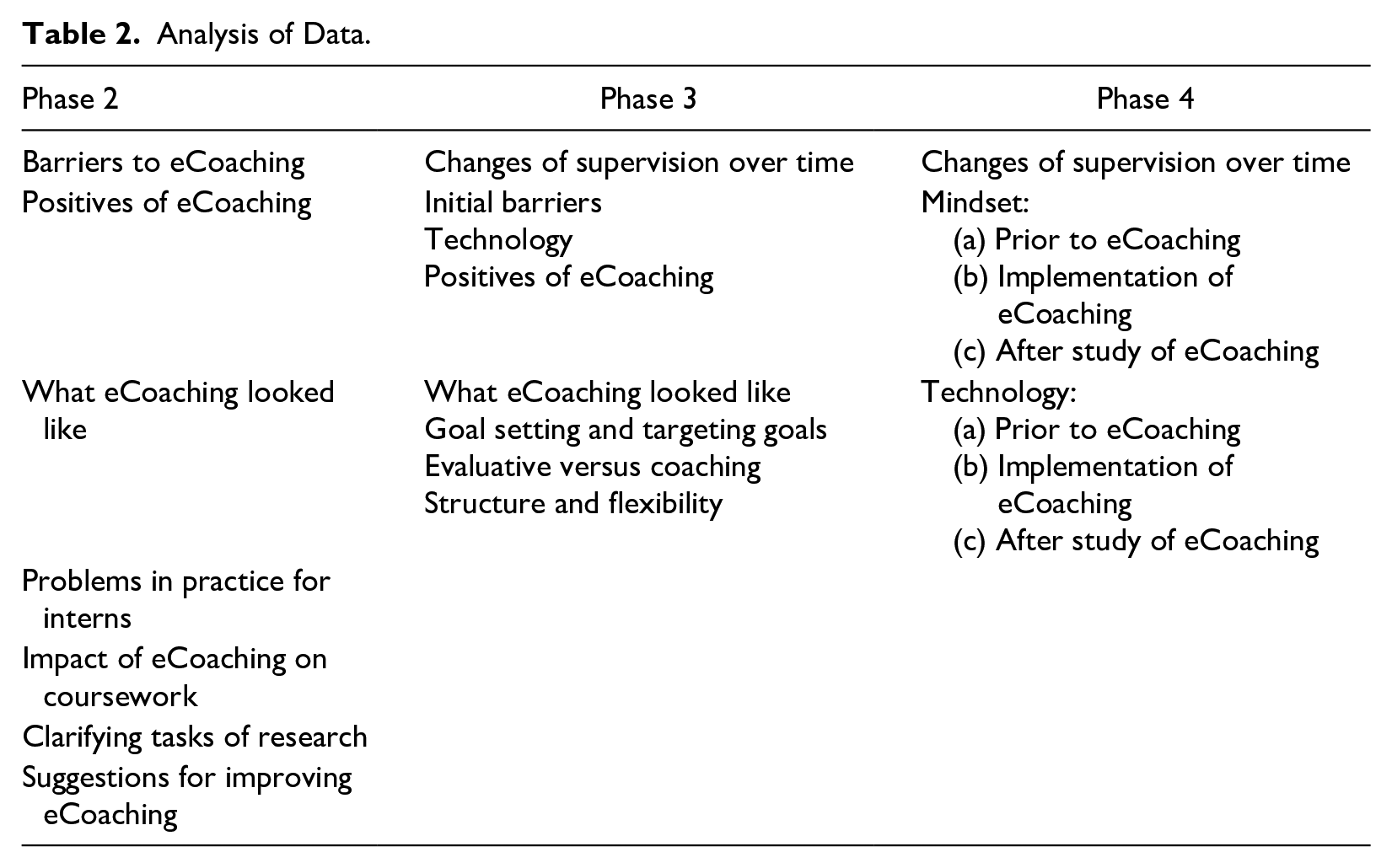
During Phase 4, potential themes were discussed by the research team as they related to Research Question 1. With the generated themes from Phase 3, the authors used an excel spreadsheet to organize key data extracts, representative of the themes. When doing so, the cross-cutting theme of change over time was consistently disrupting the story that the data told across each of the participants. Specifically, the when contextualized the data and played a larger role than we had initially anticipated. It was at this time the authors decided to frame the data across three points in time by putting categories of before, during, or after the eCoaching study into an excel spreadsheet per participant (Table 2). As extracted data chunks were then added, a coherent pattern emerged at each time point as the data fell around a theme of either technology or the mindset around supervision. The team targeted these themes as an accurate reflection of the content of the entire data set and corroborated by the artifacts and the intern interview.
Analysis of Data.
In Phase 5, the research team reviewed and agreed to the coherent schema that emerged from the analysis. The extracted data in each column of the excel spreadsheet per participant were color coded as representing either the themes of technology or mindset. The research team also defined the themes and discussed the findings in a series of analytic meetings. Finally, Phase 6 consisted of synthesizing data and writing the results.
For analysis of the intern’s interview data, the 10-minute interview was transcribed and reviewed multiple times. Primary data were then used to identify any examples or patterns that were consistent with or contrary to the data shared by the corresponding participant, Charlotte.
Finally, for Research Question 2, the team analyzed the responses from all three participants regarding their sustained use of supervisory practices and perceptions beyond the study duration. The team used their comments to add depth to the conclusions drawn from the original analysis and to inform future research.
Trustworthiness and Credibility
Credibility measures that buttressed the trustworthiness of our findings include triangulation of multiple data sources, audit trails, member-checking, and collaborative analysis. An audit trail served as a transparent record and description of the abundant data. The identified activities and products also served as evidence of what eCoaching tasks were implemented throughout the study. Second-level member checks were completed (Brantlinger et al., 2005; Lincoln & Guba, 1985). Specifically, summary study outcomes for each supervisor were organized and sent to each participant to review for accuracy and clarity. All participants responded with no suggestions for revisions or clarifications (only confirmation from our analysis). Finally, the use of multiple researchers was important to collaboratively identify meaningful data excerpts and to synthesize the data (Brantlinger et al., 2005).
Results
The evolution of the codes, categories, and themes of the thematic reflective analysis is represented in Table 2. Results were framed by two overarching domains: the use of technology and the “coaching” mindset of eCoaching. Study data depict a transformation of these two overarching domains across time—before eCoaching professional learning, during eCoaching implementation, and post-study implementation. The participants’ change in mindset and use of technology are collectively and individually presented within the next sections.
Before eCoaching
All participants came to eCoaching with supervisory experience and ongoing engagement in the field of special education via consulting or college teaching. All three mentioned the use of traditional supervisory practices such as face-to-face observations, communication with feedback, reflective practice, and a focus on evaluating the intern’s skills. And all three also indicated using the traditional required processes of in-person evaluative observations with feedback; weekly reflection feedback; and progress on all items on the internship rubric.
Claire
Prior to eCoaching implementation, Claire described her approach to supervision as collaborative. She used ongoing communication and timely, open feedback with the intern and mentor teacher. She sought dialogue with them to help her understand the learning environment, referring to this as the “triad analogy of continuous support.” Claire viewed her role as a “sounding board/consultant to discuss, outside of their school evaluation system, challenges and opportunities to enhance their instruction.” In addition to observing interns, Claire’s supervisory practices included assigning the intern to self-assess and to provide written reflections about pedagogical areas of need or competencies. Claire’s supervision was guided by evaluation: “For each candidate, I track on my own master assessment form my ‘evidence’ in each area to ensure we collectively have discussed, observed, reflected on each area with emphasis on areas of concern.” In addition to face-to-face meetings, Claire called her interns by phone and used email and Zoom to conduct supervision.
Charlotte
Prior to eCoaching implementation, Charlotte described her approach to supervision as supportive and personal. Her pre-study survey response stated, “I try and connect with each of them weekly via email or in-person. I’m always available for questions. I try to make the process non-threatening and offer lots of encouragement.” Charlotte’s supervisory practices highlighted the use of written feedback to interns in response to the intern’s written weekly reflections. Content of the reflections was typically led by the intern unless Charlotte brought up an area relevant to an observation. Charlotte provided the intern with verbal feedback in-person, guided by the internship’s evaluation forms. Apart from the final meeting in which the evaluation outcomes were discussed, interactions were face-to-face and via weekly emails.
Shelby
Prior to eCoaching implementation, Shelby described her approach to supervision as a “coach,” and she highlighted her use of tools such as conversation maps for reflection, paraphrasing, and posing questions for the intern. She provided a robust list of her prior trainings, including Cognitive Coaching, which influenced her interactions and supervisory practices. Her pre-study survey response stated, “Depending on the situation and need, it [supervisory approach] could be collaborating, consulting, and evaluating.” Shelby’s supervisory practices highlighted the use of modeling and collaborative discussions throughout sessions with the intern. Shelby also shared that she made decisions for and with the intern based on “rubrics and disposition ratings, reflections, discussions, observations, modeling and coaching sessions.” Shelby’s interactions with interns were primarily in-person and via email.
During eCoaching Implementation
Each of the participants acknowledged that eCoaching was different from their previous approach to supervision. Although there was initial dissonance with implementation, they embraced the steps to the eCoaching process with an emphasis on intern development and encouragement as opposed to evaluating and scoring intern performance. All three participants found that the focus on a targeted goal-setting cycle was the linchpin in the eCoaching model of supervision, providing structure to conversations and allowing flexibility in meeting intern needs. Targeted goals, instead of a broad focus on all components of the internship rubric, provided the coach and intern with a clear focus in the learning process. When engaging in the steps of eCoaching with flexibility in how it was done, all three participants also reported having heightened communication and rapport with interns and a keen understanding of the interns’ backgrounds, strengths, and school-based situations. The technology permitted more frequent, effortless touchpoints and candid conversations with interns instead of strictly weekly written reflections. The participants were thoughtfully reflective and receptive to the collaborative learning and feedback exchanges during the coaching sessions. As described in the following section, eCoaching allowed each participant to enhance their own unique strengths as supervisors and special educators.
Claire
Claire, who valued collaborative communication, thrived in the collaborative eCoaching model. Claire’s participation in the ongoing coaching sessions with the other participants involved an exchange of feedback and resources to problem solve intern needs. In the final focus group, she shared, “Bouncing information and ideas and sharing physical resources . . . really helped me understand that what I was experiencing with my [interns] was not in totally different silos . . . the weekly [coaching] sessions . . . was an invaluable resource.” In the initial coaching sessions with the second author and the other participants, Claire described herself as “structured” and wanted validation at times with how she was proceeding in the new role or responding to her interns. Coaching sessions served as spaces in which the flexibility of eCoaching could be discussed and reassurance could be provided to supervisors.
Claire shared in the final focus group that, throughout eCoaching, she conducted face-to-face and virtual coaching sessions via Zoom, and her interns completed written and face-to-face reflections. An eCoaching artifact video and recorded eCoaching sessions depicted the extra support Claire provided via phone calls and texting for an intern who had experienced a traumatic incident at a school. Claire also used OneDrive to share digital resources with her interns, and the professional learning artifacts revealed that she used Zoom to record interns’ instructional sessions and conduct brief feedback sessions. She reflected: “I was able to revisit the recorded classroom observation, make notes, and provide more targeted comments . . . when we used . . . [a] Zoom format.”
One element of eCoaching that stood out to Claire as different from traditional supervisory practice was the quality of the interactions with the interns. She explained in the final focus group session, “you don’t get [in traditional supervision] like [the] flavor or the challenges,” and “I just keep thinking about how much more we know about them . . . than I would have if I was just doing the traditional . . . observations and reading their reflections.” Claire not only demonstrated a deep understanding of the K-12 students in her interns’ classrooms, but she also intentionally developed relationships with school personnel and advocated for their involvement in getting supports for provisionally licensed interns. In coaching sessions, Claire mentioned how accessing more information about her interns allowed her to prioritize information and the resources needed to move the intern forward. The eCoaching framework that allowed for these high-quality interactions, often, but not always, was facilitated by technology. Claire committed to weekly Zoom meetings with her interns. She shared: . . . the goal setting cycle provided structure to our conversations and allowed flexibility in meeting the [intern] needs. [By] using the eCoaching framework I was able to get to know [interns] through developing a deeper understanding of their backgrounds, experiences, and strengths they brought . . . I believe I was able listen to their needs, and to respond quicker to those needs through our weekly conversations.
Claire’s use of technology to remotely observe intern instruction was a novel experience for both Claire and the intern. When her intern was provided an iPad to connect via Zoom during instruction, Claire enthusiastically shared in a coaching session, “I love the Zoom observations. It really allows me to hone in on the classes more frequently than being there without interrupting the normal flow of the teacher teaching and of the students . . . and their behaviors.” Claire also quickly noticed the appeal eCoaching had for her interns. Claire’s initial reflection matrix stated: Although I thought a face-to-face conference would be more effective, I realized that for teachers brand-new to the classroom, a video conference may be preferable as it allows them some measure of control over time and supports them “meeting” from home if desired.
In addition in the final focus group, she said, “This generation, they are media natives . . . having opportunities for them to use video, audio, text, email, all those tools are better than requiring them to constantly write and record.”
Charlotte
At the start of eCoaching, Charlotte expressed dissonance, explaining that, “. . . before [eCoaching], I could think about what I was going to say, and I could rewrite it . . . I supervised a lot of staff . . . but not so much in a coaching role.” She described the role as out of her routine. At this time, the coaching sessions were especially supportive in helping her to understand how eCoaching can be used flexibly and how it was different from an evaluation of skills. By the final focus group session, Charlotte remarked, “some of what we did . . . was just to be a listener . . . just being someone who listens to . . . the struggles that they’re kind of facing.”
One element of eCoaching that stood out to Charlotte as different from traditional supervisory practices was the targeted focus on coaching one goal at a time. She shared, . . . to me that is the biggest difference between this and what I’ve done in the past . . . Yeah, I wrote back to them each week on their reflections, and they were reflecting . . . But this [reflection] is focusing on the goal, and I think that is the key to the coaching. Well, one of the keys, that you’re focusing on a goal . . . If they master it, you work on another one . . ..
For example, in the coaching sessions, Charlotte articulated a goal for her intern to effectively and reasonably gather formative assessment data on her students. The focus on one goal allowed Charlotte to provide tangible, focused feedback in the coaching loop. The professional learning artifacts showed that the completed templates for Step 3 of the eCoaching process supported Charlotte to identify targeted goals and then provide that focused feedback. By the fourth coaching session with the second author, Charlotte expressed more comfort with the eCoaching process and acknowledged that the process takes time to absorb. In addition, one of Charlotte’s interns corroborated and simplified the eCoaching process: “We set goals about what I was trying to accomplish during the time that we had together. And then, basically, we just had check-in meetings along the way for how that goal was going or set of goals.”
Charlotte’s intern confirmed that throughout eCoaching, face-to-face and virtual coaching sessions took place via Zoom, and reflections were digital or often completed in-person. The intern also recorded instructional sessions with her students or meetings with her instructional assistant and shared those with Charlotte for feedback. In addition, Charlotte and the intern connected frequently via phone to reflect about observations. Finally, Charlotte leveraged the use of technology and resources by connecting two of her interns via a Zoom session. They were teachers at different schools, but both were challenged by the limited quality time they had with their instructional assistants, so Charlotte extended their learning by providing them with an opportunity to collaboratively discuss a shared problem of practice. As a result of using these supervisory practices, Charlotte . . . felt like I was more impactful with my [intern] than I have been in the past . . . I could give more real time feedback—some of our sessions were virtual—and the reflection matrix . . . they liked that combination . . . to not have to do the writing all the time.
The choice of written versus verbal reflections was also positively received by interns. Charlotte’s intern, a mother of four with a deployed husband remarked, I’ve been drinking from a fire hose for two solid years now, so that really did me a huge benefit to not have that extra thing on my plate, and just being able to talk to [Charlotte] about it rather than sit down and type reflections every time I turned around was awesome. I really appreciated that.
Shelby
At the start of eCoaching, Shelby came to the coaching sessions with vast contextual information about her interns who required support in various skill areas. Her interns were especially overwhelmed teachers, and Shelby used the coaching sessions to seek validation for how she was approaching eCoaching in these very complex cases. In one of her early professional learning artifact reflections, Shelby committed to first establishing trust and rapport with her interns and explained her intent to use paraphrasing and clarifying questions. Shelby’s subsequent reflections among the artifacts were as thorough and thoughtful. After observing her intern a few times, she reassured the intern of her role: “I’m a supervisor, but that’s a small role I play. I’m your coach. I’m your cheerleader. I’m your collaborator . . .” Shelby explained in the final focus group: “I just needed that permission . . . [to know] there is flexibility in this [eCoaching]. You choose. It’s just a little framework, is what I walked away with. You use it and make it work for you.”
Over the course of using the eCoaching process, the practice that resonated for Shelby was the funneling of an observational concern into a concrete and targeted coaching goal. In part, this was because there was so much contextual information that distracted from a focused learning skill. Shelby’s reflections noted the eCoaching structure and templates that aided in limiting goals (two or three, at most) and how she used data and reflective practice to prioritize these goals, while still holding her interns to high standards. Shelby’s eCoaching artifacts also identified how close collaborations with the intern’s mentor teacher supported the development and narrowing of the interns’ goals. Over time, coaching session discussions also cemented the notion for Shelby that supervisors can be more productive with coaching when things were more manageable for the intern. Shelby validated the supportive coaching sessions and voiced interns’ approval, as well, reporting, All the help that you all gave me last week. She [the intern] and I had a good conversation. She appreciated a lot of the support . . . she said the day you came, and you said, “I’m your coach. It just lifted [me]. Like you’re not just here to supervise me.”
Shelby recognized how the supervisory practice of narrowing the learning goal was most critical for novice teachers. For example, rather than a broad focus on improving behavior management skills in all seven classes, Shelby had her intern focus on one specific, self-selected class. In another example, Shelby was receptive to scaffolding the process of instructional planning by making it more concrete for her intern. Shelby connected with her intern on Zoom and used cognitive cues and think aloud methods to explicitly model lesson planning, then simplified the goal for her intern to be able to first identify appropriate learning objectives for students.
Shelby shared in the final focus group that she followed the eCoaching process and structure and relied on holding scheduled weekly video-conferencing sessions via Zoom with her interns. She also made face-to-face observations as well as virtual observations and exchanged frequent emails with her interns throughout the process. Often, the debrief sessions she had via Zoom with interns served as the interns’ reflections, or Shelby provided specific questions to guide their thinking. During the focus group, Shelby shared: . . . it’s in one of my . . . recorded sessions that they’ve [the interns] appreciated this level of support, the frequency of support . . . and not only the frequency, but it’s the quality . . . The quality of support, and how it was conducted . . . they also appreciated the scaffolded lesson format that I created . . ..
Post-Study Implementation
All three participants reported continued use of not only eCoaching supervisory practices beyond the study but also newly developed and shared tools and protocols to further enhance eCoaching. For example, Charlotte shared a “Get to Know You” questionnaire she used at the initial conference, a weekly newsletter format she sent via email to the intern and the mentor teacher, and a set of reflection questions she used to guide an intern’s reflection after lesson delivery. In addition, eCoaching protocols continued to be used including the pre-observation protocol that is used to provide feedback and inform evolving goals for the intern. Shelby shared that although she made adaptations to some of the eCoaching protocols, the steps in the process were followed.
In addition, all three participants continued providing multiple touch points via virtual and in-person observations, shared video recordings, video-conferencing, and email. They also continued to collaborate with the mentor teacher, when able, or school personnel and used the approach flexibly and responsively to address their interns’ needs and individual challenges. For example, Shelby reported video-conferencing with an intern to “do a dry run of their lesson” and to model explicit instruction. In other instances, she held open office hours on Zoom to simply talk about what was happening and how things were going for her intern.
Claire continued to provide close communication among the “triad” (i.e., intern, university supervisor, and mentor teacher) with weekly sessions. She also maintained her advocacy for those in the field, represented by a final goal set for one of her interns to: “. . . feel valued, have confidence in self-advocacy within her school setting, and understand how strong she is as a special education teacher, and want to sign that contract to return next year!” Similarly, Shelby continued to set specific learning goals and maintained weekly virtual meetings with her interns. Charlotte continued the use of goal setting and varied her written feedback considerably, providing at least 50% of her feedback sessions virtually. She also continued to have the intern “self-record their own teaching, watch the recording, and produce a reflection . . . again a result of eCoaching on the importance of reflection.”
Discussion
For new special education teachers who are employed in schools and working toward completing their provisional license, opportunities for skill development with feedback and support is critical. Their access to any level of mentorship varies, and supervised fieldwork is largely absent, apart from the culminating internship experience of alternative route-preparation programs (Day et al., 2024). The current study’s analysis of data gathered from a semester-long internship in which university supervisors implemented an eCoaching approach brings insight into re-visioning the role of supervision for provisionally licensed special education teachers.
Following professional learning of eCoaching, three experienced university supervisors modified their evaluative mindset (Ibrahim, 2013; Kolman, 2018) to one that was more malleable and responsive to an intern’s development and context. The dissonance experienced by the supervisors during initial implementation was expected from prior research (Weiss, Regan, & Glaser, 2020), but the ongoing supportive coaching sessions involving the participants and led by the second author was an unexpected key support for professional learning that allowed the participants to effectively and fully engage in the eCoaching process. With parallels to Rock’s (2019) “group coaching” in the eCoaching continuum, the supervisors came together weekly to collaborate, be thought partners, and problem solve about intern situations and coaching goals.
During implementation, eCoaching relieved the participants from required evaluative observations and from responding to weekly written reflections, allowing them to take advantage of their unique personas as supervisors. eCoaching also enhanced their practices. Foremost, the university supervisors enacting eCoaching resulted in a heightened quality of interactions with interns. Second, the cycle of feedback and reflections specific to targeted learning goals provided structure and clear expectations for both the intern and the supervisor. Finally, the use of varying technologies enabled frequent and effortless touchpoints with interns and innovative means of connecting with others and learning. The technologies served as options on a menu to be selected based on an intern’s needs. Video-conferencing was emphatically the most common technology adopted by the supervisors in this study, used for not only observations as done in the study by Heafner et al. (2012) but also for debriefing and reflection with interns. Although the bug-in-ear technology (Regan & Weiss, 2020) was an option included in the eCoaching model, given its success in improving the use of research-based practices by in-service teachers (Rock et al., 2014), none of the supervisors used this type of real-time feedback. It is likely that university supervisors did not select this type of technology given that the goals set for their interns (e.g., working with instructional assistants, lesson planning) were more aligned with delayed feedback than real-time feedback during instruction.
Implications for Practice
Whereas other models of eCoaching have been implemented with pre-service teachers (e.g., Blanton et al., 2019), this eCoaching model is specifically designed for provisionally licensed special education teachers who are in the first 3 years of being an in-service special education teacher. The process of eCoaching focused supervisor’s feedback on areas of concern and need for each intern and allowed for growth in that area before moving to the next focus area. This scaffolded approach, with the ability to provide multiple touchpoints at times and in settings that are convenient and private to the intern and supervisor by the use of technology, allowed for the supervisors to learn more about the context of the intern. In the cases of our supervisors, the contexts within which these interns were working created significant stress for them, stress that often distracted them from the goal they were attempting to reach. The content of the coaching provided by the supervisors in this study then addressed the concerning contexts, most of which were ones that impact many special educators (Billingsley et al., 2020). Specifically, the content of coaching in this study often revolved around stress, well-being, finding resources in the building or in the school division, and management of time and responsibilities, in addition to coaching on internship rubric items. Claire and Shelby referred to the “nuts and bolts” of teaching beyond pedagogy that enable teachers to plan accordingly and anticipate what is to come. Some of the interns in this study were in buildings among other first- or second-year special educators, without any seasoned teacher to provide guidance and mentorship. To illustrate, Shelby’s overwhelmed intern was missing certain team meetings, so Shelby spent a session showing the intern how to use her outlook calendar to color code meetings and stay organized. One intern had no idea how to complete progress reports for students. In addition, Claire’s intern was staying after school well into the evening planning instruction, so in fear of her burning out, they developed a goal to take time for herself. Most telling is the request an intern made to Claire to be informally available to support her after the internship. Claire and the intern’s mentor teacher agreed that having someone to speak with outside the school would be beneficial. The sense of efficacy and understanding expressed by our coaches when interacting with interns more frequently and using many different means of communication reinforces the findings related to coaching reported by Joyce and Showers (2002) and others. The use of coaching practices and technologies that allow for more (and better) opportunities to coach is critically important to helping provisionally licensed teachers given their unique situation and needs, develop as professionals who feel equipped to be effective special educators. However, we recognize, as did our coaches, that providing this type and frequency of coaching required more time and engagement in the process. Although that time was spent more efficiently (e.g., coaching using technology and not driving to school sites) and supervisors felt more effective in their work, they did note that they were spending more time in support of their interns than in previous semesters.
Limitations and Future Research
This study provides critical insight into how university supervisors can be supported and trained to use eCoaching to help meet the unique needs of provisionally licensed special education interns. However, it is important to acknowledge some limitations of the study. First, given that this is a qualitative study of three university supervisors, findings cannot be generalized. Second, all participants were from the same teacher-preparation program and had extensive background in supervision prior to the study. They were also purposefully selected due to their strength in supervision and commitment to providing interns with feedback. Finally, our analysis only included one of seven possible intern interviews. Future research should address these limitations by including a larger sample of university supervisors as well as those with varying levels of comfort with technology and the voices of their interns. In addition, future research should also include new university supervisors who have not had previous supervision experiences. Following these supervisors would allow for evaluating the need for professional learning around supervision in general, in addition to understanding the depth and level of instruction necessary for understanding and implementing the eCoaching process. Finally, future research should compare traditional supervision to eCoaching supervision to determine specific differences in the approaches and ultimately compare intern outcomes when experiencing eCoaching to those of traditional supervision.
Conclusions
Despite these limitations, several conclusions can be drawn from this descriptive study. First, university supervisors who have experience in an evaluative capacity can change their style of supervision to a more supportive, coaching model, following professional learning. This is increasingly important since the turnover of special educators is inevitably resulting in fewer and fewer veteran special educators or special education administrators to fill this role (Carver-Thomas & Darling-Hammond, 2019). Second, the use of technology allows for a greater number of touchpoints with interns with fewer disruptions to the classroom environment, providing more opportunities for provisionally licensed special educators to receive coaching and feedback during a non-traditional internship. Finally, eCoaching can be sustained without continuous support.
Footnotes
Declaration of Conflicting Interests
The author(s) declared no potential conflicts of interest with respect to the research, authorship, and/or publication of this article.
Funding
The author(s) disclosed receipt of the following financial support for the research, authorship, and/or publication of this article: disclosed that a grant from the Virginia Department of Education supported the research and authorship of this article.
