






Abstract
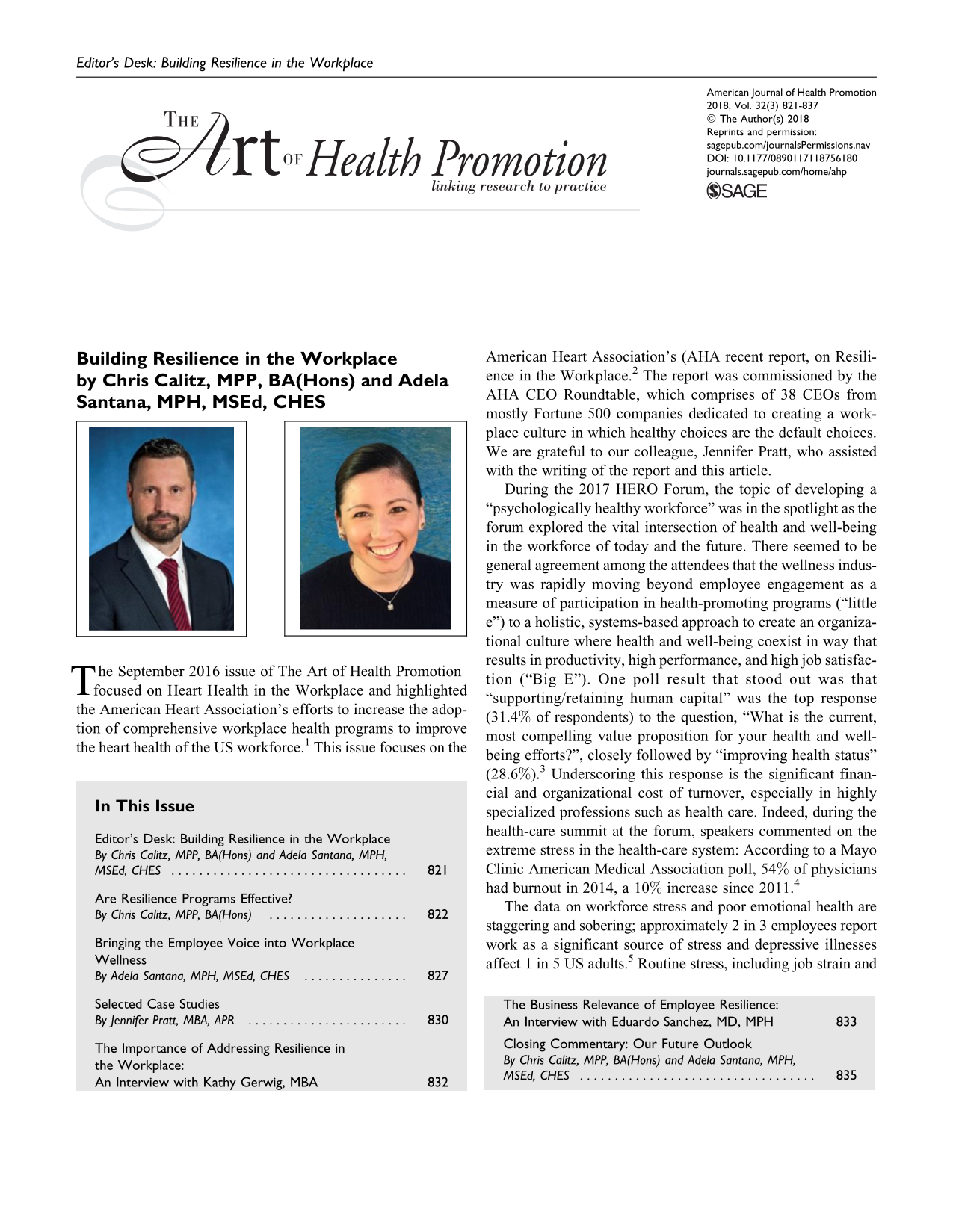
Building Resilience in the Workplace by Chris Calitz, MPP, BA(Hons) and Adela Santana, MPH, MSEd, CHES


The September 2016 issue of The Art of Health Promotion focused on Heart Health in the Workplace and highlighted the American Heart Association’s efforts to increase the adoption of comprehensive workplace health programs to improve the heart health of the US workforce. 1 This issue focuses on the American Heart Association's (AHA recent report, on Resilience in the Workplace. 2 The report was commissioned by the AHA CEO Roundtable, which comprises of 38 CEOs from mostly Fortune 500 companies dedicated to creating a workplace culture in which healthy choices are the default choices. We are grateful to our colleague, Jennifer Pratt, who assisted with the writing of the report and this article.
During the 2017 HERO Forum, the topic of developing a “psychologically healthy workforce” was in the spotlight as the forum explored the vital intersection of health and well-being in the workforce of today and the future. There seemed to be general agreement among the attendees that the wellness industry was rapidly moving beyond employee engagement as a measure of participation in health-promoting programs (“little e”) to a holistic, systems-based approach to create an organizational culture where health and well-being coexist in way that results in productivity, high performance, and high job satisfaction (“Big E”). One poll result that stood out was that “supporting/retaining human capital” was the top response (31.4% of respondents) to the question, “What is the current, most compelling value proposition for your health and well-being efforts?”, closely followed by “improving health status” (28.6%). 3 Underscoring this response is the significant financial and organizational cost of turnover, especially in highly specialized professions such as health care. Indeed, during the health-care summit at the forum, speakers commented on the extreme stress in the health-care system: According to a Mayo Clinic American Medical Association poll, 54% of physicians had burnout in 2014, a 10% increase since 2011. 4
The data on workforce stress and poor emotional health are staggering and sobering; approximately 2 in 3 employees report work as a significant source of stress and depressive illnesses affect 1 in 5 US adults. 5 Routine stress, including job strain and long working hours, may contribute to serious health problems, including elevated risk of heart disease and stroke and experiencing depression for the first time. 6,7 Unmanaged stress and poor mental health are very costly to the society and to employers. Each year an estimated $190 billion dollars are lost to work-related stress, half of which is borne by employers through lost productivity, including absenteeism and low engagement. 8
The importance of retaining human capital and developing initiatives to address epidemic levels of stress and poor mental health was a catalyst to the AHA CEO Roundtable commissioning the Center for Workplace Health Research and Evaluation to develop a report on workplace resilience. Building resilience through education and training is an emerging and potential promising workplace intervention and CEOs wanted to know more about the scientific evidence of the effectiveness of these programs. To understand the topic of resilience more robustly, the center evaluated 3 data sources: (1) a synthesis of studies published between 1990 and the present, (2) insights from a nationally representative sample of employees on their perceptions of resilience in the workplace, and (3) select case studies that document innovative programs employers are using in the field. Based on this multipronged approach, the report aimed to provide insight on the following questions: How is resilience defined and measured? What elements comprise a resilience training program? What do we know about the effectiveness of developing, implementing, and evaluating resilience training programs? How can the current body of evidence be practically applied to improve outcomes? What gaps are there in research and practice that can strengthen the evidence base?
In this article, we summarize our findings and provide preliminary tips to employers who wish to design, implement, and evaluate resilience training programs. This article has been abstracted from the full report, which can be downloaded at the American Heart Association website. 2