







Abstract
Purpose:
To investigate the direct and indirect effects of sociodemographic/health factors on diet quality through practical nutrition knowledge (PNK) about how to compose a balanced meal.
Design:
A cross-sectional study using data from an online survey of the 10 000 Steps cohort (data collected November-December 2016).
Setting:
Australia.
Participants:
Adults (n = 8161). Response rate was 16.7%.
Measures:
Self-reported lifestyle, health, and sociodemographic characteristics, including diet quality and PNK.
Analysis:
The PROCESS macro for SPSS was used to conduct the mediation analyses.
Results:
Better diet quality was associated with being female, older, more highly educated, and having a lower body mass index. Mediation analysis showed that PNK significantly mediated the associations between sex (a*b = 0.54, 95% confidence interval [CI] = 0.39-0.70) and education (vocational education: a*b = 0.22, 95% CI = 0.12-0.35, university: a*b = 0.48, 95% CI = 0.35-0.64), and diet quality. Practical nutrition knowledge suppressed the association between age and diet quality (a*b = −0.03, 95% CI = −0.04 to −0.03).
Conclusion:
Variations in diet quality between sociodemographic groups were partially explained by differences in PNK, suggesting that focusing public health efforts on increasing this specific knowledge type might be promising.
Keywords
Purpose
Dietary quality varies by sociodemographic characteristics and poorer diet quality is typically observed in lower socioeconomic status (SES) groups. 1 Nutrition knowledge is one of many factors that influence diet quality and studies have shown that nutrition knowledge mediates the relationship between sociodemographic variables and diet quality. 2,3 A recent systematic review reported significant positive, however weak, associations between nutrition knowledge and dietary intake. 4 The magnitude of this association might be influenced by the way nutrition knowledge is measured; 4 -6 recent evidence suggests that practical nutrition knowledge (PNK; eg, knowing how to combine different foods together to create a well-balanced and nutritious meal) is more closely related to dietary behavior as compared to factual knowledge about nutrition (eg, knowing that pasta is high in carbohydrates). 7,8 Despite this recognition, the examination of the effect of different levels of PNK has been limited due to a reliance on knowledge measures assessing factual knowledge. 8 Consequently, the aim of this study was to examine the potential mediating role of PNK in the relationship between sociodemographic factors and dietary quality. It is hypothesized that practical knowledge about the composition of a balanced meal mediates this relationship, and a focus on this specific type of nutrition knowledge may be of benefit to nutrition education and practice.
Methods
Design and Sample
Cross-sectional data were obtained from a larger data set collected through an online survey from participants of the 10 000 Steps program (www.10000steps.org.au). 9 The details of the study design and measures have been published elsewhere. 9 All current members of the program who had valid e-mail addresses (n = 42 090) were invited to complete the survey, and 7021 and 4262 respondents completed the survey in full or provided a partially completed survey, respectively. The overall response rate was 16.7% (7021/42 090). A total of 8161 adults were included in the analysis as they had provided complete data for all variables of interest in the present study. Participants provided informed consent, and the study was approved by the Human Research Ethics Committee at Central Queensland University (H15/09-210).
Measures
Practical nutrition knowledge to compose a balanced meal was assessed using the validated PKB-7 scale. 8 A typical item of this scale was as follows: “Does a portion of spinach and ricotta ravioli with basil pesto contain the recommended serving of vegetables per meal?.” Diet quality was assessed using 12 items to assess intake in comparison with the Dietary Guidelines for Australian Adults, which have been used to assess dietary quality previously. 9 Participant’s sociodemographic (sex, age, education level) and health (body mass index [BMI]) characteristics were also assessed. Survey instruments and scoring are provided in Supplements 1 and 2.
Analysis
All statistical analyses were performed with IBM SPSS version 23. The mediating role of PNK was examined using MacKinnon’s product-of-coefficients method. 10 A single simple mediation model was used for each sociodemographic/health variable separately using PROCESS macro version 2.13. The product of coefficients (a*b) was calculated to represent the indirect effects and was statistically significant if the confidence intervals (CIs) around the indirect effect did not include zero. 11 The PROCESS macro generated bias-corrected bootstrapped (5000 replications) 95% CIs for each product of coefficients. Additionally, the same mediation analyses were performed for each sociodemographic/health variable, but the models were adjusted for the other sociodemographics (included covariates listed in Supplement 4).
Results
A total of 8161 participants were included in the analysis. A larger proportion of females (74.4%) were present in this sample. The mean age was 50.8 years (standard deviation [SD] = 11.6, Min = 18, Max = 101) and approximately 42% of the total sample was 55 or older. The majority (62.6%) had a university degree or higher. The mean BMI was 27.6 kg/m2 (SD = 5.7, Min = 15.06, Max = 49.95) and 37.4% of the participants had a healthy weight, 33.9% were overweight and 28.6% were obese. A mean score of 3.6 (SD = 1.4) out of 7 (51%) was found for PNK, and 82.0 (SD = 15.2) out of a total score of 120 (68%) for diet quality. A table with the sociodemographic characteristics and mean scores for PNK and diet quality per sociodemographic group can be found in Supplement 3. Compared to those excluded, the included respondents were more likely to be female (In: 74.4%, Ex: 70.5%), slightly older (In: 50.8 [SD = 11.6], Ex: 47.6 [SD = 12.2]), have a higher educational attainment (Uni; In: 62.6%, Ex: 60.4%), and a higher score for PNK (In: 3.6 [SD = 1.4], Ex: 3.0 [SD = 1.6]) and diet quality (In: 82.0 [SD = 15.2], Ex: 80.6 [SD = 15.7]). The differences in PNK and diet quality, although statistically significant, were small in magnitude and not meaningful. Comparison of the mean differences between included and excluded respondents can be found in Supplement 5.
In the single-mediation models, female sex, older age, a higher educational level, and a lower BMI were significantly associated with better diet quality (c path or total effect). Figure 1 summarizes the direction and magnitude of associations for the different pathways. A significant indirect effect of sex (a*b = 0.54, 95% CI = 0.39-0.70, 14% of total effect) and education level (Technical and Further Education (TAFE): a*b = 0.22, 95% CI = 0.11-0.35, University: a*b = 0.48, 95% CI = 0.34-0.64) on diet quality through PNK was observed. Age showed a significant negative association with PNK. The total effect of age on diet quality was found to be 13% smaller than the direct effect, suggesting that PNK suppressed the influence of age on diet quality (a*b = −0.03, 95% CI = −0.04 to −0.03). A significant negative direct effect of BMI on diet quality, however no significant, indirect effect of BMI on diet quality was found.
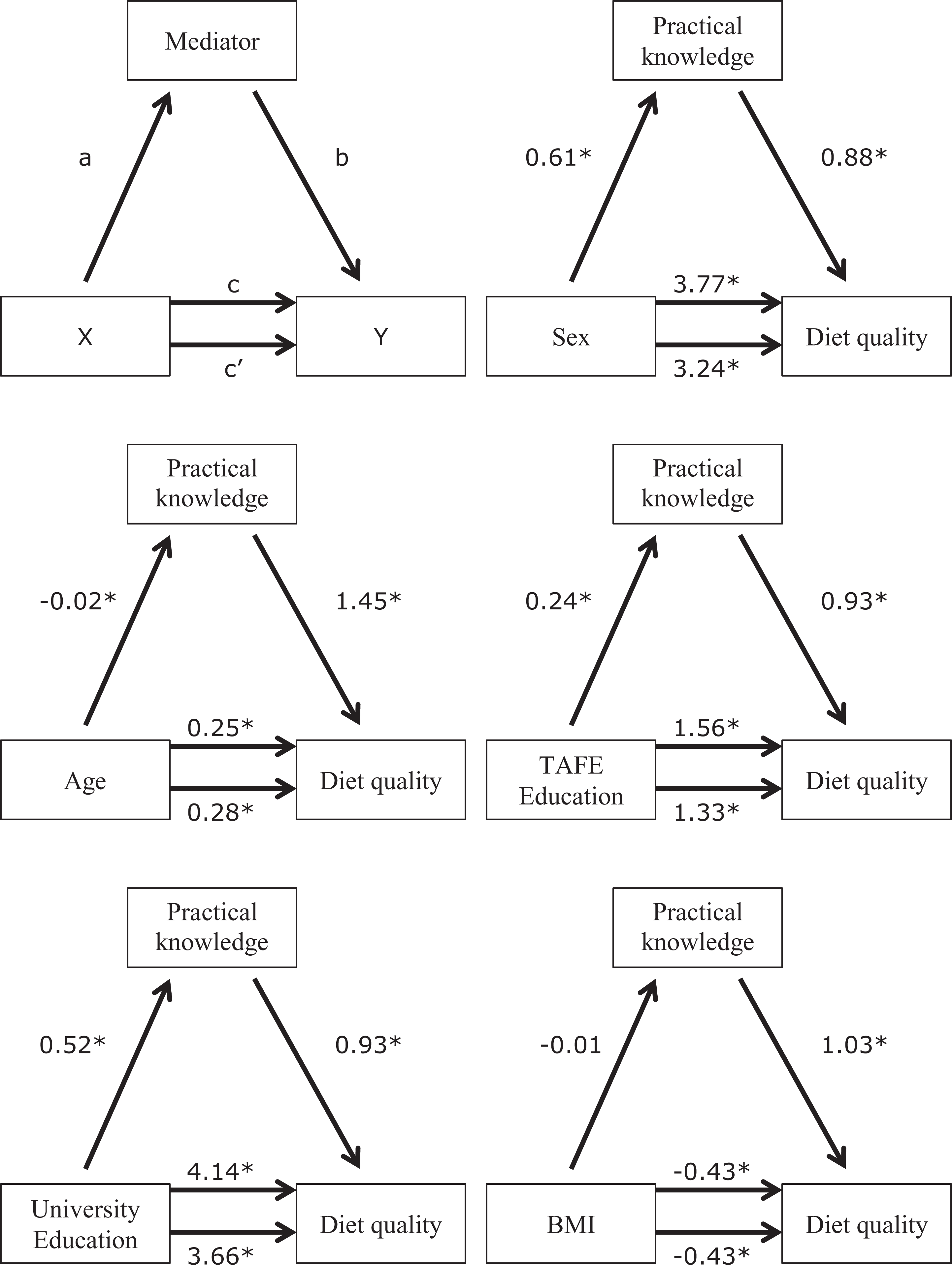
Path analyses for the single mediation models.
The direction and statistical significance of the associations remained in adjusted models; however, the magnitude of the associations was slightly higher. When adjusted for sex, age, education level, and BMI, a 1 unit increase in PNK was found to be associated with an increase in 1.11 units in diet quality and the total model explained approximately 9% of the variance (R 2 = 0.0947). The values for the pathways of the adjusted mediation models can be found in Supplement 4.
Discussion
Results demonstrated that PNK could explain part of the association between the sociodemographic characteristics (sex, age, and education) and diet quality. However, the mediated effects in this study only accounted for small percentages of the total effects of sociodemographic characteristics on diet quality, suggesting the sociodemographic variables still had an important direct relationship with diet quality. This is in accordance with previous studies. 2,3
No significant, indirect effect on diet quality was found for BMI. Although mediation is possible when causal effects exist in both directions, the presence of any bidirectional relationship might have caused the nonsignificant results. 10
This study had several limitations. The higher proportion of highly educated, middle-aged women limits generalizability, and a reliance on self-reported measures, which typically result in underreporting of dietary intake, needs to be taken into account when interpreting the findings of this study. Due to the study design, causation cannot be inferred. Also, the adjusted model only explained approximately 9% of the variance in diet quality, reinforcing the fact that dietary quality is influenced by a wide variety of factors. This may include other individual determinants (eg, cooking skills, self-efficacy, attitude, intention) and environmental determinants (eg, social norm, availability and accessibility of healthy food options). 6
SO WHAT?
What is already known on this topic?
Dietary quality differs by sociodemographic/health groups and nutrition knowledge is a modifiable determinant of diet quality, which may mediate the effects of sociodemographic characteristics on diet quality.
What does this article add?
The present study investigated the mediating role of practical nutrition knowledge (PNK), which is the type of knowledge that is considered more relevant and closely related to behavior than factual nutrition knowledge. Strengths of the present study include a large sample size and the use of measures with good psychometric properties. The present study contributes to the very limited amount of literature that investigated the role of nutrition knowledge measured as practical knowledge about composition of balanced meals. 8
What are the implications for health promotion practice or research?
The study findings could provide information for the design of tailored nutrition education initiatives, which may wish to target population groups with lower levels of PNK as part of multicomponent interventions (including eg, food purchasing and cooking skills). Further research is needed to compare different types of nutrition knowledge and further assess the effect of PNK on diet quality and to investigate intervention strategies to increase PNK as a way to improve diet quality in specific groups.
Supplemental Material
Supplemental Material, Revised_Supplementary_material_AppliedResearchBrief_AJHP_PracticalNutritionKnowledge - Practical Nutrition Knowledge Mediates the Relationship Between Sociodemographic Characteristics and Diet Quality in Adults: A Cross-Sectional Analysis
Supplemental Material, Revised_Supplementary_material_AppliedResearchBrief_AJHP_PracticalNutritionKnowledge for Practical Nutrition Knowledge Mediates the Relationship Between Sociodemographic Characteristics and Diet Quality in Adults: A Cross-Sectional Analysis by Kristine Deroover, Tamara Bucher, Corneel Vandelanotte, Hein de Vries and Mitch J. Duncan in American Journal of Health Promotion
Footnotes
Declaration of Conflicting Interests
The author(s) declared no potential conflicts of interest with respect to the research, authorship, and/or publication of this article.
Funding
The author(s) disclosed receipt of the following financial support for the research, authorship, and/or publication of this article: MJD (ID 100029) and CV (ID 100427), are supported by a Future Leader Fellowship from the National Heart Foundation of Australia. This study was partially supported by Future Leader Fellowship (ID 100029) from the National Heart Foundation of Australia. MJD is supported by a Career Development Fellowship (APP1141606) from the National Health and Medical Research Council.

Supplemental Material
Supplemental material for this article is available online.
References
Supplementary Material
Please find the following supplemental material available below.
For Open Access articles published under a Creative Commons License, all supplemental material carries the same license as the article it is associated with.
For non-Open Access articles published, all supplemental material carries a non-exclusive license, and permission requests for re-use of supplemental material or any part of supplemental material shall be sent directly to the copyright owner as specified in the copyright notice associated with the article.
