






Abstract
Purpose:
To determine the relative impact of framing on employee intention to adopt wearable technology (eg, Fitbits) at work.
Setting and Design:
Posttest only online experiment utilizing a 2 (framing: organizational efficiency vs individual health) × 2 (financial incentive: absent vs present) between-subjects design.
Participants:
Participants (N = 310) were 18 years or older, currently employed, and residing in the United States.
Measures:
Unified Theory of Acceptance and Use of Technology (UTAUT) subscale on behavioral intent (modified for wearable technology).
Analysis:
Chi-square and between-subjects analysis of variance.
Results:
Participants receiving the organizational efficiency frame (M = 3.97) expressed significantly lower intention to adopt a wearable compared to the individual health frame (M = 4.37), F2,308 = 3.99, P = .047. Financial incentives had a positive effect on adoption intention (M = 4.39 with incentive, M = 3.95 no incentive), F2,308 = 4.46, P = .036. The main effects of frame and incentive were additive, with participants in the individual health with incentive condition (n = 78, M = 4.60) expressing the highest intention to adopt and organizational efficiency without incentive expressing the lowest adoption intention (n = 77, M = 3.80; P = .03).
Conclusions:
Messaging emphasizing individual health benefits plus financial incentives might prove most successful when encouraging adoption of wearables at work.
Purpose
As health wearable technologies (eg, Fitbits, Apple Watches, and activity trackers) enter the workplace, practitioners and researchers have begun to investigate the best strategies for promoting adoption by employees. Prior studies involving wearable technology at work have examined the benefits and challenges of the technology
1
including privacy and ethical concerns of tracking employees.
2,3
Although research has identified factors that influence the general acceptance of wearables at work,
4,5
it is largely limited to correlational surveys. This study extends previous research by conducting an online experiment to test whether different message framing (individual health vs organizational efficiency) can influence employees’ intention to adopt wearable devices at work.
Method
Design
This study utilized a 2 (framing: organizational efficiency vs individual health) × 2 (financial incentive: absent vs present) between-subjects posttest only factorial online experiment to test whether framing impacts behavioral intent associated with wearable technology adoption at work.
Sample
Data was collected in August 2018 using Qualtrics Research Services. Participants resided in the United States, were at least 18 years of age, and worked for their current company for at least 6 months. After providing informed consent, 310 participants were randomly assigned to one of the 4 conditions: organizational efficiency frame with incentive (O$, n = 78), individual health frame with incentive (I$, n = 78), organizational efficiency frame with no incentive (O, n = 77), and individual health frame with no incentive (I, n = 77). As indicated in Table 1, there were no significant differences in demographics, suggesting randomization was successful.
Demographics, χ2, and ANOVA Results by Condition.
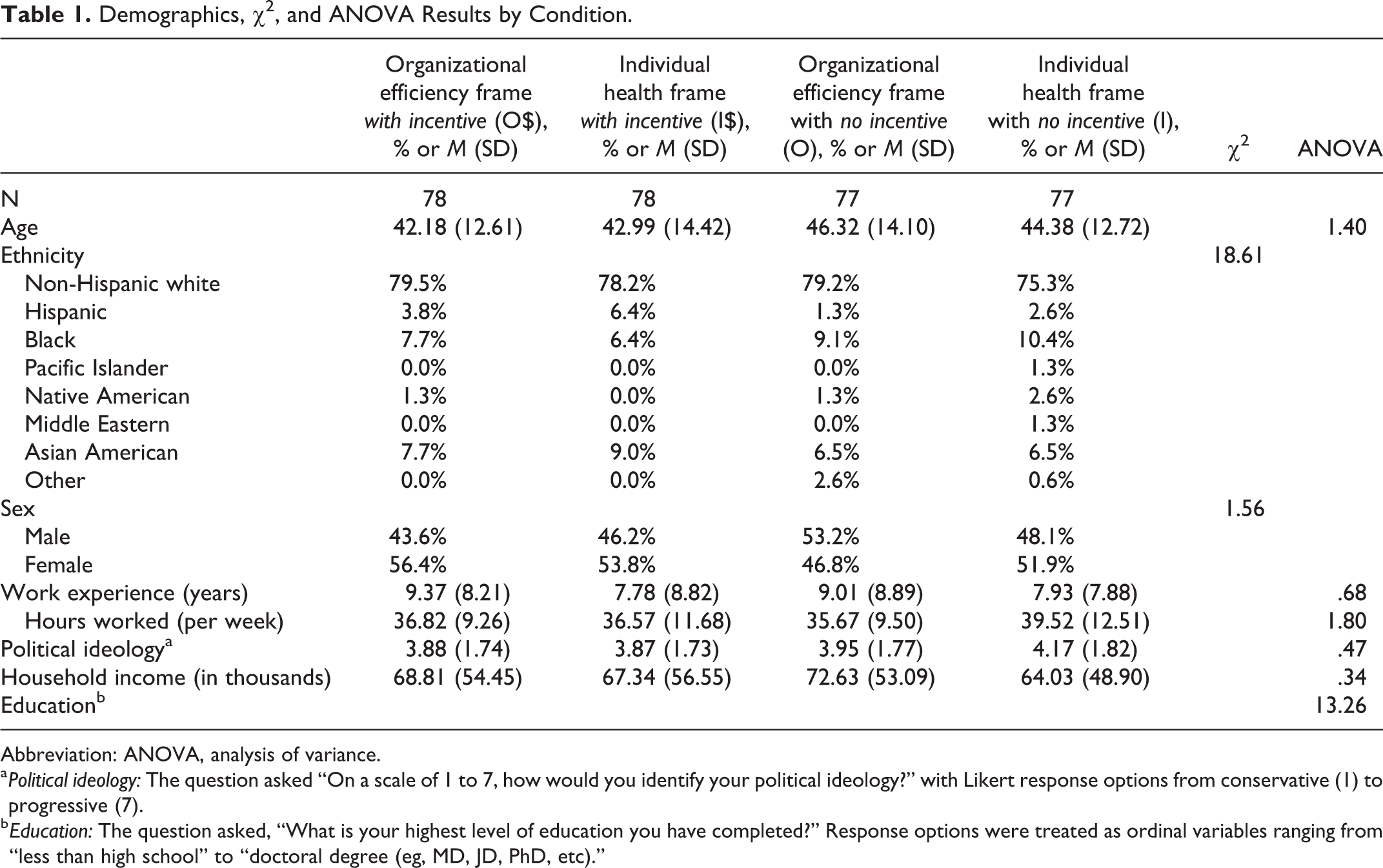
Abbreviation: ANOVA, analysis of variance.
a Political ideology: The question asked “On a scale of 1 to 7, how would you identify your political ideology?” with Likert response options from conservative (1) to progressive (7).
b Education: The question asked, “What is your highest level of education you have completed?” Response options were treated as ordinal variables ranging from “less than high school” to “doctoral degree (eg, MD, JD, PhD, etc).”
Manipulation
Participants were exposed to one of the 4 different versions of an article about the benefits of wearable technology at work. Information about wearable technology at work, its impact, and specific benefits (productivity, error reduction, savings, and job satisfaction) was identical. Differences involved attributing the benefits of wearable devices to either increased operational efficiency or employee health. For instance, when describing how wearables enhanced productivity at work, the organizational efficiency frames attributed improved productivity to the ability of managers to monitor participant’s activities at work resulting in better time management, fewer unnecessary breaks, and less downtime. Alternatively, the individual health frame attributed improved productivity to employees better understanding their behaviors at work, which led to better self-management of health resulting in less sick days, burnout, and stress.
The difference between financial incentive conditions was O$ stated the company kept the savings from insurance premiums, while I$ passed savings on directly to employees. No financial incentive information was included in conditions O and I.
Measures
The manipulation check consisted of 6 true/false items measuring participants’ perceived understanding and recall of information presented in their article and 1 multiple-choice question asking about the primary beneficiary of wearable technology at work.
The 3-item Unified Theory of Acceptance and Use of Technology (UTAUT) 6 subscale on behavioral intent (modified for wearable technology) was used to measure participants’ intent to adopt and use wearable devices at work. The scale ranged from 1 (strongly disagree) to 7 (strongly agree). Two additional items asking how participants intended to use devices were added, resulting in a 5-item scale. Examples include “I intend to use wearable devices at work if they were available to me,” “If available to me, I plan to sign up for programs that offer wearable devices to employees,” and “I would use wearable devices to monitor my productivity.” All items loaded onto a single factor (lowest loading = 0.92, total explained variance = 89.97%, ∝ = 0.97).
Analysis
Chi-square and analysis of variance (ANOVA) were used to check randomization among groups. Behavioral intent to adopt scores were entered into a 2 × 2 between-subject ANOVA.
Results
The ANOVA indicated a main effect for the benefit frame. Participants who were exposed to messages stressing benefits to the organization were less likely to express intention to adopt wearable technology compared to those exposed to messages stressing individual health benefits (M = 3.97 for the organizational efficiency frame and M = 4.37 for the individual health frame, F2,308 = 3.99, P = .047). This finding supports
The ANOVA also revealed a main effect for incentive. Participants offered a financial incentive were significantly more likely to adopt wearable technology (M = 4.39 with incentive and M = 3.95 no incentive, F2,308 = 4.46, P = .036). This finding answers
These 2 main effects were additive such that individuals with the highest intent to adopt were those exposed to the individual health frame with incentive (I$, M = 4.60). Those with the lowest intent to adopt were exposed to the organizational efficiency frame without incentive (O, M = 3.80, P = .03). The interaction between the 2 factors—frame and incentive—was not statistically significant.
Discussion
Summary
This study examined the effect of framing and financial incentives on participant’s intention to adopt a wearable health device at work. Using a posttest only experiment, this study found support for the 2 main effects of frame and incentive on behavioral intent to adopt a wearable at work.
With respect to
For
From a practical standpoint, this suggests that companies should not overlook the importance of communicating with employees about new technology in the workplace. Organizational efficiency frameworks might be useful when persuading leadership to invest in wearables, but this study shows it is far less effective at convincing employees to adopt the technology. To maximize the likelihood of adoption, companies should develop strategies that stress individual health benefits of wearables while including incentives.
Future studies should continue to explore communication strategies utilized by organizations to encourage employee buy-in. This includes how factors like organizational culture, support, and trust impact employee decision-making as well as how privacy attitudes impact behavioral intention.
Limitations
Limitations include cross-sectional data rather than longitudinal, no-pretest data, and an online sample reacting to a hypothetical scenario. However, the posttest only design was beneficial in reducing test sensitization. This study minimized bias with randomization. Using Qualtrics, we recruited a sample that was representative of the US population. To ensure data integrity, we included screening criteria and quality checks and excluded cases with suspicious responses (ie, those who answered too fast, had over 25% missing data, and straight-line responses).
Significance
This study is one of the first experimental studies to test 2 common frames—individual health versus organizational benefits—on wearable adoption at work. Findings suggest individual health frames are more likely to motivate adoption of health-related behaviors at work particularly when combined with financial incentives.
So What? (Implications for Health Promotion Practitioners and Researchers)
What is already known on this topic?
Previous scholarship has identified challenges 1 -3 and important factors for influencing wearable technology adoption at work 5,6 but has yet to test them empirically.
What does this article add?
This study extends previous survey-based research on wearable adoption at work 1,4,5 by using an online experiment to test the impact of message framing and financial incentives on wearable adoption intention.
What are the implications for health promotion practice or research?
Practitioners and employers should understand that how information is framed can dramatically influence technology adoption. Results apply to adoption of any health-related behavior at work, suggesting that messaging emphasizing individual benefits (as opposed to organizational benefit) combined with financial incentives might prove most successful.
Footnotes
Authors’ Note
Kwong conceived the project’s idea and theoretical framework. Kwong designed and performed the experiment with the assistance of Cruz and Murphy. Kwong, Cruz, and Murphy contributed to the interpretation of the results. Kwong wrote the manuscript with the consultation of Cruz and proofing of Murphy. The authors have no relationship to any wearable company. This research is approved by University of Southern California Institutional Review Board (IRB) under UP-18-00088.
Acknowledgments
The authors thank Margaret L. McLaughlin, PhD for her insight, advice, and guidance on this project and Paul Sparks for his suggestions when preparing the manuscript for submission.
Declaration of Conflicting Interests
The author(s) declared no potential conflicts of interest with respect to the research, authorship, and/or publication of this article.
Funding
The author(s) disclosed receipt of the following financial support for the research, authorship, and/or publication of this article: Annenberg Doctoral Summer Research Fellowship.
