







Abstract
Objective:
To identify and describe the mechanisms of lifestyle characteristics—obesity, DM, hypertension and physical inactivity—that may lead to the severity of illness among individuals with COVID-19.
Data Source:
A scoping review was conducted by searching electronic databases of PubMed and Scopus from December 2019 to August 2020.
Inclusion/Exclusion Criteria:
inclusion criteria were studies that explicitly describe the mechanism of COVID—19 in relationship with either hypertension, type 2 diabetes mellitus type 2 (DM), obesity and/or physical inactivity. Studies of epidemiological background, descriptive surveys and interventional studies were excluded.
Data Extraction:
study characteristics were tabulated according to purpose, type of non-communicable diseases (NCDs), the hypothesis on the mechanism of infestation (MOI) and conclusion.
Data Synthesis:
NCDs were categorized according to type and hypothesis on mechanisms of infestation. The interplay between COVID—19, type of NCDs and MOI leading to the severity of the disease was appraised.
Results:
Twenty-four (24) studies were identified from 357 unique records. Eight studies postulated the mechanism of infestation and interaction between COVID 19 illness severity and Obesity, while 7 studies described COVID—19 and DM. Five studies highlighted the interaction between COVID—19 and hypertension with 4 studies showing how physical activity restriction suppresses immunity.
Conclusion:
The current review, identified and explicitly described the mechanisms of the lifestyle characteristics that may increase the severity of illness among people with COVID-19.
Keywords
Objective
The novel coronavirus disease (COVID-19) which was first detected in December 2019 and caused by severe acute respiratory syndrome coronavirus 2 (SARS-CoV-2) has slowed the world and led to devastating effect on all spheres of life. World Health Organization (WHO) reports that as of August 3, 2020, there have been 17,889,134 confirmed cases of COVID-19, including 686,145 deaths. 1
The WHO Global Status Report on non-communicable Diseases (NCDs) in 2010 projected that NCDs will cause around 3.9 million deaths by 2020. Unfortunately, the COVID-19 pandemic is likely to increase this death rate. According to Nyirenda, 2 NCDs cause a large and growing burden of death and disability in Africa; with regional hypertension prevalence of 48%, diabetes of 5.1%, and obesity of 20%. Holmes, Dalal, Volmink, Adebamowo, Njelekela, Fawzi, Willett, Adami, 3 projected that NCDs will overtake infectious diseases as major sources of morbidity and mortality in Africa by 2030. The present COVID-19 pandemic would most likely worsen the morbidity and mortality rate not only in Africa but around the globe.
According to the centers for disease prevention and control (CDC), any person irrespective of age with certain underlying medical conditions like hypertension, diabetes mellitus, and obesity have increased risk for severe illness from COVID-19. 4 It is well known that most people suffering from the severe effect of COVID-19 have 1 or more comorbidities of NCDs. 5 Most NCD related deaths are attributable to cardiovascular disease, diabetes, cancers, and chronic respiratory diseases, which are amenable with lifestyle changes like reducing tobacco and alcohol use, consuming a healthy diet, increasing physical activity, losing weight, and lowering blood pressure, glucose, and cholesterol levels. The current review, therefore, aimed to identify and describe the mechanisms of lifestyle characteristics—obesity, diabetes mellitus type 2 (DM), hypertension and physical inactivity—that may increase the severity of illness among individuals with COVID-19.
Methods
A scoping review was conducted in accordance with Munn, Peters, Stern, Tufanaru, McArthur, Aromataris, 6 as proposed by Tricco, Lillie, Zarin, O’Brien, Colquhoun, Kastner, Levac, Ng, Sharpe, Wilson. 7
Data Sources
PubMed and Scopus electronic databases were searched for peer-reviewed, English-language research articles published from December 2019 to August 2020. Search terms included; COVID—19 and illness severity with Obesity, hypertension, diabetes mellitus type 2 (DM), and physical activity or sedentary lifestyle. See Supplemental appendix 1 for the search strategy with Boolean operators and MeSH terms.
Inclusion and Exclusion Criteria
Included in this study, were studies that explicitly describe the mechanism of COVID—19 in relationship with either hypertension, DM, obesity, and physical inactivity. Studies of epidemiological background, descriptive surveys and interventional studies were excluded as they are not expected to give explicit description about mechanisms but rather quantify the magnitude of the problem or effects of the intervention on the conditions.
Data Extraction
Study characteristics were tabulated according to the aim and purpose of research, type of non-communicable diseases (NCDs), the hypothesis on the mechanism of infestation (MOI) and conclusion. All identified papers were exported into Endnote for removal of duplicates and then uploaded to Covidence (Covidence Systematic Review software Veritas Health Innovation, Melbourne, Australia; www.covidence.org) for screening. Titles and abstracts of identified studies were independently screened by both authors (BB & UU). Full-text copies of papers were assessed for eligibility by the same 2 authors (BB, UU) with any disagreements resolved by discussion and consensus. Data for each included study were extracted by 1 author (BB) and cleaned and checked by another (UU). The 2 reviewers (BB and UU) extracted data using a standardized extraction form, to ensure that it adequately captured study data. The methodological quality for included studies was not assessed as they were neither qualitative nor quantitative data.
Data synthesis
NCDs were categorized according to type and hypothesis on mechanisms of infestation. The interplay between COVID—19, type of NCDs and MOI leading to the severity of the disease was appraised.
Results
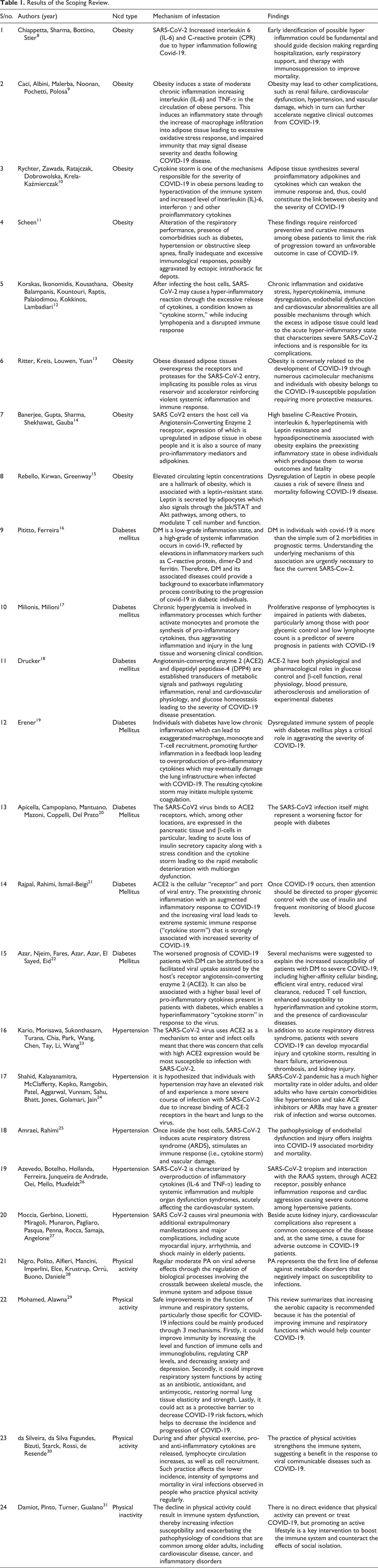
Among 1357 records identified from the databases, 24 studies were included in the study and assessed for eligibility (see Figure 1). Eight studies postulated the mechanism of infestation and interaction between COVID-19 illness severity and Obesity, while 7 studies described COVID—19 and DM. Five studies highlighted the interaction between COVID—19 and hypertension with 4 studies showing how physical activity restriction suppresses immunity. (See Table 1). All 24 eligible articles included in this study were published within the year 2020 and used “review” as the study design.
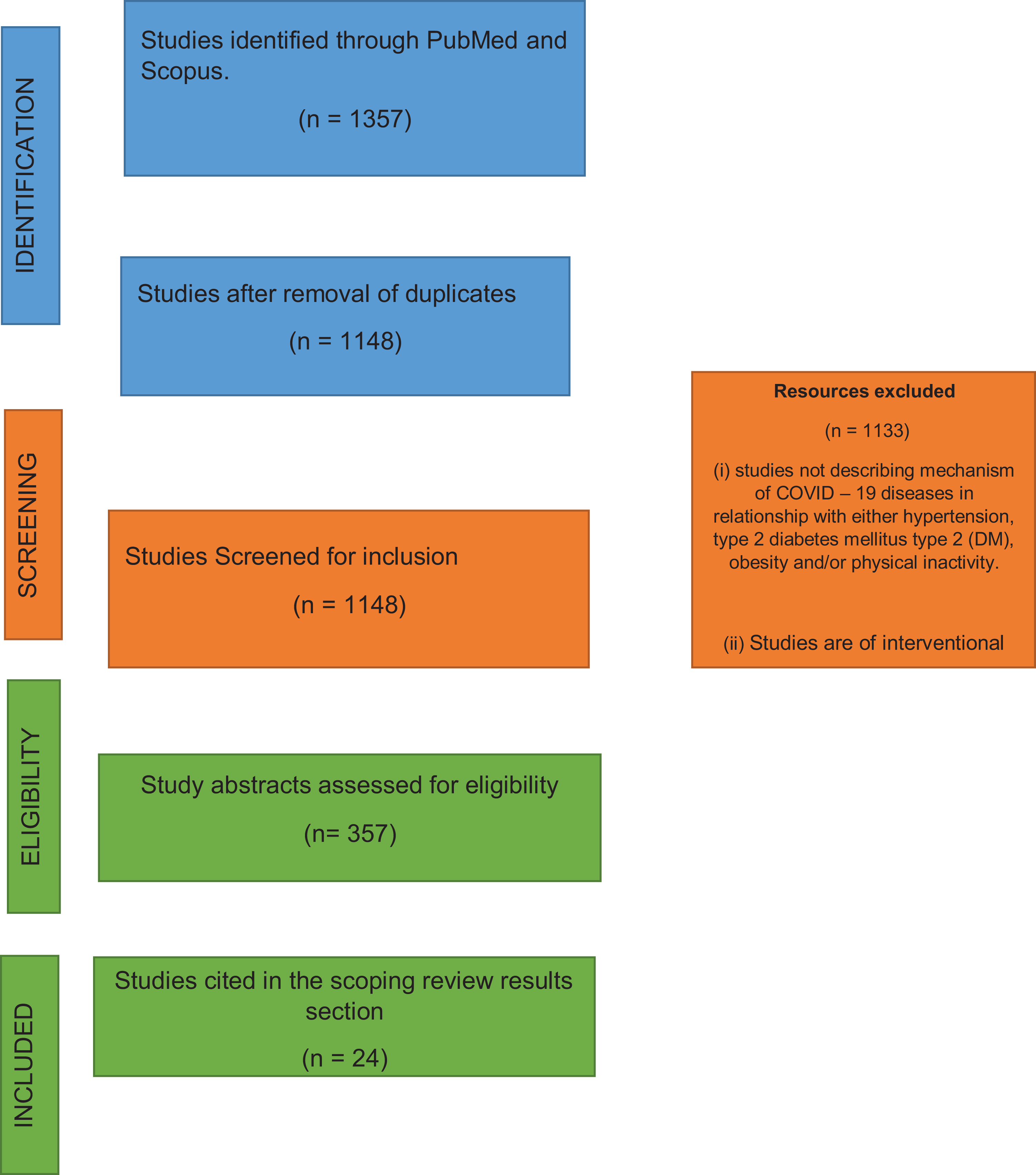
Flowchart of study identification and screening process.
Results of the Scoping Review.
COVID-19 Severity in Obese People
All the 8 obesity studies 32 -39,20 in relation to COVID-19 hypothesized that obesity induces a state of moderate chronic inflammation increasing interleukin (IL-6) and TNF-α in the circulation of obese people which leads to increased macrophage infiltration into adipose tissue leading to excessive oxidative stress response, and impaired immunity that may signal disease severity and deaths following COVID-19. One study 20 also added that elevated circulating leptin concentrations are a hallmark of obesity, which is associated with a leptin-resistant state. Leptin is secreted by adipocytes which also signals through the Jak/STAT and Akt pathways, among others, to modulate T cell number and function. All the studies 32 -39,20 concluded that obese people face reduced immunity and hyper inflammation which are considered risks of increased severity of illness from COVID-19.
COVID-19 Severity in Diabetic People
Among the 7 studies 33 -39 that postulated the interaction between COVID-19 severity with DM, all the authors hypothesized that preexisting chronic inflammation with an augmented inflammatory response to SARS-CoV-2 infection and the increasing viral load leads to extreme systemic immune response (“cytokine storm”) that is strongly associated with increased severity of COVID-19. They were attributed to a facilitated viral uptake assisted by the host’s receptor angiotensin-converting enzyme 2 (ACE2) when expressed in the pancreas. The authors concluded that the dysregulated immune system of people with DM plays a critical role in aggravating the severity of COVID-19.
COVID-19 in Hypertensive People
All the 5 studies 40 -43,20 we included in this review, indicated that individuals with hypertension may present with an elevated risk of high blood pressure and experience a more severe course of infection with SARS-CoV-2 due to heart and lungs viral tropism, which may be explained by overexpression of ACE-2 receptors. One author 42 also added that SARS-CoV-2 tropism and interaction with the renin-angiotensin-aldosterone system (RAAS) through ACE-2 receptors, possibly enhance inflammation response and cardiac aggression, leading to imperative concerns about the use of angiotensin-converting enzyme inhibitors (ACEi) and angiotensin II receptor blockers (ARBs) in infected patients. All the authors concluded that individuals with hypertension are also at higher risk of having severe illness following SARS-CoV-2 infection.
COVID-19 Severity in Sedentary People
All the studies 44 -47 on the interaction between COVID-19 and physical inactivity hypothesized that physical inactivity could result in immune system dysfunction, thereby increasing infection susceptibility and exacerbating the pathophysiology of conditions that are common among older adults, including cardiovascular disease, cancer, and inflammatory disorders. One study 46 added that during and after physical exercise, pro-and anti-inflammatory cytokines are released, lymphocyte circulation increases, as well as cell recruitment. Such practice influences the lower incidence, intensity of symptoms and mortality in viral infections observed in people who practice physical activity regularly. This may apply to SARS-CoV-2 infection.
Discussion
The current review identified and described in summary, the mechanisms of lifestyle characteristics—obesity, DM, hypertension and physical inactivity—that may lead to the severity of illness among individuals with COVID-19.
The review suggests adequate and substantial evidence on the mechanism of infestation by SARS-CoV-2 virus on people with lifestyle characteristics of obesity, DM, hypertension and sedentarism are at increased risk of severe illness with COVID-19.
Findings from the hypotheses on obesity show that people with obesity have a higher risk of becoming severely ill with Covid-19 due to hyperinflammation and compromised immune system. Albashir 32 affirmed that obese patients are at increased risk of exacerbations from viral respiratory infections. The author explained that during the H1N1 pandemic, obesity was associated with an increased risk of intensive care unit (ICU) admission and death as well as longer duration of mechanical ventilation, and hospital stays. Cabandugama, Gardner, Sowers 33 described that adipocytes may substantially contribute to the production of circulating angiotensinogen which leads to the production of angiotensin II (Ang II) leading to over-activity of the RAAS, which is linked to poor prognosis in COVID-19 resulting in high morbidity and mortality. 34 It is therefore very pertinent and urgent among governments, health ministries and non-governmental organizations (NGOs) to prioritize the prevention and management of NCDs to reduce deaths and severe complications following COVID-19.
Diabetes mellitus had been mentioned over the years as a common health problem of NCDs globally, leading to high morbidity and mortality. 35 Individuals with DM have their innate immunity compromised due to impaired polymorphonuclear functions, including chemotaxis, adherence, phagocytosis, and intracellular killing, 36 which would make the first-line defence against SARS-CoV-2 challenging, thereby allowing the unhindered proliferation of the pathogen within the host. 37 Several authors have mentioned that in earlier infectious disease epidemics, high glucose serum levels were an independent predictor of morbidity and mortality which is also the same case for Covid-19. 38,39 Apicella, Campopiano, Mantuano, Mazoni, Coppelli, & Del Prato 20 explained that SARS-CoV-2 tropism for pancreas and β-cells specifically, may cause acute impairment of insulin secretion and/ or destruction of β-cells resulting in the development and progression of diabetes.
Grant 40 also explained that DM is associated with an increases risk of thromboembolism event due to imbalance between clotting factors and fibrinolysis. Since COVID-19 had also been linked with increased coagulation activity through endothelial dysfunction, Covid-19 patients with poor serum glucose control have a high tendency of being severely affected with greater risk of morbidity and mortality.
ACE-2 has been mentioned to be found in the respiratory and cardiovascular system as well as other parts of the human body. 41 Zhou, Yang, Wang, Hu, Zhang, Zhang, Si, Zhu, Li, Huang 42 affirmed that ACE-2 is considered the receptor for SARS-COV-2 to enter the human cell. They explained that the enzyme can catalyze the conversion of angiotensin II (Ang II) to angiotensin 1–7, which enhance the proinflammatory, pro-oxidation, and vasoconstrictive effects of Ang II leading to hypertension. This explains why hypertension is a common comorbidity among persons with COVID-19. Guan, Ni, Hu, Liang, Ou, He, Liu, Shan, Lei, Hui 43 in their study of 1099 COVID-19 patients, had a 23.4% prevalence of hypertension in severely ill patients. It was also reported in a Global, regional, and national study that over 24% were estimated to be at increased risk of severe COVID-19 due to hypertension. 5 It is therefore important to ensure prevention and prompt management of hypertension in the general population to assist with the reduction of morbidity and mortality following COVID-19.
Physical activity (PA) has been documented to reduce the risk of NCDs like cancers, hypertension, stroke, diabetes and other chronic inflammatory disorders. 44 Several studies have affirmed that a physically active lifestyle reduces the risk of being infected by various bacterial and viral diseases. 45 -47 A recent review 48 showed that regular exercise training enhances body immunity through multiple pathways. They affirmed that epidemiological studies had consistently revealed physically active adults with high fitness levels demonstrated low levels of inflammatory biomarkers due to the effects of exercise training. These authors also confirmed that there is growing evidence that the circulatory flow in cells of the innate immune system with each exercise bout and the anti-inflammatory and antioxidant effect of exercise training has a summation effect over time in modulating tumorigenesis, atherosclerosis, and other disease processes. The authors, therefore, concluded that exercises of moderate to vigorous intensity, less than 60 minutes support the immune system to stimulate the ongoing exchange of distinct and highly active immune cell subtypes between the circulation and tissues and with each exercise bout improving the antipathogen activity of tissue macrophages in parallel with an enhanced recirculation of immunoglobulins, anti-inflammatory cytokines, neutrophils, NK cells, cytotoxic T cells, and immature B cells. 48
The lockdown periods result in a reduction of PAs or some cases a complete absence of same. According to Das, Horton 49 sedentarism generally leads to reduced energy expenditure and physical fitness which was estimated to be the cause of over 5.3 million deaths annually around the world. The previous assertion was supported by Campbell, Turner 50 who reported that a sedentary lifestyle with high levels of sitting time and low levels of PA are associated with increased risks of depression and NCDs risk factors. 51 Davies, Sprung, Norman, Thompson, Mitchell, Halford, Harrold, Wilding, Kemp, Cuthbertson 52 affirmed that 2 weeks of reduced PA leads to a decrease in cardiorespiratory fitness and multi-organ insulin sensitivity. Kubota, Cushman, Zakai, Rosamond, Folsom 53 also found out that immobilization and sedentary behavior, such as TV viewing, are strong risk factors for venous thromboembolism which eventually lead to CVD or death. On the other hand, Ekelund, Tarp, Steene-Johannessen, Hansen, Jefferis, Fagerland, Whincup, Diaz, Hooker, Chernofsky 54 asserted that regular PA and low sedentary time are associated with reduced risk for morbidity and all-cause mortality.
Limitations
The interpretation and generalization of our findings should be with caution due to several reasons; firstly, the study design could have missed out some vital information from other different study designs not included in this study. However, our justification for using only review papers was to be able to capture explicit description or hypothesis on the subject matter without any quantification as would be seen in other study designs. Secondly, new information which may differ from the present literature after the review period since the understanding of COVID-19 is getting better by the day. Thirdly, there are no quantifiable methods that could be used to appraise hypotheses in reviews of the study. Lastly, the results may not be generalized globally given the included studies were exclusively published in English. Empirical data in other languages such as China where the disease started may show different perspective or hypotheses.
Conclusion
In conclusion, the current review, identified and explicitly described the mechanisms of lifestyle characteristics—obesity, diabetes mellitus type 2 (DM), hypertension and physical inactivity—that could increase the severity of illness among individuals with COVID-19. We, therefore, recommend adequate prevention and prompt management of these lifestyle characteristics mentioned to reduce the impact of COVID-19 morbidity and mortality.
So What?
What is already Known on this Topic?
Lifestyle characteristics—obesity, DM, hypertension and sedentarism are likely to cause the severity of illness when infected with SARS-CoV-2 virus.
What does this article add?
The article highlighted the possible mechanisms by which these lifestyle characteristics could lead to severity of illness following COVID-19.
What are the implications for practice or research?
Public Health practitioners, clinicians, governments and individuals should be aware of lifestyle characteristics—obesity, DM, hypertension and physical inactivity that could increase the risk of severe illness following COVID-19. Hence, necessary prevention and management programs that would mitigate these factors should be put in place to reduce the susceptibility of having severe illness when faced with COVID-19. More rigorous studies (such as large-scale intervention studies with RCT design) targeting COVID-19 populations at different stages of the disease with and without NCDs risk factors would be needed to confirm the hypotheses or theories postulated.
Footnotes
Declaration of Conflicting Interests
The authors declared no potential conflicts of interest with respect to the research, authorship, and/or publication of this article.
Funding
The authors received no financial support for the research, authorship, and/or publication of this article.

References
Supplementary Material
Please find the following supplemental material available below.
For Open Access articles published under a Creative Commons License, all supplemental material carries the same license as the article it is associated with.
For non-Open Access articles published, all supplemental material carries a non-exclusive license, and permission requests for re-use of supplemental material or any part of supplemental material shall be sent directly to the copyright owner as specified in the copyright notice associated with the article.
