







Abstract
Purpose
The purpose of this study was to explore a food-insecure, low income, predominantly African American community’s experiences with a produce prescription program (PPP).
Design
Researchers conducted 3 focus groups and 4 individual interviews with Maywood Veggie Rx (VRxM) participants asking questions about the logistics of the program while also exploring ideas around health, food, and community.
Setting
This produce prescription program took place in Maywood, Illinois which is an urban underserved community with 23.5 K people, most of whom are Black/African American (61%) and Hispanic (32%).
Participants
The 24 participants interviewed through focus groups and individual interviews were enrolled in the 2021-2022 VRxM program. Participants were mainly female, with only three participants being males. Ages ranged between 34 and 74 years of age with a mean age of 56.3.
Method
Qualitative data from transcripts were then coded via a grounded theory approach to identify common themes.
Results
A research team of seven including the two Co-PIs, three medical students and two dietetic interns identified 278 codes which were then condensed into 117 codes and then placed into 9 categories. Researchers identified three recurrent themes among the experiences of VRxM participants: (1) trust building, (2) culturally relevant and adaptive nutrition education, and (3) bidirectional feedback. These three themes mirror many of the principles of Community Based Participatory Research (CBPR).
Conclusion
The study findings identify common themes among the experiences of VRxM which are in line with the collaborative approach of CBPR principles. Produce Prescription Programs should utilize CBPR principles in the creation and implementation of programming to improve the participant experience. Future research should include additional focus groups on new iterations of VRxM and should also include those people who chose not to participate in VRxM to explore barriers to participation.
Keywords
Purpose
According 2022 USDA data, 22% of Black households were food insecure at some point in 2022, as were 21% of Hispanic households. This is in stark contrast to the 9% of White, 1 non-Hispanic households affected by food insecurity in 2022. 2 Food insecurity is associated with increased risk for multiple chronic health conditions including diabetes and heart disease. 3 Conversely, fruit and vegetable intake is associated with positive health outcomes and decreased mortality from chronic diseases such as diabetes and heart disease.4,5 Given this Produce Prescription Programs (PPP’s) are one way to address chronic health conditions through improved access to fresh produce. The National Produce Prescription Collaborative defines a PPP as a system where health care providers can provide a prescription to patients experiencing diet related health risks, food insecurity or other challenges in accessing healthy produce. These prescriptions result in access to healthy produce at low or no cost to the patient. 6
Although produce prescription programs (PPPs) have been in existence for years, there is little research focused on participant perspectives on these programs. The purpose of this study was to explore a food-insecure, low income, predominantly African American community’s experiences. More specifically, this qualitative research explores the participant experience within the VeggieRx Maywood (VRxM) program.
Background
Maywood, Illinois is located in West Suburban Cook County. According to 2021 census data, Maywood has a population of 23.5k people. The most common ethnic groups are Black/African American (61%) and Hispanic (32%). Nearly fifteen percent of the population lives below the poverty line and, of those who live below the poverty line, 76% are African American or Hispanic. 1 Residents in West Suburban Cook County experience rates of food insecurity greater than the national rate and have limited access to fresh fruits and vegetables. 7 Similar to other food insecure areas, the low-income residents of suburban Cook County are disproportionately affected by chronic disease. 8
VeggieRx Maywood (VRxM) was a produce prescription program initiated through Proviso Partners for Health, a local community coalition. VRxM started as a USDA regional initiative but then branched off in 2019 to form a partnership with Windy City Harvest, Chicago Botanical Gardens and Real Foods Collective to help those who are food-insecure obtain locally grown and packed fresh produce while promoting health nutrition literacy. While physicians from a local academic center could refer their patients to the program, any community member was welcome to participate. Only SNAP beneficiaries would be provided a free produce bag, but anyone could purchase low cost produce at the farm stand and join any educational piece of the program. Aspects of the program included food distribution sites, nutrition education, cooking classes, and physical activity. The VRxM program started in 2018 by distributing 186 produce boxes. By 2021, the program distributed nearly 3000 produce boxes to the Maywood community. Prior to the COVID-19 pandemic, the cooking demonstrations and nutrition education classes were conducted during onsite and in-person on produce distribution days in Maywood. During the pandemic, nutrition education classes were transitioned onto a virtual platform. Nutrition education and recipes were based on both the contents of the produce bag as well as participant suggestions.
Approach
Focus groups and individual interviews were conducted with VRxM participants in November and December of 2022. All aspects of the study were approved by the university’s Institutional Review Board. Verbal informed consent was obtained from each participant prior to the focus group or interview.
Setting
Trained moderators which consisted of a facilitator and co-facilitator conducted virtual (via a HIPAA-compliant Zoom link) focus groups lasting 60 minutes. These trained moderators also conducted additional individual interviews via Zoom audio conferencing for those participants who preferred a non-group setting or an alternate time. The focus groups and individual interview discussion guide contained a set of open-ended questions, accompanied by probes, which provided structure to the discussion while allowing for the flexibility needed to allow for spontaneity and candor. The discussion guide was developed by the research team and is included in the Appendix.
Participants
All VRxM participants were invited to participate in focus groups or individual interviews during VRxM produce pickup through verbal communication, social media posting on the VRxM Facebook group, and posted fliers at the distribution site and farm stand. All interested participants, regardless of their level of participation, were allowed to be a part of the study. Participants who could not make the focus group times or preferred a non-group setting were allowed to choose an individual interview format instead. All individuals who expressed interest and responded to correspondence were included in the study.
Method
Three focus groups were conducted by a facilitator and co-facilitator team via Zoom video conferencing. Four individual interviews were conducted by additional moderators via Zoom audio conferencing. A research team member called each participant the day before the interview to remind them of the date, time and instructions to log into Zoom if needed. Participants were allowed to turn off their cameras if Zoom was used. During the interview, consent was obtained to record audio and take written notes. Trained moderators led the discussion while the assistant moderator took comprehensive notes, assisted with technical issues and attended to unexpected interruptions. Questions focused on the logistics of the Maywood Veggie Rx program while also exploring ideas around health, food, and community. Participants in both focus groups and individual interviews were compensated for their participation with $15 in cash.
The audio recordings were transcribed via Rev, a secure transcription service. Participants were de-identified and transcripts were given to each member of the research time for analysis. A research team of seven including the two Co-PIs, three medical students and two dietetic interns worked together to code transcriptions using a grounded theory approach. Grounded theory approach, created by Glaser and Strauss, involves first assigning individual words or small groups of words into codes, also taking note of patterns, similarities and differences through constant comparison. From there, theories are generated to explain the phenomenon. Additionally, verbatum quotes that support these theories are recorded as “in vivo” codes to illustrate the developing theory. 9 The research team reviewed the data and identified codes individually. After individual coding was complete, the research team met together to discuss the codes and later develop categories and themes through an iterative process. Themes and categories were continually scrutinized to be certain that they were unique and not overlapping in content. Together, the team identified 278 codes which were then condensed into 117 codes and then placed into 9 categories. This evolved into 3 themes which mirror the principles of Community Based Participatory Research (CBPR). CBPR is based on a set of principles with the aim to increase health equity through translational research. The principles emphasize collaboration between community and researcher from start to finish as well as mutual benefit between both parties in program development and research. 10
Results
A total of 24 participants shared their experiences with the VRxM program: 20 participants within 3 focus groups and 4 individual interviews. Thirteen participants identified as Black Non-Hispanic, four identified as White Non-Hispanic, one identified as White Hispanic, and six did not disclose race/ethnicity information. Participants were mainly female, with only three participants being males. Ages ranged between 34 and 74 years of age with a mean age of 56.3.
Themes and Community-Based Participatory Research Principles.
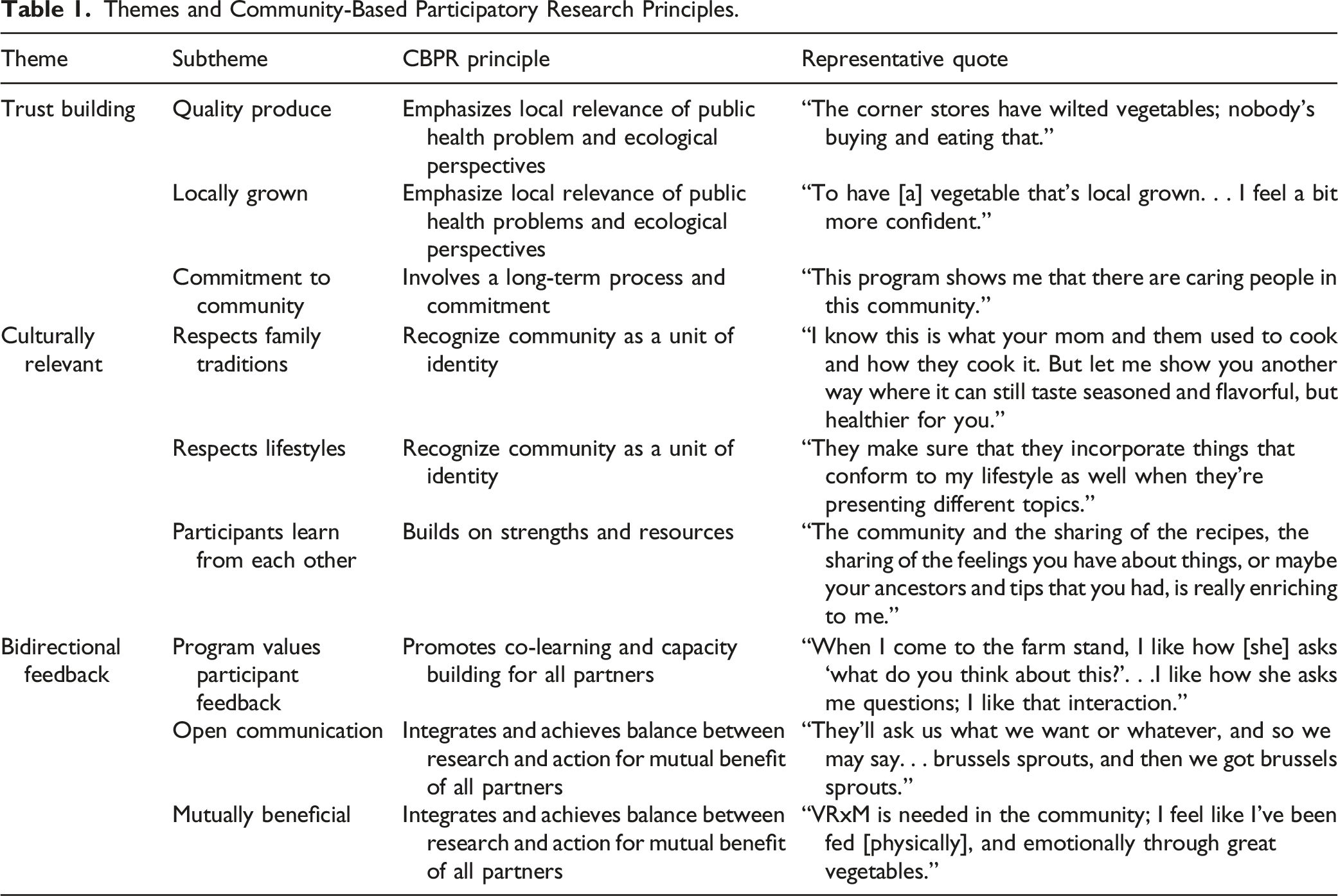
Trust Building
The VRxM provided locally grown, quality produce in a trusted stable environment which built participant trust in the program. VRxM participants felt more comfortable participating in the program and eating the produce given because they felt they could “trust” in the food made available to them. Members of VRxM acknowledged the “variety, abundance and great quality of the vegetables” as opposed to the typical rotten, wilted, or easily spoiled produce available in their neighborhood. One Maywood resident stated, “I think the best thing about VeggieRx and the reason why I wanted it to be in Maywood is because I think a lot of people think black people don’t eat vegetables. They have to realize why we don’t eat vegetables…the corner stores have wilted vegetables; nobody’s buying and eating that.” Additionally, participants felt that obtaining locally grown produce was better because they believed it was safer to eat. One participant explained, “To have [a] vegetable that’s local grown, that’s not flown across the country, I feel a bit more confident that it's on our soil as opposed to coming from across the sea. I don’t know what dirt touched it, or what the agriculture rules [say] about what they put in the ground, or how they grow them.” Focus group participants expressed fear of addition of unknown chemicals in store bought produce: “I think with the vegetables. . . hopefully they are not adding stuff.” Finally, participants trusted in the program because it was dependable. Participants were grateful for the consistency of distributions in spite of barriers such as the pandemic and inclement weather, particularly given their past experiences with disappointment. “Especially in certain communities, [there have been] so many promises made by people, especially higher-level people or people in leadership that says, ‘We’re going to come in and we’re going to do this,’ but then the change doesn’t happen.”
Trust building falls in line with the two CBPR principles: recognizing the local relevance of a public health problem and aiming to demonstrate a long-term commitment to addressing this issue. VrxM addresses the community’s need for access to quality food in order to improve health through a sustainable long term solution.
Culturally Relevant and Adaptive Nutrition Education
The VRxM program provides culturally relevant recipes and nutrition education is fluid to respect the needs of the group. During the nutritional education piece, members are encouraged to make recipes as they “know and love” while thinking about moderation, portion control and other dietary considerations. Cooking demonstrations were guided by the contents of the produce bag as well as feedback from the participants. Most importantly, participants are encouraged to share nutritional information and recipes with each other. One participant of VRxM explained, “I want someone who can say, ‘I know this is what your mom and them used to cook and how they cook it. But let me show you another way where it can still taste seasoned and flavorful, but healthier for you.’" One participant explained, “They make sure that they incorporate things that conform to my lifestyle as well when they’re presenting different topics.” The participants appreciated their “exchange of ideas” to learn from each other. Another member described, “The community and the sharing of the recipes, the sharing of the feelings you have about things, or maybe your ancestors and tips that you had, is really enriching to me.” Both at the cooking demonstrations and on social media, members exchanged and commented on recipes. One member wanted to try a better way to make beets and explained, “[We] work with the community, and they can tell you their ideas and ways to fix it…it’s really helpful.”
This theme is in line with the CBPR principles of identifying the community as a unit of identity and building on existing strengths and resources. By respecting the culture and traditions of the community, the program acknowledges, respects and appreciates the community’s own identity. By encouraging participants to share their recipes and cooking techniques with each other, the program builds on the existing knowledge of its community members.
Bidirectional Feedback and Evaluation
In addition to looking at data, surveys, or outside research, program staff continuously looked for guidance from participants and used this as their guide. Participants helped with decisions such as distribution location, types of produce, and adjustments to the program during the pandemic. For example, one participant shared, “When [I] come to the farm stand, I like how [the director] asks ‘what do you think about this, how do you think we can get the news out to the community? I like how she [asks me] questions and interacts with me.” Participants felt heard by the program coordinators: “They’ll ask us what we want or whatever, and so we may say…brussels sprouts, and then we got brussels sprouts. I think they’re taking the feedback from the group, what they’re interested in using, because in that way they’re more likely to utilize it.”
Bidirectional feedback and evaluation embodies the CBPR principles of co-learning and capacity building and mutual benefit for all partners
Discussion
PPPs can have a meaningful impact on building up the local food environment and the community. A qualitative study by Joseph and Seguin 11 describes how a pilot PPP project improved the food environment while simultaneously improving social connections. Lofton et al 12 similarly summarizes the efficacy of community-based local food systems, and findings from this VRx study are consistent . Our qualitative analysis gathers perspectives from the participants of a PPP in a low-income, primarily African American community. Overall, participants describe three key themes including 1) trust building, 2) culturally relevant and adaptive nutrition education, and 3) bidirectional feedback. When evaluating the main themes discovered, they are in line with many of the core principles of the CBPR framework and confers with existing literature. The theme of trust building is key and not surprising given the historical trauma experienced by this predominantly African American population. 13 The theme of trust building was similarly identified by Speights et al when investigating strategies for engaging African American women in CBPR. 14 In addition, recent studies similarly highlight the importance of culturally relevant nutrition education and recipes. For example, Ard et al 15 demonstrates improved dietary changes in African American participants when implementing a culturally relevant weight loss program against a control group. The commitment to bidirectional feedback emphasizes the importance of community involvement in any initiative. Other studies similarly describe the impact of community-led coalitions to establish local food policy changes and the importance of community partnership to create effective nutritional interventions.16,17
VRxM seeks to improve the current food environment for the Maywood community through quality affordable fresh produce and culturally relevant nutrition education. When looking for a common thread within the themes identified, this study demonstrates the critical role that community codesign plays in program development. The goal should be an equal partnership that recognizes the strengths of the community and acknowledges the ongoing injustices its people have endured. PPPs should implement a CBPR framework in order to provide a thriving and sustainable PPP that creates access to fresh produce and thus the opportunity for a healthy community.
The themes identified in the focus groups are continuing to guide future direction with the VRxM program in the Maywood community. Increased grant funding will fulfill the expressed desire for expanded hours and allow for expansion of the program into surrounding communities. Given the findings from these focus groups, VRxM will work to increase participation in the program by reaching out to partners who are trusted by the community, including community centers and churches. The program did hire and will continue to hire more community members to help with distribution given the upcoming expansion. Finally, and most importantly, the goal of this larger scale VRxM program will move away from identifying community members as participants and instead look to creating an equal collaboration between the program and the community, working towards better health together.
Future research should include additional focus groups and individual interviews on the new iterations of VRxM, now including expanded distribution and the employment of community members. It would also be helpful to have focus groups with people who did not participate in VRxM to evaluate barriers to participation. On a broader level, it would be interesting to conduct additional focus groups on the VeggieRx program in different communities to look for similarities and differences in themes.
Limitations
Research findings should be interpreted with these limitations in mind. Focus groups and in-depth interviews were composed of participants who frequently used the VRxM program and were motivated to share their experiences and thoughts about the program. It would be helpful to have information from those who were eligible for participation in VRxM but did not to participate. Additionally, due to the COVID-19 pandemic, in-person focus groups and interviews were not an option. This limited participation to those that possessed the necessary equipment and technology to participate in virtual discussions. Furthermore, idea sharing may have been different in a more intimate in person setting. Interpretation of body language, facial expression and group dynamic was limited by video only and some participants chose to not enable their camera during the interview. Moreover, we did not have access to interpreter services, so we were unable to capture the experiences of non-English speaking participants.
Conclusion
Other PPPs can learn from the community codesign themes identified from this focus group by including these aspects in their PPP. VRxM program providers can codesign future PPPs in a partnership with the community to stay true to the principles of CBPR and consequently improve participation and community investment into these programs. The CBPR framework shows respect to the community by acknowledging the community’s identity and strengths by giving them the power and the tools to create a program that improves the food environment and promotes health in a culturally relevant way.
Supplemental Material
Participants’ Experiences With a Community Based Participatory Research Produce Prescription Program: Findings From a Qualitative Study
Supplemental Material for Participants’ Experiences With a CBPR Produce Prescription Program: Findings From a Qualitative Study by Courtney Kimi Suh, Abigail Huliganga, Jeriann Collymore, Naomi Desai, Mary Mora, and Lena Hatchett Ballard in American Journal of Health Promotion
Footnotes
Declaration of Conflicting Interests
The author(s) declared no potential conflicts of interest with respect to the research, authorship, and/or publication of this article.
Funding
The author(s) received no financial support for the research, authorship, and/or publication of this article.

Supplemental Material
Supplemental material for this article is available online.
References
Supplementary Material
Please find the following supplemental material available below.
For Open Access articles published under a Creative Commons License, all supplemental material carries the same license as the article it is associated with.
For non-Open Access articles published, all supplemental material carries a non-exclusive license, and permission requests for re-use of supplemental material or any part of supplemental material shall be sent directly to the copyright owner as specified in the copyright notice associated with the article.
