






Abstract
Occupational health has historically focused on the mitigation of acute physical hazards and environmental exposures. However, a growing body of evidence suggests that for highly sedentary positions, such as truck and bus drivers, the primary threat to longevity and productivity are lifestyle-related chronic diseases.1,2,3
In 1953, Jeremy Morris and his colleagues published a landmark study in The Lancet that would fundamentally alter our understanding of the relationship between work and health. By studying London transport workers, a striking disparity was identified: bus conductors, who spent their shifts moving through the aisles and climbing the stairs of double-decker buses, had significantly lower rates of coronary heart disease (CHD) than the drivers who remained seated for their entire shift. 4
This research was one of the first to identify physical activity as a primary protective factor against cardiovascular disease, independent of socioeconomic status.
4
Fast forward decades later, modern truck and bus drivers represent one of the most health-vulnerable populations in the global workforce. Their roles are defined by prolonged sitting, “food desert” environments, social isolation, irregular hours, stressful situations and environments, and disrupted circadian rhythms. In 2014, Sieber et al published results from the National Survey of Long-Haul Truck Driver Health and Injury which showed the following sobering statistics:5,6 • Obesity: approximately 69% of long-haul truck drivers are obese, compared to roughly 31% of the general adult working population. • Smoking: Nearly 51% of drivers are current smokers, more than double the national average. • Physical Inactivity: Over 70% of drivers report getting no regular vigorous physical activity. • Chronic Conditions: Type 2 diabetes and hypertension are significantly more prevalent in this group, and many may remain undiagnosed due to the mobile nature of the work. • Sleep: 27% of drivers report getting ≤6 hours of sleep per night.
These statistics may be a result of the day-to-day environment, as well as the industry culture. When a driver’s income is tied directly to miles driven, every minute spent exercising or preparing a fresh meal could be perceived as a financial loss.
7
However, truck drivers must undergo the Department of Transportation’s (DOT) physical exam to obtain their DOT medical certificate needed to drive a commercial vehicle. The physical example evaluates a driver’s overall health to ensure they can handle the physical and mental demands of commercial driving. For most drivers, the DOT medical certificate is valid for a period of 24 months. However, the driver may be issued a certificate for a shorter duration (ranging from 3 to 12 months) when ongoing medical monitoring is necessary.
8
There are several reasons for shortened certificates: • High blood pressure (Hypertension Stage 1 or 2), • Diabetes under insulin treatment, • Vision or hearing impairments requiring corrective aids, and • Heart conditions requiring follow-up.
8
The FIT (Fit to Pass/driver fitness) program is a structured health-coaching and wellness initiative designed specifically for commercial truck drivers, combining remote coaching, behavior-change techniques, and practical nutrition and fitness guidance to help drivers meet DOT medical requirements and build sustainable healthy habits. 9 This program has shown impactful results 10 which Bob Perry shares in his article “Improving Health Outcomes and Certification Rates Among Commercial Drivers: Evaluation of a Targeted Wellness Intervention” published in this issue of Knowing Well, Being Well.
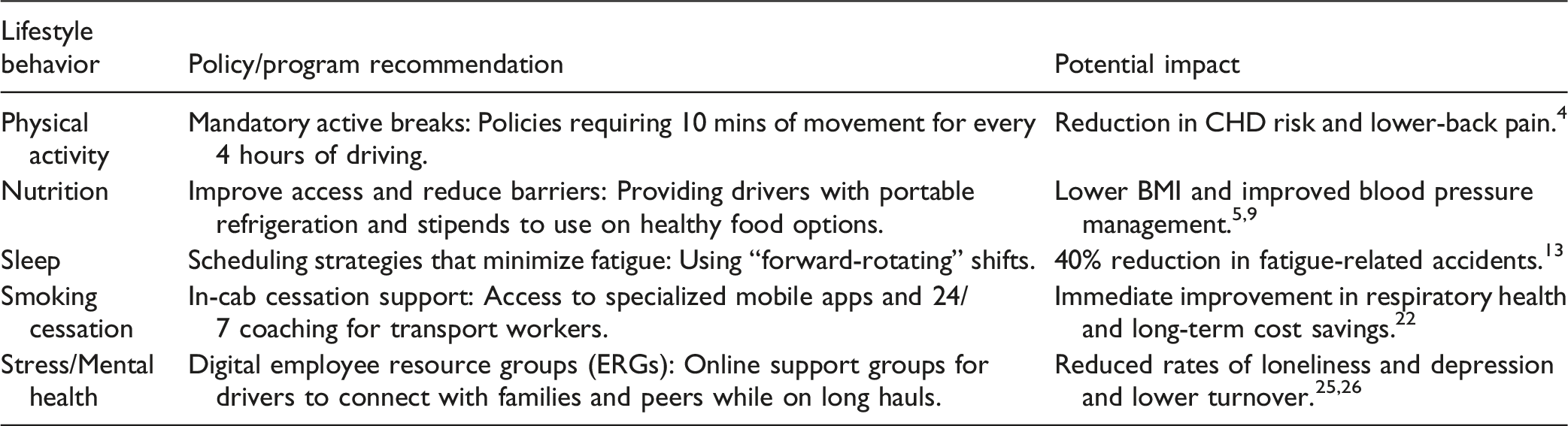
Health and wellness programs designed for the trucking industry have commonly focused on the following lifestyle behaviors:
Physical Activity and Movement
The lack of movement can lower metabolic rate, and prolonged sitting is also linked to chronic low-back pain and musculoskeletal disorders. Research by Thorp et al 11 emphasizes that sedentary behavior is an independent risk factor for mortality, even among those who exercise outside of work. For drivers with irregular schedules, the “outside of work” window is often non-existent. Workplaces must therefore integrate movement into the workday by requiring mandatory “active breaks.” As Abdullah et al point out in their article “Supervised exercise interventions: Evidence, outcomes, and policy implications for chronic disease management” published in this issue, structured, supervised, flexible and accessible physical activity interventions are far more effective than unsupervised approaches for improving health outcomes and sustaining behavior change. Therefore, workplace wellness programs for truck drivers should consider offering structured physical activity options that are embedded into the realities of the job, rather than putting the responsibility solely on the driver to seek out physical activity options.
Nutritional Practices
Dietary choices for drivers are often dictated by the “truck stop environment.” These locations are typically saturated with energy-dense, nutrient-poor foods. 12 While many health promotion efforts have focused on nutrition education for drivers, education can only be successful if the environment aligns.12,13 We must ensure that healthy food options are available, affordable, and convenient for drivers.14,15 Systematic reviews have shown that when organizations provide healthy food subsidies or improve the nutritional quality of on-site vending, workers show improved glycemic control and weight management. 16
Sleep and Fatigue Management
Chronic sleep deprivation is common in truck drivers, as a result of irregular schedules and poor sleeping environments. It is also one of the biggest safety risks for truck drivers, impacting reaction time, decision-making, and overall health. 17 Research from the Large Truck Crash Causation Study (LTCCS) reported that 13% of commercial motor vehicle (CMV) drivers were considered to have been fatigued at the time of their crash. 18 As a result, the FMCSA has hours of service regulations to help ensure that drivers get enough sleep, including driving time limits, workday hour limits, and break policies. 19 However, fatigue still shows up. Workplace wellness programs can try to help drivers combat fatigue through providing sleep hygiene education, sleep apnea screening, technology support for monitoring sleep patterns and driver alertness, as well as using scheduling strategies that minimize fatigue, such as forward-rotating shifts. Forward-rotating shifts for drivers are a structured, progressive schedule that moves from day to evening to night, designed to reduce fatigue, improve safety, and align with natural sleep patterns. 20 Finally, physical activity, healthy nutrition practices, and hydration can also reduce fatigue. 21
Smoking Cessation
Given the high stress and isolation of driving, smoking often serves as a coping mechanism. In fact, as noted above, rates of tobacco use are double that of the overall US adult population. 5 A study by Kagabo et al in 2020 surveyed and interviewed 37 drivers and found that 69% were daily smokers while 97% had smoked at least 100 cigarettes in their lifetime. 22 Given the influence of tobacco use on chronic disease risk, transport organizations need to have a smoking cessation strategy in place. Sorensen et al found that workplaces that offer telephonic coaching and nicotine replacement therapy (NRT) specifically tailored to drivers that spend a large proportion of their time on the road, see higher quit rates. 23 Further, Kagabo et al found that 68% of drivers reported interest in using NRT either as gum or patch in addition to smoking cessation counseling to help them quit. 22
Stress Management and Social Connection
The isolation of long-haul driving, driven by strict schedules and constant pressure, creates chronic stress and cortisol elevation that impacts driver health. The PrePass Safety Alliance has published a list of strategies and resources available to help truckers improve their mood, stress levels, and mental health while on the road. Some individual strategies include breathing exercises and meditation, prioritizing sleep, healthy eating, and movement breaks, as well as connecting with other drivers at rest stops. Organizations can also help drivers by fostering social support networks and implementing digital communication tools to help drivers maintain connections while on the road.24,25
Organizational Policies and Programs
Conclusion
Prioritizing lifestyle behaviors is essential in all industries, but especially important for those with highly sedentary employees, such as truck drivers. 12 By addressing key factors such as sleep, nutrition, physical activity, and stress management, organizations can reduce accident risk, lower healthcare and insurance costs, and improve driver retention and productivity. 27 Ultimately, investing in driver well-being is a strategic decision that supports a safer and healthier workforce while strengthening long-term operational success and competitive advantage.10,25
Footnotes

Funding
The author received no financial support for the research, authorship, and/or publication of this article.
Declaration of Conflicting Interests
The author declared no potential conflicts of interest with respect to the research, authorship, and/or publication of this article.