







Abstract
Honesty is a highly valued social trait, but research into it is impeded because current measures of trait honesty both differ in their content coverage and neglect non-behavioral aspects of traits such as cognitions and motivations. Building on recent conceptual and empirical developments highlighting truthfulness as an important and perhaps central element of honesty, we developed and validated trait and state measures of truthful communication (six studies, total N = 2797). Applying these measures to a series of assessments of everyday honesty experiences indicated that state manifestations of truthfulness showed notable variability at both person and situation levels, correlated with trait levels of truthfulness, and systematically varied as a function of the goals people were pursuing in situations (consistent with predictions from Whole Trait Theory, a dynamic personality theory). This work provides conceptually grounded, psychometrically sound tools for researchers to precisely probe truthfulness as a feature of both persons and day-to-day experiences and highlights the functional nature of moral traits such as truthfulness.
Plain Language Summary
People value honesty. However, research on this topic has been hampered by large differences in the content assessed by measures of trait honesty, as well as the exclusion of non-behavioral aspects of traits such as cognitions and motivations in these assessments. We build on recent conceptual and empirical developments highlighting truthfulness as a central element of honesty and develop trait and state measures of truthful communication (six studies, total N = 2797). Consistent with Whole Trait Theory, a dynamic theoretical model of personality, moment-to-moment truthfulness varied notably both between people (i.e., some people were more truthful than others) and within people (i.e., a given person was more truthful at some times than others). Moreover, momentary ratings of truthfulness were sensibly related to self-ratings of one’s own truthfulness, as well as being sensitive to the situational goals people were pursuing (e.g., trying to avoid avoiding disapproval was related to being less truthful). In summary, we provide a conceptually grounded and psychometrically sound set of tools for researchers to study a core characteristic of honesty.
Introduction
Honesty is highly valued and plays an important role in everyday life. People around the world strive to teach it to their children (Alwin, 1989; A. Cooper, 2022; Pew Research Center, 2023), desire it in both casual acquaintances (Hartley et al., 2016; Landy & Perry, 2024) and close social partners (Regan et al., 2000; Sun et al., 2022), expect it in moral exemplars (Walker & Hennig, 2004), and value it in the self (McGrath, 2015; SimanTov-Nachlieli & Moran, 2022). Moreover, honesty is relevant to many everyday experiences (Hofmann et al., 2014; Yudkin et al., 2025). Given this importance, personality psychologists are increasingly interested in understanding honesty and its role in daily life (e.g., Cohen et al., 2022; Fleeson et al., 2022; Jayawickreme & Fleeson, 2017; Meindl et al., 2015; Paul et al., 2022; Thielmann et al., 2024). While we believe that this work is important, it will benefit greatly from conceptual focus and methodological improvements highlighting truthfulness as the core component of honesty. Thus, the purpose of this paper is to advance the study of honesty in daily life by presenting new measures of trait and state truthful communication.
Honesty is a diverse construct
The term honesty captures a wide variety of seemingly disparate traits and behaviors. For example, Miller’s (2021) conceptual account of honesty includes actions such as telling the truth, being appropriately forthcoming, refraining from stealing, refraining from cheating, and keeping one’s promises. Similar diversity is found in experimental studies of honesty, which often operationalize honesty as specific behaviors in the research setting, such as returning a “lost” wallet without removing money, overreporting one’s performance on a task, paying for goods taken from unattended “honor stands,” or reporting overpayments (see Rosenbaum et al., 2014). Even more diversity may be found in dispositional measures related to honesty (Fleeson et al., 2022). For example, the Values in Action’s Honesty scale includes content focusing on promise-keeping and value-adherence; the SAPA Personality Inventory’s Honesty scale (Condon, 2017) focuses on lying, cheating, and exploitation; the Workplace Productivity Questionnaire includes Deceiving and Cheating facets that focus on lying, taking undeserved credit, and shifting blame (Nicol, 1999; Nicol & Paunonen, 2002); and the HEXACO-PI-R’s Honesty-Humility factor (Lee & Ashton, 2018) includes content related to generosity, modesty, law-abidingness, and (not engaging in) exploitative lying.
The diversity captured by the term honest raises conceptual and empirical challenges. Conceptually, it is unclear what, if anything, unites such disparate behaviors and qualities (i.e., the unification challenge, see Miller, 2021), or what is at the core of honesty. Among other empirical issues, the diversity means that ostensible measurements of honesty may reflect meaningfully different phenomena and that ostensible measures of honesty might reflect phenomena that are actually peripheral to honesty. Such ambiguity, in turn, hinders clarity in interpreting individual studies and in accumulating understanding across studies.
Conceptual and empirical evidence for the centrality of truthfulness
Recent philosophical and empirical work has begun resolving the ambiguity of honesty, revealing that truthfulness is an especially important facet of honesty, perhaps even its central core. First, Miller (2021) proposes and evaluates various conceptualizations of the virtue of honesty, but all of them frame it in terms of a disposition “to not intentionally distort the facts as the agent sees them.” Similarly, Um (2024) provides several examples of honest behavior as his motivating cases, and they involve either telling the truth or avoiding deception. This conceptualization then highlights the “respect for the right not to be deceived” as honesty’s fundamental motivation. Such strong emphasis on avoiding deception and on truth appears in many recent conceptual discussions of honesty (Carr, 2014; Roberts & West, 2020; Wilson, 2018).
Reinforcing this, a recent set of empirical studies (Reynolds et al., 2025) suggests that truthfulness may be the most central feature to how laypeople apply the term honest to both people and behaviors, at least in the United States. In this work, participants freely generated characterizations of honest people/behaviors (over 6000 in total). Qualitative and quantitative analyses revealed the frequency with which various themes of honesty/dishonesty (e.g., truthfulness, forthrightness, cheating, stealing) emerged and the priority in which the themes emerged in participants’ lists (e.g., beginning, middle, or end). Separate samples of participants then judged these free responses on their importance to honesty and indicated whether each response was an example of honesty versus other moral categories. Across five studies and all metrics of conceptual centrality, truthfulness consistently emerged as the most central feature of lay honesty concepts.
Given its nature and its importance within the scope of honesty, we see three nested reasons that personality psychologists should focus significant attention on truthfulness. First, even beyond its status as a part of honesty, truthfulness is an important psychosocial phenomenon in its own right, featuring as an essential element of human coordination (e.g., T. R. Levine, 2014). Although truthfulness has likely always been an important psychosocial issue, understanding how people respond to truth, deception, and “alternative facts” may be important now more than ever in a world overflowing with information access, much of which is inaccurate (e.g., van der Linden, 2022). Second, if one grants that truthfulness is an important component of honesty, even if not the core of honesty, fully understanding the psychological processes underlying honesty means understanding the processes of truthfulness. So, attention is needed to the extent that we care about understanding honesty. Finally, if truthfulness is indeed at the center of honesty, understanding honesty in a way that resonates with both lay peoples’ views and philosophical conceptualizations of honesty is impossible without understanding truthfulness.
Defining and conceptualizing truthful communication
To advance understanding of honesty, we focus on the core personality manifestation of truthfulness, truthful communication. At the dispositional level, we define truthful communication as the tendency toward expressing one’s beliefs accurately and faithfully. People with high levels of truthful communication tend toward expressing their beliefs accurately and in a way that avoids being misleading (about those beliefs) when communicating with others. Even in situations that might make such truthfulness difficult, uncomfortable, or costly, they are oriented toward truthful expression. People with lower levels of truthful communication are less oriented toward expressing their beliefs accurately and truthfully, perhaps even tending toward deception.
Similar to most other traits, we see truthful communication as a multidimensional construct (see, e.g., Wilt & Revelle, 2015). Its cognitive/evaluative component is the belief that truthful/non-misleading communication is “correct” and “the right thing,” morally speaking. Its affective component is the experience of guilt and/or shame in instances where one fails to express one’s beliefs faithfully. This component also includes anticipating those moral emotions if one were to fail to express beliefs faithfully. Its motivational component is the desire that others know one’s actual beliefs when those beliefs are expressed. Finally, its behavioral component is the tendency to actually express one’s beliefs faithfully and non-misleadingly, that is, not intentionally misleading others. These components are consistent with contemporary theories of personality that articulate the causal processes underlying personality traits (e.g., Fleeson & Jayawickreme, 2021; Furr & Funder, 2021). These components also reflect a virtue-oriented conceptualization of truthful communication (Miller, 2021; Wright et al., 2021), as they refer to a value-oriented type of cognition, morally relevant emotions, and a morally oriented type of motivation (i.e., as opposed to self-enhancing or self-protective motivation to be truthful).
In terms of “expressing one’s beliefs accurately and faithfully,” we intend “beliefs” to reflect a variety of cognitive representations. These include: (a) one’s understanding of objective physical or temporal facts (e.g., whether the earth is flat), (b) one’s interpretation/evaluation of physical or temporal facts (e.g., whether the weather is “warm”), (c) one’s recollection of events (e.g., what happened during an argument), (d) one’s understanding of other people’s psychological states and traits (e.g., whether one thinks that Columbus believed Earth was flat), and (e) one’s opinions or attitudes (e.g., whether one enjoyed a dinner). Note that, on this view, if a person’s beliefs are wrong (objectively speaking) but they express them accurately, then the person is “truthful” according to this definition. 1 Put another way, we use “truthful” as a description of people and their communicative behaviors, not as a description of beliefs or claims themselves, which can be said to be “truthful” to the extent that they are consistent with reality. 2
Although our definition is articulated at a dispositional level (i.e., “a tendency toward…”), truthful communication is also a situational phenomenon. As one moves from situation to situation in daily life, there can be variability in the degree to which one expresses one’s beliefs accurately and faithfully. One’s truth-related cognitions, emotions, motivations, and behaviors can vary across situations. A full understanding of the psychological causes, correlates, and consequences of truthful communication in daily life requires examination from both dispositional and situational levels. Ideally, such examination employs a measurement approach that operationalizes truthful communication similarly across those levels of examination.
Understanding truthful communication in daily life: Incorporating trait and state perspectives
To understand truthful communication and its role in individuals’ daily life experiences, researchers should examine it from both state and trait perspectives. From a trait perspective, truthful communication is a variable that differs between people, in terms of a relatively stable tendency to act, think, feel, and be motivated toward (or away from) truthfulness. From a state perspective, recent advances in personality theory have also highlighted the importance of examining how people’s manifestations of personality systematically vary across contexts (Furr & Funder, 2021; Jayawickreme et al., 2021). Notably, this dynamic perspective on personality has recently been extended to understanding moral traits and virtues (Fleeson & Jayawickreme, 2021; Jayawickreme et al., 2021; Jayawickreme & Fleeson, 2017; Mendonça et al., 2023; Wright et al., 2021). Dynamic accounts of personality can thus explain both variations in people’s manifestations of truthful communication from context to context, as well as long-term stability within a person.
Whole Trait Theory (WTT; Fleeson & Jayawickreme, 2015, 2021) is one such dynamic theory that also fosters engagement with the philosophical literature on virtue and character development and has emerged as an important model of moral traits (Doris, 2022; Jeffrey & Beary, 2023; Wright et al., 2021). According to the principles of WTT, while an individual’s behavior varies rapidly and frequently across different occasions, their behavior is both stable and distinct from other individuals when averaged across a larger period of time such as a few days or a week. Extending from this account, moral traits such as truthful communication are stable in the sense that there is reliable between-person variation, and flexible in the sense that there is also substantial within-person variation in an individual’s behavior depending on both situational cues and the specific goals being pursued in that context.
Furthermore, WTT proposes that the descriptive side of an individual’s character traits can be represented as a distribution of states (Fleeson & Jayawickreme, 2017; Jayawickreme & Fleeson, 2017) measuring the extent to which an individual manifests a given moral traits at a specific point in time. According to WTT, possessing the descriptive side of a specific trait—truthful communication in this instance—is simply akin to communicating in a more truthful manner more often. Such states are similar to traits in affective, cognitive, and behavioral content, but states are manifested for a few minutes or hours rather than for months or years (Cattell et al., 1947; Fleeson, 2001). Past research has used experience sampling methodology (ESM) in which participants are asked to report to the extent to which they have manifested moral behavior consistent with a given moral trait at regular time intervals across the duration of several days or weeks (e.g., Meindl et al., 2015). These reports can then be aggregated into a distribution to convey the frequency with which an individual enacted each level of a given state. By examining the full distribution of an individual’s behaviors, research testing the predictions of WTT has found that reliable between-person differences in individuals’ aggregated moral behaviors exist, and that also individuals also respond flexibly in different situational contexts.
A further insight of WTT is the functional nature of traits—individuals enact trait manifestations in order to fulfill specific goals and thereby achieve specific outcomes (McCabe & Fleeson, 2016) and in response to specific opportunities afforded by the situation (Zachry et al., 2018). In other words, people intentionally modulate their levels of truthful communication to fulfill specific goals and manage distinct environments. Examining how truthful communication functions and systematically varies in daily life should therefore be an important task for personality scientists interested in the dynamics of truthful communication in daily life.
Measurement of truthful communication
Unfortunately, the field’s ability to study truthful communication is limited by a lack of relevant precise measures. Existing measures of honesty (or other similar constructs, such as authenticity) are inadequate for assessing truthful communication, as they commonly suffer from one of two problems (see Fleeson et al., 2022 for an overview of scale content in trait honesty measures). First, many trait measures of honesty incorporate content beyond truthfulness or possibly not directly related to honesty. For example, the Values in Action honesty scale based on the International Personality Item Pool (IPIP, n.d.) includes content related to promise-keeping and adherence to one’s values, making it imprecise as a measure of truthfulness. More broadly, the HEXACO-PI-R Honesty-Humility scale incorporates items related to generosity and modesty, and its truthfulness-related items focus specifically on lying to manipulate or take advantage of others. 3 This inclusion of other features in measures muddies interpretation to the extent that criterion variables should be expected to differentially relate to different aspects of honesty. 4
Second, many trait honesty measures focus solely on overt behaviors such as telling the truth or lying. 5 Though these behavioral manifestations are an important aspect of trait honesty/truthfulness, these scales miss other mechanisms and processes that make up moral traits, such as beliefs, emotions, and motivational processes (Jayawickreme & Fleeson, 2017). For example, the Honesty subscale of the Externalizing Spectrum Inventory-100 asks participants to assess how frequently they lie but makes no reference to any psychological components beyond overt behaviors. By missing other psychological components, such measures miss important elements of traits and fail to capture cases where the elements may not be congruent with each other. For example, a person who speaks truthfully in a situation only after a difficult struggle with a temptation to lie is meaningfully different from a person who speaks truthfully without experiencing such temptation (see Ng & Tay, 2020, for a broader discussion of the importance of including multiple psychological components when assessing moral traits).
These two problems also exist with the very few examples of state assessments of honesty that exist in the current literature. One study (Sherman et al., 2015) assessed state manifestations of Honesty-Humility with a set of adjectives combining both honesty and humility (“humble, honest—arrogant, dishonest”). Such assessments provide an imprecise assessment of honesty in daily life. Meindl and colleagues (2015) developed a measurement tool for assessing state manifestations of moral thoughts and behaviors in daily life. This tool included a multi-item assessment of honesty. While this measure included items relevant to truthful communication (“Did you try to make someone believe something that you know is false?”), it focused on behaviors, as opposed to other characteristics of the trait of truthful communication (e.g., motivations, emotions).
The present studies
To advance the field’s ability to understand a crucial component of honesty, we present six studies in which we develop and psychometrically evaluate both trait and state measures of truthful communication. We see these new measures as important complements to other measures that assess broader honesty-relevant personality traits. Studies 1–4 developed a reliable trait measure of truthfulness with good convergent and discriminant validity (Study 2), incremental validity in predicting a behavioral criterion differently than a related measure (Study 3), and predictive validity in predicting people’s honesty throughout the events of their day (Study 4). Studies 5 and 6 developed a reliable measure of state manifestations of truthfulness and used it to examine how moment-to-moment truthfulness varies between and within people in cross-sectional (Study 5) and ESM designs (Study 6). Moreover, Studies 5 and 6 examined how such variability is not random, but systematic as a function of both trait truthfulness and momentary goals, evidencing the validity of the state measure.
In developing these measures, we frequently compare the novel trait measure of truthfulness to measures of the Honesty-Humility factor of the HEXACO personality framework, for two reasons. First, HEXACO Honesty-Humility scales are widely used measures related to trait honesty, and comparing our new measure to familiar and common scales helps clarify its nomological network. Second, the authors often see Honesty-Humility scales used as a proxy for honesty (or more specifically, for truthfulness) in probing various truthfulness-relevant behaviors. 6 To the extent that researchers use broad Honesty-Humility measures to assess truthfulness specifically, they likely introduce unrelated variance, potentially obscuring understanding about truthfulness. However, if broad Honesty-Humility measures already capture the same variance as a precise truthfulness measure, it would make the more precise measure somewhat redundant. Thus, a useful truthfulness measure would complement Honesty-Humility measures by capturing additional unique variance.
All studies were approved by the Wake Forest University IRB. Studies 2b (osf.io/xeauj) and 3 (osf.io/9ug6y) were preregistered.
Study 1: Item generation, Internal structure (exploratory), reliability, and scale refinement
In Study 1, we generated an initial pool of trait items, had them conceptually evaluated by an interdisciplinary team of content experts (psychologists and philosophers), refined the item pool, and presented it to participants. Empirically, we examined the internal structure and reliability of the items. Based upon psychometric and conceptual considerations, we reduced to a final Trait Truthful Communication Scale (T-TCS).
Item generation and refinement
Seven team members (faculty, postdocs, and graduate students) generated 148 items based on the working definition of truthful communication: Truthful Communication (TC) is the tendency toward expressing one’s beliefs accurately and faithfully. People with high levels of TC tend toward expressing their beliefs accurately, truthfully, and in a way that avoids being misleading (about those beliefs) when communicating with others. Even in situations that might make such truthfulness difficult, uncomfortable, or costly, they are relatively oriented toward truthful expression. People with lower levels of TC are less oriented toward expressing their beliefs accurately and truthfully, perhaps even tending toward deception.
Project leaders independently reviewed those items, evaluated the conceptual fit and clarity of each, discussed their reviews, and retained 75 items.
Next, ten members of the interdisciplinary team (psychology and philosophy faculty, postdocs, and graduate students) independently reviewed these 75 items, rating each item’s conceptual fit to the definition and likely clarity to respondents. They also noted which psychological component (i.e., behavior, motivation, etc.) each item reflected. Using strict criteria based on these ratings 7 , we retained, revised, and added items, resulting in 49 items that we administered to Study 1 respondents (see Supplement Table S1 for full list).
Method
Participants and procedure
Overview and demographics for all studies.
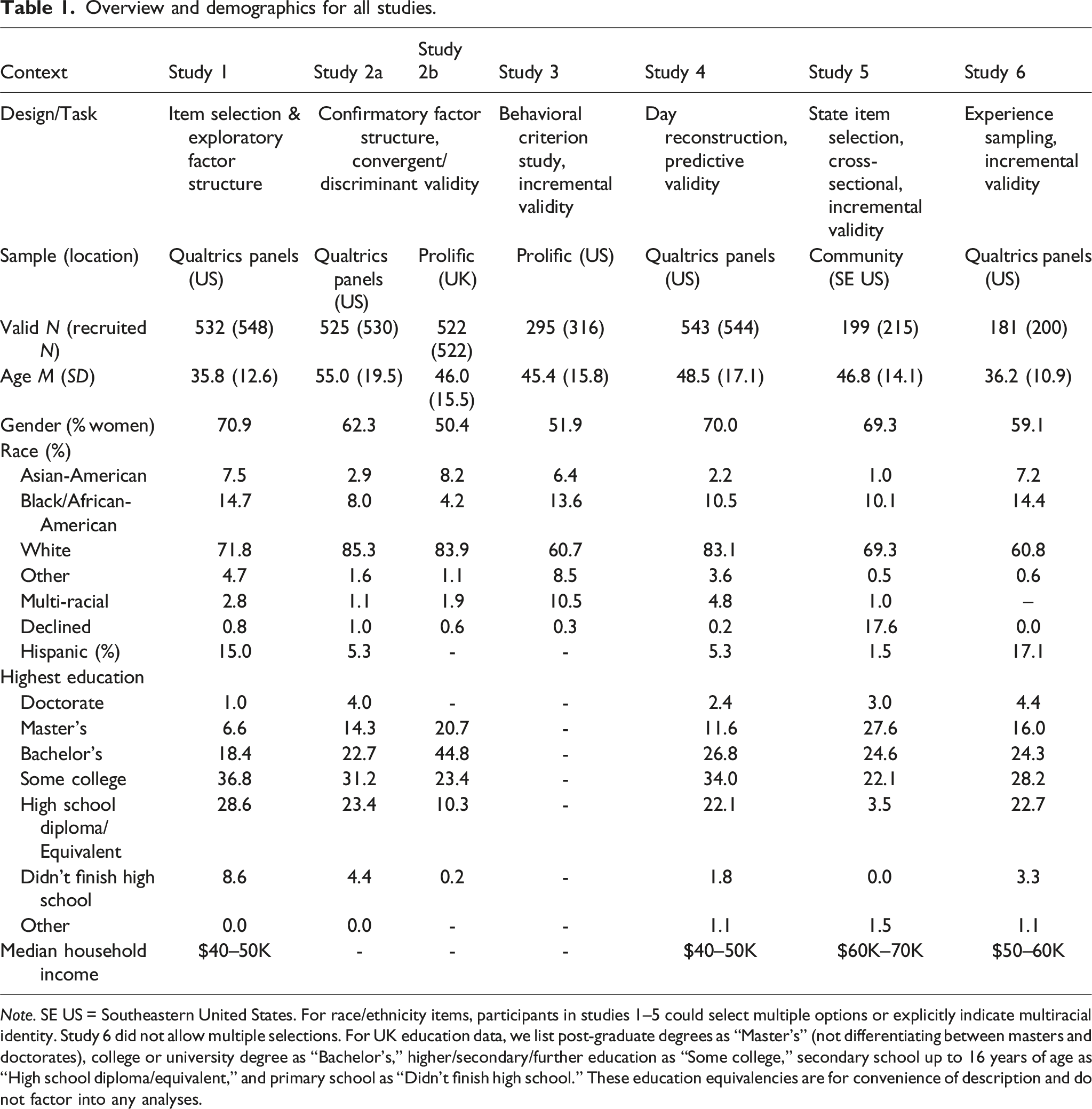
Note. SE US = Southeastern United States. For race/ethnicity items, participants in studies 1–5 could select multiple options or explicitly indicate multiracial identity. Study 6 did not allow multiple selections. For UK education data, we list post-graduate degrees as “Master’s” (not differentiating between masters and doctorates), college or university degree as “Bachelor’s,” higher/secondary/further education as “Some college,” secondary school up to 16 years of age as “High school diploma/equivalent,” and primary school as “Didn’t finish high school.” These education equivalencies are for convenience of description and do not factor into any analyses.
Participants provided demographic information and responded to the 49 items using a 5-point agreement scale (strongly disagree to strongly agree). We conducted a series of exploratory factor analyses (EFAs) to evaluate internal structure and determine the final scale.
Results and discussion
We began with an EFA of all 49 candidate items. An initial EFA’s scree plot suggested a strong common factor, and all but two items loaded ≥.32 on that factor. However, parallel analyses suggested six factors. We thus conducted a series of EFAs (using promax rotation) to gauge the meaning and relevance of different structures. When several factors were extracted, they largely reflected the intended components of motivation, behavior, affect, and cognition.
Based on their sizable cross-loadings and because they were at a different level of abstraction from the other items (which specifically targeted motivations, cognitions, etc.), we dropped several items reflecting broad self-perceptions/reputations, including identity concerns (i.e., seeing oneself as a truthful person). To refine the scale further, we retained items that (a) strongly represented a general factor common to all items, (b) strongly represented several more subtle factors reflecting behavior, motivation, cognition, and affect, and (c) collectively included positively keyed and negatively keyed items.
Trait truthful communication scale (T-TCS) items with factor loadings, Study 1.
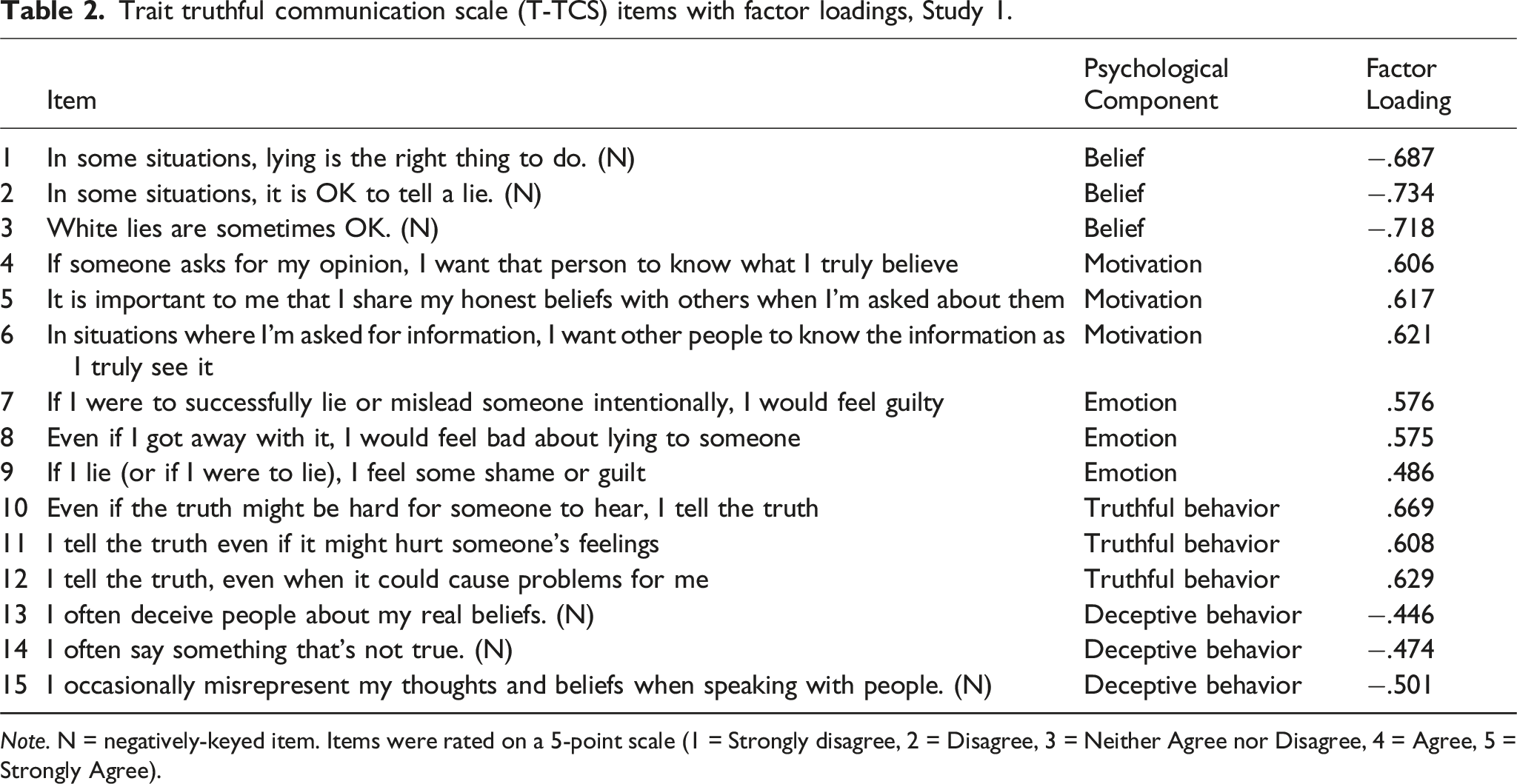
Note. N = negatively-keyed item. Items were rated on a 5-point scale (1 = Strongly disagree, 2 = Disagree, 3 = Neither Agree nor Disagree, 4 = Agree, 5 = Strongly Agree).
Initial examination suggests the T-TCS predominantly reflects a single general factor and thus could be scored as a single, reliable score reflecting truthful communication. The presence of five more subtle factors is conceptually important as it attests to the breadth of content of the T-TCS and its convergence with conceptual considerations. In Study 2, we conducted confirmatory tests to examine the appropriateness of scoring the T-TCS as a single truthful communication score.
Study 2: Internal structure (confirmatory), reliability, and convergent/discriminant validity
Study 2 provided confirmatory tests of the factor structure of the 15-item T-TCS and examined convergent and discriminant validity in comparison with a wide range of other self-report variables. To evaluate validity, we adopt the quantifying construct validity procedure (QCV; Furr & Heuckeroth, 2019; Westen & Rosenthal, 2003). For this procedure, the actual correlations between a focal scale (the T-TCS) and a set of criterion variables are compared to theory-driven predictions. This procedure emphasizes the overall pattern of convergence between predicted and actual correlations. Although there might be points of difference between predicted and actual correlations, the QCV reflects the general degree to which the differences among the obtained validity correlations are consistent with the predicted differences. We conducted this procedure first among US participants (Sample 2a). We later conducted a preregistered replication (Sample 2b, osf.io/xeauj) in a representative United Kingdom sample.
Method
Participants
As in Study 1, we requested 500 participants per sample, which offers power >.80 for small to medium individual difference correlations (r > |.13|, see Gignac & Szodorai, 2016). Table 1 provides detailed demographic information.
Procedure
Procedure and analysis for the two studies was identical. Participants provided demographic information, and they responded to the 15-item T-TCS (using a 5-point agreement scale, from strongly disagree to strongly agree) and to 32 scales and/or subscales selected for convergent and discriminant validity (see Supplement Tables S2–S4). Criterion scales were selected to reflect a range of constructs expected to have strong, moderate, or weak associations with trait truthful communication.
Predicted validity correlations
As data collection was underway for sample 2a (but before data were cleaned, scored, and analyzed), six team members (faculty, postdoctoral fellows, graduate students) independently generated predictions for all validity correlations. Experts received our definition of truthful communication (importantly, they did not receive the T-TCS items), along with items from each criterion scale/subscale. They were then asked to read each criterion scale’s items and consider “If we have a good measure of [truthful communication], then what should its correlation be with this set of criterion items?” They then recorded a prediction for each criterion scale. Each expert’s predictions were made prior to knowing the actual validity correlations.
Agreement among the raters was high (ICC = .96), so we averaged across raters to obtain the hypothesized correlations in Figure 1. These correlations represent the pattern of convergent/discriminant validity correlations that we should obtain if the T-TCS is validly interpretable as a measure of truthfulness as defined in the Introduction. We collected these predictions prior to analyzing data for Sample 2a and preregistered these hypothesized correlations ahead of collecting data for Sample 2b. Predicted and observed correlations between T-TCS and criterion variables, study 2.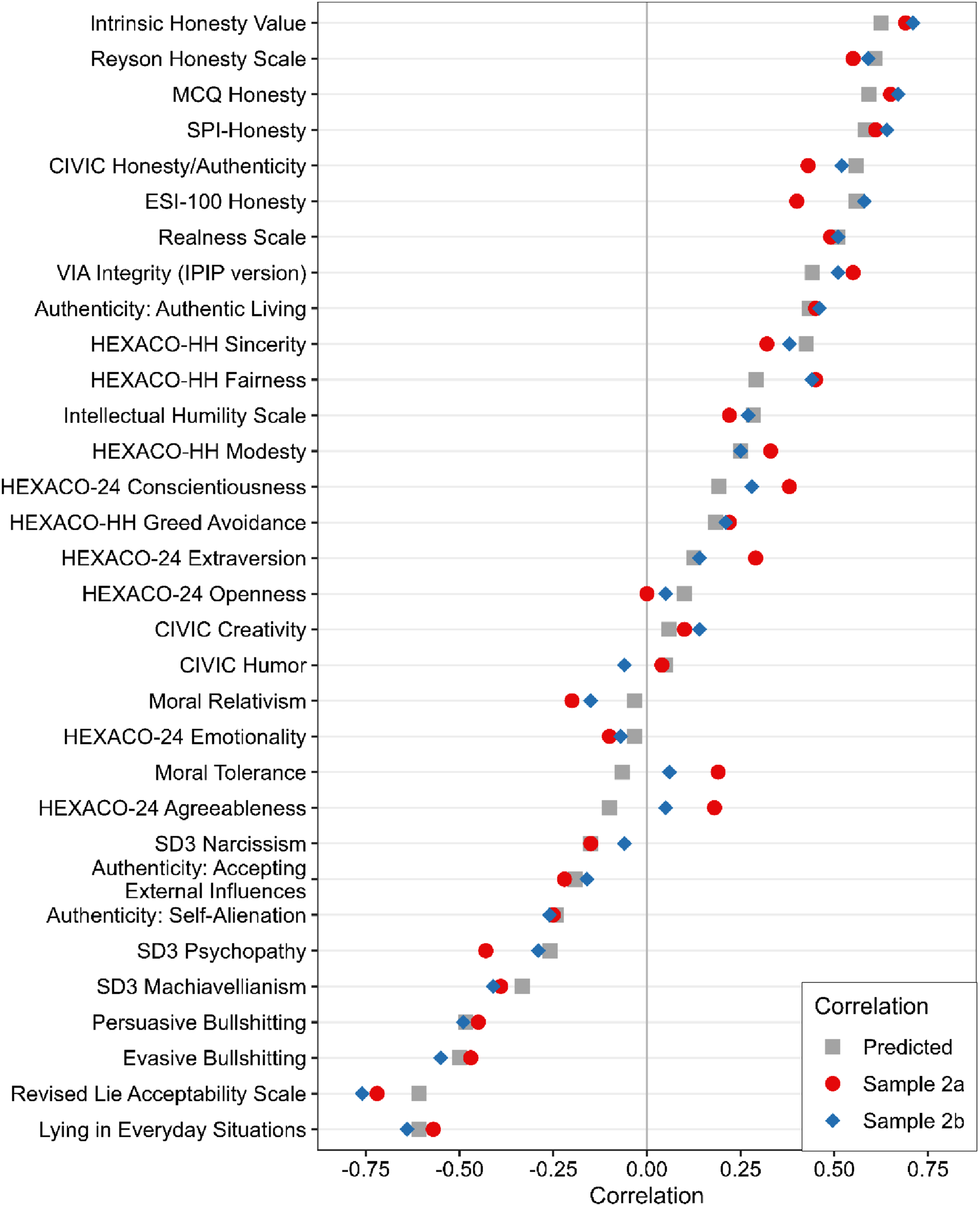
Two effect sizes are computed via the QCV procedure. r alerting-CV denotes the simple correlation between the (z-transformed) hypothesized and actual correlations. r contrast-CV incorporates information about the intercorrelations among criterion variables and about the variation across the observed correlations (see Furr & Heuckeroth, 2019, for details). Both are correlations and reflect the degree to which the pattern of actual validity correlations generally matches the pattern of hypothesized validity correlations.
Results and discussion
Internal structure
We conducted confirmatory factor analysis (CFA) of the T-TCS items (after reverse-scoring negatively-keyed items). To account for subtle but intended systematic differences across sets of items representing different psychological processes (e.g., items for motivation, items for emotion, etc.), we evaluated a bifactor model. All items loaded on a single common factor ostensibly reflecting trait truthful communication. Each item also loaded on a second factor common only to the items within each set, representing what those items share beyond trait truthful communication (e.g., factor-specific features of items, systematic variance in reporting different types of psychological content). In total, this model includes six orthogonal factors—a general trait truthful communication factor on which all items loaded and five three-item factors for cognition/beliefs, motivation, emotion, truthful behavior, and deceptive behavior.
This bifactor model fit well based on general cutoffs (see West et al., 2023) 10 in both Sample 2a, χ2 (75) = 295.39, p < .001; CFI = .96, TLI = .94, RMSEA = .075, SRMR = .09, and Sample 2b, χ2 (75) = 157.29, p < .001; CFI = .98, TLI = .97, RMSEA = .046, SRMR = .051. 11 Importantly, the bifactor model fit better than a unidimensional model (Sample 2a: ΔBIC = −2618.0; Sample 2b: ΔBIC = −2279.4), which fit poorly in both samples: Sample 2a, χ2 (90) = 3007.33, p < .001; CFI = .43, TLI = .33, RMSEA = .25, SRMR = .18; Sample 2b, χ2 (90) = 2530.52, p < .001; CFI = .46, TLI = .35, RMSEA = .23, SRMR = .15. 12
Standardized factor loadings for bifactor models of the T-TCS, Study 2.
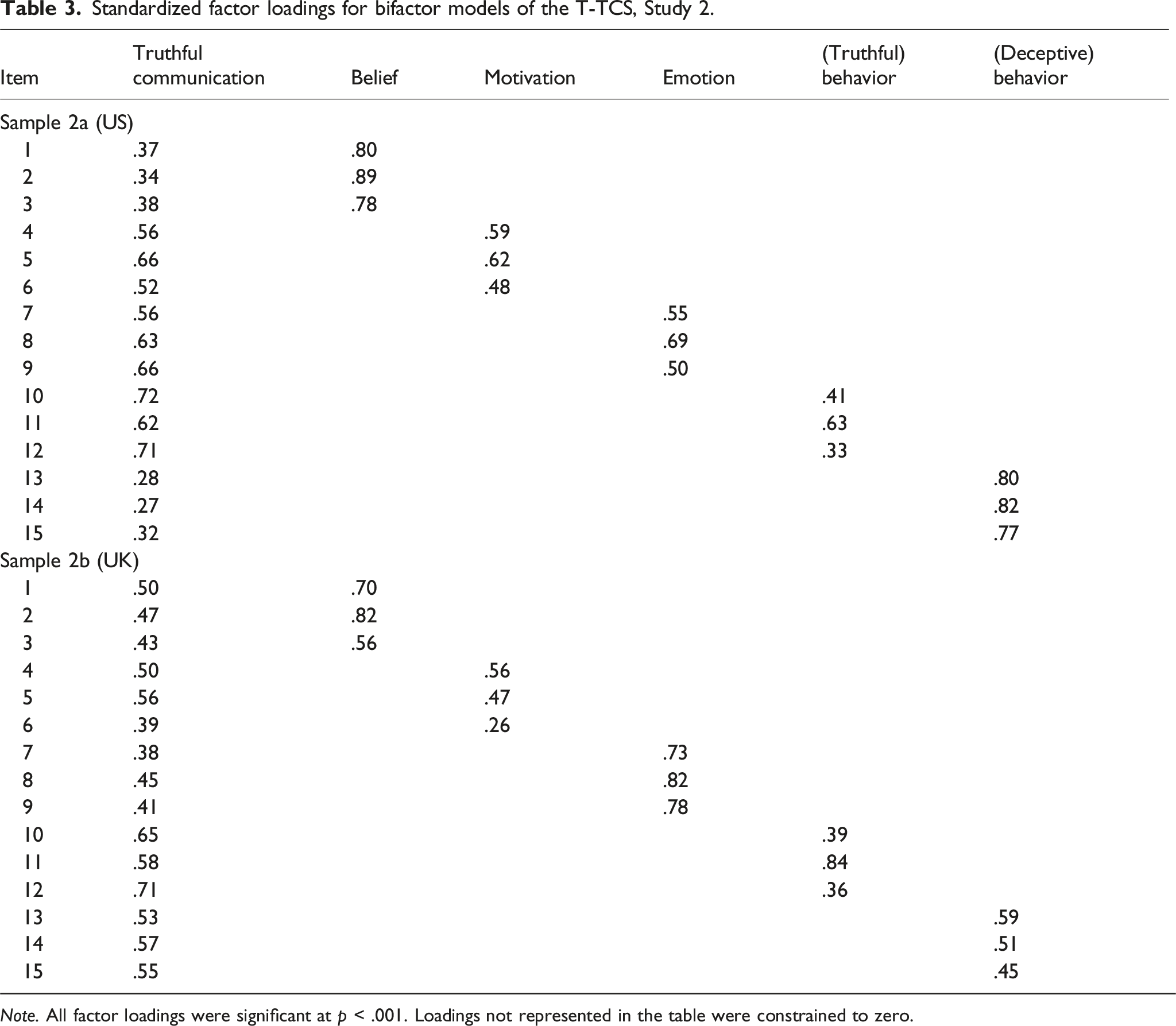
Note. All factor loadings were significant at p < .001. Loadings not represented in the table were constrained to zero.
Scoring and reliability
To consider the appropriate scoring for the T-TCS, we examined reliability indices based on the bifactor model (Reise, Bonifay, et al., 2013). Omega hierarchical (ω H ) represents the proportion of systematic variance in total scale scores attributable to the general truthfulness factor. Omega hierarchical subscale (ω HS ) represents the proportion of systematic variance in subscale scores after partialing out variance due to the general factor. High values of the former support scoring the measure as a total score; high values of the latter support the usefulness of subscale scores (either in isolation or in addition to the total score). In Samples 2a/2b, ω H was .71/.72, indicating that around seventy percent of variance in total scores (75/77% of the reliable variance) was attributable to the general factor. These values suggest that observed total scores on the T-TCS would be correlated at approximately r = .84 with the general truthful communication factor represented in the bifactor model (Rodriguez et al., 2016b). 13 In contrast, subscales did not consistently reflect reliable unique variance. The beliefs subfactor showed ω HS of .77/.63, but no other factor was more than .45 in both samples, suggesting that subscales themselves would not be reliable indicators specifically of their unique content, but rather would mostly reflect general truthfulness variance (see Supplement pp. 7–10 for further details).
With these considerations in mind, we opted to score the T-TCS as a single truthfulness score, taking the mean of all 15 items. Based on the bifactor model, we estimated reliability via the omega total index. This value for the T-TCS was very high in both samples at .95 (Sample A) and .94 (Sample B). This reveals “a highly reliable multidimensional composite - a composite that reflects variation on the weighted combination of latent factor(s) underlying it” (Rodriguez et al., 2016a, p. 224). This reliability draws from variance explained by both the general factor as well as the specific factors.
Convergent and discriminant validity
As Figure 1 indicates, correlations between T-TCS and criterion measures generally make sense as reflecting truthful communication. For example, in Sample 2a, the SPI Honesty scale, VIA Integrity Scale, and CIVIC Honesty/Authenticity scale correlated with T-TCS at r ≥ .43 (all p < .001). In contrast, the Bullshitting scales and Revised Lie Acceptability scale negatively correlated with T-TCS at r ≤ −.45. 14 Such results suggest convergent validity. Discriminant validity is shown in part by the fact that the T-TCS is uncorrelated or weakly correlated with other socially desirable characteristics such as Humor and Creativity (as measured by the CIVIC).
QCV analysis provides more systematic support for the convergent and discriminant validity of the T-TCS. Although there were some discrepancies between the actual validity correlations and the predicted correlations (e.g., predicted r psychopathy = −.26, actual r psychopathy = −.43), the overall pattern of actual correlations was very consistent with the predicted pattern. Both QCV effect sizes were extremely large and statistically significant (Sample 2a: r alerting-CV = .96; r contrast-CV = .97; Sample 2b: r alerting-CV = .98; r contrast-CV = .97, all p’s < .001). Thus, the pattern of actual convergent and discriminant validity correlations is quite consistent with the pattern expected if the T-TCS were validly interpretable as a measure of truthful communication (as we have defined it).
Study 3: Prosocial lying behaviors
Part of validating a novel measure is demonstrating that it measures different constructs than alternative measures and that it offers incremental predictive validity over those measures. Many honesty-relevant behavioral paradigms are available for such work, but most combine lying with other dishonesty-relevant self-oriented or antisocial goals (e.g., lying to hide one’s cheating or stealing). In such paradigms, lying is done in the service of self-oriented or antisocial goals broadly associated with dishonesty. The utility of a truthfulness-specific measure, particularly in contrast to a measure of Honesty-Humility, may best be demonstrated in situations when lying is done in the service of other-oriented or prosocial goals. In such paradigms, truthfulness pulls against other moral motives that might empirically correlate with honesty but are otherwise conceptually distinct. One such common countervailing motive is kindness: Although kindness may be generally associated with honesty, people will often engage in “prosocial lying,” saying things that are less than fully true out of a desire to be kind to the other person or to preserve harmony (E. E. Levine & Lupoli, 2022). Indeed, such lies are sometimes seen as more ethical than being fully truthful (E. E. Levine & Schweitzer, 2014). 15
In Study 3, we tested whether the T-TCS showed differentiation and incremental validity over a measure of HEXACO Honesty-Humility in predicting such prosocial lying. We did so in a preregistered (osf.io/9ug6y) replication and extension of studies linking Honesty-Humility to prosocial lying (Paul et al., 2022). Participants rated the quality of a poorly written essay, received information meant to evoke compassion for the author, and rated the essay again before providing open-ended feedback to the author. Positive shifts in essay ratings after the compassion induction were deemed as prosocial lies. Additionally, participants offered free response feedback for the essay author, which was rated for both how kind it was (i.e., how much it tried to soften or negate negative feedback) and how truthful it was (i.e., how much it tried to tell the honest truth about the poor quality of the essay).
In the original study (Paul et al., 2022), Honesty-Humility predicted more prosocial lying, as well as more kind feedback, but was unrelated to truthfulness of the feedback. A preregistered replication (Reinhardt et al., 2024) replicated Honesty-Humility’s positive correlation with prosocial lying and null correlation with feedback truthfulness. Moreover, although Honesty-Humility showed a directionally consistent pattern with feedback kindness, it was not statistically significant. We expected to replicate the original pattern for Honesty-Humility (positive correlations with lying and feedback kindness, unrelated to feedback truthfulness), but expected that trait truthfulness would show a different pattern. Namely, we predicted that T-TCS would show a more negative relationship with prosocial lying than would Honesty-Humility, such that people who scored highly on T-TCS would be less likely to tell prosocial lies, rather than more likely as for Honesty-Humility. Moreover, we expected that T-TCS scores would positively predict feedback truthfulness. We were agnostic as to whether T-TCS scores would predict feedback kindness.
Method
Participants
To examine incremental validity and construct differentiation, a key question was whether the T-TCS differentially predicts prosocial lying compared to Honesty-Humility. Therefore, we powered the sample for a Z test of differences between two correlations (how prosocial lying correlates with Honesty-Humility vs. T-TCS). Using GPower 3.1 (Faul et al., 2007) and assuming weak correlations of .1 and −.1 with the two measures intercorrelated at .4, we found that power of .80 required 238 participants, whereas 300 participants would provide power of .88. We therefore requested a representative US sample of 300 participants through Prolific, who participated in exchange for $3, and we received 316 records. Removing one person who participated twice, 13 based on free responses that were empty or indicated that the participant didn’t take the task seriously, and 6 for failing an instructional attention check left 295 participants, providing power of .87 to detect an effect as specified above.
Procedure
Participants completed the T-TCS, the Honesty-Humility items from the HEXACO-100 (Lee & Ashton, 2018), and the items of the other five facets from the HEXACO-60 (Ashton & Lee, 2009), with measures in a random order (descriptives and full correlations in Supplement Tables S6 & S7).
Participants then completed an essay rating task as first presented by Lupoli et al. (2017). They read a short, poor-quality essay and rated it on five dimensions (focus, logics, organization, support, and mechanics) from Worst (1) to Excellent (5). This first set of ratings was described as being specifically for the researchers and would not be shown to the essay author. Participants then read another paragraph ostensibly written by the author that detailed the recent loss of a close cousin. This served as an attempt to induce compassion for the author in the participants, who then had another opportunity to rate the essay on the same dimensions and to provide open-ended feedback on the writing. This second set of ratings and the open-ended feedback was explicitly for the essay author.
Consistent with Paul et al. (2022) and Reinhardt et al. (2024), we averaged the researcher-focused (ω = .85) and author-focused (ω = .87) ratings and computed a difference score between the two as an index of prosocial lying. Positive scores represented giving higher ratings when directing them to the author than to researchers. Additionally, two independent raters blind to the purposes of the study rated the open-ended feedback for both truthfulness 16 and kindness (interrater reliability: r = .62 for both).
Results & discussion
Although the direction of its correlation with prosocial lying was consistent with preregistered predictions and previous studies (r = .14 in both Paul et al., 2022; Reinhardt et al., 2024), Honesty-Humility did not significantly predict prosocial lying, r = .11, CI95 = [−.01, .22], p = .061. Similarly, though directionally consistent with preregistered predictions, the T-TCS did not significantly predict prosocial lying, r = −.07, CI95 = [−.19, .04], p = .201.
However, as predicted, Honesty-Humility more positively predicted prosocial lying than did T-TCS, Z = 3.17, p = .001. That is, though neither trait measure reached statistical significance in directly predicting prosocial lying, the two showed different relationships with prosocial lying, with Honesty-Humility showing a more positive correlation than did T-TCS. Moreover, we examined a (preregistered) regression model predicting prosocial lying as a function of Honesty-Humility and T-TCS simultaneously. Honesty-Humility significantly predicted more prosocial lying, b (SE) = 0.15 (0.05), p = .003, whereas T-TCS predicted less, b (SE) = −0.14 (0.05), p = .009, and adding T-TCS to a model where Honesty-Humility predicted prosocial lying significantly increased variance accounted for, ΔR2 = .02, p = .009 (though overall variance accounted for was still low, R2 = .035).
Neither Honesty-Humility nor truthfulness predicted third party ratings of the feedback the participant gave. Inconsistent with Paul et al. (2022), Honesty-Humility did not predict feedback kindness, r < .01, p = .985. As in both Paul et al. and Reinhardt et al. (2024), Honesty-Humility did not predict feedback truthfulness, r = .01, p = .85. Similarly, T-TCS did not significantly predict ratings that the feedback was truthful, r = −.07, p = .247, or kind, r = .09, p = .123. Unlike with prosocial lying, Honesty-Humility and TCS did not show different relationships with ratings of how truthful, Z = 1.34, p = .089, or kind, Z = −1.53, p = .063, the feedback was. The same pattern held in multiple regression models.
In summary, the T-TCS showed a different relationship with prosocial lying than did an Honesty-Humility measure. Put simply, when looking at prosocial lying, Honesty-Humility was about the “prosocial,” truthfulness was about the “lying.” This suggests that the two measures capture different variance in conceptually meaningful ways, providing some evidence of construct differentiation. Moreover, T-TCS predicted variance in prosocial lying above and beyond that shared with Honesty-Humility, evidencing incremental validity for the T-TCS.
However, truthfulness did not significantly predict fewer prosocial lies (though it was directionally consistent) and did not predict the rated kindness or truthfulness of the feedback. Notably, results for Honesty-Humility in this sample were slightly weaker than in prior studies we were replicating (Paul et al., 2022; Reinhardt et al., 2024) though magnitude of effects for prosocial lying was comparable (r = .11 here, .14 in prior work), indicating weak relationships in this study were not a feature unique to the T-TCS. This may be in part because of low reliability due to the use of difference scores (but see Gollwitzer et al., 2014) or single instances of behavior (e.g., Epstein, 1979), or it may have to do with participants being less convinced by the paradigm in our study (especially compared to its original use by Lupoli et al. (2017), who used the grad school essay cover story among undergraduate students).
Study 4: Diary of truthfulness-relevant experiences
Following predictions of dynamic personality theories such as WTT, people’s aggregated state manifestations of honesty should correlate with their trait standing on truthful communication (Horstmann & Ziegler, 2020; Jayawickreme et al., 2021) 17 , so Study 4 tested whether T-TCS scores predicted aggregated state honesty scores assessed via diary assessments. Moreover, to inform sampling strategies for experience sampling of state truthfulness manifestations (Study 6), we assessed the frequency with which people experience honesty-relevant affordances (i.e., situations that specifically offer the person an opportunity to be truthful or not) in everyday life and how honest people generally report being in the face of these affordances.
Method
Procedure
Day reconstruction methodology (DRM; Kahneman et al., 2004) sampled people’s behavior from the previous day. Participants broke up the morning, afternoon, and evening of their previous day into logical episodes based on what they were doing throughout the day. Participants could report up to 10 episodes in each of the broader time sessions (morning/afternoon/evening). For each episode, participants named the episode, indicated start and end times, gave a brief text description of the details of the episode, indicated the episode’s context from a list of options (e.g., commuting, socializing, working), indicated if the situation offered 5 different affordances relevant to truthfulness (yes/no), and indicated how honest they were in this situation (1 Completely not honest to 5 Completely honest, including a prominent option for NOT RELEVANT). 18
Through rounds of discussion amongst the team, we designed 5 non-exclusive, non-exhaustive affordance items to capture situations in which we thought truthful communication would be relevant, such as opportunities or requests to express one’s thoughts, beliefs, etc., perhaps even in the face of difficulty for self or others. Items were as follows (italicized descriptive labels were not presented). Social interaction: Did the situation afford the opportunity for meaningful social interaction (i.e., interaction in which you did more than merely exchange pleasantries)? Asked to express: Did someone explicitly ask you to express facts or your thoughts, feelings, beliefs, or opinions? Opportunity to express: Did the situation afford the opportunity to express your thoughts and opinions? Difficult for self: Did the situation afford the opportunity to tell the truth even though it may be difficult for you? Difficult for others: Did the situation afford the opportunity to tell the truth even though it may be difficult for the other person/someone else?
We scored the presence of any one of these affordances as an instance of a researcher-defined truthfulness affordance. Providing an honesty rating option of NOT RELEVANT also allowed for an indicator of participant-defined honesty affordances, as a participant providing a rating on their honesty suggests they viewed it as relevant to the episode.
After the DRM task, participants completed the trait TCS measure and demographic items. Internal consistency for the T-TCS items was good (ω = .92), and scores tended to be above the scale midpoint (M = 3.81, SD = 0.61, median = 3.73).
Participants
As in Studies 1 and 2, we aimed for 500 participants, which would offer power >.80 for small to medium individual difference correlations (r > |.13|). 544 Qualtrics Panels participants started the study, 543 of whom contributed affordance data (Table 1). Participants offered data on honesty affordances for 5018 episodes. Participants tended to rate several episodes, with the bulk of participants rating between three and twelve episodes (see Supplement Figure S2 for distribution).
Results and discussion
Honesty affordances
Percent of episodes for which participant indicated the affordance was present, Study 4.
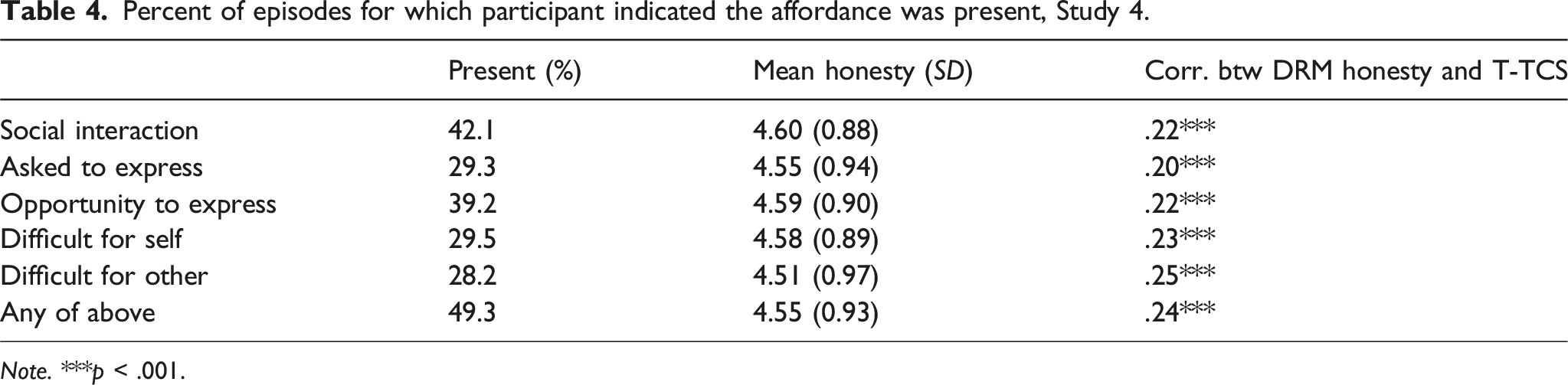
Note. ***p < .001.
Honesty in episodes
People reported being quite honest across most episodes, consistent with research on the frequency of lying in everyday life (e.g., Serota et al., 2022). Participants indicated that they were Completely honest in the vast majority of episodes (80.8%) in which they rated their honesty (n = 3365). In the remaining episodes, participants still rated themselves as generally honest (4 Mostly honest 11.5%; 3 Somewhat honest 3.9%; 2 Mostly not honest 1.5%; 1 Completely not honest 2.3%). Focusing only on episodes containing researcher-defined honesty affordances (n = 2475) did not substantially change this conclusion, as 74.5% of participants indicated being Completely honest (4 Mostly honest 15.0%; 3 Somewhat honest 5.0%; 2 Mostly not honest 2.2%; 1 Completely not honest 3.2%).
Trait honesty
People who scored high on trait truthfulness reported significantly higher average honesty in daily episodes, r (508) = .23, p < .001, offering some evidence to the construct validity of the T-TCS as a measure of trait truthfulness. The correlation between trait truthfulness and aggregated honesty was similar across types of researcher-defined affordances (Table 4).
Together, Studies 1–4 indicated that the novel T-TCS has a coherent internal structure with a strong common factor, produces reliable scores, and has good convergent, discriminant, and incremental validity. In Studies 5–6, we used the T-TCS as a starting point to develop a measure of state manifestations of truthful communication.
Study 5: State manifestations of truthfulness across recalled situations
According to dynamic personality theories such as Whole Trait Theory (WTT), state manifestations of truthfulness should be simultaneously related to trait truthfulness as well as systematically responsive to the goals people pursue in given situations (Jayawickreme et al., 2021; McCabe & Fleeson, 2016). In Study 5, we developed a short measure of state truthfulness manifestations—the State Truthful Communication Scale (S-TCS)—and evaluated its factor structure, reliability, and variability both within and between persons. Participants recalled state experiences of truthfulness across a variety of situations defined by particular goals (e.g., a situation in which you were trying to change someone’s mind) to probe the influence of such goals on truthfulness manifestations.
Item generation and refinement
With the working definition of truthfulness and the trait items in mind, several members of the research team (3 psychology PhDs, 2 graduate students) generated items intended to capture state manifestations of truthfulness. Taking the T-TCS as a starting point, we wrote items sampling a breadth of psychological components that characterize state experiences: behaviors, beliefs, motivations, emotions, and identity concerns.
In addition to capturing multiple elements of state manifestations of truthfulness, a broad set of items has the added benefit of potentially increasing variability in state measures of truthfulness. Several studies have indicated that most people report very few lies in day-to-day life (DePaulo et al., 1996; DePaulo & Kashy, 1998; Serota et al., 2022), which suggests that we should expect relatively low variability in truthfulness behaviors (see also the high mean ratings for honesty in Study 4, Table 4). However, including other situation-specific psychological elements such as evaluations (how right or wrong truthfulness is in that particular situation) or motivation (how much one wants the truth to be known at that moment) might capture meaningful differences absent in overt behaviors. For example, a person who struggles with the temptation to lie but tells the truth anyway is meaningfully different from a person who tells the truth without temptation. The two would look identical on a behavior-focused state measure but would look different on a state measure that captured momentary motivation in addition to overt behavior.
We sought a set of state items that exhibited several desiderata: (1) Content coverage of several trait domains—relevant behaviors, beliefs, motivations, emotions, and experiences of identity by which truthfulness would manifest in specific experiences, (2) Internal consistency as a single-factor measure (mirroring the observed structure for the trait form) (3) Variability in responses within and across persons and situations, (4) a relatively small number of items, to facilitate use in intensive longitudinal studies such as ESM or diary studies.
State truthful communication scale (S-TCS) items with factor loadings.
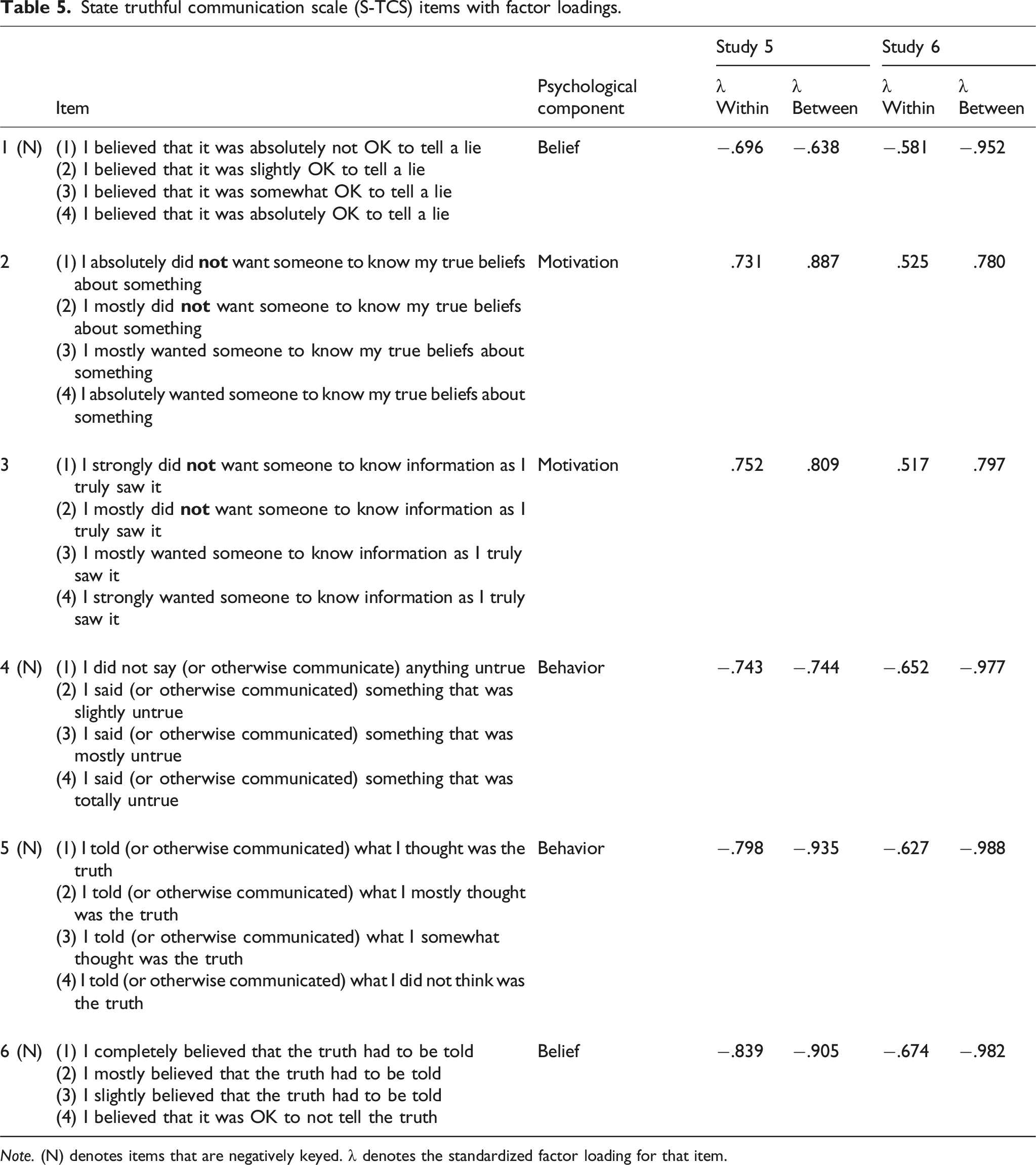
Note. (N) denotes items that are negatively keyed. λ denotes the standardized factor loading for that item.
Method
Participants and procedure
Members of the Winston-Salem, North Carolina community participated in exchange for $5 in Amazon gift cards. 215 participants started the survey, of whom 199 provided state truthfulness responses and so were included in analyses. We aimed for around 200 participants, which exceeds sample sizes successfully used in similar studies (Fleeson & Gallagher, 2009; Meindl et al., 2015), and the within-subjects nature of analyses (up to 10 repeated measures per participant) offers a substantial increase in precision over a between-subjects design of the same sample size.
Participants were asked to consider a series of social goals and asked to recall a time they had been in a situation defined by that goal. If participants could recall such a time, they wrote a short description of the situation, answered some questions about the situation to facilitate access to episodic memory (who, when, how, etc.), and completed the 20 candidate state items in relation to that situation. Participants did this for up to 10 situations.
We identified various situations based on interaction goals we believed would pull for a range of truthfulness, that is, that some goals would be better served by higher truthfulness, some by lower truthfulness. All participants were asked to recall situations in which they were (a) trying to leave a conversation, (b) trying to avoid an argument, (c) trying to avoid doing something, (d) delivering unpleasant news to someone else, (e) trying to impress someone, (f) trying to get something, (g) trying to change someone’s mind, (h) telling a story, (i) trying to avoid blame, and (j) giving negative feedback to someone. Presentation order was randomized across participants. Participants who could not recall one or more of these situations were also asked to recall a situation in which they were (k) explaining instructions to someone, or (l) trying to complete a task. Participants described a maximum of ten situations. 19
Participants also completed the T-TCS and the 24-item Brief HEXACO Inventory (de Vries, 2013).
Results and discussion
Exploratory factor analysis
We conducted a series of EFAs both within and aggregating across situations. Examination of scree plots when aggregating across situations (Supplement Figure S4) indicated a strong first factor (eigenvalue >9.0) and a questionable second factor (eigenvalues between 1 and 2, depending on extraction method). Based on factor loadings and with an eye to preserving content coverage over several psychological elements, we trimmed to a set of 6 items (Table 5) that consistently loaded well across situations, covered several psychological elements, and minimized redundancy. We dropped items related to identity and emotion because of inconsistent loadings and being potentially confusing to rate (e.g., retrospectively reporting on having prospectively anticipated guilt/shame if one were to have lied). This left items covering content related to beliefs, motives, and behaviors. Table S9 in the Supplement contains factor loadings within each of the situations, the mean across situations, and aggregated across situations.
With the 6 items, we conducted further EFAs which again indicated the presence of a strong single factor (eigenvalues >3.5, all other factors had eigenvalues of .6 or less, see Supplement Figure S4). We therefore took the mean of these six items as our measure state truthfulness. State reports showed strong internal consistency across the assigned situations (mean ω = .92, range .86–.96). With the final set of 6 items, we examined state truthfulness as a function of both momentary goal pursuit and trait honesty.
Multilevel factor structure and variance components
We conducted multi-level CFAs of the 6 final items to examine contributions of the items while accounting for the multilevel nature of the observations. We fixed the within- and between-person item loadings to equality to maximize interpretability of the latent factors (Jak, 2019). Model fit was initially mediocre—χ2 (23) = 321.76, p < .001; CFI = .94, TLI = .92, RMSEA = .099, SRMR = .138. Because the six items were selected with two items reflecting each of three psychological elements, we reasoned that misfit might be due to correlated residuals between the pairs of items for beliefs, behaviors, and motivations. We allowed these pairs of residuals to correlate with each other at each level and model fit noticeably improved—χ2 (17) = 65.74, p < .001; CFI = .99, TLI = .98, RMSEA = .046, SRMR = .117. Factor loadings for this model are represented in Table 5. Reliability was decent at both the between-person level (ω = .91) and the within-person level (ω = .87).
In this design (situational goals assigned to participants), most of the variance in state truthfulness manifestations (90.4%) was at the situation level, rather than the person level. 20
Goals
Dynamic theories of personality imply that a valid measure of state truthfulness should systematically vary as a function of different goals that people pursue, as social cognitive mechanisms such as goals determine how a person manifests a trait at a given time. To test this, we examined whether and how state truthfulness varied based on the situation participants were assigned to report on.
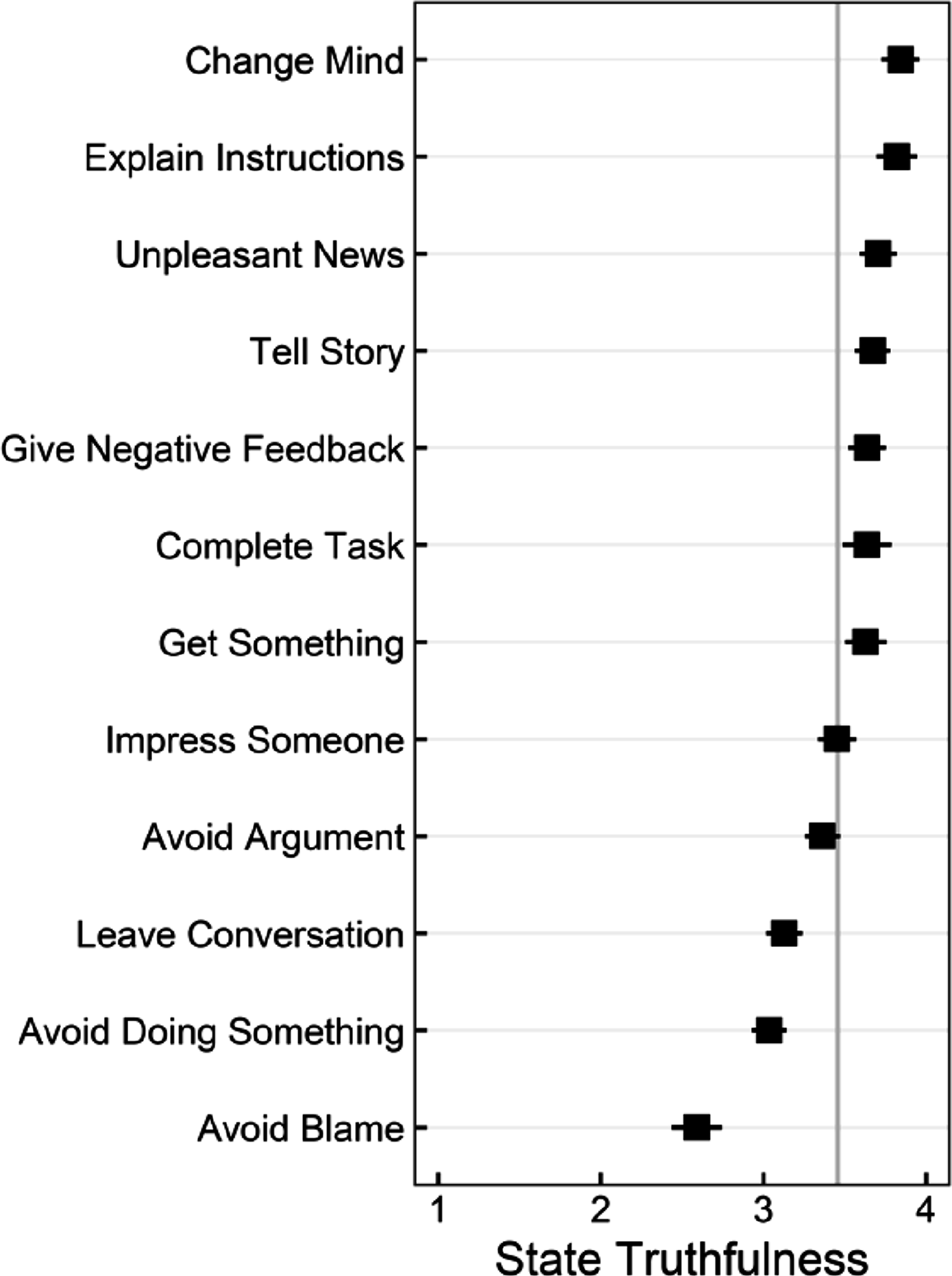
First, a multilevel model predicting S-TCS as a function of assigned goals indicated that state truthfulness varied as a function of goals (see Figure 2), which accounted for ∼20% of variance in state reports, F (11, 1322) = 31.24, p < .001. Thus, the goals that people were pursuing were a significant contributor to how truthful they were. Coefficients for the various situational goals (Figure 3) indicated that participants were less truthful when trying to leave conversations, avoid doing something, or avoid blame and were more truthful when trying to deliver unpleasant news or negative feedback, tell a story, explain instructions, complete a task, or change someone’s mind. Thus, not only did state manifestations of truthfulness vary based on situation, but they did so in reasonable, systematic ways. State TCS Scores by Assigned Goals, Study 5. Note. Goals are ordered by median then by mean truthfulness. Fitted Means of State Truthfulness by Assigned Goals, Study 5. Note. The vertical line denotes the grand mean, error bars denote 95% confidence intervals.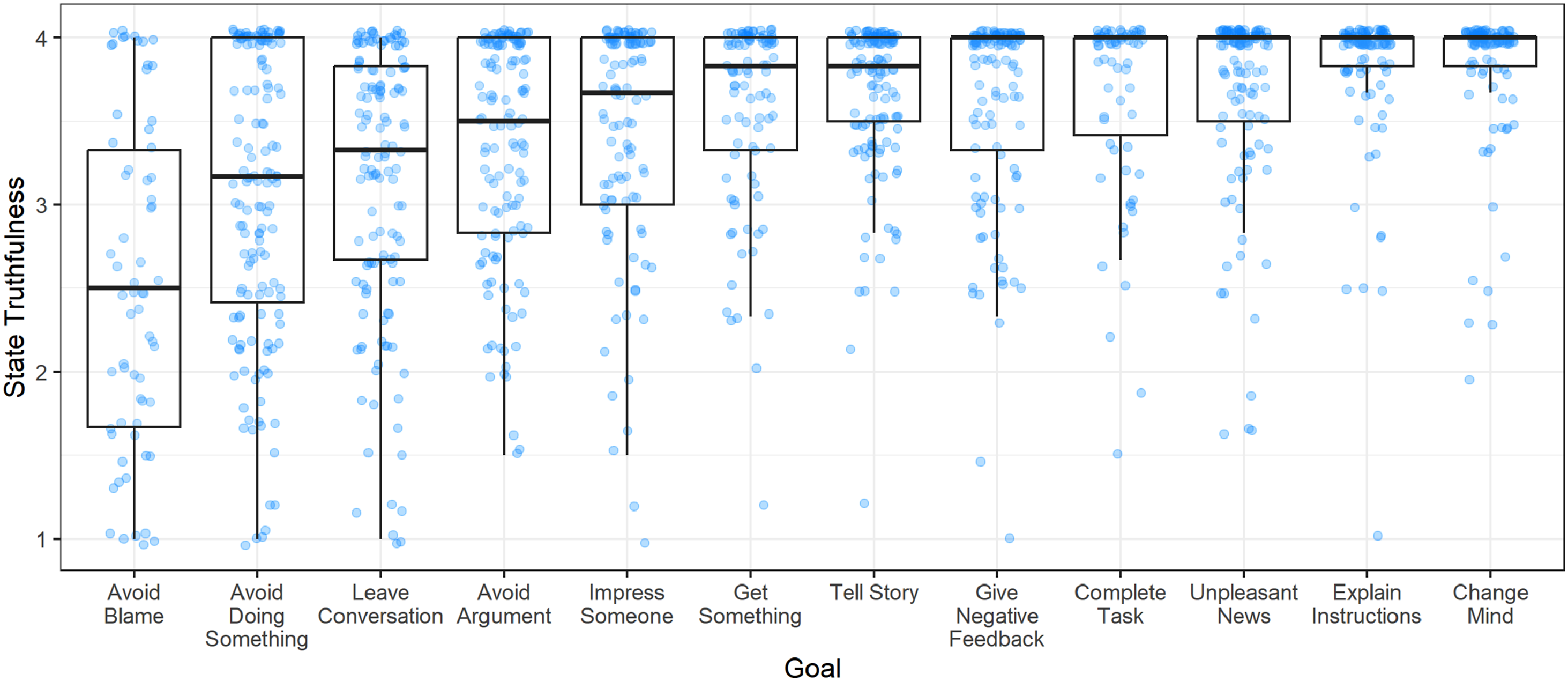
Trait honesty
Dynamic personality theories also imply that trait truthfulness scores should strongly predict aggregated state truthfulness scores and also predict single state manifestations to a lesser extent (Fleeson, 2001; Fleeson & Jayawickreme, 2021). As a benchmark, Fleeson and Gallagher (2009) found that Big 5 trait measures correlated .38 (Extraversion) to .53 (Openness) with aggregated ESM reports of their corresponding state measures, and .18 (Extraversion) to .37 (Openness) with single instances.
Trait truthfulness scores were strongly correlated with aggregated state TCS, r (161) = .53, p < .001, and also predicted single S-TCS scores, r (1245) = .25, p < .001. The strong correlation between trait scores and aggregated state scores indicates that the state measure adequately captures state manifestations of the psychological content captured by the trait measure. However, the correlation of .25 with single state manifestations (and the substantial difference between this correlation and the correlation with aggregated state scores) shows that participants were not merely reporting on their trait level of truthfulness when they reported recalled state manifestations.
Finally, as a test of incremental validity, we also directly contrasted T-TCS and Honesty-Humility scores in predicting state truthfulness. When both were included in a multiple regression model, Honesty-Humility did not significantly predict state truthfulness over and above T-TCS, b (SE) = .07 (.04), p = .076, whereas T-TCS still predicted much of the variance in aggregated state honesty, b (SE) = .31 (.05), p < .001. The addition of T-TCS to a linear model with Honesty-Humility added explained another 16% of variance in state TCS aggregates, p < .001 (T-TCS and Honesty-Humility correlated at r = .48, p < .001). Though it is not surprising that T-TCS scores correlate more strongly with S-TCS scores than do Honesty-Humility scores, it does provide evidence that the two TCS measures specifically capture a common construct beyond what is captured by Honesty-Humility measures.
Study 6: State variability in truthfulness
In Study 6, we evaluated the psychometric properties of the S-TCS in the design for which it is intended—experience sampling (ESM) studies—and evaluated test-retest reliability for the T-TCS. Participants completed a three-week experience sampling study in which they assessed the truthfulness of their communication in extended communication with others.
Method
Participants
Participants recruited through Qualtrics Panels completed an intake battery at the first daily assessment, completed a three-week ESM study (2 reports per day), and completed a set of additional questionnaires. As participants for this study were recruited from multiple sources, they were compensated based their specific arrangements with Qualtrics Panels. We aimed for 200 participants, reasoning that this sample size and up to 42 observations per participant would offer sufficient power for within-person analyses. This sample size exceeds sample sizes successfully used in similar studies (Fleeson & Gallagher, 2009; Meindl et al., 2015).
Battery measures
At both intake and output, participants completed the trait TCS measure, the Honesty-Humility scale from the 100 item HEXACO PI-R (Lee & Ashton, 2018), and the non-Honesty-Humility scales of the 24-item Brief HEXACO Inventory (de Vries, 2013). This allowed us to examine test-retest reliability for the T-TCS and compare it to that for established personality measures in the same sample.
At intake only, participants also completed demographic measures (age, gender, ethnicity, education, income, religious affiliation, and general religiosity).
ESM
Twice a day during the ESM period, participants were asked via email to complete an ESM report.
21
Participants saw a list of 20 researcher-defined situations selected to pull for either honesty or dishonesty and were asked whether they had had a social interaction that could be described by one or more of the situations listed (see Figure 4). Participants who answered affirmatively then reported which of the situations applied
22
and how many people they were interacting with (one vs. more than one). Participants then completed the 6-item state TCS scale (which assesses beliefs, motivations, and behaviors) as well as another 3 behavioral TCS items from the Study 5 pool to make a 5-item behavior-focused variant (see Supplement Table S10). Participants who did not indicate such a situation responded to a series of questions about their more recent social interaction. Fixed Effects of Situations on State Truthfulness, Study 6. Note. Effects are unstandardized regression coefficients indicating the change on a 1–4 scale for the presence of each feature. Situations with an asterisk are statistically significant at α = .05.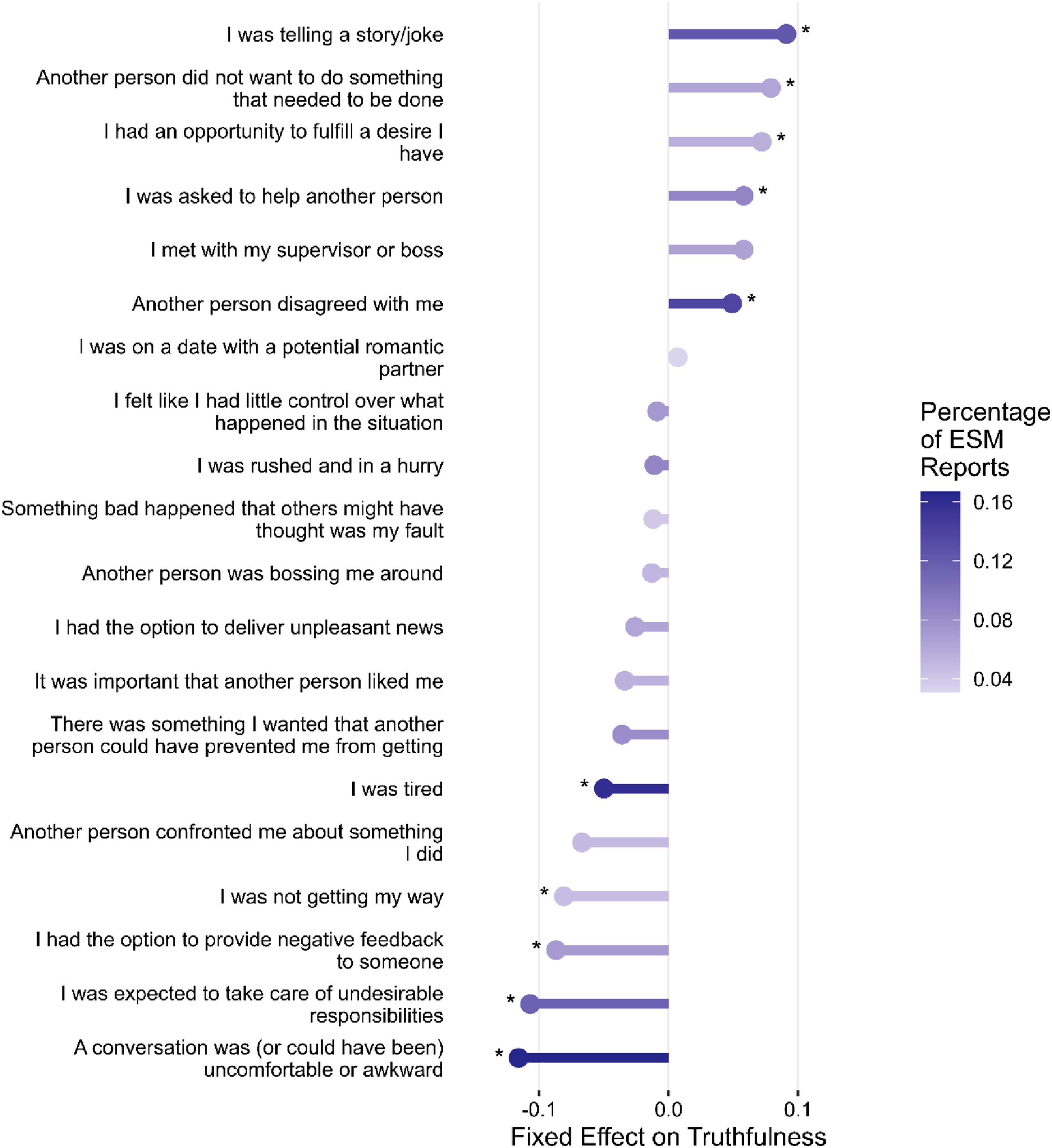
Following the state TCS items, participants reported on how much they were trying to accomplish four different goals in the interaction: avoid the other person’s disapproval, protect the other person’s feelings, treat the other person with respect, and convey information the other person needed to know. Participants also completed other measures not directly related to the present research questions (Supplement).
Excluding problematic ESM reports (see Supplement pp. 29–30) left 5376 ESM reports from 181 participants (mean = 29.7, range = 20–44). State reports were primarily from one-on-one interactions (80.4%), rather than conversations with multiple people.
Results and discussion
Test-retest for trait truthfulness scores
Test-retest correlations for truthful communication and HEXACO scales, correlations with aggregated state honesty, Study 6.
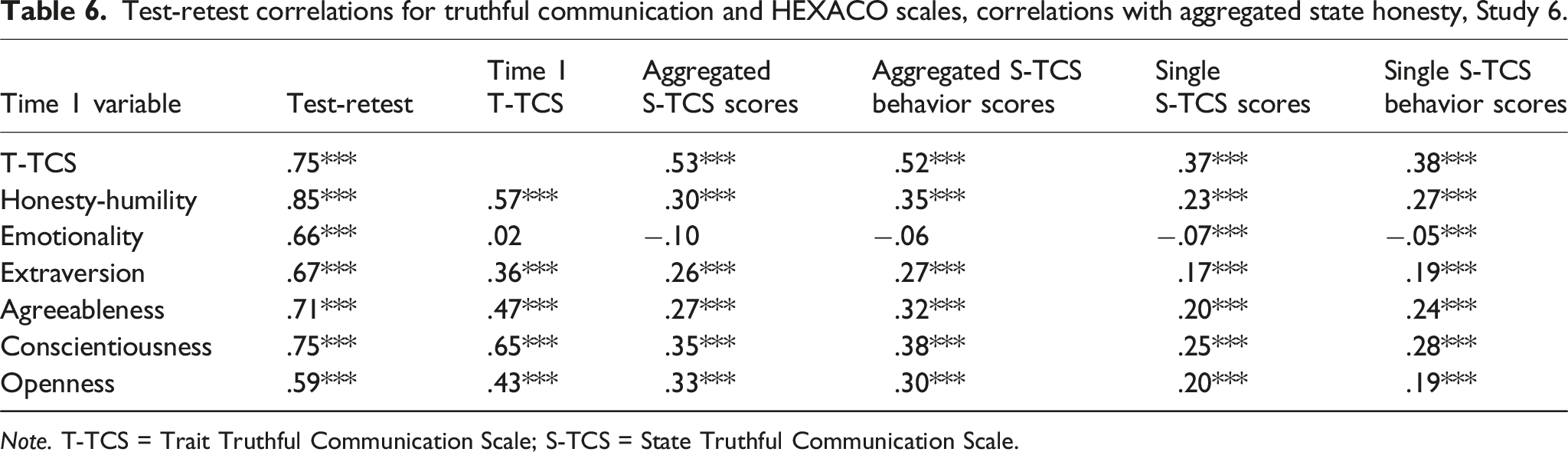
Note. T-TCS = Trait Truthful Communication Scale; S-TCS = State Truthful Communication Scale.
State manifestations
Factorial structure and variance components
As in Study 5, we fit multilevel confirmatory factor analysis models to examine the factor structure for the S-TCS, modeling a single truthfulness factor both within and between persons. We again constrained loadings to be equal across levels. As in Study 5, initial fit was mediocre—χ2 (23) = 704.69, p < .001; CFI = .92, TLI = .90, RMSEA = .074, SRMR = .107—but allowing correlated residuals for the pairs of related items (i.e., the two items for each psychological component) dramatically improved fit to excellent levels—χ2 (17) = 87.84, p < .001; CFI = .99, TLI = .99, RMSEA = .028, SRMR = .067. See Table 5 for factor loadings. About half of the variance in state TCS scores was within participants (48.0%), and reliability was good at the between-person level (ω = .94) but questionable at the within-person level (ω = .74). See Supplement for comparable results for the behavior-focused state measure.
Situational features and goals
Participants indicated that one or more of the 21 researcher-defined situational features were applicable in 86.2% of the state reports (median = 1 feature, mean = 1.90). Because situational features were not exclusive, we analyzed them as a series of independent indicator variables. Figure 4 presents fixed effect coefficients for the effect of each situational feature on state truthfulness, with reports nested within participants. The strongest positive effects were for telling a story or joke, having a conversation about something another person did not want to do, fulfilling a desire, and disagreeing with another person. The strongest negative effects were for having to provide negative feedback, dealing with undesirable responsibilities, or having an uncomfortable or awkward conversation. 23 When modeled simultaneously, these situational features only accounted for 3.1% of the variance in state truthfulness. 24
Fixed effects of goals on state truthfulness, Study 6.
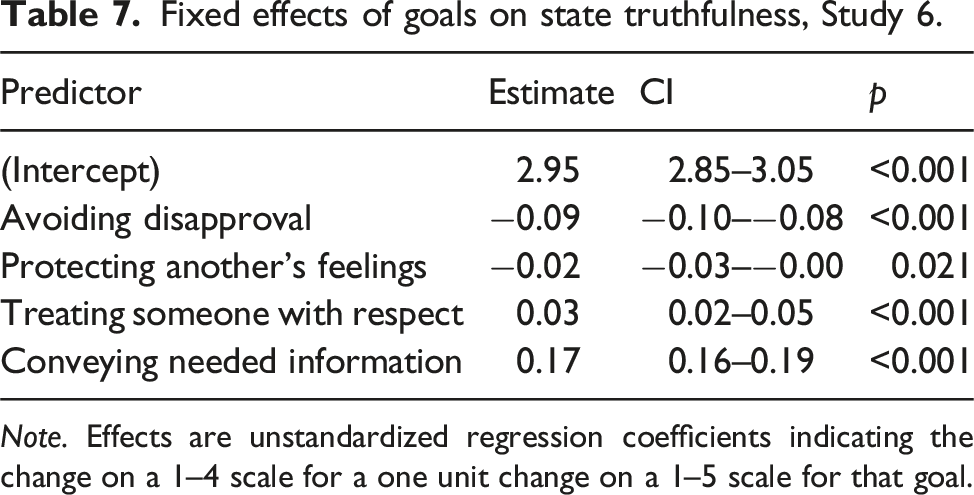
Note. Effects are unstandardized regression coefficients indicating the change on a 1–4 scale for a one unit change on a 1–5 scale for that goal.
Trait honesty
Similar to Study 5, T-TCS scores at intake predicted both aggregated state TCS scores and single state scores (both general and behavior-specific) across the ensuing three-week ESM period (Table 6). Simple linear models indicated that trait TCS accounted for 27.1% of variance in aggregated state reports. This strong correlation with reports collected from day-to-day life provides further evidence that the S-TCS adequately captures state manifestations of the trait content captured by the T-TCS.
Finally, as a test of incremental validity, we also directly contrasted T-TCS and Honesty-Humility scores in predicting state truthfulness. As in Study 5, when both are included in a multiple regression model, Honesty-Humility did not significantly predict state truthfulness over and above T-TCS, b (SE) < .01 (.06), CI [−0.11, 0.11], p = .983, whereas T-TCS still predicted much of the variance in aggregated state honesty, b (SE) = .46 (.07), CI [0.33, 0.59], p < .001. The addition of T-TCS to a linear model with Honesty-Humility added explained another 19% of variance in state TCS aggregates (p < .001).
General discussion
The purpose of this work was to develop and psychometrically evaluate two new measures of a construct fundamental to honesty—truthfulness. Honesty is a diverse construct comprising multiple facets, such as (not) cheating, (not) stealing, and (not) breaking promises; however, recent conceptual and empirical work reveals truthfulness as a crucially important facet of honesty, perhaps even its central facet. To understand honesty and the psychological processes that shape it and emerge from it in daily life, researchers must understand truthfulness. Unfortunately, no existing measures are designed specifically to assess truthfulness in daily life. Existing measures related to honesty (or similar constructs) either include content that goes beyond truthfulness, or they fail to reflect truthfulness as a multidimensional construct with behavioral, motivational, affective, and cognitive components. To advance research focused on honesty, the current studies present new trait and state measures of truthful communication. Evidence suggests that these measures have good conceptual and psychometric quality and thus may be valuable tools in the study of honesty.
The Trait Truthful Communication Scale
To assess truthful communication at a trait level, we developed a 15-item scale reflecting the construct in terms of its dynamic components and in terms of a virtue. Intended to tap into dynamic processes underlying personality traits (e.g., Fleeson & Jayawickreme, 2021), the T-TCS includes content related to behavior, emotion, cognition, and motivation. Reflecting truthful communication as a virtuous characteristic, the T-TCS focuses on specific forms of emotion, cognition, and motivation (Miller, 2021; Wright et al., 2021). That is, it focuses on morally related emotions (i.e., feelings of guilt or shame related to being untruthful), morally related cognition (i.e., believing that truthful communication is good or correct), and morally related motivation (i.e., wanting others to know one’s true beliefs, rather than wanting to avoid being caught lying).
Evidence indicates that the T-TCS has good psychometric quality. Analysis of bifactor models (Study 2) revealed that all items loaded significantly on a general TCS factor and on five specific factors, but that variance in total scores (e.g., overall item mean scores) was primarily attributable to the general factor. Thus, the items as a whole reflect truthful communication in general, but also systematically tap into subtle but detectable differences between different types of psychological manifestations (behavior, motivation, etc.). These findings suggest that the entire T-TCS can be used to reflect trait-level truthful communication in general.
Analyses also reveal that the T-TCS has good to very good reliability. Its omega reliability estimate was .95 (and .94 in a preregistered replication), and its 3-week retest correlation was .75. Notably, the latter value was equal to or greater than the retest correlations for five of the six HEXACO scales in the same sample, suggesting that stability over a few weeks is comparable to well-established trait measures.
Evaluation of T-TCS item content reveals conceptual precision in indicating truthfulness. In a supplemental Study 7 (see Supplement pp. 32–42), participants rated the clarity with which each T-TCS item would reveal a person’s level/standing on several psychological dimensions related to truthfulness and honesty/humility facets. T-TCS items were rated as significantly more revealing of a truthful-versus-deceptive dimension than any other dimension (e.g., greed avoidance), suggesting conceptual precision. Participants also rated each HEXACO Honesty-Humility item, and they saw T-TCS items as being more revealing of a truthful-versus-deceptive dimension than were any HEXACO Honesty-Humility facets. The latter finding is not only consistent with our suggestion that the broad HEXACO-PI-R’s Honesty-Humility scale (nor any of its facets) does not precisely reflect truthfulness specifically but it also suggests that the T-TCS item content reflects truthfulness better than does HEXACO Honesty-Humility item content. In other words, while Honesty-Humility scales are extremely useful for targeting the broad Honesty-Humility trait, the TCS complements them by targeting the narrower trait of truthfulness.
Finally, analyses revealed good convergent, discriminant, and predictive validity and incremental validity over Honesty-Humility for predicting state truthfulness manifestations and potentially for predicting decreased prosocial lying. When examined alongside a diverse range of other personality trait measures, the pattern of correlations between T-TCS scores and those measures was strongly consistent with expert judges’ predictions for a hypothetical measure of truthfulness, in both an initial study (2a) and a preregistered replication in a different population (2b). For example, people with relatively high T-TCS scores tended to have relatively high scores on measures such as the CIVIC Honesty/Authenticity scale, the Realness scale, and the (IPIP version of the) VIA Integrity scale, as predicted. They also tended to have relatively low scores on measures such as the SD3 Machiavellianism scale, Bullshitting scales, and the Lie Acceptability scale, again as predicted. Demonstrating discriminant validity, T-TCS scores showed weak or null associations with scales such as the Intellectual Humility scale, HEXACO Openness, and CIVIC Humor, once again as predicted. 25 As revealed by our QCV analyses, the overall pattern of convergent and discriminant validity correlations was strongly consistent with what our experts predicted should be found for a valid measure of truthful communication. In terms of predictive validity, T-TCS scores were significantly positively correlated with contextualized reports of truthful behavior in daily life, assessed in multiple ways (Furr, 2009)—in a day-reconstruction study of truthful behavior from the previous day (Study 4), retrospective reports of behavior in specific situations (Study 5), and experience sampling measurements of behavior in-situ from the last few hours (Study 6). Finally, in directly contrasting the T-TCS with what is likely the most commonly used trait honesty construct—HEXACO Honesty-Humility—the T-TCS showed incremental validity over measures of Honesty-Humility, predicting unique variance in behavioral assessments of prosocial lying (Study 3) 26 , retrospective reports of truthfulness (Study 5), and ESM reports of recent truthfulness (Study 6).
In sum, we believe that the psychometric evidence indicates that T-TCS scores are reliable and interpretable as indicating individual differences in the tendency toward truthful communication. Moreover, we believe the evidence also indicates that the measure is not redundant with the preeminent honesty construct but has unique utility for understanding truthfulness. Given the importance of truthfulness and its centrality within the scope of honesty, the T-TCS should be a valuable tool for researchers interested in individual differences in general and for those interested in honesty specifically.
The State Truthful Communication Scale
We also designed a 6-item scale to assess truthful communication at a state level, again reflecting the construct in terms of multiple dynamic components. With the notable exception of emotion, the S-TCS captured the same components of truthful communication as the T-TCS: behaviors, motivations, and beliefs. While we included items assessing emotion as part of the pool of S-TCS items in Study 5, we excluded them from the final measure since experiencing emotions related to truthful communication is contingent on manifesting high or low levels of truthful communication in a given situation. This makes such items distinctive from the other components, which directly ask about manifestations of truthful communication. Given the need to be clear about the function of this state measure (i.e., assessing the extent to which people manifested truthful communication; Horstmann & Ziegler, 2020), and to ensure that the final measure had good psychometric properties, we decided to exclude emotion assessment from the S-TCS. However, assessing such contingent emotional reactions when manifesting truthful communication in daily life is an important goal for future research.
In designing the S-TCS, we were mindful to use best practices in state measure development (e.g., Horstmann & Ziegler, 2020). In particular, we developed a set of state items that would both ensure that the S-TCS would successfully capture the core features of truthful communication and be brief enough to be easily used in intensive longitudinal assessment. We sought content coverage of several characteristics of truthful communication manifestations in specific experiences (i.e., momentary behaviors, beliefs, and motivations), a single-factor measure (similar to the trait measure), good variability in responses within and across persons and situations, and a final set of brief items that would lend itself to use in ESM and other intensive designs.
We found that the S-TCS has good psychometric properties—there was decent fit for a single truthfulness factor at both the within- and between-person level. We also found that T-TCS scores strongly predicted aggregated state S-TCS scores. Furthermore, consistent with the predictions of dynamic personality theories, S-TCS scores exhibited substantial between- and within-person variability. Indeed, the observed within-person variability when assessed via ESM was comparable to that observed in the honest behavior ESM studies reported by Meindl and colleagues (2015), suggesting that people vary meaningfully in their manifestations of truthful communication from situation to situation (a fact further suggested by the moderate correlation between single-state S-TCS and T-TCS scores).
Furthermore, and also in line with dynamic personality theories, variability in S-TCS was systematically associated with specific goals and situational features. Specifically, WTT predicts that S-TCS scores will vary as a function of different goals that people pursue, and indeed, people were less truthful than average when trying to leave conversations, avoid doing something, or avoid blame. Conversely, they were more truthful than average when trying to deliver unpleasant news or negative feedback, tell a story, explain instructions, complete a task, or change someone’s mind. We also found that specific goals predicted variability in S-TCS scores across different situations. Goals to avoid disapproval and protect others’ feelings predicted lower levels of truthful communication, whereas goals to treat someone with respect or convey needed information predicted higher levels of truthful communication.
Implications
Distributions of truthfulness in daily life
An important implication of these findings relates to the frequency with which we would expect people to manifest truthful communication in daily life. The results of Study 4 and Study 6 indicated that people are generally truthful in most contexts, meaning that the base rate for low levels of truthful communication would be relatively low (see also Truth Default Theory; T. R. Levine, 2014, 2020). However, the present results suggest that people are willing to report lower levels of truthful communications in specific situations that “pull” for dishonesty, that is, where the goals of the situation can be fulfilled by dishonesty. While these findings suggest that the S-TCS captures responses that have some degree of validity (as people are in fact willing to rate themselves low on a socially desirable measure in specific contexts), we only assessed a specific set of situations and goals in the current investigation. Future research should examine further the different types of situations and goals that facilitate high and low manifestations of truthful communication, as well as clarifying individual differences in expectancies people may have about how manifesting truthful communication may facilitate specific goals.
Approaches to studying honesty
The present findings provide some interesting conceptual implications regarding how best to study honesty. Our studies (in particular Studies 5 and 6) describe people’s everyday manifestations of truthful communication and provide a snapshot of “everyday” honesty and dishonesty. However, this raises an interesting question: Given the focus of much research on explicit manifestations of dishonesty in contrived lab settings (e.g., cheating for rewards; Gerlach et al., 2019), should future research focus on these somewhat atypical examples of dishonesty, or should we seek to further understand more quotidian examples of dishonesty (e.g., lying to excusing oneself from an awkward conversation)? While we think that understanding “everyday” morality is an important goal (Jayawickreme & Fleeson, 2017), we acknowledge that social norms about everyday behavior may push for manifestations of low truthful communication that may nevertheless constitute a culturally appropriate response (e.g., not sharing personal health challenges when a colleague at work asked how that person is doing). Further interdisciplinary discussions on these questions are warranted.
Trait truthfulness and honesty-humility
It is worth clarifying how we see truthfulness and the TCS fitting into the broader landscape of related constructs and what this implies for measurement of these constructs. Truthfulness is a facet of honesty, albeit an important one (e.g., Reynolds et al., 2025). Honesty itself tends to be largely subsumed in personality space under the broader trait of Honesty-Humility. Thus, truthfulness is not on the same hierarchical level as Honesty-Humility and may indeed be a sub-sub-facet thereof.
This opens the question of how meaningful a contrast between measures of truthfulness and measures of Honesty-Humility actually is. To the extent that Honesty-Humility scales are intended to capture a much broader trait than merely truthfulness, they should capture variance outside of truthfulness (see supplemental study 7), including perhaps variance that can oppose truthfulness (see Study 3; also Paul et al., 2022). Put another way, a valid measure of the broad Honesty-Humility trait should not show the same relationships with criteria as does a valid measure of the specific truthfulness trait.
However, validity of a measure is always validity for a particular use (e.g., Furr, 2018). For example, the conscientiousness scale of the HEXACO-100 (Lee & Ashton, 2018), while a valid measure of trait conscientiousness, is likely invalid as a measure of academic achievement. We believe the same is analogously true of broad Honesty-Humility scales as measures of honesty more narrowly—and more so as a measures of truthfulness even more narrowly. Thus, Honesty-Humility scales may be strongly valid and useful as measures of that broad construct, but they may not be strongly valid as (and were not designed to be) measures of narrower sub-constructs.
This point that Honesty-Humility scales are not specifically measures of honesty or truthfulness per se is entirely consistent with broader theorizing on Honesty-Humility. HEXACO theorists have explicitly argued that Honesty-Humility is not to be conceptualized as “an unconditional unwillingness to lie,” but rather centers on an “unwillingness to deceive or exploit for self-interest” (Lee & Ashton, 2020; for alternative characterizations, see Diebels et al., 2018; Fleeson, 2020). Indeed, if unconditional truthfulness is among the manifestations of Honesty-Humility, it is so only obliquely, not obviously captured by HEXACO items (Fleeson, 2020; Paul et al., 2022).
Thus, we do not see the present work as challenging the importance of Honesty-Humility nor the validity of HEXACO scales for capturing Honesty-Humility. Instead, the present work highlights the importance of matching measures to targeted traits in the study of honesty and offers T-TCS as a valuable complement to existing Honesty-Humility scales. We encourage researchers to carefully consider the theoretically relevant elements of honesty for their project and consider the match between those relevant elements and the content of honesty measures being used (for an overview of item content of several honesty scales, see Fleeson et al., 2022).
Strengths of current approach
Our trait and state measures of truthful communication break new ground by providing morality researchers with a conceptually grounded assessment of the central psychological characteristics of a core feature of honesty (Reynolds et al., 2025). Although the data reported here use self-report assessments (although we note that trait and state assessments represent different forms of self-report; Jayawickreme et al., 2023), these measures can be easily adapted as informant assessments, similar to other work from our lab (see also Sun & Goodwin, 2020, who adapted assessments from Furr et al., 2022). While limitations exist with self-report measures, we note that self-report assessments are likely of primary importance when assessing specific psychological characteristics of truthful communication that are particularly subjective in nature (e.g., motivation). Nevertheless, we fully endorse a multi-method approach to understanding morality (Helzer et al., 2014), and expect that self-informant agreement on T-TCS scores will be significant (we are currently collecting data to test this prediction).
Truthfulness is an important construct at the heart of honesty, and as such, it deserves special attention from researchers wishing to understand honesty. To advance such research, the current work presents a new measure focused on this important construct; however, other facets of honesty also deserve greater measurement attention. Many constructs lie within the scope of honesty, including (not) cheating, (not) stealing, (not) promise-breaking, truth-seeking, and fostering accurate understanding in others (e.g., B. Cooper et al., 2023; Miller, 2021). Although such constructs tend to co-occur within people (thus producing the Honesty/Humility factor), they are conceptually separable and may have distinct psychological causes, correlates, and consequences. A full understanding of honesty as a personality characteristic requires psychometrically strong and focused examination of each narrower construct.
Unfortunately, the observation that existing honesty scales fail to reflect truthfulness precisely likely also applies to those constructs. Most honesty scales measure multiple narrower constructs (Fleeson et al., 2022), making it unclear which distinct facets of honesty are operative in criteria behaviors. This is an inherent feature of the tradeoff between broad traits that can predict a wide array of behaviors and narrow traits that can strongly predict precise behaviors (e.g., Buss, 1989), so it is not specific to honesty. Nonetheless, we believe that future study of honesty is facilitated by more precise conceptualizations and measurements of specific constructs within honesty. We thus encourage future measurement-oriented work to produce conceptually well-grounded and psychometrically strong measures of many specific constructs within the broad scope of honesty.
Limitations and future directions
Although based on eight samples representing multiple methods of recruitment and sampling, the current studies are geographically and culturally limited. Although the US samples are diverse in age and location within the US, the studies include relatively few persons of color. Moreover, all samples are from Western countries, so they reflect Western, industrialized perspectives and experiences. Future research should evaluate the TCS’s properties within a wider range of participants.
More generally, empirical work centering truthfulness at the core of honesty (Reynolds et al., 2025) has focused on Western (especially US) samples. To the extent that conceptualizations of moral traits may differ cross-culturally (e.g., Shi et al., 2021), truthfulness may not feature as prominently to honesty outside of Western populations. Thus, though TCS may capture trait truthfulness outside of Western populations, that feature might not be as central to studying honesty in these contexts. We invite future cross-cultural research on the relative importance of various facets of honesty.
To keep the T-TCS relatively brief but inclusive in its coverage of key psychological processes, we included sets of three items assessing several processes—motivation, emotion, and cognition, and both positive and negative behaviors. This ensures that the overall scale is balanced and representative of important processes underlying dynamic personality characteristics. We anticipate that most researchers will wish to use the T-TCS in this way, relying on a total score across all items. However, some researchers might want to focus even more deeply on one or more of those processes, and they might generate sub-scale scores based on the relevant T-TCS items. We recommend that such work be done with caution. As noted in Study 2 and the Supplement (pp. 7–10), scores on subfactors predominantly reflect the common truthfulness factor, making specific subscale scores than if the subscales were more distinct. Again, we anticipate that most researchers will opt for total T-TCS scores, and our current analysis suggests such scores have robust psychometric properties. We suspect that the 3-item sub-clusters within the T-TCS may thus be good foundations for more narrowly focused measures of truthfulness-related motivation, emotion, and cognition. However, the development and evaluation of such narrower measures is a task for further work.
Supplemental Material
Supplemental Material - Honesty as truthfulness: New trait and state measures of truthfulness to advance research and theorizing on when and why people are honest
Supplemental Material for Honesty as truthfulness: New trait and state measures of truthfulness to advance research and theorizing on when and why people are honest by Caleb J Reynolds, Eranda Jayawickreme, Ryan Wheat, Emily Stokes, Carlos Santos, William Fleeson, and R Michael Furr in European Journal of Personality
Footnotes
Acknowledgements
The authors would like to thank Taya Cohen, Christian Miller, Tobias Flattery, Peyton Graves, Ben Hardin, Adam Paul, and Ye Dam Yi for their invaluable assistance on the studies reported here.
Declaration of conflicting interests
The author(s) declared no potential conflicts of interest with respect to the research, authorship, and/or publication of this article.
Funding
The author(s) disclosed receipt of the following financial support for the research, authorship, and/or publication of this article: This work was supported by Grant 61842, “The Honesty Project” from the John Templeton Foundation.
Open science statement
Data, analysis scripts, and materials for all studies are available at osf. io/xsk49.

Supplemental Material
Supplemental material for this article is available online.
Notes
References
Supplementary Material
Please find the following supplemental material available below.
For Open Access articles published under a Creative Commons License, all supplemental material carries the same license as the article it is associated with.
For non-Open Access articles published, all supplemental material carries a non-exclusive license, and permission requests for re-use of supplemental material or any part of supplemental material shall be sent directly to the copyright owner as specified in the copyright notice associated with the article.
