







Abstract
The HEXACO model describes human personality through six major domains, each one further specified by four facets. Honesty-Humility is a key component of the model, and subsumes facets sincerity, fairness, modesty, and greed-avoidance. Although established and comprehensive measurement tools of HEXACO traits and facets through sentence items exist, a comprehensive assessment of Honesty-Humility through adjectives has not yet been developed. We present a novel instrument, the Adjective Checklist of Honesty (ACH), designed to enhance the assessment of Honesty by incorporating lexical descriptors of its facets, developed using a systematic approach. In Study 1, we identified a broad set of potential descriptors of Honesty-Humility facets, and refined it through independent raters to identify candidate items. In Study 2 (N = 266), we examined the factorial structure of the candidate items and developed the final 22-item version of the ACH. In Study 3 (N = 300), we confirmed the factorial structure of the shortened ACH questionnaire and collected validity evidence for the new scale. Our studies have important implications for the assessment of Honesty-Humility, shed light on the relationships between Honesty-Humility and truthfulness and, more generally, showcase the importance of a systematic approach in constructing assessment scales in personality psychology.
Plain language summary
Honesty is a key personality trait that influences how people interact with others, from telling the truth to acting fairly. Psychological researchers often measure honesty as part of a broader personality trait called Honesty-Humility, which includes fairness, sincerity, modesty, and greed-avoidance. However, existing tools for measuring this trait primarily use full-sentence descriptions, which may not always apply to everyone’s experiences. Our study aimed to improve how honesty is assessed by developing a new tool: the Adjective Checklist of Honesty (ACH). This checklist uses a set of carefully selected adjectives to measure different aspects of honesty and humility. The ACH was developed through a systematic process, including expert evaluations and multiple studies with participants to ensure it accurately captures the key components of Honesty-Humility. Our findings show that the ACH effectively measures honesty-related traits and provides a clearer picture of how sincerity and truthfulness fit into the broader concept of Honesty-Humility. This tool offers a quicker, more flexible way to assess honesty in various settings, including research studies and personality assessments. By improving how we measure honesty, the ACH can help psychologists better understand how personality influences ethical behavior, decision-making, and social interactions. This research has important implications for personality psychology, ethics, and real-world applications, such as workplace integrity and trustworthiness in social relationships. By refining the way we assess honesty, we take a step toward a deeper understanding of what it means to be a truthful and fair person.
According to the psycholexical hypothesis, personality traits are encoded in lexical descriptors (mostly adjectives) found in natural language use (Allport & Odbert, 1936; Goldberg, 1993, 2002). Looking to define the factorial structure of personality, current models relied, in fact, on the analysis of person-descriptive adjectives (e.g., Ashton & Lee, 2001; Caprara & Perugini, 1994; Costa Jr. & McCrae, 1988; De Raad et al., 1998) to identify a five-factor (e.g., Caprara & Perugini, 1994; McCrae & Costa, 1987) or six-factor (e.g., Ashton, Lee, & Goldberg, 2004) solution. The six-factor solution is at the basis of the HEXACO model (Ashton, Lee, & Goldberg, 2004) and has been consistently replicated across languages and cultures (e.g., Ashton et al., 2006; Ashton & Lee, 2005; Lee & Ashton, 2008) showing to portray the most reliable factorial structure (Ashton & Lee, 2008, 2020).
Differences between the five-factor solution, also known as Big Five (Goldberg, 2002), and the HEXACO model, can be traced, besides the obvious number of factors, also in the semantic content captured by each factor. The Big Five model encompasses five factors labeled as Extraversion, Agreeableness, Conscientiousness, Neuroticism vs. Emotional Stability, and Openness to Experience or Intellect, while the HEXACO model includes Honesty-Humility, Emotionality, eXtraversion, Agreeableness vs. Anger, Conscientiousness, and Openness to Experience (or Intellect/Imagination/Unconventionality). Some content overlaps between models: in particular the Extraversion, Conscientiousness, and Openness to Experience are similar in the two models (Lee & Ashton, 2008). Some differences appear in the Agreeableness and Emotionality content, which present a few shifts between the five- and six- factor models (see Lee & Ashton, 2008 for a detailed discussion of the differences between Big Five and HEXACO). The most notable difference is, however, the addition of a sixth factor that emerged from adjectives like honest, sincere, humble, modest, etc. (and their contraries: dishonest, insincere, immodest, etc.), labeled Honesty-Humility (Lee & Ashton, 2008).
The HEXACO Personality Inventory–Revised (HEXACO-PI-R), as well as the shorter HEXACO-100 and HEXACO-60, are widespread questionnaires that have been developed to assess the six HEXACO traits and a set of four facets for each major trait, plus Altruism vs. antagonism as an interstitial facet (Ashton & Lee, 2009; Lee & Ashton, 2004, 2006, 2018). In the HEXACO-PI-R, Honesty-Humility is operationalized in terms of four facets: Sincerity, Fairness, Modesty and Greed-Avoidance. The role of these facets is to capture specific aspects of Honesty-Humility (e.g., being generous or manipulating others) which reflects a tendency towards prosocial behavior, cooperation, altruism, and avoiding exploiting others (Ashton & Lee, 2008, 2020; Lee & Ashton, 2008).
Although the Honesty-Humility factor incorporates some aspects previously coded in the Agreeableness factor (McCrae & Costa, 2008), Agreeableness of the five-factor model does not encompass the full content of Honesty-Humility (see Ashton & Lee, 2007, 2020). In the HEXACO model, Honesty-Humility and Agreeableness versus Anger are seen as complementary traits rather than as being hierarchically ordained (where one encapsulates the other). In fact, while Honesty-Humility can be ascribed to a general tendency to avoid exploiting others (active cooperation), Agreeableness versus Anger has been linked to an individual response to being exploited by others (reactive cooperation vs. retaliation; Ashton & Lee, 2007; Hilbig et al., 2013). This is particularly evident in the facet-level description of the two traits in the HEXACO-PI-R model, which helps to better understand the breadth of content they represent and the differences between the two traits (Ashton et al., 2009, 2014; Ashton & Lee, 2007, 2020). On the one hand, the facets of Agreeableness versus Anger denote how one person reacts to being exploited by others (Patience and Forgiveness), or during negotiations or interactions with others (Flexibility and Gentleness). On the other hand, the facets of Honesty-Humility denote the tendency to exploit others through lying or manipulating (low Sincerity and low Fairness), or to feeling entitled to a gain, to the point of being willing to exploit others to obtain it (low Modesty and high Greed—the negative polarity of Greed-Avoidance). Positive polarities of Honesty-Humility facets are instead reflective of positive and non-exploitative interactions.
In terms of assessment, the phrased items included in the HEXACO-PI-R sometimes represent specific situations that might not apply to the personal experience of the person filling in the questionnaire, but by being asked in a conditional format (e.g., “I wouldn’t use flattery to get a raise or promotion at work, even if I thought it would succeed”), require respondents to engage in reasoning about their potential behaviors in specified situations. Recently, the HEXACO Adjective Scales (HAS; Romano et al., 2023) has been introduced as an alternative measure that assesses each HEXACO trait with 10 person-descriptive adjective items (e.g., “attentive”). Adjectives offer a different and more decontextualized way to assess personality, with adjectival self-ratings presumably representing an implicit aggregation of behavioral patterns demonstrated across diverse circumstances and contexts.
While The HAS includes adjectives related to Honesty-Humility, it, however, does not cover the facet structure of the trait in its full extension. Among the HAS adjectives, a few can be associated with Honesty-Humility facets: sincere is clearly related to Sincerity, while humble, haughty, and snob can be related to Modesty, even if humble maintains also some connections with Greed-Avoidance, which seems to be represented solely by greedy. There seems to be no adjective assessing specifically facet Fairness in the current HAS scales. The remaining adjectives, like honest, dishonest, loyal, faithful, and hypocrite seem to relate to a more general conceptualization of Honesty, which cannot be directly connected to a specific facet. Given the relevance of the facets for the correct conceptualization and measurement of Honesty-Humility, the first aim of this work is developing the Adjective Checklist 1 of Honesty (ACH), an analog of the HAS focusing specifically on lexical descriptors of honesty and its facets.
Since the identification of a sixth broad trait across languages and cultures, alternative labels have been considered for this dimension, until “Honesty-Humility” was chosen as a suitable descriptive name that could capture the essence of this personality dimension (Ashton et al., 2000; Ashton et al., 2000; Ashton, Lee, Perugini et al., 2004; Ashton, Lee, Perugini et al., 2004). Whereas substantial portions of this factor’s content align with common conceptualizations of honesty, certain aspects that individuals might consider central to honesty may remain tangential to this dimension. This debate still reverberates in the current discussion around the precise conceptualization of Honesty-Humility (Miller et al., 2021). A key issue concerns the discrepancy between the everyday meaning of “honesty”—which primarily relates to truthfulness, authenticity, directness, and avoiding deception—and its conceptualization and measurement within Honesty-Humility. For instance the HEXACO-PI-R items assessing the Sincerity and Fairness facets, which are conceptually closest to truthfulness, tend to focus more on exploitative behaviors than on truthfulness itself (Fleeson et al., 2022). This has led some scholars to argue that truthfulness may be underrepresented in assessments of Honesty-Humility, prompting suggestions to rename the trait as “Benevolence/Simplicity” (Fleeson, 2020). Empirical findings on the relationship between Honesty-Humility and truthfulness have been mixed. Some studies suggest that Honesty-Humility is associated with truthfulness regardless of prosocial considerations and benevolence (Thielmann et al., 2024). Others indicate that individuals high in Honesty-Humility may lie for prosocial reasons (Choshen-Hillel et al., 2020; McArthur et al., 2022, 2024; Paul et al., 2022; Ścigała et al., 2020). The second aim of this study is thus to further examine the relationships between truthfulness and Honesty-Humility. To this end, we considered truthfulness alongside the four existing Honesty-Humility facets and investigated whether an adjective-based assessment of truthfulness could be generated without excessive conceptual overlap with respect to the other facets. Furthermore, we decided to include in the ACH a larger set of adjectives representing truthfulness, to obtain a measure that would represent this aspect more clearly.
Throughout our work, we followed a transparent and documented item selection process (Flake & Fried, 2020). Studies 1 and 3 were preregistered. Study 2 was part of a larger study that included other measures not analyzed here. Preregistrations, data, and analysis code are available at https://osf.io/94w6r/overview?view_only=df7bea97fc5145ee8bb9ad3f73bdfe25.
Study 1: Identification of descriptors of honesty-humility facets
The aim of Study 1 was to generate an initial set of candidate items to assess honesty and its facets. Personality-descriptive adjectives have been previously used to investigate different aspects of personality, including HEXACO traits (e.g., Ashton & Lee, 2005; Ashton, Lee, & Goldberg, 2004; Costantini & Perugini, 2018; Perugini & Leone, 2009; Romano et al., 2023). Previous attempts, however, did not consider the full complexity of the Honesty-Humility trait or its relationship with the general construct of honesty and truthfulness. We, therefore, started by identifying a comprehensive set of adjectives related to honesty and its facets, and we aimed at reducing this number relying on the evaluation of expert judges in order to identify adjectives that could describe specific facets of honesty. In doing so, we closely examined the conceptual overlap between truthfulness and the four Honesty-Humility facets, to examine whether truthfulness could be assessed as an additional facet of Honesty-Humility, or whether truthfulness-related content should be embedded within the existing facets.
Materials and methods
Materials
We identified an initial list of adjectives related to truthfulness (or lack thereof) and the facets of Honesty-Humility as defined in the HEXACO (Ashton & Lee, 2008), starting from previous lexical work (Ashton et al., 2006; Ashton, Lee, & Goldberg, 2004; Caprara & Perugini, 1994; Lee & Ashton, 2008; Romano et al., 2023). Adjectives extracted from previous work on the English language were translated by the authors. Some adjectives were translated into multi-word expressions in order to preserve the original meaning (e.g., “goodhearted” translates as “una persona di buon cuore”—a person with a good heart). We further expanded the initial list inspecting one of the available semantic spaces for the Italian language (WEISS, Marelli, 2017) and dictionaries. We identified an initial list of 120 adjectives potentially related to Honesty-Humility and its facets. The preregistration file mentions 122 adjectives, because two adjectives (“altruista/altruistic” and “degno di fiducia/trustworthy”) were included twice due to an oversight in programming the study: We only retained the ratings of their first occurrence.
We further included six items from each HAS scale, excluding Honesty-Humility, balanced by trait pole. The resulting 30 adjectives served as controls, to better identify adjectives that were specifically relevant to Honesty-Humility and not also to other traits. See OSF Supplement for the full list of adjectives.
Procedure
Five independent experts with a record of publication in Personality Psychology received a definition of the four main facets of Honesty-Humility and of truthfulness. The definition of Honesty-Humility facets were adapted from Lee and Ashton (2008), whereas the definition of truthfulness was adapted from Miller et al. (2021, pp. 7–8), considering the tripartite conception of honesty introduced by Cooper and colleagues (2023). The raters indicated the extent to which each of 150 adjectives was representative of the negative vs. the positive pole of different facets of honesty plus truthfulness, on an 11-point scale. For example, in the case of sincerity, the scale ranged between −5 ([representative of] insincerity) and +5 ([representative of] sincerity). The midpoint 0 was used to indicate that the adjective was non representative [of sincerity]. Study materials are available in the OSF Supplement S1. All studies were implemented in the QualtricsXM platform, and data were analyzed in the R environment (4.2.2; R Core Team., 2022).
Results
First, we assessed inter-rater agreement by computing the intraclass correlations across facets and for each facet separately. The ratings were highly consistent (overall across-facet ICC(2, 5) = .93; truthfulness ICC (2, 5) = .96; sincerity ICC(2, 5) = .96; fairness ICC(2, 5) = .91; greed-avoidance ICC(2, 5) = .88; and modesty ICC(2, 5) = .91).
Study 1, correlations among average ratings.
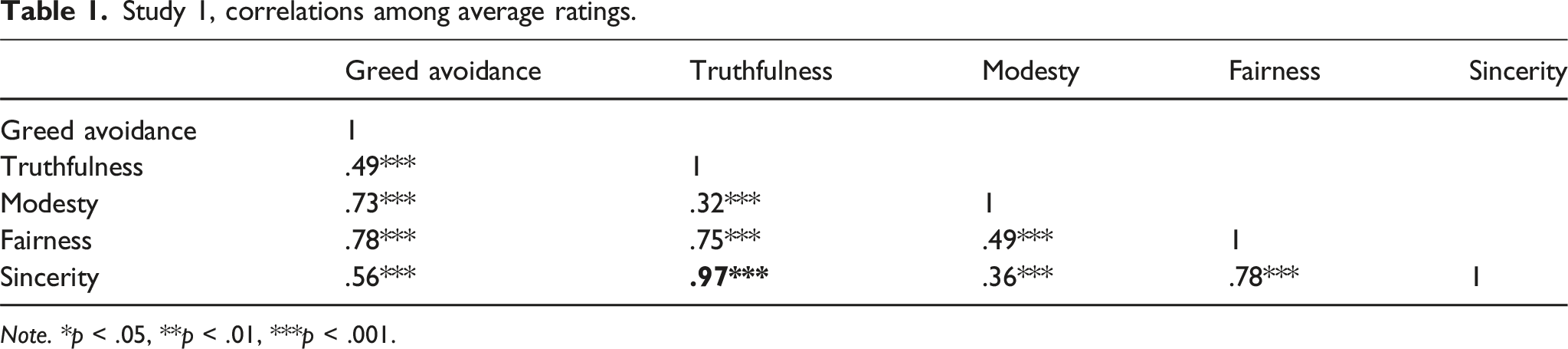
Note. *p < .05, **p < .01, ***p < .001.
We projected each adjective into the four-dimensional space and estimated the Euclidean distance of each adjective from the center of the space. For brevity, we call this index Center-distance (C-distance). The C-distance allowed quantifying the extent to which each adjective was generally representative of Honesty-Humility: Adjectives close to the center of the space (with a C-distance near zero) were not representative of any facet of Honesty-Humility, whereas those distant from the center could represent a facet or a combination of facets. We also quantified the Euclidean distance between each adjective and the pole of a facet that was the closest to the adjective. Lower values indicate adjectives that are very representative of the pole of a facet. For brevity, we call this index Facet-distance (F-distance; for a conceptually similar approach, see Gallucci & Perugini, 2007). The F- and C-distances of adjectives are represented in Figure 1, exact values are reported in OSF Supplement S2. Visualization of the 150 adjectives in the four-dimensional space. Each dot represents a single adjective. The blue diamond is the adjective “vero” (true), which was identified as representative of Sincerity for its low F-distance from positive pole of this facet; the red circle is the adjective “menzognero” (liar), representative of Insincerity for its low F-distance from negative pole of the facet. The green triangle is the adjective “righteous” (retto) representative of many aspects of honesty at once, as indicated by its high C-distance, whereas the brown square is the control adjective “calmo” (calm), which is not representative of any aspect of honesty, as indicated by its null C-distance.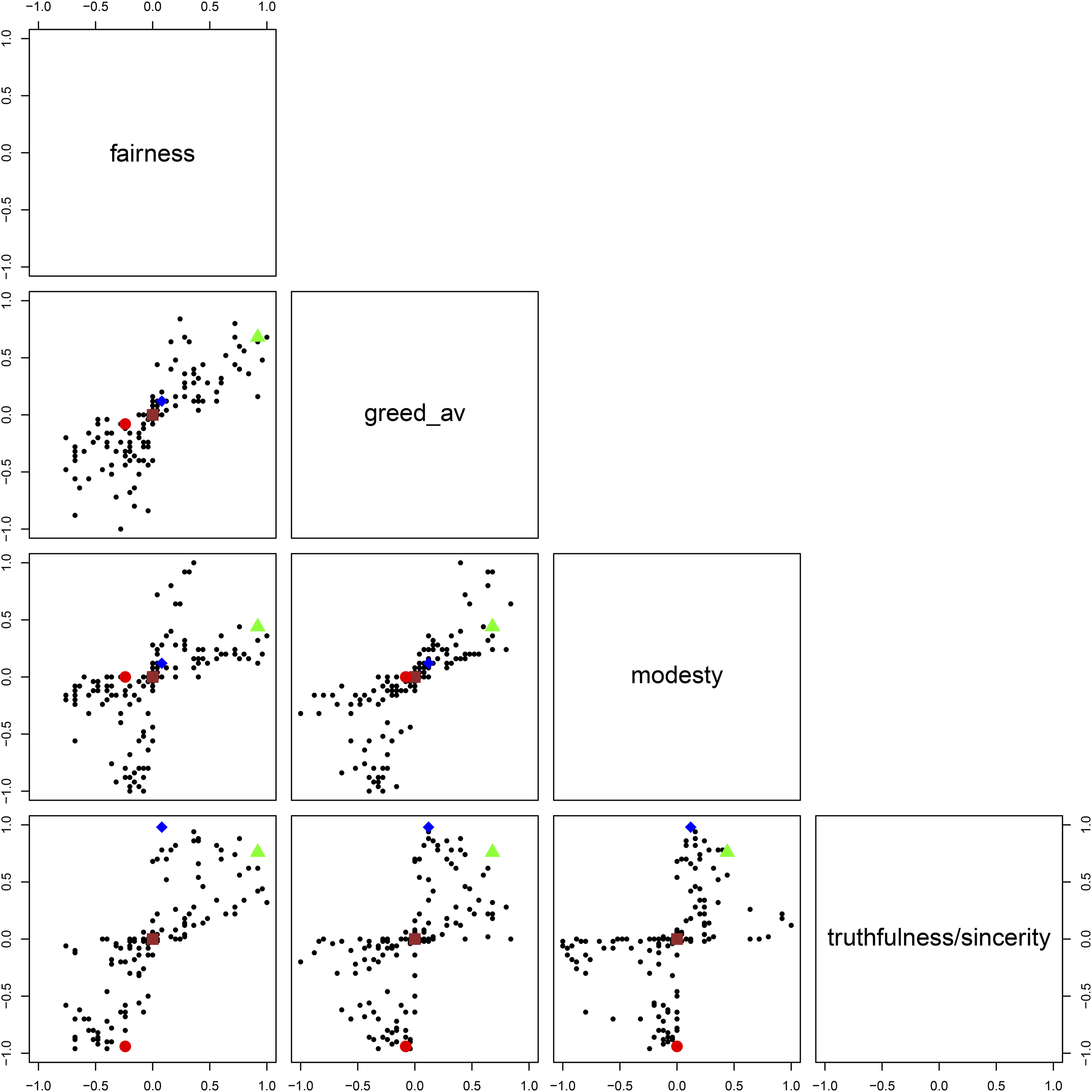
Our preregistered hypothesis was that the C-distance of the 120 adjectives selected to represent Honesty-Humility would be, on average, larger than the one of the 30 control adjectives. The hypothesis was confirmed, with average C-distance = .85 (SD = .30) for honesty-related adjectives and .10 (SD = .12) for controls, as indicated by a Welch’s independent samples t-test, t (119.77) = 21.52, p < .001, to correct for unequal variances.
Study 1. List of 30 adjectives to serve as an initial pool for developing the ACH.
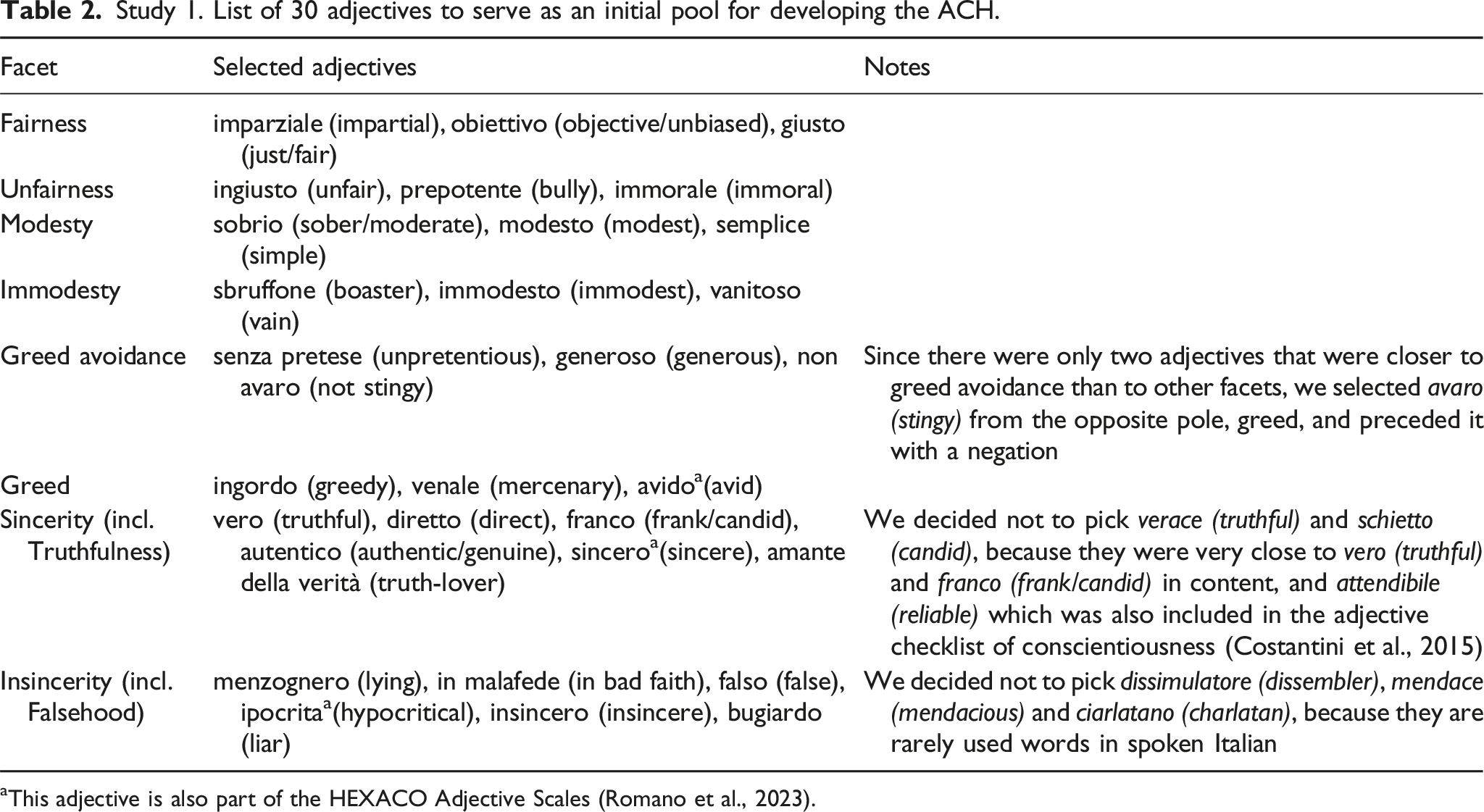
aThis adjective is also part of the HEXACO Adjective Scales (Romano et al., 2023).
Discussion
The aim of the study was to select an initial set of items covering the facets of Honesty-Humility. To do so, we collected a list of 120 candidate descriptors of Honesty. Our initial set of adjectives included all Italian adjectives relevant to Honesty-Humility identified in previous lexical work, plus several additional ones. We intentionally broadened the scope of the item pool because our work was guided by the goal of creating a scale that would align as much as possible with the four Honesty-Humility facet labels, Sincerity, Fairness, Modesty, and Greed-Avoidance, while including more clearly content related to truthfulness. For this reason, in Study 1, we decided to expand the set of descriptors using other sources, such as dictionaries and lexical spaces, and employed independent raters to judge the alignment of each descriptor with each facet. This approach is different compared to previous studies, somehow reversing the approach that starts from factors emerging from psycho-lexical studies and then identifies labels best describing them. By ensuring alignment in meaning between personality descriptors and facet labels, we wanted to assuage jingle-jangle issues (Flake & Fried, 2020; Wulff & Mata, 2025) and ensure that truthfulness-related content would not be neglected in the process (Fleeson, 2020). We see these two approaches as potentially complementary and both useful to improve assessment in psychology. Our decision to expand the set of descriptors also reflects the fact that language changes over time: Some of the original studies performed on Italian Language (Caprara & Perugini, 1994; Di Blas & Forzi, 1998) are now quite old and may not fully reflect current language use.
Out of the initial set of adjectives, we selected 30 adjectives covering the breadth of content of trait honesty, including both Honesty-Humility facets in the HEXACO model (Ashton & Lee, 2020) and Truthfulness (Fleeson, 2020; Miller et al., 2021). Notably, our data indicated a nearly perfect conceptual overlap between adjectives describing truthfulness and sincerity. An inspection of specific adjectives suggested that, of the 120 items examined, no single one could be identified as representative of truthfulness and not of sincerity, or representative of sincerity and not of truthfulness. This result suggests that in language use, truthfulness is virtually indistinguishable from the sincerity facet of Honesty-Humility. Hence, the lack of conceptual overlap between Honesty-Humility and Truthfulness (Fleeson, 2020; Fleeson et al., 2022) might be due to the operationalization of the trait in the HEXACO-PI-R items, which emphasize other aspects of Honesty-Humility (see Ashton & Lee, 2020), rather than to the failure to include an additional and specific Truthfulness facet within the assessment. In light of this result, in the process of developing the ACH, we decided to include truthfulness-related content within facet Sincerity rather than as a separate facet.
Study 2. Development of the adjective checklist of honesty
Study 2 was aimed at further refining a subset of items for the ACH, inspecting their factorial structure and convergence with the HEXACO-PI-R.
Materials and methods
Participants
Two-hundred-sixty-six participants (60 men, 206 women; mean age = 31, SD = 12.5) took part in the study. All participants gave informed consent before starting the survey and took part in the study on a voluntary basis. They were recruited through the University’s Sona System. An additional 14 participants were excluded for reporting inattentive responding, as indicated by a Self-Reported Single-Item (Meade & Craig, 2012). The study was run as part of a larger study that included other measures not analyzed here. The final sample size allows detecting a correlation as small as r = .17 with 80% power in a two-tailed test at the conventional α level of .05 (Perugini et al., 2018).
Materials and procedures
Participants evaluated the 30 candidate ACH items identified in Study 1. They indicated the extent to which each of the adjectives (e.g., “honest”) described themselves, on a scale from 1 (it does not describe me at all) to 7 (it describes me completely). Cronbach’s α reliabilities ranged between .79 and .91. They also completed the HEXACO Adjective Scale (HAS; Romano et al., 2023), an instrument featuring 60 adjectives meant to cover the main six dimensions of personality as reflected in the HEXACO model (see Romano et al., 2023). Three adjectives that were both part of the candidate ACH items and of the HAS (avid, sincere, and hypocritical; see Table 2) were administered only once. Since the HAS and ACH items shared the same format and response options, they were administered as a single questionnaire. Cronbach α reliabilities for the HAS scales ranged between .73 and .91.
Subsequently, participants filled in the 60-item version of the HEXACO-PI-R (Ashton & Lee, 2009), that assesses six major personality traits with 10 items each. The trait Honesty-Humility was investigated in more detail with the full 32-item HEXACO-PI-R scale, which also assesses the four main facets of the trait (Ashton et al., 2006). Cronbach’s α reliabilities ranged between .71 and .90 for traits, and between .76 and .82 for Honesty-Humility facets. Participants indicated their level of agreement with each item (e.g., “I would be quite bored by a visit to an art gallery”), on a scale from 1 (strongly disagree) to 5 (strongly agree).
At the end of the survey, participants answered to a Self-Report Single Item asking whether their data could be used in the study or if they had responded inattentively (Meade & Craig, 2012). Participants who reported careless responding were excluded from the analyses.
Results
Study 2. CFA model comparison.

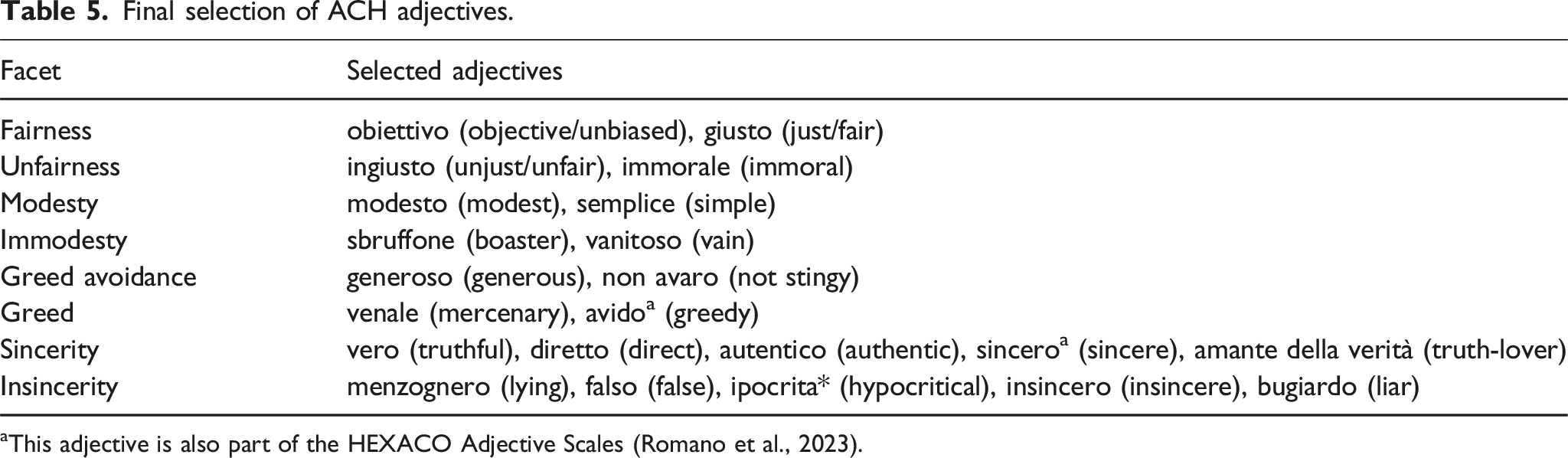
The fit of Model 1 was acceptable but not optimal. We hence decided to retain for each scale only the four best items, based on modification indices, but also on semantic considerations (e.g., removing polysemous items which can be misinterpreted out of a sentence context like “sobrio”—sober), and keeping in sight the breadth of the content of each facet. Removed items were: “franco” (frank) and “in malafede” (in bad faith) for Sincerity; “prepotente” (bully) and “imparziale” (impartial) for Fairness; “immodesto” (immodest) and “sobrio” (sober) for Modesty; “senza pretese” (unpretentious) and “ingordo” (greedy) for Greed-avoidance. A total of 22 adjectives were hence selected for the final ACH. After removing these items, we refitted the model. Model fit improved substantially (CFI = 0.928; RMSEA = 0.050; SRMR = .051; χ2 (181) = 300.643, p < .001; see the OSF Supplement S3 and Figure 2 for individual loadings). Standardized model parameters from the bifactor models in Studies 2 and Study 3. SI = Truthfulness-Sincerity, FA = Fairness, MO = Modesty, GR = Greed-avoidance, G = General factor.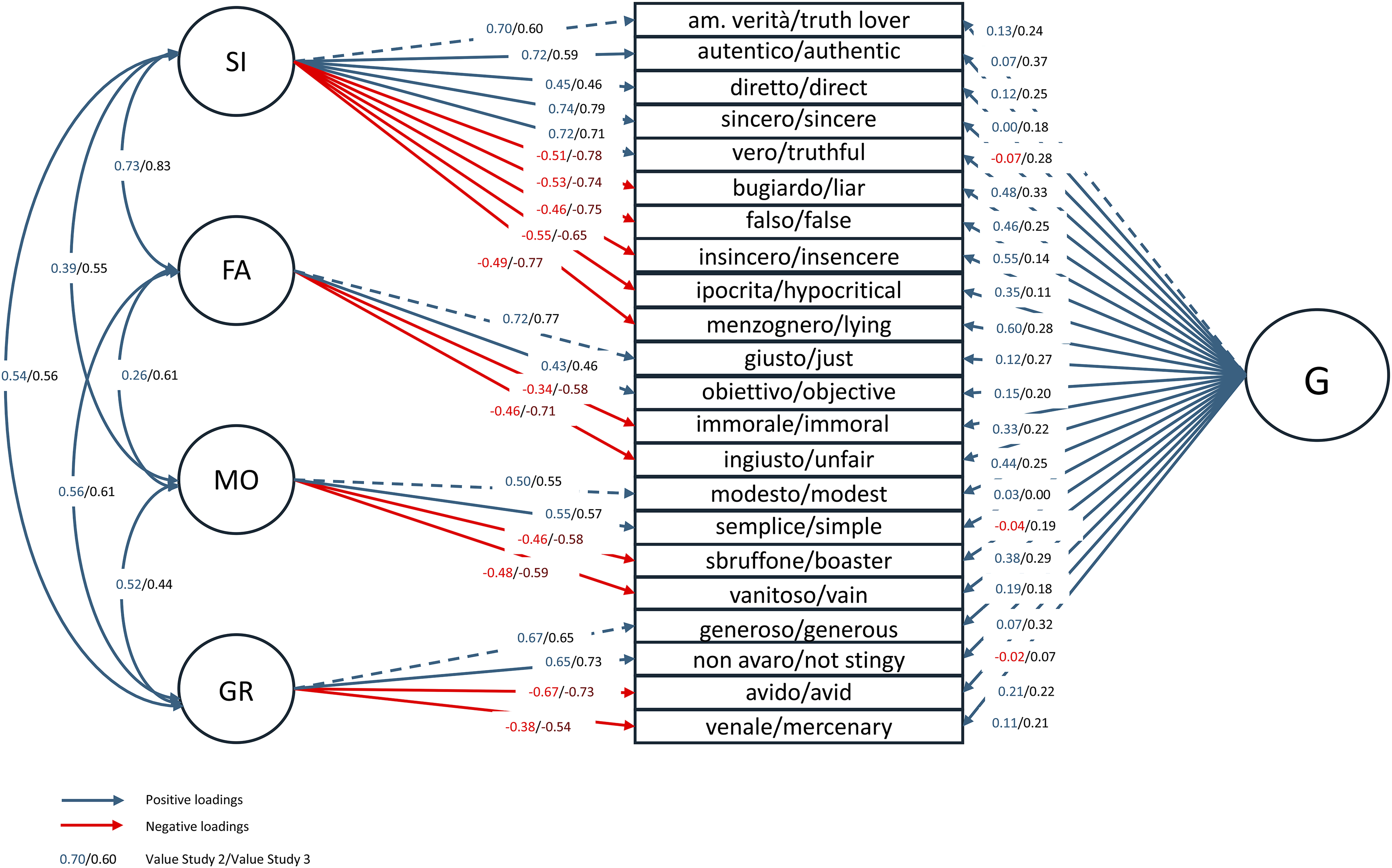
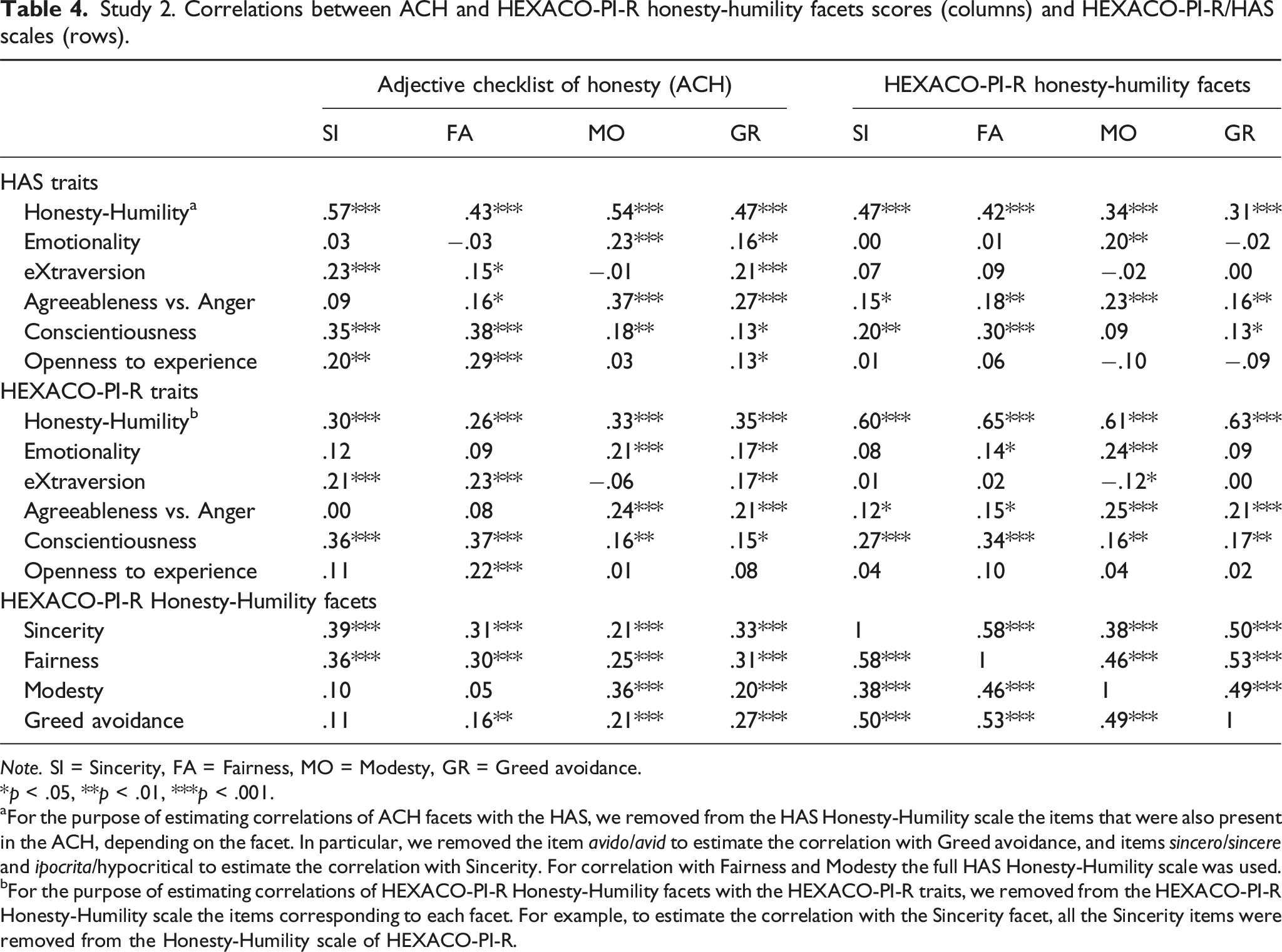
Study 2. Correlations between ACH and HEXACO-PI-R honesty-humility facets scores (columns) and HEXACO-PI-R/HAS scales (rows).
Note. SI = Sincerity, FA = Fairness, MO = Modesty, GR = Greed avoidance.
*p < .05, **p < .01, ***p < .001.
aFor the purpose of estimating correlations of ACH facets with the HAS, we removed from the HAS Honesty-Humility scale the items that were also present in the ACH, depending on the facet. In particular, we removed the item avido/avid to estimate the correlation with Greed avoidance, and items sincero/sincere and ipocrita/hypocritical to estimate the correlation with Sincerity. For correlation with Fairness and Modesty the full HAS Honesty-Humility scale was used.
bFor the purpose of estimating correlations of HEXACO-PI-R Honesty-Humility facets with the HEXACO-PI-R traits, we removed from the HEXACO-PI-R Honesty-Humility scale the items corresponding to each facet. For example, to estimate the correlation with the Sincerity facet, all the Sincerity items were removed from the Honesty-Humility scale of HEXACO-PI-R.
Discussion
In this study, we refined the set of the ACH items, developing the final 22-item scale, inspected its factorial structure, and examined its convergence with the HAS and HEXACO-PI-R. Confirmatory factor analysis showed that the attribution of adjectives to the four facets based on expert raters’ scores of Study 1 could be recovered in the scale’s structure. Whereas the ACH facet converged with Honesty-Humility as expected, sizable correlations with Conscientiousness emerged for facets Sincerity and Fairness. We followed up this result by examining correlations between ACH facets and HEXACO-60 Conscientiousness items (Ashton & Lee, 2009). The results are reported in the OSF Supplement S4 and show that the most substantial correlations were with items of Diligence and Perfectionism, and particularly with items “I do only the minimum amount of work needed to get by,” “I often push myself very hard when trying to achieve a goal,” and “I always try to be accurate in my work, even at the expense of time.” Interestingly, these items include aspects related to workplace ethics, which are conceptually and empirically related to trait Honesty-Humility (e.g., Pletzer et al., 2019).
Although ACH scales showed positive correlations with respect to the HEXACO-PI-R Honesty-Humility facet scales, a clear pattern of convergent and discriminant validity did not emerge, particularly with respect to Greed-Avoidance. We argue that this may be related to the specific content of the HEXACO-PI-R items, which is not always in line with the facet labels, but covers a broader range of content (see Fleeson, 2020). For example, Fairness items mostly portray situations in which a person is not willing to cheat or break rules for an advantage (e.g., “I would be tempted to buy stolen property if I were financially tight”), whereas our adjective items concern fairness in more general terms, not necessarily connected to getting or giving up a personal advantage. HEXACO-PI-R Sincerity items mostly concern pretending to like someone in order to get something from them (e.g., “I see nothing wrong with flattering people to get ahead in life”), whereas ACH Sincerity adjectives assess a tendency to fostering truth in others and be authentic, without implying specific motives for doing so. Greed-Avoidance items are related to not-wanting luxury (e.g., “I would like to live in an expensive and exclusive area”) and desire for admiration (e.g., “I would like to be seen driving around in a very expensive car”), while our adjectives emphasize a dichotomy between being greedy or generous, without including love for luxury or admiration. HEXACO-Modesty items mostly refer to seeing oneself or being seen as better than others (e.g., “I am a normal person, I am not better than others,” “I want people to know that I am someone of some importance”). In this case, the content is closer with ACH than for other facets, and this resulted in higher convergence between ACH and HEXACO-PI-R Modesty scales. Although some ACH facets do not converge perfectly with corresponding HEXACO-PI-R facets, we chose to retain the original facet names, because the initial descriptor selection and judgments by expert raters in Study 1 were explicitly guided by the alignment with HEXACO-PI-R facet labels. Hence, the ACH facet scales can be seen as a slightly different but complementary operationalizations of the same facets.
Final selection of ACH adjectives.
aThis adjective is also part of the HEXACO Adjective Scales (Romano et al., 2023).
Study 3—Validity of the ACH
The aim of this study was twofold: first, we wanted to provide converging evidence of the scale structure by administering the final version of the ACH to a new independent sample; second, we wanted to assess the relationship between the ACH and a series of validated measures of constructs conceptually related to each subscale.
Participants
N = 300 participants (M age = 31.5; SD = 9.98), all Italian native speakers, participated in the study through the Prolific Academic platform. Of them, 148 identified as men, 145 identified as women, and 7 identified as “other.” Participants received written informed consent and were compensated with £3.75/each for a 30-min task.
In order to identify highly inattentive responses, the HAS and the HEXACO-PI, and the Modest Behavior Scale each included a directed question (Maniaci & Rogge, 2014), an item that was visually presented in a similar format to other items, but asked for a specific response (e.g., “This is a verification question, answer four and proceed with the questionnaire”). Ten participants who failed two or more directed questions were immediately expelled from the questionnaire and did not receive compensation. To achieve the preregistered sample size of 300 participants, new participants were invited to replace excluded ones. The final sample size allows detecting a correlation as small as r = .16 with 80% power in a two-tailed test, at the conventional α level of .05.
Materials and procedure
Personality traits were assessed through the same set of questionnaires used in Study 2. Participants completed the ACH (Cronbach’s α between .65 and .89) and the HAS (Cronbach’s α between .81 and .92; Romano et al., 2023). They subsequently completed the HEXACO-60 (Ashton et al., 2009), with the Honesty-Humility trait being investigated with the full 32-item HEXACO-PI-R scale (Lee & Ashton, 2004; α between .77 and .91 for traits and between .79 and .84 for honesty facets). In addition, participants completed a battery of measures exploring constructs that we expected to overlap in content with each facet of Honesty-Humility, which were administered after the personality scales, in a random order.
For Sincerity, we employed the Revised Lie Acceptability Scale (Oliveira & Levine, 2008; α = .84) and the Authenticity Scale (A. M. Wood et al., 2008; α = .89). The Revised Lie Acceptability Scale comprised 11 items, wherein participants indicated their level of agreement (on a scale from 1 = strongly disagree to 7 = strongly agree) with statements such as “Lying is no big deal.” The Authenticity Scale consisted of 12 items, requiring participants to indicate the extent to which each statement (e.g., “I am true to myself in most situations”) described them, using a scale from 1 (it does not describe me at all) to 7 (it describes me very well). The Authenticity Scale encompassed three subscales: Authentic Living (α = .73; “I think it is better to be yourself than to be popular”), Self-Alienation (α = .87; “I feel as if I don’t know myself very well”), and Accepting External Influence (α = .90; “I am strongly influenced by the opinions of others”).
For Fairness, we employed the Justice Sensitivity Short Scale (Baumert et al., 2014), which captured Justice Sensitivity from different perspectives (Schmitt et al., 2010). Each subscale included two items: Perpetrator (“I feel guilty when I enrich myself at the cost of others,” α = .84), Observer (α = .80; “I am upset when someone is undeservingly worse off than others”), Victim (α = .72; “It makes me angry when others are undeservingly better off than me”), and Beneficiary (α = .69; “I feel guilty when I am better off than others for no reason”). Participants indicated their level of agreement with each statement, using a 6-point scale, ranging from 1 (strongly disagree) to 6 (strongly agree), reflecting how they would respond in unfair situations.
For Modesty, we employed the Modest Behavior Scale (Xiaohua Chen et al., 2009; α = .83), which consisted of 39 items capturing a range of modest behaviors. Examples of these behaviors included attributing success to luck rather than personal ability in front of others and admitting and rectifying mistakes after recognizing them. Participants responded to these items using a 5-point scale, anchored from 1 (strongly disagree) to 5 (strongly agree). The Modest Behavior Scale encompassed three distinct subscales: Self Effacement (α = .70; “Talking myself down to downplay my talent”), Other Enhancement (α = .83; “Usually praise other people”), and Avoid Attention Seeking (α = .81; “Not praise myself in an attention-getting way”). Additionally, we assessed Entitlement via the Psychological Entitlement Scale (Campbell et al., 2004; α = .89), in which participants indicated their level of agreement with nine statements such as “I honestly feel I’m just more deserving than others.” Participants rated their agreement on a scale ranging from 1 (strongly disagree) to 7 (strongly agree).
Lastly, for Greed Avoidance, we included two scales: the Vices and Virtue Scale (VAVS) - Greed subscale (Veselka et al., 2014; α = .78) and the Dispositional Greed Scale (Krekels & Pandelaere, 2015; α = .84). In the VAVS, participants rated their agreement level with 6 items, such as “I enjoy being a part of exclusive clubs or groups that are not open to everyone,” using a 5-point scale ranging from 1 (strongly disagree) to 5 (strongly agree). Similarly, the Dispositional Greed Scale comprised 6 items, including statements like “No matter how much I have of something, I always want more,” where participants indicated their agreement level on a scale ranging from 1 (strongly disagree) to 7 (strongly agree).
Furthermore, we also included in the battery the Dirty-Dozen scale (Chiorri et al., 2019; Jonason & Webster, 2010) to capture the dark triad, a cluster of three personality traits associated with exploitative behaviors. The scale consisted of 12 items, organized into three subscales: Machiavellianism (α = .87; “I tend to manipulate others to get my way”), Psychopathy (α = .82; “I tend to be unconcerned with the morality of my actions”), and Narcissism (α = .80; “I tend to want others to admire me”). Participants were asked to indicate their agreement level with a series of statements on a scale ranging from 1 to 7.
To ensure linguistic equivalence, scales for which an Italian version was not available were translated into Italian and back-translated by the authors. The back-translation was cross-checked with the original version by a native English speaker for accuracy and consistency. Scale and facet scores were computed as the mean of the corresponding items.
Results
Replication of the factorial structure
Since in Study 2, we used the same sample for selection of items and for selective analyses (Kriegeskorte et al., 2009), the first aim of Study 3 was to replicate the factorial structure identified in Study 2 in a new preregistered one. The model confirmed its good fit, χ2 (181) = 343.415, p < .001; CFI = .941, RMSEA = .054, SRMR = .047; see the OSF supplement S3 and Figure 2 for individual loadings).
Correlations with honesty-humility scales
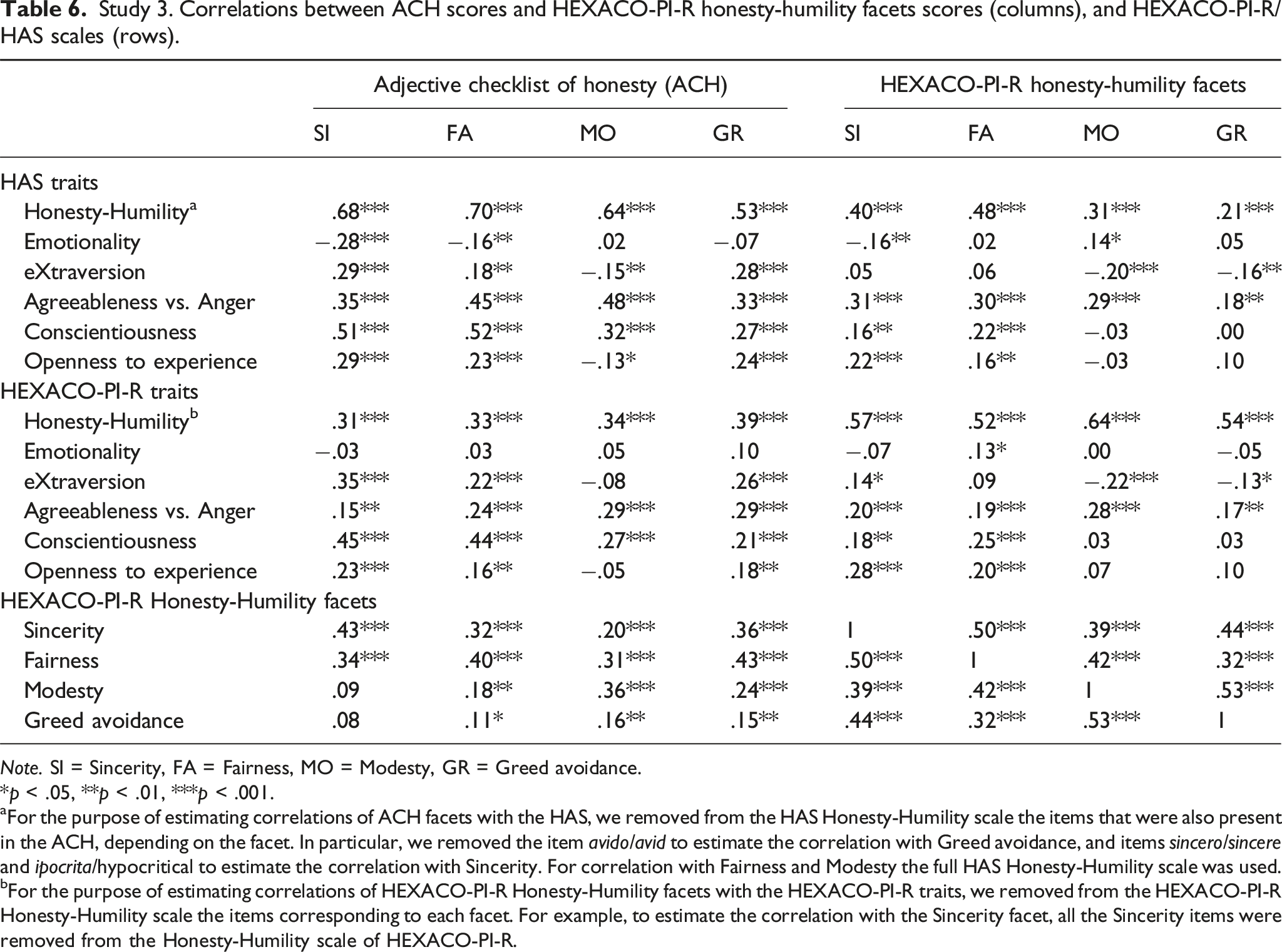
Study 3. Correlations between ACH scores and HEXACO-PI-R honesty-humility facets scores (columns), and HEXACO-PI-R/HAS scales (rows).
Note. SI = Sincerity, FA = Fairness, MO = Modesty, GR = Greed avoidance.
*p < .05, **p < .01, ***p < .001.
aFor the purpose of estimating correlations of ACH facets with the HAS, we removed from the HAS Honesty-Humility scale the items that were also present in the ACH, depending on the facet. In particular, we removed the item avido/avid to estimate the correlation with Greed avoidance, and items sincero/sincere and ipocrita/hypocritical to estimate the correlation with Sincerity. For correlation with Fairness and Modesty the full HAS Honesty-Humility scale was used.
bFor the purpose of estimating correlations of HEXACO-PI-R Honesty-Humility facets with the HEXACO-PI-R traits, we removed from the HEXACO-PI-R Honesty-Humility scale the items corresponding to each facet. For example, to estimate the correlation with the Sincerity facet, all the Sincerity items were removed from the Honesty-Humility scale of HEXACO-PI-R.
Correlations with other constructs
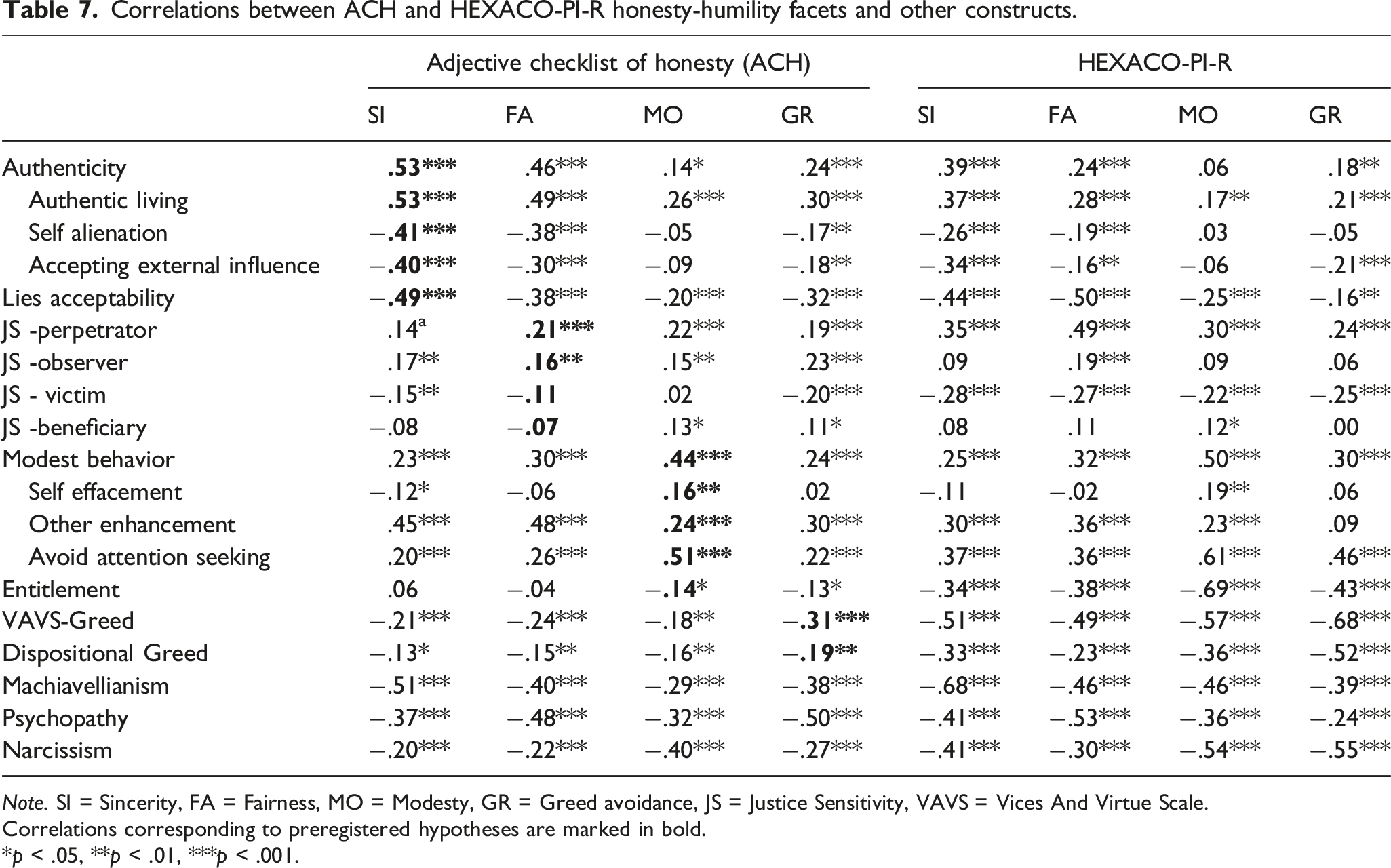
Correlations between ACH and HEXACO-PI-R honesty-humility facets and other constructs.
Note. SI = Sincerity, FA = Fairness, MO = Modesty, GR = Greed avoidance, JS = Justice Sensitivity, VAVS = Vices And Virtue Scale.
Correlations corresponding to preregistered hypotheses are marked in bold.
*p < .05, **p < .01, ***p < .001.
As hypothesized, the Authenticity scale, its facets, and the Lie Acceptability scales showed the highest correlations with ACH Sincerity. The same pattern was observed for HEXACO-PI-R facets, although correlations were generally larger in size for Sincerity assessed with ACH than HEXACO-PI-R.
Perpetrator sensitivity, the aspect of Justice Sensitivity more clearly related to Honesty-Humility in previous studies (Baumert & Schmitt, 2016), showed positive correlations with ACH Fairness, as did Observer sensitivity. In both cases, similarly sized or even larger correlations emerged with other ACH facets, particularly Modesty and Greed-Avoidance. No significant correlations emerged between ACH Fairness and Victim or Beneficiary sensitivities. Victim sensitivity was higher for greedy individuals (with low Greed Avoidance), whereas Beneficiary sensitivity showed only weak correlations with Modesty and Greed-Avoidance. HEXACO-PI-R Fairness showed stronger correlations with Perpetrator, Observer, and Victim sensitivity, whereas consistent with the ACH, no correlation emerged between Fairness and Beneficiary sensitivity.
The Modest Behavior scale correlated most with ACH Modesty. Considering its subscales, however, it is noteworthy that this relationship was much stronger for the Avoid Attention Seeking scale than for the other ones. A similar pattern emerged for HEXACO-PI-R Modesty. As hypothesized, Entitlement correlated most with Modesty, but this correlation was weak and similar in size to that observed for Greed-Avoidance. Conversely, Entitlement seemed to reflect more central elements of HEXACO-PI-R Modesty and of HEXACO-PI-R Honesty-Humility in general.
As expected, the highest correlations with both measures of Greed (VAVS and Dispositional Greed) emerged with ACH Greed-Avoidance. A similar pattern emerged for the HEXACO-PI-R facets, albeit the correlations were generally more sizable with HEXACO-PI-R than with ACH scales.
The Dark Triad traits showed substantial negative correlations with all ACH subscales. However, each ACH facet showed a slightly different pattern of correlations with these traits. Sincerity correlated mostly with Machiavellianism, the tendency to manipulate others and to prefer a pragmatic approach to situations. Fairness and Greed-Avoidance showed a stronger association with Psychopathy, which is characterized by impulsive behaviors, lack of empathy and cooperation, and a general absence of moral qualities and remorse. Modesty showed the highest correlation with Narcissism, which is characterized by entitlement and an enhanced sense of self. A similar pattern of correlations emerged also with the HEXACO-PI-R subscales, with a noteworthy difference: HEXACO-PI-R Greed-Avoidance seemed to be more clearly characterized by (lack of) Narcissism and not by (lack of) Psychopathy, whereas the opposite was true for ACH Greed-Avoidance.
Discussion
The aim of the current study was twofold: First, we wanted to confirm the factorial structure of the ACH in a preregistered study, by administering the scale to a new sample; second, we intended to demonstrate the convergent and discriminant validity of the scale showing that its four subscales could be consistently associated with other validated measures of similar constructs. Study 3 corroborated the good fit of the bifactor model identified in Study 2. All four ACH scales correlated with their respective counterparts in the HEXACO-PI-R and ACH subscales generally aligned with the hypothesized related constructs. However, the strength of these associations varied.
ACH Sincerity aligned with its HEXACO-PI-R counterparts. Interestingly, this scale showed generally stronger correlations with Authenticity and Lies Acceptability than the HEXACO-PI-R, suggesting that truthfulness and authenticity might be more central in the operationalization of Sincerity within the ACH than within the HEXACO-PI-R (Fleeson, 2020; Fleeson et al., 2022; Miller et al., 2021).
Fairness aligned with the corresponding HEXACO-PI-R scale, but, unexpectedly, correlated with Justice Sensitivity only from the perspectives of the Perpetrator and of the Observer, but not of the Beneficiary or the Victim. These findings suggest that ACH Fairness can capture some nuances of Justice Sensitivity, but not the whole construct. In particular, individuals with high ACH Fairness could be particularly concerned with preventing others from being treated unfairly, especially when they themselves are in the position of perpetrating such injustice, in line with the idea that Honesty-Humility reflects proactive cooperation (Ashton & Lee, 2007; Hilbig et al., 2013). A similar pattern emerged for HEXACO-PI-R Fairness, which, however, correlated significantly with Victim sensitivity, reflecting the sensitivity to injustice when suffering a personal disadvantage, corroborating the idea that HEXACO-PI-R Fairness might be different from ACH Fairness because the first makes a clearer reference to personal advantages or disadvantages than the latter.
In line with our predictions, within the ACH, Modesty was the facet most correlated with the Modest Behavior scale, particularly so with the Avoid Attention Seeking subscale. A correlation between ACH Modesty and entitlement emerged, but this relationship was more sizeable for HEXACO-PI-R Modesty. In fact, Entitlement was quite strongly correlated with all HEXACO-PI-R facets, whereas ACH facets showed much weaker relationships with this construct. This suggests that entitlement might be particularly central for the HEXACO-PI-R operationalization of Honesty-Humility, but it might not be as central for other measures of the same construct (see also Thielmann et al., 2017).
In line with Study 2, among ACH facets, Greed-Avoidance showed the weakest convergent and discriminant validity with respect to HEXACO-PI-R facet scales. This distinction was further reflected in how the ACH and HEXACO Greed-Avoidance were related to other constructs. Whereas ACH Greed-Avoidance aligned with other measures of Greed, HEXACO-PI-R Greed-Avoidance was more clearly related to these constructs. In addition, HEXACO-PI-R Greed-Avoidance was more strongly connected to Narcissism, consistent with previous studies (Aghababaei et al., 2014), further corroborating the idea this scale may reflect desire for luxury and admiration, rather than just a dichotomy between generosity and greed. Conversely, ACH Greed-Avoidance was more closely associated with psychopathy, a trait that reflects lack of empathy and lack of cooperative behaviors, particularly in situations in which this could lead to an immediate payoff (Balafoutas et al., 2021; Gunschera et al., 2022). Adjectives in the negative pole of the ACH Greed-Avoidance subscale (“greedy” and “mercenary”) may indeed reflect a broader antagonistic tendency (see also Sekhar et al., 2020).
General discussion
Honesty is crucial for the functioning of society, as it is closely related to prosocial and moral behaviors and attitudes (Ashton & Lee, 2008). As such, studying honesty as both a moral virtue and a personality trait is relevant for understanding and predicting socially important behaviors (Miller et al., 2021). However, assessing honesty is complex as it requires considering its multiple facets beyond its narrowed understanding as the mere absence of lying and cheating behavior (Miller et al., 2021). The first aim of this work was to create and validate an adjective checklist able to measure both the Honesty-Humility domain and its facets, as was done in previous studies for other traits (Costantini et al., 2015; Costantini & Perugini, 2016). Romano et al. (2023) have proposed a comprehensive adjective scale to measure, through lexical descriptors, the main personality traits reflected in the HEXACO model. The resulting HEXACO Adjective Scales (HAS) offer an efficient and effective way to assess broad personality traits. Nevertheless, its current version does not account for the full complexity of the Honesty-Humility HEXACO domain and does not include adjectives that differentiate its facets. For this reason, we have developed a new adjective checklist, which captures the four main Honesty-Humility facets: Sincerity, Fairness, Modesty, and Greed-Avoidance. The ACH offers a comprehensive and efficient assessment of Honesty-Humility through adjectives, complementing existing proposals (Ashton, Lee, & Goldberg, 2004; Romano et al., 2023; Thielmann et al., 2017) and emphasizing truthfulness-related aspects (Fleeson, 2020; Fleeson et al., 2022). The full content of the scale is reported in the Appendix.
Adjectives-based measures rely on the lexical hypothesis (Goldberg, 1993; 2002, Wood, 2015) and, when compared to phrased items, present both advantages and disadvantages. Measures based on phrased items are more contextualized than adjectives, and for this reason their interpretation can be clearer (Condon et al., 2020). On the other hand, adjectives-based measures are faster to administer, can be more easily included in intensive-longitudinal studies (e.g., Di Sarno et al., 2023; Fleeson, 2001; Ringwald et al., 2022), and they can be used as the basis to implement reaction-time based procedures (Back et al., 2009; Costantini et al., 2015, 2016; but see Yovel & Friedman, 2013). For these reasons, we see the ACH as a complement to existing measures of Honesty-Humility that can be useful in situations where brief and decontextualized items are desirable.
The factorial validity of the ACH was confirmed in two independent studies. Furthermore, the four ACH scales generally converged with the hypothesized constructs and often showed a stronger relationship with the constructs than other facets, as preregistered. The nomological network of Honesty-Humility as a trait is theoretically robust (Ashton & Lee, 2007, 2020) and it has been corroborated by a large body of empirical studies (e.g., Zettler et al., 2020). Our studies further contribute to clarifying the nomological network of Honesty-Humility at a level that has been underinvestigated: the level of its facets. The results observed suggest that some connections with conceptually related constructs may depend on the specific operationalization of Honesty-Humility facets. In fact, the HEXACO-PI-R and the ACH facet scales emphasize different aspects of the Honesty-Humility, with constructs such as psychological entitlement and narcissistic tendencies, encompassing, for example, love for luxury, being more central for HEXACO-PI items (see Ashton & Lee, 2020) and truthfulness and theoretically related constructs, such as authenticity, being closer to the core of the ACH. We additionally explored the possibility that the tendency to respond at the extremes of the scales in adjective vs. phrased items could be responsible for some of the differences emerged in the patterns of correlations characterizing the ACH and the HEXACO-PI-R 2 . The results of this analysis are reported in the OFS Supplement S5 and did not suggest meaningful differences between the ACH and the HEXACO-PI-R in terms of response extremity. Given these distinctions and potential measurement considerations, future research would benefit from further corroborating the construct validity of the scale, for example, by examining self-observer agreement for those instruments. Past research focusing on the HEXACO-PI found somewhat attenuated self-observer convergence for the Honesty-Humility and Agreeableness vs Anger dimensions relative to the remaining four factors (Ashton & Lee, 2010). In addition, previous research on the HAS has documented notably lower self-observer agreement specifically for its Honesty-Humility scale compared to other dimensional scales within the same instrument (Romano et al., 2023). These discrepancies suggest the need to conduct a larger study with self- and observer reports for the ACH, HAS, and HEXACO instruments. Looking at the relationships between the ACH and the HEXACO-PI-R traits, we observed correlations between the ACH facet scales and HEXACO-PI-R Conscientiousness, which were in some cases even stronger than the correlations observed with HEXACO-PI-R Honesty-Humility. Notably, this pattern of relationships was much less marked when Conscientiousness was assessed with an adjective measure, the HAS. The nature of the overlap between traits Honesty-Humility and Conscientiousness is currently debated, with some ascribing them to the presence of common superordinate factors (e.g., Catano et al., 2018) and others assuming that some indicators result from a blend of different traits (Ashton et al., 2009). In previous studies, such correlation involved mainly facet fairness (Ashton & Lee, 2020), whereas in our data a similar pattern extended to facet sincerity. These results are in line with past research showing that some aspects of moral behavior fall within Conscientiousness, particularly those reflecting obligations towards other individuals and society in general (Roberts et al., 2005). This is reflected in conceptual overlaps between the Conscientiousness and the Honesty-Humility domains, with the former encompassing task-related conscience and the latter moral conscience. These overlaps become evident in workplace moral behavior, which both traits substantially contribute to predict (de Vries & van Gelder, 2015; Lee et al., 2005; Pletzer et al., 2019). A follow-up analysis at the item-level (reported in Table S3) showed that the correlation with HEXACO-PI Conscientiousness was, in fact, mainly driven by HEXACO-PI-R Conscientiousness items related to workplace behavior. These results corroborate the idea that an overlap between these traits may be simply explained by the presence of blended indicators, without the need to postulate second-order factors (Ashton & Lee, 2020).
The second aim of this work was to further deepen the connections between Honesty-Humility and Truthfulness. In developing the ACH, we used a systematic approach to capture the studied domain comprehensively. Recent discussions in personality psychology highlight the need for systematic bottom-up procedures in measurement construction that focus on personality characteristics below traditional traits—such as aspects, facets, and nuances (Mõttus et al., 2019; Revelle et al., 2021; Seeboth & Mõttus, 2018; Wilt & Revelle, 2015). The procedure outlined in Study 1 is not specific to the development of the ACH, but it can be more generally employed as a tool for screening candidate items when developing psychometric scales, aligning the item’s content with the intended constructs. By using a bottom-up method, involving expert raters, and following a transparent and preregistered procedure, we successfully minimized the risk of jingle-jangle fallacy (Flake & Fried, 2020; Wulff & Mata, 2025). This strategy allowed disconfirming the initial idea to assess five separate facets, pointing to the fact that sincerity and truthfulness were too overlapped to be assessed separately. However, in developing the ACH, we decided to assess the Sincerity facet (encompassing truthfulness) with a larger number of items, to obtain a measure of this facet that could assess this part of the trait more closely.
More in general, our findings corroborate the idea that the observed mismatch between Honesty-Humility and truthfulness noted in some works (Fleeson, 2020; Fleeson et al., 2022) might stem from the specificity of some of the HEXACO-PI-R items, with truthfulness being a crucial part of the core of Honesty-Humility as a trait (Thielmann et al., 2024).
Supplemental Material
Supplemental Material - A lexical examination of the facets of honesty-humility: The adjective checklist of honesty
Supplemental Material for A lexical examination of the facets of honesty-humility: The adjective checklist of honesty by Simona Amenta, Anastasia Galkina, Daniele Romano, Marco Perugini, Giulio Costantini in European Journal of Personality
Footnotes
Acknowledgments
We wish to thank Rossella Di Pierro, Erica Casini, Luca Pancani, Marco Di Sarno, and Simone Mattavelli for serving as expert raters.
Declaration of conflicting interests
The authors declared no potential conflicts of interest with respect to the research, authorship, and/or publication of this article.
Funding
The authors disclosed receipt of the following financial support for the research, authorship, and/or publication of this article: This study is supported by This project/publication was made possible through the support from a grant from The Honesty Project at Wake Forest University and the John Templeton Foundation (#61842), awarded to Giulio Costantini and Marco Perugini (#21-021). The opinions expressed in this publication are those of the authors and do not necessarily reflect the views of The Honesty Project, Wake Forest University, or John Templeton Foundation.
Ethical considerations
Study 1 did not involve human subjects beyond expert raters. Studies 2 and 3 were judged as involving minimal risk for the participants by the Committee for Research in Psychology (CRIP) of the University of Milan-Bicocca (protocol numbers RM-2022-646 and RM-2023-713).
Open science statement

Consent to participate
All participants provided written informed consent in digital form prior to participating.
Supplemental Material
Supplemental material for this article is available online.
Notes
Appendix
References
Supplementary Material
Please find the following supplemental material available below.
For Open Access articles published under a Creative Commons License, all supplemental material carries the same license as the article it is associated with.
For non-Open Access articles published, all supplemental material carries a non-exclusive license, and permission requests for re-use of supplemental material or any part of supplemental material shall be sent directly to the copyright owner as specified in the copyright notice associated with the article.
