






Abstract
Background:
In 2011, Australia published a set of 6 population-level indicators assessing breastfeeding, formula use, and the introduction of soft/semisolid/solid foods.
Objectives:
This study aimed to report the feeding practices of Australian infants against these indicators and determine the predictors of early breastfeeding cessation and introduction of solids.
Methods:
Mother–infant dyads (N = 1470) were recruited postnatally in 2 Australian capital cities and regional areas of 1 state between February 2008 and March 2009. Demographic and feeding intention data were collected by self-completed questionnaire at infant birth, with feeding practices (current feeding mode, age of breastfeeding cessation, age of formula and/or solids introduction) reported when the infant was between 4 and 7 months of age, and around 13 months of age. Multiple logistic regression was used to determine the predictors of breastfeeding cessation and solids introduction.
Results:
Although initiation of breastfeeding was almost universal (93.3%), less than half of the infants were breastfed to 6 months (41.7%) and 33.3% were receiving solids by 4 months. Women who were socially disadvantaged, younger, less educated, unpartnered, primiparous, and/or overweight were most likely to have ceased breastfeeding before 6 months of age, and younger and/or less educated women were most likely to have introduced solid food by 4 months of age. Not producing adequate milk was the most common reason provided for cessation of breastfeeding.
Conclusion:
The feeding behaviors of Australian infants in the first 12 months fall well short of recommendations. Women need anticipatory guidance as to the indicators of breastfeeding success and the tendency of women to doubt the adequacy of their breast milk supply warrants further investigation.
Well Established
Feeding practices in Australia fall well short of recommendations for breastfeeding and age of solids introduction. Sociodemographic factors affecting these behaviors are maternal age, marital status, education, and income level.
Newly Expressed
This study supplements the findings of a national report assessing feeding practices in Australia against newly published indicators. It identifies the high prevalence of breastfeeding cessation before 6 months and the introduction of solids before 4 months of age.
Background
Nutrition is a key determinant of health, growth, and development in infancy, and there is strong evidence that early feeding and growth patterns of infants are linked to a number of long-term health consequences. 1 The global recommendations for infant feeding practices are exclusive breastfeeding to 6 months, and thereafter, that infants should receive nutritionally adequate and safe complementary foods while breastfeeding for up to 2 years of age or beyond. 2 Since 2003, Australian infant feeding guidelines have recommended the introduction of solid foods at around 6 months of age.2,3 Although some groups have advocated in the past decade for solids to be introduced variously between 4 and 6 months,4,5 it is widely accepted that solids should not be introduced before 17 weeks. 6
In 2011, the Australian Institute of Health and Welfare (AIHW) published the National Breastfeeding Indicators 7 (Appendix 1), a set of 6 population-level measures assessing breastfeeding, formula use, and the introduction of soft/semisolid/solid foods (hereafter referred to as solid food) using standard definitions of breastfeeding practices. 8 Data from the 2010 Australian National Infant Feeding Survey (ANIFS), 9 a cross-sectional survey involving 28 436 infants from 0 to 24 months of age, were analyzed in relation to these 6 indicators to produce the first nationally representative “picture” of infant feeding practices in Australia. Key findings were that initiation of breastfeeding was high (96%), however, breastfeeding prevalence and the degree of exclusivity declined rapidly. Although 63% were receiving some breast milk at 5 months, only 1 in 5 infants (21%) were predominantly breastfed to 5 months. Even fewer (15%) were exclusively breastfed to 5 months, with the majority of infants having been introduced to nonhuman milk or formula (61%) and/or solid food (57%) by 5 months of age.
Two recent studies in 2 Australian states (Queensland and South Australia)10,11 have longitudinally collected feeding data comparable to that of the cross-sectional ANIFS. These data supplement the findings of the ANIFS, and the longitudinal nature of the data allows the inclusion of earlier events in multivariate analysis to identify key demographic and other factors that are independent predictors of specified feeding practices. The aims of this article, therefore, are to report the feeding practices to 12 months of age of infants participating in these 2 studies using the AIHW indicators; report practices against national guidelines with respect to duration of breastfeeding and age of introduction of solids; and determine the predictors of early breastfeeding cessation and introduction of solids.
Methods
The participants are a subset of mothers who at the time of their infants’ birth agreed to further contact regarding participation in either the NOURISH Randomised Controlled Trial or the South Australian Infant Dietary Intake (SAIDI) study.10,11 The NOURISH intervention comprised 2 modules of six 1- to 2-hour group sessions commencing when infants were 4-7 and 13-16 months of age. It did not focus on breastfeeding or the timing of introduction of solids but on the “what” and “how” of feeding solids. 7 The SAIDI study was a concurrent prospective observational study of feeding practices and dietary intake of infants in the first 2 years of life. Details of the 2-stage recruitment process have been described. 12 In brief, mothers giving birth in public and private hospitals across metropolitan Brisbane (NOURISH only) and Adelaide (NOURISH and SAIDI) and 7 regional hospitals in South Australia (SAIDI only) were invited (stage 1) within 72 hours of giving birth to register their interest in being recontacted in the following months for final consent to participate in 1 of these studies. Stage 1 occurred between February 2008 and March 2009. To participate in NOURISH, participants were required to be a first-time mother, be age 18 years or older, be living in the metropolitan area, have a facility for English, and have given birth to a healthy infant weighing 2500 g or greater at 37 weeks gestation or later. Mothers with a documented history of substance abuse or self-reported mental health disorders were excluded, as were infants with a congenital abnormality or a chronic condition affecting feeding. The same criteria were applied in the SAIDI study except that multiparous and regional dwelling mothers were also eligible. Mothers consenting at stage 1 to further contact completed a short questionnaire providing demographic details and feeding intention. At some time between 2 and 5 months of age, mother–infant dyads were recontacted (stage 2) and formally invited to participate in the relevant study. Mothers who declined to participate further (nonconsenters) were requested to complete a short questionnaire regarding breastfeeding initiation and cessation and introduction of solids at this stage, and consenting participants provided this and additional information on introduction of infant formula and complementary fluids as well as reasons for breastfeeding cessation at 2 points—time 1 and time 2. Time 1 was baseline data collection for NOURISH participants prior to randomization (mean age ± SD = 4.3 ± 1.0 months), and for SAIDI participants was close to 6 months of age (6.1 ± 0.8 months). Time 2 occurred at a similar age for both studies (14.0 ± 1.2 months). Participants at times 1 and 2 also participated in anthropometric measurements and completed a 24-hour recall and 2-day diet record.
To maximize the sample, all possible data from questionnaires were used. For example, when reporting on breastfeeding cessation by age in months, nonconsenters were included if breastfeeding had ceased, however, nonconsenters who were still breastfeeding at the time of withdrawal could not be included in any analysis assessing breastfeeding cessation beyond the time of returning the questionnaire. For each indictor, only those subjects for whom the indicator could be determined for each month to 12 months are included. Thus, the sample size varies slightly between indicators (n = 801: predominant breastfeeding to n = 1278: breastfeeding duration). The data presented are derived from the questionnaires, but in a few cases, reference was made to the 24-hour recall data to clarify questionnaire responses with respect to current feeding method (eg, whether complementary feeding had begun or the infant was having formula).
Data were assessed against 5 of the 6 core National Breastfeeding Indicators. 7 It was not possible to distinguish exclusive breastfeeding (infant receives only breast milk or expressed breast milk and no other liquids or solids with the exception of syrups consisting of vitamins, mineral supplements, or medicines including oral hydration solutions) from predominant breastfeeding across the 12 months as we had not asked if and when the infant received water. Therefore, indicator 3, “proportion of children exclusively breastfed to each month of age 0-6 months,” is not reported. Expressed breast milk was included as breastfeeding. In line with the methodology of the National Breastfeeding Indicators report, 7 when assessing the other 5 indicators, the following concepts of age were used. If mother reported ceasing breastfeeding at 4 months, her child was identified as being breastfed to 4 months and at 4 months. If solids were introduced at 4 months, a child was identified as having solids at 4 months and from the age of 4 months. In assessing age of introduction of solid foods, mothers were asked to report at what age their child received soft/semisoft food regularly, that is, more than twice a week for several continuous weeks. Introduction of solids by 4 months of age (≤ 4 months) was used in this study as an indicator of early introduction of solids.
Statistical Analysis
IBM SPSS version 20 was used for data analysis. Data are presented as the proportion of infants meeting indicators at each month of age and meeting feeding guidelines, and as frequency of responses with respect to reasons for cessation of breastfeeding. Following bivariate analysis, multivariate logistic regression was used to determine the independent predictors of cessation of breastfeeding prior to 6 months and introduction of solids by 4 months using the sample for which these variables were available. Variables included in the analyses were demographic characteristics of maternal age, country of birth, marital status, education, prepregnancy weight status, area of residence and socioeconomic status (SES) based on postcode of residence, infant birth order and sex, whether the respondent agreed to active participation in either NOURISH or SAIDI, whether the respondent was allocated to the intervention group of NOURISH or not, and the age of infant at second contact (stage 2). All variables that were tested in the bivariate analysis were entered into the multivariate analysis using a backward model.
The studies were approved by 11 Human Research Ethics Committees covering Queensland University of Technology, Flinders University, and all the recruitment hospitals.
Results
Figure 1 shows the source of participants included in this study. Of the 2973 participants who agreed to further contact at stage 1 of recruitment, data on breastfeeding duration at each month for 12 months were available for 1278 (43.0%) children and data related to the introduction of solids for 1194 (40.0%) children. The overall sample for which data for at least 1 of these indicators were available was 1470 (49.4%). Table 1 shows the characteristics of mothers and child sex for this overall sample. Data on the use of nonhuman milk (predominantly formula) across the 12 months were available for a smaller number of infants (N = 905). To determine predominant breastfeeding status at each month up to 6 months, data on both use of formula and introduction of solids were required and these were available for only a subset of 801 infants. Overall, the differences in demographic characteristics between these different subsets were minor and the data reported in Table 1 for the sample of 801, for which differences were greatest, illustrate this. The smaller subset of participants has a higher proportion of university educated mothers (49.3% vs 41.6%) and fewer mothers with education only to the end of year 12 or less (23.6% vs 31.8%) compared with the overall sample.

Source of 1470 Participants Providing Information Included in This Study.
Characteristics of Mothers and Infants for Whom Breastfeeding Status or Solids Status Could Be Determined at Every Month in the First Year (n = 1470) and Those for Whom Predominant Breastfeeding Status Could Be Determined (n = 801).

Abbreviations: ATSI, Aboriginal and/or Torres Strait Islander; SEIFA, Socio-Economic Indexes for Areas; TAFE, Technical and Further Education.
Self-reported prepregnancy weight status: response options are underweight, normal, and overweight.
Socio-Economic Indexes for Areas is a broad definition of relative socioeconomic disadvantage based on postcode of residence, standardized to a population mean (SD) of 1000 (100); lower values represent greater disadvantage. 13
Indicator 1: Proportion of Children Ever Breastfed
Of a total of 1278 children for which this information was available, 1193 (93.3%; 95% confidence interval [CI], 91.9-94.7) were breastfed at least once.
Indicator 2: Proportion of Children Receiving Any Breast Milk at Each Month of Age (Figure 2)
There was a substantial decline in breastfeeding in the first month of life such that by 1 month, only two thirds (70.4%) of all infants were receiving breast milk. Another large decline occurred during the second month of life, by the end of which time, 59.5% of all infants were receiving breast milk. After this age, the breastfeeding prevalence steadily declined, and at 6 and 12 months, 41.7% (95% CI, 39.0-44.4) and 23.9% (95% CI, 21.6-26.2) of infants, respectively, were receiving breast milk.

Proportion of Children Receiving Breast Milk at Each Month (n = 1278), Receiving Infant Formula (n = 990), and Receiving Solids (n = 1194).
Indicator 3: Proportion of Children Exclusively Breastfed to Each Month of Age 0-6 Months
We were unable to assess indicator 3 (see Methods section).
Indicator 4: Proportion of Children Predominantly Breastfed
Figure 3 shows the proportion of children at each month who were receiving only breast milk, receiving both formula and breast milk, or receiving formula only, according to whether the child was also receiving solids. Predominantly breastfed children are those receiving breast milk only and no solids. Breast milk as the sole source of milk (with or without solids) declined over 6 months from a high of 67.3% at 1 month to 33.4% at 6 months. Half the children were predominantly breastfed (ie, no solids) at 3 months, but this number rapidly declined over the next 2 months such that only a quarter (25.2%) were predominantly breastfed at 5 months.

Proportion of Children in Each Breastfeeding Category according to Whether Infant Was or Was Not Receiving Solidsa (n = 801).
Indicator 5: Proportion of Children Receiving Soft/Semisolid/Solid Food at Each Month of Age, 0-12 Months
Figure 2 shows the proportion of infants receiving solid food at each month in the sample of 1194 for whom this could be assessed. Almost 10% (n = 113) of children were receiving solids by 3 months of age. One third of children (n = 396, 33.2%) were having solid food by the time they were 4 months old, with a further quarter (n = 337, 28.2%) being introduced to solid food by 5 months of age, and by 6 months, almost all infants (n = 1159, 97.1%) were receiving solid food.
Indicator 6: Proportion of Children Receiving Nonhuman Milk or Formula at Each Month of Age, 0-12 Months
Figure 2 shows the proportion receiving formula at each month among the 990 for whom this information was available. By 1 month of age, almost half the children (48.0%) were receiving some formula. This increased to nearly two thirds (61.0%) at 3 months and three quarters (72.9%) at 6 months of age. At 12 months of age, all but 10% of children were receiving some formula. Four children were having cow’s milk at 12 months.
Reasons for Breastfeeding Cessation
Participants were asked to report their main reasons for ceasing breastfeeding. Several possible reasons were provided in a tick-box format with the option of mothers providing their own reason under “Other, please describe.” The most frequently cited reasons for ceasing breastfeeding by period of cessation are reported in Table 2. For each period of cessation, more than 50% of mothers who gave a reason reported “Not producing any/adequate milk,” that is, perceived breast milk insufficiency. “Resumed work” was a more common reason given for cessation between 4 and 6 months than earlier, although it was a far less frequent response (10.9%) than “Not producing any/adequate milk.”
The Most Frequently Cited Reasons for Cessation of Breastfeeding by Time of Cessation.
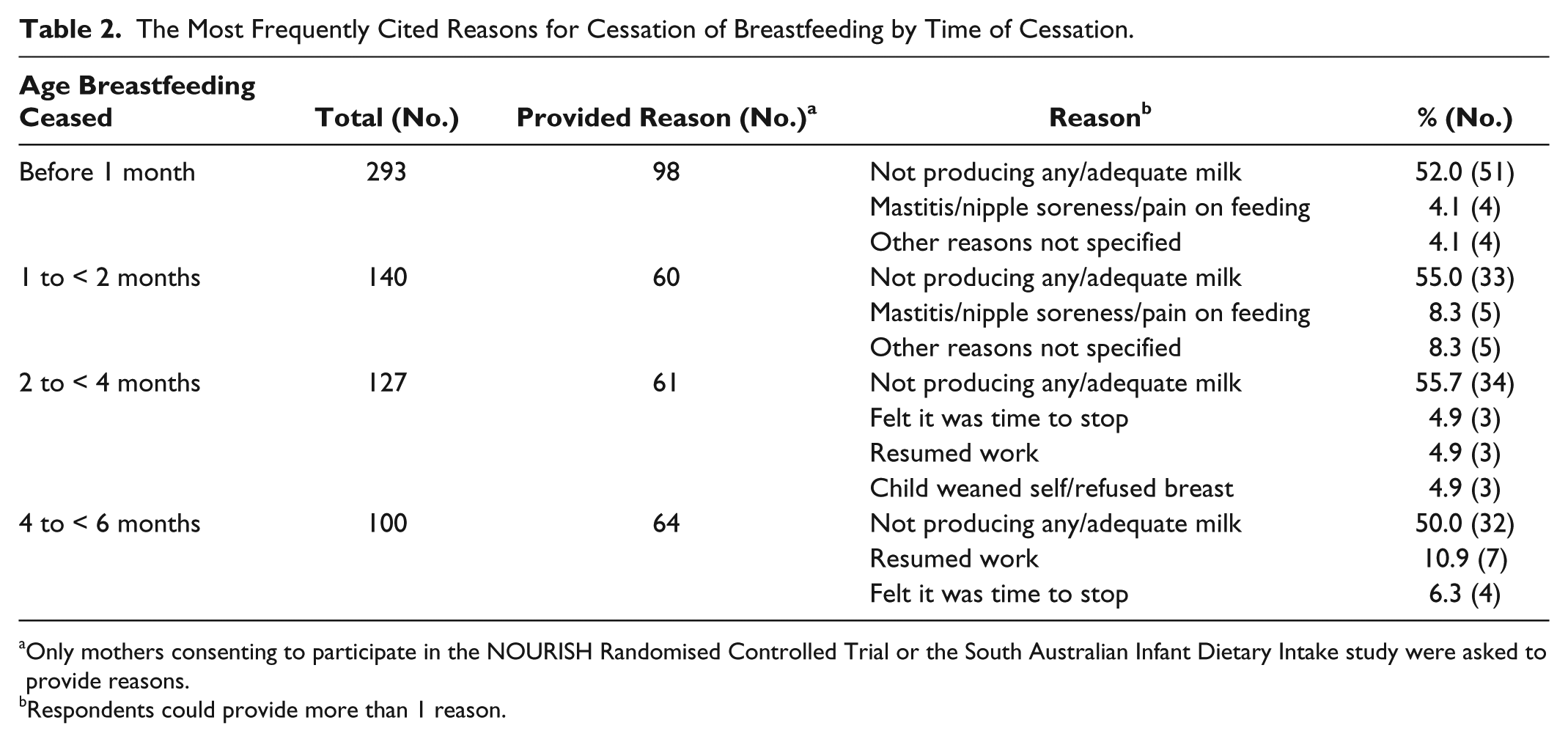
Only mothers consenting to participate in the NOURISH Randomised Controlled Trial or the South Australian Infant Dietary Intake study were asked to provide reasons.
Respondents could provide more than 1 reason.
Predictors of Meeting Guidelines
Table 3 presents the crude and adjusted odds ratios for cessation of breastfeeding prior to 6 months and the introduction of solid food by 4 months by sociodemographic characteristics (n = 1061) and study participation. Women who ceased breastfeeding before 6 months of age were more likely to be younger, be less educated, primiparous, introduce solids by 4 months of age, and decline active participation in either NOURISH or SAIDI. Similarly, nonactive participants with a child younger than 5 months of age at second contact, who were younger, less educated, more socially disadvantaged, a metropolitan resident, multiparous, and had ceased breastfeeding by 4 months were most likely to have introduced solid food by 4 months of age.
Crude and Adjusted Odds Ratios for Cessation of Breastfeeding Prior to 6 Months and the Introduction of Solids by 4 Months by Sociodemographic Characteristics (n = 1061).

Abbreviations: CI, confidence interval; OR, odds ratio; SEIFA, Socio-Economic Indexes for Areas; TAFE, Technical and Further Education; —, the variable was not a significant predictor in the multivariate model.
The total of the categories do not always add up to 1061 due to missing or incomplete data for some items.
Socio-Economic Indexes for Areas is a broad definition of relative socioeconomic disadvantage where 1 is most deprived and 10 is least deprived. 14
Self-reported prepregnancy.
No = declined extended participation in cohort or randomized controlled trial but provided data for some indicators at stage 2.
Yes = participant was randomized to the NOURISH Randomised Controlled Trial intervention group; No = participant was a South Australian Infant Dietary Intake study participant or a NOURISH participant allocated to the control group.
Age at second contact.
Discussion
This article reports the feeding practices and their independent predictors in a cohort of mother–infant dyads from 2 states in Australia during the first 12 months of their child’s life. Overall, these results show that feeding practices fall well short of current guidelines. 3 Although the initiation of breastfeeding was almost universal, less than half the children were breastfed to 6 months (with considerably less predominately breastfed), two thirds of children were receiving formula by 5 months of age, and nearly two thirds of children were receiving solid food by 5 months of age.
The prevalence of having received any breast milk (93.3%; 95% CI, 91.9-94.7) is marginally lower than that reported in the nationwide ANIFS study conducted in 2010 (95.9%; 95% CI, 95.5-96.3 ). 9 The prevalence at 6 months of those receiving any breast milk in the present study is substantially lower than in the ANIFS study; 41.7% (95% CI, 39.0-44.4) were receiving any breast milk versus 60% (95% CI, 58.4-61.8). The decline in breastfeeding is sharpest in the first month, during which time almost one third of mothers (378/1197) who initiated breastfeeding stopped breastfeeding. It is interesting that predominant breastfeeding prevalence in this study was 4 to 7 percentage points higher than in the ANIFS. It is unfortunate that no comparisons could be made for breastfeeding prevalence at 12 months with ANIFS, due to the ANIFS grouping infants older than 6 months into a single group of those aged 7 to 12 months.
Some of these differences in breastfeeding prevalence may be accounted for by the varying demographics of the 2 cohorts. Prevalence of breastfeeding initiation and duration have been consistently associated negatively with younger maternal age and lower level of education.15,16 For instance, despite our sample having a higher proportion of women with a university education than the ANIFS participants (our sample vs ANIFS sample 9 ; 47.5% vs 41.2%), there was a higher proportion of participants in our sample with an education level at year 12 or less (27.0% vs 22.0%). In addition, our sample was younger, with a greater proportion younger than 25 years (19.3% vs 8.8%) and more commonly primiparous (78.2% vs 41.0%). Numerous studies have reported that multiparous women are likely to breastfeed for longer than primiparous women.16,17 Subgroup analysis of our sample indicates that prevalence of breastfeeding at 6 months was lower across all subgroups compared with ANIFS, but differences were particularly large for mothers younger than 25 years (our sample 15.7% vs 39.1% ANIFS), those with year 12 education or less (our sample 25.3% vs year 11 40.3% and year 12 52.0% ANIFS), and primiparous women (our sample 40.4% vs 57.1% ANIFS). The reasons for these large differences are not readily apparent. Irrespective of these demographic differences, however, the data clearly show that despite a high incidence of initiation, this cohort of mothers failed to achieve breastfeeding recommendations, with the proportion of breastfeeding mothers declining rapidly in the first month and steadily thereafter.
The definition of receiving soft, semisolid, or solid foods differed between the current study and the ANIFS study. 9 The present study asked mothers to report if their child was receiving soft/semisoft food regularly, that is, defined as more than twice a week for several continuous weeks, whereas the ANIFS study asked mothers to report if their child had received soft/semisolid/solid food in the past 24 hours. As such, comparisons should be made with caution. These differing definitions of receiving solids are likely to explain in part the differences in the proportion of children receiving solids, which was slightly lower in this study compared to the ANIFS 9 at 4 months (33.3% vs 35.3%) and 5 months (61.6% vs 70.2%), whereas at 6 months of age, the proportion of children receiving solids was higher compared to the ANIFS (97.4% vs 91.5%).
The data clearly show that Australian infants are receiving solids very early in life (30% ≤ 4 months and 7% ≤ 3 months) (Figure 2), most likely before they have developed the necessary physical and physiological abilities to consume and digest solid food safely. Current recommendations are that solid food should be introduced at around 6 months of age,11,12 with no indication of increased allergic disease, and with a range of risks associated with introduction of solids before this time. 18 As a population recommendation, “around 6 months” allows that some infants may require solids earlier or later, with timing ideally dependent on the infant displaying developmental cues that indicate readiness, such as improved head and neck control, ability to sit with some support, and disappearance of the tongue-extrusion reflex. 3
A range of demographic factors is known to predict breastfeeding duration15,16 and timing of introduction of solids.19-21 Our data confirm these associations and identify through multivariate analysis that the strongest independent predictors for cessation of breastfeeding prior to 6 months are declining study participation, younger maternal age, lower maternal education, first child, and introduction of solids by 4 months. With respect to introduction of solids by 4 months, the independent predictive factors are declining study participation, lower maternal age, lower maternal education, metropolitan residence, breastfeeding cessation at 4 months or less, and second contact at less than 5 months. Lower SES, based on postcode of residence, was not a consistent independent predictor of early breastfeeding cessation but was a predictor of early solids introduction, as previous research has shown.14,16,17 A possible explanation for this variability is that SEIFA 13 is a crude district-level measure of SES that includes a number of factors (eg, education) already included in the model. Further inclusion of study participation in the regression model may also account for some of the variability in SES as we have reported the lower SES of those declining study participation. 8 The identification of study participation as a predictor of practices that fall short of guidelines is an important finding as it alerts researchers to the potential of sampling bias of results from cohort studies, particularly those nested in intervention studies.
Readers might expect that participation in the NOURISH intervention would predict closer adherence to guidelines with respect to age of introduction of solids. We did not find this to be so and can explain this by the age at which the intervention commenced (1-4 weeks after baseline assessment, which was at a mean age of 4.3 ± 1.0 month) and by the fact that the intervention focused on the what and how of solids rather than the when. 12
As nonconsenters had not been asked to provide reasons for cessation of breastfeeding, this information was available for less than half of those mothers who had stopped breastfeeding, thus identifying the limitation of these data. However, the overwhelming response, irrespective of early or later breastfeeding cessation, related to milk supply—“not producing any/adequate milk.” It appears that women everywhere historically have doubted, and continue to doubt, the adequacy of their milk supply, 22 although this explanation may be a way of mothers expressing their lack of confidence in breastfeeding. 23 The experience or perception of “breast milk insufficiency” has been shown consistently to negatively influence breastfeeding duration and level of exclusivity in Australia9,24,25 and elsewhere.26-28 This response of insufficient milk supply also suggests that mothers may not understand the mutable process of breastfeeding. For example, in the early months, it can take time to establish supply. In later months, that supply can be increased in response to the infant’s fluctuating growth rate and corresponding requirements and intake, and by allowing the child to suckle more. This adjustment in supply can take several days to occur.
It is unclear exactly why women continue to doubt the adequacy of their milk supply in later months, presumably after breastfeeding has been successfully established. It is possible, however, that introducing solids, which can displace breast milk consumption and thus reduce breast milk supply, is leading some mothers to perceive their supply as inadequate. Indeed, our findings show that the early introduction of solids (< 4 months) is a predictor of early breastfeeding cessation even after adjusting for covariates. Hörnell et al, 29 however, in a study of Swedish mothers, found that breastfeeding duration was not associated with the age at which solids were introduced but that in breastfed infants given infant formula, breastfeeding frequency and suckling declined swiftly once formula was introduced. The direction of any association between age of introduction of solids and breastfeeding duration is unclear, and our finding may be an example of reverse causality, as “not enough milk” was 1 of the reasons given by 1 in 5 women in a US study for introducing complementary foods before 4 months. 30
Nevertheless, real or perceived breast milk insufficiency is clearly a major hurdle to overcome in helping mothers to meet recommendations to exclusively breastfeed their child to around 6 months of age. Our findings suggest that the early months are a tenuous/vulnerable time during the course of breastfeeding and that appropriate supports during this time are crucial to enhance breastfeeding duration. Gilmour et al’s 31 study reported that strong support from health professionals, particularly midwives and child health nurses, who provided consistent advice were the most commonly suggested factors that mothers believed would have assisted them in breastfeeding for longer.
A limitation of this study is the high attrition rate resulting in the sample not being representative of the population from which it was drawn, with a higher proportion of younger and primiparous women than the recent ANIFS, thus limiting the generalizability of our findings. Furthermore, it is not possible to generalize the reasons for breastfeeding cessation, as due to the study design, a large proportion of those ceasing in the first few months had not been asked to provide a reason. Although a common practice, the use of postcode as a measure of SES is also a limitation, although other measures of SES such as maternal education and marital status were included in the analysis. On the other hand, a strength of this study is that data were collected longitudinally at several time points during infancy. Event recollection was relatively close to the time at which the event happened, thus reducing recall bias, which is inherent in retrospective cross-sectional studies where the recall period is often 12 months or more.32,33
Conclusion
This study clearly shows that despite a high incidence of breastfeeding initiation, the proportion of mothers who maintain breastfeeding declines rapidly in the first month and steadily thereafter, with less than half of infants receiving any breast milk by 6 months of age and less than a quarter at 12 months. Similarly, a third of infants were regular consumers of solids by 4 months of age. The implications of these findings for optimal growth and development of infants and prevention of long-term health consequences are of concern. The identification of factors that increase the risk of early cessation of breastfeeding and early introduction of solids provides support for targeting subgroups within the population who are particularly vulnerable. However, our results suggest a role for universal education about the growth and adequacy of breast milk for healthy term infants and about establishing and maintaining breastfeeding, including professional support in this process.
Footnotes
Declaration of Conflicting Interests
The authors declared no potential conflicts of interest with respect to the research, authorship, and/or publication of this article.
Funding
The authors disclosed receipt of the following financial support for the research, authorship, and/or publication of this article: NOURISH was funded 2008-2011 by the Australian National Health and Medical Research Council (Grant 426704). SAIDI was funded by the South Australian Government Department of Health. Additional funding was provided by Meat & Livestock Australia (MLA), Food Standards Australia New Zealand (FSANZ), Heinz Australia, and Queensland University of Technology.

References
Supplementary Material
Please find the following supplemental material available below.
For Open Access articles published under a Creative Commons License, all supplemental material carries the same license as the article it is associated with.
For non-Open Access articles published, all supplemental material carries a non-exclusive license, and permission requests for re-use of supplemental material or any part of supplemental material shall be sent directly to the copyright owner as specified in the copyright notice associated with the article.
