






Abstract
Background:
Breastfeeding rates for low-income, African American infants remain low.
Objective:
This study aimed to determine the barriers, support, and influences for infant feeding decisions among women enrolled in the Washington, DC, Special Supplemental Nutrition Program for Women, Infants, and Children (WIC) after revisions in the WIC package to include more food vouchers for breastfeeding mothers and their infants and improvement of in-hospital breastfeeding support.
Methods:
We surveyed 100 women, using a 42-item verbally administered survey that asked about demographics, infant feeding method, and influences and support for feeding decisions.
Results:
The majority of participants (76%) initiated breastfeeding; 31% exclusively breastfed in the hospital. Participants were more likely to breastfeed if they had some college education, were unemployed or employed full-time, had only one child, and had been breastfed themselves as infants. Barriers to prolonged breastfeeding included limited support after hospital discharge, pain, and perceived insufficient milk supply. Participants in this study had higher breastfeeding initiation and in-hospital exclusivity rates after improvement of in-hospital breastfeeding support.
Conclusion:
Clients of WIC initiated breastfeeding at a high rate but either supplemented with formula or stopped breastfeeding for reasons that could be remedied by improved prenatal education, encouragement of exclusive breastfeeding in the hospital, and more outpatient support.
Keywords
Well Established
Despite the efforts of the Special Supplemental Nutrition Program for Women, Infants, and Children (WIC) to improve breastfeeding rates, WIC clients still have lower breastfeeding rates than women who are WIC eligible but not participating in the WIC program. Previous studies have identified influences and barriers to breastfeeding among WIC clients.
Newly Expressed
Washington, DC, WIC clients initiated breastfeeding at a high rate but either supplemented with formula or stopped breastfeeding for reasons that could be remedied by improved prenatal education, encouragement of exclusive breastfeeding in the hospital, and more outpatient support.
Background
Breastfeeding is recognized by all leading health organizations as the optimal form of infant nutrition.1-9 The American Academy of Pediatrics recommends that women exclusively breastfeed for 6 months, with continued breastfeeding for at least 12 months. 7 Among industrialized nations, the United States ranks among the lowest in breastfeeding rates; women who are African American, live in poverty, and/or participate in the Special Supplemental Nutrition Program for Women, Infants, and Children (WIC) have disparately lower rates.3,7,9-12
The WIC program promotes and supports breastfeeding by providing enhanced food packages, nutrition education, and breastfeeding counseling and by allowing breastfeeding mothers to participate in WIC for a longer duration than nonbreastfeeding mothers.13,14 Despite these efforts, WIC participants have consistently had lower breastfeeding rates compared to both women nationally and women who are WIC eligible but not participating in the WIC program.10,15
Previous studies have evaluated the barriers, influences, and factors affecting duration of breastfeeding among WIC clients. Notable barriers include maternal employment, pain with breastfeeding, and receipt of manufacturer-sponsored formula discharge packs.16,17 Studies documenting the effect of receiving formula through WIC on breastfeeding duration have had conflicting results.11,18 The main positive influences on breastfeeding are maternal beliefs about breast milk’s nutritional and health benefits, social support (partner/spouse, patient’s mother), and health care provider’s influence.16,19 In-hospital formula supplementation is linked to decreased breastfeeding duration; reasons for in-hospital supplementation include maternal desire, perception of insufficient milk supply, and pain with breastfeeding. 20
In the past 5 years, breastfeeding support has improved nationally and in Washington, DC. The number of hospitals certified as Baby-Friendly has tripled nationally, and WIC revised its food packages to create incentives for breastfeeding by providing a higher quantity and variety of foods for breastfeeding mothers and their infants.21,22 In Washington, DC, all birthing facilities are in the process of trying to become designated as Baby-Friendly. 23
In 2004, we studied Washington, DC, WIC clients’ reasons for their infant feeding decisions. 20 The current study uses the same survey methodology to assess barriers to breastfeeding, factors that influence feeding decisions, and effects of social support and health care personnel support on breastfeeding initiation and compares current and 2004 results, noting the interval revisions in the WIC food packages and improvement of in-hospital breastfeeding-friendly practices. We hypothesize that, although current WIC clients will have higher rates of breastfeeding initiation than in 2004, there are continued barriers to breastfeeding after hospital discharge.
Methods
This study included English-speaking women older than 18 years with a child younger than 1 year enrolled at the WIC clinic at Children’s National Health System in Washington, DC. We used the same 42-item survey that was used in our 2004 study, which was based on previously validated surveys and reviewed by an expert panel. 20 The survey took 10 to 15 minutes to complete and captured basic socioeconomic and demographic characteristics, prenatal feeding intentions, actual infant feeding practices (breast/formula/mixed), and influences and attitudes about feeding methods. It also contained questions about breastfeeding duration, barriers, and social/health care support.
One of the authors (OO) recruited eligible participants in the waiting area of the WIC clinic between July 7, 2014, and September 26, 2014. Verbal consent was obtained for the anonymous and voluntary survey. The surveys were either self-completed or verbally administered to the participants, depending on participant preference. The descriptive data were analyzed by STATA 13 SE. Descriptive analysis was used for infant feeding status, influences, prenatal education, support, and reasons for formula supplementation and discontinuing breastfeeding. Pearson chi-square test was performed to compare (1) the demographic information between the ever breastfed and exclusively formula-fed groups and (2) the breastfeeding and formula feeding rates between 2004 and 2014. The Children’s National Medical Center Institutional Review Board approved this study.
Results
In this study, 109 mothers met eligibility criteria and 104 (95%) agreed to participate. The 5 who declined participation did so because of lack of time or interest. In addition, 4 participants’ results were excluded due to incomplete data, leaving a total of 100 surveys for analysis.
Study Participants
Participants’ demographics and univariate analysis results for likelihood of ever breastfeeding based on demographic and social factors are shown in Table 1. The majority of participants were African American and multiparous, with a mean ± SD age of 26.3 ± 5.7 (range, 18-41) years. The infants’ mean ± SD age, at the time of the survey, was 14.6 ± 13.6 weeks.
Demographic Characteristics Grouped by Feeding Method. a

N = 100.
Participants were more likely to initiate breastfeeding if they had at least a high school education, were unemployed or employed full-time, were multiparous, and had been breastfed themselves as infants. Although differences were not statistically significant, there was a trend toward ever breastfeeding if women were older (> 34 years) or had a friend who had breastfed. Forty-seven percent of the participants stated that prenatally they had intended to exclusively breastfeed for a mean duration of 8.3 months, 23% had intended to exclusively formula feed, 22% had intended to mixed (breast and formula) feed with planned breastfeeding for a mean duration of 8.6 months, and 8% had been undecided.
Descriptive Analysis
In 2004, 60% of the WIC participants initiated breastfeeding (breastfed at least once), 39% exclusively formula fed, and 3% were exclusively breastfeeding at the time of the survey. Twenty-two percent of the breastfed infants were exclusively breastfed in the hospital. For infants who were supplemented with formula, 87% were not medically indicated and 20% were given formula without their mothers’ approval. 20
In the current study, 76% of participants initiated breastfeeding, 24% exclusively formula fed, and 8% of breastfed infants were exclusively breastfeeding at the time of the survey. A total of 44 infants (65% of mixed fed) received their first formula during the hospital stay and 54 infants (80% of mixed fed) received formula at ≤ 4 weeks of life. Thirty-one infants (41% of breastfeeding participants) were exclusively breastfed in the hospital. Reasons for in-hospital formula supplementation are shown in Table 2. More than half of breastfeeding participants who supplemented with formula during the hospital stay responded that they “wanted their babies to get formula,” and almost one-third said that their medical provider recommended it for reasons such as insufficient milk production, low birth weight, blood transfusion, and infection. The breastfeeding initiation and in-hospital breastfeeding exclusivity rates were significantly higher in 2014 than in 2004 (P values of .012 and .005, respectively).
Reasons for In-Hospital Formula Supplementation. a
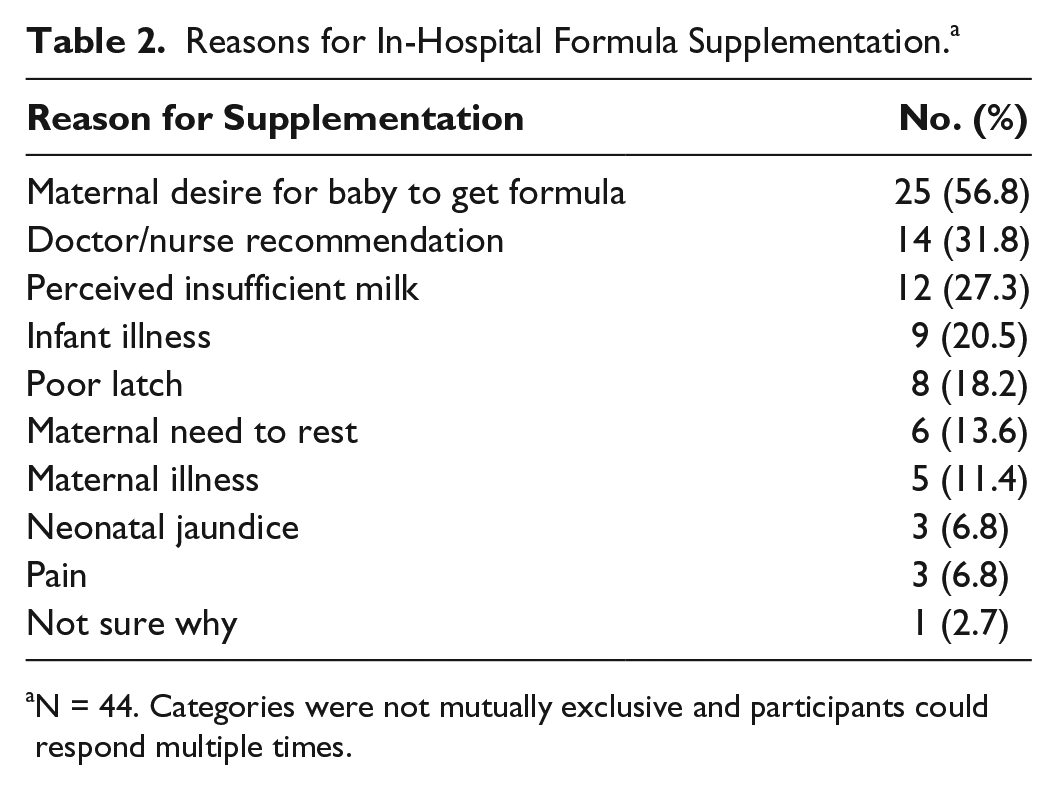
N = 44. Categories were not mutually exclusive and participants could respond multiple times.
Prenatally, women received breastfeeding education and information from the following sources: media (books, magazines, television) (39%), obstetrician/midwife (36%), prenatal class (29%), breastfeeding peer counselor (25%), pediatrician (18%), and family/friends (15%). Eight percent did not receive any breastfeeding education or information. In the hospital, breastfeeding participants (n = 76) received assistance from nurses (54%), lactation consultants (29%), family members (8%), and doctors/nurse practitioners (4%); 11% did not receive assistance. After leaving the hospital, breastfeeding participants identified very few sources of breastfeeding help; 62% said that they “were able to breastfeed on their own” and 11% said that they received no help. Other sources included medical providers (7%), friends (4%), WIC nutritionists (3%), and lactation consultants (1%).
The participants’ influences for their infant feeding decision are shown in Table 3; medical providers, WIC employees, and social network (friends/family) were chief influences on breastfeeding decision. For the 65 women who mixed fed, the most common reason given was “can’t tell if the baby is getting enough milk if breastfeeding only” (n = 30). Wanting others to feed the baby and return to work/school were also commonly cited reasons among formula-only and mixed-feeding groups. The people identified as the most influential in the participants’ infant feeding decision were own decision (70.8% formula, 53.9% breastfed), doctor/pediatrician (20.8% formula, 23.7% breastfed), family (0% formula, 9.2% breastfed), and partner (4.2% formula, 6.6% breastfed).
Influences on Maternal Infant Feeding Choice.
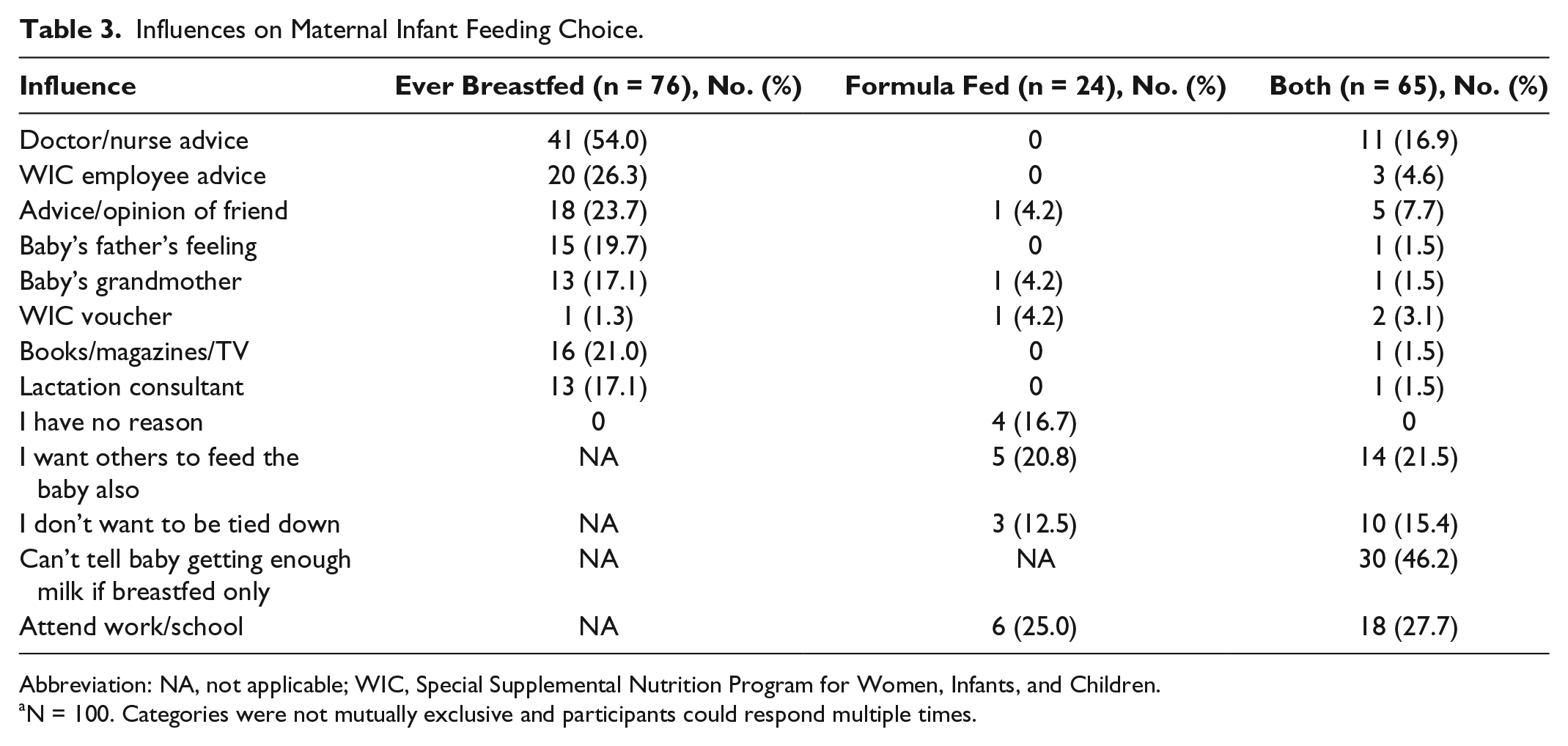
Abbreviation: NA, not applicable; WIC, Special Supplemental Nutrition Program for Women, Infants, and Children.
N = 100. Categories were not mutually exclusive and participants could respond multiple times.
We asked women who had exclusively formula fed or breastfed for less than 1 month about factors that would have encouraged them to breastfeed or breastfeed for a longer time (Table 4). The most frequently stated responses were more help with breastfeeding problems, more assistance from medical providers, and improved milk supply. None of the women felt that more information or vouchers from WIC would have changed their breastfeeding duration or formula-feeding decision. More than half (n = 40) of the women who initiated breastfeeding had stopped at the time of the survey. The reasons for discontinuing breastfeeding are shown in Table 5; mostly cited were perceived insufficient milk supply, maternal pain, and employment. One woman said that she stopped because she felt she had breastfed long enough.
Maternal Report of What Would Have Positively Affected Breastfeeding. a

Abbreviation: WIC, Special Supplemental Nutrition Program for Women, Infants, and Children.
N = 40. Categories were not mutually exclusive and participants could respond multiple times.
Maternal Reasons for Stopping Breastfeeding. a

N = 40. Categories were not mutually exclusive and participants could respond multiple times.
Discussion
With implementation of more breastfeeding-friendly practices in Washington, DC’s birthing facilities, WIC participants have higher breastfeeding initiation rates than in 2004 and yet still face barriers to exclusivity and prolonged duration of breastfeeding. The breastfeeding initiation rate increased from 60% to 76%; the in-hospital exclusivity rate for breastfed infants increased from 22% to 41% and a greater percentage of the reasons for formula supplementation were medically justified. 20 In addition, the percentage of infants who received formula without maternal approval dropped from 20% to 1%. This improvement in initiation, exclusivity, and medically indicated formula supplementation coincided with all hospitals in Washington, DC embarking on the pathway to become certified as Baby-Friendly and adds to the growing literature suggesting that improved hospital breastfeeding practices result in higher breastfeeding rates.24-26 The increase in breastfeeding rates also coincided with changes in the WIC package for breastfeeding mothers, yet it is unclear if this was an important factor in mothers’ decisions as only 2% of the mothers stated that WIC vouchers influenced their decision to breastfeed.
The majority of participants in our study intended to exclusively breastfeed for an average of 8.5 months, yet most did not reach their breastfeeding goal. Sixty-five percent of breastfed infants received their first formula during the hospital stay; the most common reason cited for supplementing was “my own decision.” Almost one-fourth of participants received no prenatal education or spoke only with family/friends about breastfeeding. In addition, almost two-thirds of participants reported that their prenatal medical provider (obstetrician/midwife) did not discuss breastfeeding with them. Consistent prenatal education about the risk of supplementation on breastfeeding duration and more encouragement for exclusive breastfeeding in-hospital may reduce the number of women who supplement. Another barrier to exclusive breastfeeding in the hospital, challenges with lactation management (milk supply, latching issues), may be decreased by improved prenatal education and assistance by someone knowledgeable about breastfeeding. Prenatal breastfeeding education and encouragement and support for exclusive breastfeeding in the hospital could help women reach their breastfeeding goals.
The role of the medical provider is crucial. Physicians were cited most frequently as the person who influenced the mother’s feeding decision yet were infrequently identified as helping either in the hospital or after hospital discharge. Medical providers receive limited breastfeeding education and might benefit from more lactation education to help them feel confident providing direct assistance and support in managing common breastfeeding challenges.27-29 This could significantly help mothers reach their breastfeeding goals, as women in our study who formula fed or breastfed for less than a month stated that teaching from medical providers and more help with problems with breastfeeding would have helped them breastfeed or breastfeed longer.
The most cited reasons for shorter breastfeeding durations and supplementing with formula, such as pain with breastfeeding or perceived insufficient milk supply, could be remedied by improved breastfeeding education and lactation management. Medical provider observation of breastfeeding, assistance with positioning/latch, maternal education, encouragement, and referral to a lactation consultant if indicated could alleviate many of these obstacles.
Limitations
This study has limitations inherent in self-reporting; participants may have reported their feeding influences and choices in what they perceived to be a socially desirable manner. This retrospective study relied on the mothers’ recollection about infant feeding practices. Finally, our sample size was relatively small and limited to a defined geographic and socioeconomic group; hence, results may not be applicable to the general population. The small sample size did not permit sub-analyses in the exclusive breastfeeding group. The predominant African American sample demographic did not permit analysis of the association between other races and infant feeding method. Nonetheless, we believe our findings to be important in understanding reasons for infant feeding decisions in economically disadvantaged breastfeeding mothers receiving WIC benefits in Washington, DC.
Implications for Future Research
A prospective study of a geographically and racially diverse group of WIC recipients would better delineate influences and barriers to breastfeeding initiation and duration nationally.
Conclusion
Breastfeeding initiation and in-hospital exclusivity rates for Washington, DC, WIC clients have increased since 2004 and may be due in part to improved support during the hospital stay. Breastfeeding exclusivity rates remain low. The participants intended to breastfeed for a longer time but experienced barriers including perceived insufficient milk supply, pain, and lack of support. Medical providers play a crucial role in supporting the breastfeeding dyad and could improve breastfeeding initiation, exclusivity, and duration by more intensive assistance in the perinatal and neonatal periods.
Footnotes
Acknowledgements
The authors would like to thank Jayasri Janakiram, MS, RD, LD, director of the Children’s National Health System’s WIC clinic; Sara Beckwith, MS, RDN, LD, CLS; and the WIC staff for their support throughout the study. Thank you to all the WIC participants and to Melissa Napolitano, PhD, for her guidance and supervision.
Declaration of Conflicting Interests
The authors declared no potential conflicts of interest with respect to the research, authorship, and/or publication of this article.
Funding
The authors disclosed receipt of the following financial support for the research, authorship, and/or publication of this article: This publication was supported by the National Institute on Minority Health and Health Disparities of the National Institutes of Health under Award Number P20MD000198. The content is solely the responsibility of the authors and does not necessarily represent the official views of the National Institutes of Health.