






Abstract
Background:
Strong recommendations have been made for exclusive breastfeeding of infants for the first 6 months of life, with continuation throughout the first year. In an attempt to optimize support for breastfeeding, particular barriers in populations with decreased rates need to be analyzed.
Objective:
This study aimed to determine if participation in the Special Supplemental Nutrition Program for Women, Infants, and Children (WIC) food voucher program, involvement of the infant’s father, involvement of the adolescent mother’s parents or other caregivers, and participation in early skin-to-skin contact after birth are associated with the decision to breastfeed or bottle feed among this adolescent population.
Methods:
A retrospective chart review of 457 adolescent patients who delivered January 2010 through May 2013 at the University of Louisville Hospital was conducted. Nursing documentation was used to determine the patient’s intention to breastfeed or bottle feed, participation in WIC, involvement of the infant’s father, involvement of the patient’s parents, and participation in early skin-to-skin contact after delivery. These factors were compared using Fisher exact test.
Results:
Three hundred one adolescents reported a plan to breastfeed (65.9%) and 156 reported a plan to bottle feed (34.1%) when questioned pre-delivery. There was no significant difference between the groups with respect to WIC participation or involvement of the infant’s father. The bottle-feeding group had a significantly higher percentage who reported parental involvement (80.1% vs 67.8%, P = .0059). The breastfeeding group had a significantly higher percentage who participated in early skin-to-skin contact after birth (74.5% vs 58.1%, P = .0064).
Conclusion:
Involvement of the adolescent mothers’ parents or caregivers was associated with the decision to bottle feed. Participation in early skin-to-skin contact after birth was associated with the decision to breastfeed.
Well Established
Breastfeeding has been associated with decreased incidence of diseases in the newborn and multiple maternal health benefits. Adolescent mothers are found to have lower breastfeeding rates when compared to adult mothers.
Newly Expressed
This study explored the influence of participation in the Special Supplemental Nutrition Program for Women, Infants, and Children, involvement of the infant’s father, involvement of the adolescent mother’s parents or other caregiver, and early skin-to-skin contact on adolescent breastfeeding choice.
Background
Breastfeeding has been shown to be the healthiest feeding choice for most infants. Breastfeeding is associated with decreased incidences of many diseases in the newborn, including minor ailments such as otitis media and gastroenteritis, as well as more severe diseases such as diabetes, asthma, sudden infant death syndrome (SIDS), and necrotizing enterocolitis. 1 The breastfeeding mother is also afforded health benefits, including a decreased risk of type 2 diabetes and breast and ovarian cancers. 1 Secondary to the many health benefits, the US Healthy People 2020 objectives include a goal to increase breastfeeding rates in the nation. 2 The Centers for Disease Control and Prevention reported that 74.6% of all infants born in 2008 were breastfed at some point. Although this was very close to the Healthy People 2010 goal of 75%, the Healthy People 2020 objective target is now 81.9%.1,2 More interventions and education will likely be necessary to reach this goal.
One group who would likely benefit from more intervention and education is the adolescent population. In 2013, the birth rate for US teenagers was 26.5 births per 1000 females ages 15 to 19 years. 3 Adolescent females have lower breastfeeding rates compared to mothers of other age categories. Of mothers younger than 20 years who delivered in 1999 to 2006, only 43% ever breastfed. 4 This is much lower than the rates for mothers ages 20 to 29 years (65%) and mothers older than 30 years (75%). 4
Two-thirds of adolescent mothers live in households below the poverty line. 5 Adolescent mothers and their infants are disproportionately affected by adverse health outcomes, some of which can be minimized with breastfeeding. Breastfeeding rates differ greatly based on socioeconomic status. Mothers of low-income status show significantly lower rates of breastfeeding (59%) when compared to mothers of higher income (74%). 6 One initiative to improve the health of mothers and their infants is the Special Supplemental Nutrition Program for Women, Infants, and Children (WIC), a federal initiative that provides vouchers for food, health care referrals, and nutrition education to low-income pregnant or postpartum women. 7
Most adolescent mothers meet eligibility requirements to participate in the program. In 2010, approximately 52 000 women younger than 18 years participated in WIC. 8 Based on WIC eligibility criteria, these 52 000 adolescents were either pregnant, postpartum, and bottle feeding (eligible until 6 months postpartum), or postpartum and breastfeeding (eligible until the infant is 12 months old). 7 Despite efforts to promote breastfeeding in the WIC population, multiple sources have revealed that breastfeeding rates are lower among women who participate in WIC when compared to women who do not.9,10 One study specific to the WIC population in Missouri showed a lower rate of breastfeeding among the adolescent mothers participating in WIC when compared to the adult mothers participating in WIC. 11 Adolescents participating in WIC appear to be a particularly susceptible population.
Family members have also been shown to have an influence on infant feeding choices for mothers of all ages. A qualitative study that reported the results of interviews of pregnant or recently postpartum African American and Latina adolescents indicated that a majority of the adolescents involved their mothers in the decision to breastfeed or bottle feed. 12 Also, 90.9% of bottle-feeding mothers stated that they would have been more likely to breastfeed if they had more support from their own mothers. 13
The involvement of the mother’s significant other also seems to play a strong role in her infant feeding choice. A survey of mothers who brought their children to a specific pediatric office in Pennsylvania found that one of the main reasons for bottle feeding was the mother’s perception of the father’s preference. 13 Fathers who are supportive of breastfeeding are more likely to have a positive influence on a mother’s decision to breastfeed. Fathers who are younger, have less education, and have less knowledge of breastfeeding are less likely to support breastfeeding.14,15
There is strong evidence that early skin-to-skin contact between a mother and her infant after delivery is associated with an increased rate of breastfeeding. This early skin-to-skin contact is referred to as “Kangaroo Care” at the University of Louisville Hospital Center for Women and Infants (CWI) and at many other hospitals and birthing centers. A Cochrane review article indicates that early skin-to-skin contact between mothers and healthy term infants is associated with increased breastfeeding rates, increased success during first breastfeeding attempt, and increased breastfeeding duration. 16
This study was performed to determine if participation in WIC, involvement of the infant’s father, involvement of the adolescent mother’s parents, or participation in early skin-to-skin contact are associated with the decision to breastfeed or bottle feed in the adolescent population. It was hypothesized that participation in early skin-to-skin contact between mother and infant and reported involvement of a patient’s parents or caregivers are associated with increased rates of breastfeeding in the adolescent population. It was also hypothesized that participation in WIC and involvement of the infant’s father are associated with decreased rates of breastfeeding in the adolescent population.
Methods
This study was approved by the University of Louisville Hospital Institutional Review Board. This included the departmental research committee review and approval, followed by a proposal to the hospital committee, where this study was found to be in compliance with institutional research standards. All reviews were in accordance with ethical standards of the University of Louisville Hospital CWI. Information for all patients ages 12 to 18 years who delivered at the University of Louisville Hospital between January 2010 and May 2013 was collected. The decision for study age criteria was based on prior studies with an age limit of 18 years and a general consensus that females older than 18 may be considered young adults. Data was extracted from the Navicare WatchChild system used at the University of Louisville Hospital CWI. The nursing documentation was used to determine if the patient had plans to breastfeed or bottle feed her infant. Immediately following hospital admission, a nursing intake questionnaire assesses multiple medical and social characteristics. Patients who reported a plan to both breastfeed and bottle feed were assigned to the breastfeeding group. The nursing documentation was also used to determine if the patient reported involvement of the infant’s father, participation in WIC, and involvement of the patient’s parents or caregivers. Involvement of the infant’s father and participation in WIC are direct questions asked of every patient admitted for delivery. Involvement of the patient’s parents was designated as “involved” if the patient listed at least 1 parent as a support person or if the patient reported that she lived with 1 or both of her parents. If neither of these conditions were satisfied, the involvement of the patient’s parents was designated as “not involved.”
WatchChild documentation at the time of delivery was used to determine if the patient participated in early skin-to-skin contact between mother and infant. At this institution, Kangaroo Care is documented if there was skin-to-skin contact within 5 minutes of birth. Patients are considered “eligible” for Kangaroo Care if the patient had a vaginal delivery and there was not a need for the infant to go to the neonatal intensive care unit.
If any of this information was not documented for a patient in the WatchChild system, the patient’s medical record was accessed via the hospital’s electronic medical record system to determine if this information was documented in the physicians’ written notes or in Social Services consultation notes.
The statistical analysis program Prism Version 5.04 (GraphPad Software Inc) was used to perform Fisher exact test to compare participation in WIC, participation in early skin-to-skin contact, involvement of the infant’s father, involvement of the adolescent’s parents, mode of delivery, and race between the breastfeeding group and the bottle-feeding group. Student t test was used to determine if there were any differences in patient age, gestational age, gravidity, and parity between the 2 groups.
Results
There was a total of 502 females between the ages of 12 and 18 years who delivered at the University of Louisville Hospital CWI between January 2010 and May 2013. Of these patients, 45 were excluded from analysis because of delivery before 24 weeks gestation, intrauterine fetal demise, infant given up for adoption, or incomplete data in the medical record. Of the 457 patients used for analysis, 301 reported a plan to breastfeed (65.9%) and 156 reported a plan to bottle feed (34.1%).
The baseline characteristics of the adolescent mothers were compared using Student t test. No significant differences were found in patient age, gestational age, gravidity, parity, or mode of delivery (Table 1). There was a significant difference between the 2 groups with respect to race. A significantly larger percentage of the bottle-feeding group was African American (77, 49.4%) than was the breastfeeding group (110, 36.5%), P = .048. There were no differences noted in the other races of Caucasian, American Indian, Asian, or Unanswered category who were bottle feeding when compared to the breastfeeding group.
Baseline Characteristics of Adolescent Mothers. a

N = 457.
Only Caucasian and African American were included in this analysis.
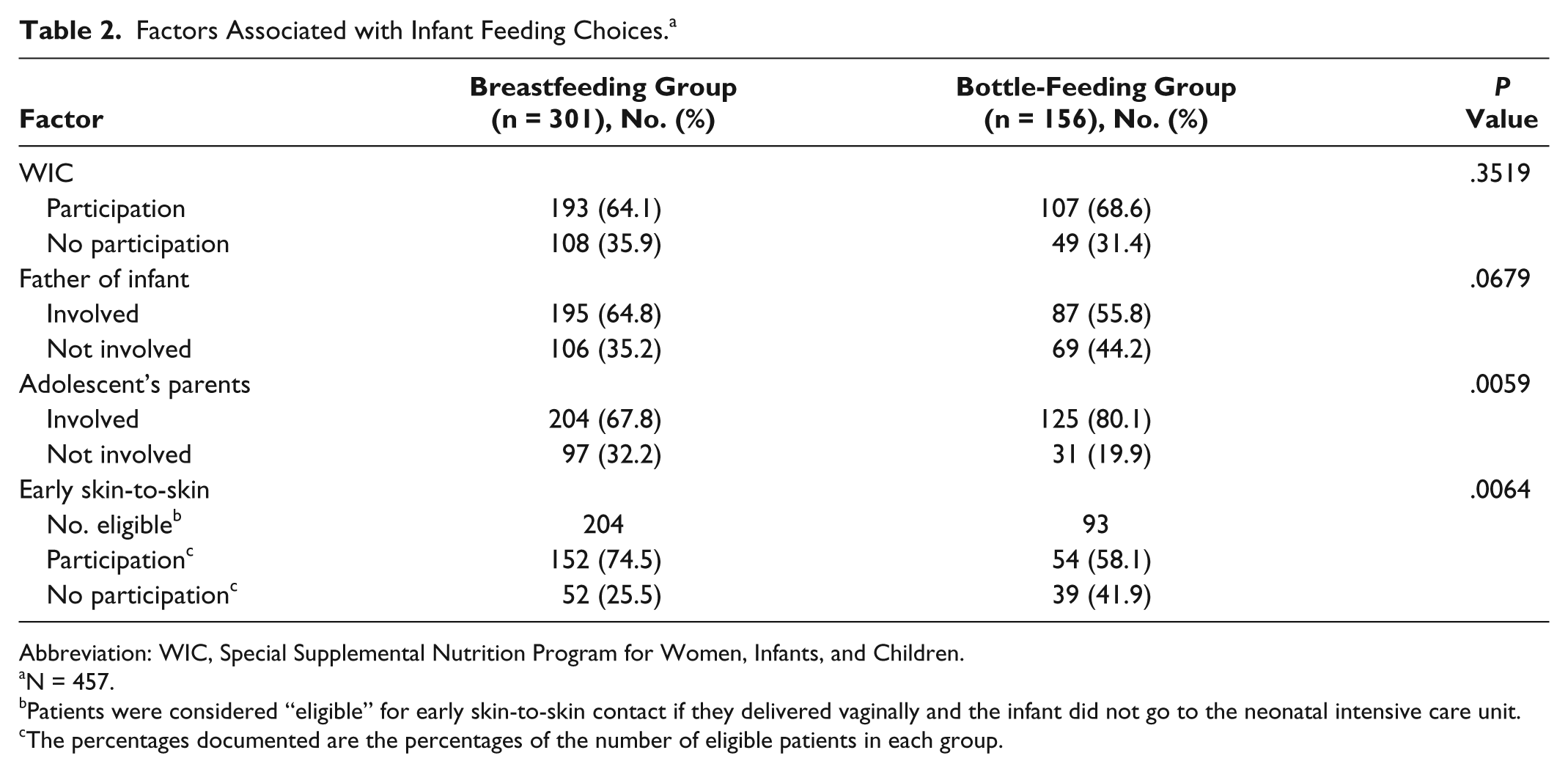
A slightly larger percentage of bottle-feeding patients reported participation in WIC (68.6% vs 64.1%), but this was not statistically significant (Table 2). A total of 195 breastfeeding adolescents (64.8%) reported involvement of the infant’s father and 87 bottle-feeding adolescents (55.8%) reported involvement of the infant’s father. This was not a statistically significant difference (Table 2).
Factors Associated with Infant Feeding Choices. a
Abbreviation: WIC, Special Supplemental Nutrition Program for Women, Infants, and Children.
N = 457.
Patients were considered “eligible” for early skin-to-skin contact if they delivered vaginally and the infant did not go to the neonatal intensive care unit.
The percentages documented are the percentages of the number of eligible patients in each group.
There was a significant difference in the involvement of the adolescent mother’s parents when the 2 groups were compared. There were 204 breastfeeding adolescents (67.8%) who reported at least 1 parent as involved and 125 of the bottle-feeding adolescents (80.1%) reported at least 1 parent as involved. This was a statistically significant difference, but it was the opposite of our hypothesis. The adolescent mothers in the bottle-feeding group were more likely to have parents who were involved than were the adolescent mothers in the breastfeeding group (Table 2).
There was also a statistically significant difference between the 2 groups of early skin-to-skin contact (Table 2). Of the 301 breastfeeding mothers, 204 were eligible for early skin-to-skin contact and 152 (74.5% of the eligible patients) participated. Of the 156 bottle-feeding mothers, 93 were eligible for early skin-to-skin contact and 54 (58.1% of the eligible patients) participated. The mothers in the breastfeeding group were more likely to have participated in early skin-to-skin contact if they were eligible (P = .0064).
Discussion
The postpartum adolescent population is a group that falls behind in breastfeeding numbers. Although the group of adolescents included in this study had a higher rate of breastfeeding than is often documented (65.9% of the adolescent mothers reported a plan to breastfeed), we are still far from the Healthy People 2020 objective of 81.9% of infants to be breastfed. 2
It was interesting to find that participation in WIC was not associated with a direct or indirect effect on the adolescent mothers’ decision to breastfeed or bottle feed. This is a favorable finding since this federal program was not intended to discourage breastfeeding. Other studies have shown significantly lower breastfeeding rates in the WIC population compared to mothers who do not participate in WIC. Some possible explanations for the finding of lower breastfeeding rates include WIC incentives for formula feeding, inability to afford extensive maternity leave time, lack of breastfeeding-friendly workplaces, or lack of social support. 9 One possible explanation for why we did not see a significant difference is that this study was looking specifically at the adolescent population. There are many social, maturity, and economic challenges that are unique to adolescent mothers. Perhaps, these unique challenges make the influence of WIC less important.
Although not significant, the trend of the involvement of the father of the infant was the opposite of our hypothesis: a larger percentage of the breastfeeding mothers reported that the father of the infant was involved (P = .0679). A significant difference may have been seen if a larger population of adolescent mothers was studied. This pattern suggests that it would not be unreasonable for future attempts at increasing breastfeeding rates in the adolescent population to target education of the young fathers regarding the benefits of breastfeeding. This would provide another route to reach more than half of the patients who chose to bottle feed. Initiatives to encourage the fathers’ involvement, stress the importance of maintaining a sense of family, and support the infants and mothers may improve breastfeeding rates.
The adolescents’ parents appear to influence infant feeding choices of the adolescents in our study, but opposite of the direction of the hypothesis. Bottle-feeding adolescents were more likely to report that their parents were involved. This may be related to the lower rates of breastfeeding that were seen in the 1990s, which would correspond to the time when the adolescent mothers were infants. Perhaps, the adolescent mothers’ parents are less likely to encourage breastfeeding if they did not breastfeed themselves. In addition, parents of the mother may have plans to assume the role of primary caretaker of the infant. They may support formula feeding as a means of transition to these alternative roles in order to provide their daughter a chance at continued education without breastfeeding responsibilities. Educating the new grandparents on the benefits of breastfeeding may lead to more encouragement from them and, ultimately, higher rates of breastfeeding in the adolescent mothers.
The breastfeeding mothers were more likely to have participated in early skin-to-skin contact immediately after birth. There is evidence that longer duration of skin-to-skin contact is associated with increased overall breastfeeding rates, increased rates of exclusive breastfeeding, and increased duration of breastfeeding. 15 Preliminary data from the University of Louisville Hospital CWI in 2011 revealed that the breastfeeding rates increased with higher rates of participation in Kangaroo Care. Although this intervention has been shown to increase overall breastfeeding rates in other studies, we are unable to say with certainty that this intervention actually caused an increase in the breastfeeding rate in the adolescent population studied. It is possible that the mothers who already intended to breastfeed were simply more receptive to such an idea than were the mothers who had already chosen to bottle feed. Although favorable inferences can be made regarding skin-to-skin contact in the adolescent population, the current published literature is not specifically inclusive of adolescent mothers. Further studies to compare the adolescent patients’ projected feeding plans and actual feeding choices with respect to participation in early skin-to-skin contact should be undertaken. Until then, it may still be worthwhile to strongly encourage all eligible adolescent mothers to participate in early skin-to-skin contact with their infants.
It is also important to note that although there was a significant difference between the groups with respect to race, the documentation system used at this institution does not allow for designation of ethnicity. A relatively large number of patients at this hospital are of Hispanic origin. These patients are likely included in the Caucasian or Unanswered race categories. This may cause apparent differences that may or may not be seen if patients are also compared based on ethnicity.
The most important limitation to this study was the reliance on nursing documentation that was completed before this study was planned. Five percent of all charts were excluded because of incomplete data. A questionnaire for the father of the infant would be useful to determine his status of support in breastfeeding. The involvement of the parents of the adolescents was inferred based on answers to other routine questions and not from a direct question about parental involvement. Future studies that examine the role of the adolescent mothers’ parents should include questions that directly ask the patient if she feels that her parents are involved and if they have an effect on her infant feeding choice. It would be interesting to see if there is a difference in the involvement of the adolescent’s mother, father, or both parents and if it affects feeding choice.
Another limitation to this study was the lack of long-term breastfeeding outcomes in the adolescent population. Healthy People 2020 also has objectives for continued breastfeeding at 6 months and 12 months of age (60.6% and 34.1%, respectively). 2 Because this study identified only patients who planned to breastfeed at the time of hospital admission, we are unable to comment on the breastfeeding rates of these patients during the first year after delivery.
Finally, adolescent mothers likely face very different challenges once they are discharged from the hospital. Although this study is sufficiently powered, the population analyzed cannot represent the many different social, economic, and maturity challenges that are unique to adolescent mothers. Associations may be made between these certain influences and feeding choices; however, causality cannot be firmly assessed due to the nature of the study. Further studies should include contacting the patients after discharge to question any changes in feeding choices to give further insight into potential influences.
Conclusion
Adolescent mothers are disproportionately affected by low socioeconomic status. These mothers and their infants will experience a higher incidence of adverse health outcomes due to this status. This study showed a higher-than-average participation in breastfeeding in this adolescent population compared to previous studies. Although there was not a statistically significant difference in the involvement of the father of the infant and a feeding-choice correlation, there was a trend toward more involvement and a decision to breastfeed. Involvement of the adolescent mother’s parents was associated with the decision to bottle feed, and participation in early skin-to-skin contact after birth was associated with the decision to breastfeed. This study is one of the first to investigate the multiple variables associated with infant-feeding practices in the adolescent population in the United States. Identifying social factors and interventions that can affect an adolescent mother’s feeding choice can serve as a bridge for the gap in health disparities seen in this at-risk population. Future research direction should focus on exploring the limitations expressed within this study, such as expanding the numbers of adolescents included, questioning the infant’s father’s perception of breastfeeding, and following up with changes in feeding choices after hospital discharge.
Footnotes
Declaration of Conflicting Interests
The authors declared no potential conflicts of interest with respect to the research, authorship, and/or publication of this article.
Funding
The authors received no financial support for the research, authorship, and/or publication of this article.