






Abstract
Background:
In addition to the well-known benefits of human milk and breastfeeding for the mother and infant, breastfeeding may mitigate neonatal abstinence syndrome severity in prenatally opioid-exposed infants. However, lack of conclusive data regarding the extent of the presence of buprenorphine and active metabolites in human milk makes the recommendation of breastfeeding for buprenorphine-maintained women difficult for many providers.
Objective:
This study seeks to determine the concentrations of buprenorphine and its active metabolites (norbuprenorphine, buprenorphine-glucuronide, and norbuprenorphine-glucuronide) in human milk, maternal plasma, and infant plasma of buprenorphine-maintained women and their infants.
Methods:
Up to 10 buprenorphine-maintained women provided paired breast milk and plasma samples at 2, 3, 4, 14, and 30 days postdelivery, and 9 infants provided plasma samples on day 14 of life. All samples were analyzed via liquid chromatography tandem mass spectrometry to determine concentrations of buprenorphine, norbuprenorphine, buprenorphine-glucuronide, and norbuprenorphine-glucuronide by a fully validated method.
Results:
Concentrations of buprenorphine and metabolites are low in human milk and maternal plasma. Breastfed infant plasma concentrations of buprenorphine were low or undetectable and metabolite concentrations undetectable at 14 days of infant age. There were significant correlations between maternal buprenorphine dose and maternal plasma and human milk buprenorphine concentrations.
Conclusion:
These data find low concentrations of buprenorphine and metabolites in human milk and lend support to the recommendation for lactation among stable buprenorphine-maintained women. However, the correlation between maternal dose and maternal plasma and human milk buprenorphine concentrations bears further study.
Well Established
Buprenorphine concentrations in human milk are generally low, but the lack of more conclusive data makes the recommendation of breastfeeding difficult in buprenorphine-maintained women.
Newly Expressed
Concentrations of buprenorphine in maternal plasma and human milk are low and dose dependent, and infants of buprenorphine-maintained breastfeeding women have minimal concentrations of buprenorphine and metabolites in their blood.
Introduction
The expanding problems related to maternal opioid use disorders and associated neonatal abstinence syndrome (NAS) in the United States over the past 2 decades are well documented. 1 Consequently, there are national calls for improved access to specialized treatment for pregnant women with opioid use disorders, with a major goal of mitigating NAS severity among prenatally opioid-exposed infants. Medication-assisted treatment, such as methadone or buprenorphine maintenance, is frequently indicated for this population. Buprenorphine use among pregnant women with opioid use disorders has expanded in recent years 2 since publication of the Maternal Opioid Treatment, Human Experimental Research (MOTHER) study, 3 which found that buprenorphine may confer an advantage to the infant relative to methadone in the form of reduced NAS severity. Buprenorphine is a semisynthetic opioid derived from thebaine, which occurs naturally in the opium poppy, and is a narcotic agonist and antagonist with complex metabolism. It has a large hepatic first-pass metabolism, with less than 20% of orally administered buprenorphine remaining unchanged in adult blood. Consequently, buprenorphine has low oral bioavailability, necessitating sublingual administration. Buprenorphine is extensively metabolized by N-dealkylation to norbuprenorphine, a poorly active metabolite with one-fiftieth the potency of buprenorphine, 4 and both buprenorphine and norbuprenorphine are subsequently conjugated with glucuronic acid to buprenorphine-glucuronide and norbuprenorphine-glucuronide. 5 Both glucuronide metabolites are active, and all 4 compounds have distinct pharmacologic profiles in animal models. All have binding affinity for opioid receptors; however, norbuprenorphine alone produces significant respiratory depression, 6 and only norbuprenorphine and norbuprenorphine-glucuronide alter motor capability, indicating sedative effects. 7
Breastfeeding and human milk have many significant, well-known health and other benefits for mothers and infants, which are particularly salient for women with substance use disorders and their infants. 8 Despite this, currently many women with opioid use disorders who are stable in treatment and recovery are discouraged from breastfeeding their infant for a variety of reasons, 8 contrary to established guidelines for this population. 9 Breastfeeding may reduce NAS severity in opioid-exposed infants, 10 but it is likely that this benefit has more to do with human milk and the act of breastfeeding (ie, smaller, more frequent feedings of digestible milk, maternal attention to more frequent infant cues) than with concentrations of medications used to treat opioid dependency in human milk. For methadone, previous work by this research group11,12 and others 13 confirmed that methadone concentrations in human milk are low, are not likely to affect the infant, and were unrelated to maternal dose. 12 However, breastfeeding recommendations for buprenorphine-maintained women may be hampered by a general dearth of data regarding concentrations of this medication and its metabolites in human milk and potential consequent effects on the breastfed infant. Previous research in small sample sizes14 -16 concluded that concentrations of buprenorphine and norbuprenorphine in human milk are low and unlikely to cause adverse effects. However, the generally good outcomes of breastfed infants of buprenorphine-maintained women are limited to case-report findings. 17 Lacking in the current literature are measurements of plasma concentrations of buprenorphine and metabolites in the plasma of infants of lactating, buprenorphine-maintained women and the examination of the correlation, or lack thereof, of breast milk and plasma concentrations with maternal buprenorphine dose. Conclusive data are lacking, limiting the breastfeeding option for many buprenorphine-maintained women.
The purpose of this study was to delineate buprenorphine, norbuprenorphine, and the glucuronide metabolites buprenorphine-glucuronide and norbuprenorphine-glucuronide concentrations in human milk and maternal plasma over the first month of life, and in infant plasma at 14 days of age. Furthermore, the relationship between maternal buprenorphine dose and these concentrations was determined.
Patients and Methods
As part of a larger study evaluating fetal and infant effects of maternal buprenorphine treatment (R01DA033689, Jansson PI), opioid-dependent and buprenorphine-maintained women attending comprehensive substance abuse treatment (described elsewhere), 18 who wished to breastfeed their infants and met other criteria to do so, 19 were invited to participate in a substudy, funded by a supplement to the parent grant, evaluating concentrations of buprenorphine and metabolites in human milk, and maternal and infant plasma. Fourteen participants provided informed consent to participate; 4 of the participants did not provide samples because they met exclusion criteria prior to delivery (1 delivered preterm, 1 infant had significant medical complications, and 2 participants had positive urine toxicology indicating recent illicit substance use/licit substance misuse), leaving 10 participants. Of these 10 participants, 5 were on psychiatric medication compatible with breastfeeding, and 6 had at least 1 urine toxicology positive for illicit substance use/licit substance misuse during their time in substance abuse treatment, but all met abstinence criteria for breastfeeding prior to delivery. 19 Ten buprenorphine-maintained (dose range 2-22 mg, sublingually, once per day) participants provided human milk samples at times of peak buprenorphine concentrations (2-2.5 hours after daily sublingual dose) on days 2, 3, 4, 14, and 30 after delivery. Days were determined as the 24-hour period of the corresponding infant day of life on days 2, 3, and 4, and by the 48-hour period surrounding days 14 and 30. Infant participants provided blood samples on day 14 of life coincident with a heel stick for phenylketonuria testing (a routine pediatric screening blood test performed around this time). This study was approved by the Johns Hopkins Medicine Institutional Review Board, and written informed consent was obtained from participants.
Specimens and Analysis
Maternal blood was collected into a sodium fluoride/potassium oxalate vacutainer tube, mixed, and stored on ice for no more than 2 hours before centrifugation (1200 g, 10 minutes, 4°C). Plasma was transferred to CryoTubes and stored frozen (–20°C) prior to analysis. Infant blood was collected via heel stick into a microcentrifuge tube containing sodium fluoride and potassium oxalate, mixed, and stored on ice for no more than 2 hours before centrifugation (5000 g, 5 minutes, 4°C). Plasma was transferred to a microcentrifuge tube and stored frozen prior to analysis.
Breast milk was pumped into a 50-mL Falcon tube and stored on ice for no more than 2 hours before transferring to a 10-mL conical polypropylene tube and stored at −20°C prior to analysis.
Plasma and human milk samples were simultaneously analyzed for buprenorphine, norbuprenorphine, buprenorphine-glucuronide, and norbuprenorphine-glucuronide via liquid chromatography tandem mass spectrometry by a fully validated method. 20 Briefly, plasma or human milk (100 µL) was fortified with deuterated internal standards and proteins precipitated with acetonitrile. Supernatants were diluted with 0.1 M phosphoric acid and loaded onto preconditioned polymeric, strong cation exchange, solid phase extraction cartridges (Strata X-C, 60 mg/3 mL). Analytes were eluted with methylene chloride:isopropanol:ammonium hydroxide (70:26:4, v/v/v), dried under nitrogen, and reconstituted in mobile phase. Samples were injected (50 µL) onto a Shimadzu Prominence UFLCxr coupled to a SCIEX 500 QTRAP MS for analysis. Lowest limits of quantification (LOQs) were 0.1 (buprenorphine, buprenorphine-glucuronide), 0.25 (norbuprenorphine-glucuronide), and 2 (norbuprenorphine) µg/L. Upper LOQs were 20 (buprenorphine, buprenorphine-glucuronide), 50 (norbuprenorphine-glucuronide), and 100 (norbuprenorphine) µg/L. Bias and imprecision were < ±16%.
Results
Maternal participants were an average of 26.1 ± 4.7 years of age, with a high school (mean 12.2 ± 1.9 years of education) education. Mean gestational age upon treatment entry was 17.3 ± 7.6 weeks. All participants except 1 smoked cigarettes. Three participants exclusively breastfed their infants; the rest breastfed and supplemented with formula. Infant participants (4 male, 6 female) were born at term (mean 39.2 ± 1.2 weeks gestation), all with 5 minute Apgar scores of 9. Birth parameters were appropriate for gestational age in all infants (mean birth weight 3279.5 ± 465.5 grams). One infant required pharmacotherapeutic treatment with oral morphine sulfate for mild NAS for 12 days; the remainder left the hospital on day 4 of life without pharmacotherapy. The numbers of maternal participants providing breast milk and plasma and infants providing plasma on each collection day are described in Table 1. Reasons for missing human milk samples are as follows: on day 4, 2 participants had insufficient human milk after feeding their infant; on day 14, 1 participant lost custody of her infant to the father, who removed the baby from her care; on day 30, 1 participant had inadequate milk supply, 1 participant had a positive toxicology for benzodiazepines and was disenrolled from the study, and the participant who had lost custody was no longer with her infant. Reasons for missing plasma samples are as follows: on day 4, 1 participant refused to give a blood specimen; by day 14, the participant who lost custody of her infant had been transferred to another treatment program; and on day 30, the participant who was disenrolled for positive toxicology testing and the participant who lost custody did not leave samples.
Human Milk Concentrations of Buprenorphine and its Active Metabolites.

Abbreviations: BUP, buprenorphine; Gluc, glucuronide; LOQ, limit of quantification; NBUP, norbuprenorphine.
0.1 µg/L.
2 µg/L.
0.25 µg/L.
Human Milk Concentrations of Buprenorphine and Norbuprenorphine
Concentrations of buprenorphine, norbuprenorphine, and glucuronide metabolites in human milk samples are presented in Table 1. Buprenorphine was detected in all human milk samples on all sampling days. Norbuprenorphine and metabolites were variably detected.
Maternal Plasma Concentrations of Buprenorphine and Norbuprenorphine
Buprenorphine, norbuprenorphine, and glucuronide metabolite concentrations in maternal plasma samples are presented in Table 2. Similar to human milk concentrations, buprenorphine was detected in all maternal plasma samples on all sampling days. Buprenorphine-glucuronide and norbuprenorphine were variably detected. Norbuprenorphine-glucuronide also was detected in all maternal plasma samples.
Maternal Plasma Concentrations of Buprenorphine and its Active Metabolites
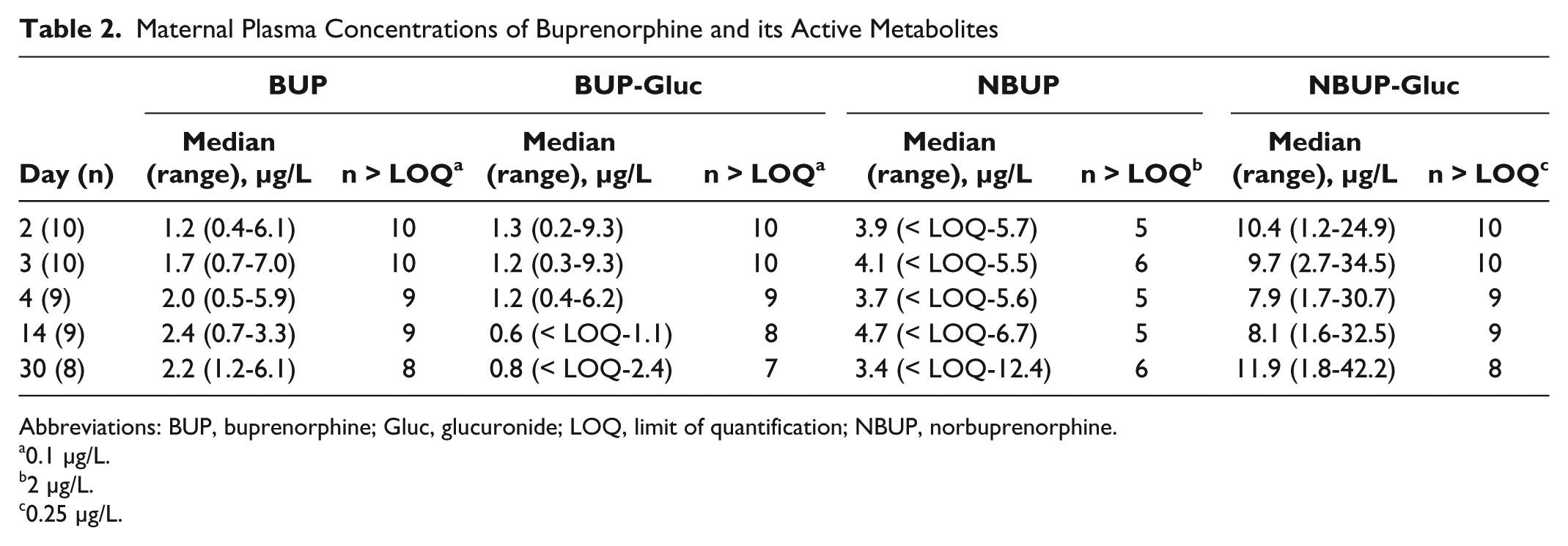
Abbreviations: BUP, buprenorphine; Gluc, glucuronide; LOQ, limit of quantification; NBUP, norbuprenorphine.
0.1 µg/L.
2 µg/L.
0.25 µg/L.
Buprenorphine Human Milk to Maternal Plasma Ratio
Ratios of median concentrations of buprenorphine in human milk to maternal plasma ratios by day are presented in Table 3. Ratios vary from 0.7 (day 4) to 2.0 (day 14).
Human Milk to Plasma Ratio by Day

Abbreviations: BM, breast milk; P, plasma.
Infant Plasma Buprenorphine, Norbuprenorphine, and Glucuronide Metabolite Concentrations
Infant plasma buprenorphine, norbuprenorphine, and glucuronide metabolite concentrations are presented in Table 4. Buprenorphine was detected at low concentrations (0.2, 0.7, 1.0, and 2.9 µg/L) in 4 of 9 infant plasma samples on day 14 of life and was undetectable in the remaining 5 infant plasma samples. Norbuprenorphine, buprenorphine-glucuronide, and norbuprenorphine-glucuronide concentrations were not detected above the LOQ in any infant plasma sample.
Infant Plasma Concentrations of Buprenorphine and its Active Metabolites (N = 10).

Abbreviations: BUP, buprenorphine; Gluc, glucuronide; LOQ, limit of quantification; NBUP, norbuprenorphine.
0.1 µg/L.
2 µg/L.
0.25 µg/L.
Relationship of Maternal Buprenorphine Dose to Human Milk, Maternal Plasma, or Infant Plasma Concentrations
Nonparametric correlation coefficients (Spearman correlations) assessed the strength of association between maternal daily buprenorphine dose and buprenorphine concentrations in maternal plasma and human milk (Table 5). Results are presented in Table 6. Statistically significant correlations between dose and maternal plasma buprenorphine concentrations ranged from 0.67 (day 14) to 0.85 (day 2). Correlations between maternal dose and human milk concentrations ranged from 0.64 (day 3) to 0.88 (day 4). All but 1 was significant, and the P value of the nonsignificant relationship was .051.
Buprenorphine Concentrations in Maternal Plasma and Human Milk on Days 2, 3, 4, 14, and 30.

Abbreviations: BUP, buprenorphine; IQR, interquartile range.
Correlation between Maternal Buprenorphine Dose and Maternal Plasma and Human Milk Buprenorphine Concentrations on Days 2, 3, 4, 14, and 30.

Abbreviation: BUP, buprenorphine.
Spearman’s rank correlation coefficient.
Bolded values represent significance at p<.05.
Discussion
Breastfeeding/human milk consumption is particularly beneficial for prenatally opioid-exposed infants, who are at risk for myriad concerns in the neonatal period and beyond. Breastfeeding/human milk was associated with reduced NAS severity and can mitigate effects of maternal opioid exposure on the infant. Currently, few data are available to guide providers in supporting buprenorphine-maintained women in lactation. With data lacking, many buprenorphine-maintained lactating women are not encouraged to breastfeed or are actively discouraged from breastfeeding their infants due to a lack of conclusive evidence regarding concentrations of buprenorphine and its active metabolites in human milk. Per these results, we find that buprenorphine appears in human milk at a ratio of approximately 1 to 2 times that of maternal plasma. Concentrations of buprenorphine, norbuprenorphine, and glucuronide metabolites in maternal plasma and human milk were low, similar to results of other studies,14 -16 and the potential infant dose of buprenorphine delivered via lactation also was low. Buprenorphine’s poor oral availability further decreases the amount of buprenorphine that is deliverable to the infant during feeding. In addition, we found that infant plasma buprenorphine concentrations were < LOQ (56% of infants) or low (0.2-2.9 µg/L in 44% of infants), and norbuprenorphine, buprenorphine-glucuronide, and norbuprenorphine-glucuronide were not detected. It is important that metabolites with sedation and respiratory depression properties were absent in infant plasma. It is interesting that only 1 of 3 infants of exclusively breastfeeding women had detectable plasma buprenorphine (0.7 µg/L). Using an estimate of 600 mL human milk per day for an exclusively breastfeeding infant at 2 weeks of age, and median concentration of buprenorphine in breast milk at this age (4.8 µg/L), a relative infant dose of 2.9 µg/day buprenorphine can be calculated. Buprenorphine has been used in experimental algorithms to treat NAS in opioid-exposed infants 21 at doses beginning at 15.9 µg/kg/day (for an average term 14-day-old infant of 5.7 kg, 22 dosing begins at 90.6 µg/day in 3 divided doses). Hence, the amount of buprenorphine delivered via breast milk as calculated would be insufficient to treat NAS. It is important to note that all values reported are maximal, as samples were taken at time of peak maternal buprenorphine concentration.
Limitations of this study include small group size, a feature common to lactation research regarding women with substance use disorders, and variable amounts of human milk received by the majority of the sample, who received formula supplementation. Reports of exclusive breastfeeding versus supplementation with formula were by maternal report, which can be unreliable. Only 3 of the infants were exclusively breastfed. This may affect the interpretation of infant plasma results but not the maternal results as maternal dosing for all participants was observed.
The significant correlations between maternal dose and maternal plasma and human milk concentrations of buprenorphine are in contrast with the lack of such relationships found in methadone-maintained breastfeeding women. 12 Buprenorphine has a higher logarithm of partition coefficient 23 than methadone, 24 indicating higher lipophilicity. Therefore, it is likely that buprenorphine partitioning into human milk is superior to that of methadone, which may explain this finding.
Only 1 of the infants in this sample required pharmacologic treatment for NAS. Both maternal buprenorphine maintenance (as compared to methadone) and breastfeeding (in a methadone-maintained sample) are associated with lower severity of NAS.3,25 Kacinko et al 26 reported that although there was no significant relationship between maternal buprenorphine dose and meconium concentrations of buprenorphine or norbuprenorphine, concentrations of buprenorphine in meconium were related to NAS scores > 4. The mother of the infant who required treatment for NAS was on a dose of 18 mg of buprenorphine per day, and she was not an exclusive breastfeeder. The fact that the theoretically calculated dose of buprenorphine delivered via breast milk is low, combined with the low rate of pharmacologically treatable NAS in this breastfed sample, lends strength to the argument that the benefits of breastfeeding by women with opioid use disorders receiving medication-assisted treatment are not from opioid delivered via breast milk. 8
It is unclear why buprenorphine was detected in some infant plasma samples and not in others; however, all concentrations were low and close to the LOQs. One reason for this finding might be that oral buprenorphine has low bioavailability, and variations in infant feeding mechanics, frequently dysregulated in opioid-exposed infants, might lead to absorption in some infants via mucosa and not others. In addition, variable metabolism between infants may also contribute to this finding. Of the 4 infants who had detectable buprenorphine concentrations in their plasma at 2 weeks of age, 3 of their mothers had the 3 highest buprenorphine doses (22, 18, and 16 mg daily with respective infant plasma concentrations of 0.7, 2.9, and 0.2 µg/L) and only 1 of these (22-mg dose) was an exclusive breastfeeder. Another mother who was maintained on 16 mg of buprenorphine daily had an infant with a buprenorphine plasma concentration < LOQ. However, for the fourth infant, the mother was not an exclusive breastfeeder and had a daily dose on the lower range of the spectrum (6 mg daily with an infant plasma concentration of 1.0 µg/L). All 4 mothers of infants with detectable plasma buprenorphine concentrations on day 14 had buprenorphine human milk concentrations < LOQ on day 14. Infant plasma concentrations on day 14 may be due to in utero exposures of the highly lipophilic buprenorphine that is stored in fetal tissue as well as from human milk.
Conclusion
The significant relationships between maternal dose and maternal plasma and human milk concentrations found here bear further study; however, these results in general contribute to the recommendation for breastfeeding in buprenorphine-maintained women, given the low concentrations of buprenorphine found in maternal plasma and human milk and the poor bioavailability of this medication when taken orally. It is evident that the relationship between maternal daily dose of buprenorphine and the concentration of buprenorphine in infant plasma is complex. Unknown are the consequences or lack of effects of even small amounts of opioid on the developing infant brain over time. Future research should additionally evaluate human milk, maternal plasma, and infant plasma concentrations among buprenorphine-maintained women who are on higher doses of buprenorphine and breastfeed for longer periods of time, and breastfed infant buprenorphine plasma concentrations sampled longitudinally to differentiate buprenorphine concentrations from in utero exposure from human milk exposure. In addition, these concentrations should be determined in buprenorphine-naloxone–maintained women, a group currently often discouraged from breastfeeding due to an absence of data to recommend breastfeeding in this group.
Footnotes
Acknowledgements
The authors thank the participants for their contribution to this research and acknowledge NIDA RO1 DA031689 (supplemental) funding.
Authors’ Note
The clinical trial registry name and registration number is A Study of Breastfeeding in Buprenorphine Maintained Women, NCT01806389.
Declaration of Conflicting Interests
The authors declared no potential conflicts of interest with respect to the research, authorship, and/or publication of this article.
Funding
The authors disclosed receipt of the following financial support for the research, authorship, and/or publication of this article: This research was funded by a NIH/NIDA supplement to RO1DA031689, awarded to the first author.