






Abstract
Background:
Successful human milk supply in neonatal intensive care units (NICUs) requires the development of family-centered services.
Objective:
This study aimed to assess parent perceptions of factors that help or hinder providing human milk to very preterm infants (VPI) in the NICU according to sociodemographic, reproductive, and obstetric characteristics.
Methods:
This cross-sectional quantitative study included 120 mothers and 91 fathers of VPI hospitalized in a level 3 NICU located in the Northern Health Region of Portugal (July 2013-June 2014). Interviewers administered structured questionnaires regarding parent characteristics and the provision and perception of factors that help or hinder human milk supply in the NICU, 15 to 22 days after birth.
Results:
The main facilitators of human milk supply were its contribution to infant growth and well-being (51.4%) and parents’ knowledge of breastfeeding benefits (27.6%). The main barriers were worries related to inadequate milk supply (35.7%), difficulties with expressing breast milk (24.8%), and physical separation from infants (24.3%). Fathers referred less frequently to the contribution of human milk to infant growth and well-being (odds ratio [OR] = 0.57; 95% confidence interval [CI], 0.32-1.00) but more frequently to knowledge of breastfeeding benefits as facilitators (OR = 2.31; 95% CI, 1.23-4.32). Participants with > 12 years of education (OR = 1.91; 95% CI, 1.05-3.47) and those with an extremely low birth weight infant (OR = 1.90; 95% CI, 1.02-3.54) highlighted worries related to inadequate milk supply. Fathers (OR = 2.16; 95% CI, 1.11-4.19) and participants with ≤ 12 years of education (OR = 0.25; 95% CI, 0.11-0.57) more frequently reported difficulties with expressing as the main barrier.
Conclusion:
The parent’s gender and education and the infant’s birth weight are crucial considerations for establishing optimal practices for supporting breastfeeding.
Keywords
Well Established
Recent recommendations and consensus provide strategies to promote human milk supply in the neonatal intensive care unit (NICU), primarily based on expert views. Parents report that successful breastfeeding depends on knowledge, reinforcement of the mother’s motivation, and alignment between NICU routines and parental needs.
Newly Expressed
Considering the parent’s gender and education and the infant’s birth weight is crucial for establishing optimal practices to support breastfeeding. Increasing the father’s understanding of the mother’s experience and improving knowledge and confidence in breastfeeding may help promote family-centered care.
Background
The benefits of human milk for preterm infants’ health and well-being are widely recognized. 1 Host protection, lower rates of retinopathy of prematurity, fewer hospital readmissions for illness, and improved long-term developmental and health outcomes2-4 support advocacy for the protection and promotion of breastfeeding in neonatal intensive care units (NICUs). With this objective, recommendations, protocols, and consensus guidelines regarding successful breastfeeding 5 and kangaroo mother care6,7 have been recently published, primarily based on expert views. 8
Optimal practices that support breastfeeding in the NICU include the establishment of clear guidelines,5,8 the provision of accurate information about the human milk supply,5,6 the support of parents’ roles,6,8 and staff motivation.7,8 A sensitive approach to care and a friendly physical environment6,8 are crucial to such practices. Therefore, the implementation of these strategies supports the development of services centered on families’ needs, preferences, and experiences.9,10
A recent systematic review examining parent perspectives about the facilitators and barriers to human milk supply for children hospitalized in the NICU indicated that a successful experience depends on the following: (1) coherent and accurate knowledge about human milk supply techniques and benefits; (2) continuous and positive feedback to reinforce mothers’ motivation; and (3) alignment between NICU routines and parents’ needs while safeguarding the privacy and proximity of the mother, father, and child. 11 In fact, parents perceive that the main facilitators of human milk supply are its contribution to the infant’s growth and well-being,12,13 the sense of “normality,”14,15 the opportunity to hold and connect with the infant, 16 the learning of breastfeeding techniques,12,14 and knowledge regarding infants’ and women’s bodies and behaviors. 15
The effort that mothers and fathers undertake in the NICU to establish their roles as parents17,18 is particularly intense after a very preterm delivery. The child’s vulnerability, 14 difficulties with pumping and worries surrounding inadequate milk supply,13,14 challenges with being the infant’s primary caregiver,15,19 and the physical separation from the child combined with structured and controlled opportunities for interaction15,16,19 emerged as the main barriers to human milk supply in the NICU. In addition, feelings of failure, guilt, and uncertainty about prematurity,20,21 as well as the ideology of intensive parenthood, which promotes parenting that is exclusive, wholly child-centered, emotionally involving, and time consuming,22,23 may hinder the establishment and maintenance of human milk supply.12,14
Previous works have rarely analyzed fathers’ perceptions of lactation during their child’s hospitalization in the NICU24,25 and have not discussed how socioeconomic, reproductive, and obstetric factors may influence parents’ perceptions of the facilitators and barriers to human milk supply in the NICU. 11 Also, evaluating parents’ perceptions of the facilitators and barriers to milk supply differs from the study of the adequacy of the human milk supply and its facilitators and barriers. This study addresses this gap by assessing parents’ perceptions of factors that help or hinder human milk supply for very preterm infants in the NICU according to sociodemographic, reproductive, and obstetric factors.
Methods
This observational and cross-sectional study is based on a cohort of parents of very preterm infants, and the protocol has been previously described. 26 The study was approved by the National Data Protection Commission and the Ethics Committees of all hospitals where the study was performed, and written informed consent was obtained from all participants.
All mothers and fathers of infants born before 32 weeks of gestation between July 2013 and June 2014 and hospitalized in all level 3 NICUs in the Northern Health Region of Portugal (n = 7) were consecutively and systematically invited to participate in the study. None of these units have individual or smaller rooms for 2 infants, but all offer a breastfeeding corner that provides some degree of privacy. Parents are allowed to visit their infants during the day and can stay overnight in specific situations. When an infant’s clinical conditions permit, parents are offered the opportunity to hold their infant close to their chest and provide skin-to-skin contact in the intensive care areas.
Parents were approached 2 weeks after birth during the hospital stay by a NICU health professional (neonatologist or professional nurse) who was responsible for the study presentation and invitation. Only parents without serious illness that precluded NICU visitation (eg, severe chronic conditions) and families who were present in the NICU during the hospitalization period were considered eligible to participate in the study. Among the 126 families eligible for the study, 122 (98.6%) agreed to participate, including 120 mothers and 91 fathers (Figure 1). During data collection, 2 mothers were absent because of medical complications, and 31 fathers were absent because of professional commitments or emigration. After the exclusion of 1 participant with missing data pertaining to factors that help or hinder human milk supply, 210 participants were included in our analysis.

Flowchart of Participant Selection.
Trained interviewers were responsible for administering structured questionnaires to mothers and fathers separately 15 to 22 days after the child’s birth. Data on sociodemographic characteristics (gender, age, and education), previous pregnancies, the use of assisted reproductive technologies for the current pregnancy, and the provision and the perception of factors that help or hinder human milk supply in the NICU were collected through self-report.
All of the mothers and fathers were asked if their infant had ever been fed with the mother’s own milk and all were asked to report their perceptions of facilitators and barriers to providing human milk in the NICU. The main facilitators to human milk supply were assessed through a specific question: “I will present some situations that parents may consider facilitators of human milk supply in a NICU. Among these, which in your opinion is the one that most helps with human milk supply in the NICU?” A similar question was used to assess the main barriers by asking what, in the parents’ opinion, is the main factor that hinders human milk supply in the NICU. The answers were categorized according to the results of a recent systematic review that synthesized parent views on factors that help or hinder human milk supply in the NICU. 11 According to that review, the primary factors that facilitate the provision of human milk in the NICU were the following: knowing the benefits of human milk supply (accurate knowledge regarding its health benefits for both mothers and infants); the contribution of human milk to infant growth and well-being; the opportunity to hold and connect with infants; knowledge regarding milk expression (techniques and strategies); positive reinforcement and feedback from health professionals; sharing experiences with the parents of other hospitalized children; the availability of sterile supplies for milk expression; and the father’s involvement in the provision of the mother’s milk. The main factors that hinder human milk supply included difficulties with milk expression, such as pain, transporting the milk, stimulation, and feelings of exhaustion and frustration; worries related to an inadequate milk supply; inconsistent information and/or conflicting advice; physical separation from infants; the newborn’s appearance (infant vulnerability); and lack of support. Both questions allowed the participants to select “other” as an option and to specify the other factor.
Clinical records were also reviewed to retrieve data on pregnancy complications, such as infectious, placental, hemorrhagic, and cardiovascular complications; multiple pregnancy; birth weight; and gestational age. Extremely low birth weight and extremely preterm infants were defined as those with a birth weight of less than 1000 grams and a gestational age of less than 28 weeks, 27 respectively.
Statistical analysis was performed using Stata 11.0. The proportion of parents who named each of the factors that help or hinder human milk supply in the NICU is presented according to sociodemographic, reproductive, and obstetric characteristics. Crude and adjusted odds ratios (ORs) and their respective 95% confidence intervals (CIs) were estimated with unconditional binary logistic regression models to assess the association between the participant characteristics and each factor that helps and hinders human milk supply, which was reported by more than 10% of the participants. The models were adjusted for potential sociodemographic (gender, age, and education level), reproductive (gravidity), and obstetric (extremely low birth weight infants) confounders.
Results
Only 4 families reported that they did not provide human milk to their newborns at some point since birth, for the following reasons: inadequate milk supply, newborn refusal, maternal drug therapy, and difficulties with expressing. All human milk was expressed with a breast pump.
Overall, 70.5% of the parents were younger than 35 years, and approximately 38% had more than 12 years of education (Table 1). This was the first pregnancy for nearly 56% of the participants, and 13.7% had undergone assisted reproductive technologies for the current pregnancy. Almost 43% had had at least 1 pregnancy complication, and 23.3% of the pregnancies were multiple. One-fifth of the deliveries resulted in extremely preterm infants, whereas 29.5% of the deliveries resulted in infants who were classified as extremely low birth weight.
Characteristics of Participants (n = 210).

< 28 gestational weeks.
< 1000 g.
The factors that help human milk supply in the NICU according to sociodemographic, reproductive, and obstetric characteristics are summarized in Table 2. When asked about the main factors that help human milk supply in the NICU, more than half of the participants (51.4%) reported human milk’s contribution to the infant’s growth and well-being. Moreover, 27.6% referred to knowledge about human milk supply benefits, 9.1% to the opportunity to hold and connect with the infants, and 7.6% to knowledge regarding milk expression, whereas 4.3% reported other factors, such as sharing experiences with the parents of other hospitalized children (n = 4), the father’s involvement (n = 4), and the perception that breastfeeding is mandatory (n = 1). The mothers more frequently indicated human milk’s contribution to the infant’s growth and well-being and the opportunity to hold and connect with their infants as the main facilitators of human milk supply, whereas the fathers were more likely to highlight knowledge about the benefits of human milk supply. Participants with previous pregnancies, those who used assisted reproductive technologies for the current pregnancy, those with a multiple pregnancy, and those who delivered an extremely low birth weight infant more frequently indicated that human milk’s contribution to the infant’s growth and well-being was a helping factor. Knowledge of the benefits of human milk supply was more likely to be the main facilitator for parents without previous pregnancies, those who did not use assisted reproductive technologies, and those who had no pregnancy complications but an extremely preterm delivery.
Factors That Help Human Milk Supply in Neonatal Intensive Care Unit, according to Sociodemographic, Reproductive, and Obstetric Characteristics (n = 210).
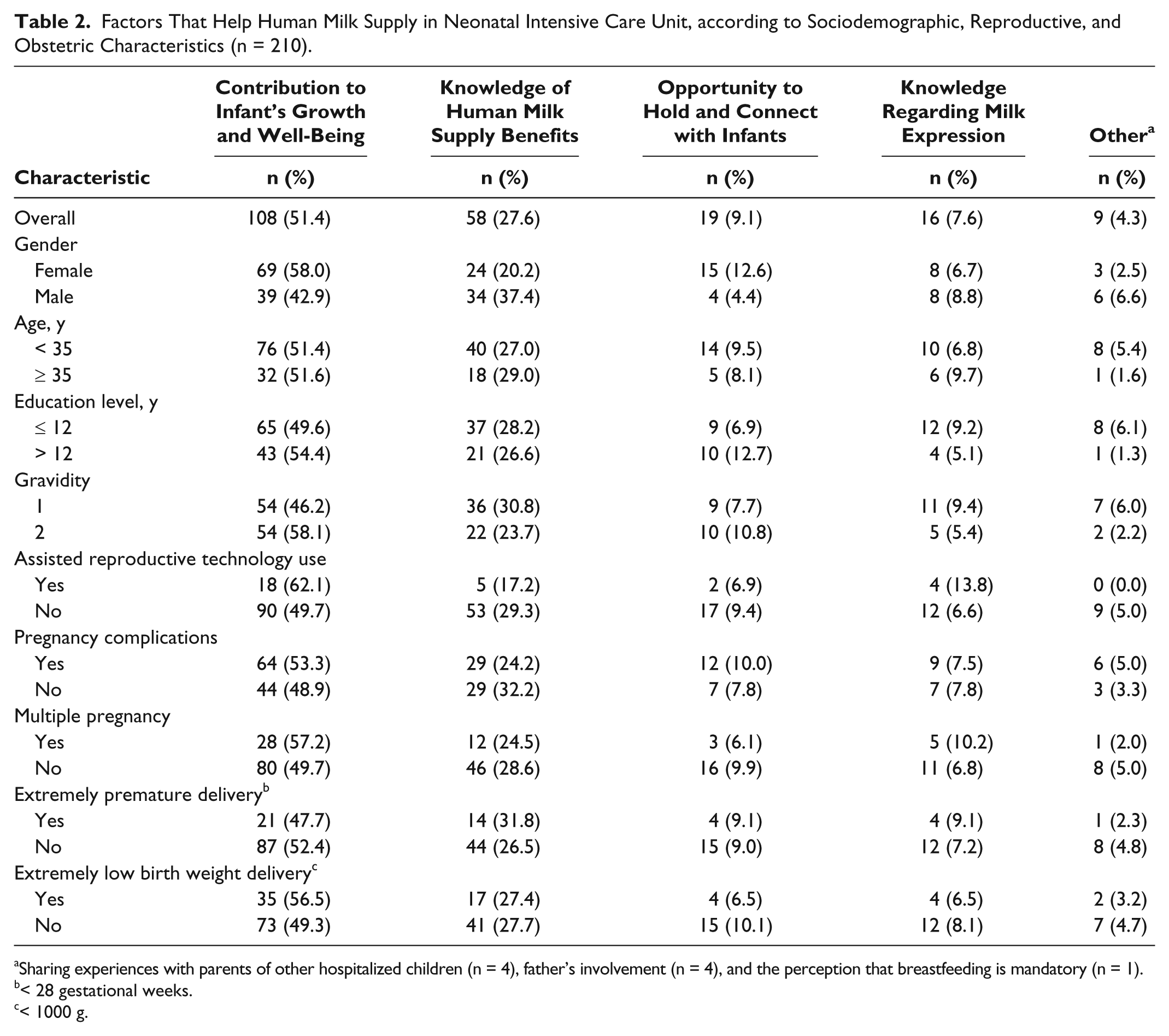
Sharing experiences with parents of other hospitalized children (n = 4), father’s involvement (n = 4), and the perception that breastfeeding is mandatory (n = 1).
< 28 gestational weeks.
< 1000 g.
Table 3 summarizes the factors that hinder human milk supply in the NICU, according to sociodemographic, reproductive, and obstetric characteristics. The participants selected the following as the main factors that hinder human milk supply in the NICU: worries related to inadequate milk supply (35.7%), difficulties with expressing (24.8%), and physical separation from infants (24.3%). Almost 9% (8.6%) reported other reasons, including inconsistent information and/or conflicting advice (n = 9), a lack of support (n = 3), a lack of sterile supplies (n = 2), the appearance of the newborn (n = 1), a lack of privacy (n = 1), worries regarding the hospitalization (n = 1), and the clinical situation of the infant (n = 1). It is noteworthy that 6.7% of the participants stated that there was no barrier to human milk provision in the NICU. Worries related to inadequate milk supply and the physical separation from infants were primarily expressed by the more educated parents, whereas those with an education equal to or less than 12 years were more likely to note difficulties with expressing. Participants without previous pregnancies, those with no complications during pregnancy, and those who did not have a multiple pregnancy but had an extremely preterm delivery or an extremely low birth weight infant tended to more frequently report worries related to an inadequate milk supply as the main barrier. Difficulties with expressing were more frequently identified by those with a multiple pregnancy or those who had no complications during pregnancy but were less likely to be cited by those who used assisted reproductive technologies for the current pregnancy. Mothers and fathers who used assisted reproductive technologies and those with a multiple pregnancy or complications during pregnancy but without an extremely preterm delivery or an extremely low birth weight infant were more likely to highlight the physical separation from the infants.
Factors That Hinder Human Milk Supply in the Neonatal Intensive Care Unit, according to Sociodemographic, Reproductive, and Obstetric Characteristics (n = 210).

Inconsistent information and/or conflicting advice (n = 9), lack of support (n = 3), no access to sterile supplies (n = 2), the newborn’s appearance (n = 1), lack of privacy (n = 1), worries regarding the hospitalization (n = 1), and the clinical situation of the infant (n = 1).
< 28 gestational weeks.
< 1000 g.
Table 4 presents the characteristics associated with the perception of the main factors that help or hinder human milk supply in the NICU. After adjustment for gender, age, education level, gravidity, and extremely low birth weight infants, fathers remained less likely to refer to human milk’s contribution to the infant’s growth and well-being as the main facilitator (OR = 0.57; 95% CI, 0.32-1.00), but they were more likely to indicate knowledge of the benefits of human milk supply (OR = 2.31; 95% CI, 1.23-4.32). Regarding the main barriers to human milk supply in the NICU, parents with more than 12 years of education and those who delivered an extremely low birth weight infant were approximately 2 times more likely to indicate worries related to inadequate milk supply (OR = 1.91; 95% CI, 1.05-3.47; and OR = 1.90; 95% CI, 1.02-3.54, respectively). Fathers more frequently selected difficulties with expressing as the main factor that hinders human milk supply (OR = 2.16; 95% CI, 1.11-4.19), whereas parents with more than 12 years of education (OR = 0.25; 95% CI, 0.11-0.57) were less likely to select this barrier.
Sociodemographic, Reproductive, and Obstetric Characteristics Associated with the Main Factors That Help or Hinder Human Milk Supply in the Neonatal Intensive Care Unit.

Abbreviation: OR, odds ratio.
Adjusted for all the variables in the table.
< 1000 g.
Discussion
This study found that there are gender, education, and obstetric differences in parents’ perceptions of factors that help or hinder human milk supply in the NICU. Fathers were more likely to indicate knowledge regarding the benefits of human milk supply as the main facilitator and difficulties with expressing as the main barrier to human milk supply in the NICU but were less likely to choose the contribution to the infant’s growth and well-being as a facilitator. In addition, participants who indicated worries related to inadequate milk supply were more likely to have an education level higher than 12 years and to have delivered an extremely low birth weight infant, whereas those who noted difficulties with expressing were less likely to have more than 12 years of education.
Parent perceptions of the factors that help or hinder providing human milk to very preterm infants in the NICU may reflect their internalization of wider sociocultural norms associated with intensive parenthood, in the sense that these parenting practices are child centered and expert guided.22,23,28 Parents value the facilitators associated with medical and scientific knowledge regarding the benefits of breastfeeding,23,29 particularly the benefits for the children. 1 Furthermore, the importance attributed to a woman’s difficulty producing and/or expressing milk of adequate volume or high quality13,14 as a barrier reproduces the biomedical metaphor of the production line for breastfeeding, with its notions of demand and efficient supply. 29 In fact, biomedical knowledge tends to emphasize the quantity of expressed milk, as well as the frequency and duration of breastfeeding, rather than the psychosocial and affective dimension that underlies breastfeeding.15,30 It is noteworthy that the delivery of a premature infant is associated with a delay in lactogenesis stage II, which can result in an inadequate volume of human milk for feeding.31,32 In fact, decreased milk production may be caused by decreased mammary gland development and decreased exposure to prolactin, cortisol, and other hormones that normally occur during a full-term pregnancy. 31
Physical separation from the infants was a barrier more frequently indicated by mothers. Intensive parenthood has different effects for mothers and for fathers, 33 and fathers more often emphasize difficulties with expressing. The paradoxical view of the pump as simultaneously a source of separation from and connection to the infant 34 has been previously described, and some mothers express profound dislike for the expressing process despite continuing to provide milk to their infants.34,35 In this context, the father’s awareness of barriers to human milk supply may be explained by social representations regarding women’s difficulty with adequately using technology36,37 combined with the fathers’ interpretation of the feelings expressed by the mothers.34,35 Because of the importance of the father’s support during breastfeeding, 38 it may be useful to sensitize fathers to the mother’s views and experiences.
Our findings also show that less-educated parents more often report difficulties with milk expression, which may in part explain the previously described trends in the association between lower socioeconomic positions and lower rates of breastfeeding initiation and duration among the families of very preterm infants.39,40 This association may be related to differential access to electric pumps versus battery-operated pumps, as electric pumps decrease the risk of problems and injuries associated with expressing 41 ; the lack of understanding of lactation or pumping instructions; or inadequate time to devote to pumping because of work or child care responsibilities. Therefore, more concerted efforts to thoroughly explore the specific difficulties parents may have with expressing according to education level are needed to fully understand our results. Increased worries regarding inadequate milk supply among parents of extremely low birth weight infants may reveal the parents’ fears regarding their contribution to their child’s development.20,42 Because parents tend to use an infant’s weight as the criterion for evaluating the child’s health and well-being 35 and as a symbolic indicator of the child’s prognosis, providing “adequate” milk to the most vulnerable infants has particular relevance for parents.
The inclusion of fathers constitutes a main methodological advantage of the present study because it enabled the identification of gender differences. Another major contribution is the representativeness of the sample. The data collection was performed over an extended recruitment period of 1 year, and patients from all level 3 NICUs located in the Northern Health Region of Portugal were consecutively and systematically invited to participate. Despite the innovative nature of this study, some limitations should be discussed. First, we could not assess the association between different facilitators and barriers because each participant selected only 1 facilitator and 1 barrier. In addition, further studies comparing parental perceptions according to family-centered care regimens are needed. In addition, because almost all of the families reported providing human milk to their newborns, further research should be performed in different countries and settings to allow the integration and comparison of findings for a better understanding of parent perspectives regarding human milk supply in the NICU.
Conclusion
Parents’ perspectives regarding the factors that help or hinder human milk supply in the NICU express the wider sociocultural norms of intensive parenthood, emphasizing the benefits for the children as the main facilitator and the woman’s inability to produce and/or express an adequate volume and quality of milk as the main barrier.
To the existing recommendations, guidelines, and consensus regarding optimal practices for supporting human milk feeding of infants during NICU hospitalization, this study adds the importance of considering the parent’s gender and education and the infant’s birth weight. Facilitating the father’s understanding of the mother’s experiences related to having a very preterm infant, the emphasis on providing mother’s own milk for her infant(s) and factors that help or hinder the mother’s ability to meet her baby’s human milk needs over the course of the hospitalization; developing education interventions regarding milk extraction techniques, strategies, and challenges directed to less-educated parents; and improving the confidence in the human milk supply among parents of extremely low birth weight infants will help health professionals provide services that are responsive to the needs, preferences, and values of the parents.
Footnotes
Acknowledgements
The authors thank all mothers and fathers, as well as health professionals, for their collaboration in the study.
Declaration of Conflicting Interests
The authors declared no potential conflicts of interest with respect to the research, authorship, and/or publication of this article.
Funding
The authors disclosed receipt of the following financial support for the research, authorship, and/or publication of this article: This study is based on work supported by FEDER funding from the Operational Programme Factors of Competitiveness–COMPETE and by national funding from the FCT–Foundation for Science and Technology (Portuguese Ministry of Education and Science) within the project “Parenting roles and knowledge in neonatal intensive care units” (FCOMP-01-0124-FEDER-019902) and the grants IF/00956/2013 (to SS), PD/BD/105830/2014 (to MA), and SFRH/BPD/103562/2014 (to EA).