






Abstract
Background:
The Ten Steps to Successful Breastfeeding outline maternity practices that protect, promote, and support breastfeeding and serve as the foundation for the Baby-Friendly Hospital Initiative.
Research aim:
This systematic review describes interventions related to Step 3 of the Ten Steps, which involves informing pregnant women about the benefits and management of breastfeeding. Our main objective was to determine whether prenatal clinic- or hospital-based breastfeeding education increases breastfeeding initiation, duration, or exclusivity.
Methods:
The electronic databases MEDLINE and CINAHL were searched for peer-reviewed manuscripts published in English between January 1, 2000, and May 5, 2016. Bibliographies of relevant systematic reviews were also screened to identify potential studies.
Results:
Thirty-eight studies were included. The research studies were either randomized controlled trials or quasi-experimental studies conducted in developed or developing countries. Findings suggest that prenatal interventions, delivered alone or in combination with intrapartum and/or postpartum components, are effective at increasing breastfeeding initiation, duration, or exclusivity where they combine both education and interpersonal support and where women’s partners or family are involved. However, varying study quality and lack of standardized assessment of participants’ breastfeeding intentions limited the ability to recommend any single intervention as most effective.
Conclusion:
Future studies should test the strength of maternal breastfeeding intentions, assess the role of family members in influencing breastfeeding outcomes, compare the effectiveness of different health care providers, and include more explicit detail about the time and full cost of different interventions.
Keywords
Background
The Ten Steps to Successful Breastfeeding were originally endorsed as one component of the Innocenti Declaration on the Protection, Promotion, and Support of Breastfeeding, enacted by the World Health Organization (WHO) and United Nations International Children’s Emergency Fund (UNICEF) in 1990 (UNICEF, 2006). The Ten Steps outline maternity practices that protect, promote, and support breastfeeding and serve as the foundation for the Baby-Friendly Hospital Initiative (BFHI). The scientific basis for the Ten Steps was published shortly after the Innocenti Declaration in 1998 (WHO, 1998). Recent reviews of the BFHI have found that implementation of the Ten Steps has a positive, dose-response relationship on breastfeeding outcomes (Howe-Heyman & Lutenbacher, 2016; Munn, Newman, Mueller, Phillips, & Taylor, 2016; Pérez-Escamilla, Martinez, & Segura-Pérez, 2016). However, Munn et al. (2016) noted that the mechanisms contributing to maternal breastfeeding decision-making remain unclear. In addition, after conducting a systematic review of 19 studies, Wong, Tarrant, and Lok (2015) suggested that there is no consensus regarding which prenatal breastfeeding education format is most effective (i.e., individual, group, or combination) to increase breastfeeding duration or exclusivity. Therefore, this article reviews prenatal breastfeeding interventions that target Step 3 of the BFHI.
Step 3 requires BFHI facilities to inform all pregnant women about the benefits of breastfeeding, the importance of exclusive breastfeeding, and the management of breastfeeding, including feeding on demand, ensuring adequate milk, and reviewing proper positioning and attachment. Prenatal education techniques described as effective in a WHO review included the following: building a mother’s confidence to breastfeed using group education sessions; discussing breastfeeding myths and inhibitions; offering practical demonstrations; and involving the mother’s social supporters, such as partners or grandmothers (WHO, 1998).
A review of primary care interventions to extend breastfeeding duration delivered during prenatal and/or infant care (de Oliveira, Camacho, & Tedstone, 2001) found that the only effective strategy during prenatal care was group education; however, the most effective interventions spanned the prenatal and postnatal periods with intensive group sessions, home visits, and individual sessions. These interventions generally provided information on the benefits of breastfeeding; guidance on positioning, attachment, and overcoming problems; and support, encouragement, and reassurance (de Oliveira et al., 2001). A more recent review conducted in 2011 evaluated the effect of breastfeeding support and education on breastfeeding at 4 to 6 weeks and at 6 months postpartum (Imdad, Yakoob, & Bhutta, 2011). Interventions delivered in the prenatal, postnatal, or combined prenatal and postnatal periods were included for review. The authors found that prenatal counseling improved any breastfeeding at 4 to 6 weeks, whereas combined prenatal and postnatal promotion improved any and exclusive breastfeeding at 6 months (Imdad et al., 2011). They noted that lay support and education in addition to professional support were effective at increasing exclusive breastfeeding at 4 to 6 weeks and 6 months, and group counseling was effective only for improving exclusive breastfeeding at 4 to 6 weeks (Imdad et al., 2011). This review included only studies with true randomization of participants and excluded web- or Internet-based interventions, interventions directed primarily toward fathers or family members, and education delivered within the context of a broader package of interventions.
A Cochrane systematic review in 2012 assessed randomized controlled trials (RCTs) of the effect of prenatal education on breastfeeding duration, excluding all interventions that included any intrapartum or postpartum components (Lumbiganon et al., 2012). The authors concluded that educational interventions using multiple methods, such as counseling from a lactation consultant and an educational breastfeeding booklet, were not significantly more effective than a method that included only an educational intervention for increasing breastfeeding initiation or duration (Lumbiganon et al., 2012). However, multiple methods of breastfeeding education were significantly more effective than routine care for increasing exclusive breastfeeding at 3 months. The small effect sizes and methodological limitations of included studies led the authors to avoid making any specific prenatal breastfeeding education recommendations based on these findings. The generalizability of this review is also limited because all included studies, except for one, were drawn from developed countries.
Key Messages
There is no consensus regarding the most effective format to deliver prenatal breastfeeding education, Step 3 of the Ten Steps.
Prenatal interventions are effective where they combine education with interpersonal support and where they involve women’s partners or family.
Heterogeneous study quality and definitions of participant breastfeeding intention limit our ability to recommend any single intervention as most effective.
Future studies should measure strength of breastfeeding intentions, effectiveness of different providers, and time/cost associated with various delivery formats.
Our review aims to update the evidence for Step 3 and to address some of the limitations of previous reviews by including a broader selection of interventions: those delivered during the prenatal period alone or in combination with intrapartum and postpartum components; studies drawn from both developed and developing country contexts; and quasi-experimental studies in addition to randomized trials. The main objective of this review was to determine whether prenatal breastfeeding interventions initiated in any clinic or hospital setting and delivered to the mother and/or her family members or other supportive individuals increase breastfeeding initiation, duration, or exclusivity.
Methods
Design
A systematic review of the literature was conducted to identify all interventions that could provide evidence for the effect of Step 3 on breastfeeding outcomes. In accordance with PRISMA guidelines, the electronic health science databases MEDLINE and CINAHL were searched by two of the authors (K.W. and K.P.T.) for peer-reviewed journal articles published in English between January 1, 2000, and May 5, 2016 (Liberati et al., 2009). These two databases were chosen due to their focus on medical research. Bibliographies of relevant systematic reviews were also screened to identify potential studies. Search methodology combined the terms breast feeding* or breastfeed*; counseling or health education; and prenatal or antenatal in all fields.
Sample
Our inclusion and exclusion criteria are based on the PICOS format: participants, interventions, comparisons, outcomes, and study design (WHO, 2014). For inclusion, we required that articles (1) be published in a peer-reviewed journal, (2) describe a prenatal breastfeeding education intervention initiated in a clinic or hospital setting, (3) include a control or comparison group, and (4) report breastfeeding initiation, duration, or exclusivity as an outcome. We defined breastfeeding initiation as any or exclusive breastfeeding at hospital discharge or within 2 weeks of delivery; breastfeeding duration as any breastfeeding measured after at least 2 weeks postpartum; and exclusive breastfeeding according to study definitions. We excluded pilot, cross-sectional, and retrospective studies as well as studies without comparison groups.
Our search strategy returned 1,369 manuscripts, and 5 additional studies (Gijsbers, Mesters, Knottnerus, Kester, & Schayck, 2006; Graffy, Taylor, Williams, & Eldridge, 2004; MacArthur et al., 2009; Petrova, Ayers, Stechna, Gerling, & Mehta, 2009) were identified in screening of citations of relevant systematic reviews (de Oliveira et al., 2001; Imdad et al., 2011; Lumbiganon et al., 2012). After removing duplicates, 1,329 studies remained and 1,256 studies were excluded based on abstract review. The 73 remaining full-text articles were reviewed for consideration, and 38 studies met inclusion criteria for this review (see Figure 1).
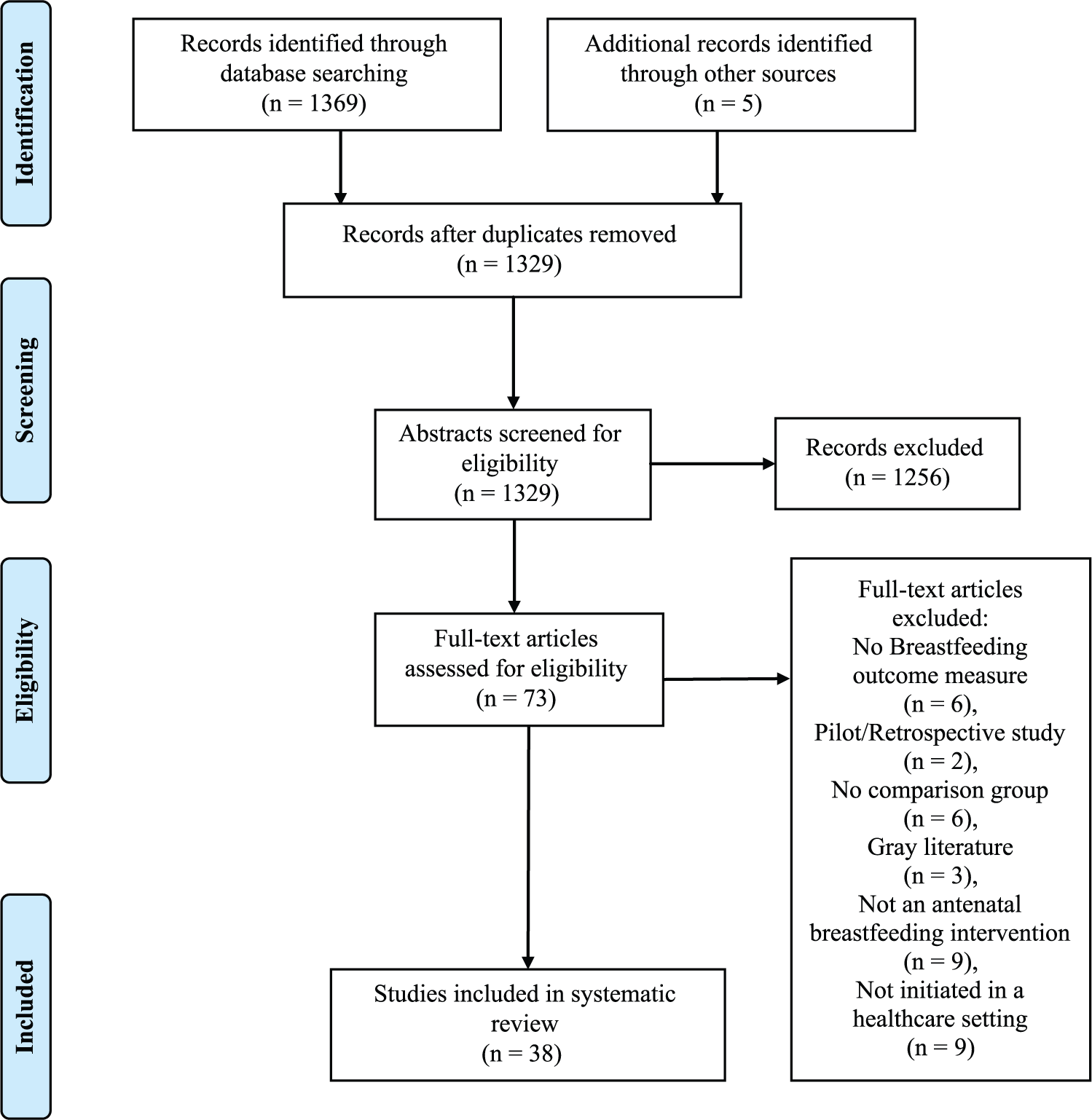
Preferred Reporting Items for Systematic Reviews and Meta-Analyses (PRISMA) flow diagram.
Risk of Bias Assessment
To assess methodological quality of included studies, we used the Cochrane Collaboration’s tool for examining potential risk of bias: selection bias was assessed through randomization procedures and allocation concealment; performance and detection bias through blinding procedures; detection bias through double-blinding procedures; and attrition bias through completeness of outcome data.
Results
Study Characteristics
Study characteristics are presented in Table 1. Of the 39 studies identified for review, 33 were RCTs and 5 had a quasi-experimental design. Sample sizes ranged from 54 to 2,511 for a total of 15,250 participants or couples across the included studies. Fifteen studies were conducted in the United States, 9 in Asia, 6 in Europe, 2 in Africa, 1 in the Middle East, 4 in Australia, and 1 in Canada. Definitions of usual care ranged from no mention of breastfeeding support to BFHI standard of care. Only 1 study (Wambach et al., 2011) assessed the strength of maternal breastfeeding intentions prior to administering the intervention, although 30 studies measured at least one variable related to breastfeeding plans: intent to initiate breastfeeding (Aidam, Pérez-Escamilla, & Lartey, 2005; Anderson, Damio, Young, Chapman, & Pérez-Escamilla, 2005; Bonuck et al., 2014; Bonuck, Trombley, Freeman, & McKee, 2005; Chapman, Damio, Young, & Pérez-Escamilla, 2004; Forster et al., 2004; Huang et al., 2007; Kamran, Shrifirad, Mirkarimi, & Farahani, 2012; Kellams et al., 2016; Kupratakul, Taneepanichskul, Voramongkol, & Phupong, 2010; Lavender et al., 2005; C. H. Lin, Kuo, Lin, & Chang, 2008; S. S. Lin, Chien, Tai, & Lee, 2007; Mattar et al., 2007; Meedya, Fahy, Yoxall, & Parratt, 2014; Muirhead, Butcher, Rankin, & Munley, 2006; Nichols, Schutte, Brown, Dennis, & Price, 2009; Noel-Weiss, Rupp, Cragg, Bassett, & Woodend, 2006; Otsuka et al., 2014; Petrova et al., 2009; Ryser, 2004; Srinivas, Benson, Worley, & Schulte, 2014; Su et al., 2007; Wambach et al., 2011; Wolfberg et al., 2004; Wong, Tak Fong, Yin Lee, Chu, & Tarrant, 2014); intended breastfeeding duration (Aidam et al., 2005; Anderson et al., 2005; Chapman et al., 2004; Forster et al., 2004; Graffy et al., 2004; Lavender et al., 2005; Meedya et al., 2014; Noel-Weiss et al., 2006; Srinivas et al., 2014); intended breastfeeding exclusivity (Aidam et al., 2005); breastfeeding knowledge (Bonuck et al., 2014; Kronborg, Maimburg, & Vaeth, 2012; S. S. Lin et al., 2007; Ochola, Labadarios, & Nduati, 2013; Petrova et al., 2009); breastfeeding self-efficacy (Chapman et al., 2013; Kronborg et al., 2012; Otsuka et al., 2014; Petrova et al., 2009); breastfeeding attitudes (Huang et al., 2007; C. H. Lin et al., 2008; S. S. Lin et al., 2007; Petrova et al., 2009); previous breastfeeding experience (Bonuck et al., 2014; Mattar et al., 2007; Srinivas et al., 2014); confidence in breastfeeding (Kronborg et al., 2012; Meedya et al., 2014; Petrova et al., 2009); decided to breastfeed prior to pregnancy (Noel-Weiss et al., 2006); or perceived their partner to be supportive of breastfeeding (Meedya et al., 2014). Eight publications did not describe any participant breastfeeding intentions (Bich, Hoa, & Målqvist, 2014; Gijsbers et al., 2006; Gill, Reifsnider, & Lucke, 2007; Gross, Mendelsohn, Gross, Scheinmann, & Messito, 2016; Ickovics et al., 2007; MacArthur et al., 2009; Maycock et al., 2013; Sandy, Anisfeld, & Ramirez, 2009). None of the 38 articles specified the full costs of the interventions, although 2 provided partial-cost information (Ickovics et al., 2007; Muirhead et al., 2006) and Bonuck et al. (2005) estimated the intervention cost per participant.
Study Characteristics

Note. ABF = any breastfeeding; BF = breastfeeding; BFHI = Baby-Friendly Hospital Initiative; BMI = body mass index; CI = confidence interval; EBF = exclusive breastfeeding; EP = electronically prompted; GA = gestational age; HR = hazard ratio; IBCLC = International Board Certified Lactation Consultant; LC = lactation counselor; NPSGs = nutrition and parenting support groups; OR = odds ratio; PC = peer counsel; RCT = randomized controlled trial; RD = registered dietician; RR = risk ratio; UNICEF = United Nations International Children’s Emergency Fund; WHO = World Health Organization; WIC = Special Supplemental Nutrition Program for Women, Infants, and Children.
Prenatal Interventions
Seventeen studies (Forster et al., 2004; Huang et al., 2007; Ickovics et al., 2007; Kamran et al., 2012; Kellams et al., 2016; Kronborg et al., 2012; Lavender et al., 2005; C. H. Lin et al., 2008; S. S. Lin et al., 2007; Mattar et al., 2007; Nichols et al., 2009; Noel-Weiss et al., 2006; Otsuka et al., 2014; Ryser, 2004; Su et al., 2007; Wolfberg et al., 2004; Wong et al., 2014) evaluated interventions delivered in the prenatal period without additional intrapartum or postpartum components. Of these, 10 assessed breastfeeding initiation and 5 (Huang et al., 2007; Ickovics et al., 2007; C. H. Lin et al., 2008; Ryser, 2004; Wolfberg et al., 2004) found a statistically significant increase in breastfeeding initiation. Of the 10 studies that assessed breastfeeding duration, 2 (Huang et al., 2007; Noel-Weiss et al., 2006) found a statistically significant increase. Finally, of the 12 prenatal studies that assessed breastfeeding exclusivity, 6 (Huang et al., 2007; Kamran et al., 2012; C. H. Lin et al., 2008; Mattar et al., 2007; Noel-Weiss et al., 2006; Otsuka et al., 2014) showed a statistically significant increase.
Six of the 17 prenatal interventions found a significant difference for all breastfeeding outcomes measured (Huang et al., 2007; Ickovics et al., 2007; C. H. Lin et al., 2008; Mattar et al., 2007; Noel-Weiss et al., 2006; Ryser, 2004). Huang et al. (2007) used a web-based breastfeeding program with text, graphics, animations, interactive flash animations, audio, and video to provide prenatal education to nulliparous women planning to breastfeed at the time of enrollment. This intervention included a real-time communication system and message board to allow program participants to interact with one another for interpersonal support, leading to significant increases in breastfeeding initiation, duration, and exclusivity through 6 weeks (Huang et al., 2007). Another prenatal intervention improved both breastfeeding duration and exclusivity at 8 weeks postpartum using self-efficacy and adult learning principles delivered in a 2.5-hour prenatal breastfeeding workshop, with additional tools such as dolls, videos, and group discussions (Noel-Weiss et al., 2006). C. H. Lin et al. (2008) significantly improved breastfeeding initiation and exclusivity at 1 month among women with a scheduled cesarean childbirth in Taiwan by providing educational booklets in combination with a 22-minute videotape and two follow-up phone calls shortly before delivery. Mattar et al. (2007) significantly increased exclusive breastfeeding at 3 and 6 months by providing a 15-minute session with a lactation counselor alongside an informational booklet and a 16-minute educational video. In a separate arm of this study, education provided without the lactation counselor component yielded no significant increase in exclusive breastfeeding (Mattar et al., 2007). Two interventions that significantly improved breastfeeding initiation incorporated interpersonal support into prenatal education in the form of group prenatal care with health care providers (Ickovics et al., 2007) or four prenatal counseling sessions to address breastfeeding barriers perceived by low-income women (Ryser, 2004).
Seven studies found no significant differences between intervention and control groups for all breastfeeding outcomes assessed (Forster et al., 2004; Kellams et al., 2016; Kronborg et al., 2012; Lavender et al., 2005; S. S. Lin et al., 2007; Nichols et al., 2009; Wong et al., 2014). These interventions provided prenatal education using a variety of tools, such as an interactive workbook (Nichols et al., 2009) or an informational video (Kellams et al., 2016; Lavender et al., 2005); however, the lack of interpersonal support in all but one (Wong et al., 2014) of these seven interventions may have contributed to the nonsignificant effect on breastfeeding outcomes. Furthermore, three of these interventions used comparison groups that received BFHI standard of care (Forster et al., 2004; Kronborg et al., 2012; Wong et al., 2014), which may have led to a nonsignificant effect of additional prenatal breastfeeding education.
Prenatal Interventions Combined With Intrapartum or Postpartum Support
Twenty-one studies described prenatal interventions delivered to women with additional intrapartum or postpartum support or counseling components. Of the 15 studies reporting breastfeeding initiation outcomes, 8 found a statistically significant effect on initiation (Anderson et al., 2005; Bonuck et al., 2014; Bonuck et al., 2005; Chapman et al., 2004; Gill et al., 2007; Kupratakul et al., 2010; Sandy et al., 2009; Wambach et al., 2011). Of the 15 that measured breastfeeding duration outcomes, 7 reported a significant intervention effect (Bonuck et al., 2014; Bonuck et al., 2005; Gill et al., 2007; Kupratakul et al., 2010; Maycock et al., 2013; Meedya et al., 2014; Wambach et al., 2011). Of the 13 studies assessing breastfeeding exclusivity, 9 showed a significant increase on exclusivity outcomes (Aidam et al., 2005; Anderson et al., 2005; Bich et al., 2014; Bonuck et al., 2014; Gijsbers et al., 2006; Gross et al., 2016; Kupratakul et al., 2010; Meedya et al., 2014; Ochola et al., 2013).
Nine of the prenatal interventions delivered alongside intrapartum or postpartum support found a significant difference for all breastfeeding outcomes measured. Two significantly increased breastfeeding initiation, duration, and exclusivity (Bonuck et al., 2014; Kupratakul et al., 2010). Bonuck et al. (2014) provided IBCLC support alone or in combination with electronically prompted guidance from a health care provider at five prenatal visits for predominantly low-income mothers in New York. Electronically prompted guidance included several open-ended questions where providers normalized breastfeeding, clarified knowledge about how long and how much to breastfeed, and discussed the importance of social support, and IBCLC support included two prenatal sessions, a hospital visit, and postpartum phone calls (Bonuck et al., 2014). The second intervention, conducted in Thailand, provided a 3-hour knowledge-sharing and empowerment-building program added to routine prenatal breastfeeding education coupled with postnatal support by phone and home visits for women who reported breastfeeding problems (Kupratakul et al., 2010). Three interventions delivered postpartum telephone support alongside one-on-one (Gill et al., 2007) or group prenatal education (Meedya et al., 2014; Wambach et al., 2011) to significantly increase breastfeeding initiation (Gill et al., 2007; Wambach et al., 2011), duration (Gill et al., 2007; Meedya et al., 2014; Wambach et al., 2011), and exclusivity (Meedya et al., 2014). All three interventions were delivered by an IBCLC who in Wambach et al. (2011) also worked collaboratively with a peer counselor to support young women ages 15 to 18 years. The two interventions with group prenatal education sessions used theories of midwifery and self-efficacy (Meedya et al., 2014) or the Theory of Planned Behavior (Wambach et al., 2011) to promote breastfeeding among women and their primary support partners. Three interventions, conducted in Ghana, the Netherlands, and Kenya, provided prenatal education alongside home-based support by a variety of breastfeeding support personnel to significantly increase breastfeeding exclusivity (Aidam et al., 2005; Gijsbers et al., 2006; Ochola et al., 2013).
Seven studies found no significant differences between intervention and control groups for all breastfeeding outcomes measured (Bonuck et al., 2014; Chapman et al., 2013; Graffy et al., 2004; MacArthur et al., 2009; Muirhead et al., 2006; Petrova et al., 2009; Srinivas et al., 2014). Four of these interventions used peer counselors to offer prenatal and postpartum breastfeeding education and support and found no significant increase in breastfeeding initiation (Graffy et al., 2004; MacArthur et al., 2009; Muirhead et al., 2006; Srinivas et al., 2014) or duration (Graffy et al., 2004; Muirhead et al., 2006; Srinivas et al., 2014). In one of the intervention arms of their study, Bonuck et al. (2014) found no significant improvement in breastfeeding initiation, duration, or exclusivity for mothers who received electronically prompted anticipatory guidance from their prenatal providers at five prenatal visits when no additional lactation support was provided. In a BFHI setting, Chapman et al. (2013) reported no significant additional improvement in breastfeeding initiation, duration, or exclusivity where mothers with a high pre-pregnancy body mass index were offered 3 prenatal visits, in-hospital visits after birth, and up to 11 postpartum home visits by a peer counselor. Finally, Petrova et al. (2009) found no significant increase in initiation or exclusivity from two prenatal one-on-one education sessions with an International Board Certified Lactation Consultant (IBCLC), possibly due to a ceiling effect of high levels of breastfeeding in the mostly Hispanic population across both the intervention and control groups.
Prenatal Interventions Involving Partners or Other Supportive Individuals
Evidence for the positive effect of incorporating partners into prenatal breastfeeding education comes from three interventions directly targeting expectant fathers (Bich et al., 2014; Maycock et al., 2013; Wolfberg et al., 2004) and five studies that encouraged participation of the woman’s primary support person (Anderson et al., 2005; Bonuck et al., 2014; C. H. Lin et al., 2008; Meedya et al., 2014; Wambach et al., 2011). All of these studies found significant differences in at least one breastfeeding outcome measure (initiation, duration, or exclusivity). Group sessions with a facilitator to discuss benefits of breastfeeding, breastfeeding myths, and overcoming difficulties were effective in increasing breastfeeding initiation (Maycock et al., 2013; Wolfberg et al., 2004) and exclusivity (Bich et al., 2014; Maycock et al., 2013). In one of these interventions, an additional mass media campaign used posters, public events, and giveaways to promote fathers’ involvement in breastfeeding support (Bich et al., 2014). Among studies that encouraged partner participation in education and support offered to women, two studies involved partners in prenatal clinic visits as well as postpartum home visits by an IBCLC (Bonuck et al., 2014) or a peer counselor (Anderson et al., 2005) with significant increases in breastfeeding initiation and exclusivity. Two interventions invited partners to participate in group prenatal education targeting breastfeeding intention and self-efficacy (Meedya et al., 2014) and enhancing social network support (Wambach et al., 2011) with significant increases in breastfeeding duration. Finally, C. H. Lin et al. (2008) significantly increased breastfeeding initiation and exclusivity by including partners in a prenatal education program to review their role in assisting with breastfeeding before elected cesarean childbirth.
Risk of Bias Assessment
The risk of bias assessment is presented in Table 2. Seven studies demonstrated a high risk of bias due to the lack of adequate randomization procedures or allocation concealment. Prenatal education interventions that significantly increased breastfeeding initiation, duration, and exclusivity were drawn from studies assessed to have a generally low risk of bias. Common sources of bias across studies in this review included the lack of blinding of participants and intervention personnel. Eleven studies showed a high risk of bias due to incomplete outcome data. Selective reporting was not an issue for the selected studies because they specified breastfeeding outcome variables of interest prior to intervention administration and data collection.
Risk of Bias Assessment

Note. BF = breastfeeding; BFHI = Baby-Friendly Hospital Initiative; EBF = exclusive breastfeeding; LC = lactation counselor; LTFU = loss to follow up; SPSS = Statistical Package for the Social Sciences.
Discussion
There is mounting evidence that prenatal interventions, alone or in combination with intrapartum and/or postpartum support, can increase breastfeeding initiation, duration, and exclusivity. Although we recognize that some of the effect of interventions combining prenatal education with intrapartum or postpartum support may not be attributable to the prenatal component alone, we included evidence from combination interventions to better understand broad delivery methods for realistic application within the Ten Steps.
Prenatal education that includes both informational materials and interpersonal support increases breastfeeding initiation, duration, and exclusivity. Effective interventions included both provision of information along with support from an IBCLC, peer counselor, medical provider, or researcher. These findings align with previous systematic reviews that showed that health education and peer support interventions increase breastfeeding initiation and that peer counseling, IBCLCs, and formal prenatal breastfeeding education increase breastfeeding duration (Dyson, McCormick, & Renfrew, 2005; Lumbiganon et al., 2012). Interpersonal support included home visits, telephone support, and novel web-based formats that allowed mothers to communicate in real time to provide peer support.
Breastfeeding education was delivered through home visits and individual or group sessions at prenatal clinics. When combined with interpersonal support, a variety of education technologies were effective in increasing breastfeeding initiation, duration, or exclusivity, such as web-based tools with interactive flash animations and a message board (Huang et al., 2007) and informational videos (Anderson et al., 2005; C. H. Lin et al., 2008; Mattar et al., 2007; Ryser, 2004; Su et al., 2007); however, without additional support, the use of education technology was not adequate to increase breastfeeding outcomes (Kellams et al., 2016; Lavender et al., 2005; Mattar et al., 2007; Noel-Weiss et al., 2006). Although we did not include pilot studies in this review, a recent videoconferencing pilot intervention highlights the promise of incorporating new technologies to connect hospital-based health care providers with difficult-to-reach communities to provide both breastfeeding education and support (Friesen, Hormuth, Petersen, & Babbitt, 2015). Text-messaging technologies have also been shown to increase exclusive breastfeeding duration when delivered during the postpartum period (Gallegos, Russell-Bennett, Previte, & Parkinson, 2014) and should be considered for use in prenatal education by future studies.
Involving a woman’s family in prenatal education can improve breastfeeding initiation, duration, and exclusivity. Health care providers should consider how the attitudes of the infants’ father or grandmother toward breastfeeding may influence women’s breastfeeding intentions and success (Arora, McJunkin, Wehrer, & Kuhn, 2000; Grassley & Eschiti, 2008). In addition, Odom, Li, Scanlon, Perrine, and Grummer-Strawn (2013) found that maternal perceptions of their health care providers’ infant-feeding recommendations interact with the opinions of family members to affect breastfeeding initiation. Therefore, shared decision making regarding infant feeding should be integrated within family dynamics, with clear messaging, support, and information from providers.
Our review has several limitations. Studies were identified using only two databases and manuscripts published in languages other than English were excluded, limiting generalizability. Although the diversity of contexts, breastfeeding definitions, and comparison groups of included studies improve the generalizability of results to various clinical settings, the heterogeneity of interventions and differences in study quality limit our ability to recommend any single intervention as most effective. Furthermore, because we were unable to quantitatively compare the strength of findings across studies, clinicians should consider results from those interventions that have similar patient populations and available resources. In addition, only one study (Wambach et al., 2011) assessed the strength of participant breastfeeding plans at baseline, which was found to be the greatest predictor of breastfeeding initiation in their sample. Most of the other studies included some measure of breastfeeding plans or previous experience; however, baseline assessments would benefit from inclusion of the Infant Feeding Intentions Scale to assess the strength of maternal plans for breastfeeding exclusivity and duration, which is correlated with breastfeeding duration (Nommsen-Rivers & Dewey, 2009). Without a validated pre-intervention measure of the strength of breastfeeding intention, room for improved outcomes associated with the intervention is unclear. Such ceiling effects mask the effectiveness of the interventions themselves. Finally, information about the cost of delivering prenatal breastfeeding interventions was not available for most studies; changes in breastfeeding intentions and realization of infant-feeding goals must be considered alongside cost-effectiveness when determining the most appropriate prenatal breastfeeding education interventions for particular settings.
Conclusion
Prenatal education that includes both informational materials and interpersonal support is positively associated with breastfeeding initiation, duration, and exclusivity. Breastfeeding support delivered in a variety of formats, including home visits and individual or group sessions at prenatal clinics, is associated with improved breastfeeding outcomes. However, lack of standardized assessment of participants’ breastfeeding intentions limits the comparability of the interventions assessed in this review. If women have strong plans for breastfeeding initiation, duration, and exclusivity, the effectiveness of prenatal education and support may be masked by ceiling effects. Additional research could improve understanding of the mechanisms by which Step 3 increases breastfeeding outcomes by including pretesting and posttesting of the strength of maternal breastfeeding intentions, further assessment of the interactive role of family members, comparison of the effectiveness of different providers involved in prenatal and postnatal breastfeeding support, and explicit detail about the time and cost associated with different intervention delivery formats.
Footnotes
Authors’ Note
Kathryn Wouk is a doctoral student in the Gillings School of Global Public Health. She is a reproductive, perinatal, and pediatric epidemiology trainee in the Department of Maternal and Child Health.
Declaration of Conflicting Interests
The authors declared no potential conflicts of interest with respect to the research, authorship, and/or publication of this article.
Funding
The authors disclosed receipt of the following financial support for the research, authorship, and/or publication of this article: This work was supported by a NICHD predoctoral training grant (5T32HD052468-08) to K.W. and by the Carolina Global Breastfeeding Institute (K.W., M.H.L., and K.P.T.).