






Abstract
Background:
Few breastfeeding education programs focus on primiparas and the importance of family members on exclusive breastfeeding in China.
Research aim:
This study aimed to explore the influence of a family-centered breastfeeding education program in promoting exclusive breastfeeding up to 6 months postpartum and to improve women’s attitude and knowledge, family members’ knowledge, and family support.
Methods:
This was a two-group quasi-experimental design with multiple comparisons. Participants (N = 59) were randomized to either the intervention (n = 29) or the control (n = 30) group. The intervention group received two prenatal breastfeeding education lectures that included important family members, three home visits, eight telephone calls, text or video/audio support, and quality online resources during lactation. The control group received in-hospital care and follow-up by community nurses after discharge.
Results:
Compared with the control group, the intervention group was more likely to exclusively breastfeed in the first 6 months, odds ratio = 0.44, 95% confidence interval [0.20, 0.98]. The mean knowledge level of the intervention group improved more across time (p < .05) and was higher than the control group (p < .05). Perceived family support within the intervention group was significantly higher than the control group from 1 to 6 months (p < .05).
Conclusion:
The breastfeeding education program is an effective strategy to promote exclusive breastfeeding in China.
Keywords
Background
It is well known that breastfeeding promotes infant development, improves maternal and child health, and decreases unnecessary economic losses (American Academy of Pediatrics, 2012; Gonzalez-Jimenez, Garcia, Aguilar, Padilla, & Alvarez, 2014; McCrory & Layte, 2012; Victora et al., 2016; Zhang, Zhang, Liu, Li, & Wang, 2015). The World Health Organization (WHO, 2011) has recommended that infants be exclusively breastfed to achieve optimal infant growth. WHO and UNICEF (2009) launched the Baby-Friendly Hospital Initiative to establish supportive breastfeeding approaches. However, the prevalence and duration of breastfeeding have not been optimistic to date in China (Tang, Lee, & Binns, 2015). Victora et al. (2016) reported that a total of 63% of infants younger than 6 months were not breastfed, and the weighted prevalence for 6 months of exclusive breastfeeding was 20.8% (Yang et al., 2016). Li (2015) reported exclusive rates of 17% in Chinese urban areas. The prevalence of exclusive breastfeeding in China is not on a trajectory to meet the global nutrition target of at least 50% exclusive breastfeeding in the first 6 months by 2025 (WHO, 2015).
Breastfeeding has been reported to be affected by many physiological, psychological, demographic, and social factors (Balogun, Dagvadorj, Anigo, Ota, & Sasaki, 2015; Demirtas, 2012; Hauff, Leonard, & Rasmussen, 2014; Liu et al., 2013). Researchers have identified maternal breastfeeding education as a positive factor to improve the rate of exclusive breastfeeding (Cattelona, Friesen, & Hormuth, 2015; Nabulsi et al., 2015). Education via mobile text messages or the Internet has been considered an effective tool to promote exclusive breastfeeding (Giglia & Binns, 2014; Giglia, Cox, Zhao, & Binns, 2015). WeChat is a social media application developed by Tencent in 2011; information can be shared in WeChat public platforms. Quality breastfeeding information can be found in WeChat public platforms (e.g., La Leche League International). Ding and colleagues (2016) used WeChat in the intervention group for breastfeeding information and found that the rate of exclusive breastfeeding in their intervention group was 35.44% compared with 29.11% in the control group. Researchers have demonstrated that home visiting provided sustainable assistance and supported lactating women to feed infants exclusively (Naohiro, Dowswell, Shuko, & Rintaro, 2014; Sitrin et al., 2015). Postnatal at-home support offered by community health workers has successfully increased breastfeeding duration and knowledge (Aksu, Kucuk, & Duzgun, 2011; Yonemoto, Dowswell, Nagai, & Mori, 2013).
Family members play an important role in supporting lactating women and in preventing weaning or switching to formula feeding (Demirtas, 2012; Mueffelmann, Racine, Warren-Findlow, & Coffman, 2014). Family members’ lack of breastfeeding knowledge and their misunderstandings about breastfeeding practices have been identified as nonsupportive factors (Yazgan, Yazgan, Keleş, & Gebeşçe, 2012). Women’s self-identified important family members mainly refer to infants’ father and grandmothers, who live together with women and often help to take care of infants in most of Chinese families. In many cultures, grandmothers have taken part in maternal decision making during pregnancy and lactation, especially in developing countries. They have had a potential influence on feeding decisions because it relates to their experience (Grassley & Eschiti, 2011; Negin, Coffman, Vizintin, & Raynes-Greenow, 2016). Some grandmothers mistakenly believed that formula feeding was a manifestation of high economic status (Grassley & Eschiti, 2011). Recent studies have confirmed that education interventions involving fathers and/or grandmothers reduce unnecessary intake of water and improved exclusive breastfeeding rates (Nunes, Giugliani, Santo, & de Oliveira, 2011; Raeisi, Shariat, Nayeri, Raji, & Dalili, 2014; Su & Ouyang, 2016). Thus, lactating women and their self-identified important family members were encouraged to be involved in education interventions to increase their breastfeeding knowledge and family supportive behaviors (Dashti, Scott, Edwards, & Al-Sughayer, 2014; Talbert et al., 2016; Zhu & Lu, 2013). Few breastfeeding education interventions involving important family members have been done in China; an intervention program including fathers and grandmothers has not been conducted.
The purpose of this study was to test the hypothesis that a family-centered breastfeeding education program will promote 6 months of exclusive breastfeeding and will improve participants’ knowledge and family support. The aims of this study were (a) to explore the influence of a family-centered breastfeeding education program in promoting exclusive breastfeeding up to 6 months postpartum and (b) to improve mothers’, fathers’, and grandmothers’ attitudes, knowledge, and family support.
Key Messages
A comprehensive and intensive education program including lectures and support for the whole family has not been conducted in China.
Compared with the control group, the intervention group, who receive education and follow-up support, is more likely to exclusively breastfeed in the first 6 months.
Breastfeeding knowledge of both women and their family members as well as family support are improved during the intervention period.
This study provides evidence that a family-centered breastfeeding program including the whole family is effective to promote exclusive breastfeeding.
Methods
Design
The evaluation of the family-centered breastfeeding education program’s outcomes of interest was a two-group longitudinal quasi-experimental design. This design was used to test the influence of continued support by researchers from late pregnancy to 6 months postpartum on feeding behaviors, attitude, knowledge, and family support and examine whether there was a difference between two groups. This study was reviewed and approved by the Research Ethics Committee of the university and the tertiary hospital. Participation was voluntary and all participants gave written informed consent; withdrawal from the study resulted in no prejudice. The intervention program followed scientific guidelines and resulted in no harm to participants.
Setting
This study was conducted in the prenatal outpatient department of a tertiary hospital in Wuhan, central China. Wuhan is one of the seven largest cities in China and is an economic and cultural center. The tertiary hospital in this study is a government-funded hospital and mainly serves middle- or relatively high-income households. Previous breastfeeding research in Wuhan showed a 17.6% exclusive breastfeeding rate at 6 months for women who accepted standardized care (Su & Ouyang, 2016).
Sample
Convenience sampling was used to recruit women attending the prenatal outpatient department from August to September 2015. Women and their self-identified important family members were asked during their prenatal visit if they agreed to take part in this study. They were then assigned to either the intervention group or control group using random numbers without blinding.
Inclusion criteria were (a) pregnant women aged 20 years or older; (b) 32 to 34 weeks’ gestation; (c) primigravida with single fetus; (d) available for a 6-month postpartum period following delivery; (e) read and understood Mandarin; and (f) resided with important family members (infant’s father and grandmother/grandmother-in-law). Exclusion criteria were (a) women with severe physical diseases (hepatitis B virus, active tuberculosis, human immunodeficiency virus, mammary defect/deformity) and/or mental illness and (b) suspected fetal congenital malformations (Trisomy 21, cleft lip/palate, hydrocephalus, and heart disease).
Sample size was calculated by performing t test and a prior power analysis in G*Power (Faul, Erdfelder, Buchner, & Lang, 2009). An alpha error of .05, a statistical power of 0.80 in consideration of previous research (Su & Ouyang, 2016; Wu, Hu, McCoy, & Efird, 2014), and two tails were set. An effect size of 0.80 was determined according to a similar previous study (Aksu et al., 2011). The final desired sample size was 64 (32 in each group) with 20% projected attrition rate. The final sample (N = 59) included 29 participants in the intervention group and 30 in the control group owing to follow-up loss (see Figure 1).
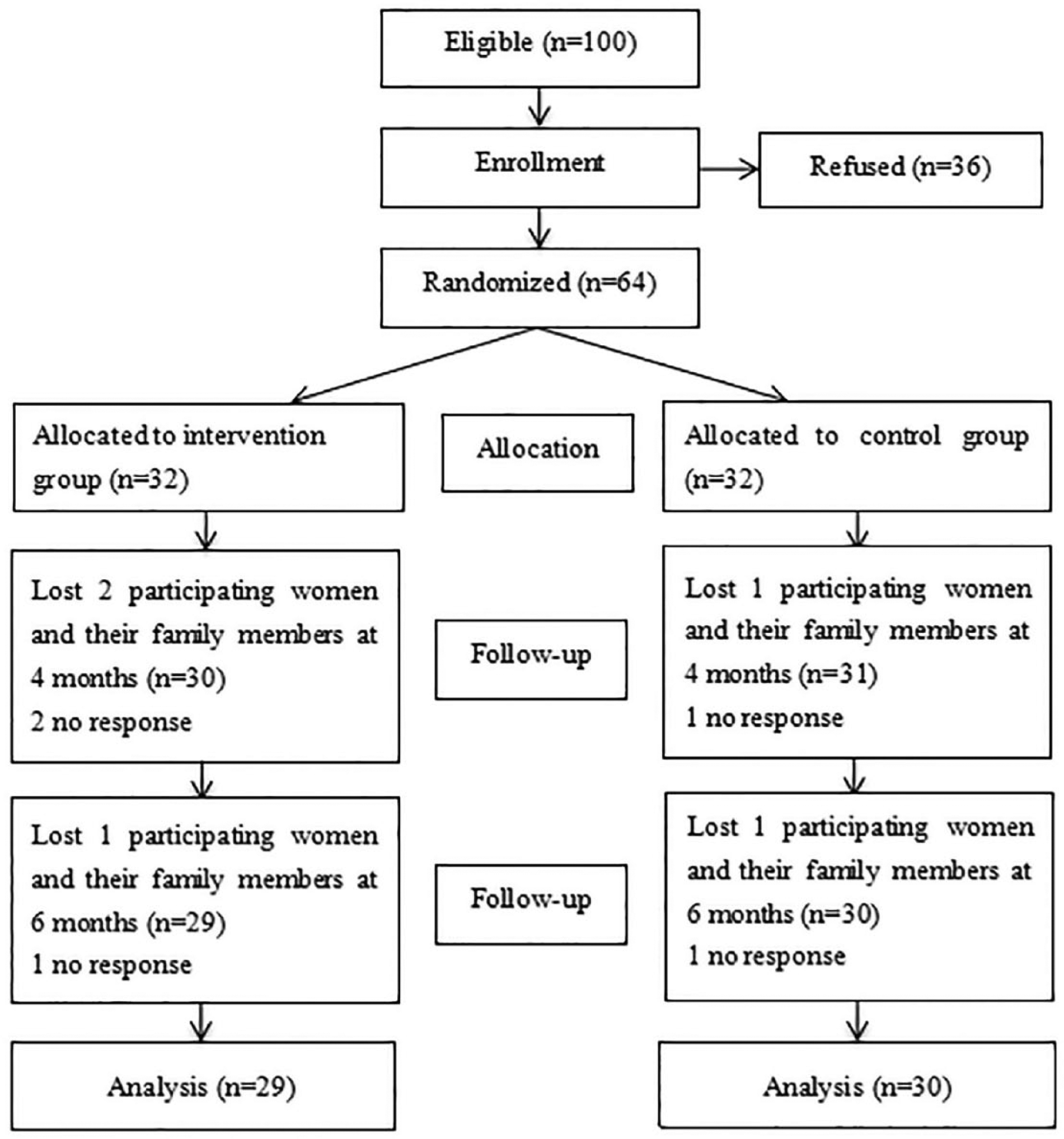
Flowchart of recruitment.
The Intervention: Family-Centered Breastfeeding Education Program
The intervention group received two prenatal breastfeeding education lectures, three home visits during the 1st month postpartum when fathers and grandmothers were present in the home, and eight telephone calls or text messages with video/audio interactions every 2 weeks from 2 to 6 months postpartum by a researcher who had completed 90 hours of education in human lactation and breastfeeding. Participants in the intervention group could discuss breastfeeding-related issues at any time via text messaging/WeChat and had access to information on Internet/public information platforms. Participants in the control group received in-hospital care and one follow-up at 14 days postpartum by community nurses after discharge.
Breastfeeding education content was developed according to WHO (2009, 2012) guidelines, La Leche League International (2013), and the Mesters, Gijsbers, Bartholomew, Knottnerus, and Van Schayck (2013) study. The breastfeeding education program was reviewed by two obstetricians, a pediatrician, an International Board Certified Lactation Consultant (who completed 90 hours of education in human lactation and breastfeeding), and a nurse educator, and the content of the education program was reached by consensus. Two pamphlets with prenatal breastfeeding education were distributed to participants after each lecture. Except for the WHO (2009, 2012) and La Leche League International (2013) guidelines, the educational and informational support used during the home visits, calls and responses, and WeChat/phone conversations was developed based on Core Curriculum for Lactation Consultant Practice (Mannel, Martens, & Walker, 2013) and Medications & Mothers’ Milk (Hale & Rowe, 2014). The schedule and content of the education program are shown in Tables 1 and 2, respectively.
Family-Centered Breastfeeding Education Program Intervention.

Family-Centered Breastfeeding Education Content.

Note. GA = gestation age; WHO = World Health Organization.
Measurements
Based on review of the literature, a demographic questionnaire was designed by the research team. It consisted of eight questions categorized into two parts. Part I was administered prenatally and included ethnicity, age, maternal education level, father’s education level, and monthly income. Part II was administered postpartum and included delivery mode, maternal leave, and early maternal–infant separation. Except for age, the other seven variables were all categorical. Maternal leave granted to new mothers was defined as a temporary period of absence from employment immediately after childbirth. Early maternal–infant separation was defined as separating the mother from the infant because of specific medical indications after delivery (Jaafar, Ho, & Lee, 2016). The demographic questionnaire was completed by participants.
Study Aim 1: Feeding Behaviors Over the First 6 Months of Life
Feeding behaviors at 7 days, 1 month, 4 months, and 6 months postpartum were assessed by the mother using a self-report form, which included the categories of exclusive breastfeeding, any breastfeeding, and exclusive formula feeding. Exclusive breastfeeding was defined as giving only human milk to infants, without any other food or liquid including water (Labbok & Krasovec, 1990). Any breastfeeding was defined as feeding human milk, other fluids, and solid food. Exclusive formula feeding was defined as feeding infants with formula, solid food, and water instead of human milk (Labbok et al., 1990).
Study Aim 2: Changes in Attitudes, Knowledge, and Family Support
The Iowa Infant Feeding Attitude Scale (IIFAS) was used to assess the participants’ feeding attitude. This scale includes 17 items developed by de la Mora, Russell, Dungy, Losch, and Dusdieker (1999). The items incorporate a 5-point Likert-type scale with categories strongly disagree (1), disagree (2), being neutral (3), agree (4), and strongly agree (5). Nine items (numbers 1, 2, 4, 6, 8, 10, 11, 14, and 17) are reverse-scored whereas others are positively scored. The total final score ranges from 17 (negative breastfeeding attitudes) to 85 (positive breastfeeding attitudes). The original scale showed an adequate reliability with Cronbach’s alpha ranging from .68 to .86 and content validity (de la Mora et al., 1999). In the current study, a Chinese version of the IIFAS was used (Dai & Liu, 2013) and the Cronbach’s alpha in the present study was .81.
The Breastfeeding Family Support Questionnaire (BFSQ), a self-evaluated questionnaire designed by Zhu, Li, and Lu (2013), was used to assess participants’ perception of family support in China. This questionnaire was completed by participants during lactation. This 4-point Likert-type scale has nine items with responses of strongly disagree (1), disagree (2), agree (3), and strongly agree (4). Psychological support includes seven items (items 1-7) and behavioral support includes two items (items 8 and 9). Three items (2, 4, and 5) are reverse-scored; other items are positively scored. A higher mean score reflects stronger family support. The questionnaire had reliability with Cronbach’s alpha of .886 (Zhu et al., 2013). In the present study, Cronbach’s alpha of the BFSQ was .84.
The Breastfeeding Knowledge Questionnaire (BKQ) was used to assess breastfeeding knowledge of program participants (Ouyang, Xu, & Zhang, 2012). The questionnaire includes 18 items. It is a closed-ended questionnaire with true or false responses with previously reported adequate internal reliability and Cronbach’s alpha of .93 (Ouyang et al., 2012). In this study, Cronbach’s alphas of the BKQ for participants, fathers, and grandmothers were .80, .78, and .80, respectively.
Data Collection
Once eligible women and their family members agreed to participate in this study and signed consent forms, baseline questionnaires and part I demographic questionnaires were completed during a face-to-face interview. All data collection (IIFAS, BKQ, BFSQ, and feeding behaviors form) for both groups occurred online (at 7 days and 1, 4, and 6 months postpartum) after the initial in-person interview. The BFSQ is related to the actual behavioral support for breastfeeding during lactation, so it was collected only postpartum. Part II of the demographic questionnaire was collected online at 6 months postpartum. All participants were able to consult with the first author immediately if they had any questions.
Data Analysis
Data were entered in SPSS 17.0 (Statistical Program for the Social Sciences, Inc., Chicago, IL). Descriptive statistics were used to analyze demographic data. The balanced test between the intervention group and control group was analyzed by chi-square test for qualitative data and by t test for group means.
Study Aim 1: Feeding Behaviors Over the First 6 Months of Life
Generalized estimating equation (GEE) was used to test the longitudinal effect of the intervention on feeding behaviors over the period from 7 days to 6 months postpartum. The feeding behavior was revalued using two categories (any breastfeeding or exclusive formula feeding = 0, exclusive breastfeeding = 1). Variables included in the GEE model were groups, time points, and demographic variables (age, ethnicity, participant’s education level, delivery mode, maternity leave, and early maternal–infant separation). The AR(1) (the first-order autoregressive) working correlation matrix was chosen for longitudinal data as Vens and Ziegler (2012) recommended to identify predictive factors of exclusive breastfeeding rates. Measures of association were presented as odds ratios (ORs) with 95% confidence intervals (CIs).
Study Aim 2: Changes in Attitudes, Knowledge, and Family Support
Differences in the outcome variables (IIFAS, participants’ and their families’ knowledge levels, and perceived family support) within and between groups were examined using repeated-measures analysis of variance (ANOVA). In the results of the repeated-measures ANOVA, Time × Group interaction reflects the difference in the changes of means of the variable over time between the two groups. Main effect reflects the difference in means of the variable between two groups without considering time effect. Time effect reflects the difference in the change of mean of the variable over time. Mauchly’s test of sphericity showed that all outcome variables did not meet the assumption of sphericity, so within-participant effects were tested using adjusted F tests (Greenhouse-Geisser correction). Differences in outcome variables at different time points between two groups were examined using multivariate analysis. A two-tailed p value of < .05 was considered as a significant difference.
Results
There were no statistically significant differences between each of the demographic variables (see Table 3). The influence of the intervention on each of the study aims is presented below.
Demographic Variables of Participants (N = 59).

Unemployed housewives were included in this group.
Study Aim 1: Feeding Behaviors Over 6 Months
The descriptions of the feeding behaviors at four time points postpartum in two groups are shown in Table 4.
Feeding Behaviors at Four Time Points (N = 59).

Note. Values are presented as n (%).
Table 5 shows the longitudinal influence of the intervention on feeding behaviors and predictive factors of exclusive breastfeeding rate. Compared with the control group, the intervention group was more likely to exclusively breastfeed in the first 6 months (OR = 0.44, 95% CI [0.20, 0.98]). Compared with participants at 7 days postpartum, participants at 1 month and at 4 months postpartum were more likely to exclusively breastfeed their infants (OR = 0.28, 95% CI [0.14, 0.55] and OR = 0.43, 95% CI [0.20, 0.91], respectively). Exploration of demographic factors and feeding behaviors showed a significant correlation between early maternal–infant separation and feeding behaviors. Compared with participants who were separated from their infants, those who were not separated from their infants were more likely to exclusively breastfeed their infants (OR = 0.19, 95% CI [0.05, 0.72]).
Generalized Estimating Equations Model to Test Intervention Effectiveness and Assess Predictive Factors of Exclusive Breastfeeding Rate (N = 59).

Note. OR = odds ratio; CI = confidence interval.
Study Aim 2: Changes in Attitudes, Knowledge, and Family Support
There were significant differences in Time × Group interactions of participants’ knowledge (F = 6.67, p < .01), fathers’ knowledge (F = 10.92, p < .01), and grandmothers’ knowledge (F = 3.90, p < .05 [.02]) but no significant differences in Time × Group interactions of the IIFAS (F = 1.84, p > .05 [.15]) and perceived family support (F = 0.13, p > .05 [.92]). There were significant differences in main effects of participants’ knowledge (F = 16.91, p < .01), fathers’ knowledge (F = 18.53, p < .01), and perceived family support (F = 19.60, p < .01) but no significant differences in main effects of the IIFAS (F = 0.36, p > .05 [.55]) and grandmothers’ knowledge (F = 2.93, p > .05 [.09]). There were significant differences in time effect of the IIFAS (F = 15.80, p < .01), participants’ knowledge (F = 16.76, p < .01), fathers’ knowledge (F = 28.45, p < .01), and grandmothers’ knowledge (F = 6.43, p < .01) but no significant difference in time effect of perceived family support (F = 1.01, p > .05 [.38]) (see Figures 2-6).

Estimate marginal means of the Iowa Infant Feeding Attitude Scale.

Estimate marginal means of participants’ knowledge.

Estimate marginal means of fathers’ knowledge.

Estimate marginal means of grandmothers’ knowledge.
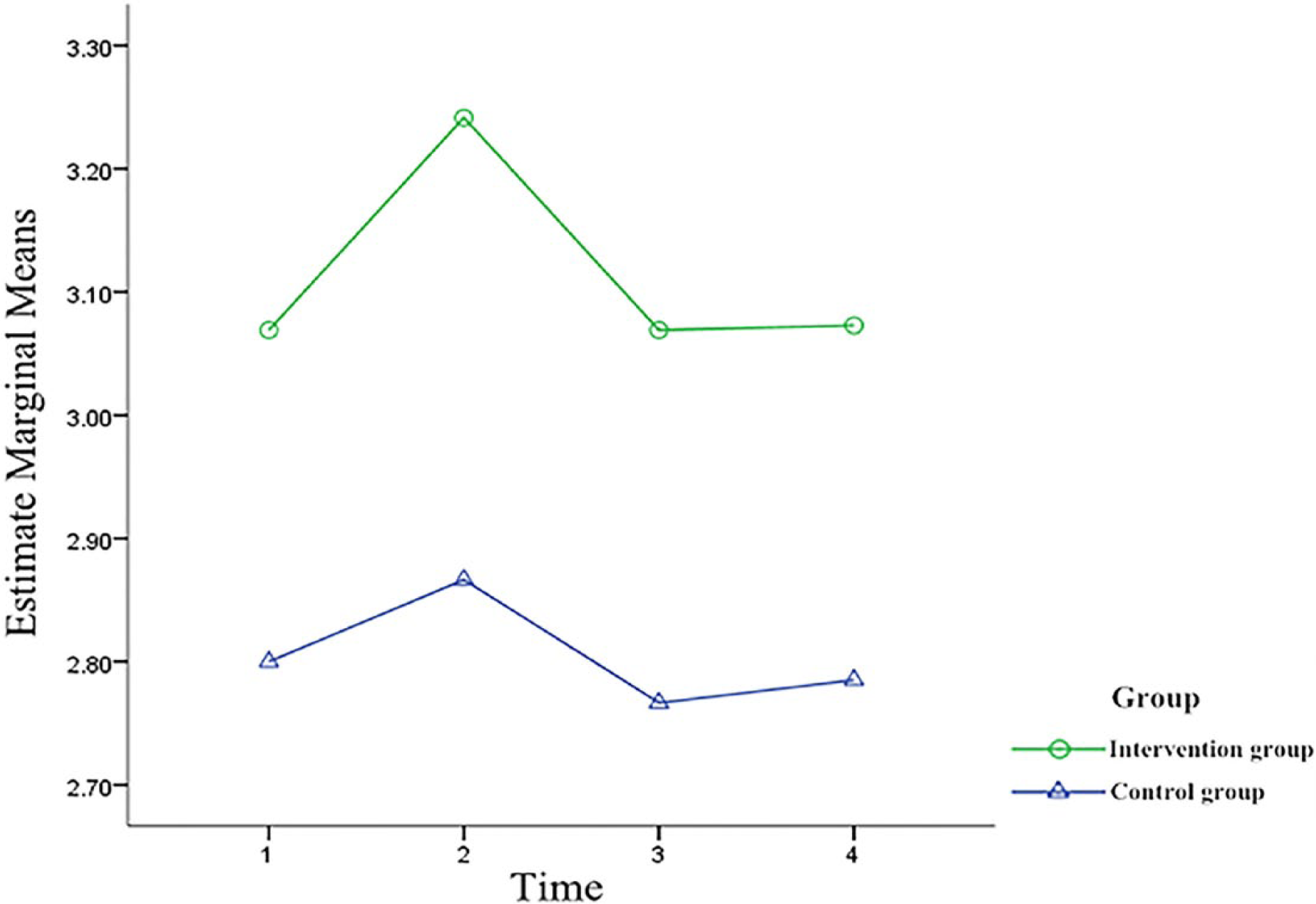
Estimate marginal means of perceived family support.
Comparisons of Participants’ Attitude, Knowledge of Participants, and Family Support at Different Time Points
Following the results of the repeated-measures ANOVA, a multivariate test was used to determine the differences of means of participants’ attitude, participants’ knowledge, and perceived family support of the intervention group and control group at different time points. There were no statistical differences in means of the IIFAS, participants’ knowledge, fathers’ knowledge, and grandmothers’ knowledge at baseline (p > .05). There were no significant differences in mean IIFAS scores at each time point between the two groups (p > .05). The intervention group had significantly higher means of participants’ knowledge and fathers’ knowledge at each time point than those in the control group (p < .05). Grandmothers in the intervention group had significantly higher means of knowledge after prenatal lectures and at 1 month postpartum than those in the control group (p < .05). Participants in the intervention group had significantly higher means of perceived family support at 1 month, 4 months, and 6 months postpartum than those in the control group (p < .05) (see Table 6).
Comparisons of Attitudes, Knowledge, and Family Support at Different Time Points (N = 59).

Perceived family support is related to the actual behavioral support for breastfeeding postpartum and cannot be measured during pregnancy. Therefore, it was measured only at 7 days postpartum, 1 month postpartum, 4 months postpartum, and 6 months postpartum. bMean difference between the intervention group and control group was calculated. cFirst measure was after the second prenatal lecture. dSecond measure was at 7 days postpartum. eThird measure was at 1 month postpartum. fFourth measure was at 4 months postpartum. gFifth measure was at 6 months postpartum.
p < .01.
Discussion
Study Aim 1: Feeding Behaviors Over 6 Months
This is the first evaluation of the longitudinal influence of a breastfeeding intervention program in China. The outcome evaluation of the family-centered breastfeeding education program had a notable influence on exclusive breastfeeding in the first 6 months. Exclusive breastfeeding rates came close to meeting the recommended goal of 6 months (WHO, 2015).
Longitudinal changes of exclusive breastfeeding rates
At 7 days postpartum, rates of exclusive breastfeeding were low in both groups, but participants were more likely to exclusively breastfeed their infants at 1 month and at 4 months rather than at 7 days, which was similar to the results of the Su and Ouyang (2016) study. This might be explained by the fact that primiparas faced challenges of discomfort after cesarean section, perception of insufficient human milk, misunderstanding their infant’s cry, breast engorgement, and latching-on problems at initiation time (Neifert & Bunik, 2013; Ouyang, Su, & Redding, 2016; Tully & Ball, 2014), and these difficulties and challenges negatively influenced breastfeeding. As they practice and become skillful in breastfeeding, some of these difficulties might be overcome and the exclusive breastfeeding rate would increase. There were obvious declines of the exclusive breastfeeding rate of both groups from 4 months to 6 months. In Chinese tradition, it is better to feed infants with human milk in the first 4 months of life, and medical personnel commonly suggest adding complementary food after 4 months. Many medical staff had poor knowledge of breastfeeding and did not strictly follow the WHO’s recommendations (Ouyang et al., 2012). The findings further support the necessity of educating and training healthcare providers with evidence-based breastfeeding knowledge.
Early maternal–infant separation was a risk factor for exclusive breastfeeding
The results of the GEE model further suggested that early maternal–infant separation was a risk factor for exclusive breastfeeding. Early maternal–infant separation can reduce the frequency of breastfeeding. It has been proven that reduced breastfeeding frequency in the early postpartum contributes to suboptimal milk production and inadequate milk supply for a longer period (Kent, Prime, & Garbin, 2012) and, thus, is likely to result in a decrease of exclusive breastfeeding and duration of breastfeeding. Nyqvist et al. (2013) also suggested that early maternal–infant separation was harmful to breastfeeding and should be minimized. How to avoid the negative influence of early maternal–infant separation on breastfeeding initiation and exclusive breastfeeding duration requires further exploration.
Study Aim 2: Changes in Attitudes, Knowledge, and Family Support
Participants’ knowledge improved by the intervention program
Participants’ in the intervention group had higher knowledge scores at different time points than those of the control group up to 6 months. Education and follow-up motivation by healthcare providers can positively improve participants’ knowledge and affect participants’ decisions about breastfeeding continuation (Aksu et al., 2011; Hanafi, Shalaby, Falatah, & El-Ammari, 2014). Since text messaging and the Internet are widely accessible and convenient, many women intended to get breastfeeding information from the Internet (Giglia & Binns, 2014; Giglia et al., 2015). Although three home visits in this study during the 1st month postpartum did not directly contribute to higher breastfeeding rates at 7 days and 1 month postpartum, it was a facilitating factor that offered participants access to guidance and encouragement from healthcare providers when they were at home. This has been reported as desirable by lactating women (Ouyang et al., 2016).
Family members’ breastfeeding knowledge and family support improved by the intervention
The prenatal education lectures and postnatal home visits that included breastfeeding knowledge, breastfeeding skills, infant development, and solutions for breastfeeding issues succeeded in enhancing the knowledge of fathers and grandmothers. The current study has shown statistical improvement of participants’ perceived family support at the end of this program. Fathers with scientific knowledge of breastfeeding and neonatal growth would be more confident to provide emotional support and encourage women to breastfeed continuously when they face breastfeeding challenges as previous studies reported (Maycock et al., 2013; Su & Ouyang, 2016). Grandmothers with facilitated breastfeeding knowledge would value breastfeeding as important and be willing to offer support, such as providing nutritional meals and taking care of infants when needed, which made women feel comfortable and confident when breastfeeding. Although family support was not the direct factor of breastfeeding improvement, it could be a promoting factor of breastfeeding as was reported in a previous study (Zhu et al., 2013).
Limitations
There were several limitations in this study. First, the sample size was small, which limited the power to explore the breastfeeding education on knowledge and practice. Furthermore, a convenience sample could cause bias. Second, a majority of participants in this study were from middle- or relatively high-income households, so it was unknown if this had an influence on breastfeeding education support. Third, the present study initialized a breastfeeding intervention program in late pregnancy, rather than the first trimester, which is indicated by most studies as the crucial antenatal education timing. Future research should consider recruiting a larger sample through random sampling and begin earlier in the first trimester.
Conclusion
The intervention evaluated in this study is helpful in increasing knowledge of primiparas and their family members and improving family support. Support programs with a larger sample from a different area and targeting strategies for women who separated from their infants are needed to explore their effectiveness on breastfeeding exclusivity to meet the WHO (2012) recommended guidelines.
Footnotes
Acknowledgements
The authors are especially grateful to all who participated in this study. This study could not have been possible without their assistance.
Authors’ Note
This research is Jian Ke’s graduation thesis. Her research interest is supporting and promoting breastfeeding.
Declaration of Conflicting Interests
The authors declared no potential conflicts of interest with respect to the research, authorship, and/or publication of this article.
Funding
The authors received no financial support for the research, authorship, and/or publication of this article.