






Abstract
Keywords
Background
As milk banking continues to grow and expand globally, it is valuable to consider the practice norms outside of North America. The World Health Organization (WHO) recommends exclusive breastfeeding for the first six months of age (WHO, 2003). For low-birthweight infants, in the absence of a mother’s own milk, WHO (2011) recommends pasteurized human donor milk (PHDM). Guatemala is a surprising leader in milk banking in the Americas. Although one of the poorest and economically unequal countries in the world, where 13.5% of the 15.5 million population live on less than US$1.25/day (UNICEF, 2013), the country is home to eight milk banks (Pan American Health Organization [PAHO], 2013). Guatemala experienced almost 40 years of civil war, from 1960 to 1996. Approximately 40% of the Guatemalan population identify as Indigenous Mayan (Gobierno de Guatemala, 2012) and experience the greatest poverty and hardship. The population is young: There are approximately 474,000 births annually in Guatemala (UNICEF, 2013). Infant mortality rests at 27 deaths per 1,000 births, having declined from 60 deaths per 1,000 births in 1990 (UNICEF, 2013). The milk banks aim to address the risks faced by the preterm, low-birthweight population.
From observations collected on site in April 2017 and through dialogue with milk bank staff in the year since, this “Insights in Practice” describes the operations at the Banco de Leche (Milk Bank) at the Roosevelt Public Hospital in Guatemala City. The practices differ significantly from North American norms as governed by the Human Milk Banking Association of North America (HMBANA, 2015; Paynter, 2017).
Literature Review
Infant and Child Nutrition in Guatemala
Relatively high rates of exclusive breastfeeding coexist with poor infant and child nutrition in Guatemala. According to UNICEF (2013), 49.6% of infants are exclusively breastfed to 6 months. In Guatemala, 46.2% of infants remain breastfed at 2 years of age (UNICEF, 2013). It is common to see Indigenous children carried and nursed by their mothers throughout the day and in public spaces. The traditional women’s blouse, a huipil, is often made with two discrete vertical slits to accommodate breastfeeding. Due to poverty and food insecurity, young children in Guatemala experience high rates of chronic malnutrition; up to 50% are malnourished (Davis, Fischer, Rohloff, & Heimburger, 2014). Thirteen percent of Guatemalan children are estimated to be moderately to severely underweight (UNICEF, 2013).
Stunting, manifested as impaired growth and development, is caused by inadequate nutrition, infection, and lack of psychosocial stimulation (WHO, 2014a). Guatemala experiences the fourth highest rate of stunting in the world (48%; UNICEF, 2013), and Indigenous Mayan children are particularly vulnerable: 70% experience stunting (Davis et al., 2014). Stunting impacts brain development, immune function, and learning capabilities (WHO, 2014a). Stunting is caused by mothers’ inadequate nutrition and poor health in pregnancy and associated with short birth spacing, adolescent pregnancy, and suboptimal breastfeeding in infancy (WHO, 2014b).
Agüitas, Exclusive and Predominant Breastfeeding
The literature illustrates that the high rates of exclusivity published by UNICEF (2013) may not be uniform. Early introduction of agüitas (sweetened water) is a common cultural infant feeding practice in Guatemala (Wren, Solomons, Chomat, Scott, & Koski, 2015). It is associated with an elevated risk of stunting (Doak et al., 2013). Early introduction of complementary foods (including agüitas) is described in much of the research on breastfeeding in Guatemala (Hernandez et al., 2011). Vossenaar, van Beusekom, Doak, and Solomon (2014) interviewed mothers of 150 Guatemalan infants aged 6 to 23 months and found 14% of infants were exclusively breastfed for the first 5 months and only 9% for the recommended 6 months. The practice of “predominant breastfeeding” allows water, juices, and ritual fluids (agüitas) while providing human milk most of the time. Vossenaar et al. (2014) found 33% of the participants practiced predominant breastfeeding for the first 5 months of infant life.
Labor Protection to Support Breastfeeding in Guatemala
Labor legislation provides some protection for breastfeeding in Guatemala. Most paid workers in Guatemala work in the informal sector, without state regulation or protection: 4.5 million people compared with 1.9 million people in the formal sector (US Department of State, 2017). The Labour Code (Guatemala, 1971) is only enforceable for formally employed workers. Article 152 of the Labour Code governs maternity leave and specifies that working mothers in the formal sector receive paid leave with 100% of their salary during the 30 days that precede birth and the 54 days after. The 30 prenatal days may be applied to the postpartum period.
There are labor benefits specific to lactation for formal sector workers. Article 153 of the Labour Code (1971) states that every worker during the lactation period is entitled to half an hour twice a day during her workday to feed her child. This time will be remunerated by the employer, and noncompliance of this provision will result in a penalty for the employer. The lactation period should be calculated from the day in which the mother returns to her work and up to 10 months later unless medical prescription indicates it should be prolonged. As most workers in Guatemala are not employed in the formal sector, these benefits are of limited reach.
Child Marriage, Pregnancy Complications, and Prematurity
In Guatemala, over 50% of young women are married before the age of 18 (Sinclair, 2015). The legal age of marriage with parental consent is 14. Sinclair (2015) describes child brides as experiencing violence, lack of schooling, and pregnancy complication, including prematurity. The rate of preterm birth in Guatemala is 7.7%, and there are 35,900 recorded preterm births per year (World Bank, 2012). Low-birthweight neonates comprise 11.4% of births (UNICEF, 2013). Adolescent pregnancy also contributes to poor maternal health associated with stunting (WHO, 2014b). WHO (2011) recommends that when mother’s own milk is unavailable, PHDM be provided to the low-birthweight, preterm infant population to reduce infection and associated morbidity and mortality. Milk banks in Guatemala prioritize provision of PHDM to these populations.
Milk Banking in North America
The first author of this “Insights in Practice” is familiar with North American milk bank practices because of her clinical work at a hospital that uses PHDM and as a community advocate for access to PHDM. Her background in the North American context informed the observations of practices at the Banco de Leche. For those unfamiliar with HMBANA norms, this paragraph provides an overview. HMBANA (2015) guidelines stipulate that mother’s milk is the best food for all infants; however, when that is unavailable, PHDM should be made available according to need. Donation must be voluntary and free from payment, donors and their children must seek health care provider approval that both are healthy enough for the mother to donate excess milk, donors may not use galactologues, donation is anonymous to the recipient, and while donations are commonly pooled into batches, each donation must be traceable to the source. One sample from each batch pool must be cultured for bacteria. Assessment of fat content and acidity is not required.
Guatemala Hub of Milk Banking in Central America
Milk banking began in Guatemala in 2008 with support, instruction, and equipment from the Government of Brazil, a world leader in milk banking (PAHO, 2013). Reportedly, 4,901 mothers donated to all of Guatemala’s milk banks in 2012, and 2,256 newborns received donor milk (PAHO, 2013). The information for this “Insights in Practice” was collected at the Roosevelt Hospital in Guatemala City, one of the largest public hospitals in the country and one of the few with a neonatal intensive care unit (NICU). Its Banco de Leche was established in August 2009. In 2017, there were 1,049 recipients and 5,681 donors to the Roosevelt Hospital bank. That year, the bank collected 381 L of milk, pasteurized 297 L, and distributed 281 L (see Table 1). Milk not suitable for pasteurization (84 L) or that had positive bacteria culture after pasteurization (16 L) was discarded (Figure 1).
Milk Donation at the Banco de Leche, January through December 2017.
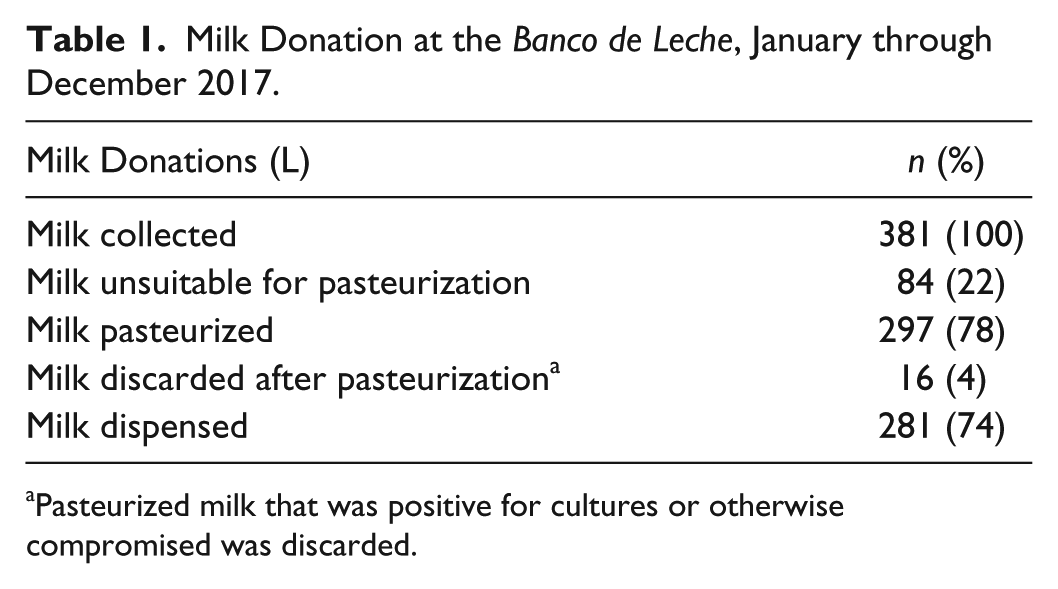
Pasteurized milk that was positive for cultures or otherwise compromised was discarded.

Técnico de laboratorio (Lab technician) Douglas Hernández Méndez culture samples.
Every day, approximately 50 infants are born at the Roosevelt; this amounts to over 20,000 births per year. All services at Roosevelt are provided free of charge. The milk bank is made up of two rooms adjacent to the NICU: one for extracción (milk expression) and a small laboratory next door for milk processing and milk storage. All Roosevelt NICU inpatients, until they can tolerate preterm formula (often estimated to be at about 33 weeks gestational age), receive trophic feeds of PHDM. Trophic feeds are administered seven times per day up, at gradually increasing amounts to 20 ml per feeding. Using this approach, the director of the bank reports that the hospital has a rate of necrotizing enterocolitis of less than 1%.
All the mothers of NICU infants are asked to donate milk. National standards govern the screening of potential donors. The mothers are interviewed by nurses and asked about their habits and medications. Their blood is tested for HIV, Hepatitis B, and syphilis. Approximately 70% of NICU mothers participate in the donation program, arriving daily at the milk extraction room. The milk bank director estimates there are usually 60 infant recipients at a time.
Every weekday morning, participating mothers arrive at the unit and change into pink hospital gowns with vertical lactation slits. Although all are invited to participate, about 30% cannot because of barriers to participation. Roosevelt Hospital acts as a major referral center for high-risk pregnancies; families may live far away, and there are no supports for families to stay nearby. Traveling to the hospital daily is challenging as there is a lack of public transportation, making the journey long, expensive, and arduous. Women in Guatemala have an average of 3.8 children (UNICEF, 2013); they are responsible for many children at home as well and want to visit those currently in NICU.
In the extraction room, the women sit in two rows (Figure 2). Up to 20 mothers can pump at a time, sharing nine electric pumps. For many women, the trip to the extraction room is the only time they express milk in a day, and for most, the quantity expressed is low, a few milliliters. Pumping opportunities are scarce because not only are pumps prohibitively expensive, but lack of refrigeration makes storage of hand-expressed milk at home impossible. The bank uses 120 mL glass flasks compatible in size/shape with the Brazil-donated pasteurizers. Because of the infant’s prematurity and the mother’s lack of expression opportunities, it may take a donor up to a week to fill a single flask. During the week, the flasks are stored in the milk extraction room fridge, with donors gradually filling them. The donations are not pooled. A maximum of 9 L can be pasteurized weekly. Waiting a week for donors to fill a flask is intended to maximize the amount sent to pasteurization. However, in 2017, over one-fifth of donations were found not suitable for pasteurization (Table 1). Once a year in May, to celebrate Human Milk Donation Day, the bank invites outside (non-NICU) mothers donate to the milk bank. The bank staff report these donations are less likely to be suitable for pasteurization and more likely to have positive bacteria cultures after pasteurization, which they attribute to external donors’ lacking education and support for safe milk handling and storage from nursing staff.
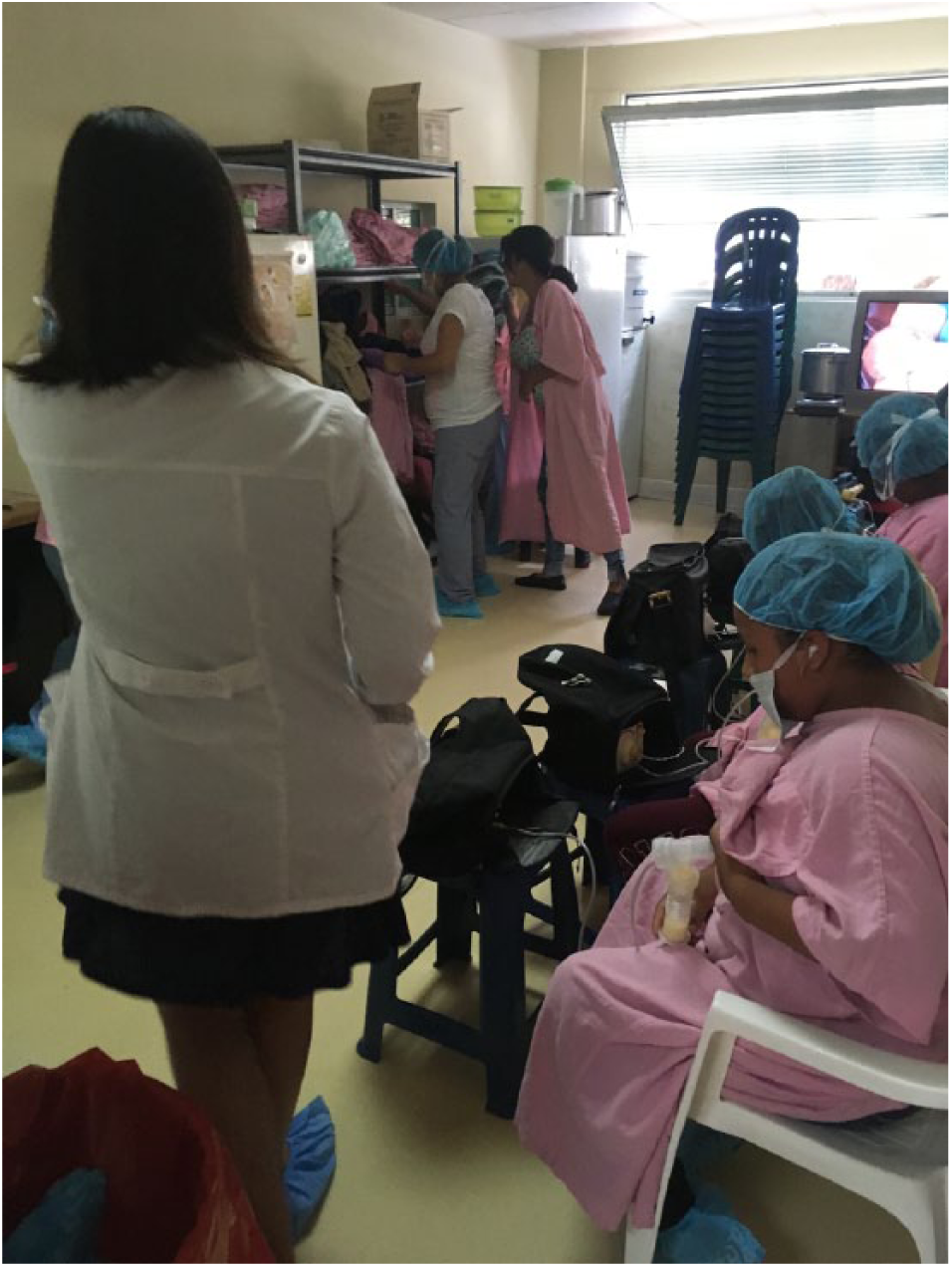
The Extracción (Extraction) Room. Up to 20 donors can pump at a time.
During the weekdays, six nurses support the bank (Figure 3). They instruct the mothers in hand hygiene practices, hand expression, use of the electric pump, the benefits of breast milk, and later, kangaroo care. All mothers are provided with ixbut galactologue tea to take home. The mothers experience high rates of malnutrition; during their visits, they are encouraged to drink cow milk provided by the hospital. After pumping, in the late morning the mothers may visit their infants at the NICU bedside. Once the infants are stabilized, off oxygen and parenteral nutrition, and preparing to go home, they graduate to kangaroo care. From 8:00 am to 11:00 am every day, these babies are held skin-to-skin by their mothers, who sit on a wooden bench in the Cangaru room (Figure 4).

Enfermera (Nurse) Esperanza Castro, one of six staff nurses providing breastfeeding education and support.

The Cangaru (Kangaroo) Room, where stable infants can be cuddled and fed at the breast.
One technician and a student microbiologist make up the laboratory staff. They label and track milk donations by hand. Processing of the milk begins with visual inspection for debris suspended in the milk by the nurses before it is even frozen. Once defrosted, lab staff sample each flask for density and acidity tests. Each flask is coded for milk maturity (colostrum, transitional, or “maternal” milk), fat density, and acidity level. The milk bank uses the Holder pasteurization method in pasteurizers made in and donated by Brazil. After pasteurization, each flask is sampled and cultured for bacteria. If any bacteria or other anomaly is detected, the individual donor is identified and informed, and that single flask of milk is discarded.
The infants receive donor milk according to their need: Neonatologists prescribe milk according to milk maturity, fat density, and acidity and dependent on infant condition. Infants’ own mother’s milk is not necessarily provided to them once pasteurized; rather, donors are providing for the bank’s recipient population generally. The director of the bank describes the arrangement as “a two-way job: mothers maintain their production of breast milk [after] the delivery of the baby, and we use milk for babies who need it.” While once-daily milk expression limits success, without the equipment in the extraction room and the support of nursing staff, the mothers of NICU inpatients would have greater difficulty building and maintaining milk supply. Protecting milk supply is critically important in a context where the cost of substitute feeding preparations is prohibitive and suboptimal infant nutrition is so common. Once the infants can tolerate 20 ml, around 33 weeks, the infants are switched to formula. Their mothers are asked to continue to donate to the bank to maintain the bank’s supply and their own lactation. During visiting hours while mothers are with their stable infants in the Cangaru room, they receive support and education from nurses to feed their infants at the breast. This facilitates the transition to breastfeeding independently by discharge.
On weekends, due to staffing shortages, the bank is closed. Mothers cannot come in to pump. New prescriptions for PHDM are not filled. For infants already receiving PHDM, if adequate and appropriate frozen milk remains in the laboratory, they may receive it. If not or if an infant is born on the weekend, the infant receives preterm formula. Although greater staffing is a priority concern, the director describes staffing decisions as a state decision as Roosevelt is a public hospital.
Limitations
The first author visited a single milk bank and collaborated with the staff there. Practices may vary across the country.
Conclusion
By inviting all their mothers to participate in the program, all NICU inpatient infants under 33 weeks gestation at the Roosevelt Hospital receive PHDM. Mothers cannot breastfeed their infants directly, but rather, they are asked to express milk on site, where it is pasteurized and then provided to an infant according to that infant’s needs and donor milk maturity, density, and acidity. The milk bank is closed on weekends, limiting continuous access to PHDM. Donated milk is not pooled, facilitating identification and exclusion of milk not suitable for distribution. Nurses provide breastfeeding support and education directly to donors.
The Roosevelt Hospital approach is remarkably different from milk bank donation/dispensation and NICU donor milk programs in North America. The approach aims to address the risks of infection, morbidity, and mortality associated with lack of access to human milk among preterm and low-birthweight infants. Poverty, maternal malnutrition, and adolescent pregnancy all contribute to high rates of premature birth in Guatemala. Asking all mothers of NICU infants to participate in the donation program both increases donation volumes and supports establishing and maintaining lactation among women who may be largely separate from their newborns. Despite the barriers to participation, most NICU mothers participate. Only having mothers pump once daily and closing the milk bank and the extraction room on weekends limits sustainability of the milk bank’s volumes, maternal milk supply, and continuity in infant receipt of human milk. Yet, this model allows most infants in need to receive PHDM and results in low necrotizing enterocolitis. The Milk Bank in Guatemala City promotes breastfeeding and access to human milk in a country with severe issues of malnutrition and stunting, high fertility, and moderate rates of low birthweight and prematurity.
Footnotes
Acknowledgements
Thank you to Douglas Hernández Méndez, technician at the Banco de Leche, and Monica Leonardo Segura. Martha J. Paynter is supported by a Dalhousie University School of Nursing Doctoral Scholarship, Helen Watson Memorial Scholarship, Nova Scotia Research and Innovation Graduate Scholarship, Maritime SPOR (Strategy for Patient-Oriented Research) Support Unit Doctoral Scholarship, the Canadian Nurses Foundation Caroline Sifton Research Award, and the Killam Trust.
