







Abstract
Keywords
The International Baby Food Action Network (IBFAN) is the oldest global network in the world. It invented “networking” before that became a common concept. It began officially in 1979 and was 40 years old in 2019, which it celebrated in Rio de Janeiro. This summary was inspired by archiving the IBFAN Penang office in 2019 and 2020. It covers how IBFAN started from six founding members, growing to 273 citizen groups in 168 developing and industrialized nations, and how it works. It has remained a “flat” non-governmental organizational (NGO) coalition, with no bosses. IBFAN’s middle name is Action, and it aims to actively seek ways to regulate powerful baby food companies, which compete directly with mother’s milk, a pillar of infant health. IBFAN aims to remove that commercial competition, giving breastfeeding a much better chance. Our work has included:
Internationalizing the Nestlé Boycott (Figure 1). Nestlé is the largest producer of baby food: infant formula, other human milk substitutes, baby juices, and cereals.
The Boycott led to the World Health Organization (WHO) and the United Nations Children’s Fund (UNICEF) drafting the International Code of Marketing of Breastmilk Substitutes (Code) from 1979 to 1981.
For 2 full years, governments, NGOs, industry, and scientists were the four partners in a novel drafting process conducted by WHO and UNICEF. There were four drafts. IBFAN participated in all the drafting by providing evidence of commercial promotion in the third world. This provided direct practical input that gave the Code better content and justification.
IBFAN (only 3 years old) managed to get 90 people from around the world to the World Health Assembly (WHA) in Geneva in 1981 to lobby for unanimous Code adoption. Despite strong United States government and industry pressures against the Code, the wording was not diluted, and the Code was adopted by vote, with 118 countries in favor and just one against (the United States). There was lots of press attention, and headlines such as “The United States Votes Against Babies.”
IBFAN groups grew rapidly in numbers and were organized by region: four in Asia, three in Africa, two in Latin America, one in North America, one in Middle East, and two or three in Europe.
Groups are independent but adhere to “IBFAN’s Seven Principles” (Table 1) and share through information exchange. Reporting, regional newsletters, and other cross-fertilization methods result in strong global cooperation and mutual support.
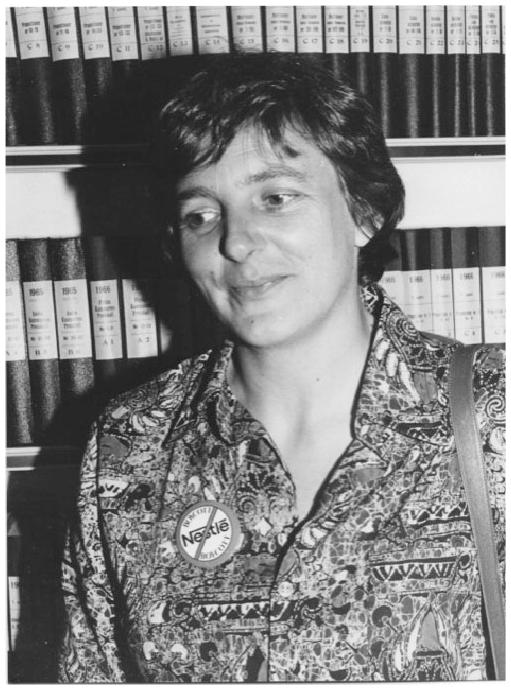
The author, Annelies Allain, explains why the Nestle Boycott is so important for IBFAN at a 1982 meeting in Stockholm organised by SIDA (Swedish International Development Association).
International Baby Food Action Network Seven Principles.
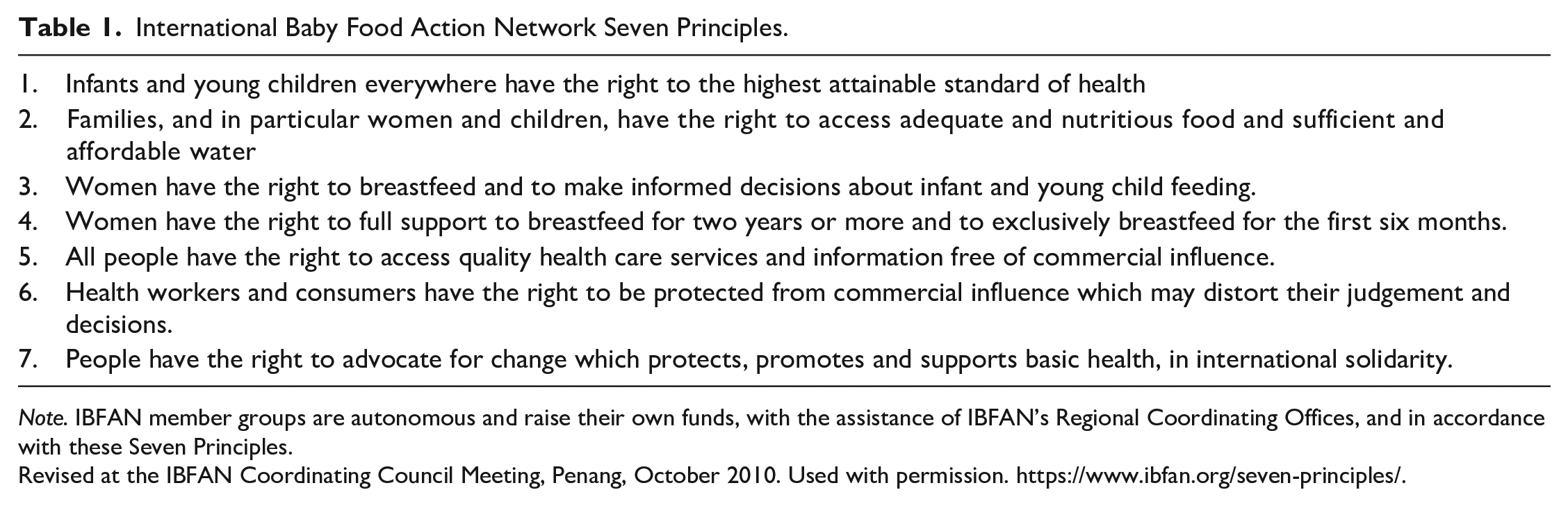
Note. IBFAN member groups are autonomous and raise their own funds, with the assistance of IBFAN’s Regional Coordinating Offices, and in accordance with these Seven Principles.
Revised at the IBFAN Coordinating Council Meeting, Penang, October 2010. Used with permission. https://www.ibfan.org/seven-principles/.
Our Challenges
Lack of Resources
During the early years, IBFAN had lots of enthusiasm but no resources at all. Communications were limited to letters (yes, snail mail) and occasional telexes, but only rarely phone calls. International calls were very expensive. There was no internet in those years. The advantage of telex was that the cost forced us to weigh each word, to trim the message to its very essence, very different from today’s lengthy, chatty emails. Faxes and websites, and Skype and Zoom conferences came much later. Yet, for 2 decades, without computers, without free calls, we managed global action, coordination, and understanding.
The United Nations
Dealing with the United Nations was an unforeseen challenge. While fighting for strong provisions in the Code, IBFAN had a legitimate place, but gradually the WHO lost interest and from the start the United States wanted us out. They feared big pharma would be next for an international code. Keeping the Code on the agenda at the WHA, year after year, required strong lobbying. NGOs have low status; the only time they can speak officially (for 3 min or less) is after governments, after decisions have been made. Therefore, we had to learn how to influence, even draft those decisions from the sidelines, via like-minded delegations.
Industry had the same limitations at the WHA, but the companies had the means to invite delegates to press conferences and fancy dinners in nearby hotels, introduce misinterpretation of the Code, and present new products invented to bypass the scope of the Code.
Campaigns
The Code is on the WHA’s agenda for action every 2 years. IBFAN has been present every year with publications and advocacy to call attention to sly and subtle new marketing methods and the need to take action at global and national levels. Some examples are:
✓ STOP companies from giving free formula (supplies) to hospitals, clinics, and health workers. This was a tough one. Giving samples increases sales. It took 7 years of lobbying to close loopholes in Code interpretation to ensure zero tolerance.
✓ Expand the scope of the Code, because companies invent new products and practices: The Code now covers marketing of foods for infants 0–36 months old, forbids cross-promotion and claims, internet clubs, and so forth.
✓ Exclusive breastfeeding for 6 months was adopted as the new worldwide norm.
✓ Build legal support for Guatemala, Latvia, Botswana and other countries as they tried to enforce national law against aggressive company lawyers.
✓ Alert governments about the impact of trade agreements (e.g., NAFTA, TPP) with clauses like Investor State Dispute Settlement (ISDS), which allowed companies to claim for present and future losses incurred because of national marketing laws, and so forth. Prepare for chilling effect i.e., governments are worried about corporate backlash but need to learn there are international arguments to protect them..
World Health Assembly Resolutions
Opening the Code to renegotiation would definitely lead to weakening it. Hence, the only way to update and clarify Code provisions, considering new marketing tactics adopted to circumvent it, is by WHA resolutions, which have the same legal power as the Code. Nearly every 2 years, IBFAN has lobbied for a clear resolution clarifying issues (as stated above) and also pushing for more national implementation. Between 1984 and 2018 we obtained about 19 resolutions clarifying the Code (Figure 2). There are records in the IBFAN Archives for each of these WHA years, describing the issue needing attention, the preparation of the text, the context, the politics of that particular year, which governments supported it, and how it was adopted or voted on.
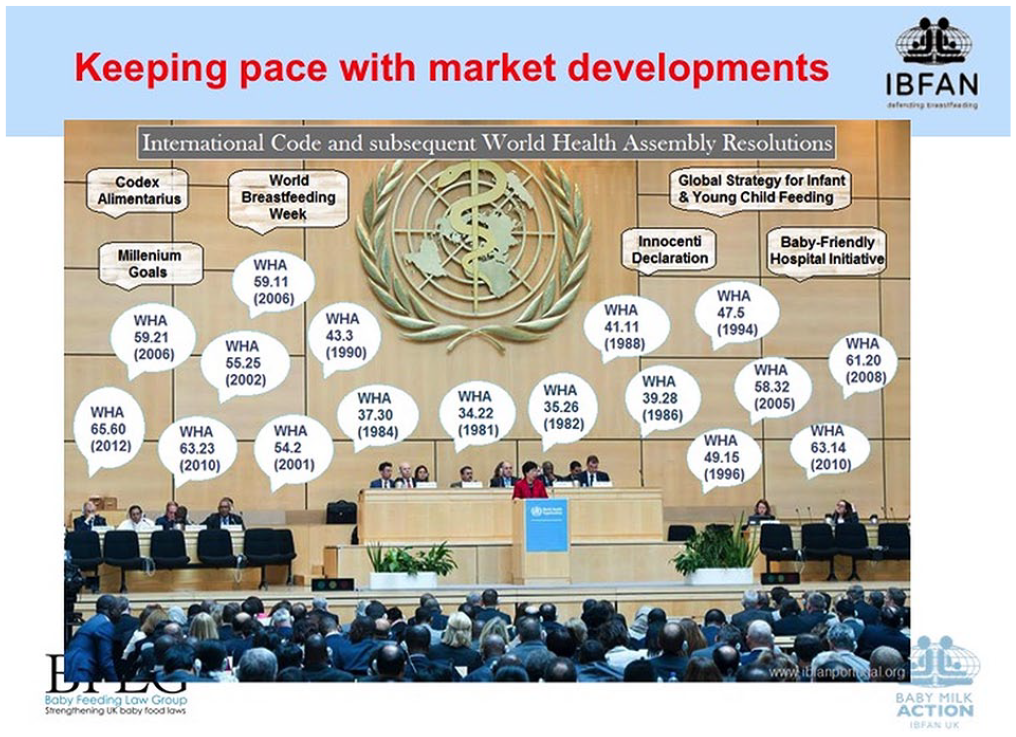
Graphic representation of the 19 resolutions and documents adopted by the WHO General Assembly since 1981.
Implementing the Code
National Implementation
Implementation at the national level became a hurdle. This was unexpected because many of us were convinced the battle was won once the Code had been overwhelmingly adopted. IBFAN had to learn the hard way that what delegates promised at the United Nations in Geneva does not automatically become law in Member States. The companies will not allow it; the market is far too lucrative for them to act ethically or to listen to appeals to behave for the sake of public health. Curbs on marketing therefore have to be enforced by law, and laws need to be drafted with care and pushed through political roadblocks.
Name and Shame
As of 1985, IBFAN began to record which countries had done what to implement the Code and which companies were the worst at complying with the Code, even though they had promised to comply in 1979. Every 2 or 3 years, IBFAN published two charts: State of the Code by Country and State of the Code by Company. This was very successful; some years delegates were queuing to get theirs.
Training
As of 1991, IBFAN began Code training, first for NGOs, then for governments. Over the next 25 years it trained over 2000 government officials from 148 countries. No other NGO has been so specialized that countries send their legal drafters to IBFAN courses. Training was flexible in duration and place. There were more than 60 courses: International 9-day Annual Courses; Regional 6-day Courses; and 3-day National Courses, and many had strong UNICEF support. Drafting support was provided in situ and online.
Monitoring
IBFAN also did training for groups to do professional checking of corporate marketing techniques. For 15 years, funding from the Dutch government enabled us to pay for groups to come for such trainings and then do systematic surveys to check on company tactics designed to influence mothers and health workers to buy human milk substitutes.
Promotional activities of the 18 big human milk substitutes manufacturers and 10 feeding bottles and teats manufacturers have been recorded and examined since 1984. Code violations have been publicized and used to demonstrate that strong laws are needed (Allain, 2005). Our IBFAN Archives hold correspondence with these companies and show how their “self-regulations” have been challenged and denounced in press releases.
International Code Documentation Centre
The International Code Documentation Centre (ICDC) was set up in 1985 as a specialized arm of IBFAN to keep track of Code implementation worldwide. ICDC collects, analyses, and evaluates national laws and draft laws. It conducts courses on Code drafting and monitoring and publishes global monitoring reports.
After Dutch and Norwegian government funding ended, ICDC had to rely on voluntary monitoring alone. The results continued to feed into publications: Breaking the Rules; Look What They’re Doing in (Country); and Focus. These served as lobby tools at the WHA to strengthen Code compliance. Companies are named and shamed. The 16 editions (1980, 1982, 1984, 1985, 1986, 1988, 1989, 1991, 1994, 1998, 2001, 2004, 2007, 2010, 2014, and 2017) of Breaking the Rules (2017) became so well known that the last ones paid for themselves (Figures 3 and 4). Companies paid up to $2000 USD to find out what IBFAN had reported on them. IBFAN also sold to investment companies, to governments, and sometimes to the media, first hard copies but later digital.
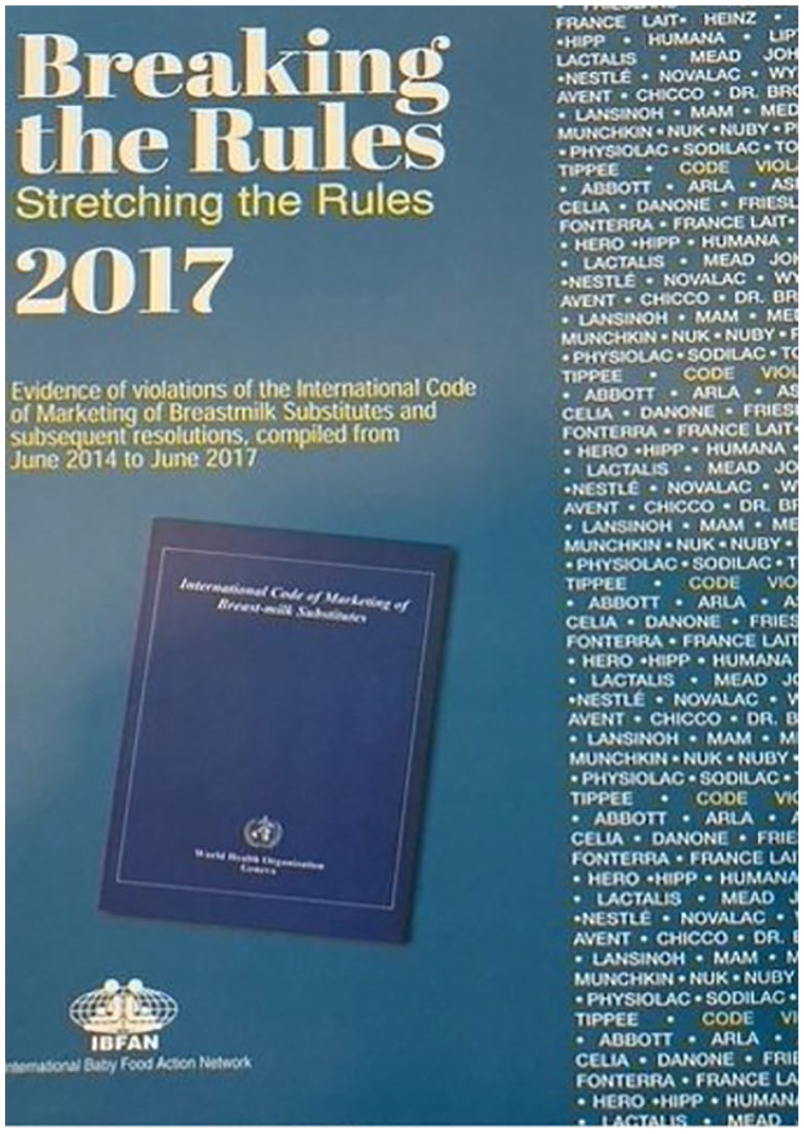
IBFAN’s latest Breaking the Rules 2017. (237 illustrated pages)
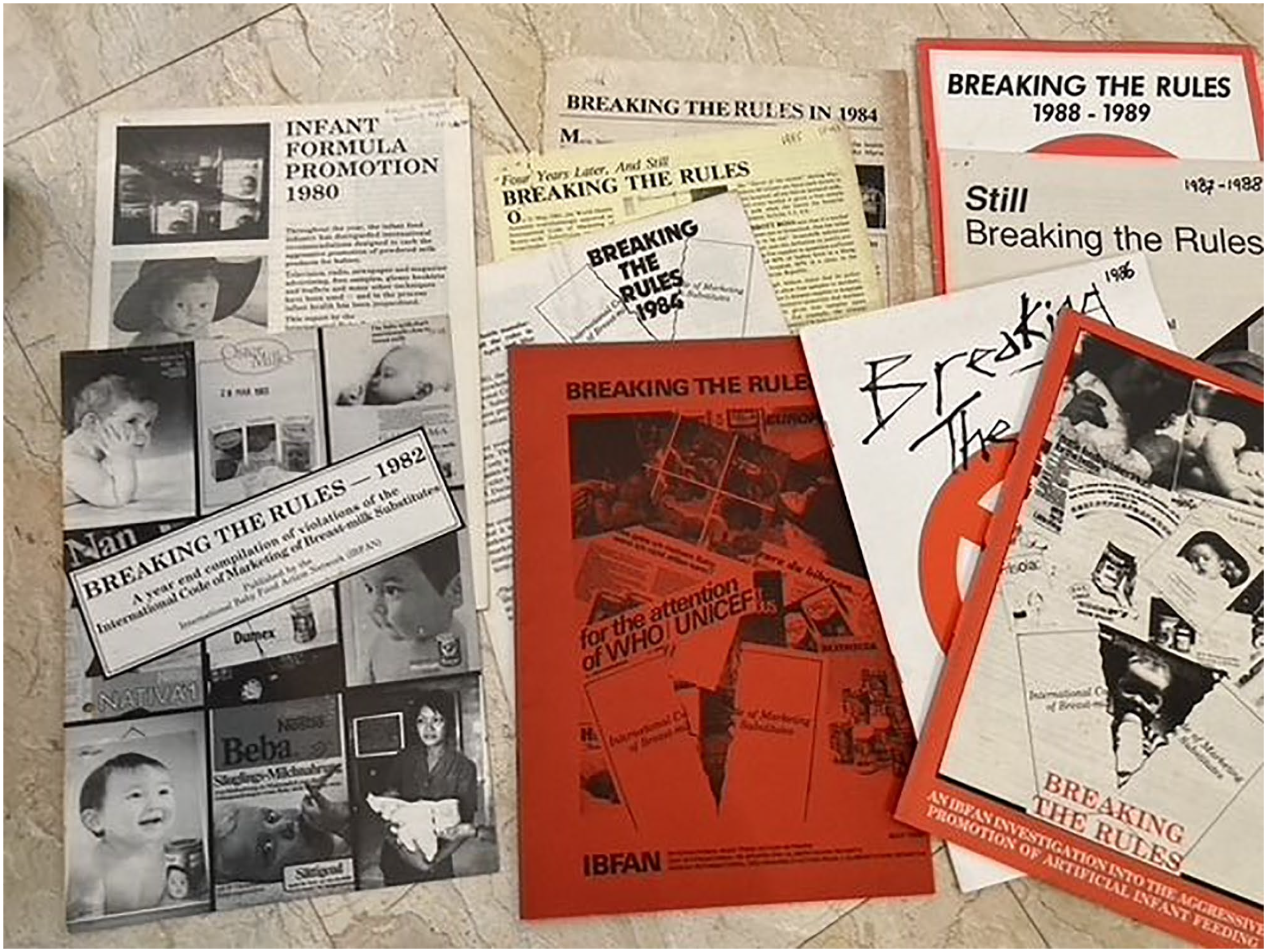
Early IBFAN Breaking the Rules Materials 1980–1988.
The WHO Joins Monitoring Action
Since 2015, the WHO finally became more interested in Code implementation (WHO, 2020). For 3 decades IBFAN had been doing the WHO’s work. The WHO realized IBFAN-ICDC had more information and skills and began catching up. In 2016, 2017, and 2018, the Status Report on National Implementation of the International Code became a joint publication by IBFAN, UNICEF, and WHO.
Our history is inIBFAN Archives Worldwide.
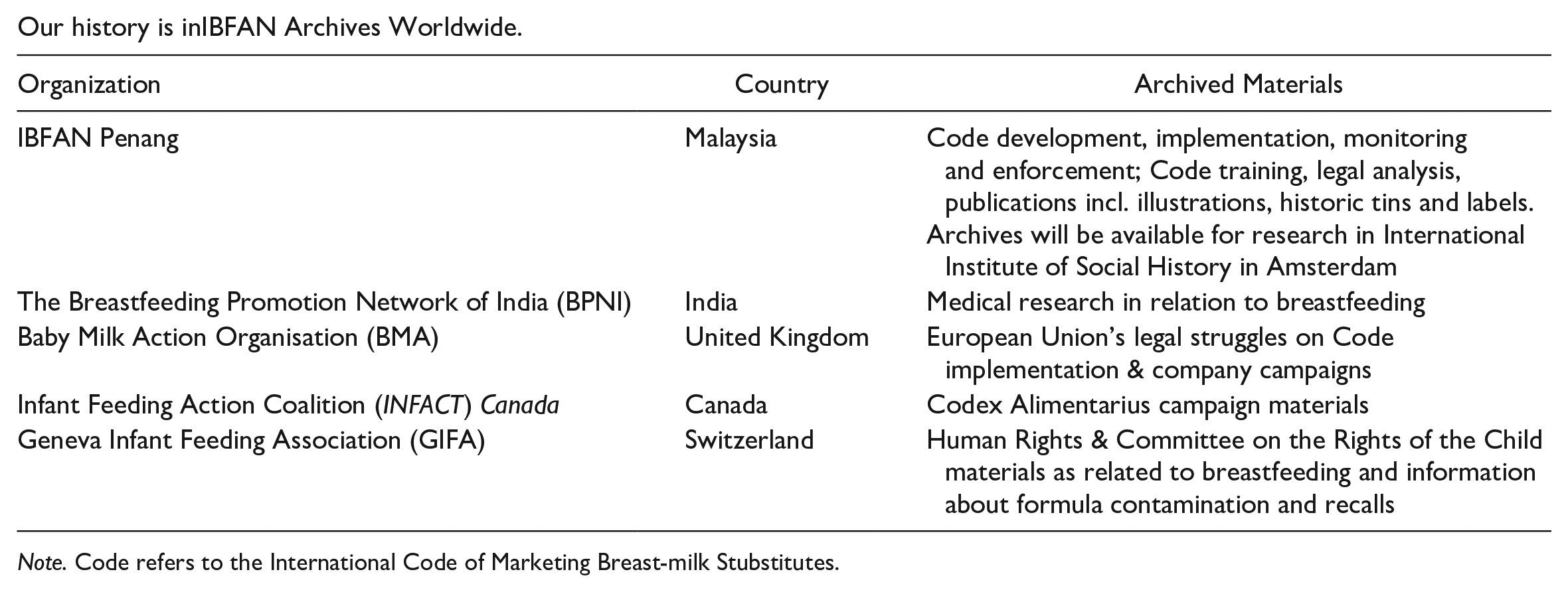
Note. Code refers to the International Code of Marketing Breast-milk Stubstitutes.
Footnotes
Disclosures and Conflicts of Interest
The author declared the following potential conflict of interest with respect to the research, authorship, and/or publication of this article: Ms. Allain has been an active member of IBFAN since its inception.
Funding
The author received no financial support for the research, authorship, and/or publication of this article.