







Abstract

Keywords
Background
As knowledge and discussions of diversity in sex, gender identity, and gender expression have expanded and evolved, it has become clear that healthcare providers and researchers can no longer treat sex or gender as binaries. Gender and sex are separate concepts, and one does not imply the other. They are important factors in patient-provider interactions, research, and results (Heidari et al., 2016; Tannenbaum et al., 2016). Using exclusively binary models of sex and gender (i.e., male/female; man/woman) and imprecise descriptions and methodologies concerning gender in research and academic writing have historically erased, pathologized, and marginalized transgender, gender non-conforming (TGNC), and people with intersex traits (Cameron & Stinson, 2019; Heidari et al., 2016).
Lack of access to, and availability of, quality healthcare are among the various forms of discrimination that TGNC people face. These barriers in accessing healthcare include refusal of care, denial of coverage for “gender specific” care, and verbal and physical assault (Farrow, 2015; Moseson et al., 2020; Romanelli & Lindsey, 2020; WHO, 2015). In addition, poor education of healthcare providers results in gaps in medical knowledge concerning TGNC people and those who receive gender affirming care. This contributes to a lack of healthcare availability and unnecessarily invasive and alienating questions from providers (Romanelli & Lindsey, 2020). These issues, while harmful themselves, are further compounded by the over medicalization of gender variance (Johnson, 2016).
People with intersex traits also face discrimination and violence in healthcare. Most prominently, stigma, lack of access to quality healthcare, over medicalization, institutional violence, and erasure. Often unethical, unnecessary cosmetic surgeries and treatments have been performed on infants and children born with intersex traits to “normalize” their bodies, which can result in lifelong complications and necessitate repeat procedures (WHO, 2015).
Appropriate and culturally sensitive research and publications concerning topics specifically pertaining to TGNC and intersex populations are needed. However, regard for sex and gender diversity when conducting all research is also vital. Research and the resultant publications that are built on cisnormative and dyadic (Table 1) models of sex and gender, exclude and marginalize TGNC people and people with intersex traits. These publications reinforce inequities by not addressing diversity in gender and sex, which then reinforces erasure. They can erase clinically significant differences between and within sex and gender, compromise scientific rigor, and reduce the effectiveness of interventions in these marginalized populations (Heidari et al., 2016; Tannenbaum et al., 2016). This erasure only perpetuates the existing lack of knowledge and reinforces the idea that TGNC people and people with intersex traits do not need to be considered in research in the “general population.”
Definitions of Terms in Current Use.
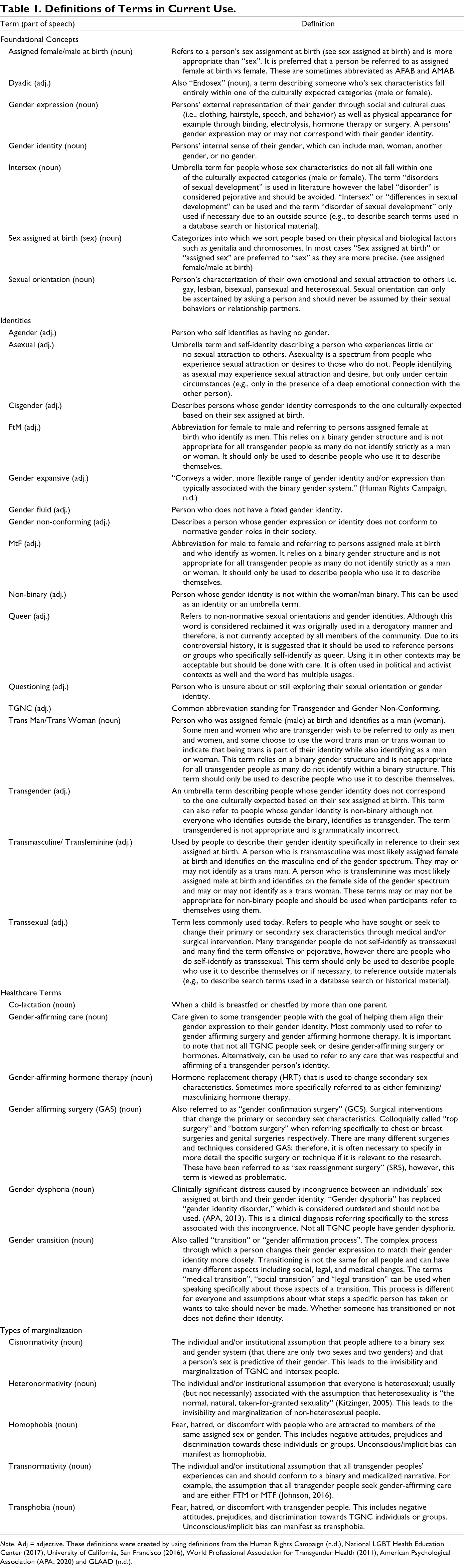
Note. Adj = adjective. These definitions were created by using definitions from the Human Rights Campaign (n.d.), National LGBT Health Education Center (2017), University of California, San Francisco (2016), World Professional Association for Transgender Health (2011), American Psychological Association (APA, 2020) and GLAAD (n.d.).
Although current and reliable demographic information regarding the prevalence of people with intersex traits in the population are not available, estimates have ranged as high as 2% of live births (Blackless et al., 2000). Similarly, comprehensive demographic information about the prevalence of TGNC people in the population is currently not available. However, there are a growing number of openly TGNC people in younger populations (GLAAD, 2017). This suggests that, although already relevant, it will become increasingly important that healthcare professionals and researchers across all fields recognize people with intersex traits and TGNC people in study designs and subsequent publications.
Inclusion and regard for sex and gender minorities is especially pertinent in highly gendered fields of health care. Research and language that refers exclusively to cisgender women is inherently harmful and inaccurate when used in a field that is relevant to more than just cisgender women. It has been shown that gender and sex diversity exist in the lactating population; thus, they must be adequately accounted for in research and writing done in the field. Although some may argue that the majority of people who give birth and produce milk could reasonably be assumed to identify as women, who were assigned female at birth, there are documented cases of TGNC parents and parents with intersex traits lactating (LeCain et al., 2020; MacDonald et al., 2016; Reisman & Goldstein, 2018). However, due to a current lack of research that accounts for sex and gender diversity in people who give birth and/or lactate, it is not possible to say how large or small this population is. Further, the small body of research available describes some unique issues, but further research into the challenges that these populations face in lactation is required (Farrow, 2015; LeCain et al., 2020; MacDonald et al., 2016).
A major hurdle to producing inclusive and accurate research can be a lack of understanding by scholars about how to conduct studies and author papers in ways that accurately and inclusively account for both gender and sex. Without appropriate knowledge and language usage on the part of scholars, TGNC study participants and participants with intersex traits may go unnoticed; therefore, pertinent information relating to sex and gender may not be adequately conveyed to the reader. This is why it is important to develop specific tools and words to discuss lactation in an inclusive way.
As a note on our usage of the term gender non-conforming in this paper: After much consideration of different terms, we chose to use the term gender non-conforming for two reasons. First and most simply, this term has gained popularity in writing (APA, 2020, p. 139) and we believe that recognizability of terms can help facilitate understanding. However, we also believe that this term is uniquely suited to the discussion in this paper, as it is defined by opposition to gender conformity, making it somewhat sensitive to the context in which it is used. As we are largely discussing current norms of English language academic publishing, we could view gender non-conformity as those gender related concepts and identities that are largely not accounted for or considered in the majority of this reading and writing. Practically, this means we are mostly referring to transgender and gender non-binary identities. However, gender inclusivity and equity in language also goes beyond these identities. We chose this term to recognize that fact and challenge readers to consider, who else is the expectation of gender conformity affecting? Further, throughout the paper, the terms sex and gender are sometimes used in broad statements and non-specific ways, like “one should account for gender in research.” The term gender and sex when used broadly in this paper refer to the many complex aspects of identity, expression, and its role in culture.
Key Messages
Current research and writing in lactation make normative assumptions about the gender and sex of people who give birth and people who lactate. However, this is not accurate and further marginalizes transgender people, gender non-conforming people, and people with intersex traits.
We have presented a discussion about inclusive language as well as some strategies on how to write academic papers using language that is both more accurate and inclusive of sex and gender diversity.
Using language that is more inclusive of diversity in sex and gender will help to improve healthcare access and availability for these marginalized populations by improving the quality and accuracy of research papers.
The aims of this paper were to provide a discussion about (1) how to use language that is inclusive of gender and sex diversity in academic writing and (2) how attending to these issues could lead to more accurate research results and writing, and lead to better outcomes in lactation service provision. In conjunction with the other two articles on related aspects of our topic in this issue (Bamberger & Farrow, 2021; Dodgson & Bamberger, 2021), we aim to equip authors and readers with the skills and language to conduct, write, and read research in a more inclusive way.
Inclusive Language
Normative Assumption in Writing
Academic writing must seek to be as clear and accurate as possible. Gender expression, gender identity, and sex are not the same. People may identify as women, men, or one of many gender non-binary identities, including non-binary, genderqueer, agender, or a culturally specific identity (e.g., Two-Spirit in north America or Hijra in the Indian subcontinent). Further, some people are born with sex traits that differ from those expected by narrow binary definitions of male and female. However, often in writing and in everyday speech, these terms are used interchangeably. A study conducted by Cameron and Stinson (2019) reviewed 106 psychological research papers to examine how they discussed their measurement and presentation of gender and sex. They found that only 11 (10%) of the papers described a gender measurement and 83 (78.3%) discussed a single or binary gender/sex in the description of the sample (Cameron & Stinson, 2019), showing that researchers and academic writers often rely on cisnormative and dyadic models of sex and gender. If both assigned sex and gender identity are not specified using clear and appropriate language, this could lead readers to erroneous normative assumptions and stereotypes (Duffy & Keir, 2004).
Writers need to examine what assumptions they are expecting—consciously or not—the reader to make. As a simple example, the term “the opposite sex” can only be understood by making assumptions about what sexes exist and their relation to each other. Usage of this term would most likely result in the reader assuming that the writer was referring to a dyadic model of sex. This example may seem blatant, but often these assumptions that we ask readers to make are much more subtle or due to omissions of key specifics. Although assumptions like this can be problematic in many areas of writing, in focusing on sex and gender we must be most aware of heteronormativity, cisnormativity, and dyadic assumptions about sex. Heteronormative assumptions regarding family structure could be assumptions that a child has two parents, specifically a mother and a father, with each performing certain roles. For example, the mother gives birth to and breastfeeds their child and the father plays a supporting role. This can lead to biases like the belief that the person who gave birth was the mother, primary caregiver, and the sole provider of milk or the primary provider of milk when there is more than one lactating parent. Cisnormative assumptions might be assuming the gender of a person based on their physical attributes or sex. Dyadic assumptions about sex would be the assumption that there are only two sexes and that everyone has either all male characteristics or all female characteristics.
Even in the case that a normative assumption may lead to a correct understanding on the part of the reader, it should be avoided as it is a possible source of error or confusion and further reinforces erasure of marginalized groups. Often researchers in lactation will have inclusion criteria similar to “mothers and their infants with…,” and exclusion criteria that do not mention sex or gender. This is problematically vague and imprecise, as it relies on the reader assuming that the writer was making normative assumptions. In that specific example, it is unclear who the authors are referring to by using “mother”: Only lactating people that identify as mothers (this could exclude cisgender women who are gestational carriers and include cisgender women, people with intersex traits, and TGNC people who identify as mothers); anyone who is lactating and feeding a baby; only lactating cisgender women; lactating people who identify as women; and others. In some cases, the reader may be able to determine who the authors are referring to if details are provided about the precise questions asked. However, this information is usually not given and often it is not possible to determine how data about gender identity and sex were gathered (Moseson et al., 2020). Although this confusion may be due to deeper methodological concerns, more careful language usage would let readers know more precisely who was included and excluded without having to rely on normative assumptions.
A possible rule of thumb to consider is that any place where a writer would feel it important to specify non-normative information may be a place where that information should be presented, even if it is normative. For example, if writing about a group of women who all happened to be cisgender, an author may initially want to just refer to them as women. However, the author could ask themselves, “if they were not cisgender women, would that information be necessary for understanding the intended meaning?” If the answer is yes, then it should be clarified that the women being talked about are cisgender, having been determined that this level of knowledge is important to understanding the overall meaning of what is being said. This is not to say that every instance of the word “women” needs to be qualified in this way, rather that this should be stated explicitly for the reader at some point. Additionally, due to the pervasiveness of normative assumptions, authors may consider indicating places where an intentional lack of information may lead to unwanted normative assumptions. For example, an author may say “all participants identified as women. Sex data were not available.” This extra statement serves to actively combat normative assumptions and erasure.
Gendered Language, Non-gendered Language, Inclusive Language, and Pronouns
Language itself can be thought of as either gendered or nongendered. Gendered language is language that acknowledges the gender of the subject or prescribes gender to a theoretical subject. The pronouns he and she, words that include a gendered term in them (e.g., fireman, policewoman), as well as other words that imply gender (e.g., host, hostess) should all be considered gendered language (British Columbia Public Service, 2018; State Government of Victoria, 2020; United Nations, n.d.). Although the English language does not use grammatical gender in the same way as some other languages do (for example, the Romance languages use gendered nouns and verb tenses), some terms that are not inherently linguistically gendered in English are often commonly understood as associated with specific genders or sexes (e.g., breasts, mustache, beard). Writers should take care in using words that are often perceived as gendered or sexed or culturally tied to a gender or sex to avoid unintended implications. In many cases it is appropriate to use gendered language. An author may know that a participant identifies as a woman and mother, and in that case they should use those terms to refer to her. Gendered language can be problematic, however, when the writer, either knowingly or unknowingly, makes assumptions about the gender identity or sex of their participants. Referring to a group of lactating people as women runs the risk of being incorrect, damaging, and/or alienating if someone in that group does not identify as a woman. Further, if a study only discusses women or mothers, then it may be assumed that the study is only applicable to cisgender women who identify as mothers, regardless of whether this is actually true.
Non-gendered language does not speak to the gender or sex of the subject or prescribe gender identity or sex characteristics to theoretical subjects. Pronouns like they/them or terms like police officer, are examples of this in the English language. Although every attempt should be made to allow for a person to indicate the language that they use for themselves, non-gendered language can be used to refer to people who have not made this indication. Non-gendered language also is useful when referring to a group of people with mixed, unknown, or not relevant gender identities and/or sex traits. When talking about a hypothetical person or population where gender and sex are not immediately relevant, non-gendered language should be used (APA, 2020, p. 140). However, avoiding gender in language altogether should not be done. Using non-gendered language to describe someone who has indicated that they use gendered language is not respecting the language that they have indicated for themselves. For example, a transgender person, who has struggled to have their gender identity recognized, may find being referred to by exclusively non-gendered language, despite indicating otherwise, erasing, and tantamount to being misgendered. In addition, the recognition of gender is still important for women’s equity in healthcare and healthcare research (Heidari et al., 2016).
“Inclusive language is language that is free from words, phrases or tones that reflect prejudiced, stereotyped or discriminatory views of particular people or groups. It is also language that does not deliberately or inadvertently exclude people from feeling accepted” (British Columbia Public Service, 2018, p. 4). Gender and sex inclusive language, in its most simple form, can be thought of as knowing when to use gendered language and when to use non-gendered language. It seeks to keep gender and sex in language where appropriate, while being inclusive of and reflecting the diversity inherent in sex and gender. This type of language usage must include all people to whom it is intended to refer. To use inclusive language, a writer must try to identify any assumptions that they are making. When writing, ask yourself “who am I discussing, and do I know what language they use for themselves?” If writing about a group, ask “are all the people I am discussing represented by the language used?” (British Columbia Public Service, n.d.). A researcher who has collected the appropriate data about gender and sex may ask themselves this question and find that all their participants have identified as women. In this case, the researcher should define their participants as women. However, if later the researcher tries to universalize their conclusions to encompass all lactating people, using the term “breastfeeding women” is no longer correct as the breastfeeding population includes more than women who breastfeed. For example, the researcher may say “breastfeeding women in my study are… It remains to be seen if the broader population of people who are lactating are also…” Carefully attending to and examining assumptions in writing increases the accuracy of writing by reflecting the inherent sex and gender diversity already present in the world.
One of the most commonly gendered parts of the English language is pronouns. Gender is generally ascribed to a person by using the pronouns he/him/his or she/her/hers. However, as not all people identify within normative gender binaries, these pronouns are not appropriate for some people. There are many non-gendered pronouns that can be and are used in English (e.g., Ze/Zir or Per/Pers). The most commonly used today are the singular versions of they/them/their/theirs. A discussion of the correct usage of the singular they can be seen in the Publication Manual of the American Psychological Association (2020, pp. 120–121), which is used by JHL. When the genders of participants are not known, not relevant, or have not been collected, then they/them/their pronouns are appropriate. The use of pronouns is not always necessary; in some cases, it may be more appropriate to not use them at all and instead use appropriate nouns (e.g., “they reported…” vs. “the participants reported…”). In all cases it is important to respect the language that people use to describe themselves and, if referring to participants using pronouns, they should always be referred to by the pronouns that they themselves use. In the case that a participant does not use pronouns, this should also be respected in the language of the manuscript (APA, 2020, p. 140).
Specific Considerations, Terms and Examples
There is, unfortunately, no one source for terminology, and variations in language usage may exist between regions and culturesTables 1 and 2. For that reason, it is important that authors use their best judgment and consider the relevant cultural norms when composing a manuscript and defining the terms they use. Authors can find appropriate language in a number of ways. Local LGBTQIA+ organizations or advocacy groups may have lists of terms. If a study participant has identified themselves as TGNC or having intersex traits, they may be willing to assist in defining the terms that they use to describe themselves (if the researchers are respectful, open, and demonstrate a basic understanding of the diversity of gender and sex). The inclusion of diversity within research teams also may provide a source of culturally relevant terms and more inclusivity.
Terms Not in Current Use.
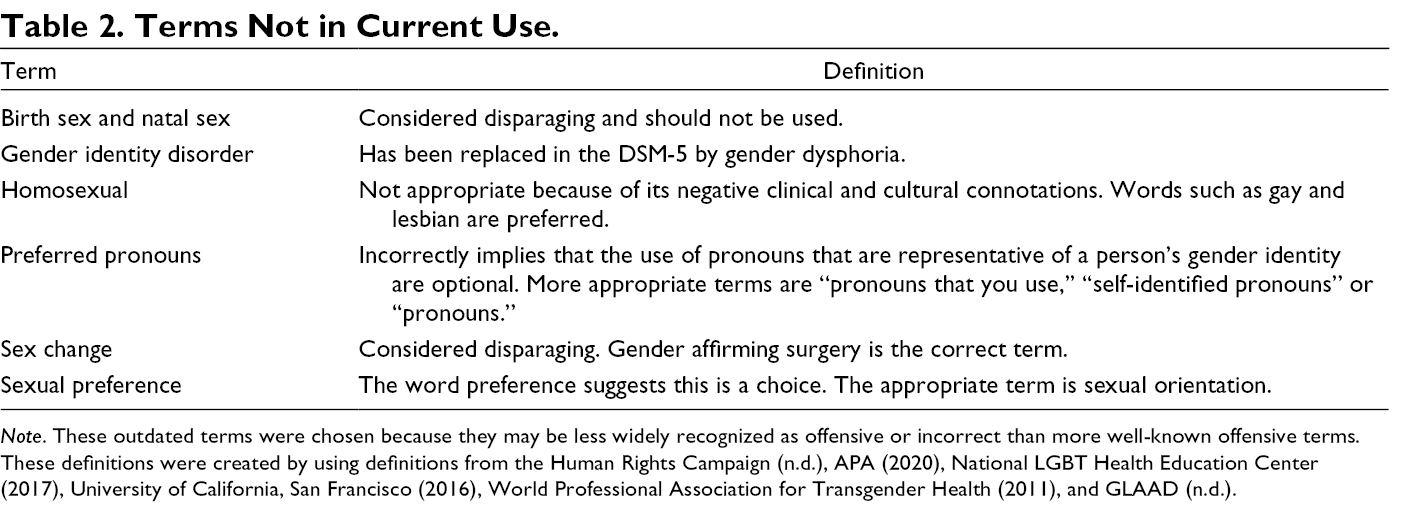
Note. These outdated terms were chosen because they may be less widely recognized as offensive or incorrect than more well-known offensive terms. These definitions were created by using definitions from the Human Rights Campaign (n.d.), APA (2020), National LGBT Health Education Center (2017), University of California, San Francisco (2016), World Professional Association for Transgender Health (2011), and GLAAD (n.d.).
In this paper, we do not intend to prescribe novel language that should be used. Rather, we aim to present and describe some language currently in use, while leaving room for new terms, and encouraging authors to learn about the inclusive language in use within their own and their research communities. Table 1 is a list of current terms in use with definitions, and Table 2 is a short list of outdated terms. These tables are intended to give readers an overview of the foundational concepts around gender, sex, and orientation and to provide terms that facilitate understanding. It is important to note that the tables are only a selection of definitions. The tables lack regionally-specific terms, and some terms may be replaced in the future as language itself is constantly evolving.
In some cases, the language may not yet exist or is not used in the mainstream academic world and may need to be introduced to the academic lexicon. This has been happening within the field of human lactation due to the inherent gendered and sexed interpretation of terms like “mother” and “breast” and the prevalence of these terms in the field. For example, although it was already in use in blogs (Maconald, 2012), the term “chestfeeding” was first introduced into academic papers by MacDonald et al. (2016) Transmasculine individuals’ experiences with lactation, chestfeeding, and gender identity: A qualitative study. Shortly after this paper was published, the term “chestfeeding” was included in the International Lactation Associations Style Guidelines (International Lactation Consultant Association [ILCA], 2017). The term chestfeeding is now being used when participants use this term, as sometimes seen in TGNC populations (MacDonald et al., 2016).
The term “mother” and terms containing mother or maternal (e.g., mother’s milk, mother–infant dyad, and maternity leave) should only be used if the author knowns that the parent self-identifies as a mother. If study participants do not identify as women/mothers or their gender identities are unknown, the terms “birthing parent,” “human milk,” “parent–infant dyad” (ILCA, 2017), or the “dyad” should be used alone or in conjunction with gendered terms (e.g., mothers and parents). When it is known that the participant identifies as a man/father then it may be most appropriate to use terms that include father (e.g., father–infant dyad, ILCA, 2017) and paternal. The term “breastmilk” is not used in JHL publications, for unrelated reasons, instead the terms “human milk” or “mother’s own milk” are used (Dodgson, 2018). “Mother’s own milk” is appropriate if it is known that the participant(s) identifies as a mother, otherwise “human milk,” “father’s own milk,” “parent’s own milk,” or “expressed milk” should be used, depending on the context (ILCA, 2017).
Researchers should also be aware that, just as chestfeeding entered academic writing via qualitative research interviews, other new language and terms will be emerging and scholars should not be confined to the terms we currently use when talking about lactation. We encourage researchers and writers to help make academic language more inclusive and precise by sharing terms or strategies that help further that goal.
Conclusion
Lactation is a specialized realm within the field of what is traditionally defined as maternal and infant health. As it is centered on childbirth and, typically, the assigned female at birth body, the language that is used is often cisnormative and based on a dyadic model of sex. However, lactation is an activity practiced by cisgender women, people with intersex traits, and TGNC individuals; therefore gender associated terms are not always appropriate (Duckett & Ruud, 2019; MacDonald et al., 2016; Reisman & Goldstein, 2018). We must seek to avoid the inherent inaccuracy and harm caused by using language that erases ever present gender and sex diversity. In many other areas of healthcare, language and terminology used surrounding gender and sex are changing to be more inclusive and respectful. The language and terms used in lactation care and lactation scholarship must evolve as well.
Footnotes
Disclosures and conflicts of interest
The author(s) declared the following potential conflicts of interest with respect to the research, authorship, and/or publication of this article: At the time of publication, Ethan Bamberger was an Associate Editor for the Journal of Human Lactation and Aiden Farrow was a member of the Journal of Human Lactation’s Editorial Review Board.
Funding
The author(s) received no financial support for the research, authorship, and/or publication of this article.
