






Abstract
Workplace breastfeeding support remains a critical yet under-addressed factor influencing maternal and infant health. Although federal protections mandate lactation accommodations, they often fall short of supporting sustained, on-demand breastfeeding. This Insight into Practice and Policy paper describes the development and implementation of an Infant at Work (IAW) policy in a pediatric clinic setting. The policy allows employees to bring their infants to work until 12 months of age, contingent on safety and job performance considerations. Over the past decade, three mothers have participated in this policy with a total of five children, reporting benefits such as extended breastfeeding duration, improved emotional well-being, and enhanced work-life balance. Clinic staff emphasize the importance of leadership support, a family-oriented culture, and flexible workflow accommodations to facilitate policy success. This paper highlights how direct infant presence in the workplace can normalize breastfeeding, strengthen maternal-infant bonds, and reduce the logistical and emotional strain of early postpartum employment. While this model may not be feasible in every work environment, it offers a novel framework for reimagining lactation support. This practice-oriented perspective provides clinicians, lactation professionals, and policymakers with actionable insights for replicating or adapting IAW policies in similar settings.
Background
Breastfeeding offers well-established health benefits for both mothers and infants (Figueiredo et al., 2021; McGowan & Bland, 2023; North et al., 2022; Tucker & O’Malley, 2022). Yet only 25% of U.S. infants meet the Center for Disease Control’s (CDC) recommendation for exclusive breastfeeding during the first 6 months of life (Centers for Disease Control and Prevention [CDC], 2020). In response, global and national organizations increasingly call on employers to improve lactation support in the workplace (United Nations International Children’s Emergency Fund [UNICEF], 2020). Current strategies often include lactation spaces, scheduled pumping breaks, and organizational policies (Chang et al., 2021; Hernández-Cordero et al., 2022). While these accommodations represent important progress, they typically require mothers to separate from their infants during the workday and rely on breast pumps to maintain milk supply, both of which can create logistical, emotional, and physiological challenges (Snyder, Hulse, et al., 2021; Snyder, Worlton, et al., 2021). Despite growing attention to workplace lactation accommodations, little empirical research has examined policies that allow infants on site to support direct breastfeeding, and existing studies have largely been exploratory or formative in nature (DeMaria et al., 2021; Stoltenburg, 2018). Thus, there is limited documentation of how IAW policies are implemented and experienced in clinical or professional settings. As a result, there is a gap in practical and implementation-focused knowledge regarding the feasibility and organizational impact associated with integrating infants into the workplace. This paper highlights a pediatric clinic that has successfully implemented an IAW policy over the past decade. Unlike traditional accommodations that separate work and caregiving, this model intentionally integrates them. The purpose of this paper is to describe the policy, share qualitative insights from semistructured interviews with mothers and clinical staff (n = 5), and explore practical considerations for replication and adaptation. These interviews were overseen by a university-affiliated Institutional Review Board (0745-24-EX).
Clinical Innovation
Policy Overview
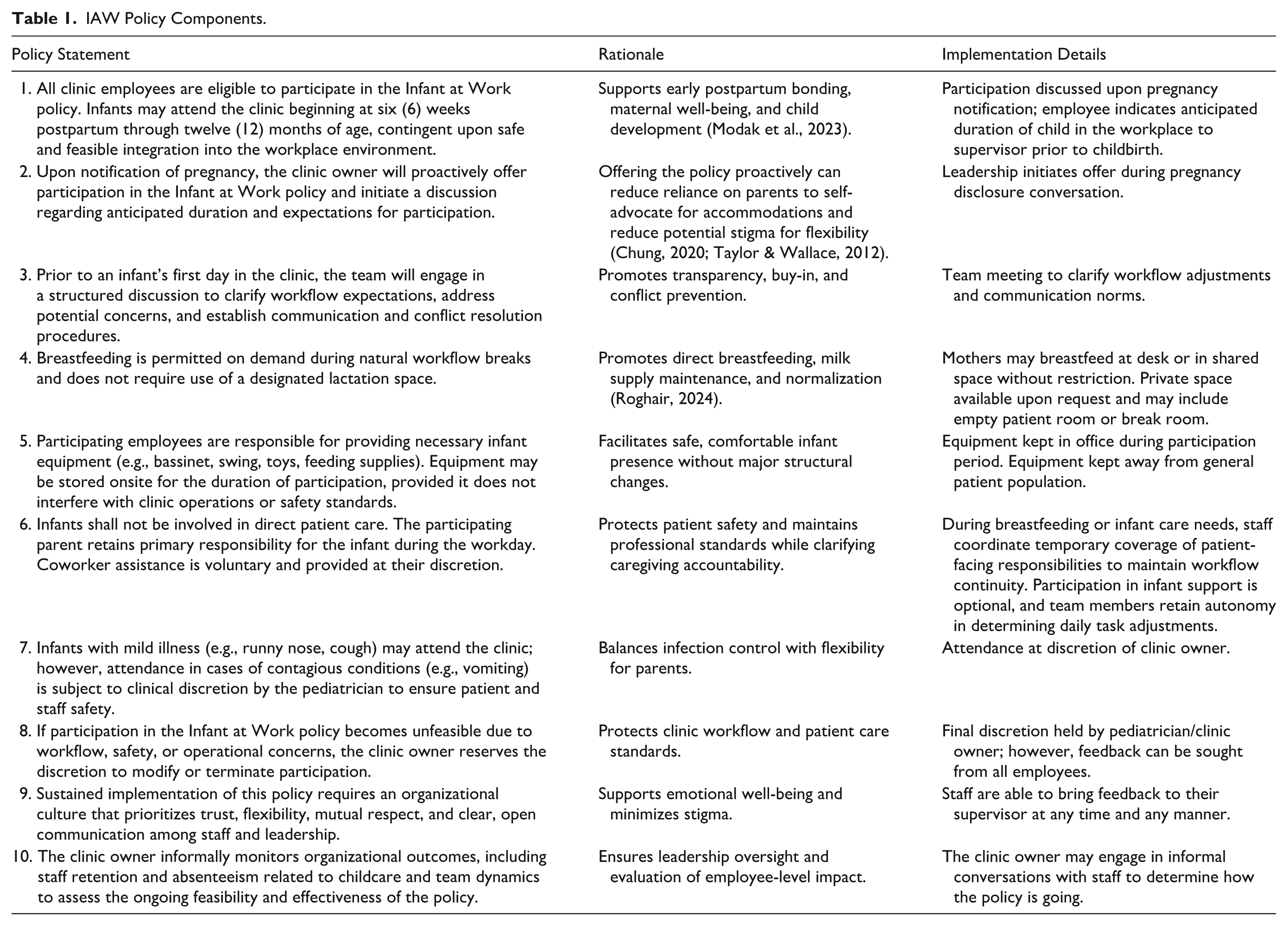
The IAW policy at this pediatric clinic allows employees to bring their infants to work starting at 6 weeks postpartum and continuing until the child reaches 12 months of age, provided the infant can be safely integrated into the workplace environment. Employees are automatically offered this opportunity upon notifying the pediatrician (clinic owner) of their pregnancy. At that time, employees are asked to indicate the duration for which they intend to use the policy. All employee roles are eligible to participate, including physician assistants, nurses, medical assistants, and administrative associates. Policy components can be seen in Table 1.
IAW Policy Components.
Clinical Setting
The pediatric clinic is located in a large Midwestern city with an average census of approximately 25 patients per day. The majority of pediatric visits include well checks, acute care, and breastfeeding consults. It is privately owned by a board-certified pediatrician who is also an International Board Certified Lactation Consultant (IBCLC), certified by the North American Board of Breastfeeding and Lactation Medicine (NAABLM-C), and a Fellow of the Academy of Breastfeeding Medicine (FABM). The clinic typically sees patients from 9:00–5:30 pm with a 1-hour gap for lunch. The clinic staff team is typically made up of one advanced practice provider, three to four nurses, and one administrative associate.
Rationale and Implementation
The policy was developed as a strategy to promote family-centered organizational culture during the critical postpartum period. Over the past decade, all eligible staff have taken advantage of this policy, which has included three clinical staff members (mean age: 28.0 ± 4 ): one nurse who brought her twins to work, one physician assistant who brought her third child, and one office associate who brought both of her children to work, two years apart.
Strengths and considerations for the implementation of the policy were described in semistructured interviews with participating mothers (n = 3) and clinical staff (n = 2).
Strengths of the Policy
Key Messages
Few workplace policies directly support on-demand breastfeeding by allowing infants in the workplace, leaving a gap in practical guidance for integrating caregiving into the clinical workday.
This paper describes the development and implementation of an Infant at Work policy in a pediatric clinic, where employees are permitted to bring their infants to work through the first year of life.
The policy supports breastfeeding, emotional well-being, and work-life integration by normalizing infant care in a family-oriented clinical setting.
This paper provides a real-world model of infant-inclusive workplace support, offering practical insights for clinical leaders and policymakers seeking to promote maternal and infant health.
Considerations for Implementation
Perspective of the Employer
From the employer’s perspective, the policy has not negatively affected staff retention or workplace dynamics. Over the past decade, no employees have left the clinic due to participation in the policy, and any workflow or interpersonal concerns were addressed collaboratively through open communication. Anecdotally, the employer reports that the policy has also contributed to continuity of staffing during the postpartum period, reduced unexpected absences related to childcare disruptions, and supported earlier and more confident returns to work. Informally, the clinic has observed high employee satisfaction, sustained productivity, and strengthened team cohesion, as staff describe a shared sense of support and mutual investment in one another’s well-being. These factors suggest that, in this setting, the policy has functioned not only as a family-supportive benefit but also as a strategy that reinforces workforce stability and organizational culture.
Looking Ahead: Sustainability and Research
While this case highlights positive maternal and organizational experiences, the perspectives of patients were not formally evaluated. Future research should include patient or family perceptions of infant presence in clinical environments to provide a more comprehensive understanding of policy feasibility. Although no formal complaints or documented disruptions occurred in this setting, systematic evaluation would strengthen confidence in broader implementation.
From an employer's perspective, future research could more rigorously evaluate organizational outcomes such as staff retention, absenteeism, sick leave utilization, recruitment advantages, and workplace morale. While this clinic experienced stable retention and collaborative resolution of operational concerns, formal evaluation metrics would provide stronger evidence for scalability.
Finally, areas for refinement include developing clearer written guidelines, establishing formal feedback mechanisms for staff, and identifying objective indicators of workflow impact. Such measures could enhance transparency and sustainability as IAW models are considered in other professional contexts.
Conclusion
At the heart of implementation success for this policy is a strong, preexisting culture of trust, flexibility, and mutual support. As one staff member put it, “If you’re going to implement a policy like this, you have to have the right support, or it won’t work.” This paper illustrates how a pediatric clinic successfully implemented an IAW policy to support breastfeeding mothers, resulting in improved breastfeeding outcomes, emotional well-being, and work-life balance. A family-oriented culture, normalization of breastfeeding, and flexible workflows were key to the policy’s success. For organizations considering a similar approach, three elements are critical: (1) fostering a supportive workplace culture through leadership engagement and staff training, (2) creating a lactation-friendly environment where breastfeeding is accepted and accommodated without barriers, and (3) planning for workflow adjustments by clearly defining roles, establishing backup care guidelines, and maintaining open communication. These strategies can help ensure that infant-inclusive policies are both sustainable and beneficial to families and organizations alike.
Footnotes
Acknowledgements
The authors used ChatGPT, a language model developed by OpenAI, to support writing refinement and editing during the manuscript preparation process. The authors reviewed and verified all content for accuracy and appropriateness.

Author Contributions
Funding
The authors received no financial support for the research, authorship, and/or publication of this article.
Declaration of Conflicting Interests
The authors declared the following potential conflicts of interest with respect to the research, authorship, and/or publication of this article: One of the coauthors of this case study is the owner of the pediatric clinic where the Infant at Work (IAW) policy was implemented. This author was not involved in interviews. Additionally, author 1 and author 3 are related; author 1 was not involved in the interview, and author 2 supported interview administration to mitigate potential bias. The authors declare no conflicts of interest.
AI Use Disclosure
ChatGPT (OpenAI, San Francisco, CA) was used solely to assist with grammatical editing, sentence fluency, and readability. The authors reviewed and edited all AI-assisted text and take full responsibility for the content, accuracy, and integrity of the manuscript.