






Abstract
Background:
Breastfeeding is widely recognized as the optimal source of nutrition for infants, providing complete nourishment while supporting growth, cognitive development, and immune protection.
Research Aim:
This study investigated the experiences of primiparous Omani mothers who practiced EBF to understand the challenges and support needs influencing their practices.
Method:
A qualitative grounded theory approach was used. A total of 35 primiparous mothers were recruited from postnatal clinics through purposive and theoretical sampling. Data were collected via semi-structured interviews and analyzed using the constant comparative method.
Results:
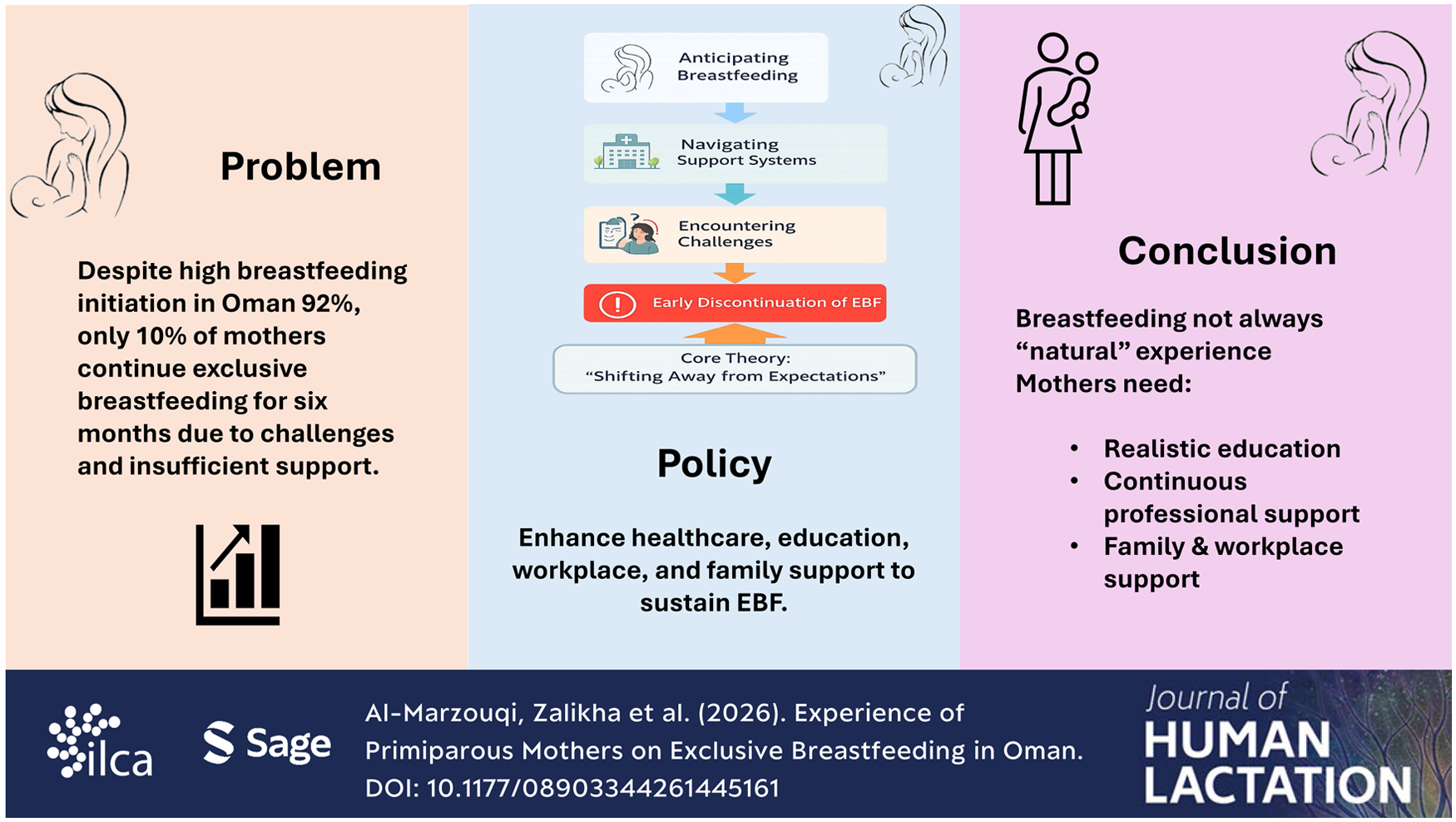
Three categories emerged—anticipating breastfeeding, navigating support systems, and encountering challenges—which led to the development of the grounded “Shifting Away from Expectations. Mothers began with optimism, viewing breastfeeding as natural and manageable. However, difficulties with positioning, pain, perceived low milk supply, inconsistent professional support, and limited family assistance beyond 6 weeks contributed to early discontinuation. All participants ceased EBF before 4 months postpartum.
Conclusion:
First-time mothers’ expectations of breastfeeding as instinctive were challenged by unanticipated barriers and insufficient support. Findings highlight the need for culturally tailored education, consistent professional involvement, and extended family and workplace support to help women sustain EBF for the recommended 6 months.
Background
Breastfeeding is widely recognized as the optimal source of nutrition for infants, providing complete nourishment while supporting growth, cognitive development, and immune protection (Prentice, 2022). In addition to infant benefits, breastfeeding is associated with maternal health advantages, including reduced risks of breast and ovarian cancers and improved maternal–child bonding (Prentice, 2022). For these reasons, breastfeeding is promoted as both a public health priority and a fundamental right for mothers and children.
The World Health Organization (WHO) and the United Nations Children’s Fund (UNICEF) recommend early initiation of exclusive breastfeeding (EBF) within the first hour of life, and continuation of exclusive breastfeeding for the first 6 months, followed by continued breastfeeding alongside complementary foods up to 2 years or longer (Lokeesan et al., 2024). Global initiatives such as the Baby-Friendly Hospital Initiative (BFHI) have sought to improve breastfeeding practices worldwide. Despite these recommendations and interventions, adherence to EBF remains suboptimal. Studies have shown that many mothers discontinue breastfeeding earlier than intended due to factors such as pain, difficulties with positioning, lack of support, and sociocultural pressures (Chesnel et al., 2022; Rabb et al., 2023).
In the Middle East and Gulf region, breastfeeding is deeply embedded in cultural and religious traditions, with the Qur’an recommending breastfeeding for 2 full years. However, contemporary challenges, including urbanization, maternal employment, and limited breastfeeding-friendly policies, have contributed to declining rates of sustained EBF (Frazier et al., 2023). A study reports that while initiation rates are high, continuation often falls significantly by 6 months (Frazier et al., 2023). In Oman, breastfeeding has been promoted since the adoption of the BFHI in 1992, yet national statistics continue to show sharp declines. According to the Ministry of Health (MOH), 92% of mothers initiate breastfeeding at birth, but only 10% sustain exclusive breastfeeding to 6 months (MOH, 2023). This striking drop highlights systemic, cultural, and individual barriers that require further exploration.
Breastfeeding practices are also shaped by cultural norms, social expectations, and family structures, which influence how mothers perceive and experience breastfeeding. Ethnographic and social science literature emphasizes that breastfeeding is not only a biological act but also a socially constructed practice shaped by cultural beliefs and societal contexts (Cassidy & El Tom, 2015). Understanding these sociocultural influences is therefore essential when examining breastfeeding experiences in different cultural settings.
Previous research in Oman and the wider region has largely relied on quantitative methods, focusing on prevalence and determinants of breastfeeding (Al-Marzouqi, 2023; Al Rifai et al., 2023; Frazier et al., 2023). While these studies provide important epidemiological data, they do not capture the depth of mothers’ lived experiences. A study in Oman provided early qualitative insight into women’s perceptions of EBF, highlighting the influence of cultural expectations and resilience in navigating challenges (Al-Marzouqi et al., 2020). In addition, workplace factors have been shown to significantly influence continuation, with limited support available for employed mothers in Oman (Al-Marzouqi, 2023). These findings underscore the need for further qualitative exploration of primiparous women’s experiences.
More recently, Khalaf et al. (2025) explored breastfeeding transitions across three generations of Omani mothers, highlighting how social development and modernization have influenced breastfeeding practices over time. While their study provides valuable insights into intergenerational changes in breastfeeding attitudes and behaviors, it focuses primarily on sociocultural transitions across generations. In contrast, the present study specifically examines the lived experiences of primiparous mothers during their first breastfeeding journey, focusing on their expectations, challenges, and support systems during the early postpartum period. By concentrating on first-time mothers, this study provides a deeper understanding of the processes and adjustments involved in establishing exclusive breastfeeding in contemporary Omani society.
Key Messages
Exclusive breastfeeding (EBF) is crucial for infant and maternal health, but first-time mothers (primiparous) often face unique challenges that affect initiation and continuation, particularly in Middle Eastern contexts where cultural and social expectations play a strong role.
This qualitative study provides in-depth insights into the experiences of primiparous mothers in Oman, revealing the interplay of cultural norms, family support, healthcare guidance, and personal emotions in shaping EBF practices.
The findings highlight the need for culturally sensitive breastfeeding support programs, stronger antenatal and postnatal education, and family-inclusive interventions. This evidence can inform maternal health policies and strengthen Oman’s progress toward improving breastfeeding rates in line with World Health Organization recommendations and national health priorities.
This study aimed to explore the experiences of primiparous Omani mothers with exclusive breastfeeding using a constructivist grounded theory approach. By examining their expectations, sources of support, and challenges, the findings contribute to a deeper understanding of the breastfeeding journey. These insights are intended to inform culturally sensitive nursing practice, family-inclusive education, and health policies that can strengthen support for EBF in Oman and potentially in other similar contexts.
Methods
Study Design and Setting
A qualitative design was adopted to explore primiparous mothers’ perspectives, beliefs, and experiences regarding EBF. Qualitative methods are particularly suited to capturing the complexity of social and cultural contexts and participants’ lived experiences (Creswell & Poth, 2017). The study employed constructivist grounded theory, which aims to generate conceptual understanding grounded in participants’ narratives while acknowledging the co-construction of meaning between researchers and participants (Charmaz, 2014; Glaser & Strauss, 1967). This approach allows for iterative data collection and analysis, enabling concepts and relationships to emerge inductively from the data.
The study was conducted in postnatal clinics within MOH primary healthcare facilities in the North Batinah Governorate (NBG), Oman, one of the most populated regions in the country with extensive maternal and child health services.
Sampling and Participants
Purposive sampling was initially used to recruit participants who met the predefined inclusion criteria. Eligible participants were Omani primiparous mothers who had delivered a healthy singleton infant, were classified as low-risk, and had initiated EBF during their hospital stay.
As data analysis progressed, theoretical sampling was applied to refine emerging categories and explore developing concepts in greater depth, consistent with grounded theory methodology (Fram, 2013; Glaser & Strauss, 1967). Recruitment continued until theoretical saturation was reached, when no new conceptual insights emerged from additional interviews. In total, 35 mothers participated in the study.
Data Collection
Data were collected through semi-structured, in-depth, face-to-face interviews using an interview guide developed based on existing breastfeeding literature and the study objectives. Interviews were conducted in Arabic by trained researchers and lasted approximately 40–60 minutes.
All interviews were audio-recorded with participants’ consent and transcribed verbatim in Arabic. The transcripts were subsequently translated into English to facilitate collaborative analysis among the research team. Field notes were also maintained during and after interviews to capture contextual observations and preliminary analytical insights.
Rigor
The study adhered to Charmaz’s criteria for rigor in constructivist grounded theory, including credibility, resonance, originality, and usefulness (Charmaz, 2014). Reflexivity was maintained throughout the research process, with researchers reflecting on their assumptions and interactions with participants (Charmaz, 2006).
Credibility was enhanced through prolonged engagement with participants’ narratives and systematic coding procedures. Transferability was supported by providing detailed contextual descriptions of the study setting and participants. Confirmability was strengthened by maintaining an audit trail of analytic decisions, memos, and coding development to ensure that findings were grounded in participants’ accounts rather than researchers’ assumptions.
Data Analysis
Data analysis followed the constant comparative method, a key component of grounded theory (Charmaz, 2014; Glaser, 1978; Glaser & Strauss, 1967). The analysis was conducted concurrently with data collection, allowing emerging insights to inform subsequent interviews and guide further exploration of participants’ experiences. Initially, transcripts were examined line by line to identify significant concepts and actions expressed by participants (initial coding). Frequently occurring or conceptually significant codes were then grouped to form preliminary categories during the focused coding stage. Throughout the process, codes and categories were continuously compared across interviews to refine similarities, differences, and relationships within the data, using constant comparison. Analytical memos were also written regularly to document emerging interpretations and conceptual connections between categories.
Qualitative data analysis software was not used in this study. Instead, coding and category development were conducted manually by the research team through repeated reading of transcripts, coding tables, and analytic memo writing. Manual analysis allowed the researchers to remain closely engaged with participants’ narratives and facilitated reflexive interpretation throughout the analytic process.
Categories were generated inductively from the data rather than predetermined. Broader conceptual categories were intentionally retained to capture the overall experiential process of primiparous mothers as they anticipated, initiated, and adapted to exclusive breastfeeding.
Through this iterative and reflective process, categories were progressively refined and integrated to develop an interpretive understanding of primiparous mothers’ experiences with EBF.
Results
Participant Characteristics
A total of 35 primiparous Omani mothers participated in the study (Table 1). Most participants were between 23 and 29 years of age (82.9%), and all were married. The majority were employed (62.9%), while the remaining participants were housewives. Educational attainment varied, ranging from a general diploma to a master’s degree, with 42.9% holding a bachelor’s degree.
Demographic Data.

Emergent Grounded Theory
Analysis generated three interrelated categories that explained mothers’ experiences with EBF: Anticipating Breastfeeding, Navigating Support Systems, and Encountering Challenges. These categories interacted dynamically and culminated in the grounded theory Shifting Away from Expectations.
This theoretical explanation illustrates how primiparous mothers initially approached breastfeeding with confidence and positive expectations but gradually experienced a mismatch between expectations and reality as they encountered practical challenges and inconsistent support.
Category 1: Anticipating breastfeeding
Before childbirth, mothers described strong expectations that breastfeeding would be natural, instinctive, and easily manageable. These expectations were largely shaped by cultural norms and early exposure to breastfeeding within extended families.
Many participants recalled observing breastfeeding among female relatives during childhood, which contributed to the belief that breastfeeding would occur naturally after delivery. For example, “All mothers were breastfeeding their children” (Participant 2). “When I was a small girl, I saw the mothers in my family breastfeeding, so I expected to breastfeed” (Participant 1).
Participants also believed that breastfeeding would be effortless because it was widely described as a natural maternal process: “Before my delivery, I expected to breastfeed because I knew that breastfeeding is a natural process” (Participant 5).
Mothers further expected consistent guidance and encouragement from both family members and healthcare providers during the early postpartum period: “I thought my family members and midwives would support me after my birth, but when I asked the midwives to help during breastfeeding, they were not supportive” (Participant 10). These expectations created an optimistic outlook toward breastfeeding prior to the birth of their infants.
Category 2: Navigating support systems
Following childbirth, mothers relied heavily on family support, particularly from their own mothers and older female relatives. Grandmothers often played an important role in providing practical advice and emotional encouragement during the early postpartum period: “After birth, my mother instructed me on how to breastfeed my baby” (Participant 12).
However, this support was frequently limited to the traditional 40-day postpartum period, after which many mothers found themselves managing breastfeeding independently: “My mother supported me for 40 days [6 weeks after birth]. This was not enough; I needed more support” (Participant 15). Spousal support was generally perceived as emotional rather than practical, as many husbands were absent due to work commitments: “My husband works in Dhofar and returns home only on weekends. He encourages me to breastfeed but does not provide much practical support” (Participant 8).
In addition to family support, participants expected guidance from healthcare professionals during the early postpartum period. However, several mothers described limited or inconsistent professional support when they encountered breastfeeding difficulties. Some participants reported that healthcare providers were often busy or unavailable to provide practical breastfeeding assistance: “When I asked the midwife to help me with breastfeeding, she told me to try by myself because the ward was busy” (Participant 22). Others expressed disappointment that they did not receive sufficient guidance regarding breastfeeding techniques such as positioning and latching: “The nurses told me breastfeeding is important, but no one showed me how to position the baby properly” (Participant 17).
These experiences contributed to mothers’ feelings of uncertainty and frustration, particularly during the early postpartum period when breastfeeding challenges were most pronounced. The perceived lack of professional support further intensified mothers’ reliance on family members for breastfeeding advice. Although support from family members was valued, mothers often reported gaps in professional breastfeeding guidance from healthcare providers.
Category 3: Encountering breastfeeding challenges
Despite initial confidence, many participants reported significant practical difficulties during the breastfeeding process. Common challenges included difficulties with positioning and latching, nipple pain, fatigue, and concerns about insufficient milk supply: “I did not know how to hold my baby for breastfeeding after delivery. Breastfeeding was new to me, and I developed sore nipples” (Participant 11).
Some mothers relied on advice from family members to manage these challenges: “My mother taught me how to massage my nipples before breastfeeding and how to position the baby correctly” (Participant 33). However, once mothers returned to their own homes and family support decreased, many struggled to continue breastfeeding independently. Concerns about milk supply were frequently reported: “My baby was crying all the time, and I feared he was not getting enough milk. I stopped breastfeeding three months after birth” (Participant 20).
The return to work also emerged as a major barrier to continued EBF: “After returning to work, I had to take care of my newborn and breastfeed. I felt exhausted from work, and breastfeeding made me even more tired, so I could not continue” (Participant 29).
Several participants discontinued breastfeeding within the first months postpartum due to persistent pain, fatigue, and limited support: “It was hard to breastfeed with sore nipples, so I stopped breastfeeding two months after delivery” (Participant 25).
Grounded Theory: Shifting Away From Expectations
The interaction between the three categories—anticipating breastfeeding, navigating support systems, and encountering challenges—led to the development of the grounded theory Shifting Away from Expectations. This theory explains how primiparous mothers entered motherhood with strong cultural and personal expectations that breastfeeding would occur naturally and effortlessly. However, when faced with practical challenges and limited sustained support, many mothers experienced a gradual shift from confidence to frustration and eventual discontinuation of EBF. The theory highlights a process in which initial optimism transitions into disillusionment, as mothers attempt to reconcile their expectations with the realities of breastfeeding in the postpartum period.
Discussion
This study explored the experiences of primiparous Omani mothers with EBF. Findings revealed that while mothers anticipated breastfeeding as natural and straightforward, their expectations shifted as they encountered inconsistent support, practical challenges, and workplace barriers. The grounded theory—Shifting Away from Expectations—reflects this transition from optimism to struggle, culminating in early cessation of EBF.
These findings complement recent qualitative research conducted in Oman that examined breastfeeding practices across three generations of mothers (Khalaf et al., 2025). While that study highlighted how modernization and social development have influenced breastfeeding attitudes over time, the present study focuses specifically on the lived experiences of primiparous mothers navigating exclusive breastfeeding for the first time. By examining mothers at the beginning of their breastfeeding journey, this study provides deeper insight into the processes through which expectations are reshaped by real-life challenges during the early postpartum period.
Anticipation and Cultural Expectations
Mothers entered breastfeeding influenced by cultural norms that framed it as a natural and expected practice (McGlothen-Bell et al., 2023; Severinsen et al., 2024). Exposure to breastfeeding within extended families shaped their assumption that breastfeeding would occur instinctively. Similar findings have been reported in other cultural contexts, where women often perceive breastfeeding as both a defining aspect of motherhood and a moral responsibility (Debucquet & Adt, 2020; Van Esterik, 2018).
Breastfeeding is also deeply embedded within social and cultural systems, where beliefs, traditions, and family expectations influence how mothers approach infant feeding (Cassidy & El Tom, 2015). In many societies, including those in the Middle East, breastfeeding is strongly associated with maternal identity and moral responsibility, which can intensify the emotional impact when mothers encounter difficulties.
However, when participants encountered unanticipated challenges, these assumptions became sources of stress and disappointment. This underscores the importance of preparing mothers with realistic information about potential difficulties rather than solely emphasizing the “naturalness” of breastfeeding.
The challenges described in this study are consistent with prior Omani research. Al-Marzouqi and collegouse (2020) reported that women entered breastfeeding with strong cultural expectations but soon faced difficulties that tested their resilience. In a similar way, our participants experienced a transition from optimism to challenge, a shift that is captured in the grounded theory Shifting Away from Expectations.
The Role of Family Support
Grandmothers played a pivotal role in sustaining breastfeeding during the early postpartum period by offering practical guidance, reassurance, and cultural wisdom. This aligns with research from Papua New Guinea and Malawi, where extended family support is central to breastfeeding continuation (Chipojola et al., 2020; Maviso et al., 2022). Yet, in the Omani context, this support was often limited to the first 6 weeks, leaving mothers without guidance thereafter. Given the collectivist nature of Omani society, integrating grandmothers into structured breastfeeding education programs could leverage their influence for longer-term support. Spousal support, while emotionally encouraging, was constrained by employment demands. This finding echoes prior studies emphasizing that partner involvement remains underutilized despite its potential to positively influence breastfeeding outcomes (Budiarti & Suja, 2024).
Healthcare Professional Support
Many mothers expressed dissatisfaction with the care and guidance they received from healthcare professionals (HCPs). Reports of inconsistent or minimal support are concerning, as HCPs are expected to provide evidence-based guidance and encouragement. Similar gaps between expectations and experiences have been documented elsewhere, where inconsistent advice and rushed interactions have undermined mothers’ confidence (Al-Marzouqi et al., 2020; Al Rifai et al., 2023; Chesnel et al., 2022; Scott et al., 2023). These findings highlight a critical practice gap in Oman: while HCPs recognize breastfeeding support as part of their role, the quality and consistency of this support require improvement. Nurses and midwives are uniquely positioned to bridge this gap through consistent, empathetic, and culturally sensitive care.
Workplace Barriers and Policy Gaps
Returning to work emerged as a major challenge for participants. Many mothers associated employment with fatigue, lack of time, and early discontinuation of EBF. This reflects international evidence showing that employed mothers are less likely to sustain breastfeeding when workplace policies are unsupportive (Vilar-Compte et al., 2021). In Oman, maternity leave policies and workplace accommodations remain limited, which exacerbates the strain on working mothers. Policy reforms, such as extending maternity leave, providing workplace lactation spaces, and promoting flexible schedules, are urgently needed. Nurses and midwives can play an important advocacy role by raising awareness of these systemic barriers and lobbying for supportive workplace policies. Importantly, the influence of workplace barriers identified in this study aligns with previous Omani research, which highlighted insufficient institutional and policy support as significant obstacles to sustaining exclusive breastfeeding (Al-Marzouqi, 2023). Taken together, these findings illustrate the multifactorial nature of breastfeeding discontinuation and reinforce the need for systemic interventions at family, professional, and workplace levels.
Perceived Insufficient Milk Supply
Perceived low milk production and infant crying were frequently cited as reasons for discontinuing EBF. These concerns have been consistently identified in global studies as major barriers (Rabb et al., 2023; Tracz et al., 2021; Akalpler et al., 2023). Importantly, such perceptions often reflect anxiety and lack of anticipatory guidance rather than actual insufficiency. Preparing women during antenatal visits with realistic expectations about infant feeding patterns and strategies to manage perceived insufficiency could strengthen mothers’ confidence and reduce unnecessary discontinuation.
Theoretical Contribution
The grounded theory developed in this study, Shifting Away from Expectations, offers a conceptual explanation of how primiparous mothers navigate the early breastfeeding journey. Initially, mothers approached breastfeeding with strong cultural expectations that it would occur naturally and effortlessly. However, as practical challenges emerged—including inconsistent professional guidance, perceived milk insufficiency, and workplace pressures—these expectations gradually shifted toward uncertainty and struggle. This conceptual framework highlights breastfeeding not as a single decision but as a dynamic process shaped by personal beliefs, social influences, and structural conditions. By illuminating this transition, the theory contributes to breastfeeding literature by emphasizing the importance of continuous support across the postpartum period rather than focusing solely on breastfeeding initiation.
Limitations
This study was limited to mothers attending MOH facilities in one governorate, which may not reflect experiences in other regions. As a qualitative study, the findings are not generalizable but provide in-depth understanding of first-time mothers’ experiences. Additionally, only mothers’ perspectives were included; the views of healthcare providers and family members were not captured.
Conclusion
Primiparous Omani mothers anticipated breastfeeding as a natural process but encountered unexpected challenges and inconsistent support, resulting in early discontinuation of exclusive breastfeeding. The grounded theory Shifting Away From Expectations captures this shift from optimism to difficulty. Strengthening culturally tailored education, consistent professional involvement, and extended family and workplace support is essential to help mothers sustain exclusive breastfeeding for 6 months.
Footnotes
Acknowledgements
The authors would like to express their sincere gratitude to the Ministry of Health, Sultanate of Oman, for ethical approval and for supporting the conduct of this study. We also extend our appreciation to the Directorate General of Health Services in the North Batinah Governorate for cooperation. Special thanks are due to all the mothers who generously shared their time, experiences, and insights, without whom this research would not have been possible. Finally, we acknowledge the contributions of our colleagues and research assistants who provided guidance and support throughout the study process.

Author Contributions
Funding
The authors received no financial support for the research, authorship, and/or publication of this article.
Declaration of Conflicting Interests
The authors declared no potential conflicts of interest with respect to the research, authorship, and/or publication of this article.