






Abstract
Dear Editor,
Breastfeeding is associated with a reduced risk of maternal cancers, including breast and ovarian cancer (Hameiri-Bowen et al., 2024). In this regard, the protective benefit against breast cancer increases with the duration of nursing. In the United Kingdom, women have a 15% lifetime risk of acquiring breast cancer. Childbearing later in life raises the risk, although early pregnancies provide some protection. Each baby reduces breast cancer risk by around 7%, and each year of breastfeeding adds an additional 4.3% (Stordal, 2023).
Global guidelines for BRCA1/2 genetic testing exhibit significant variation. The bulk of publications and guidelines are developed in North America and Europe, with the United States, Canada, the United Kingdom, France, and Italy leading the way. Some countries, such as Germany and Spain, only publish their own guidelines, while others develop them while consulting worldwide sources, such as the National Comprehensive Cancer Network or the European Society for Medical Oncology. Many countries, particularly in Asia, South America, and the Middle East, do not have national norms and instead rely on international ones. Large regions, including the majority of Africa and Southeast Asia, lack written or referenced guidelines (Hughes et al., 2023; Saj et al., 2024).
Breastfeeding reduces the chance of developing breast cancer by roughly 20% and the risk in BRCA1 mutation carriers by 22% to 55% (Stordal, 2023). In the UK, exclusive breastfeeding decreases from 24% at 6 weeks to 17% at 3 months and 1% at 6 months. At 6 months, only 34% of infants receive any breast milk, indicating a significant drop in sustained breastfeeding duration (https://www.unicef.org.uk/). This mismatch is due in part to cultural and generational disparities in breastfeeding experience, with today’s grandmothers being less likely to have breastfed their children. It is estimated that not breastfeeding accounts for 4.7% of all breast cancer cases in the UK: https://www.breastcanceruk.org.uk/.
Changes in gene expression and cellular differentiation are two biological processes that contribute to pregnancy and breastfeeding safety. Studies have discovered changes in RNA processing and stem cell regulation in breast tissue after pregnancy, which could explain the lower risk of cancer. Breastfeeding appears to help reduce the quantity of mammary stem cells, which are a common cause of breast cancer (Gutiérrez-Díez et al., 2021; Stordal, 2023).
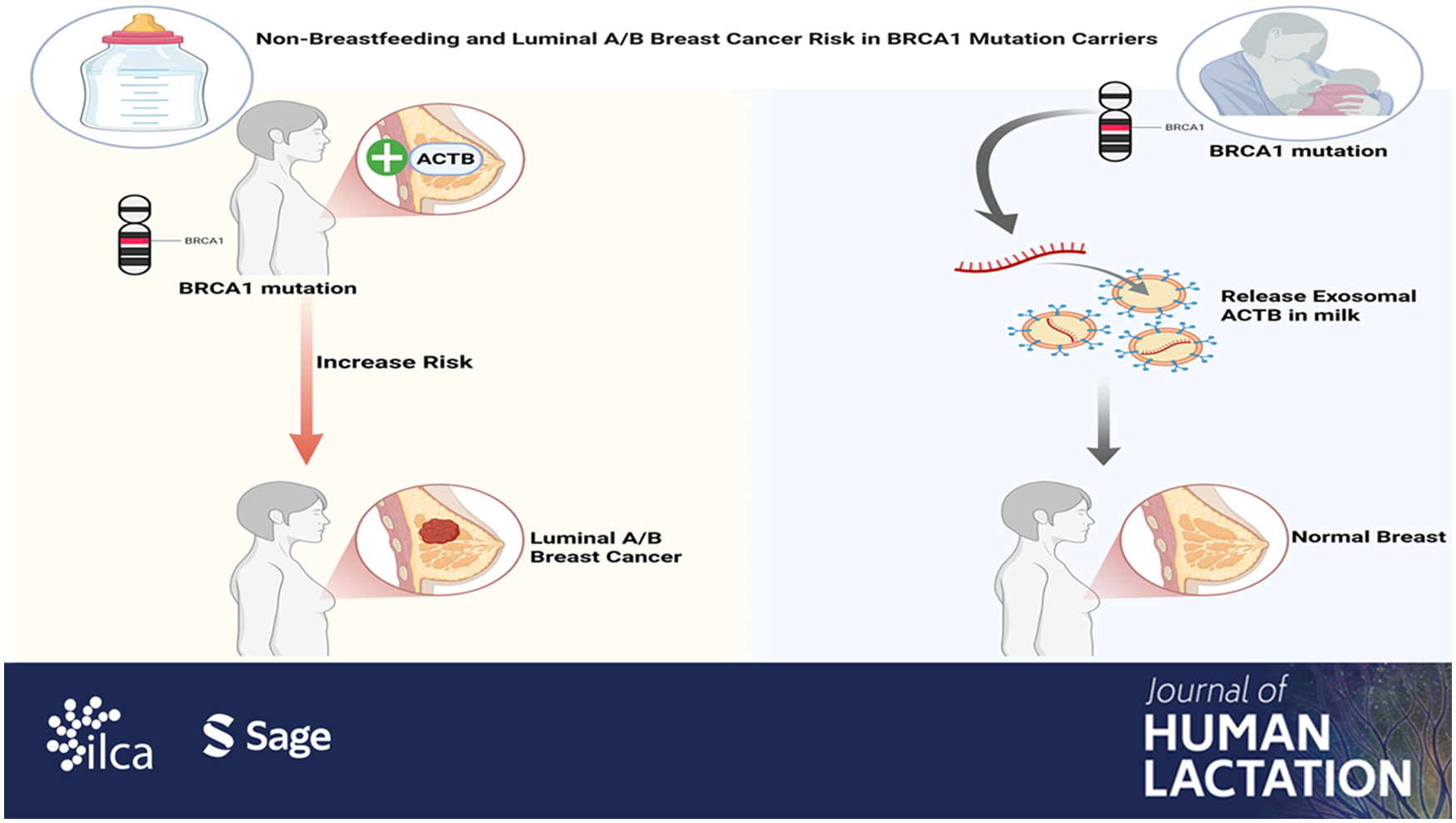
Herein, I’d like to shed light on how breastfeeding may contribute to a lower incidence of breast cancer in mothers with the BRCA1 mutation. Exosomes are extracellular vesicles produced by host cells to maintain intracellular balance, facilitate communication, and regulate immune responses (El-Arabey et al., 2023). Exosomes transport nucleic acid mRNAs, altered DNA fragments, stress-related proteins, and transcription factors that are responsible for cellular communication in the host cell (Takahashi et al., 2017). Exosomes generated from human breast milk play an important role in managing inflammation, immunology, epithelial cell protection, and baby nutrition (Kim et al., 2025).
The bioinformatic analysis of human breast milk-derived exosomes indicated the presence of actin-beta (ACTB). Next, I investigated the relationship between ACTB expression and the presence of BRCA1 mutations in different types of breast cancers via TIMER2.0 (Li et al., 2020). When compared to wild-type BRCA1, the study found that ACTB is highly expressed in luminal A and B breast cancer with the BRCA1 mutation (Figures 1A and B), but not in Her-2 or basal breast cancer (Figures 1C and D).
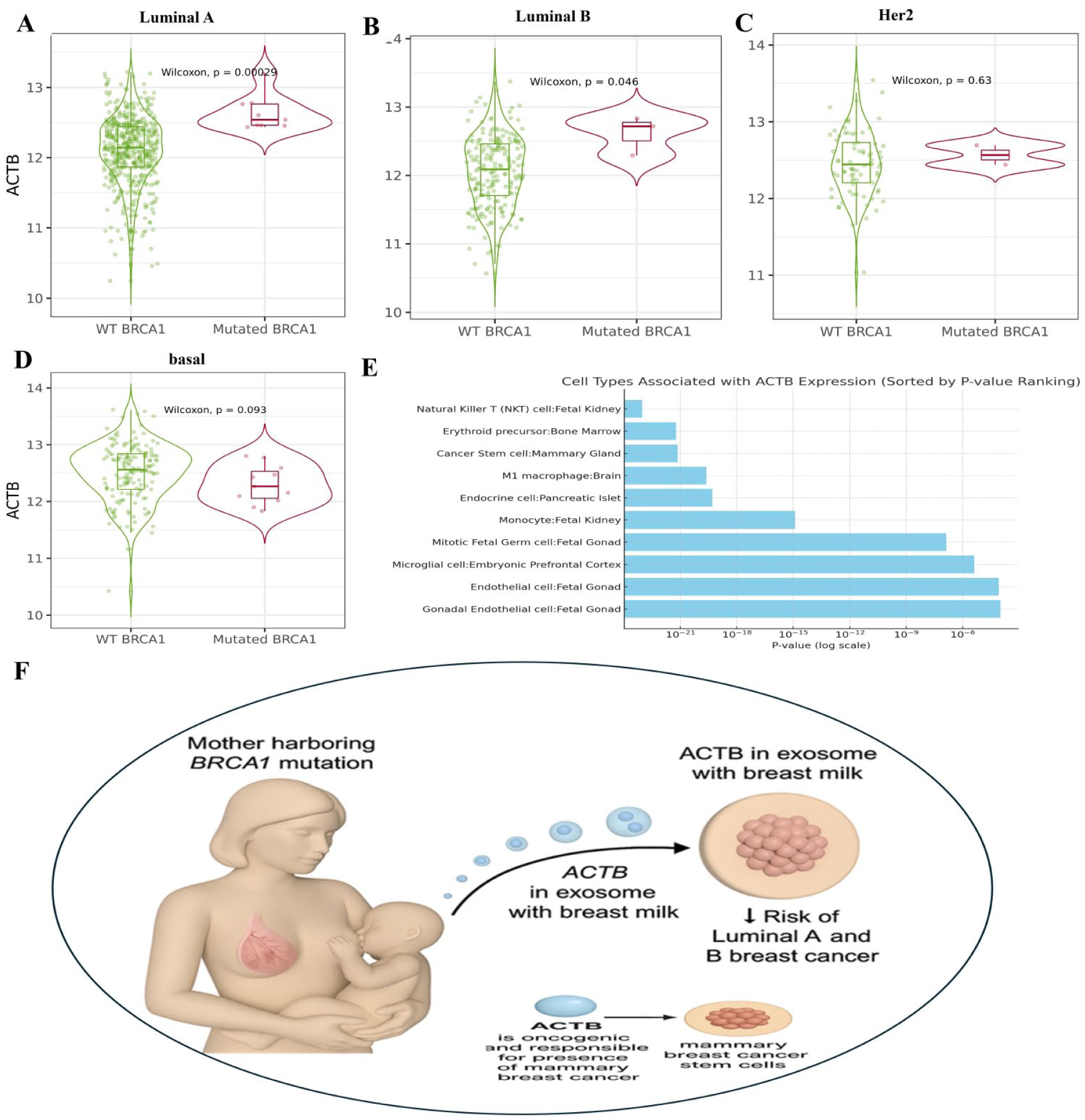
The Association of ACTB Expression with the BRCA1 Mutation and Its Possible Impact on Breast Cancer Risk. (A–D) Violin graphs compare the expression of ACTB in wild-type (WT) and mutant BRCA1 carriers across multiple datasets. ACTB expression is considerably higher in BRCA1-mutated groups in panels A (Wilcoxon, p = 0.0029) and B (Wilcoxon, p = 0.046), while there are no significant changes in panels C (p = 0.63) or D (p = 0.093). (E) A bar chart displaying cell types that are substantially related to ACTB expression, ordered by p-value (log scale). The most significant connections (lowest p-values) appear at the top, with a log-scale x-axis to highlight the differences. (F) Graphical abstract of the suggested mechanism: A mother with a BRCA1 mutation secretes ACTB-containing exosomes in breast milk, which may lower the mother’s risk of developing luminal A and B breast cancer. The ACTB is oncogenic and associated with the presence of mammary breast cancer stem cells; exosomal release during breastfeeding may contribute to risk modulation.
Furthermore, an analysis of the top 100 genes coexpressing with ACTB, conducted using the NURSA RNA-seq gene-gene coexpression matrix, revealed an enrichment of specific cell types. The RNA-seq gene-gene coexpression matrix by Cell Marker Augmented 2021 (Diamant et al., 2025) revealed that ACTB is closely related with the initiation of cancer stem cells in the mammary gland (Figure 1E). Consequently, these findings suggest that ACTB is linked to mutant BRCA1- luminal breast cancer via regulating the cancer stem cells. In addition, ACTB is a promising target for diagnostic and therapeutic treatments in mutant BRCA1-luminal breast cancer. These findings further demonstrated the critical relevance of genetic risk assessment in national cancer control programs.
Footnotes

Author Contributions
Funding
The author disclosed receipt of the following financial support for the research, authorship, and/or publication of this article: The author extends their appreciation to the Deanship of Research and Graduate Studies at King Khalid University for funding this work through Small Research Project under grant number RGP1/66/47.
Declaration of Conflicting Interests
The author declared no potential conflicts of interest with respect to the research, authorship, and/or publication of this article.