







Abstract
In this article, I use life histories of progressive activists to examine the class-inflected nature of activist identities. These life histories reveal three different conceptions of activist identity based primarily on the class origins of the narrators. Middle-class activists define their activism as a career, and their narratives depict a sequential and linear path to a new somewhat professionalized identity. Working-class activists conceive of their activism as a calling, and their narratives move backwards and forwards to an activism that links to and reinvents their working-class roots. Low-income activists make little distinction between their nonactivist and activist lives. They regard their activism as a way of life, and their related narratives combine episodes of collective action with stories of economic deprivation. Overall, this study demonstrates the utility of a more discursive understanding of identity talk, particularly for rethinking processes of recruitment to and participation in social movements.
What can we learn from the stories that activists tell about how and why they became activists? What do these stories tell us about the nature of activist identities and the role of activism in the lives of those who participate in collective action? Scholars of social movements ask these questions in order to better understand what they call micro-mobilization processes: the factors that account for participation in, commitment to, and disengagement from collective action (McAdam, McCarthy, and Zald 1988). While this focus has yielded many important insights into these processes, it typically sidesteps or glosses over the understandings of the activists themselves as they “tell their own stories” about becoming an activist. More recently, social movement scholars have been turning their attention to this activist identity talk: how it is constructed and its relationship to the collective identity of the social movements in which activists participate (Hunt and Benford 1994; Ruiz-Junco 2011; Valocchi 2001, 2007). I continue this line of inquiry by examining the identity talk of activists located within the broadly defined progressive social movement sector of one medium-sized city in the northeastern United States in the first decade of the twenty-first century. What patterns exist in the “coming to activism” stories told by progressive activists who come from many different social positions and personal experiences but operate in the same social movement sector?
Much of the research on identity talk in social movements has taken place under the conceptual rubric of framing which focuses on the multifaceted interpretive work done by social movements to make their grievances persuasive to various audiences and take people from inaction to action (W. Gamson 1992; Johnston and Noakes 2005; Snow et al. 1986). Although the elaborations of this framework have started paying attention to activists’ own cultural scripts and social positions in constructing identity talk, this talk is analyzed either in terms of the strategic challenges that movements must meet in mobilization (Snow and McAdam 2000; Valocchi 2009) or in terms of the biographical work activists must perform to build and sustain a coherent activist identity (Ruiz-Junco 2011). While both these approaches are important, they still privilege the collective action frames of the movement and pay little attention to the differences that may exist among activists as they construct their activist identities. These differences among activists are interesting in their own right but may also be important for understanding both how activists perform their biographical work and why they participate in and get committed to social movements.
My analysis foregrounds these differences in the social characteristics of activists while still paying attention to the social movement context within which activists operate. In particular, I focus on the patterning of the identity talk on the basis of the activist’s class background and investigate the function of this talk for the activists’ orientation to activism and for their understandings of themselves vis-à-vis that activism. I also focus on the class-inflected nature of the social movement context (i.e., the class constituency served by the activism, the class position of activist coworkers, and the financial stability of the organizations or campaigns) in which activists conduct the bulk of their activist work and investigate how this feature of the context affects the structure and function of their identity talk.
Between 2001 and 2007, I conducted oral history interviews with thirty-four progressive activists in Hartford, Connecticut. These activists operate in a fairly tight-knit social movement sector in an array of organizations, campaigns, and social networks which, according to the website that collects and advertises these efforts, “work in common cause for social justice, democracy, and equality” in the Hartford region of Connecticut. An overwhelming majority of these activists identify on the left of the traditional political spectrum traversing a landscape from liberal Democrat to socialist and anarchist. Despite these broad commonalities, the organizations, campaigns, and networks within which these activists operate possess somewhat diverse class compositions. These differences in the class character of the social movement sector where the activists (who themselves vary in terms of their class backgrounds) operate enables an analysis of activist talk attentive to both individual biography and social structure (Mills 1959). To what extent is the identity talk reflective of the class character of the organizations and campaigns these activists are involved in and to what extent is it reflective of the activists’ class background?
In order to examine class-related patterns in how activists reconstruct their stories of activist recruitment and participation, I situate the analysis in three broad sets of sociological literature. The first set of literature on the sources of activist identity talk describes a diverse set of cultural scripts that activists draw on from both their individual biographies and the collective identity of the social movements these activists are involved in. The second set of literature draws from the social stratification research on the dynamics and consequences of the discursive construction of social class and mobility among different groups of individuals and in different institutional contexts. Finally, I review a third set of literature on how and why individuals participate in social movements mainly in terms of how this literature pertains to the retrospective construction of pathways to activism.
Identity Talk
Social movement scholars refer to identity talk as the discursive presentation of an individual’s identity in light of her or his relationship to collective action and view it as one important component of an activist identity (Hunt and Benford 1994; Snow and Anderson 1987; Valocchi 2007). Initially, this talk was seen mainly as a function of the social movement sector within which individuals were involved, and the content and shape of this talk had more to do with the collective identity of the movement—that is, with “the shared definition of a group derived from members’ common interests, experiences, and solidarities” (Taylor and Whittier 1992, 172)—than with the individual characteristics of the participants in the movement. More recent research, however, has more carefully considered how an activist’s individual identity interacts with (but does not disappear into) the collective identity of the movement. Individuals retain aspects of their social identities throughout their participation in social movements; indeed, these identities move them to particular types of activism and these identities help inform their experiences in this activism. For example, both Robnett (2005) in her study of the civil rights movement in the 1960s and Valocchi (2007) in a study of progressive activists in the early 2000s show how the nature of activist identity talk is influenced by such social characteristics as an individual’s race and class as well as her or his ideological predispositions formed at the intersection of individual biography and the historical context (Robnett 2005, 208; Valocchi 2007; also see Whittier 1995). In a somewhat different vein, Ruiz-Junco (2011) describes how activists use the frames of the environmental movement in Spain to reconstruct and reinterpret their activist biographies in order to achieve identity coherence between their personal experiences prior to activism and the values and goals of the movement. These findings suggest that we pay closer attention to the structure, content, and function of activist identity talk as it takes shape at the intersection of the individual biography and social movement context.
One way to do that is to view this talk as a “practical discursive accomplishment” (Holstein and Gubrium 2000, 70), in terms of a “vocabulary of motives” (Mills 1940, 905; Burke 1950), or as comprising “structures of feeling” (Williams 1977). These concepts encourage a close analysis of talk as storytelling with motive attribution and disavowal, plot lines, themes, points of view, and emotions. As Scott and Lyman (1968, 60) state, talk can be seen as comprising a “vocabulary of motives” that is a “manifestation of an underlying negotiation of identities.” Mills (1940, 906) expresses this talk as “the observable lingual mechanism of motive imputation and avowal” that does not arise from internal states but is a function of “institutionally different situations.” Williams (1977, 132) refers to structures of feeling in talk as comprising “meanings and values as they are actively lived and felt” and embodying “the affective elements of consciousness and relationships” that vary by historical period and social location. Thus, identity talk is best conceived as embodying vocabularies, grammars, scripts, and feelings and as socially patterned. Here I am concerned with if and how they are patterned by the deep structures of inequality.
The Discursive Construction of Class
Very little research has examined how activist talk is patterned by social class. In one notable exception, a study of grassroots environmental activists in the 1990s, Lichterman (1996) describes two class and racially inflected mobilizing styles used by different organizations: personalism, or an emphasis on self-expression and individual empowerment utilized by the more middle-class suburban “Greens”; and communalism, or an appeal to the common experience of racism utilized by the working-class and African American organization in its fight against environmental racism. In a finding that will resonate somewhat with my own findings, some of the middle-class activists tended to use concepts rooted in individual interests, personal satisfactions, and the pursuit of careers, and some of the working-class identity activists invoke group allegiances to construct narratives of recruitment and participation. Nonetheless, this important research focused primarily on the implications of this talk for micro-mobilization processes and did not disentangle the collective identity of the organizations or the social movement frames used by the organizations from the individual identities of the activists.
A more explicit focus on individual identity can be found in the research on the cultural construction of inequality (Lamont 2000; Stuber 2011). This research is particularly useful in that it calls attention to the “feeling states” associated with living in various social classes. Building on the classic work of Sennett and Cobb (1972) on working-class men and Ehrenreich and Ehrenreich (1979; Ehrenreich 1989) on the professional middle class, Stuber (2006) notes that working-class college students express ambivalence about their prospects for social mobility since they construct the upper classes as morally suspect yet subscribe to the tenets of the achievement ideology perpetuated in the college setting. Conversely, in a ethnography of working-class and middle-class families conducted by Lareau (2003), middle-class parents speak of a “fear of falling” from their relative comfort and allay this fear by engendering in their children the valued cultural capital necessary for class reproduction.
This research calls our attention to the social psychological dynamics that may be involved in the experiences of progressive activists as they understand their activist identities in terms of “where they come from,” “where they thought they were going,” and “where their activist commitments are taking them.” In other words, their identity talk—in terms of accounts given and rejected about how and why they came to participate in activism—may be an opportunity to express, allay, or deflect social mobility or social class anxieties.
Recruitment and Participation in Social Movements
A vast scholarly literature exists on why individuals join social movements (Klandermans 1997; McAdam 1988; Schussman and Soule 2003). The most consistent finding to emerge from this literature is the important role of social networks in taking individuals from nonparticipation to participation to commitment (Diani 2005; McAdam 2003). In addition, this research on participation is only beginning to understand the process of participation as affected by the position of potential activists in a structure of inequality (Beyerlein and Hipp 2006). For example, Somma (2009) demonstrates that pathways to participation are dependent on an individual’s socioeconomic status. His research also reaffirms the importance of social networks and ties in the recruitment process but shows that strong ties are “more effective among those targets that have the necessary resources” (Somma 2009, 303). Individuals with fewer resources cannot translate the motivation and information that come from strong ties into action.
The goal of this research literature is to address the empirical question of “why.” That is, what factor or factors distinguish those who participate from those who do not? This literature is not concerned with how activists themselves reconstruct their motives for participation or give accounts of their “coming to activism.” We know from the research on identity talk reviewed above that activists use a plethora of motives embedded in a variety of accounts; they do not use the trope of “factors” to construct their coming to activism. This literature assumes a sequential and linear process that can be reconstructed empirically regardless of whether the individual represents it as such. In that way, it is less concerned with the motives that activists use to impute meaning onto their accounts of participation in social movements. Even with the research that is attentive to the class position of potential activists, the goal remains specifying the causal pathways to activist participation not whether or how lower-class and working-class activists reconstruct their accounts differently from middle-class activists. Nonetheless, the research is useful in identifying the various factors—family background, attitudes, opportunities, social networks—that individuals do indeed reference in the construction of their stories and how class may play a role in that construction.
Combining the insights from these three literatures, I suggest that the way that activists incorporate the several different factors for participation into their stories of coming to activism (i.e., what factors they include or exclude and how they combine those factors into somewhat coherent narratives) vary in class-inflected ways. Rather than “true” or “accurate” accounts of the micro mobilization processes of social movements, these stories are freighted with social psychological meaning for the activists themselves and reflect both their individual identities and their experiences in the movement. Their accounts also reflect general anxieties around social mobility as well as specific experiences with discrimination and marginalization in social movements.
Methods
Based on my familiarity with the progressive community in Hartford and after receiving approval from the Institutional Review Board, I assembled an initial list of contacts within each area defined broadly as labor, community, peace, global justice, antiracist, immigrant and welfare rights, feminist, LGBTQ (lesbian, gay, bisexual, transgender, queer), and asked those contacts to recommend others “doing progressive work in town.” In addition to these contacts derived from this snowball sampling strategy, I also included an equal number of activists not obtained through already-recruited activists by visiting websites, contacting organizations, and going to events and demonstrations in the community. This technique of purposive sampling ensured that I included activists with whom I was unfamiliar and who were members of different social networks from the ones I identified through snowball sampling. Together, these sampling techniques ensured that I found those key individuals doing progressive work in a city with a fairly close-knit activist community but in a variety of social networks.
I use life history or oral history methodology to reconstruct activists’ narratives of becoming activists. These interviews covered a broad range of topics organized roughly around the details of their activism (i.e., what they do; how they do it; with whom do they do it) and the details of their lives (i.e., their family background and socialization, their lives prior to their activist involvements, their lives during these involvements; their “personal” and “professional” concerns about their activism). Following the theoretical and conceptual guidelines of Davis (2002) and Maynes, Pierce, and Laslett (2008) about narrative analysis and the procedural and methodological suggestions of Grele (1991) and Yow (1994) regarding the life history interview, I guided the conversations from the “present to the past” and from the “specific to the general.” Narrative analysis assumes that talk about the past is always done from the vantage point of the present, so I focused on the nature of the narrator’s current activism as the entrée into talk about how they came to do that work. Oral history interviewing suggests a method of moving back and forth between specific events and experiences, on the one hand, and the meanings or reflections “behind” these facts, on the other. Therefore, I organized the conversation in terms of specific questions of what narrators did and how they came to do it and more general questions about how narrators felt about the role of activism in their lives. These methodological approaches enable an expanded understanding of activist talk as comprising sequence, plot, themes, cultural scripts, and structures of feeling. These dimensions comprise the overarching coding scheme for the qualitative analysis. 1
Since I was mainly interested in how activists’ class origins and class biographies influenced their identity talk, I defined class using mainly economic and social criteria. Narrators spoke at length about the jobs their parents had, the security of those jobs, their parents’ educational levels, and the neighborhoods or communities they lived in. On the basis of these conversations and building on the ethnographic work of Lareau (2003) and Bettie (2003) and the theoretical work of Weber (1968), I identified low-income, working-class, and middle-class activists. Low-income activists come from homes where there was sporadic employment in low-wage jobs. These activists also use the informal economy and public assistance to supplement their incomes. Working-class activists come from homes supported by manufacturing jobs (both union and nonunion), union-protected service work, or self-employment. Many of these working-class activists grew up in ethnically defined urban neighborhoods or in racially mixed inner-ring suburbs. Middle-class activists grew up in suburban homes supported by usually one main breadwinner who had an administrative, technical, or professional position. These jobs required college (and in some cases, postgraduate) educations.
Although I am mainly interested in how activists’ class origins affected identity talk, a large body of literature on collective identity asserts the importance of social movement context for shaping that talk. For the most part, this literature highlights the organizational (e.g., J. Gamson 1996) or ideological (e.g., Reger 2002) features of this context and does not interrogate the class “inflections” of those features or the class biases embedded in the social movement context (Valocchi 1999). Thus, the literature gives little guidance for how to “measure” these inflections or biases in social movement organizations or campaigns. As a first, admittedly tentative, step in this direction, I use several different conceptions of class that emphasize economic and social criteria to delineate the social movement context.
Using these understandings and based on the information provided by the activists themselves as well as information from websites and documents of various campaigns and organizations throughout the city, I coded each activist’s work in terms of three different class-related dimensions: the social class of the people they worked with (measured through questions about “other activists” in the campaign or organization), the constituency served by the organizations or campaigns (identified by the activists themselves or through organization documents), and the financial condition or economic stability of the organizations or campaigns (measured by questions about the organization’s nonprofit status, and organization documents regarding budgets, grants, contracts, etc.). I identified sixteen separate organizations, campaigns, and mobilizations that the activist narrators participated in. Based on the dimensions of class described above, three organizations/campaigns scored middle class on all dimensions, five scored working class, and three scored lower class. The remaining five organizations/campaigns possessed combinations of the class dimension I listed above.
Some examples illustrate this process of classification. Several organizations or campaigns relating to feminist or LGBTQ issues, for example, were staffed by college-educated individuals and financed by private multiyear grants or a combination of private grants and state monies. I coded these as middle class. Other campaigns, especially those that “spun off” from better-established and better-financed organizations were staffed by volunteers of working-class background and served low-income constituencies. Examples of these involved organizing by Latina women, and HIV activism in the Black and Latino communities. I coded these as working class. Campaigns or mobilizations that emerged at the grassroots or on the periphery of (and sometimes in opposition to) more established organizations and without stable sources of support were coded as lower class. Examples of these included mobilizations by poor women against welfare cuts and takeovers of neighborhood streets in protest of police brutality. Other organizations and campaigns complicate these classifications by combining stable and relatively ample resources and middle-class coworkers with low-income or working-class constituents or conversely organizations that were financially insecure but run by middle-class activists. Two examples of the former include community or neighborhood organizing and labor organizing and I coded these as mixed working class. An example of the latter includes street theater and public art as protest by middle-class youth to expose corporate corruption in state and city development. I coded these as mixed middle class.
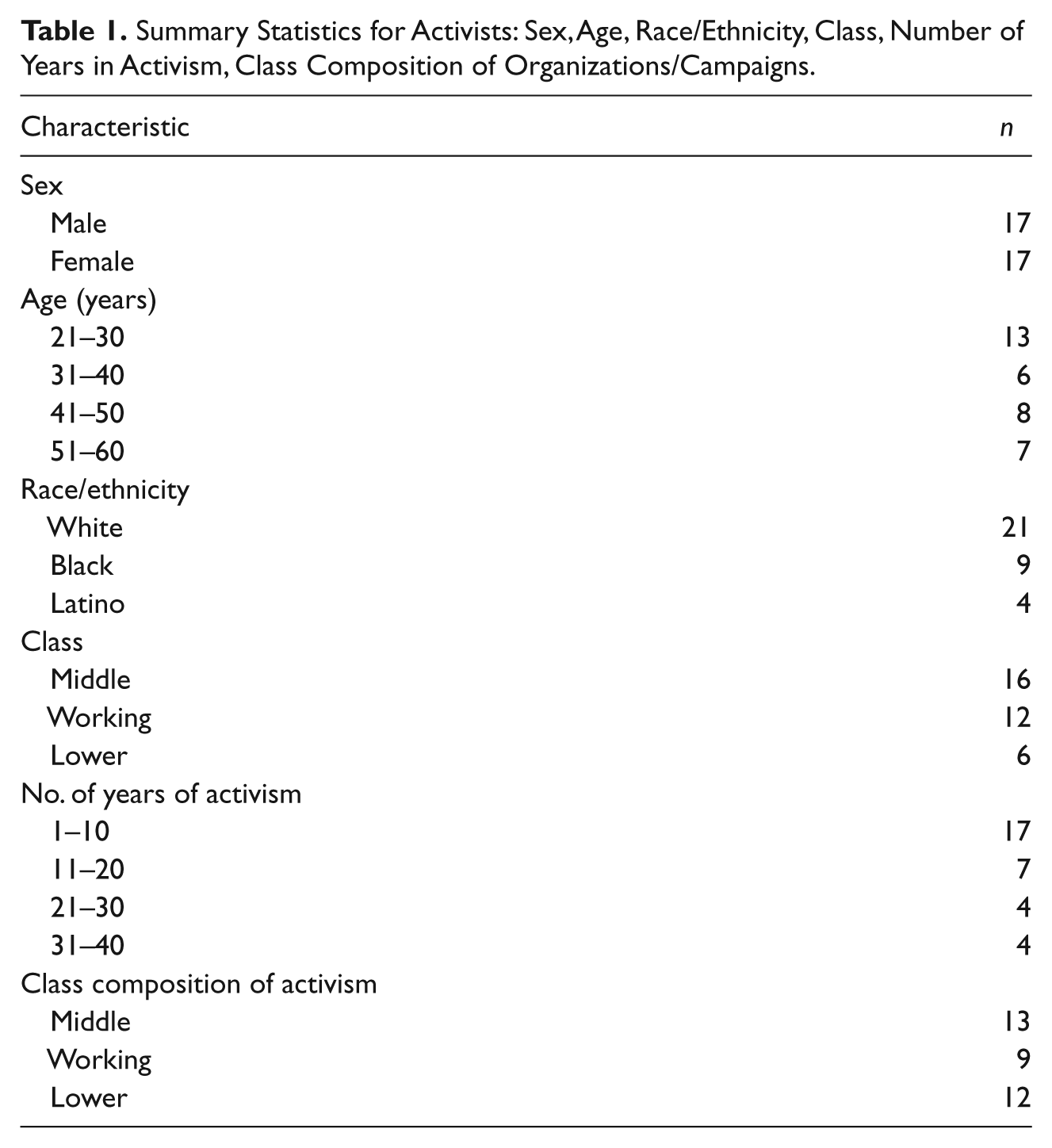
Table 1 presents summary characteristics of the activists included in the sample: not only the social class characteristics of the activists but also their age, sex, race and ethnicity, number of years in activism, and the class context of their activism. Eighteen percent of the sample is lower class, 35 percent is working class, and 47 percent of the sample is middle class. 2 Thirty-five percent of the sample is nonwhite (Black and Latino). The average age of the sample is 38, with slightly more than half the activists in their twenties and thirties. The average number of years in activism for the activists is fourteen, with 76 percent of the sample having spent between one and twenty years in activism. Thirty-eight percent of the sample works in middle-class organizations or campaigns, 35 percent in lower-class organizations and campaigns, and the remainder (27 percent) work in working-class organizations or campaigns.
Summary Statistics for Activists: Sex, Age, Race/Ethnicity, Class, Number of Years in Activism, Class Composition of Organizations/Campaigns.
Since I was interested in whether the class-inflected context of activism described above contributed anything unique to the construction of activist identities, I focused on the instances where the class origins of the narrators differed from the class character of the organization or campaign. This method yielded three main patterns of “class mismatch” between activist and context: (1) middle-class activists who work with a working-class constituency or activists in financially insecure organizations, (2) working-class activists who work with a middle-class constituency or activists in financially secure organizations, and (3) lower-class activists who work with a middle-class constituency or activists in financially secure organizations. Although the number of activists who occupy these spaces is relatively small, these cases of “mismatch” provide an opportunity to explore if or how class context mattered for the construction of activist identities independent of the class origins of the activists themselves.
I approach the life history interviews as narratives complete with story structures and sequences, plotlines and pathways, story themes and cultural scripts, and structures of feeling. These theoretically informed expansions of identity talk guided the data analysis and constituted the starting point for the generation of categories and the search for patterns in the identity talk (Glaser and Strauss 1967). As soon as this inductive method yielded various categories and codes (a triangulation between general theoretical categories and activists talk), I utilized a software package (Atlas-ti) for analyzing qualitative data to count these components of identity talk across the class positions of the activists and, where possible, the class composition of the activists’ social movement context.
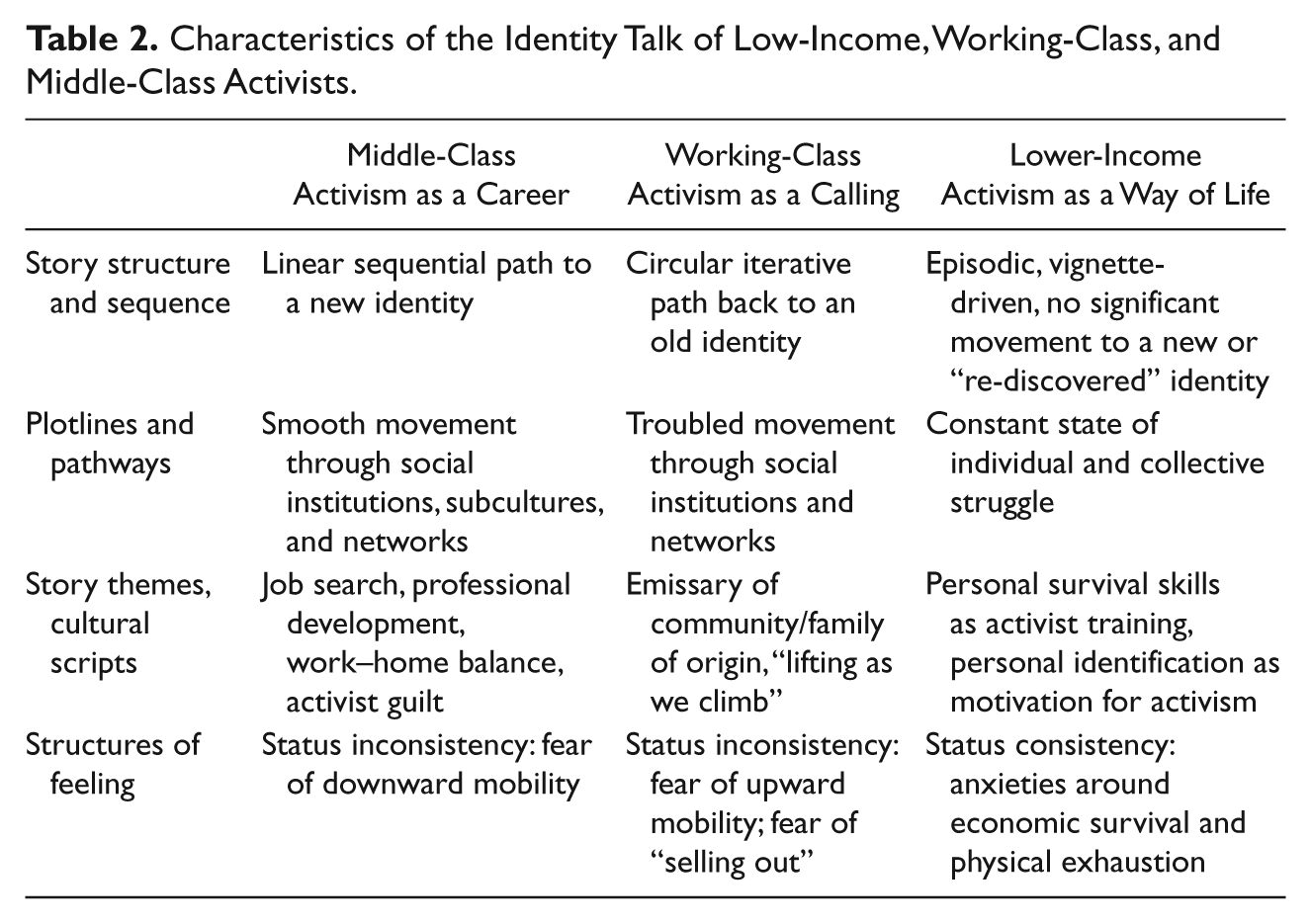
This analysis yielded three relatively distinct types of activist identity—activism as a career (for middle-class activists), activism as a calling (for working-class activists), and activism as a way of life (for lower-class activists)—and these patterns were not significantly affected by the kinds of organizations or campaigns the activist was involved in. The class composition of the organizations or campaigns did affect, however, the structures of feeling “attached” to these different types of activist identity. This feature was seen in cases where the class origins of the activist differed significantly from the class character of the activist setting. Middle-class activists experience anxieties of downward mobility; working-class activists, the anxieties of upward mobility; and lower-class activists experience the frustrations and resentments of no mobility. Table 2 lists in summary form many of the characteristics of the identity talk of these low-income, working-class, and middle-class activists. I elaborate and illustrate these characteristics in the following sections.
Characteristics of the Identity Talk of Low-Income, Working-Class, and Middle-Class Activists.
Activism as a Career: The Identity Talk of Middle-Class Activists
Middle-class activists construct linear, sequential narratives of coming to activism. They describe their journey to activism much like other professionals describe their acquisition of a career: a training process, a deep commitment to a new identity, and the associated tensions of work–home or work–leisure balance. When asked “how they came to be an activist,” many middle-class narrators constructed a fairly smooth trajectory of family socialization, youth subcultures or volunteerism, and college experiences leading to an activist career. As illustrated below, social networks figure prominently in these stories.
Antiracist and media activist, Josh, remembers growing up in an “FDR Democratic-type family.” This “vague liberalism” lay dormant until, according to Josh, his exposure to the hardcore music scene with its “inherently political rejection of big tobacco and a consumerist society.” His liberal socialization and countercultural subjectivity found a home in the social networks of college: “The Council of Student Activities [was where] a lot of progressively minded students who didn’t have a place to go [went].” Other middle-class activists like Laura L. who also had a liberal family socialization speak about how some of their college courses and college volunteer work interacted with that socialization to produce a desire for activist work.
I came into college with some awareness of power differences since my parents were very liberal. I took this course when I was a freshman called “Prejudice and Discrimination” and it just blew me away! [Because of that experience] I did some volunteer work . . . I joined the African American Social Club. When I got out [of college] I was very radicalized . . . very idealistic and wanted to change the world and wanted to do empowerment work to redistribute wealth and power, but wasn’t sure quite how to do it. . . . I got a job as an outreach worker for [a social service agency]. I did that for a year and a half, but was always looking for something else. And then when I saw a community organizer position in the paper, I was like, “My God, this is exactly what I want to do.” I contacted [some veteran organizers I knew] and, as you know, they can be very persuasive [laughs].
Both Josh and Laura leave college looking for opportunities for activism similar to the way that any college graduate would search for a career. Their social networks prove useful in providing the cultural material for their identities as activists, the motivation for their activism, and the information regarding activist opportunities.
What perhaps distinguishes these narratives of “becoming an activist” from becoming an account executive or a website manager, for example, is the profound changes in consciousness alluded to in Laura’s excerpt but forcefully exerted in so many other narratives of middle-class activists. Kevin, a peace and global justice activist, stresses the importance of social networks in college as providing both ideas for a new identity and actual opportunities to act on this new identity. For Kevin, this transformation of consciousness involved changes in his understanding of society from one based on individualism and competition to one based on community and solidarity.
It comes down to your conception of society and community and how do you define your community: Is it your family? Extended family? People on your block? People in your town? People of your race? No, it should be (include) all of that. It should be a person in California is your brother as much as the guy who sits at your table. And if that conception was more prevalent than the selfish materialism that goes on, we’d be in a much better place. So this is what’s happened for me: it’s about redefining some of those values.
As if to reinforce this important change, he ends with: “that’s when something really clicked with me. I didn’t make those connections before!”
Other middle-class activists define this transformation differently: some speak about the change in terms of acquiring a feminist consciousness; others in terms of a critical socialist or anarchist consciousness. They all, however, use that transformation to frame their career aspirations. Again, Kevin alludes to these aspirations.
I just feel like it has to be something that really makes me feel like I’m accomplishing something beyond a paycheck. The best minds in my generation are in insurance. And what are they doing? They’re feeding the system which is absolutely horrible. I can’t work somewhere where I would feel like I’m part of the problem.
As we will see below, this search for a career causes some anxieties among middle-class activists, particularly those who work in organizations or on campaigns that are underresourced and financially unstable. This disjuncture between the class background of the activists and the class character of their social movement activities heightens their need to “come to terms” with the status inconsistencies between their relatively high class standing and their relatively low economic circumstances.
Similar to other demanding careers, middle-class activists report ongoing problems with time management, balancing work and home, and career development. Quite interestingly, the change in consciousness described above exacerbates these tensions since it contributes to activist guilt and the pressure to always be “in the struggle.” As antiracist activist Laura L. admits, “there’s definitely some progressive activist guilt there, you’re just like, ‘You should be doing it all and there’s so much injustice and you just need to do more.’” Like many conventional high-powered careers, the activist career has an incessant quality to it and because of it many middle-class activists teeter on the edge of activist burnout.
“Professional development” is another aspect of this idea of activism as a career for middle-class activists. Although they would never characterize their journeys to nor their lives in activism using this corporate language, these activists do use the language of training, internships, and skills development in their narratives of becoming and being. Not surprisingly, many middle-class activists trained as activists in the context of higher education. Julia, the head of an activist theater group, summarizes her training thusly:
I went to the University of Massachusetts for two years and while I was there I was a student of Augusto Boal’s Theatre of the Oppressed. Then I left for a year and went to Nicaragua to work with the Theatre and then I transferred to UCLA School of Film and Television. . . . I secured my internship with the mime troupe [in San Francisco] while I was a senior. There were already lots of people doing [activist theater] in San Francisco; that’s why I moved here. I grew up here. And we really wanted to work in a city that needed change.
Like many other middle-class activists, this “career development” was positioned as part of a sequence of stages in the making of an activist identity: in Julia’s case, from radical parents to socialist summer camps to college to activist theater.
Although several middle-class activists expressed some status anxiety around their activism, this “feeling state” characterized all the middle-class activists who spent much of their time in activism that addressed the needs of working-class or low-income individuals typically in underresourced or low-resourced organizations. This feature of their social movement landscape seems to accentuate the distance between these activists’ middle-class training and their failure to make good on that training (at least in conventional terms). This process is subtle: some express frustration about parents who just “don’t get it” (Jeremy), vague regret about “always being poor” (Julia), and even some discomfort (perhaps jealousy) as they watch their friends and contemporaries “all becoming doctors and lawyers” (Laura M.). These narrators do not permit their anxieties to persist in their identity talk for very long, however. As soon as they express these sentiments in their interviews, they immediately dismiss them using various accounts, as if these sentiments somehow betray their progressive identities. Julia who worked for several years with little or no salary to build a progressive theater project illustrates this process in a comment that immediately follows her summary of her activist training cited above.
When I turn on TV, I see all my classmates. . . . They’re making the money! . . . I don’t foresee ever having film credits or television credits and I don’t ever foresee having Broadway credits. There’s that part of me that was an overachiever growing up and still is now and says “shit I should, you know . . . I was trained in that!” And then I have the angst that comes with being poor. . . . But whenever I sit with myself I realize it doesn’t matter because I don’t have a choice because nothing else would make me happy. It just wouldn’t make me fulfilled!
In a similar fashion, Laura M., a labor organizer who freely admits she is “overworked” and “underpaid,” expresses some regret or status anxiety as she compares herself with her friends.
The crisis I had at 30 was not over my biological clock—I had a crisis about I’m never going to make money. Because my two best friends in my 20’s were both pre-med and med students when I met them, and they were nearing the end of their course of study, and I realized these people had access to living comfortably in a way that I wasn’t going to. . . . What had seemed like a decision I had made for the time was actually turning out to be a life decision, and did I really want it to be—Now this is the stuff about coming from a relatively privileged upbringing, right? These are all choices for me. Many people don’t get this choice.
These two excerpts capture the complexity of this status anxiety around downward mobility and illustrate the uniquely middle-class inflected nature of this anxiety, especially for those who work in either underresourced organizations (Julia) or for working-class or lower-income individuals (Laura M.).
Activism as a Calling: The Identity Talk of Working-Class Activists
While middle-class activists see their work as a career, working-class activists see it as a calling. In the words of Karen, a community organizer who moved back from the suburbs to the predominately black working-class neighborhood in which she was born: “it’s your passion; it’s your ministry.” This passion stands in contrast to the nature of the commitment of the middle-class activists who speak of the transformation of consciousness they experience less like a conversion or awakening and more like an intellectual and political learning process. And, as we will see in greater deal below, the consciousness-raising process is less about finding something new or learning to see the world anew like the middle-class activists. For working-class activists, it is a rediscovery of their “roots” and/or a new appreciation or understanding of those roots.
Although working-class activists explicitly reference many of the factors cited by middle-class activists (e.g., family socialization, church volunteerism, and college) to account for their recruitment and participation in activism, they put them together somewhat differently than the middle-class activists. Rather than a sequential and additive journey through various institutions that results in a transformation of consciousness and a career, the narratives of working-class activists tend to be somewhat circular or iterative in nature as the narrators move back and forth between their “roots” and their current activism, culminating in a rediscovery or re-cognition of their working-class background.
Like so many of the middle-class activists, Charlie, a young immigration rights activist foregrounds his college experience as central to his “coming to activism” story. Unlike the middle-class activists, however, this experience does not signal a new consciousness or identity but the realization of the importance of his class background vis-à-vis his new yet-to-be-realized class position. For Charlie and other working-class activists, the structure of their “coming to activism” story is somewhat circular as they go back and forth between their “roots” and their current activism.
I am a border walker; I am walking two different worlds. As a student [at an elite liberal arts college) and coming from where I come from: I’m a Uruguayan from Leominster, Mass., whose father is a baker. And I’m privileged to be here, and I know that I have responsibility of doing work for other immigrants everywhere else. The work that we do hopefully gets seen as one ripple.
John also captures this story theme of “moving forward” through institutions on his way to activism while simultaneously “moving backward” to his class origins.
My activism was started by the influence of this Catholic priest in high school who turned my world upside down. He led me to see the injustices at that time. And then taking that experience and looking back at my own family history and the class issue, because coming from a working-class family because my father was a janitor in City Hall, there was always this issue around lack of money. . . . [This priest] gave me a way to think about ending those economic issues, linking it with the gospels and a real social justice angle on religion. I mean that’s what my activism is rooted in.
Like middle-class activists, working-class activists represent this journey through institutions as a move from nonparticipation to participation. But unlike middle-class activists, they do not use a language of discovery and fulfillment typically associated with meaningful work. Instead, working-class activists represent their “coming to activism” as an unfolding of something that was always there.
Working-class activists also feature social networks in their “coming to activism” stories. These networks, however, operate somewhat differently for working-class activists than they do for middle-class activists. Unlike for middle-class activists, these networks are not always conflict free and do not always operate as easy vehicles for collective action. Working-class activists seem to accept some components of these networks while rejecting others. Given the many different aspects of social networks as carriers of ideas and information and as sites of contacts, this is not particularly surprising. However, for working-class activists who narrate “coming to activism” stories that are moving forward “through” middle-class social networks while referencing a working-class past, these experiences are bound to be fraught with ambivalence and conflict.
These features of social networks for working-class activists are best illustrated in an excerpt from Jack, a product of a hardscrabble working-class neighborhood in Providence, Rhode Island, and a veteran community organizer in the city, whose key social network was the Catholic priesthood in the 1970s.
[In the priesthood] I learned liberation theology, a theology that said . . . you’re responsible for building a new society, a New Jerusalem. . . . And so I came home and said, “Let me do this!” And so my getting involved in this local community organizing effort as a priest and doing it seemed to me like this is what I was taught to do.
Jack focuses mainly on the belief system built into this social network that propelled him into action. As stated below, however, he rejects other aspects of this network as noted in this “fallout” from a demonstration he was involved in.
And so I get a call from the bishop, he says, “. . . What the hell are you doing you jerk, you’re causing trouble here.” And that kind of epitomized why I had to leave [the priesthood] because he said, “I don’t want you doing that.” And I’m saying, “No, no, no, bishop, you got it wrong, this is what we all should be doing.”
Other working-class activists also narrate similar incidents that occur in schools, neighborhoods, or jobs and they also reject the demand for respectability and decorum by these institutions. Quite ironically, at least from the standpoint of the standard sociological accounts of recruitment, these social networks do not facilitate activism. These networks are rejected and it is that rejection that leads to activism. This unconventional and somewhat contradictory role of social networks in recruitment appears to be a class-inflected process.
The return to an old awareness or to a re-cognition of their “roots” is fraught for many of these working-class activists as they tell their “coming to activism” stories. Many of them understand that they may be from the working class but are not necessarily in that class. Their pathways to activism frequently include experiences in institutions and social networks (college, business, volunteer activity, churches, and unions) that give them access to middle-class cultural capital. In some instances, their lives in activism provide income and other resources. All of these contribute to a movement away from their working-class origins. I observed a more acute awareness of this disjuncture for those working-class activists who worked in fairly well-resourced organizations on the one hand or on campaigns that addressed the needs of low-income communities, on the other. These kinds of social movement contexts seem to remind these activists of their “betwixt and between” status and provide points of identification and disidentification with their own class backgrounds.
Cheryl, a working-class African American woman who spent a large part of her activist life in local organizations or grassroots campaigns that addressed the needs of low-income queer youth currently works in a well-resourced philanthropic organization doing antiracist education and organizing. She constructs a story of becoming an activist that clearly illustrates this dynamic of attending to “her people” while making a living for herself: a strategy of “lifting as we climb.” Her movement back and forth from queer antiracist activism to education work in a large organization is, in part, a story of how she parlayed her activism into a vehicle for social mobility: “Unless you get with some big organization you really don’t make a lot of money at organizing. But that’s [i.e., organizing] what I love to do. So I had to balance making a living and doing my organizing work so what I decided was to do antiracist consulting work with the Haymarket Fund.” 3 While at first glance this instrumental approach seems at odds with the claim that working-class activists see their work as a calling to minister to their community, Cheryl is quick to situate her decision-making process not only in her working-class roots but also out of her identification with those who are “multiply oppressed”: “I do this for poor urban youth who are gay or bi; that is the my way of giving back.” This quote takes on additional resonance and gestures even more directly to her working-class family when you understand that she was a single mother of a gay son who died of AIDS. Cheryl finishes the above quote thusly: “that is my way of giving back to my son.”
Other working-class activists who work in poor communities register these identifications and disidentifications more explicitly. Larry, a community organizer in a low-income African American neighborhood grew up working-class in the rural South and sees his activism not only as a calling but as a divine mission. The disjuncture between his working-class background and a lower-class organizing context gives his “lifting as we climb” sentiment a somewhat sharper edge than Cheryl’s. He insists that the lessons of his life as a black working-class man who “pulled himself up” can be used in his activism to do the same for “his” community.
In Larry’s account of his “coming to activism,” he moves back and forth between his working-class roots in rural Louisiana and his community organizing in poor Northern urban communities. In doing so, he constructs two intertwined narratives of self-improvement and community empowerment. After recounting his family’s financial struggles around his college education, his activism in college in the 1970s, and his early experiences in the corporate sector, he deftly connects the skills he acquired “in these personal struggles” to his work as a community organizer.
So I got the business training. . . . Bringing employees in as part of the process with the leadership is what I learned in [the company I worked at]. It empowers two groups that normally are not a part of the planning process. First the customers, the people you’re serving, secondly the employees, those who are doing the serving. With those two groups you’ve got the best shot of defining exactly what needs to be done and exactly how it should be done at the least cost without compromising the goal overall. So, I used all that when I came here [to the community organization].
This understanding of his work, moreover, combines the philosophies of community organization, entrepreneurship, and racial uplift.
It’s all about changing the thinking of people in the community in order to affect individual behavior, and therefore bring about a higher quality of living. The answers for our community do not lie in the think tanks or the government or the foundations. The only hope that we have is to unleash the power of people who have endured for so long and therefore who understand the pressure that they’re under, and who are more motivated than anybody to get the problem solved, and to fix it in a way that it stays fixed.
Interestingly, Larry establishes a branch of this community organization in the Southern town in which he grew up, thus capturing the many features of the identities of working-class activists: his activism as a calling, as a way of “returning to roots,” and as a strategy of moving up while “bringing others along.” He conveyed this story to me as someone quite proud of his accomplishments but he also wanted me to know that he was not “selling out” or abandoning “his people.”
Like all activist narrators, working-class activists also describe tensions between their work and other areas of their lives. Compared to both middle-class and lower-class activists, however, working-class activists are the least likely to describe it as overwhelming. Jack, the priest who became an activist in his working-class community of Providence after leaving the church, states explicitly that burnout can be managed: “I’ve never worried about burnout. I think people adjust . . . if you can keep them connected to the vision.” For Jack and other working-class activists, the idea of activism as a calling (i.e., staying connected to the vision) mitigates the effects of “burnout.”
Activism as a Way of Life: Identity Talk of Lower-Class Activists
Both middle-class and working-class activists construct “coming to activism” stories that mimic sociological models of recruitment that describe sequential pathways from nonparticipation to participation and commitment. Middle-class and working-class stories foreground many of the same factors that sociologists isolate in their accounts of recruitment and participation: socialization, social networks, and biographical availability, even as these factors are embedded in various cultural scripts and narrative structures. The stories of low-income activists differ from these accounts in several respects, however. Low-income activists are the least likely of the narrators in my sample to separate their lives into pre- and post-activism. Their stories of “coming to activism” are interspersed with and take a backseat to their narratives of real material hardships and social marginalization. These narratives, furthermore, have an episodic quality to them as these low-income activists resist the assumption that their lives can be best understood with a “logic of becoming.”
David, an AIDS activist and health educator in Hartford’s Black community, constructs his story by moving back and forth between his involvements in AIDS organizations, his “coming out” as a gay black man, and his growing up obese in one of the roughest public housing complexes in the city. These rhetorical moves are not designed to valorize his class identity as “poor” as is the case for working-class activists, nor does he highlight the social networks involved in these organizations or experiences as is the case for middle-class activists. Instead, he weaves a “coming to activism” story that focuses on personal hardship as a gay black man who grew up poor and harassed. These hardships and his response to them made him an activist. Luz, a poor Latina woman who has been involved in countless episodes of collective action throughout the City speaks matter-of-factly about her activist involvements when I asked how she got involved in activism: “In my life I see a lot of people with problems everyday. . . . I just started to talk to them and it went on from there.” For Carmen, another low-income activist, her activism stems not from her training in activism, as is the case for several middle-class activists with whom she has worked, or from her need to reconnect to a working-class community that she has left behind, as is the case for working-class activists. Instead, it flows from her identification with other low-income women in her community.
What I love is sitting down with a woman who has never once written a letter in her life, someone who has a third grade or a fifth grade education, a woman like I am who has been oppressed all her life, come out that shell and learn and say, “I want change. I’m going to stop being the victim . . . like I did.”
Carmen’s life story illustrates several features of the identity talk of low-income activists. From the outset, she constructs her life as always involving fighting and struggling. The shift from individual struggle and experiences of marginalization to collective struggle and a heightened consciousness of group oppression is subtle and somewhat unremarkable in the structure of the narrative, particularly when read in light of the transformations articulated by middle- and working-class activists. Unlike these other activists, organizing is as much an individual survival strategy as it is a strategy for collective social change.
[I grew up] getting my ass beat every day. I’m a white Puerto Rican. My skin color is white, and the fact that I was [living in the housing project] and I was Puerto Rican made it ten times worse for me. It was the war between the blacks and the whites, and we happened to get caught up in the middle of that. . . . And so, after being beat up a couple times by a bunch of different girls, I started retaliating. That’s how I learned how to defend myself.
After an early marriage and domestic violence at the hands of her husband, Carmen retaliated and, as a result, was denied custody of her children for a period of time.
I took all that anger, and all that energy, and I went into meetings—I had to do something to get my mind off of the loneliness of not being with my children . . . and I remember how pretty they were going to do Park Street [the heart of the Puerto Rican community] but I kept wondering, “What’s happening to the people?” If they’re fixing this up, I didn’t see no housing. There was no housing there. I went to some meetings . . . I met some brothers and sisters from my country who explained to me what racism was and what I was going through. . . . Once I learned my roots, and I started realizing what oppression was that this [i.e., both her activism and her effort to regain custody of her children] began.
The transformation of consciousness that Carmen describes toward the end of this excerpt is not the end point of a journey toward activism as is the case for middle-class activists or, to a lesser extent, for working-class activists. Nor is it described as an “aha” moment like the realizations that take place particularly in the life stories of working-class activists. As described above, it is the deepening of an already existing oppositional relationship to the world around her. It makes little sense to distinguish her activist identity from the many other reference points she uses for acting in this world, as poor, as Latina, as a woman, as “mixed race.” Unlike the middle-class and working-class activists, the low-income activists are the least likely to call themselves activists.
Although some of these low-income activists had received formal training in organizing, they typically do not cite this as key to how they engage in their activism. Again, they insist that the survival skills they developed as low-income men and women provide them with their activist training. Luz and Carmen, both of whom have received training in Alinsky-style organizing, are the most demonstrative. They insist that their lives are their touchstone for organizing. Luz states her organizing mantra based on her years of raising children on welfare and low-wage jobs: “You need, you want, you get.” As a way of putting her “real world” experience in the context of the formal training that some of her fellow activists received in college or through their experience in social movement organizations, she says somewhat dismissively, “I feel like I have been in college for twenty years!” Carmen emphasizes her leadership skills learned amid family dysfunction and abuse.
I was a leader in my house. I was raising my little brothers and sisters, so I knew how to manage. [In my marriage] I took back my life. I decided not to be his bitch anymore. That would be the end of that.
Andrew, another low-income activist, draws his organizing skills from his time as a recovering addict and then as a drug and alcohol counselor in the social service delivery system.
I tell my clients and folks in the street, that, “Hey, listen! The frustration that you’re experiencing with human services—that sense that something’s not right about this, because everybody’s giving you the run around, it’s real.” And so, I teach people, that the only way to stop or slow down the roll of the industry is that you stop the very first person that you meet and say, “You know what? I’m not going to leave the office, or I’m going to keep coming back until I get exactly what I came in here to get.” That’s what I do [in my activism]!
The organizing skills Andrew uses in his antiracist work and antiviolence work come from the skills he needed to both recover from addiction and then navigate an unwieldy bureaucracy. For Carmen, these skills derive from her ability to negotiate an abusive relationship. Again, there is this conflation between their individual survival skills and the tools they use to “do” their activism.
The class-related anxieties voiced by low-income activists who work in well-resourced organizations are quite different from those of middle- and working-class activists in analogous situations of class background/class context mismatch. As noted above, these situations heighten status anxieties of downward mobility for middle-class activists and upward mobility for working-class activists. Lower-class activists who spend their organizing in well-resourced organizations also voice class-related anxieties but these are not related to mobility per se but to economic survival and the physical and psychic exhaustion associated with activism. These frustrations often take the form of conflicts and clashes with the leadership of the activist organization.
Carmen and Luz provide a good illustration of these sentiments and conflicts for low-income activists. Most of their work has taken place in community organizations or health and welfare coalitions financed through religious or liberal philanthropic foundations in the city. This “mismatch” between their class origins and the class nature of the organizations challenges them to defend their skills and throws into sharp relief the economic differences between them and their fellow middle-class activists, who often form the leadership cadre of these organizations.
Carmen offers an account of physical and psychic exhaustion and connects it quite directly not to activism per se but to the conflicts she experienced in many of the organizations in which she worked where she felt ignored or left out of leadership positions.
They were deliberately talking over my head. . . . They would say, “You’re such a nice girl.” Or, why don’t you just vote along with us.” I didn’t know what the hell was going on, and I felt like I was having a panic attack. I started crying. “I can’t do this anymore, I have no clue what the hell they’re talking about, and they’re deliberately keeping me in the dark.”
After a series of very public incidents that involved a conflict between Carmen and the leadership of the community organization, she quits. Her account registers anger, resentment, and burnout.
I was going to work at 7 o’clock in the morning without no pay, and going to bed at 3:30 in the morning still working without no pay. That’s what got [the organization] to where it is now! But once that happened we knew we had to pull our people out of there. . . . I went my own way for a few years and I started burning out. I took some time to have children. Exhausting . . . you work from morning to night. I decided to go get a real job.
As if to continue this story, Carmen communicates what “a real job”’ means for low-income women who burn out from activism.
It got to a point that it was too much. I had neglected my personal life. I have a child. I needed money. It’s not like I had therapy. Dealing with all the frustration affected me emotionally. . . . I took a training in accounting from the Data Institute. They fucked up my life because of the student loans. . . . Never had a steady job after I left [the community organization]. I was on welfare and did volunteer stuff. I went on welfare. That’s my pay!
Needless to say, the burnout of lower-class activists looks very different from that of middle-class activists. For the lower-class activist, the burnout is material in nature: the activism is time away from feeding the family. For the middle-class activist, activist burnout has more to do with the psychic energy expended in one role or identity spilling into the psychic space of another role or identity.
Discussion and Conclusions
What light do these class-inflected patterns of activist talk shed on the three bodies of literature in which this research is situated? What do we gain by treating activist identity talk as reflecting not only cultural scripts but also as embodying narratives with plot lines, points of view, and emotion?
With regard to the research on activist identity, the patterns I identify in the content, structure, and function of the talk among a diverse sample of Hartford’s progressive community suggest that these activists embrace class-based understandings of themselves that they then use to understand their activism. Future research would explore more systematically this relationship between activist identity and the micro-mobilization processes of social movements. How do these class-inflected identities affect the kinds of movements individuals are drawn to, how long individuals stay in these movements, the kinds of interactions or relationships forged in those movements, and the impact that these identities have on the decision making, framing, and goals of social movements? While research on the micro-mobilization process of social movements has generated nuanced theorizing about collective identity (Meyer, Whittier, and Robnett 2002), it has yet to incorporate similarly nuanced understandings of the situated social actor into that theorizing. Individuals come to activism with behavioral dispositions, structures of feeling, and worldviews derived from class backgrounds as well as many other biographical and social characteristics. This article is an attempt to theorize these individual-level differences among activists and to suggest their importance in theorizing collective identity and other components of the micro-mobilization process.
Some of this theorizing has already taken place in the sociology of conversion literature that explores how an individual’s “universe of discourse” changes with her or his involvement in various kinds of religious and personal growth movements (Snow and Machalek 1983). This literature describes how individuals reconstruct their biographies, adopt a master role and reinterpret events, problems, and people in light of the demands, norms, and ideology of the movement. At first glance, many of the activists in my sample, mainly middle-class and working-class activists, undergo various aspects of this conversion process as they describe changes in their consciousness and their identities as a consequence of their activism (also see Ruiz-Junco 2011). Rather than focus primarily on the impact of the movement on the individual as does the conversion literature, this article attends to the ways in which the class-inflected biographies of activists affect the precise nature of the conversion process and thus the unique nature of the activist identities. Their biographical reinterpretations, causal attributions, and reasoning processes—all elements of the conversion paradigm—are a consequence not only of the movements they participate in but also of their class origins and the interaction between those origins and their social movement contexts.
In addition to the finding that activist identity talk is shaped primarily by the class origins of the activists, the analysis also uncovers some evidence that these identities interact with the social movement context within which activists operate. Specifically, I find that activists whose class-inflected identities differ from the class character or composition of the social movement organizations or campaigns they work in often experience interpersonal conflicts and intrapersonal anxieties. This finding suggests that future research needs to pay greater attention to the biases or inflections built into the structure and culture of social movement organizations. What may feel “comfortable” and “progressive” for middle-class activists may be alienating and marginalizing for working-class or low-income activists (see Ward 2008). This finding suggests that the class character of activism should become more centrally incorporated into theorizing collective identity.
This research also contributes to the literature on the discursive construction of class. By “opening up” the concept of identity talk to more fully exploit the vocabulary of motives and structures of feeling comprising it, the analysis demonstrates that the social self as narrated in these activist stories is a “classed self.” The ways these individuals tell their stories, the factors they use to construct their tales of activism, the nature of their activist identities, whether they even “own” an activist identity, and the place of activism in their lives are all influenced by the class origins of these narrators. My representation of their activism as a career, a calling, and a way of life is a way to capture some of these major dimensions of class difference. Although not included in this research, future work on activist identities would benefit by incorporating an explicitly comparative dimension to the research design. Knowing how activists of different class origins view themselves vis-à-vis other activists or their “constituents” is crucial not only for addressing social movement questions about recruitment, factionalism, strategy, and goals but also for understanding the discourses that social actors use to draw moral boundaries between themselves and others who are both similar to and different from them. In this way, future work continues an important line of research that examines “class talk” in different social, organizational, and institutional contexts (Stuber 2005). How progressive activists with very different class backgrounds and discourses understand their fellow activists and how those understandings change in the context of collective action are important and still unexplored questions.
Another contribution to this literature on the discursive construction of class is the identification of the class-related anxieties associated with doing activism. While previous research in social movements has focused on issues such as commitment, burnout, or disengagement, none has explored these issues and their attendant psychic and material costs in terms of status inconsistencies and class anxieties. From this perspective, we see these narrators struggling with competing discourses of self-evaluation and self-worth, and that struggle is most acute when activists work in organizations or with activists who are inflected differently in terms of class origins or makeup. Some struggle to embrace a communal vision of “the good life” even as they are socialized in the dominant institutions that foster individualism and upward mobility as the keys to success. Others find ways to reconcile these two competing visions between the individual and the collective in a strategy of “lifting as we climb.” For still others, the discourse of the self becomes collapsed into a discourse of the family, the neighborhood, or poor women “like me.” In these cases, “the good life” is always elusive and defined, almost by default, as a life of struggle. These insights point to the need for additional work on the intersection of social class discourse and activist identities.
The analysis builds on that third body of research on social movement recruitment and participation but mainly to examine how narrators utilize the concepts highlighted by scholars to construct their “coming to activism” stories. Like previous research, various components of social networks are referenced in these narrators’ stories. These components, however, are prominent features only of the stories of the middle-class and working-class activists and are represented somewhat differently across these two sets of activists. Stated broadly, middle-class activists use social networks as career builders while working-class activists sometimes refuse aspects of these networks in their move to activist identities. Somewhat similar to past research on class and recruitment, social networks are less prominent in the stories of lower-class activists where material hardship and social marginalization are the chief tropes that shape those stories.
Finally, these findings also have the potential to speak to the organizing concerns of activists. If one tool of social movement recruitment is the “compelling story,” then knowing that all stories are not equally compelling and whose stories are more likely to resonate with certain audiences could be very useful. The analysis asks that we pay attention to the stories activists tell about the past, how they are constructed, and the role that social class plays in these processes.
Footnotes
Acknowledgements
I wish to thank the anonymous reviewers and Kent Sandstrom for their many helpful comments on earlier versions of the article. Rachael Barlow, my colleague at Trinity College, also deserves a note of thanks for her close reading of the manuscript.
Declaration of Conflicting Interests
The author declared no potential conflicts of interest with respect to the research, authorship, and/or publication of this article.
Funding
The author received no financial support for the research, authorship, and/or publication of this article.