







Abstract
The recording studio has been somewhat neglected as a site for ethnographic fieldwork in the field of ethno-musicology and, moreover, the majority of published studies tend to overlook the specific concerns faced by the researcher within these contexts. Music recording studios can be places of creativity, artistry, and collaboration, but they often also involve challenging, intimidating, and fractious relations. Given that recording studios are, first and foremost, concerned with documenting musicians’ performances, we discuss the concerns of getting studio interactions “on record” in terms of access, social relations, and methods of data collection. This article reflects on some of the issues we faced when conducting our fieldwork within British music recording facilities and makes suggestions based on strategies that we employed to address these issues.
Introduction and Background Literature
In some studies, recording studios feature as sites of contemporary popular music-making (Cohen 1991; Negus 1990), music tourism (Gibson and Connell 2005), recording technologies (Doyle 2005; Lockheart 2003; Pinch and Bijsterveld 2004; Théberge 1997, 2004), and recording practices (Kealy 1979). In addition, representations of the recording studio also feature extensively in popular music journalism, media and film (Cogan and Clark 2003; Williams 2010). However, as a central site for ethnographic fieldwork, the recording studio has received limited attention (Bates 2008; Fitzgerald 1996; Gibson 2005; Hennion 1990; Meintjes 2003; Porcello 1996, 2004, 2005), and the role of the ethnographer in studies of recording studios remains less developed. For example, Fitzgerald’s (1996) account of a recording studio project in Sydney, Australia, focuses on the musical contributions and some of the interactions between an arranger, a songwriter, and a session guitarist but lacks a detailed discussion of the concerns faced by the researcher prior to, or during, the data-gathering process. Similarly, Meintjes’s (2003) study of recording studios in Cape Town, South Africa, although extensive in its description of Zulu artists’ experiences in the recording studio, ignores the considerable physical, social, and linguistic concerns of access that would face most researchers in this context. Only Bates’s study on recording studios in Istanbul, Turkey, engages with some of the methodological issues that he faced as a participant-ethnographer during the recording processes that he was studying:
Particularly within my ethnographic study, the position of recording engineer was best characterized by the contradiction of its acute importance . . . this obviously affected my interactions with my informants, the kind of data I was able to collect, and my subsequent frame of reference for analyses. (2008, 17–18)
Bates also identified how some of the observational issues in documenting practices in the recording studio are mirrored in other ethnographic studies, specifically Higgins’s (2007) empirical investigation involving software programmers. Here, the researcher was challenged by issues of accessibility because of the ambiguous nature of gestures or movements and the virtual and digital format of their work. Bates explained that
an identical problem confronts scholars of recording studios, as there is a substantial disjuncture between the nature of appearance of the work at hand (an outsider’s impression of a human interface between technology and art) and the actual work involved in producing recordings. (2008, 16, emphasis in the original)
In addition to issues of access and ambiguity, the use of empirical research methods requires further consideration of how and where ethnographers fit into the studio as a research context.
This article addresses issues and strategies for conducting ethnographic fieldwork in music recording studios. We draw from separate research projects conducted in different studios. Paul’s research was focussed primarily on work in professional studios, and his methods included the use of CCTV-style video recordings of studio sessions, followed by interviews with participants. Brett’s fieldwork involved a collaborative, youth community–led studio project (Lashua 2013), and methods of data generation included field notes, audio recordings, and also interviews during studio sessions. We begin by describing the unique context of the recording studio and studio fieldwork, focussing specifically on issues of access. We then turn toward the social relations that are bound up in the studio spaces where we conducted our fieldwork, making particular note of the social interactions of the recording studio. Finally, we highlight the use of video and sound recording as intermediaries in our data collection, drawing attention to both the richness and repeatability of video and audio recording methods, which offered us significant advantages in coming to grips with the often frenetic swirl of activity in music recording studios. Rather than make generalizations about the practices of studio recording and the culture of recording studios, our intention is to highlight some of the issues that ethnographers may face when conducting research in the recording studio, and offer useful strategies that could be implemented in order to address them. The structure of the article is based around Buchanan, Boddy, and McCalman’s four initial stages of empirical research in organizations, which comprise “getting in, getting on, getting out and getting back” (1988, 53). Throughout the article, we use ethnographic vignettes to illustrate the spaces, interactions, and methods involved in our fieldwork. For clarity we have used our first names to identify when we are writing about our work independently and, unless noted, the remainder of the article is written in our shared “voice.”
Getting In: Issues of Access to the Recording Studio
Accessibility is one of the greatest obstacles facing ethnographers conducting their research in any field situation (Feldman, Bell, and Berger 2003; Johl and Renganathan 2010). As Hammersley and Atkinson explain,
The problem of obtaining access to the data one needs looms large in ethnography. It is often at its most acute in initial negotiations to enter a setting during the “first days in the field”; but the problem persists, to one degree or another, throughout the data collection process. (1997, 54)
It is surprising then that in the limited number of published recording studio ethnographies (with the exception of Bates 2008) the issue of access is not discussed explicitly, often with little or no comment about the issues the researchers faced during their initial negotiation to the field or during subsequent interactions.
For most people, including most musicians who pay to gain access to them, recording studios can be fortress-like, isolated worlds. Studios are difficult to access both physically and socially because they are largely “closed facilities” in several senses. First, they are separated intentionally from their immediate acoustic environment in order to avoid having unwanted sound enter or leave the studio. Second, recording studios are not considered “sociable” spaces and are typically only physically accessible through invitation from the studio owner, the main engineer or producer. Finally, and in relation to the second issue, a recording session is often an intimate and private setting where studio access is generally open only to those involved in the production, typically musicians, engineers, and producers. Contrary to popular filmic representations of anarchic recording studio sessions with “groupies” and “hangers on” socializing in the control room (e.g., Ray 2004; Sound City: Reel to Real 2013; Tupac: Resurrection 2004), contemporary recording studios, generally, are more isolated, secure (as befitting spaces filled with expensive equipment), and used specifically by musicians, engineers and producers to produce recordings. Fundamentally and practically, there is no other reason to be in a studio unless one is involved with the recording in some way.
This creates a challenge for those who are not involved with the process—e.g., ethnographers—who hope to gain access to the recording studio; at best they are considered interlopers, at worst they are obstacles to the recording process, unwelcome in either instance. In her research with a group of popular musicians Mavis Bayton noted that
it is very important that people other than band members are excluded from the practice space so that the band can concentrate on its tasks and come to see itself as a special kind of social unit. Privacy is necessary for reasons of both efficiency and morale, something which bands quickly learn for themselves if they have to deal with “outsiders” intruding on their space. (1990, 247)
Conducting research in the recording studio essentially contravenes the private nature of a recording session. This was unambiguously highlighted during Paul’s initial attempts to gain access to observing a recording project through his personal network of contacts of engineers and record producers. Paul reflected:
A friend of mine used to work in the same recording studio as a very well respected (and commercially respected) record producer in Liverpool and we were introduced at a party. I briefly discussed my research and the process of recording studio ethnography with the record and he seemed interested, however when I asked if he would be willing to let me sit in on a session the response was extremely tentative: “It would have to be an unsigned band and they would have to be happy for you to be there and you can’t get in the way.” I then asked if assisting the engineer on the session (menial tasks such as moving microphones, running cables, etc.) would help to avoid getting in the way: “I already have an assistant and a tape operator, so, no not really.” After this exchange I agreed to call him the next day to arrange an interview at the studio however I have been unable to contact him since.
I then proceeded to contact a number of other record producers that had previously visited the University to deliver workshops or guest lectures and in an attempt to learn from my previous efforts, emphasised that I wouldn’t get in the way during the recording sessions. Nearly all of the replies were understandably unenthusiastic with responses such as “my studio’s too small to have an extra person” or “the bands I work with are signed to a record label and probably wouldn’t want anyone else in the room.”
Even as a recording engineer myself, it was clear that in attempting to gain access to a recording studio session through other engineers and producers I had positioned myself as an “outsider.” One producer succinctly described the position of outsider in the recording studio as “surplus to requirements […] if you don’t have anything to do with making the record then you don’t have any reason to be there and you might disrupt the session.” The position of outsider comes with a weight of history and multitude of negative connotations. A prominent example is Yoko Ono in the recording studio with the Beatles. Although this is an extreme case because Yoko was perceived to have had some influence over one of the other participants, it is clear that outsiders are not welcome in the recording studio unless they are connected to the record-making process in some way.
Both my initial failure and my subsequent interviews with producers and engineers indicated that sound engineers or record producers were not the gatekeepers to a recording session. They are the initial gatekeepers in gaining physical access to the buildings but more generally they are there to facilitate the performance of the musicians and create a work-friendly environment for musicians to perform at their best. As one producer succinctly explained “we’re making the artist’s record, not the other way around.” The social gatekeepers to a recording session are the musicians who are performing in the recording studio and once I gained permission from a group of musicians to accompany them into the studio, I was “in.” (Paul, research reflection, May 12, 2012)
This vignette illustrates how the researcher can unintentionally find himself or herself in the role of outsider and the unwelcome status this brings (Laurila 1997; Okumus, Altinay, and Roper 2007). Although utilizing personal contacts and networks has been shown to be useful in gaining access to particular field settings (see Hoffman 1980), this instance demonstrated that personal contacts must be considered within the particular context of the field setting and that initial suppositions may not at first be accurate. Paul’s experiences echoed Bates’s (2008, 11) discovery that the recording studio is often a private space: “I quickly found that observing recording sessions to any considerable degree was impossible without being an essential participant of some sort: musician, arranger, artist or engineer. Many sessions are closed to visitors […].”
However, the incidents in this vignette did have a constructive outcome as they helped to demonstrate aspects of the tacit social hierarchy of the recording studio and the power relations that operated within it. For Paul, this initial challenge subsequently resulted in the successful negotiation of access with the unacknowledged gatekeepers of a recording studio session, not studio owners or session engineers, but musicians. Paul’s interviews with recording studio personnel also revealed that it is typically the musicians who are the service-users of the recording studio.
In our fieldwork, issues of access were not limited to the physical and social consent needed to operate in the field. Brett’s experiences present another example of challenges to “getting in”—gaining access to a recording project—regarding the vernacular speech of the participants in the recording studio. Similar to Meintjes (2003) and Porcello (2004), Brett’s fieldwork in Liverpool highlights issues of linguistic access inside the recording studio. His participant status within the studio as both engineer and musician was of little use when it came to engaging initially with the musician-participants during the recording session. As an American, Brett was regularly baffled by the British accents and unique British phrases (“British-isms”) of studio participants. His difficulty in gaining access to participants’ control room conversations—and later, their recorded lyrics—was compounded by their regional Liverpool “Scouse” accent which has unique inflection and speed. The Scouse accent is noted for its fast, nasal delivery, with rising and falling tones different to other regional British accents. It often features a hard “x” sound on some words ending in “k,” such as “look.” There are also a number of particular Scouse words or phrases, such as “boss” (“very good”), “made up” (happy), or “sound” (“good” or “ok”) that are part of local youth cultural colloquialisms that have alternate meanings from elsewhere in the United Kingdom. Brett’s ability to make sense of participant’s language was further complicated at times by participants with a Caribbean-inflected Scouse British accent, reflecting the cosmopolitan heritage of this port city. Additionally, many participants invariably spoke and sang in urban slang, employing particular phrases that were part of the local hip-hop culture on Merseyside. The following vignette indicates how access to the linguistic worlds of participants was at first a challenge for Brett:
During initial sessions, I was occasionally unaware in moments when participants were speaking directly to me, and almost wholly unable to make sense of conversations that the artists were having amongst themselves about their music and its broader socio-cultural meanings. After a satisfying take in the live room, participants spoke of having “merked” their track (merk, from “mercenary”—to kill ruthlessly) and in their lyrics rappers referred to wearing a “Lowie” (a Lowe Alpine hat), or used drug slang, such as trying to find “Oscar” (an ounce). One young local rap artist recorded a song (with me engineering) called “Scouse like this” (a remake of “Slang like this” [2010] by True Tiger featuring P Money) to celebrate Liverpudlian youth cultural slang. Its lyrics included phrases such as: Sappenin’ (what’s happening?); Lar (Similar to “Lad,” a friend); Kidda (good friend); bird (a woman, usually someone’s girlfriend); swerve (to avoid/not do something); and banger (explosive). The song identified local clothing styles, referencing “North Faces or Sprayways” (brands of outdoor jackets, part of the “uniform” of urban youth, often attributed to gangs). The lyrics also employed acronyms, including “FTM” which stands for “Fuck The Matrix” (The matrix is the section of the Merseyside police that deals with illegal drugs and antisocial behaviour. Young people also joke that it means “From The Mersey”). Other lyrics in the song referred to “potent cheese” (strong cannabis), “straps” (guns), and preferences for clothes, particularly sportswear and running shoes such as Nike Air Max 95s (which are called 110s because they used to cost £110) or Adidas PT trainers.
From the outset of the studio sessions, and later whenever it was possible, I tried to ask each artist (or other participants in the control room) what some of these terms were and the meanings behind them. As the sessions continued the participants became used to (and amused with) my confused expression. Once aware that I was struggling to keep up with their parlance, participants began checking in with me to ensure that I wasn’t left too far behind in conversations. When this began to happen during the studio sessions, I realised then that I was “in.” (Brett, research field notes, October 28, 2010)
This vignette illustrates some issues of linguistic access to the lyrics, conversations, and meanings of these musicians’ particular argot. As a participant (i.e., engineer) in the studio process, Brett was largely unsuccessful in initially following fast-flowing conversations or speech with unfamiliar terms and phrases. In contrast to Paul’s experiences of inadvertently placing himself as an outsider while negotiating access, it was primarily Brett’s outsider status that helped to create an opening to discuss some of these local, vernacular meanings. Brett’s marked difficulty in following conversations and comprehending certain terms or phrases generated openings for the participants to allow Brett access to their sociocultural world.
The vignettes in this section, and the insider–outsider positions they evoke, resonate with other ethnographic research within musical cultures (Bennett 2002, 2003; Cohen 1991; Finnegan 1989; Hodkinson 2005; Weinstein 2000). As Hodkinson (2005, 132) noted, ethnographies of musical contexts (like other cultural milieu) require reflexive analysis of the implications of conducting fieldwork from a point of “initial subjective proximity”—in our case, the recording studio. Noting the earlier work of Merton (1972, 22) where the idea of researchers as absolute insiders or outsiders was “deceptively simple,” Hodkinson added that
the role of insider researcher may offer significant potential benefits but that, far from being automatic, the realisation of such advantages and the avoidance of a series of equally significant difficulties is dependent upon caution, awareness and on-going reflexivity. (2005, 132)
In sum, our fieldwork examples highlight issues of access and insider–outsider status in recording studios. Although to the participating artists, both of us were “studio insiders” in our everyday roles as engineers and musicians, as ethnographers we were clearly outsiders. Ethnographers operating in other contexts, with an intimate connection to their field of study, may find that there are sociocultural and linguistic boundaries of gaining access (e.g., in nursing, see Plaza del Pino, Soriano, and Higginbottom 2013), and a reconsideration of the power relationships that operate in the field may be necessary in order to identify the relevant gatekeepers (e.g., Widding 2012). Our examples also highlight how examining the ethnographer’s preconceptions of the field can be useful in identifying structures that were previously invisible to the researcher because of his or her proximity and familiarity to the field context. Closely linked to gaining access to the recording studio field setting and the ongoing reflexive considerations that “getting in” invites, we next turn to a discussion of the social relations that were observed and experienced during our recording studio fieldwork.
Getting On: Social Relations in the Recording Studio
This section describes some of the social relations and expectations of the recording studio that may become apparent once access has been gained to a recording session. Although widely (and correctly) viewed as creative spaces, recording studios are working environments and like other studies of working worlds (Atkinson 2006; Becker 1982; Watson 2011), our fieldwork highlighted the sharp focus of “work” processes in which the collaborative aim is to produce recordings. This specific aim is further amplified by pragmatism and directedness of the time spent in the studio in which social relations come to be a product of, and produced by, both the unique architecture of the recording studio, the intimate setting of a recording session, and the interdependent nature of the roles of the participants. In what follows, we make note of how we were positioned, locating our “ethnographic selves” (Coffey 1999) within these social relations. First we describe the social expectations of the recording studio and how the “fly-on-the-wall” ethnographer’s position can be negotiated, altered, and transgressed by varying the degree of participation during the research/recording process. Contrasting our different researcher positions also highlights the nexus of social relationships—or “getting on” as Buchanan, Boddy, and McCalman (1988) put it—in the studio, where for Zak (2001, 63), “Making records is intrinsically a collaborative creative process, involving the efforts of a ‘composition team’ whose members interact in various ways. Social relationships among the team members also contribute to the outcome of the recording project.” The social relations, actions, and interactions involved in recording studio fieldwork are inherently connected to the roles occupied by the composition team who may utilize their status and experience in order to direct the recording process (see Long-Lingo and O’Mahony 2010 and Morrow 2013 for a specific discussion of creative collaboration in the recording studio, Sawyer 2007 for an extended study on group creativity, and Csikszentmihalyi 1988, 1996, 1999 for further explanation of creativity more generally). As Becker clearly explains,
Situations of art making lie somewhere between the extremes of one person doing everything and every smallest activity being done by a separate person. Workers of various kinds develop a traditional “bundle of tasks” (Hughes 1971, 311-316). To analyse an art world we look for its characteristic kinds of workers and the bundle of tasks each one does. (1982, 9)
The division of labor in the recording studio may vary from session to session and depend upon the budget available, the status of the musicians involved and the recording facility in which the recording project is taking place. Most sessions will involve an engineer who is concerned with the technical aspects of the recording, in which equipment such as microphones, computers, and the mixing console are set up in order to capture the best sound of the instrument or the performing musician. Some recording projects may also involve a producer, whose concerns can range from musical arrangement through to technical considerations for the session but more often the producer’s role is to take a holistic view of the recording project, managing the expectations of the musicians, directing the musicians’ performance, and working with the engineer simultaneously during the recording session. Other personnel that may be present during sessions include assistants to help with mundane studio tasks as part of their training to become recording engineers and producers themselves.
Irrespective of the role occupied, there are certain social expectations that govern the behavior of the personnel in the recording studio, often labeled “studio etiquette.” Knowledge and implementation of studio etiquette is also pertinent to the ethnographer who has gained access to a recording session and wishes to document and observe the actions and interactions inside the recording studio. In a personal interview with Paul, engineer and producer Darren Jones explained that studio etiquette is
judging about how vocal you can be about certain things because it can be quite a delicate situation and quite often if people are unsure about what they’re doing, or are coming out with new ideas, then to stay neutral in the situation is important. If you’re just there to assist then you should be assisting and helping to set things up but if you start saying “I’m not sure about this” then you’re not really assisting the session, you’re starting to interfere with it. Judging what you think appropriate language is to use, how honest to be about things are also important . . . if you say the wrong thing you can quite easily destroy the whole thing that’s going on. (personal interview, September 2013)
In an interview by Paul with Nashville record producer Vance Powell, studio etiquette is the first thing that is discussed with newcomers to the studio environment:
There’s three really important things I tell anybody coming into the studio and those are: 1. Listen to everything, 2. Be prepared for anything and 3. Say nothing, your opinion doesn’t matter. The band’s opinion, the producer’s opinion and then the engineer’s opinion; all those are way above your opinion. Don’t make comments about the song, don’t make comments about the band, I mean you can make jokes with the band if you feel comfortable with them but don’t be singing the lyrics of another song to one of their songs, that’s a really bad idea. . . . I’ve seen that go horribly, horribly wrong. (personal interview, July, 2013)
Both comments highlight the expectations that are placed on an individual who is present in the recording studio but may not be directly involved in the recording process. Awareness of these social expectations may help the ethnographer to avoid any unnecessary interruption to the studio processes, maintain a degree of sensitivity when necessary, and importantly integrate more effectively into the field setting of a recording session. For example, attempting to interview or converse with one of the participants while the engineer or producer is listening back to a performance may needlessly obstruct their ability to make critical judgements and in turn affect the natural processes within the field. In addition to observing studio etiquette, becoming socially acquainted with the participants before going into the studio can further help to cultivate relationships and define some of the roles of the participants, including that of the ethnographer. Paul’s fieldwork in commercial recording studios highlighted that these relationships can be fostered before the actual recording takes place even before the participants set foot in the studio:
In the early stages of studying a recording project with a Liverpool-based band and a record producer, the band met a week before the recording session in a nearby pub to discuss ideas of instrumentation, recording methods and to become acquainted with each other’s perspectives on recording processes and goals. This stage of the process, termed pre-production, is a common stage in most recording projects and documenting and observing the initial contact between the band and the producer can further illuminate social interactions in the field. I took along my voice recorder to document the conversations that took place. Later, when I listened to the recorded meeting, the bar was fairly busy with background music but it became clear that the meeting was necessary to break the ice, air any concerns and confirm song choices and discuss the predicted length of the project.
Over a few drinks the conversation shifted from musical influences, favourite records and some members of the band took the opportunity to speak to record producer on their own about the particulars of the recording project. The bass player talked about the way he felt the band should be recorded and some of his favourite producers and productions. The singer/songwriter chatted with the producer about the sound that he envisaged for his vocals. The pre-production meeting also provided me, as an ethnographer, the opportunity to become aquatinted with the band and to address any concerns that the band had about me being there taking notes, making sound recordings and video-recording the sessions. The band were put at ease when I told them I was a musician myself and the conversation soon shifted from being worried about swearing too much on camera to playing gigs and my own endeavours as a recording musician. Documenting and observing the pre-production meeting allowed me to identify the roles within the process, examine the relations between the band and the producer, and later revisit the specific conversations between the participants. Importantly though it allowed my role as the ethnographer to become more defined amongst the participants as the band asked me a number of questions about what I was doing, what I was interested in find out and the producer even joked that he shouldn’t be speaking to me to maintain the “fly on the wall” role. Without participating in the pre-production meeting the participants could have found my presence unnerving which may have disrupted the ethnographic process and altered the field relations. Documenting the pre-production meeting fundamentally became a two-way process in which I was able to observe and record the interactions between the band and the producer and they could become acquainted with me as the ethnographer and discuss the aims of the research, identify the extent of my participation and alleviate any concerns they may have had about having an outsider within the process. (Paul, research reflection, September 9, 2012)
Dependent upon the recording project, specific roles within the process can be conflated, shared or remain fluid, particularly for the ethnographer. In some settings, performing studio roles can serve to build rapport and establish research relations between the researcher and the participants. Brett’s fieldwork with a group of twenty-three local “urban” musicians (hip-hop, rap, R&B, soul, grime, and dubstep genres) demonstrated how active ethnographic participation in a project can help to strengthen social relations between the ethnographer and musicians in the field:
On most evenings about six or seven artists would meet with me in the studio to write, record and produce original music. In this context I was an ethnographer, producer and studio engineer. The initial idea when setting up the project was that the songs would be recorded by each individual artist, one song per artist, and each writing/singing about some particular aspect of their relations with or in the city. Thankfully, the project turned into a much better collaboration as the idea was hatched by the participants to share vocal duties on each track (e.g., alternating verses by rappers and soul singers, with the chorus sung by an R’n’B singer) and by only using original backing tracks created by local music producers. Working through established contacts with an urban music collective active in the city, we’d invite a producer to create a backing track and then invite various artists into the studio, many of whom knew of one another but had never worked together before. Together we’d build a track that showcased each of the artists in turn, and in doing so make new connections within the “scene.” The studio became a space of frenetic creativity and heated conversations about pressing local issues, the joys and pleasures and struggles these young artists were engaged with in the city. In the small space of the studio control room, various artists—sometimes meeting for the first time—discussed the politics of music, “youth” leisure, urban space, class inequities, “race” and racism, and sexual politics. The studio became a place to “sound out” the social relations in the city. (Brett, research field notes, November 25, 2010)
In Brett’s fieldwork, active involvement in most aspects of the studio project helped to establish a degree of rapport, respect, and reciprocity with participants (Harrison, MacGibbon, and Morton 2001) through the studio processes. While (or after) working on songs, participants were eager to discuss their lyrics and personal lives. While on one hand collaborating on the recording project helped to facilitate relations with participants, on the other hand the preoccupation—as studio engineer—with technical tasks also meant that time and engagement was limited, which presented challenges to documenting the fieldwork.
Our discussion of the social expectations of studio fieldwork, particularly Vance Powell’s advice to those new to studio environments, have useful implications for other contexts and resonate with the broader intentions of ethnographers more generally: “listen to everything, be prepared for anything and say nothing unless asked a question.” In addition, rather than affecting the “natural” processes in the field, building rapport with participants during fieldwork is important to developing understandings of the views and perceptions of those involved.
Getting It on Record: Documenting Our Fieldwork in the Recording Studio
In this third section we turn, finally, to some of the issues encountered in chronicling and documenting our fieldwork in the recording studio. A fundamental challenge for any ethnographer can often be the logistical constraints of the field and a recording studio is no different, particularly as professional recording studios typically have two main rooms of operation: the live room and the control room, which are intentionally isolated from each other. The live room is generally the space in which the musicians set up and perform with their instruments and the control room houses the studio’s recording equipment such as the mixing desk, computer, tape machine, and studio speakers (often called monitors) for listening to playback. The rooms are normally acoustically separated so sound does not travel from one room to the other and the majority of communication between the two rooms is achieved through a talkback system from the engineer’s mixing desk to the recording artist’s headphones. The architecture of a recording studio provides a particular challenge for the studio ethnographer, as it is physically impossible to be in both rooms at the same time without disrupting the recording process. The following section describes some of the ways in which these issues were addressed, with a specific focus on the use of video recording and audio recording in order to capture the gestures, actions, and interactions of the participants inside the recording studio.
One possible strategy that can be implemented to overcome the inherent difficulty of observation inside the context of the recording studio is video recording. Loizos (1980) identified the use of video recording as capturing and communicating effective representations of the participants’ actions and interactions:
The film as research method, recording, probing, and sometimes being an agent or actor in an event allows us, through the addition of subtitles, to form a better understanding of the nature of inquiry, and therefore the quality of the material obtained. It makes field enquiries more accessible, and “thicker” in Geertz’s sense. We have words, plus intonations, plus pauses, plus facial expressions, and even the suggestion of the elusive quality of the relationship between anthropologists and informants, matters alone, which an anthropologist alone might have difficulty writing about. (1980, 60–61)
In Paul’s fieldwork, multiple video cameras were used to capture several locations in the recording studio. Four CCTV-style cameras recorded the actions and interactions of the participants simultaneously and presented four angles on screen at the same time without unduly disturbing the process as shown in Figure 1.
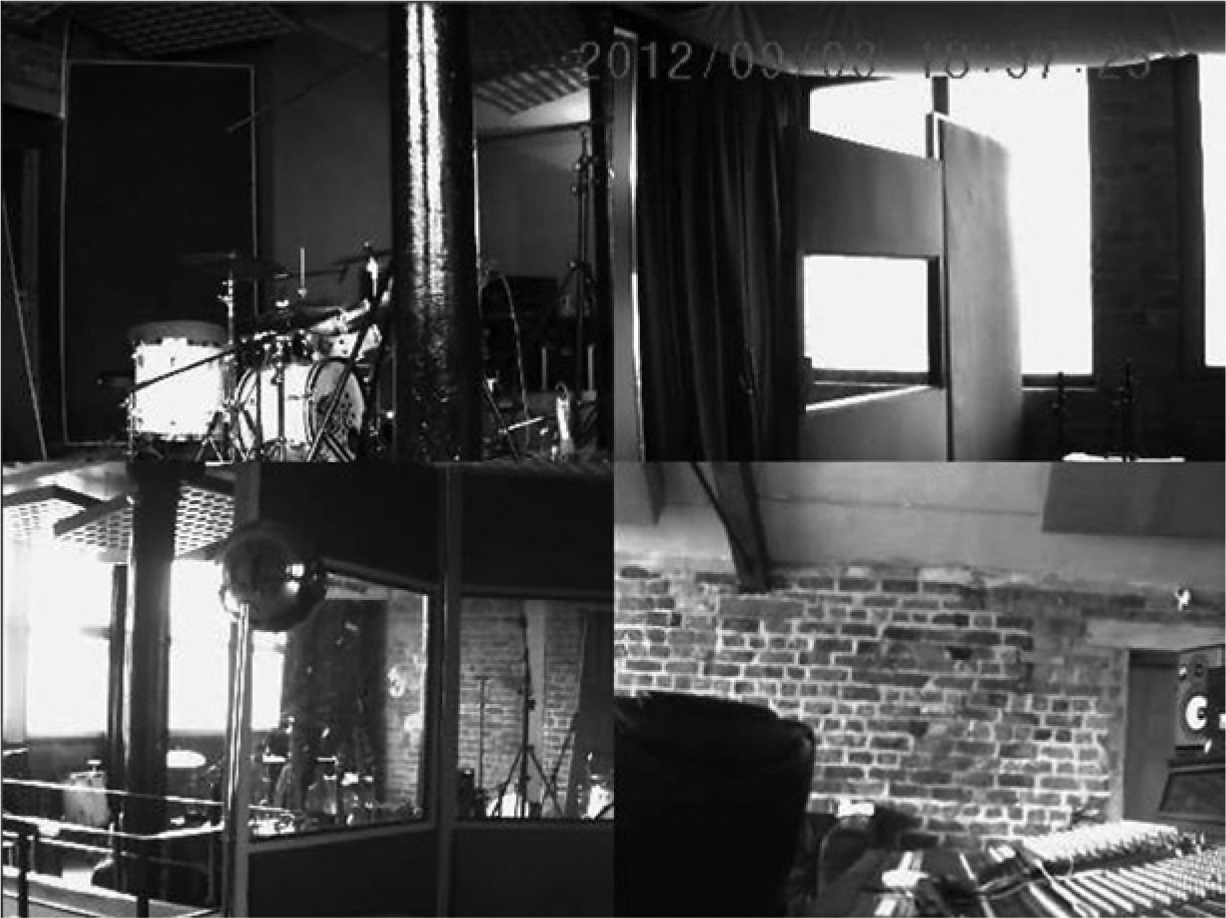
Four camera views from Paul’s field recording. Clockwise from upper left: The live room (view 1), the live room (view 2), the control room, the “vocal booth” within the live room.
Placement of the cameras was a necessary consideration particularly as their focus and perspective are limited by where they were positioned in the field setting. As Margaret Dufon suggests:
The limits of one’s perspective also affect the videotaping in another, more physical way. Although a video camera can capture a great deal of both auditory and visual information, it nevertheless confines the view. Therefore, in spite of the sense of being there that a film can provide, it does not show every observable thing that happened, but only that which was occurring within the range of the camera lens. (2002, 45)
Although limited in its ability to capture all of the events during the session, using video provided rich data (Loizos 1980) that allowed analysis of the participants’ interactions throughout the project. Rather than providing objective data, the video recordings provided a “reflexive mirror” on the recording process (Ruby 1982) and proved most useful during the later stages of analysis and interviews with the participants.
Ethnographic interviews were particularly useful to help re-contextualize the video recordings. Hammersley and Atkinson explained that “interviews in ethnographic research range from spontaneous, informal conversations in places that are being used for other purposes, to formally arranged meetings in bounded settings out of earshot of other people” (1997, 139). However, because interviews or conversations with participations whilst the events were happening were difficult, particularly at the same time as observing studio etiquette, the video recordings provided useful stimuli during interviews with the participants at a later date:
Whilst I was in the live room observing the interactions of the musicians and the producer as they discussed the set up I noticed that before the band had begun to play, the video camera had captured the engineer completing a number of tasks in the control room. Although these movements were recorded on video and easily observed by me, the impact that the movements had on the process of the recording were not at first clear because they had been completed so quickly. The engineer was making specific adjustments to specialised audio equipment in the control room whilst also typing on the computer keyboard and altering the display on the screen with the mouse. It was clear that it made no discernible difference to the sound in the studio monitors. These movements could have easily been interpreted as the sole intention of the engineer rather than to serve the musician’s needs for performance. However, during a series of interviews conducted with the participants afterwards the engineer recalled the purpose of the process: “I’m actually adding reverb here to the artist’s cans (headphones) [ . . . ] singers normally sing better when they sound like they’re in a large room or a hall or something.” (Paul, research reflection, January 23, 2013)
The process of adding reverb to an artist’s headphones is performed using multiple cables to route the signal in and out of an FX unit and then to feed the added reverberation into both the vocalist’s headphones and the main studio speakers in the control room. This process is also an interesting example as it is open to further interpretation by the ethnographer. Reverberation could be added to an audio signal for a number of reasons (e.g., to make the vocal sound less “dry,” to allow the engineer or producer to experiment with certain FX before the final mix); however, in this instance it was added in order to give the vocalist the sensation of performing in a larger space, aiding the vocalist in their performance, allowing them to create more expression in their delivery. The ethnographer documenting a recording session can use video recording as an additional means to help further comprehend some of these actions and interactions. The documentation of gesture and movement can be further complicated by the use of specialized audio equipment, the use of which may not make any discernable difference to the ethnographer listening to the results (Bates 2008; Higgins 2007) but may be an essential adjustment for the participants in the recording studio. Gaining an insight into the tacit knowledge (Horning 2004; Sternberg and Horvath 1999) and intentions of the participants was best achieved, in this instance, through a combination of video and interviews.
As an active participant in the recording studio, Brett’s fieldwork relied on audio recordings to capture the sound of the recording studio. Music, sung lyrics, and spoken conversations were all captured as part of the ongoing social interaction during a recording studio session. As Forsey explained, for researchers, “Listening is at least as significant as observation to ethnographers. Ethnography is arguably more aural than ocular, the ethnographer more participant listener than observer” (2010, 561). Building on the idea of the ethnographer as “participant listener,” this section of the article is focused on Brett’s use of audio recording to allow the voices and sounds of the studio to get “on record”:
As in the six previous weeks, tonight’s studio session was wonderfully chaotic and full of ideas, presenting a sonic swirl of activity that I could scarcely keep track of. At one point I noted: in the back of the control room two participants are discussing a recent night out, gossiping about who-is-now-getting-with-who and checking social networking sites (twitter) while waiting their turns to record vocals. Two participants are gathered around a macbook, sharing headphones and discussing a backing track while composing their lyrics (written on their mobile phones) for the next song of the night. Across these conversations, orders are being taken for food as [a participant] has offered to collect meals from a nearby take-away. Three of us sitting at the mixing desk must lean in closer to the playback monitors and I’ve slowly turned up the volume to listen to the “take” being recorded at that moment by the participant in the “live room,” singing into the microphone. Increasing the volume of the playback only serves to make those around us speak louder and the general level of noise rises further. Someone’s mobile phone rings as more participants have arrived and are waiting outside for someone to come let them in; this will undoubtedly bring in more conversations! Too many sounds are happening at once, but we wanted to bring people together to share ideas and talk. I’m listening with one ear attuned to the recording process (the song is great, with lyrics about the legacies of racism in the city), with another ear tuned in to the on-going conversations in the control room. I catch and scribble snippets of talk and topics into my notebook hoping that I can return to them later, either during a pause in the recording session or during individual interviews in weeks to come. (Brett, research field notes, November 18, 2010)
This vignette evokes some of the “noise” present in the studio during Brett’s fieldwork. While chaotic, this example highlights the importance of sound in this context in stark contrast to the visually dominant culture of the arts and social science research, in which a visualist framework often privileges what is seen over what is heard (Bull 2000; Bull and Back 2003). Against this dominance, Clifford and Marcus (1986, 12) asked “what of the ethnographic ear?”—a question echoed in Forsey’s (2010) ethnographic research that prioritized “participant listening” rather than privileging participant observation.
The importance of sound in Brett’s research—and the social relations that sound enables and produces—has been described as the “art of listening” (Back 2007). According to Back and Drever (2005), sound is laden with ideology and ideological process (e.g., sirens cause alarm). Because of the abilities of sound to convey power, Back and Drever explored what it is that sounds do and how paying attention to sound allows researchers to learn something about the relations between people and places. For Brett, capturing the messy aural swirl of the recording studio control room, the noisy ambience and the fast-paced conversational themes would have been difficult to capture via video recording or field notes alone, particularly as the participatory role of recording engineer adopted during the sessions made documentation problematic. Participant-ethnographers in this position could benefit from using, and prioritizing, audio recording in the analysis of their observations in the recording studio. An emphasis on audio recording as facilitating “ethnographic listening” is, of course, nothing new (e.g., in ethnomusicology, see Barz and Cooley 2008; Erlmann 2004). Yet audio is not the preserve of ethnomusicologists, or even recording studio engineers, and the ready availability of high-quality portable recording devices means that it is increasingly possible to generate high-fidelity field recordings with greater ease (and lesser expense) than ever before (Beddall-Hill, Jabbar, and Al Shehri 2011). Although Brett was using the studio equipment to record the music production sessions, he was using his laptop (and sometimes his mobile phone) to record the cacophony of the studio control room; these devices would work in any number of other ethnographic research contexts just as well as in a studio (Hall, Lashua, and Coffey 2008). Our point here is that in some settings, audio recording was key, not just for the music being produced but also better suited than video or field notes to the subsequent analysis of conversations that took place in the context of the recording studio.
Through our use of video, audio and field notes, this section has highlighted some of the challenges involved in getting as much as possible of the ethnographic clamor and brio of a studio session on record. To support our field notes and interviews, Paul primarily used video recordings to capture movement, performance, and gesture and Brett’s research employed audio recording to document sounds and speech. These approaches showcased some of the affordances and constraints that may be presented to any ethnographer in a related field setting and, specifically, how varying media can be used to overcome some of the logistical problems presented by the field setting. However, such approaches involve decisions not only about what medium (video or sound recording, field notes) is employed but also regarding what kinds of data are produced and made available for analysis (Dicks, Soyinka, and Coffey 2006).
Conclusions
We began this article by acknowledging that the few completed studio ethnographies (Fitzgerald 1996; Hennion 1990; Meintjes 2003; Porcello 2004) typically gloss over many of the concerns that face ethnographers, particularly matters of “getting in” (access) and “getting on” (relations with participants), as well as approaches to recording studio interactions (getting it “on record”). In order to address these concerns, this article first discussed how we negotiated initial and ongoing access with the participants involved in our fieldwork. As in all ethnographic research, access is one of the most difficult obstacles that can face researchers in the recording studio because of the private nature of a recording studio session, the architecture of the recording studio, and the power relations that operate within it.
In addition to highlighting issues of access, this article has also illustrated some of the challenges of developing social relations during studio work and documenting our ethnographic practices in recording studios. While we were both engaged in recording studio fieldwork and our approaches shared commonalities, our contexts, participants, and methods highlighted that variations are necessary to address some of the issues presented by the different context of a recording studio session. Specific forms of media, such as video or audio recording, can be used to capture and document different aspects of the recording studio session such as movement, gesture, or conversation, which can help further analysis and comprehension of a particular cultural context. Of course, getting something on record depends as much upon deciding what that “something” is (that which we chose to pay attention to) as it depends upon the means by which it was recorded in the field. As in other fields and contexts, this remains a pertinent consideration.
Finally, it should be noted that this article has highlighted only some of the issues facing ethnographers conducting research within recording facilities and these issues are not limited to those discussed above. Rather, this article serves as a starting point for those embarking on ethnographic research in a recording facility or other field contexts that present similar challenges. These challenges include questions of gaining access and establishing relations with participants, the role and relations of the researcher in creative processes, and some affordances and constraints of the multimodal methods employed in our fieldwork (see Dicks, Soyinka, and Coffey 2006). By highlighting some of the affordances and constraints of our approaches, particularly as producers, engineers, and musicians ourselves, we also hoped to show that these challenges are not limited to insiders or outsiders, or unique to the vibrant setting of the recording studio.
Footnotes
Declaration of Conflicting Interests
The author(s) declared no potential conflicts of interest with respect to the research, authorship, and/or publication of this article.
Funding
The author(s) received no financial support for the research, authorship, and/or publication of this article.