







Abstract
Technological concentration and innovation have been identified as important forces behind growth, and entrepreneurship has been recognized as an important link between new knowledge and economic growth. This article examines the influence of entrepreneurship and technology concentration on employment growth in U.S. metropolitan areas (MSAs) over the course of the last full business cycle from 1991 to 2007. The findings are in support of the efficacy of entrepreneurship together with high technology expansion in job creation. The findings question the view that entrepreneurship in and of itself, or a high but not growing high technology concentration, can be strong contributors to employment growth. In contrast, this analysis indicates that MSAs with growing high-tech activities and above-average entrepreneurship can be expected to add jobs much faster than other MSAs. The findings suggest a need for a more targeted approach to economic development and job creation.
Introduction
In the context of high unemployment and slow employment recovery following the Great Recession of 2008-2009, there is significant interest in determining and supporting the drivers of employment growth. Technological concentration and its influence in knowledge spillovers and innovation creation have been identified as important driving forces behind growth, and entrepreneurship has been identified as an important link between new knowledge and economic growth. This article examines the influence of entrepreneurship and high technology concentration on employment changes in U.S. Metropolitan Statistical Areas (MSAs) from 1991 to 2007, including the recovery from the early 1990s and early 2000s recessions, to gain insight on the potential drivers of employment growth coming out of the 2008-2009 recession.
There is a significant body of research highlighted by Drucker (1985) and continued by Henderson and Weiler (2010) that identifies the nexus of entrepreneurship and technological innovation as important in economic growth. The dynamic suggested is that entrepreneurs can take technological innovation and create commercial ventures and generate employment growth based on the innovations. While local economic conditions “spawn different levels of entrepreneurship” (Glaeser, Rosenthal, & Strange, 2010), entrepreneurs are needed to assemble the resources, apply the business know-how, and draw on the networks necessary to create new products, new markets, and new ventures based on new knowledge and technologies. This dynamic between entrepreneurship and technology occurs most significantly in geographic clusters such as U.S. metropolitan areas through positive agglomeration and spillover effects. The nexus proposition suggests that the enterprising activity of entrepreneurs (i.e., individual or organizational) enhances the economic value of technology concentration that produces innovations. This would mean that the potential impact of high technology concentration and innovation on a region’s economy is realized only through entrepreneurship (Camp, 2005); and therefore, to derive the greatest benefit from high technology concentrations, metropolitan area leaders need to promote and develop entrepreneurship.
There has been limited testing of the nexus proposition as it relates to employment generation. Most of the empirical research on the influence of entrepreneurship and technology concentration on metropolitan area economic development has been in separate streams, and many of the studies of the individual effects are dated and/or with study time periods that could bias the results; for example, only considering tech centers during technology high-growth (boom) periods. This article intends to fill these gaps.
This article’s findings contribute to the literature by showing that the combination of entrepreneurship and high-tech concentration growth is an important factor in regional employment growth. This suggests that a more nuanced approach to regional economic development should be practiced through the development of policies and practices that encourage high-tech entrepreneurial activities that are most conducive to employment generation over the course of full business cycles, thus gaining the most leverage per level of entrepreneurial activity and technology concentration.
The article also contributes to the literature by conducting an investigation of the relative performance and resiliency of entrepreneurial and technological centers over business cycles. Here, we consider MSAs in the United States and the efficacy of concentrations in entrepreneurial and high technology activity in these areas in the period 1991 to 2007. Entrepreneurial and technology centers are identified by their scores on two measures. First, the entrepreneurship index is calculated as the percent of individuals ages 20 to 64 in each metropolitan area who do not own a business in the U.S. Census Current Population Survey that start a business in the following month, with 15 or more hours worked per week. The higher the percentage the more entrepreneurial the MSA is considered to be. Second, for technology, high-tech concentration is the employment in the high-tech industry as a percentage of total employment. The higher the concentration (percentage), the more high tech the MSA is considered to be. In particular, we consider whether entrepreneurial and high-tech centers in the United States performed better over the last full business cycle in terms of employment changes than areas without concentrations of entrepreneurial and/or high-tech activity.
The article is organized as follows. First, the literature on entrepreneurship, high technology concentration, and regional employment growth is reviewed. Then data on the recent experience of U.S. MSAs are provided. This is followed by presentation of a framework for consideration of the factors influencing regional employment growth and statistical testing of different framework models. The article’s empirical findings are then discussed along the specific dimensions analyzed, namely, entrepreneurship, high technology, human capital, unemployment rate, and wages. The last section summarizes the conclusions and their policy implications.
Body of Research
The entrepreneurship-focused economic researchers (Acs & Armington, 2004; Acs, Audretsch, Braunerhjelm, & Carlsson, 2012; Henderson & Weiler, 2010; Thompson, Hammond, & Weiler, 2006; van Stel, Carree, & Thurik, 2005) have found that the higher the rate of entrepreneurial activity the more accelerated the rate of regional economic growth. In addition, Audretsch and Keilbach (2005) find that entrepreneurial activity, as measured by new business start-ups, contributes to higher levels of value-added output and higher rates of labor productivity contributing to strong wage and salary growth. And more recently, Henderson and Weiler (2010) identify an effect of entrepreneurship on metropolitan area employment growth. Within high technology clusters, Griliches (1992) has identified the existence of ancillary benefits such as knowledge sharing, which contributes to regional economic advantages. None of these studies include any measure of high technology concentration, or the interaction of technology and entrepreneurship, and none of the time periods analyzed covers the last full business cycle.
Largely independent of the research on entrepreneurship is the inquiry of technology concentration and innovation on regional economies. Jaffe (1986) demonstrates that technology clustering affects innovation. This was a confirmation that high technology concentration can contribute to innovation. Jaffe shows that the total relevant activity of other firms influencing innovation of a particular firm can be represented by a “potential spillover pool,” which is the weighted sum of the other firms’ research and development investments, with weights proportional to the technological proximity of the firms to the one under consideration (Fallah & Ibrahim, 2004). Anselin, Varga, and Acs (1997, 2000) used the same model in similar studies and came up with similar conclusions, but with metropolitan areas as the geographical unit of study. While this previous research on technology concentration and innovation impact on regional concentration identifies important spillover effects and high-tech’s linkage to innovation, the interconnection of high technology and entrepreneurship is not directly explored. This article examines this connection and seeks to estimate the entrepreneurial dimension of high technology and the effect on regional employment growth.
In further analysis of innovation in a regional context, Acs, Audretsch, and Feldman (1994) and Acs, Anselin, and Varga (2002) compared different measures of innovation output in regional innovation systems. At the MSA level, Rosenbloom (2007) confirmed that innovation commercialization was highly concentrated geographically and that university science and engineering capacity and local patenting activity both help account for intercity differences in the level of innovation commercialization activity. Utilizing participation in the Small Business Innovation Research (SBIR) program as a measure of innovation, Wallsten (2001) showed that the greater proximity of tech firms the higher the awards in the program. Focusing on one sector, Beal and Gimeno (2002) studied the U.S. software industry and also found that clustering affected innovative outputs. In general, this clustering and innovation commercialization research indicates that geographic proximity has a distinct influence on innovation output.
Another group of studies in this category have gone further to trace the relationship between spillovers and innovation. Jaffe, Trajtenberg, and Henderson (1993) and Jaffe, Trajtenberg, and Fogarty (2000) compared the geographic location of patent citations with those of the cited patents to show that knowledge spillovers are geographically localized. Maurseth and Verspagen (2002) carried out a similar study for knowledge spillovers between European regions and reached a similar conclusion. By tracking patent citations, these studies focused on the exchange of explicit knowledge. Tacit knowledge could also play a significant role in knowledge spillovers and on innovation in clusters. From these studies one thing is clear, as Griliches (1992) states, “Spillovers are present in clusters and their magnitude may be quite large” (Fallah & Ibrahim, 2004). All these studies suggest that high technology clusters can lead to knowledge spillover benefits and regional economic benefit, but none focus on the relationship of technology concentration to entrepreneurship and their combined impact on employment growth.
Exceptions to the largely separate streams of research on entrepreneurship and innovation are Acs, Audretsch, Braunerhjelm, and Carlsson (2009) and Camp (2005). Acs et al. (2009) developed a knowledge theory of entrepreneurship and supported it with empirical testing of the relationship between knowledge base and entrepreneurial activity at the national level, but do not formally consider the influence of the nexus of knowledge creation and entrepreneurship on employment growth. Camp (2005) empirically tested the nexus proposition at the metropolitan area level and found that focusing regional development efforts on entrepreneurship and technology development contributes to boost economic growth. In a detailed empirical study of 394 metropolitan areas in the United States, Camp identified entrepreneurship and innovation both as drivers of growth of regional economies and furthermore suggested that innovative regions required entrepreneurship to fully develop local economies. Camp’s (2005) data, however, only went to the early 2000s and do not cover a full business cycle. Research that spans the entire business cycle adds to understanding the long-term effects of entrepreneurship and innovation on local economies and permits the analysis to be studied in periods of both economic growth and decline, which collectively provides a more complete picture of entrepreneurship and technology and their effects on economic development.
The link between high technology concentration and employment growth is generally considered in a theoretical context (e.g., Mortensen & Pissarides, 1998), but little empirical research examining such a relationship has been conducted using either states or MSAs as the unit of analysis. The few studies that examine how technology clusters affect regional job creation indicate that these clusters have had little economic impact (Colgan & Baker, 2003). Kassicieh (2010), however, finds that small technology start-ups greatly benefit from clustering and proximity to medium and large technology businesses. Therefore, the impact of technology clustering on job growth is still a question open to debate that deserves further empirical scrutiny. By also considering entrepreneurship activity, this research adds to the understanding of the interaction of entrepreneurship and technology innovation, in a regional context, with respect to job creation.
Empirical Contributions
This article through empirical testing attempts to enhance understanding of the entrepreneurship and technology concentration nexus. The empirical analysis is conducted using a variety of data sources. Data on total employment and unemployment rates are taken from the U.S. Bureau of Labor Statistics (BLS). Human capital is proxied by two variables calculated using microdata from the U.S. Current Population Survey (CPS). 1 The first variable is the percentage of the population 25 years and older who have a bachelor’s degree and the second variable is the percentage of the population 25 years and older who have masters, professional, or PhD degrees. The index of entrepreneurship is calculated using data and methodology from the Kauffman Foundation (Fairlie, 2009). More precisely, the entrepreneurship index is calculated as the percent of individuals ages 20 to 64 in each metropolitan area who do not own a business in the U.S. Census Current Population Survey that start a business in the following month with 15 or more hours worked per week. This index focuses on the individual level rather than the firm level and captures entrepreneurial activity as the individual changes from nonownership to starting and owning their own business. As such, the entrepreneurship index captures entrepreneurial start-up activity at the individual level for each metropolitan area.
High technology concentration and average wages are calculated using data from the BLS Quarterly Census of Employment and Wages (QCEW). The QCEW provides a “quarterly count of employment and wages reported by employers covering 98 percent of U.S. jobs, available at the county, MSA, state and national levels by industry” (U.S. Bureau of Labor Statistics, 2012). We follow Gittell and Tebaldi (2009) and use a definition of high-tech concentration that is a hybrid of the high-tech definition of both the U.S. Department of Commerce and the American Electronics Association (AeA). Table 1 lists all NAICS industries that are included in the definition of high-tech industry used in this study. We focus our analysis only on MSAs with more than 100,000 workers and 2,500 hightechnology jobs as of 1990. This approach minimizes measurement errors in calculating high-tech concentration due to “data disclosure issues” and small sample size that plague the data for small MSAs.
High Technology Industries.
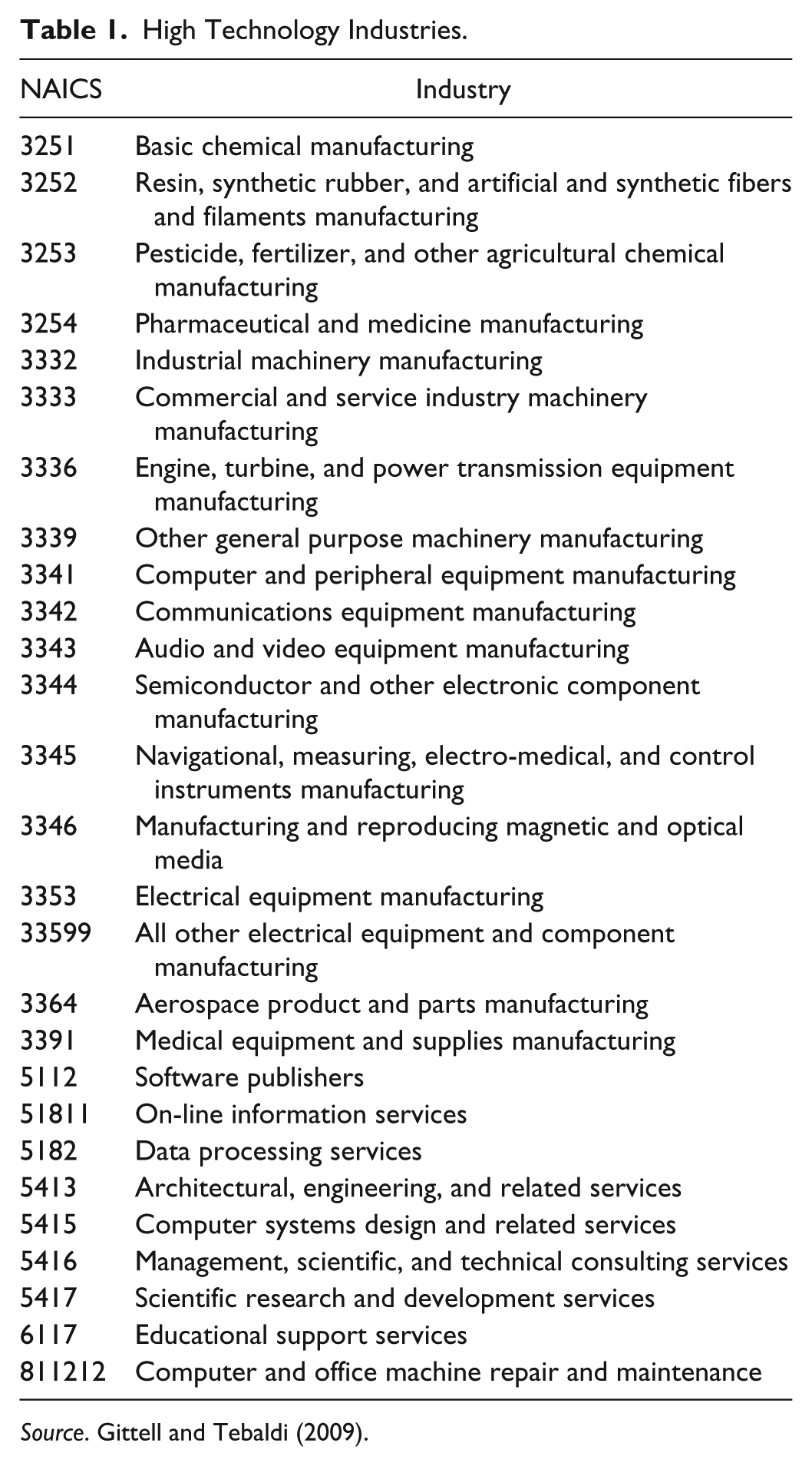
Source. Gittell and Tebaldi (2009).
High Technology Centers and Economic Growth
Particularly during the mid- to late-1990s growth phase of the 1991-2001 business cycle, many well-known high-technology centers—such as Silicon Valley (California), Boston/Cambridge (Massachusetts), Research Triangle (North Carolina), and Boulder (Colorado)—were considered models for promoting economic growth. Public officials and business leaders in other MSAs sought to replicate these high technology centers’ apparent success through the promotion of technology industries.
The focus on technology seemed justified. For example, BLS/QCEW data show that from 1991 to 2001 all the MSAs in the top 10 in average wage growth among the 116 largest MSAs in the United States were technology centers (MSAs with a high concentration of employment in the high-tech industry sector; see Gittell & Sohl, 2005). Silicon Valley (San Jose-Sunnyvale, Santa Clara) was top ranked with over 13% growth in average real wages, followed closely behind by Boulder and Austin (both 9%). Boulder (6%) and Austin (7%) joined by the Research Triangle (6%) were also among the top 10 MSAs during this time period in employment growth.
But was emulation of the tech center MSAs based on their performance during the growth phase of the last business cycle good economic development strategy when considering their performance over the full business cycle? The post-tech boom experience in some tech-center MSAs suggests otherwise. Table 2 shows, for example, that two technology center leaders—Boulder and Silicon Valley (San Jose-Sunnyvale, Santa Clara)—were at the bottom among the largest MSAs (ranked second to last and last) in employment change from 2000 to 2002 (both losing about 13% of total employment). But then again, from 2002 to 2007—in the recovery from the early 2000s recession—two tech centers, Austin (3%) and the Research Triangle (4%), were among the top 10 MSAs in employment growth. Examining the business cycle (1991 to 2007), which contains periods of growth and decline, measures more appropriately the impact of technology and entrepreneurship on economic development. While some tech centers may lead growth based on observations restricted to the growth segment of the business cycle, it is the resiliency of these tech centers over time that is important to economic development. Effective public policy that seeks systemic change, such as developing and implementing policies that build entrepreneurial and technology infrastructure and capacity, take time to develop and to provide the desired benefits. Since regions will likely experience both growth and decline cycles during these implementation phases, the contributors to economic development need to be studied throughout the business cycle. One would not want to develop a program that is effective for a down cycle, only to find out that during periods of growth the same program mitigates gains during these growth periods. Likewise, a program developed based on data from growth periods could exacerbate decline during periods of economic downturn. Thus, to design policy that is most viable over the full business cycle, it is important to analyze, in the context of this research, the efficacy of entrepreneurship and high technology in job creation throughout a complete business cycle.
Descriptive Statistics, U.S. MSAs, 1991-2007.
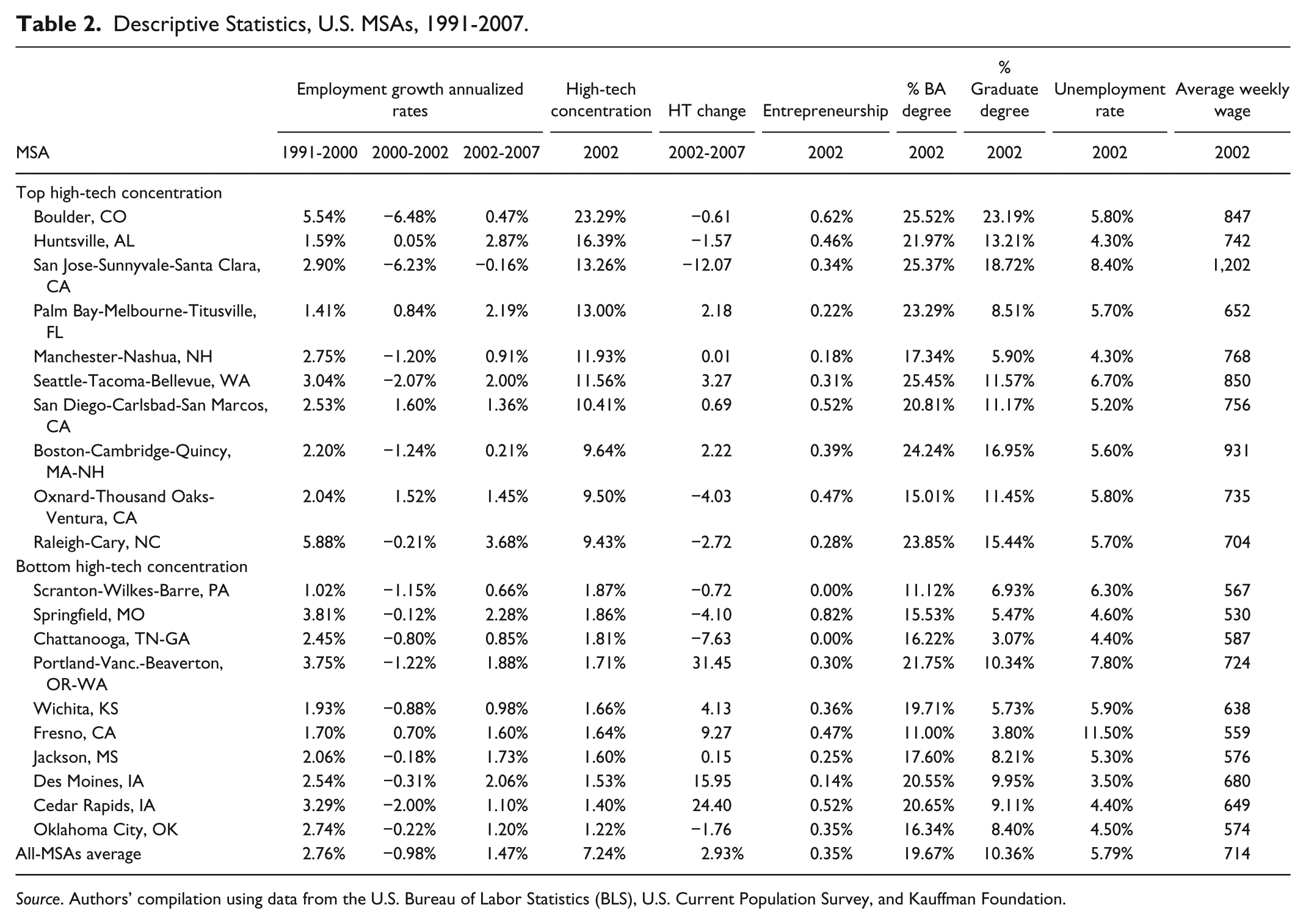
Source. Authors’ compilation using data from the U.S. Bureau of Labor Statistics (BLS), U.S. Current Population Survey, and Kauffman Foundation.
The question remains—what is best for U.S. MSAs and other regions to emphasize, to promote long-term economic well-being and employment growth? Is a focus on technology industries justified if employment generation is desired? Can a focus on entrepreneurship help promote employment growth over a full business cycle in concert with a technology focus and/or on its own? The next section explores these questions empirically with regression modeling and data over the full business cycle from 1991 to 2007.
Regression Analysis
Regression analysis is used to examine how high technology concentration and entrepreneurship affect employment growth in U.S. MSAs. The methodology used in this study is consistent with Gittell and Tebaldi (2007); Hoover, Formby, and Kim (2004); Formby, Hoover, and Kim (2001); and Glaeser, Scheinkman, and Shleifer (1995). The following model is estimated:

where i indexes metro areas, t indexes time, ΔE denotes change in total nonfarm employment, Tech measures the change in high-tech concentration, Entrep measures entrepreneurship, H measures human capital, U is the unemployment rate (which is used as a proxy for the overall economic structure of a MSA), USQ is the unemployment rate squared, W denotes the natural log of average weekly wages, D is a vector of dummy variables accounting for the business cycle, βs are parameters, ϵ is the error term, and µ measures time-invariant unobserved characteristics.
To consider the business cycle fluctuations, the dependent variable is calculated as the annual percent change in employment from 1991 to 2000, from 2000 to 2002, and from 2002 to 2007. These time periods were chosen according to turning points in the U.S. economy as determined by the National Bureau of Economic Research (NBER). 2 Then, we regress employment growth on explanatory variables measured in the initial period of the business cycle. This approach minimizes eventual endogeneity concerns because the explanatory variables are predetermined (see Gittell & Tebaldi, 2007; Glaeser et al., 1995). All models include time dummy variables to account for the distinct periods of the business cycles. Particularly, we added dummies for the expansion in the 1990s and the recession in the early 2000s. The recent growth period (or recovery) is the control or omitted category.
In practice, our data set has three observations for each MSA, which allows creating a panel data set. This method also deals with a potential omitted variable bias that plagues cross-sectional regressions by combining time series and cross-sectional, which allows controlling for time-invariant unobserved characteristics. This approach is taken because it minimizes endogeneity difficulties and allows using standard econometric techniques to obtain parameter estimates.
Findings
The estimates provide evidence that entrepreneurship, change in high-tech concentration, human capital, wages, and unemployment rates at the beginning of the cycle impacted job creation across MSAs in the United States during the last business cycle. For each of these variables, we discuss the results of the baseline model (Model 1) and then we analyze the robustness of the model by considering alternative specifications (adding other controls in the form of interaction terms).
The estimates indicate that the treatment given to the unobserved component does not significantly affect the results of the regression analysis and that the coefficients of the fixed and random effect estimators are very similar. However, the Hausman (1978) test suggests that fixed effects should be considered. 3 More precisely, with a 1% level of significance, the Hausman test provides evidence that the null hypothesis (random effects) should be rejected in favor of the alternative hypothesis (fixed effects). Therefore, the discussion below is based on the fixed effects estimator, whose results are reported in Table 3. The R-squared (within) of all regressions of Table 3 is above 0.7, which indicates that the model explains more than two thirds of the variations in employment growth across MSAs in the United States.
Results of the Fixed Effects Regression Analysis.Dependent Variable = Annualized % Change in Total Nonfarm Employment.
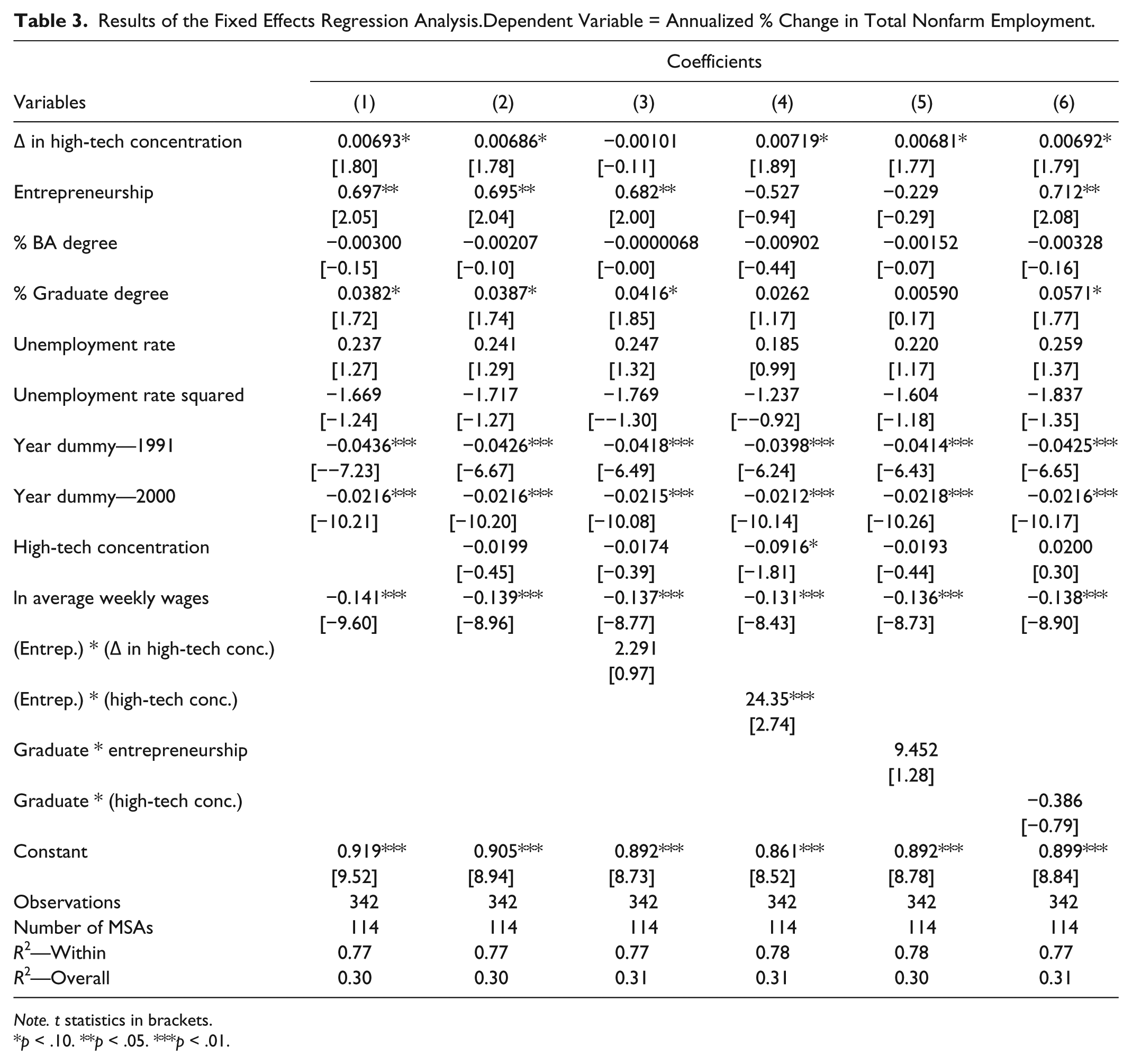
Note. t statistics in brackets.
p < .10. **p < .05. ***p < .01.
Entrepreneurship
Our results show that entrepreneurship contributes to job creation across MSAs in the United States. Model 1 of Table 3 implies that, controlling for other factors, a 1% increase in the proportion of individuals who are entrepreneurs is associated with a 0.7% increase in total employment growth across MSAs in the United States. 4 This result is robust across different model specifications (columns 1, 2, 3, and 6 of Table 3). 5 This result is also consistent with and confirms the findings of Acs and Armington (2004), Acs et al. (2012), Henderson and Weiler (2010), Thompson et al. (2006), and van Stel et al. (2005).
Model 3 of Table 3 investigates the interaction between growth in high technology concentration and entrepreneurship. The interaction term is statistically insignificant at the standard levels of significance. This result implies no additional job growth effect from the interaction between change in high-tech activities and above-average entrepreneurship. Model 4, however, provides evidence that job creation is stronger when there exists a strong link between entrepreneurship and high-tech concentration. Controlling for other factors, the positive effect of entrepreneurship on job creation during the 1991 to 2007 business cycle was significantly augmented in MSAs with larger high-tech concentrations.
Model 5 extends the baseline specification by adding an interaction term between entrepreneurship and the proportion of the population that holds a graduate degree (MA, professional, or PhD degrees). Under this specification, the coefficients on entrepreneurship and graduate education turn insignificant, but the interaction term is positive and marginally significant. 6 This equation suggests a potential link between entrepreneurship and a highly qualified labor force, but the link between these variables seems to be fragile and further research is necessary to disentangle any effects between entrepreneurship and higher education on job creation.
High Technology
Do high-tech activities increase the rate of job growth? According to our analysis, it is not high technology concentration that fuels job creation, but rather it is the growth in high technology that matters most. More precisely, Model 2 of Table 3 shows that the coefficient on high technology concentration is statistically insignificant, whereas the coefficient on change in high technology concentration is positive and significant at the 10% level of significance. This result is consistent in regressions 1, 2 4, 5, and 6 of Table 3. Holding other factors constant, the point estimate (Models 1 or 2) suggests that MSAs that managed to increase their share of high-tech activities over the last business cycle experienced slightly faster job growth. Model 1 of Table 3 provides evidence that, for example, an MSA that managed to increase its proportion of high-tech concentration by one tenth of a full point more than the average increase across all MSAs added about 0.07% more jobs than the average MSA in the United States during the last business cycle.
The results above are somewhat surprising and challenge the common view that high technology concentration is associated with faster job creation. The empirical results here indicate that it is not the level of high technology concentration that determines job creation, but rather a MSA’s capacity to grow its high-tech base that will create jobs.
Model 6 of Table 3 extends the baseline specification by including an interaction term between high-tech concentration growth and the proportion of the population who holds a graduate degree. The interaction term is not significant, which suggests that the combination of high tech and graduate education produces no additional effect on job growth than that observed in the baseline model. A discussion on the impact of human capital on employment growth is presented below.
We use the Chow (1960) test to address concerns regarding a possible “slope-effect” due to high-tech concentration. The Chow test examines whether the coefficients in two different data sets are equal. In particular, it is possible that each of the explanatory variables considered in the model have a different effect on employment whether the region is or is not an area of high high-technology concentration. To conduct the test, we divide the sample into two groups: one comprised of high concentration high-tech MSAs (belonging to the 4th quartile in terms of high technology concentration as of 1991) and another group with all other MSAs. A pooled Chow test provides evidence that the null hypothesis (equal coefficients across groups) cannot be rejected at the 5% or 10% levels of significance. Therefore, we find no evidence of a “slope-effect” (different effect from explanatory variables on employment) across high concentration high-tech MSAs and all other MSAs.
Human Capital
The results on human capital are consistent with expectations and the literature (Gittell & Tebaldi, 2007). While the coefficient on BA degree is statistically insignificant, the coefficient on graduate degree (MA/PhD) is positive and statistically significant. The estimates of Model 1 of Table 3 imply that a one tenth of a point increase in the proportion of the population with graduate degrees is associated with a 0.4% increase in the rate of job growth. Thus, it is the more advanced degrees that contribute to job growth in the sense that it is these individuals that have the ability to effect positive change in both existing firms and in new entrepreneurial firms.
Unemployment Rate
Our model considers initial unemployment as a proxy for labor market conditions and the overall economic structure. This strategy has been widely used in regional studies investigating economic performance across either states or MSAs in the United States (e.g., Gittell & Tebaldi, 2007; Glaeser et al., 1995; Hoover et al., 2004). Following this literature, unemployment rate is modeled in a quadratic form. We find evidence of an inverted U-shaped relationship between unemployment rates and employment growth. The results suggest that MSAs with very low unemployment rates might be operating at or near full employment, which unsurprisingly should be followed by a slow rate of job creation. MSAs with moderate unemployment rates might have available a pool of labor that can be tapped into as growth opportunities arise. Model 1 of Table 3, however, implies that there is an inflexion point around the 7% unemployment rate (see Figure 1). MSAs with an initial unemployment rate that crossed this threshold experienced slower job creation. As discussed in Glaeser et al. (1995) and Gittell and Tebaldi (2007), high rates of unemployment might be associated with poor workforce skills or account for measurement error due to the use of poor measures of human capital. Moreover, high rates of unemployment might also be related to poor regulatory and tax structures, or to a deficient industry structure, which are expected to hinder job creation.
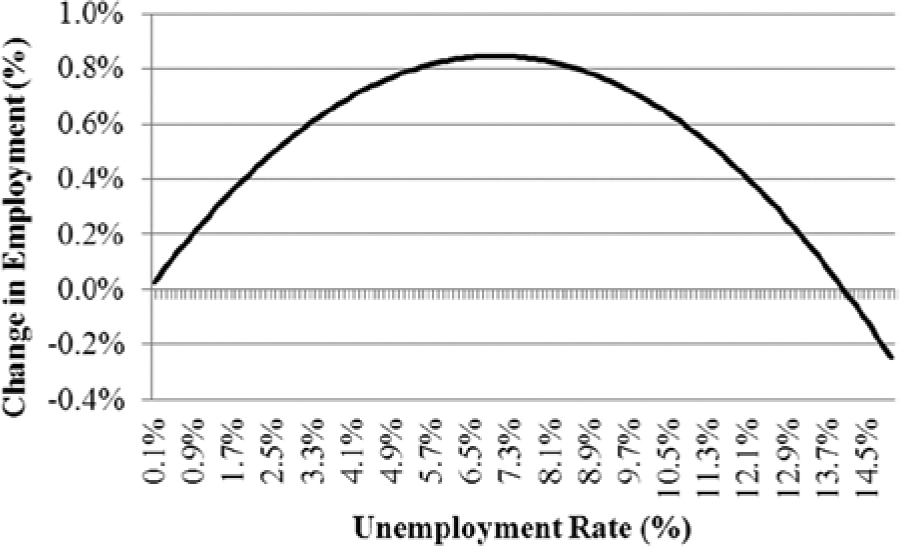
Unemployment rate and employment growth, U.S. MSAs.
Wages
Does high average wage hurt job creation across U.S. MSAs? Consistent with Glaeser et al. (1995), our empirical results suggest that high initial wages affected job creation during the last business cycle. This result implies that wage costs are nonnegligible and may affect job growth because business decisions to either expand or establish operations in MSAs depends on labor costs. This may help explain why high technology concentration in and of itself might not contribute to employment growth because areas with high concentrations of technology employment also tend to have high average wages and high costs (Global Insight, 2007).
Conclusion
The regression analysis of the largest 114 U.S. MSAs indicates that over the last business cycle entrepreneurship had a robust positive influence on employment growth during all stages of the business cycle. There is also evidence that the growth in high technology concentration spurred employment growth in U.S. metropolitan areas. The findings also suggest, however, that having a large high-technology base is not a sufficient condition for job creation. Expansion of the high technology base, on the other hand, spurs job growth.
Our empirical analysis suggests that MSAs with growing high-tech activities and above-average entrepreneurship can be expected to add jobs much faster than other MSAs. This confirms Camp’s (2005) findings on the utility of focusing regional development efforts on entrepreneurship and technology development. Furthermore, the results from Model 4 (indicating that the positive effect of entrepreneurship on job creation is significantly augmented in MSAs with larger high-tech concentrations) suggest that entrepreneurship in high-tech centers, not only those with growing high-tech concentrations, can be a significant employment growth driver.
Overall the findings are in support of the economic efficacy of human capital, entrepreneurship, and high technology industry expansion for focusing regional development efforts. The findings are in conflict with the view of a large but steady high technology concentration as a strong contributing factor to economic growth. The findings suggest a reconsideration of the economic benefits of high technology clusters (Griliches, 1992; Jaffe et al., 1993, 2000; Maurseth & Verspagen, 2002) relating specifically to their limited efficacy in employment generation when the technology base is not expanding.
The significant effect of an increase in high technology concentration on employment might be explained by the increase in concentration in MSAs coming from growth in newly-emerging industries within high tech. One implication is that this change in technology may be refining the technology impact on economic development between technology sectors that have matured and those that are emerging. Future analysis will benefit from decomposition of high tech into smaller parts and analyzing whether some MSAs are better than others over time in shifting within high tech to newer and faster-growing subsectors and whether this is the key driver to employment growth in MSAs.
This research offers implications for the development of public policy for regional economic development. While public policy has, in general, considered entrepreneurship as an important component of economic development initiatives, in many instances these policies have failed to consider that entrepreneurship has many dimensions. This multifaceted aspect of entrepreneurship considers the unique distinctions between small business and high-growth entrepreneurial ventures and the sectors within which they populate. Small business, when examined at a static point in time, tends to be dominated by lifestyle firms that provide the entrepreneur with employment and modest job creation capabilities. However, for entrepreneurs in high-tech sectors, small is a transitional stage and provides the foundation for the venture to expand and grow. The findings here suggest the importance of drawing distinctions in the spectrum of entrepreneurship and industry sectors. In particular, for regional economic development, one needs policies that directly consider that it is not the existence of a high technology base but rather the growth in this high-tech concentration that offers the best prospects for job creation. Furthermore, the importance of high-tech entrepreneurship is underscored. Therefore what is needed is not general entrepreneurship policy but rather a more targeted public policy that considers entrepreneurship and high tech jointly, since entrepreneurship in high-tech centers, not only those with growing high-tech concentrations, are a significant contributor to job creation over time. Likewise, public policies that view technology in isolation should be avoided since the findings also suggest that it is the expansion of the high technology base that contributes to job growth. The findings here can help guide regional economic development efforts to generate long-term employment growth. They concur with the large body of research supporting the efficacy of a focus on educational attainment in economic development efforts. The findings also support a focus on entrepreneurship—overall, in high-tech centers and with particular emphasis in areas with growing technology concentration. The results also suggest that areas with existing high high-technology concentration cannot rely on their existing base to generate new employment. Expanding the high-tech base with support of entrepreneurial efforts and investment in enhancing educational attainment levels could help generate employment growth in areas with a stagnating high technology sector.
Footnotes
Declaration of Conflicting Interests
The authors declared no potential conflicts of interest with respect to the research, authorship, and/or publication of this article.
Funding
The authors received no financial support for the research, authorship, and/or publication of this article.