







Abstract
Entrepreneurial ecosystems have become a focal point for regional innovation and growth. Much of the scholarship on ecosystems has focused on identifying key components and understanding factors influencing the entrepreneurial process. While scholars have acknowledged the importance of connection as the means through which information, knowledge, and resources are shared, most of the discussion has focused on entrepreneurs as the unit of analysis with limited attention to connections between entrepreneurial support organizations. This comparative analysis examines partnership and leadership among entrepreneurial support organizations in Chicago, Pittsburgh, and Richmond. The author argues that differences in partnership practices across the cases are in part a function of the unique leadership models shaping each ecosystem’s cultural and institutional norms. Understanding the role of leadership could be critical for shaping the collaborative environments for which most ecosystem stakeholders are hoping.
Entrepreneurial ecosystems have become an increasingly prominent topic of interest to economic development practitioners, scholars, and policy makers charged with building and maintaining strong economies. Several studies have focused on identifying critical components of entrepreneurial ecosystems (see Iansiti & Levien, 2004; Isenberg, 2010; Neck, Meyer, Cohen, & Corbett, 2004); however, most have focused on entrepreneurs as the unit of analysis. While a substantial body of scholarship has documented the importance of connection between entrepreneurs and advisors, the extent and nature of linkages between the other components (formal networks) that make up the ecosystem have received less attention.
The explosion of involvement in entrepreneurship and corresponding interest in ecosystems has coincided with an upsurge in the number and variety of organizations, institutions, and groups engaged in the entrepreneurial ecosystem, loosely referred to as entrepreneurial support organizations (ESOs). 1 The term is deliberately broad to encompass a wide-ranging array of organizations that support entrepreneurs. Entrepreneurs learn about and access opportunities and resources through their individual networks (informal) and through the organizations created to assist them with their businesses (formal networks; Bell-Masterson & Stangler, 2015). The extent to which those organizations are connected to key resources has a tremendous impact on the flow of those resources to the entrepreneurs they serve (Hoang & Antoncic, 2003). Understanding how organizations are partnering and collaborating with one another could provide important insights regarding the ability of entrepreneurs to take full advantage of the resources and knowledge available in their ecosystems. As Motoyama and Watkins (2014) emphasized, each ecosystem has its own unique structure. I am not aware of any study that has analyzed connections between ecosystem components and how these relationships vary across different local contexts.
The first aim of this study was to understand the factors influencing connectivity (partnership and collaboration) among ESOs and to compare differences across local contexts in Chicago, Pittsburgh, and Richmond. The second goal was to understand the relationship between leadership and partnership among ESOs in each entrepreneurial ecosystem. I used a mixed-methods approach, including interviews and surveys, to compare ecosystems. This is not intended to be a normative assessment of which ecosystem is better or how an ecosystem should be structured. A descriptive analysis is provided that focuses on comparative trends and patterns across the entrepreneurial ecosystems in these cases.
This study finds that the nature of relations between ESOs (organizational proximity) and the closeness of their shared values to the broader ecosystem rules and institutions (institutional proximity) are related to the leadership model in each ecosystem. The rules, institutions, norms, and culture that guide and govern an ecosystem, including what is valued and legitimated in it, drive partnership culture and practices. Leaders reinforce, recreate, and guide those rules and customs; therefore, differences between partnership practices in the Pittsburgh, Chicago, and Richmond ecosystems are partially a function of their unique leadership models. Ecosystem enhancement has become an important strategy for economic development practitioners to increase the likelihood of innovation and economic vitality for their economies. Understanding the factors that affect the flow of information and resources among key actors is critical for optimal outcomes. The unique partnership patterns of each region’s ecosystem have implications for system outcomes as well as outcomes for individual entrepreneurs, organizations, and communities.
In the next section, I discuss existing literature on the definition and components of ecosystems and the importance of connection between the various components. I also examine the proximity framework in relation to entrepreneurship. Next, I provide an outline of the data and methods used. Afterward, I compare the findings from interviews and survey responses regarding partnership and leadership across the three cases. In the final section, I include a summary of the findings and their implications for our understanding of partnership and leadership across various types of entrepreneurial ecosystems.
Literature Review
Scholars have documented the relationship between entrepreneurship and job creation, innovation, and economic growth (Acs, 2006; Acs & Armington, 2004a, 2004b; Acs, Audretsch, Braunerhjelm, & Carlsson, 2006; Camp, 2005; Romer, 1990; Schumpeter, 1934). Given the importance of entrepreneurship, scholars have concentrated a great deal of effort on understanding which factors influence the creation, growth, and sustainability of new firms. In doing so, they have also attempted to understand factors that influence an entrepreneur’s propensity toward success. Conceptualizations of entrepreneurs range from broad, flexible definitions including all business owners to more restrictive definitions focused either on outcomes or on the entrepreneur’s role in the broader development process. For example, Global Entrepreneurship Monitor (see Acs, Amorós, Bosma, & Levie, 2009) included in its definition any attempt to create a new business or expand an existing one either by an individual or group including self-employment. Whereas Feldman (2014) defined entrepreneurs as “ . . . agents who recognize opportunities, mobilize resources, and create value” and credits them with being “key to the creation of institutions and the building of capacity that will sustain regional economic development” (p. 9).
A fundamental question that has enthralled scholars is what makes entrepreneurs and their firms successful. Over the past 30 years, several scholars have focused on the notion that context matters. While Van De Ven’s (1993) social systems framework focused on technological innovation more broadly, Saxenian’s (1996) seminal work, which highlighted the role of social, cultural, and institutional factors in shaping regional economies, increased interest among scholars for understanding the role local context plays specifically in innovation and firm success. Around the same time, others also stressed the interdependencies between entrepreneurs, their firms, local actors, and context (Storper, 1997). Related to the greater attention to context was a movement toward a more holistic, system-based thinking about economic development generally, and entrepreneurship specifically, including focusing on networks, aligning priorities, and capitalizing on synergies between stakeholders (Mason & Brown, 2014; Rodríguez-Pose, 2013; Warwick, 2013).
The more recent conceptualization of the entrepreneurial ecosystem evolved from a series of parallel conversations about the best way to develop economically thriving regions, innovative entrepreneurs, and successful firms. Key unifying themes included the role of connectivity and the flow of information and knowledge. Inquiry and theory on these issues took on many forms, including discussions of clusters (Feser, 1998), networks (see Castells, 1996), and regional innovation systems (RIS). While these concepts cannot be fully disentangled because they overlap and depend on similar phenomenon, they differ in their treatment of the firm and the role ascribed to externalities (Spigel, 2017). Another corollary development was the rise of the information age and the resultant new knowledge-based economy. The value of accessing information and knowledge that led to innovation became a core concern for entrepreneurs and those interested in building competitive economies.
Scholars agree that networks are critical for entrepreneurial success, not only because they offer emotional support to entrepreneurs but also because they offer access to critical information and knowledge passed along or spilled over by other actors. Hoang and Antoncic (2003) timed the intensified focus on networks as an important new area of entrepreneurship research to the late 1980s. They not only acknowledged personal and organizational-level networks as critical for resource access but viewed network position as deterministic for entrepreneurial outcomes.
The entrepreneurial ecosystem concept evolved to respond to and provide a framework for bringing together a plethora of undergirding concepts and theories, all of which were concerned with ways to spur innovation and create environs conducive to successful start-ups (Isenberg, 2011; Mason & Brown, 2014; Spigel, 2017). While clusters and RIS were concerned with the broader topic of regional growth, discourse on entrepreneurial ecosystems now focuses exclusively on entrepreneurship.
Entrepreneurial Ecosystems and Their Components
The phrase “entrepreneurial ecosystem” is relatively new, having come into widespread scholarly use over the last decade. Despite the recent intense attention it has received, the ecosystem concept remains underdeveloped (Spigel, 2017). Common among conceptualizations of ecosystems is an acknowledgment of the role of actors outside the firm that support the development and growth of businesses. Other themes common among definitions include actors as part of a community (Nambisan & Baron, 2013) of interdependent and diverse interacting organizations (Cohen, 2006) that influence the creation and success of businesses. Beyond the notion of a supportive external environment, there is much variation in the definition. Some scholars only include technology and innovation-based ventures in the ecosystem, whereas others may only include high-growth firms (see Mason & Brown, 2013). Less common are scholars that explicitly include family businesses (Dubini, 1989). For example, in their 2014 study, Motoyama and Watkins focused on the start-up ecosystem and differentiated it from high growth entrepreneurship. While some scholars bound the ecosystem geographically, others consider a given geographic area to have multiple entrepreneurial ecosystems defined by industry or other categorizations of business types. Spigel (2017) provided a fairly comprehensive definition stating that,
[E]ntrepreneurial ecosystems are combinations of social, political, and cultural elements within a region that support the development and growth of innovative startups and encourage nascent entrepreneurs and other actors to take the risk of starting, funding and otherwise assisting high-risk ventures. (p. 50)
I took a broad view of entrepreneurship for this study, considering any owner who starts a business, high growth or otherwise, to be an entrepreneur. In the same spirit, I considered the ecosystem to include a geographically bounded community of stakeholders (individuals and organizations) engaged in the formation, development, and growth of new businesses. I believe the specific makeup of the community and the role of specific actors vary from place to place.
Scholars have identified a broad spectrum of possible stakeholders, such as private enterprises, foundations and governmental organizations, professional and support services, consultants, capital services (e.g., venture capital or angel investors), and incubators (Hechavarria & Ingram, 2014; Isenberg, 2011; Neck et al., 2004; Prevezer, 2001). Universities, government, and corporations have received focused attention for their roles in entrepreneurial ecosystems. Universities produce skilled workers and intellectual capital (Hsu, Roberts, & Eesley, 2007; Mason & Brown, 2013). Large established businesses attract skilled and educated workers who may ultimately start their own companies (Mason & Brown, 2013; Peters, Rice, & Sundararajan, 2004). Governments may either foster or hinder the development of ecosystems through policy enactment (Minniti, 2008), taxes, incentives, subsidies, and grants (Siegel, Wessner, Binks, & Lockett, 2003), or financing and advice (Pickernell, Senyard, Jones, Packham, & Ramsey, 2013). A few scholars challenge the necessity of certain actors and suggest those that are essential (Feld, 2012; Isenberg, 2010).
Beyond the individual actors in the entrepreneurial ecosystem, the connections between organizations also matter (Bell-Masterson & Stangler, 2015). Both informal and formal networks have been acknowledged as critical to the success of individual entrepreneurs and entrepreneurial ecosystems. An informal network represents the entrepreneur’s friends, families, colleagues, and informal relations with similar companies (Birley, 1985; Neck et al., 2004). A formal network involves relationships with and between organizations in an economic community (Birley, 1985; Cohen, 2006; Hoang & Antoncic, 2003; Neck et al., 2004). Although much of the dialogue thus far has focused on informal networks, some scholars have begun to acknowledge the importance of connections within formal networks (Isenberg, 2010; Motoyama & Watkins, 2014; Spigel, 2017; Wood, 2012).
Motoyama and Watkins (2014) emphasized the importance of understanding connections between elements of the ecosystem, which they define as “an action between specific actors” (p. 7). They identified four levels of connections: between entrepreneurs, between support organizations, between entrepreneurs and key support organizations, and between miscellaneous support organizations. Connectivity between organizations in an entrepreneurial ecosystem can range from sharing information (weak links) to undertaking joint projects and coordinating on governance (strong links). In their study of St. Louis, Motoyama and Watkins (2014) found connections between support organizations to be strategic and functional. They showed how individual entrepreneurs who were not connected to each other were connected through support organizations. ESOs pass along resources and information to individual entrepreneurs and therefore can have a significant influence on their success.
Understanding Connection Through the Proximity Lens
Connections between organizations in entrepreneurial ecosystems are extremely complex, multifaceted, dynamic, and occur on multiple levels. While there has been much literature on what connects entrepreneurs to one another and to mentors and investors, there has been far less attention paid to what connects ESOs to one another. The literature on interorganizational management and behavior uses the concept of “proximity” to examine relationships between organizations. In the most general terms, proximity refers to closeness as “measured on a certain dimension” (Knoben & Oerlemans, 2006, pp. 71-72). While geographic proximity is the form most commonly explored in relation to entrepreneurs and networks, Letaifa and Rabeau (2013) suggested that exploring other forms of proximity may provide further insights into entrepreneurship and innovation. Several forms of proximity are discussed in the literature, but the two that are most relevant to this study are organizational proximity and institutional proximity, as they relate to partnership and leadership.
Boschma (2005) defined organizational proximity as “the extent to which relations are shared in an organizational arrangement,” (p. 65). Moore (1996) specifically related the proximity concept to entrepreneurship, defining organizational proximity as the nature of relations between the actors, ranging from weak ties (autonomy) to a joint venture or a well-coordinated ecosystem of innovation (control and interdependence). An assumption underlying this dialogue is the sharing of information and complementary knowledge is facilitated by a shared frame of reference, or sharing of the same space of relations (Gilly & Torre, 2000). Organizational proximity manifests as a “set of routines—explicit or implicit—which allows coordination [between organizations] without having to define beforehand how to do so” (Boschma, 2005, p. 65). In other words, routines eliminate friction. The degree of organizational proximity can range from low, flexible to high, or hierarchical. The value of organizational proximity lies in its facilitation of cooperation and knowledge sharing between organizations (Knoben & Oerlemans, 2006). Understanding the shared frame of reference or the values and norms that attract organizations to one another can shed light on why varying levels of partnerships and specific patterns of collaboration and partnership exist within a given ecosystem.
“Institutional proximity refers to the social and cultural norms that regulate the business and non-business relationships in a specific context” (Letaifa & Rabeau, 2013, p. 2073). Whereas organizational proximity describes closeness of organizations to each other, institutional proximity describes closeness of their shared values to the broader societal norms and institutions that are inscribed by leadership practices. Boschma (2005) credited institutional proximity with stabilizing the interaction between organizations by constraining or enabling such interactions. Two interesting questions arise here. First, to what extent are the values and norms that bind a given group of organizations within an ecosystem the same as those binding other groups in the same ecosystem? Second, to what extent are the relations between two organizations or a group of organizations aligned with broader societal norms and values? The answers could provide powerful insight into how and why partnerships and collaboration have evolved in certain ecosystems the way that they have. Although too much institutional proximity can stifle innovation and exchange (Knack & Keefer, 1997), resulting in lock in and inertia, too little institutional proximity can decrease efficiency in transactions and uncertainty, and can stifle collective action, innovation, and learning (Boschma, 2005).
The Role of Leadership
I argue the creation, validation, and legitimization of institutions governing organizational interaction within entrepreneurial ecosystems are related to leadership. According to Hanlon and Saunders (2007), researchers have engaged network theory, social capital theory, and leadership theory to develop comprehensive models of the entrepreneurial process; however, ecosystem leadership has only been studied at a surface level. Even in the context of network concepts such as RIS and clusters, which generally require leadership, scholarly attention has been limited (Sydow, Lerch, Huxham, & Hibbert, 2011).
According to Huxham and Vangen (2005), a leader “makes things happen often through influencing the actions of others,” (p. 330) and has the power to mobilize, control, and legitimate. Leadership is structurally embedded and structurally reproducing. Several scholars (Drath et al., 2008; Hosking, 1988) have discussed the role of leaders in creating and reproducing social order through the process of structuration (Giddens, 1984) relying on rules and resources for legitimation and domination (Sydow et al., 2011). Entrepreneurship literature has specifically discussed the importance of “deal makers” as stewards who increase information flow and start-up rates (Feldman & Zoller, 2012).
Figure 1 summarizes the conceptual model for this research. In each region, member ESOs and other key stakeholders view certain ESOs as leaders for the ecosystem. Based on analysis of interview and survey data, I propose that lead ESOs have a great amount of influence and can create, validate, and reinforce the institutions and rules that govern the ecosystem. The strength of the connection, and hence the nature of partnership, between any given ESOs and other ESOs in the ecosystem (i.e., organizational proximity) varies (as depicted by the varying thickness of connectors). The rules and culture put in place by the leaders influence not only the nature or relations between two ESOs but also systematic patterns of partnership. For example, Orton and Weick (1990) suggested that subtle, indirect forms of leadership are typical for loosely coupled systems. Because organizational proximity describes closeness of organizations to each other and institutional proximity describes closeness of the shared values (between a group of ESOs) to the broader societal norms and institutions, varying leadership models and hence, combinations of institutional and organizational proximity strength, could help explain differences between the nature or relations between ESOs in a particular region and across regional ecosystems.
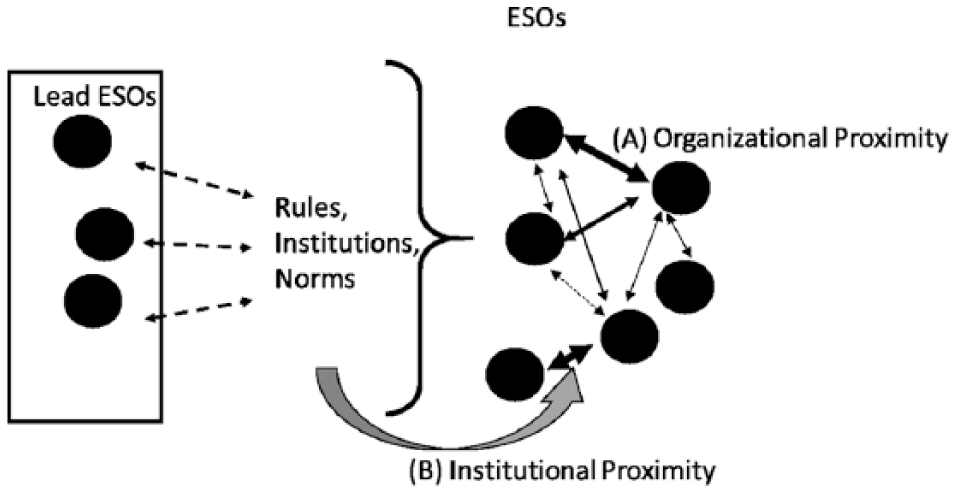
Roles of institutional proximity and organizational proximity in entrepreneurial ecosystems.
Several researchers have emphasized the importance of understanding context when studying ecosystems specifically citing the role of the historical, political, and cultural milieu in shaping leadership practices (Cohen, 2006; Saxenian, 1996; Sydow et al., 2011). Given the importance of connectivity and the intersections between partnership and leadership, it is crucial to understand how this relationship manifests in different contexts. The following questions motivated this study: What is the nature and extent of partnerships among ESOs in each ecosystem and how do they differ across cases? What are the key characteristics of the ESO identified as leaders in each ecosystem and how do they differ between the cases? What is the relationship between leadership and partnership in entrepreneurial ecosystems?
Data and Method
A multiple case-study approach was adopted to examine partnership and leadership in three entrepreneurial ecosystems, combining interview responses from key stakeholders in each entrepreneurial ecosystem and survey responses from managers and directors of ESOs. Rather than testing hypotheses or theories, the aim of this study was theory development. The geographic scale considered for most ecosystem research is a metropolitan region or metropolitan statistical area (MSA). For practical reasons, the interviews and survey participants for this research focused on the core of the ecosystem—the primary city. However, interview responses primarily addressed the broader metropolitan ecosystem. This research is part of a larger study that examines the differences of entrepreneurial ecosystems at various stages of development more broadly based on the three case-study regions.
An important concept throughout this study is connection through collaboration and partnership. Partnership within entrepreneurial ecosystems is complex. ESOs often reported that they “partner with everyone,” due to the dynamic interaction between partners, across organizational levels and through multiple channels. Hoang and Antoncic (2003) referred to this as “multiplexity” (p. 169). Organizational interactions across the three ecosystems include a combination of structural connections (connected through parent organization or funders), collaborative partnerships (sharing projects or other resources), and client-based connections (referrals and joint clients). Most parties use the terms partnership and collaboration interchangeably, but some differentiate between the two. Participants’ conceptions of linkages to other ESOs ranged from weak links, described as “we support each other,” to strong collaborations on joint projects. It is beyond the scope of this study to disentangle varying conceptualizations of what it means to partner versus to collaborate. Since this study’s primary concern is connectivity more broadly, including mutual support and partnership/collaboration, the term “partnership” is used to encompass both strong and weak linkages.
Data
The two primary data sources for this empirical study were one-on-one, semistructured, confidential interviews and an online survey. One hundred and fifty interviews (50 for each case) were conducted between July 2015 and March 2016. The purpose of the interviews was to gain an in-depth understanding of each region’s ecosystem from the stakeholder perspective, broadly focusing on the ecosystem’s partnership practices, its leadership and innovation, and the unique factors that influence each ecosystem’s development and function within the local context. Participants provided background information on their personal involvement in the ecosystem and on their organizations. Interview participants were key stakeholders in the ecosystem, including ESO administrators, government administrators (e.g., economic development administrators), leaders of local chambers, and venture firms. The initial list of potential interviewees included a purposeful sample of active ecosystem participants based on Internet searches and key informant lists. From there, I employed a snowball method of recruitment. Most interview participants were recruited by means of e-mail invitation. On average, interviews lasted between 45 minutes and 1 hour. Although most of the interviews (two thirds) were conducted in person, because of scheduling conflicts and budgetary constraints, the remaining one third were conducted by phone. Interviews were recorded, 2 transcribed verbatim, and coded using Dedoose qualitative analysis software. Interviews were inductively coded and analyzed for recurrent themes using the constant comparative approach.
The second data source was an online survey of ESOs in each study region. The purpose of the survey was to gather detailed empirical data about each ESO and the host region’s ecosystem. A database was constructed for each region containing a list of all the ESOs using data gathered from the Internet, and preexisting lists of organizations that fit the study criteria of offering any type of entrepreneurial support. ESOs were identified based on their publicly stated mission and programs offered. The target respondent was the top administrator for whom contact information could be found. Survey invitations were followed by two reminders. Responses were received from 49% of respondents, of which some submitted incomplete data, leaving an effective survey response rate of 40%. By city, the response rate translated to 43% from Chicago (51), 21% from Pittsburgh (25), and 35% from Richmond (41). Survey data were analyzed using SPSS software.
Case Studies
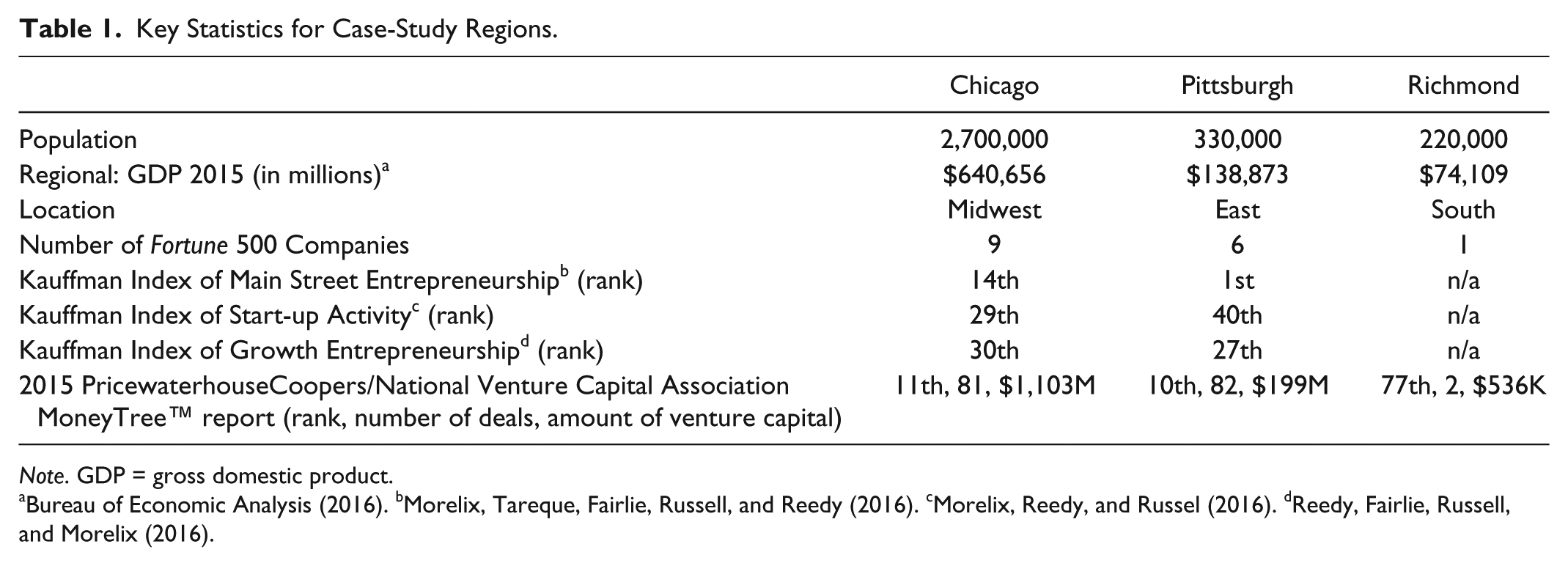
Cases for this study were selected to generate variation on several variables including size of each economy, geographic location, political climate, and entrepreneurial activity. Another consideration was the principal investigator’s prior knowledge of each ecosystem and access to key stakeholders. Table 1 summarizes key attributes of each case.
Key Statistics for Case-Study Regions.
Note. GDP = gross domestic product.
Chicago is one of the most dynamic economies in the United States. With a gross domestic product of over $500 billion, the region is home to nine Fortune 500 corporations. Chicago is also known as one of the most diverse economies in the United States, with transportation, professional and business services, and manufacturing among its largest sectors. It is also the birthplace of recent successful business launches, such as Groupon and GrubHub. The region is also home to several premier universities including University of Chicago, Northwestern University, DePaul University, and several others. Alongside the big and bold economy, the city is known for its intense politics and has a reputation for its toughness and grit.
Chicago has been called an “emerging ecosystem” (Bloomberg, 2016). Despite the girth of the economy and the ecosystem, Table 1 shows that the region has scored in the lower third in two out of three of the key entrepreneurship indexes published by the E.W. Marion Kauffman Foundation that compares the performance of the top 40 MSAs. 3 However, the MSA also ranked 11th out of 128 regions in the 2015 PricewaterhouseCoopers/National Venture Capital Association MoneyTree™ report, with 81 local companies receiving venture capital funds totaling over $1.1 billion in 2015 (NVCA, n.d.). The Chicago case provides an opportunity to study partnership and leadership in the context of a large and politically charged ecosystem.
Pittsburgh has been lauded for its orchestrated transition from an industrial base rooted in the steel industry to one heavily invested in more knowledge-intensive industries, including education and health care. Pittsburgh boasts several universities, with Carnegie Mellon University and the University of Pittsburgh most heavily involved in the city’s innovation and entrepreneurship. Pittsburgh is also known historically for its “collaborative model” of redevelopment, which has included universities, foundations, community-based organizations, and other nonprofits as partners alongside corporate interests (Ahlbrandt, 1989; Detrick, 1999).
Performance indicators for entrepreneurship in Pittsburgh are mixed. As Table 1 shows, while the city ranked higher than Chicago in two out of the three Kauffman Indexes and was about even with Chicago on the number of companies receiving venture capital, in 2015 Pittsburgh ranked dead last out of the 40 largest MSAs in the index for start-up activity. Furthermore, the city attracted only $199 million in venture capital compared with Chicago’s $1.1 billion. The Pittsburgh case represents a medium size, university-centric ecosystem known for its tradition of consensus and strategic economic development.
Richmond is the smallest of the three ecosystems and the only one situated around a state capital. Once known for its short-lived role as the capital of the confederacy and early production of tobacco, Richmond’s economy is heavily vested in federal and state government employment, banking, and manufacturing. The Richmond MSA is too small to make the Kauffman Indexes of start-up rankings. However, it ranks 77th of 128 in the PricewaterhouseCoopers/National Venture Capital Association MoneyTree™ report for venture capital, having secured $563,000 across two companies in 2015.
The Richmond entrepreneurial ecosystem is just beginning to take shape, with most of the activity in terms of organizations and resources occurring over the past 5 years. In 2013, Richmond was named by Forbes as one of 10 “Up and Coming Cities for Entrepreneurs” (Hull, 2013). The city was admired specifically for its quality of life, strategic location, and thriving arts and cultural amenities. The article also mentioned the talent produced by two main local universities, Virginia Commonwealth and the University of Richmond. This case provides the opportunity to study an ecosystem in the early stages of development and one that is smaller than the other two cases.
Results
Interviews across Chicago, Pittsburgh, and Richmond revealed that, while the general partnership practices are common, the detailed models of partnership and leadership vary tremendously. More specifically, perceptions about ecosystem partnership, collaboration intensity, and the factors either motivating or impeding partnership vary. The data suggest the nature and extent of collaboration between organizations in each region (organizational proximity) are partly a function of the level and nature of broader institutions, rules, and values that are present (or the lack thereof) in each ecosystem. Below, partnership and leadership across the three case regions are discussed.
Partnership: Practices and Perceptions
Analysis of interview and survey responses revealed three distinct partnership models across the study cases. While partnership practices tended to be similar, degrees of partnering, prevailing perceptions, and attitudes around partnership and structure of ecosystem connections all varied. In each of the three ecosystems, some ESOs felt excluded from the primary network; however, the level of exclusion and motivation behind it also varied by case region.
Partnership Ratings
Survey participants were asked to rate the overall partnership level in their ecosystems on a scale of 1 to 5 with 1 = very weak and 5 = very strong. On average, Pittsburgh participants rated their partnerships in ecosystem highest, with 72% rating it as either strong or very strong, compared with the same ratings in Chicago (65%) and Richmond (58%). In fact, 23.7% of Richmond participants rated their ecosystem either very weak or somewhat weak compared with only 16% in Pittsburgh and 16% in Chicago.
Partnership Practices and Levels
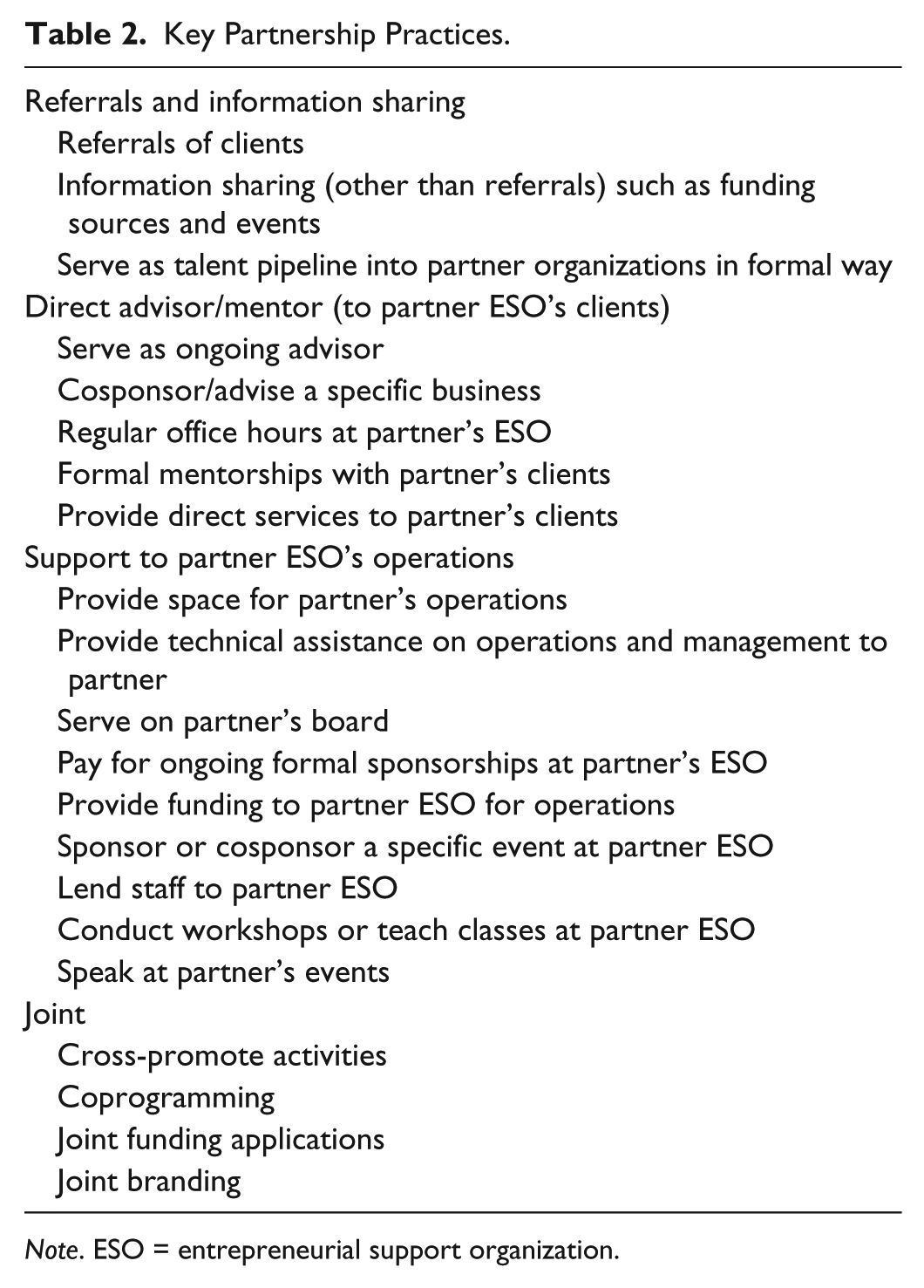
Partnership was dynamic across the three ecosystems with ESOs engaging in a wide variety of partnering practices. Interview participants were asked to describe how they partner with other ESOs. Table 2 summarizes their responses. Responses fell into four broad categories: (a) referrals and information sharing, (b) direct advising and mentoring of entrepreneurs, (c) support of other ESO operations, and (d) joint ventures.
Key Partnership Practices.
Note. ESO = entrepreneurial support organization.
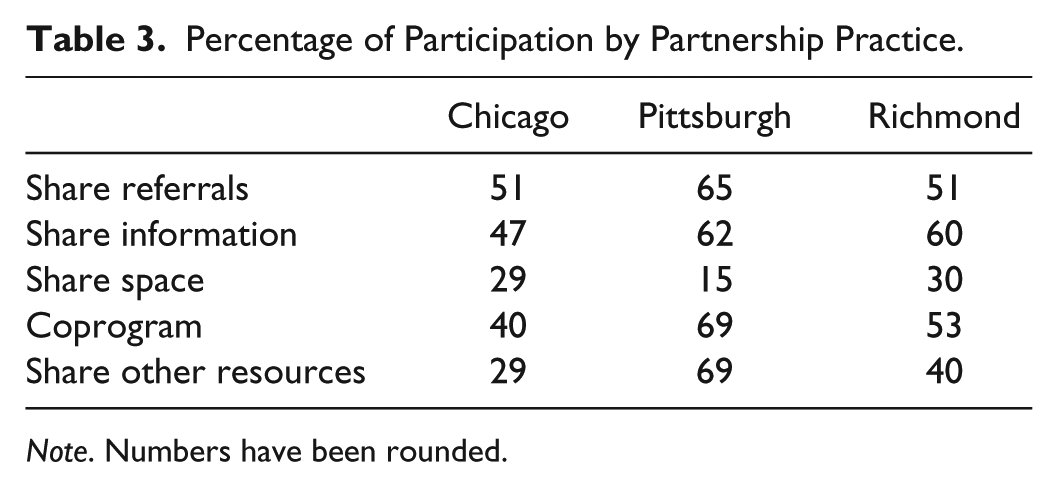
To create a manageable list for empirical analysis, key partnership practices were generalized into five broad categories. Survey participants were asked to name up to 10 key ESO partners in their ecosystem and indicate from a list of five choices (provide client referrals, share information, share resources, share space, coprogramming) all the ways they partner with each. Sharing information was the most widely acknowledged partnering practice (acknowledged 378 times), followed by referrals (344) and coprogramming (244).
Survey responses suggest that Pittsburgh ESOs were more interactive with their peer organizations than their counterparts in Chicago or Richmond. Table 3 shows that Pittsburgh respondents reported higher levels of engagement in four out of the five partnering practices compared with Chicago and Richmond. While 69.2% of Pittsburgh respondents reported coprogramming with at least one other partner, only 53.2% of Richmond and 40% of Chicago respondents did so. Although 65.1% of Pittsburgh respondents reported sharing information with at least one other partner, Chicago and Richmond were lower, at 51.1% and 50.9%, respectively. Interestingly, Pittsburgh’s respondents reported considerably lower incidences of sharing space with other ESOs than did respondents in Chicago and Richmond (13%, 29%, and 29%, respectively). The lower incidence of sharing space in Pittsburgh could be attributed to the connection between entrepreneurship and neighborhood revitalization in the city. Multiple interview participants made a connection between their location and either an ongoing or future revitalization initiative. One organization located in a storefront in a business corridor with significant vacancy saw his location as part of the rebranding and revitalization of the area. Another project is currently underway to transform the 1.4 million-square-foot former Allegheny Center Mall complex into a flexible space for entrepreneurs. 4 In both cases, entrepreneurial efforts were weaved into larger renovation and revitalization initiatives.
Percentage of Participation by Partnership Practice.
Note. Numbers have been rounded.
Perceptions of Partnership: Insights From Interviews
To obtain a deeper understanding of the nature of partnership in each region and attitudes about partnership, interviews included several open-ended questions regarding ecosystem partnership. In Chicago, three themes stood out from interview responses: purposeful, competitive, and cliquishness. Interviewees described the extensive partnership occurring in the city as purposeful. In general, the responses suggested little concern for broader ecosystem benefit. One interviewee’s statement that he decided who to partner with based on what the organization could offer his organization was typical. Several participants suggested the likelihood of a partnership expanding their client base drove the majority of their relationships with other ESOs.
The second theme that stood out was the competitive nature of interactions among ESOs in Chicago. One interview participant put it this way:
It’s disjointed and competitive. . . . [T]hey’re all fighting for the same . . . dollars . . . they’re very unwilling to share what knowledge they know . . . so it’s . . . I’m gonna’ fight for my center kind of thing.
The tone of other interviews suggested that several ESOs were vying for a spot at the top by competing with other ESOs in the ecosystem. Partnerships were formed based on getting ahead more so than in the other two regions. When asked explicitly about motivations for partnership, Chicago ESOs were more likely than participants in other places to openly admit that they were driven by gaining advantages in terms of attracting funding and those entrepreneurs who were likely to be “the next big thing.”
Finally, the ecosystem seemed to be loosely organized in clusters of activity. For example, the tech-oriented ESOs generally identified their partners as universities and other tech-related ESOs. At the same time, nontech and community-based ESOs were less exclusive, describing partnerships with tech-oriented, nontech, and community-based ESOs. In line with this, a participant who works for a technology-oriented ESO said the following:
I think one of our weaknesses is that we can be cliquey; there [are] definitely different groups of people that kind of stay together . . . tech versus nontech is definitely a cliquey group… and then there are the sort of people who are sort of ubiquitous and everyone is just like, not them again.
Many interview participants responded to questions by speaking to a specific part of the ecosystem. For example, tech-oriented ESOs appeared to be their own cluster, with high levels of interaction between them and their answers specifically addressing other tech ESOs. Other groups that respondents portrayed as clusters were manufacturing and makerspace-related ESOs. A notable number of interview participants also grouped small business development centers (SBDCs) into their own cluster, often referring to them as if they were one entity yet Chicago has 12 SBDCs. One interviewee from a tech-focused ESO grouped the SBDCs with other ESOs serving disadvantaged communities, and referred to them as “the other side of the house.”
Pittsburgh interviewees painted the opposite picture of Chicago. The three themes that best describe discussions of partnership among Pittsburgh participants are collegial, system focused, and hierarchical. Most of the interview participants described an extremely collegial environment among ESOs. The interviewee who said, “we work very well together; we play nice in the sandbox,” was typical. Several participants credited Pittsburgh’s historic roots, such as the one who said:
Pittsburgh has always been an entrepreneurial city. Carnegie, and Mellon, and Frick, and all those guys were entrepreneurs, and there’s also a very strong culture of making things . . . there’s . . . a very strong culture of collaboration and . . . that distinguishes Pittsburgh from say Silicon Valley in that everyone wants everyone to do well and there’s not the turf wars . . . between some of the different funding entities.
Another theme that resonated among Pittsburgh interviews was that their responses suggested they were system focused. Participants often spoke of the ecosystem as a whole rather than their specific part. For example, the participant who made the following comment had no relationship with the ESOs involved:
Forbes Fund saw what’s going on in the ecosystem, was thrilled that it is going on, but didn’t want to compete with Innovation Works, or AlphaLab, or Blue Tree but they wanted to support it. So, what the Forbes Fund did in conjunction with a partnership . . ., they created the first annual UpPrize.
This comment was typical in that participants in Pittsburgh described the evolution of the ecosystem as thoughtful and intentional, and described its development as more of a planned pipeline than random individual parts. The interviewees in Pittsburgh also used similar phraseology in describing their ecosystem and their goals for it. Several of the interview participants referred to citywide economic development plans and initiatives as well as overall visions and plans for the city.
Furthermore, several interviewees suggested that a part of the entrepreneurial spirit in Pittsburgh is the sentiment that each organization belongs to a collective striving for related goals. One participant explained, “[W]e all claim the same entrepreneur . . . when a business in Pittsburgh fails, there is a collective mourning,” describing a spirit of cooperation instead of competition.
A few participants in Pittsburgh felt their organizations had been left out of the core network. Most of these ESOs were either serving disadvantaged populations and/or disadvantaged communities, and several were not linked to the universities in any meaningful way. Almost all interviews with this group either directly mentioned or alluded to a “well-known secret” that the keepers of resources within the city, including the entrepreneurial ecosystem, consistently supported only a few handpicked communities and community-based ESOs. Multiple interview participants also reported that the organizations and communities receiving resources was decided in a closed-door meeting several years ago, and the others were intentionally “starved” until they went out of business. A few of these interview participants reported receiving what multiple interviewees called “a few crumbs” in terms of resources.
In Richmond, the most common sentiment expressed by interview participants was that there was a lot of activity around entrepreneurship, but ESOs were not working together very much. Unlike in Chicago, there did not appear to be clusters of ESOs partnering. Many used the phrase “working in silos” to describe limited partnership between individual ESOs in the Richmond ecosystem. One participant provided the following description:
Well, when a fragment grenade goes off, bits and pieces of it go off everywhere. . . . Because there’s a lack of communication and also people are trying to hold onto their little piece of the pie, instead of us working like this [interlocks fingers] we’re like this [pulls fingers apart and spreads them wide].
The majority of interviewees suggested a genuine desire to come together and move the ecosystem forward, but no one seemed to know where to start. Several participants suggested that the disconnect came from a lack of awareness among stakeholders on what others were doing, such as the one who commented:
I think the resources are [disjointed] here, but I don’t think we know enough about what everybody else is doing to make it effective and efficient. And that’s part of what we want to . . . understand, again, what’s out there and eliminate the duplications and then figure out what is missing.
Another participant suggested that the fragmentation might be in part due to a lack of a joint vision or plan:
Everyone’s kind of doing their own thing. One of the things that’s making it not come together as an ecosystem is that there’s no plan, there’s no structure, there’s no something that we’re all shooting for.
Several interviewees suggested that the disjointed nature and lack of cooperation was due to the early stage of Richmond’s ecosystem development, and identified a consequent lack of protocol for working with one another:
[I]t feels like the Wild West in entrepreneurship development right now. It doesn’t feel like we have well-marked streets and rules of engagement. . . . [T]here are still opportunities for us to develop better partnerships than we have right now.
Another theme raised several times in Richmond was the idea that only certain individuals and their organizations were welcome to participate in Richmond’s ecosystem. They referenced an “old boy’s network” that was “pay to play”—a structure in which “those with a lot of their own money can play.” Interviewees went on to differentiate Richmond from other places, describing Richmond’s history as a southern town with disdain for outsiders as shaping the lack of partnership.
A smaller group of interview respondents felt more positive about the level of collaboration within the Richmond ecosystem. The few members of this small group mainly identified each other as partners. Their discussion of the ecosystem tended to focus more on potential and future opportunity than on the current state of the ecosystem. Figure 2 depicts partnership models for each ecosystem.

Entrepreneurial ecosystem partnership and leadership models for Chicago, Pittsburgh, and Richmond.
Leadership
Leadership Ratings
Leadership in each region’s ecosystem was related to partnership. Survey participants were asked to rate the strength of their region’s entrepreneurial ecosystem on several attributes, including leadership, on a scale of 1 to 5 with 1 = very weak and 5 = very strong. Results revealed a statistically significant correlation between how survey participants in each region rated the strength of their ecosystem’s partnership and the strength of its leadership (correlation .492, p < .001 level). There was also a statistically significant relationship between partnership rating and strong vision (.684, p < .000 significance). As with partnership, Richmond respondents rated the strength of their ecosystem’s leadership significantly lower on average than Chicago and Pittsburgh. Whereas 78.4% of Chicago respondents and 76% of Pittsburgh respondents rated their ecosystem leadership as very strong or somewhat strong, only 69.2% of Richmond participants did. Conversely, 12.9% of Richmond participants rated their leadership as somewhat weak or weak, whereas 4% in Pittsburgh and 2.7% in Chicago did so.
Reflections on Leadership
Each interview participant was asked to identify leaders in their entrepreneurial ecosystem. While Chicago participants identified the newer cutting-edge incubators, Pittsburgh participants identified major institutions with a longer history as their ecosystem’s leaders. Richmond did not appear to have clear ESO leaders. In the next section, perceptions of leadership in each region is discussed in greater detail.
In Chicago, more than in Richmond or Pittsburgh, the ESO leaders tended to be newer, cutting edge, and innovative. For example, 1871, a self-proclaimed “hub” of entrepreneurship established in 2012, was identified as a leader five times more than any other ESO in the Chicago ecosystem. 1871 houses nine separate incubators along with several other organizations. 5 Matter, another incubator Chicago participants mentioned as a leader, was established in 2013. Tech Nexus, established in 2007, was also mentioned often. People also called the Women’s Business Development Center, a 501(c)(3) created in 1986, a leader, with several acknowledging the organization’s innovative strategies.
Chicago has an unusually large number of SBDCs. Several ESO participants, especially those affiliated with nontech and lifestyle businesses, cited various SBDCs as leaders. Participants who worked in tech-oriented ESOs sometimes identified SBDCs as a group as leaders (as opposed to identifying specific ones) but relegated their leadership to “that sector” meaning nontech and community-based ESOs.
While agreement among participants suggested wide recognition of particular leaders, the attitude of interview participants suggested that the leaders could change at any given time. Interviewees suggested that there were several contenders vying for leadership roles, making leadership less consolidated, less stable, and more competitive than in Pittsburgh. Furthermore, Chicago respondents were more likely than respondents in Richmond or Pittsburgh to talk about a leader of a particular section of the ecosystem.
At least 24 interviewees in Chicago mentioned their area’s alderman (representative on the city council) as a leader in business support in their area. They mostly alluded to the alderman as the one that could make things happen. Rahm Emanuel, the mayor of Chicago, was also frequently mentioned. Several participants discussed his role in creating World Business Chicago and streamlining the process of starting a business in Chicago.
The Chicago interviewees referenced universities as partners more often than as leaders within the entrepreneurial ecosystem. This not only contrasts with interviewees’ comments in Pittsburgh but with the literature, which emphasizes the role of universities (see Mason & Brown, 2014). One Chicago participant described the universities as “late to the game but now at the table” in terms of leadership. A common view was that universities were inward focused and most of their programs were geared toward their students. However, all the major universities had a dedicated space at 1871.
Leadership in Pittsburgh’s entrepreneurial ecosystem was not only well established and strong but generally agreed on. Furthermore, leadership in the Pittsburgh ecosystem seemed to be tied to a group of institutions that were leaders more generally in Pittsburgh. Power was consolidated into the hands of a few institutions. The leadership structure was formal, with several well-established boards and commissions, and participants generally mentioned the same entities. Interview participants generally spoke of these leaders with respect and their comments suggested a hierarchical order among leadership. They also described Pittsburgh leadership as system focused.
As several Pittsburgh interviewees pointed out, the leaders they recognized had been in the role for a long period, thus creating consistency. The universities were the center of the ecosystem. In Pittsburgh, the most commonly mentioned leader was Carnegie Mellon University, established in 1900. The second most commonly mentioned was Innovation Works, a major investor in the area established in 1999 with funding from the Pennsylvania Department of Community and Economic Development. The third most mentioned organization, the Pittsburgh Technology Council, was established in 1983. Several participants described Carnegie Mellon University as the clear leader and the University of Pittsburgh as a close second. Some also referenced universities such as Chatham University and Duquesne University. One interview participant mused, “I think [in] the community at large fundamentally the engine is still the universities. . . . Without [them], I don’t think the ecosystem survives on its own.”
Another participant put it this way:
The core drivers are the universities here. . . . [T]he reason money pays attention to Pittsburgh and the reason these organizations . . . have been able to sustain for as long as they have is there’s lots of really innovative, core research happening at the universities that are spitting out ideas. Not all the good ideas are coming out of the universities, but [they create] a critical mass that helps the ecosystem exist.
Innovations Works was identified as a leader in the Pittsburgh ecosystem almost as often as the universities. Participants emphasized its receipt, jointly with Carnegie Mellon, of the highly competitive i6 grant from the U.S. Department of Labor’s Economic Development Administration. One interview participant felt that the substantial grant “really anointed them as sort of the flag bearer of that ecosystem here.”
Foundations were also believed to have a major influence in the Pittsburgh ecosystem. A participant noted the following:
This is one of the things that Pittsburgh has that some other cities really don’t—very strong philanthropic resources. So, your R.K. Mellon Foundations, your Heinz endowments, the McCune Foundation, these are all financial and industrial leaders from 100 years ago that set up massive endowments and they support a lot of economic development activity in the city.
Foundations not only influenced where ESOs were located but also forced them to be more outward facing in their missions. They provided significant funding to Carnegie Mellon and some other key organizations supporting entrepreneurship in the city. One interviewee admitted that his organization had only become engaged with the surrounding community when the major foundations made clear that the connection would help them get funding because the foundation’s mission was to revitalize and build Pittsburgh’s communities. Several interview participants felt that when the foundations made clear what they wanted, the city (government) and most other organizations complied.
As in Chicago, Pittsburgh participants saw the City of Pittsburgh and its mayor, Bill Peduto, as leaders in the entrepreneurial ecosystem. Several participants referenced specific policies that this mayor had put in place, which had a strong impact on business. For example, several pointed out an initiative providing businesses with access to large, useful data sets. Several interviewees also noted that the mayor often attended events in support of entrepreneurship in the city and had done so regularly prior to taking office.
In Pittsburgh, the major leaders had more formal relationships than in Chicago. While the i6 grant linked Carnegie Mellon and Innovation Works, the University of Pittsburgh also worked with Carnegie Mellon on projects such as the Pittsburgh Life Sciences Greenhouse incubator. 6 Furthermore, many in Pittsburgh referred to major economic development plans developed by key organizations. Participants’ remarks suggested the existence of a strong culture of partnership and mutual planning.
Richmond’s entrepreneurial leadership differed from Pittsburgh’s and Chicago’s in three ways. Based on the responses of interviewees, Richmond did not appear to have acknowledged and agreed on organizational ecosystem leaders. Furthermore, Richmond interview participants were more likely to mention individuals as leaders than Chicago and Pittsburgh participants were, perhaps suggesting that organizations had not yet risen to the level of leaders. Finally, when Richmond interview participants were asked about ESOs who were leaders, often they identified their own organization. While some participants identified leaders, rarely was there a consensus on who the leaders are. The list of ESO leaders named by one or two people was almost as long as the list of ESOs.
Several interview participants in Richmond acknowledged the lack of leadership, with one lamenting, “If we’re really going to make a dent in this [ecosystem] and move this effort forward, we have to have one group leading the charge.” Other Richmond participants acknowledged the lack of leadership but did not consider it a disadvantage. For example, one said, “I don’t know that there is a key institution that holds it together, which would be a sign of strength. I think it’s just the culture. I think it’s just America and capitalism.” Two participants described the lack of leadership as a positive. The first stated, “I see it as . . . not centrally controlled which gives everybody opportunity.” Another participant explained, “I love the fact that Richmond’s open; there’s no gatekeeper here to it. Anyone can raise their hand and say I want to get involved and do it.”
Richmond interview participants were far more likely to identify a few key individuals as leaders of the ecosystem than organizations. The individuals mentioned tended to be mostly older and middle-aged White men. Several participants lamented that virtually no younger people or minorities held positions related to entrepreneurship in Richmond. One interviewee stated the following:
I’m hoping more young people will come or new people’s voices will come and do things differently and try things out and experiment to make it even better. . . . [T]he way we did it in the 1980s is not the way we should do it right now.
The city of Richmond was hardly mentioned in the conversation about entrepreneurship except for the city’s Office of Minority Business. Even then, this office was mentioned more as a partner than as a leader. The two main universities in Richmond, Virginia Commonwealth University and the University of Richmond, were seen as inward facing. Some complained that they should be taking more of a lead in the ecosystem, but had yet to do so. One interviewee said the following about Virginia Commonwealth University: “They are doing a lot around entrepreneurship, but mainly for their students and it’s not connected enough to the rest of the ecosystem.” As depicted in Figure 2, each ecosystem had its own unique partnership structure and leadership model.
In summary, Pittsburgh was extreme in that its ecosystem was steeped in tradition. Leadership was noted there as longstanding and had a clear consistent message. The leaders were acknowledged, respected, and held formal positions of power. There was a clear hierarchy within the ecosystem in terms of who was central and important. Furthermore, participants seemed to know, and mostly accept, their organizations’ places within the hierarchy. Leadership was system focused. Partnership was also structured and system focused. The ecosystem was highly integrated and systematic. ESOs did not intentionally compete with one another; they partnered, with an eye toward complementing one another for the purpose of system building. There appeared to be clear rules of engagement. There was an acknowledgement of a plan set forth by leadership.
Chicago, a region known for its cutthroat politics and highly competitive atmosphere, had clear leaders with loose connections who were vying for power. These leaders guided a highly energetic and crowded ecosystem where connection and partnership were political and opportunistic. More so than a unifying message or vision, competitiveness was an accepted mode of operation. Technology was heralded as superior to other types of entrepreneurship and the leaders tended to be technology focused ESOs. Other factions, such as the maker movement, were increasing their presence. The Chicago leadership model (multinodal, competitive, and loosely committed) translated into a competitive environment among ESOs. When ESOs collaborated, they sought an individual advantage. System building did not appear to be a core value. However, there was an understanding among participants about the rules of engagement—competition and politics. The result was cliques and pockets of partners—separate, loosely coupled spheres of activity based on power dynamics. Some were clearly left on the outside and represented a second tier in the ecosystem.
Richmond was the other extreme of Pittsburgh in that it lacked acknowledged and agreed-on leadership; hence, there was very little by way of institutions or rules specific to the entrepreneurial ecosystem. More individuals were identified as leaders than organizations, which translated into an “each man for himself” mentality. The lack of institutions and joint values to facilitate relationships between ESOs has resulted in lower levels of partnership. The result was substantial activity, but with stakeholders operating in disconnected silos. While all the necessary players were interested in the ecosystem, each operated independently; hence, there was a lack of systematic thinking and acting among stakeholders.
Discussion and Conclusions
This study of entrepreneurial ecosystems compared Chicago, Richmond, and Pittsburgh, and specifically examined partnership practices, leadership models, and the relationship between the two using ESOs as the unit of analysis. I found that the three ecosystems differed both in terms of partnership and leadership models, and that the two factors are related. Proponents of entrepreneurship have touted the importance of collaboration and partnership among key actors and stakeholders in entrepreneurial ecosystems. This research contributes to the literature by illuminating how patterns of partnership and leadership among ESOs compare across different political, economic, and cultural contexts.
Whereas Pittsburgh reported high levels of collaboration, Richmond reported low levels or silos, and Chicago fell in the middle with high levels of collaboration within multiple clusters of ESOs. Leadership models also varied among the three and were strongly related to partnership culture. Pittsburgh’s ecosystem was highly structured and grounded in long-standing institutions as lead ESOs. Chicago’s ecosystem was largely led by cutting edge, newer ESOs, with multiple second-tier organizations vying to be leaders. Richmond, with its fledgling ecosystem, lacked the sort of institutional leadership of the other two ecosystems but individual stakeholders were more often identified as leaders, resulting in the three configurations depicted in Figure 2. I found that the intersection between partnership patterns and leadership suggests that leadership models translate into the way ESOs partner with one another. Lead ESOs created, perpetuated, and validated the rules and institutions that shaped partnership practices and behaviors within the ecosystem and reproduced them. I also found that the broader history and culture in the region affected the leadership models.
This study confirms previous acknowledgments in the literature of the importance of connection between organizations in formal networks (Baron & Markman, 2000; De Hoyos-Ruperto, Romaguera, Carlsson, & Lyytinen, 2013; Isenberg, 2010; Motoyama & Watkins, 2014; Spilling, 1996; Wood, 2012). This study builds on the work of Motoyama and Watkins (2014), who provided a broad list of primary supports by capturing a more extensive list of ways organizations involved in the ecosystem partner with one another (see Table 2). The list derived here supports Hoang and Antoncic’s (2003) assertion that organizations serve as a key vehicle enabling the exchange of information, knowledge, and resources. Having a list that identifies the specific mechanisms by which ESOs are connecting could provide insight to fledgling ecosystems on practices they could nurture to encourage important connections.
This research also brings the proximity framework into our thinking about entrepreneurial ecosystems. The proximity framework contributes to our understanding of how ecosystem leadership models relate and at some level predict partnership patterns. The fact that Pittsburgh ESOs found it so easy to work together suggests they have high levels of organizational proximity manifested in their common perceptions, language, and approaches to interaction with one another. These likely make it easier for the core group of organizations to work together.
The nature and strength of the connection between individual ESOs and the congruence of their shared values to broader ecosystem norms represents institutional proximity. The combination of organizational and institutional proximities (as depicted in Figure 1) helps explain the differences in partnering profiles between the three cases. While other scholars have discussed the connection between institutional and organizational proximity, this research highlights how they intersect to create a partnership culture. While many ESOs in Pittsburgh had organizational proximity, the values and norms that encourage partnership were also aligned with broader ecosystem institutions set forth by a strong leadership with a consistent message (i.e., they also had high levels of institutional proximity). High organizational and institutional proximities led to a highly collaborative ecosystem wherein ESOs were system focused, there was a joint vision, and leaders were acknowledged, agreed on, and respected.
Chicago had strong organizational proximity within multiple smaller factions. The bond holding together some of these relationships was aligned with the current ESO leader values. However, Chicago also had some clusters of partners who were not as tightly aligned with the broader institutional values set forth by lead ESOs; Chicago was less unified compared with Pittsburgh’s ecosystem and had less system focus. Chicago had high organizational proximity within clusters but not system-wide and medium institutional proximity, as only some clusters were aligned with leaders’ values and rules of engagement.
In Richmond, there was less organizational proximity between ESOs, partly due to lack of knowledge about each other’s organizations. The lack of organization-level leadership made it difficult to establish institutional proximity related to the ecosystem. Sydow et al. (2011) suggested that the “bundling” of expert knowledge is difficult when the actors are unaware of other relevant actors when leadership is dispersed. This could help explain why Richmond ESOs were operating in silos. The lack of a shared understanding and direction (i.e., the “wild, wild west” mentality) likely made it difficult to work together. In the absence of institutional proximity, individuals running ESOs relied on their personal social networks. This research concludes that the structure of formal networks is at least partly influenced by the values, signals, and culture set forth by lead ESOs and the degree to which the bonds that form relationships within the ecosystem are aligned.
Each case studied here contained both strengths and opportunities. While Pittsburgh had the highest levels of partnership and collaboration, Letaifa and Rabeau (2013) warned that proximity is necessary but should not be falsely generated. The type of collaborations found in Pittsburgh relied more on highly orchestrated relationship building than spontaneous collaborations. As mentioned above, too much proximity can result in lock in. If organizational proximity facilitates knowledge and sharing between ESOs, entrepreneurial ecosystems with limited organizational proximity and, hence, limited knowledge transfer between ESOs may be inefficient and unlikely to innovate. Even in ecosystems with high levels of organizational proximity, separations into factions, such as in Chicago, could result in missed opportunities for innovation that might have occurred had the fractured pieces been able to more efficiently share knowledge and information. While the current lack of organization-level ecosystem leaders in Richmond offers an opportunity to promote ESOs representing the values and practices that other organizations can support, stakeholders must act soon because, according to Mack and Mayer (2016), having leadership in place is a necessity for sustaining entrepreneurial ecosystems.
This research has multiple implications for policy makers and stakeholders looking to make the most of their entrepreneurial ecosystems. Connectivity through partnership and collaboration has been hailed as a critical ingredient for the facilitation of innovation and knowledge sharing that is fueling new business growth and success. Scholars and policy makers wanting to understand how their ecosystems function must go beyond only studying entrepreneurs and their interactions to also examining the interaction between ESOs. ESOs are the conduit through which many entrepreneurs receive essential resources and information. Understanding the factors that decrease friction between organizations, thus allowing them to interact, share, and co-innovate, could enable ESOs to more effectively capitalize on all the ecosystem has to offer; hence, better serve their entrepreneur clients.
As this research has shown, models of how ESOs partner vary significantly across ecosystems. To ensure that an ecosystem aligns with broader regional goals and values, stakeholders need to understand partnership patterns and the implications of their particular model. For example, if ESOs were partnering in clusters or cliques, it would be beneficial to know who was left out and whether the existing partnership configuration was desirable. If ESOs are partnering in less than optimal ways, opportunities to access knowledge and resources, which could be beneficial to the entrepreneurs they serve, are likely to be compromised. To increase partnership, policy makers can play a role by raising awareness among ESOs of what others are doing, thus making the value of collaboration more obvious.
Findings here also suggest that leadership plays a critical role in shaping and guiding the entrepreneurial ecosystems; however, to be effective, lead ESOs must be acknowledged and accepted as such by other ecosystem members. Identifying who the lead ESOs are and the implications of their leadership type are crucial for understanding the current operational mode and how a particular ecosystem has evolved over time. Local policy makers and stakeholders can increase their awareness of their ecosystem’s leadership profile by asking the following key questions: Do lead ESOs exist in their ecosystem? What rules, values, and cultural norms are lead ESOs legitimating and reproducing? Does the broader ecosystem membership support and respect those rules, values, and norms? Is there a direction or vision for the ecosystem? Capturing both the partnership patterns and leadership norms and values within ecosystems are necessary to develop a plan forward.
There is a great deal more to learn about how entrepreneurial ecosystems operate and factors influencing connectivity. Results here underscore the need for more research at the organizational level. Application of the proximity framework to understanding ecosystems is new. While I have introduced it here, more research is necessary to develop explicit ways of assessing organizational and institutional proximity, identifying the mechanisms that influence each, and further delineating the influence of leadership.
Footnotes
Declaration of Conflicting Interests
The author declared no potential conflicts of interest with respect to the research, authorship, and/or publication of this article.
Funding
The author disclosed receipt of the following financial support for the research, authorship, and/or publication of this article: This research was made possible by the generous support of the Ewing Marion Kauffman Foundation.
