






Abstract
This study examines the impacts of collaboration and public participation on municipal growth in midsize U.S. municipalities. It specifically looks at the cases of land economic development projects across the nation and how local governments’ population and employment growth are associated with public participation and collaboration. This study employs two methods—a survey of planners and officials and GPT-3 semantic search. Using a survey of planners and elected officials, four individual variables (traditional public participation, online public participation, public service collaboration, and staff regional meetings) related to collaboration and public participation were employed. Additionally, a semantic search approach was used to understand the current trend of public participation methods in real land development cases. The findings show that informal collaboration pushes population and employment growth, but the value of citizen participation is more contentious.
Keywords
Local economic development today not only requires increasing municipal tax revenue by building housing or attracting businesses but also a focus on long-term growth (Liu & Washburn, 2015). Municipal growth by attracting businesses may lead to conflicts because land-use and economic development planning require the participation of many stakeholders and diverse interests. Disagreements about the definition of a successful project are common among stakeholders and this complicates the land use and economic development decisions. These themes of conflict play out through many economic development projects. To resolve complex tensions and struggles, it is essential for municipalities to collaborate with other communities, share information, and engage the public (Kang, 2022; Kang & Homsy, 2020).
Understanding the economic development of municipalities requires reviewing several interrelated areas of literature. One important area in this research is collaboration. We seek to test notions of intergovernmental contracts in service delivery and informal staff regional meetings because each is premised on increased collaboration bringing economic advantages to communities. In this paper, we examine how different avenues of collaboration might impact the likelihood of local economic growth. Another important economic development tool is public engagement. Communities have increasingly argued about the importance of the public's role in local economic development (Blair, 2004). More municipalities are trying to improve engagement methods and processes in community development projects.
The main purpose of this article is to explore the impacts of different collaboration and public engagement factors on economic growth in midsize U.S. municipalities. We specifically look at the cases of land economic development projects across the nation. Municipalities compete with nearby municipalities for many of these projects because the benefits accrue to local governments where new businesses locate. In this study, we examine how municipalities’ collaboration and citizen engagement are associated with population growth and employment growth. We have used collaboration and public participation theories for guidance in our models that focus on the following two research questions:
What is the relationship between collaboration, public participation tools, and municipal growth? Is there a certain type of collaboration and public participation technique that has a greater impact on local land development projects?
These important questions have not been adequately determined at the municipal level, especially in land development projects. We distinguish collaboration and public participation through two different factors: public service collaboration and staff regional meetings for the collaboration factor; traditional and online/web-based public participation for the public participation factor. This not only helps to understand the relationship between overall collaboration and public engagement in municipal growth but also explains the different factors associated with municipal growth. This study fills an important empirical and practical gap in the literature regarding different collaboration and public engagement factors. We believe that this study lays the foundation for more concrete and generalizable studies in the future.
Research Literature
Collaboration and Municipal Growth
Collaboration among local governments has become an important component of regional economic development (I-W. Lee et al., 2012). Local governments have traditionally been framed as competitive in economic development situations (Chen et al., 2016; Godschalk, 2004). Competition occurs because municipalities want to attract businesses to their jurisdictions for tax revenue benefits and local government growth (Bischoff et al., 2021; Homsy et al., 2014; Kang, 2022). Competition among local governments leads to unbalanced growth and makes it difficult for local governments to apply important policies and plans in a regional framework (Orfield & Luce, 2002). Additionally, local growth is a complex phenomenon that includes different factors to determine growth. Nevertheless, many local governments are now working with adjacent municipalities or counties to solve and collaborate on multijurisdictional issues. In this competitive market, cooperation may help economies of scale and efficiency gains in relation to economic development (Warner, 2011). Additionally, local governments’ goals are better served with a regional approach to economic development policy and practice (Cummings, 2004).
Previous studies have shown a significant relationship between collaboration and the financial situation of municipalities but in different directions. On one hand, richer communities may be more likely to be regionally cooperative because of their financial ability to do so (Jung & Jeong, 2013). Other studies have noted the negative association with the level of cooperation (Bel & Mur, 2009; Lackey et al., 2002; Soukopová & Vaceková, 2018). Wealthier municipalities may be less attracted to cooperation than low-income communities (Tavares & Feiock, 2018). Because low-income communities have greater needs and may lack necessary services, they may be more motivated to cooperate (Carr & LeRoux, 2005; Jung & Jeong, 2013). Additionally, population reduction could be a warning sign that a city is no longer attractive for development, making its local officials more willing to act in collaboration (Lackey et al., 2002).
Diverse fields of research have questioned and hypothesized about the relationship between the capacities of cities with collaboration/networks in general. Researchers have measured these relationships in many ways, such as focusing on community economic development strategies, business incentives, and cost efficiency (Niaounakis & Blank, 2017; Zhang et al., 2017). But there is little empirical investigation into the relationship between collaboration and municipal growth in land development cases.
Collaboration has been more important in expanding economic motivations because it is difficult for municipalities to accomplish this on their own. In practice, competition may spark economic activities initially in the community, but collaboration with transparency and trust benefits everyone and promotes economic development (Browne & Sanders, 2013). More municipalities use collaboration as a tool for leveraging economic achievement (Arku, 2014; Chen et al., 2016). Regional cooperation improves marketing strength, ensures cost-effective services, and promotes regional job growth (Hoornbeek et al., 2016; Pastor et al., 2000). Providing services across regions helps spread economic benefits to a wider area. Collaboration and trusted relationships are important factors for economic development as they support growth and the resolution of common regional problems (García, 2006; Lee et al., 2012a, 2012b). Regional cooperation may reduce conflict between developers and municipalities, which helps to foster businesses in the community (Kang, 2022; Kang & Homsy, 2020). Cooperation can also provide financial gain to local governments (Homsy & Warner, 2014).
Partnerships have the potential for better economic development and regional collaboration that fosters job growth (Pastor et al., 2000). As an example, Northeast Ohio experienced regional economic transformation through business and employment growth by promoting regional collaboration (John S. and James L. Knight Foundation, 2013). Baptista and Preto (2011) found that there is greater employment growth when a region has a higher level of agglomeration. Partnerships with other regions help promote economic growth and reduce poverty (Pastor et al., 2000). Negative economic outcomes are often the result of competition among local jurisdictions (Lee, 2016). Local governments with voluntary cooperation can spur economic growth while sharing benefits (Hawkins, 2010; Johnson & Neiman, 2004).
Public Participation and Municipal Growth
There are conflicting views about public participation in the literature. Increasing public involvement in decision-making processes is essential to help the public understand the “community needs, articulate development goals to meet these needs, and contribute their knowledge and skills” (Sullivan, 2004, p. 58). Different types of public participation encourage people to share diverse opinions, which can improve policy making (Michels & Graaf, 2010). Local governments that exclude citizens from the decision-making process are vulnerable to prioritizing growth that does not benefit citizens or sustainable growth (Eisinger, 2000; Sullivan, 2004). Civic engagement is not only effective in the growth of the city, it also produces and promotes sustainable cities (Portney, 2005). Public trust plays an important role related to economic performance by reducing transaction costs, as well as public safety expenses (Putnam, 1995; Whiteley, 2000). The public is more willing to show its support for projects when local officials make an effort to capture their constituents’ voices and build citizen-local government relationships (Glaser & Hildreth, 1999).
On the other hand, public participation can be challenging. Including the public in the decision-making process may slow the process if participants are too diverse or there is a power imbalance (Arnstein, 1969; Ruming, 2019; Williamson & Ruming, 2020). The public's negative view of a project could be a burden for local government officials. In some cases, officials may be skeptical about engaging the public in the decision-making process (Ruming, 2019). Genuine participation should give information to citizens about their rights and responsibilities rather than be a platform for power holders to educate and control citizens merely in the name of participation (Arnstein, 1969). Public participation can negatively impact certain decision- making, especially when there is a lack of trust (Irvin & Stansbury, 2004). Many citizens are “rationally ignorant” in urban planning processes if public engagement requires considerable time, effort, and cost (Krek, 2005). Therefore, it is important to find an effective and attractive engagement process that overcomes citizens’ objections to participation.
Literature on public participation techniques is largely divided into two forms: traditional public participation and online participation. Traditional public participation includes public (in person) hearings, workshops/meetings, and written comments. In-person hearings and open meetings, such as workshops, are the most widely used public engagement tools (Brody et al., 2003; Gordon et al., 2011). Hatcher (2015) found that such hearings are the most effective public participation tool for budget directors—more effective than opinion surveys and Internet feedback. These traditional engagement tools are effective when citizens are involved from the very beginning. In-person meetings can help increase social capital (Baker et al., 2005; Gordon et al., 2011). However, many researchers point out that traditional methods of public participation, especially public hearings, are ineffective at fostering meaningful participation. The common critique is that traditional public participation is difficult for providing real communications and interactions in a decision-making process, and it generally takes the form of one-way communication from expert to the public (Gordon et al., 2011; King et al., 1998). Public hearings are a difficult way to educate and help citizens understand complex issues (Hatcher, 2015).
Technology offers an online public participation forum while keeping the benefits of traditional participation methods, such as networking and sharing project information with the community (Evans-Cowley & Hollander, 2010). Local governments are adopting online communication methods to reach broad groups (Williamson & Ruming, 2020). Online public participation through common virtual communication platforms like Facebook, Twitter, or YouTube may encourage more citizens to participate. One of the main advantages of online public participation is its accessibility. Social media platforms allow the public to get information in a more timely and cost-effective manner (Fountain, 2001; Moon, 2002).
In addition to these basic online platforms, recent trends have incorporated smart technology into public participation, such as 3D virtual representations of potential new building designs using mobile-augmented reality (Allen et al., 2011), Playful Public Participation using online serious games (Poplin, 2012), or chatbots. Although online public participation is cost- and time-effective in sharing information, some individuals’ voices could be missed due to limited access to digital forms (Mergel, 2013; Uittenbroek et al., 2019).
There is a lack of literature that directly links traditional and online public participation tools to municipal growth, but previous studies hold the view that public input is important and can influence decision-makers. Local governments use different public participation methods in economic development, including the budgeting process (Ebdon, 2002; Johnson et al., 2022; Reitano et al., 2021; Sullivan, 2004), so that citizens can help set development goals and share knowledge that may promote economic development (Sullivan, 2004). Municipalities with public participation tend to implement more progressive and successful development policies (Elkins, 1995; Goetz, 1994). Citizen engagement helps reduce the chance of local development project conflict between municipalities and private land developers (Kang, 2022), which eventually may help the growth of the community.
Data and Methodology
To answer our research questions, we draw our data from an online survey of local governments that was conducted from August 1, 2018 to October 1, 2018. This survey measures regional dynamics around issues of economic development to understand the ways that local governments relate to each other and to developers seeking to work within their borders. To build our sample frame, 134 metropolitan statistical areas (MSAs) were first identified by limiting the population size of counties and municipalities to between 250,000 and 1 million. Among those 134 MSAs, the survey was assigned to local governments with a population above 5,000. This population limit was set to focus on medium-sized places and exclude small and large communities. The survey with an online link was first sent to planning and economic development leaders representing 1,745 local jurisdictions (our final sample frame). In municipalities without planning and development leaders, the survey was sent to local officials. The survey link was sent to one person per municipality until it had been sent to every possible participant. For example, the link was sent to the senior planner and if responses were not received, the survey was sent to another planner. Reminder emails were sent three times to each participant before we sent the survey to a different planner/official. We collected contact information (email addresses) from municipalities’ official websites.
A total of 353 municipalities responded (a 20.2% response rate), of which 72 were cities (20.40%), 274 were suburbs (77.62%), and 7 were rural places (1.98%). In this paper, 332 municipalities were used, and our 7 rural observations were dropped due to missing data. Representation of the sample is checked on per capita income and population. Our sample municipalities represent 1,745 jurisdictions.
For the data analysis, we used a Bayesian multivariate regression to explore the collaboration and public participation factors associated with the population and employment growth within local government. Bayesian regression fits better than ordinary least squares regression for this study because the Bayesian approach presents a posterior distribution rather than a single-point estimate. It relies on a probability statement that can be interpreted intuitively rather than focusing on the significance level to reject or accept the research hypotheses.
Dependent Variables: Population Growth and Employment Growth
There are various ways to measure economic growth, such as per capita income, median household income, new industries, or productivity growth. However, this paper provides two approaches to explore growth: population and employment growth. Figure 1 plots the two dependent variables. The pattern in Figure 1 shows that there is a strong positive correlation (r = .71) between population growth (M = 3.46, SD = 6.46) and employment growth (M = 7.39, SD = 9.53). These two approaches are linked, as population change is one of the significant contributors to changes in employment (Shearmur & Polèse, 2007). We wanted to see if there was any difference in our results between both outcomes. Both of our dependent variables are derived from the American Community Survey (ACS) data. We calculated the percentage change in population size and employment status between the 2013 and 2018 ACS surveys (5-year estimates for both years) to determine the local government's economic growth. We matched the year of ACS data to an online survey collected that covered 10 years.

Distribution of population growth and employment growth.
Explanatory Variables: Collaboration and Public Participation
To test our research questions about the factors related to population and employment growth, two main indicators were selected from the literature review: collaboration and public participation. Table 1 displays descriptive statistics for all the variables. All independent variables are drawn from the national survey data and the questions were asked in the context of economic development.
Summary Statistics of Model Variables (n = 332).

Sources: aAmerican Community Survey 5-Year Avg. 2014–2018 and American Community Survey 5-Year Avg. 2009–2013.
American Community Survey 5-Year Avg. 2014–2018.
To capture collaboration, we included two variables: public service collaboration and staff regional participation. We first used respondents’ answers to a survey question about whether a community shared any economic development service with their neighbors. Second, we used answers to the question, “Do you or other members of your staff/colleagues regularly participate in a regional entity, such as a council of governments, metropolitan planning organization, regional planning agency, or other similar venue?” Answers to both questions were coded as yes = 1 and no = 0.
We included these questions to understand two things: first, if there are places where they collaborate with specific economic development services, and second, if different regional topic discussions (network and sharing information) in meetings and building trust among officials and local governments would impact community economic growth. For places with regular regional meeting participation, we asked if certain economic development topics were discussed. We found that 77% of respondents have discussed economic development. Of those reporting having discussed economic development topics, 82% reported discussing regional economic goals, 88% touched on specific local or regional development projects, and 55% included coordinating marketing or business recruitment efforts.
To capture public participation, we measured traditional public participation and online public participation. In the national survey, respondents were asked: “Thinking about all of the ways that you engage citizens, please indicate which of the following you find the most productive.” In this study, we use five forms of public engagement: public hearings, workshops/charrettes, social media (e.g., Facebook, Twitter), municipal websites, and project-specific website/engagement platforms. Respondents chose from four categories: never used, not effective, somewhat effective, and very effective. Their answers to this question were recoded as never used = 0; not effective = 1; somewhat effective = 2; and very effective = 3. We then separated the respondents into two public participation types: traditional and online. Traditional public participation includes public hearings and workshops/charrettes. Online public participation includes all other categories: social media, municipal websites, and project-specific website/engagement platforms. We made an index variable for each that had higher scores indicating more traditional and online public participation among municipalities.
A public hearing is one of the most widely used forms of engagement representing traditional public participation. Although public hearings are required by the law in many circumstances, studies have found them to be ineffective in practice (Innes & Booher, 2004). Due to tensions in the literature about the effectiveness of public hearings, it is important to understand the relationship between this predominant method for traditional public participation and regional growth. Social media, municipal websites, and project-specific websites represent another approach to public participation that we included in this study. There are many kinds of online engagement platforms, but we only looked at the most common online engagement platforms to understand the relationship with land development cases. From those two forms of public engagement, we can test how important the online/traditional version of public participation is for municipal growth.
Control Variables
We include a set of variables that control local government characteristics and preferences toward municipal growth. These are the population, population density (per square mile), per capita income, education level, White population, Gini coefficient, and metro status that might drive changes in population and employment. Past studies have analyzed the association between municipal characteristics and economic development (Betz et al., 2012; Kang, 2022; Kang & Homsy, 2020; Lobao et al., 2012). Control variable data are taken from the 2014 to 2018 ACS. We log-transformed population and per capita income to improve the distribution of data and to reduce the influence of outliers. Education level indicates the percentage of the population 25 years and older with a bachelor's degree or more. White population measures the percentage of the total population that identifies as White. The Gini index measures income inequality and ranges from 0 to 1. Metro status is coded as city = 1; suburban = 2; rural = 3. Our final models do not include rural, so we recoded it as a dummy variable (city = 1; suburban = 0).
Model Results
Exploring Municipal Growth
A classic regression model estimates the outcome based on a single value point from a logistic equation using a p-value to find the statistical significance. Bayesian methods calculate the conditional probability to understand the uncertainty/certainty of the inferences. By using findings based on a percent estimation and reporting intuitive responses, we may reduce the possibility of incorrect conclusions. Therefore, we use Bayesian logistic regression to answer our research questions. The results of our two regression models are presented in Tables 2 and 3. The results are tied to the main research question of this study: What are the collaboration and public participation factors that are associated with local government growth in land development projects?
Bayesian Linear Regression Results: Population Growth.

Note. MCMC = Markov Chain Monte Carlo.
Bayesian Linear Regression Results: Employment Growth.

Note. MCMC = Markov Chain Monte Carlo.
We interpret the estimation results of Tables 2 and 3 by using the 95% credible intervals and additional interval tests (Table 4). Table 2 shows the results of population growth and Table 3 presents the employment growth results. To find the posterior distribution of the model parameters, Markov Chain Monte Carlo (MCMC) is used. Our model ran an MCMC model with 12,500 iterations and 2,500 burn-ins, yielding the first 10,000. The means Tables 2 and 3 show the relationship direction between our independent factors and the municipality's growth, our dependent variables. Specifically, 95% credible intervals imply the probability of the relationship between independent variables and a dependent variable. Public service collaboration, staff regional meetings, and online public participation factors have positive relationships while traditional public participation has a negative association with population growth (Table 2). We find that those relationships are consistent with employment growth (Table 3). After generating the Bayesian logistic regression, additional interval hypothesis tests were analyzed. Table 4 depicts mean estimates and MCMC standard errors of posterior probabilities associated with an interval hypothesis. Mean estimates in Table 4 indicate the probability that factors are greater or less than 0.
Bayesian Interval Tests: Population Growth and Employment Growth.

We observe similar results between population growth and employment growth because population change is one of the significant values of employment change (Shearmur & Polèse, 2007). With post-estimation output, Table 4 reveals that there is nearly a 51% chance that municipalities with economic development service collaboration are positively associated with both population growth and employment growth, which indicates that the probability is very low. This indicates that there is nearly a 49% likelihood it will not capture the model parameter in a credible interval. There is also a positive relationship between staff regional meetings and population and employment growth. Our results demonstrate that there is approximately a 98% chance that municipalities with regular participation in regional meetings will have a higher population and employment growth. This partially supports the literature that concluded that collaboration promotes economic development and growth. Intermunicipal collaboration is not only beneficial to local governments because it saves total costs for municipalities (Soukopová & Vaceková, 2018), but also because it is attractive to businesses that want to invest in places where municipalities have a regional understanding and knowledge of nearby municipalities.
The traditional public participation coefficient has a negative relationship with both population and employment growth. This tells us that traditional public participation techniques are less effective in population and employment growth, but the probability of this relationship is 78% for population growth and only 67% for employment growth. This means that there is, respectively, nearly a 22% and a 33% chance that the model parameter lies outside the Bayesian credible interval. Based on our model results, the relationships between online public participation and both population and employment growth are positive. The online public participation technique is effective and has an 89% chance of contributing to higher population growth and an 85% chance of growing employment.
There is disagreement in the literature about the effectiveness of public participation. This result is consistent with the literature that finds public hearings to be less effective and a difficult environment for meaningful engagement (Gordon et al., 2011). Although our public participation results support the literature, we find that there is a good chance that the parameter lies outside the credible interval range. Therefore, we conducted another analysis by using a semantic search approach. This additional analysis is to search the current trend of effective public participation methods.
We used a semantic search approach to better understand and check our results, an OpenAI GPT-3 to match with what is the current trend of public participation methods in real cases. This is similar to Google Trends, but GPT-3 can answer complex queries based on the meaning of natural language instead of simply matching the keywords, which helps resolve the limitations of keyword-based search models. GPT-3 provides a score for each keyword based on the semantically related query. This relevance score generally ranges from 0 to 470. A higher score indicates a query and keywords are more relevant. The relevance score is collected from the web, books, and Wikipedia (Brown et al., 2020).
We ran two semantic searches based on different keywords and queries to understand public participation trends in U.S. municipalities. In our first query, “public participation in local-level land development projects,” we used the keywords “online public engagement” and “traditional public engagement.” We then looked specifically at the trend of different types of online public engagement such as social media, websites, and project websites, which are the leading online public participation methods. We used the query “effective public participation technique in local-level land development project” and we searched for “social media” as a specific example keyword. We were interested in the relevance scores, but more interested in the comparison of the trends. Therefore, we searched every year from 2000 to 2020 and specified only the United States.
In our first semantic search we find that, on average, the online public engagement relevance score (M = 51.49; SD = 3.93) is lower than the traditional public engagement score (M = 74.12; SD = 2.16), which means that traditional public engagement is more relevant in local-level land development projects than online public engagement. The score does not say that traditional public engagement is better than online public engagement. This result is somewhat expected since traditional public participation can largely be affected by government participation (Wang & Wan Wart, 2007) and public hearings are mandatory forms of public participation for governments. Our survey results also show that all municipalities use public hearings in land development projects.
Figure 2 presents the trend scores of traditional and online public engagement. Although the traditional public engagement score is higher than the online public engagement score for land development projects, we find that there is an upward trend of online public participation in land development projects over the years. However, traditional public engagement stayed the same during this time. This indicates that online public participation has become an important tool for public participation. Then, we observe the trends in the use of social media in local-level land development (Figure 3). We find that the usage of social media clearly shows an upward trend. Social media is one of the most common online public participation techniques that municipalities use, so we expect that municipalities are more interested in using social media.

Trend of online public engagement and traditional public engagement in land development projects.
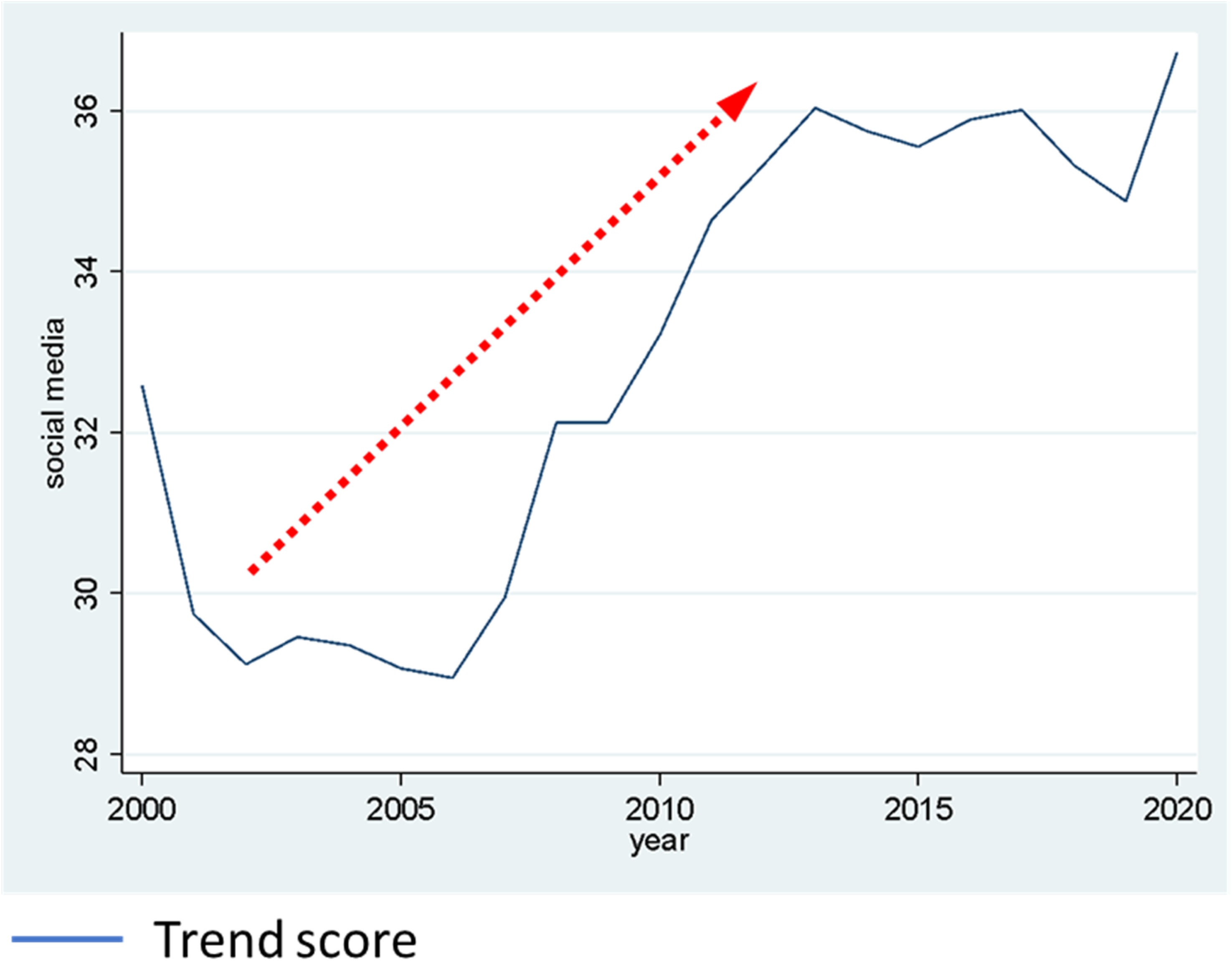
Trend of social media in land development projects.
Discussion and Conclusion
This study examines possible indicators that are related to regional dynamics, such as collaboration and public opinions that influence population and employment growth. Our study makes two important contributions. First, our findings contribute to the scholarly empirical literature about the relationship between collaboration and population and employment growth. Two collaboration variables we test in this study measure different approaches. One is formal and involves more legal and economic coordination while another is informal. Our analysis demonstrates that regular participation by local government staff promotes population and employment growth. A possible explanation for this finding is that informal staff participation brings good relationships and trust that help to resolve economic development conflicts. Communication is important, especially in economic development projects involving local governments and developers. Effective communication between parties helps them to explore their common interests and to deal with real problems in a way that helps to resolve conflict (Kempf, 2002; Massey & Dawes, 2007). Open communication improves cooperation because it helps groups to discuss challenges honestly and consider the viewpoints of others (Balliet, 2010).
Collaboration among local governments is important for their growth. The literature has shown that collaboration that builds trust among stakeholders and makes communication and the sharing of information easy, helps bring economic advantages to communities. If local governments improved their trust and relationships with nearby municipalities and collaborated more often, economic growth and development may be more sustainable. Intermunicipal collaboration improves service efficiency, quality, and effectiveness (Benton, 2013). In this study, we test for an association between different types of collaborations and population and employment growth. Building collaboration within regions to increase trust and support public input is one way to build more trust. Building trust within a municipality may require regional participation, though this might also undermine it, depending on circumstances and municipal capacity. Our finding on collaboration shows that having a shared community vision would give localities a guide and increase the capacity to shape local economic growth.
Second, our study shows the value of effective traditional and online public participation tools on municipal growth. It suggests that some techniques are more effective in certain conditions. Our results somewhat support the literature in that no single method fits every situation (Brody et al., 2003; Rosener, 1978). Planners use many different techniques for citizen participation, and they tend to choose their techniques depending on the specific information being sought by a local government. Which techniques are used is typically based on the preferences of local governments, and some techniques serve certain communities well (Brody et al., 2003). Therefore, local governments need to find the right techniques and measurements to understand the participants and their activities (Rosener, 1978).
Engaging the public may not be directly associated with population and employment growth, but we find that online public participation is an important tool for successful local development projects. Public participation results show that online participation tools are more appropriate for the municipality's growth. Our semantic search results align with the regression analysis showing that there is a growing number of local governments using online engagement tools. More local government agencies use websites, project websites, and social media as their engagement tools because local governments with more networks may expect to have higher citizen satisfaction (Helliwell & Putnam, 1995). Local economic development projects impact a broad area and a diverse population, so utilizing several engagement tools, focusing on citizens’ lives rather than strictly defining municipal boundaries, and bringing representatives from different cities into the discussion are important (Frug, 2000). Recent online participation methods provide these bidirectional communications with diverse interactions (D’agostino et al., 2011).
Online applications are already commonly used in regional development. Many local governments have combined the common forms of citizen participation with more two-way communication styles to understand the key issues (Ebdon, 2002). To help communities, there are no citizen participation techniques that should be abandoned; rather, they should be supplemented with other techniques that provide two-way communication that may help to improve outcomes. Engaging different stakeholders in the community development process would save time and unnecessary costs and reduce the rational ignorance of citizens.
Some limitations are present in this study. We focused on midsize municipalities, which we expect to be in a similar range of economic development and growth to limit outliers. However, it would be interesting to include all MSAs for better generalization of the study. We include certain types of traditional and online public participation in our analysis, but it would be fruitful to include other forms of public participation and citizens’ satisfaction with different public engagement tools in future research. Not only do the different engagement tools matter, but they are also important for understanding how much citizens are connected and involved in the decision-making process. Therefore, governments should include effective citizen participation in the planning and development process and focus on networks among municipalities and citizens. To involve citizens with satisfaction as important players in the planning or development process, it is critical to create a pleasant framework for engagement and communication with the public, rather than passively monitoring citizen complaints and their needs.
Economic development projects can involve high risks, but local governments can reduce this uncertainty through collaboration and public participation. This study examined claims of the importance of collaboration and citizen participation under local land development projects. Our finding supports the literature that municipal growth is better addressed when there is collaborative planning by local governments, which accounts for their needs and strengthens the dialogue between different communities across a region. Additionally, the findings do not represent all forms of online and traditional public participation, but they are consequential in demonstrating that online public participation is more effective in municipal growth. This paper may help local officials to understand and focus on types of collaboration and public participation in local economic growth.
Footnotes
Declaration of Conflicting Interests
The author(s) declared no potential conflicts of interest with respect to the research, authorship, and/or publication of this article.
Funding
The author(s) received no financial support for the research, authorship, and/or publication of this article.
