







Abstract
As part of a broader project focused on gender in economic development, this research uses interview data collected in 2024 and 2025 to understand the role that women play in the practice of economic development and to consider whether contributions of women working in the field of economic development have changed the practice and perception of the field. The findings underscore the importance of addressing gender and other disparities in the field of economic development and note that such efforts will require purposeful recruitment and mentoring, as well as the creation of inclusive workplace environments. Shifts in the demographics of the field demonstrate increased diversity and increased attention to equity as well as the care economy. However, ongoing structural biases and the encumbrance of cultural taxation suggest the need for increased institutional supports and the cultivation of emerging leaders from diverse backgrounds.
A compatriot of economic development, the field of urban planning has made strides toward a more diverse workforce that works to create inclusive, diverse, and equitable cities (Arroyo et al., 2023; Turesky & Warner, 2020). The field of economic development, however, has been slower to diversify and to incorporate gendered and intersectional perspectives into its agenda (André & Weisinger, 2001). Still, like nearly every other facet of society, the field of economic development has grappled with broader societal shifts like diversity, equity, and inclusion (DEI) debates, post-pandemic economic changes, and generational turnover. In such times, it is important to document who is participating in and driving these shifts as such analysis provides a lens for understanding change within a field. Though women represent only one dimension of this demographic shift, they increasingly occupy important positions within the field of economic development and a growing portion of the total practitioner population. As of December 2025, women were at the helm of the economic development offices in 15 of the 25 U. S. cities with the largest populations. Among members who completed the 2025 State of the Field survey by the International Economic Development Council (IEDC), 51% were women (International Economic Development Council, 2025). Although neither figure gives a complete picture of how many women are practicing in the field, collectively they show the growing importance of women to the field in recent years. And yet, women's contributions to and experiences within the field remain understudied. This research seeks to fill that gap by examining the historical and contemporary roles of women in economic development and assessing how their presence relates to the field's evolution.
To recognize how the field of economic development is being reshaped by a more representative workforce, it is imperative to understand the viewpoints and practices of the practitioners motivating this change. Through an analysis of qualitative interview data collected in 2024 and 2025, this study examines how the contributions of women working in a historically male-dominated profession can provide insights into broader changes taking place across the field. Insights into how gender informs both the types of work being performed and the way that work is enacted, how representation relates to everyday decision making, and how practitioners perceive emerging changes in the focus of the field elucidate the ways an increasingly diverse workforce is reframing the practice of economic development. By exploring these subtleties, the research understands women's experiences not just as a unique area of study, but as a critical lens through which to investigate systemic shifts in the practice, priorities, and principles of contemporary economic development.
Preliminary findings suggest that women's experiences in the field are shaped by multiple intersecting identities that influence their professional roles, workplace dynamics, and visions for the future of economic development. As the demographics of the field continue to evolve, these insights are crucial for understanding the broader shifts occurring in economic development. This paper ultimately explores how gender relates to the work of economic developers and the lived experiences of women in the profession today, highlighting areas where progress has been made and where further efforts are needed to foster true inclusivity.
Literature Review: Women in Economic Development
Economic development as a profession has historically been male-dominated, with an early focus on deal making, boardroom negotiations, and incentives (Rubin, 1988). Much like women working in the planning field, women working in economic development were often passed over for formal leadership roles, despite significant contributions in areas like community development and grassroots urban initiatives (Hayden, 1982; Micklow et al., 2015). Looking at what was happening in the field of planning during the feminist movement of the 1970s and 1980s, one finds that an observable but lagged shift was also at play in the economic development field. Women began advocating for planning and economic development approaches that incorporate the lived experiences of women, particularly regarding access to housing, employment, and public services (Fainstein & Servon, 2005). However, there is little documentation of this shift, which is something that this research, in part, seeks to do. The following literature review explores the impact of women in economic development by highlighting what is known about their roles in facilitating inclusive growth and community-centered development and by identifying what is not yet known.
Historically, women have been underrepresented in leadership roles due to systemic barriers, including discrimination, lack of access to capital, and societal expectations around caregiving responsibilities (OECD, 2025). Early female entrants to the field contributed largely to what are considered the “softer” sectors, namely community development, community organizing, and social services (Katz, 2003). As the field of economic development continues to shift toward inclusive growth principles, the contributions of women are difficult to ignore.
Existing scholarship from related fields suggests that as women begin to take on more economic development leadership roles in public, private, and nonprofit sector institutions, the field may begin to center priorities like equity, sustainability, and community engagement (Dolan, 2000; England & Folbre, 2003; Stratton & Jackson, 2008). Moreover, a move toward practices that prioritize participatory decision making and consider long-term social impact may be expected (Fox & Schuhmann, 1999; Stiglitz, 2012). Future research may wish to explore the timing and magnitude of this shift, but the consensus among those we interviewed is that many of these changes can be observed in practice (see Findings for more on this).
The formal contributions of women to the field of economic development practice may be less understood, but there is much literature that demonstrates their important contributions to local and regional economies, specifically in three key areas: small business development/entrepreneurship, affordable housing, and workforce development. Small business development and female entrepreneurship are critical to economic growth and poverty reduction, especially in disadvantaged neighborhoods (Allen et al., 2007; Devine et al., 2019; Yunus, 2007). Existing literature has identified the benefits to job creation and economic diversification of women-owned business ventures (Brush et al., 2009). Other scholarship has demonstrated the importance of embeddedness and the small, but strong ties that women entrepreneurs have to entrepreneurial networks within their communities (Chamlee-Wright, 1997; Minniti & Nardone, 2007).
Women have also been highly visible on the frontlines of the affordable housing movement, which is a key component of community development. Chikwe et al. (2024) and others found that organizations and movements headed by women are more likely to adopt holistic practices that effectively integrate sectors like housing and economic empowerment initiatives. Schwartz (2014) also found that having women in housing policy leadership positions leads to more inclusive housing development strategies that focus on both avoiding displacement and equitable access to safe, affordable housing for low-income populations (Schwartz, 2014).
Workforce development is another domain in which women have played a critical role, particularly in their propensity to center marginalized populations. In their work on vocational and workforce education, Ray et al. (2018) found that while these programs may provide economic opportunity, they also can exclude or limit the participation of women and thus argue that programmatic efforts and decisions should reflect the people being served. Existing studies found that programs like this are particularly beneficial to economic mobility among single mothers and women of color (Gault et al., 2014; Warner, 2006).
Collectively, women have made visible contributions to the subfields of small business development, affordable housing, and workforce development. However, there still is no single data source that provides a complete picture of how many women work in the economic development field nor in director positions, specifically. Secondary data that aggregate public resumes, job postings, company filings, as well as public and open data from government sources like the U.S. Bureau of Labor Statistics (BLS) and the U.S. Census, estimate that 35.9% of economic development directors are women (Zippia, 2025). When combined with the IEDC survey results and the review of the economic development leaders in the 25 largest U. S. cities, these figures paint a clearer, albeit imperfect, picture of the employment and leadership landscape. Research that focuses on understanding the employment landscape and closing existing gaps should be a priority for scholars working in the field of economic development. Such scholars would be wise to focus on identifying best practices for increasing women's representation in the field. My research provides an important step toward that end by describing the state of the field today from the perspective of a sample of women with current or recent experience in the field.
Data and Methods
A purposive sampling strategy was utilized to recruit participants with substantial professional experience working in the field of economic development in the United States. Participants were recruited through a combination of targeted outreach to professional networks, announcements distributed through relevant listservs, and direct email invitations to individuals identified through organizational websites. Given the field's decentralization across municipal, regional, nonprofit, and quasi-governmental entities, there is no definitive nor complete list of women working in the field of economic development. Probability sampling is therefore not feasible. Instead, a purposive, network-assisted recruitment strategy was employed to identify practitioners with relevant expertise across diverse organizational settings. Such an approach is appropriate for qualitative research conducted in contexts where the population is undefined and where analytic generalizability, rather than statistical analysis, is the goal (Patton, 2014).
The final sample consisted of 52 participants, including 43 practitioners currently working in economic development and 9 individuals with at least 10 years of prior experience in the field (see Table 1). Interviewees in the latter category were either retired or now working in an adjacent field. All interviewees identified as women and use she/her pronouns. Interested individuals completed a brief screening to confirm eligibility. Interviews with practitioners were conducted virtually in 2024 and 2025 and lasted approximately 45–75 minutes each. The study protocol was reviewed and determined to meet the criteria for exemption from institutional review board (IRB) oversight.
Interviewee Attributes.
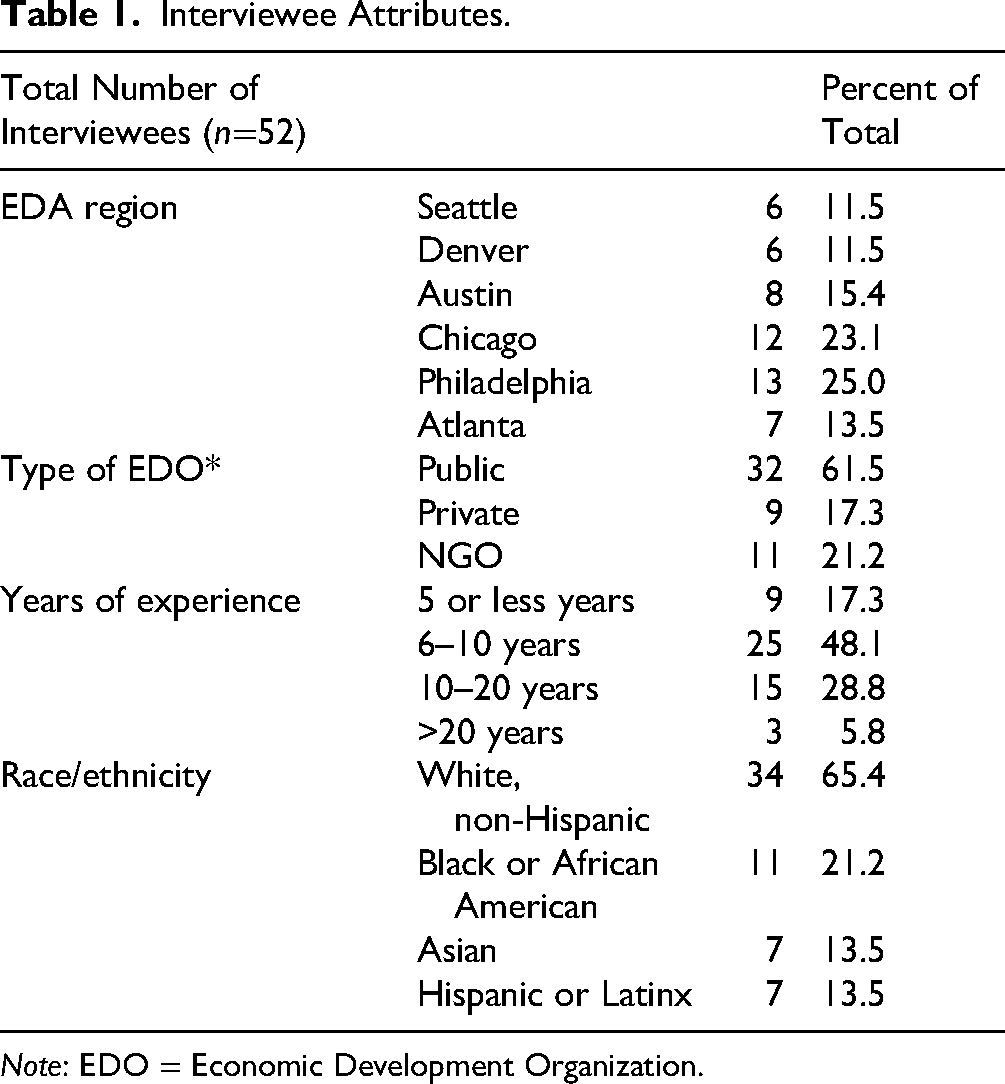
Note: EDO = Economic Development Organization.
With participants’ consent, all interview recordings were transcribed using embedded Microsoft Teams software and then edited for accuracy and consistency in data representation. The qualitative interview data were analyzed using thematic analysis followed by structured coding. To enable familiarity with the content, all transcripts were read a minimum of three times before proceeding with a first round of open coding by the author. The first round of coding aimed to identify preliminary concepts and patterns, as well as key phrases. Initial codes emerged through an inductive process, whereby recurrent themes and patterns emerged from the data. The initial codes were then reviewed and refined so that similar codes could then be grouped into broader categories. The data were reviewed and the codes refined as new insights were revealed. Refined codes were then grouped into broader themes that convey the main ideas and patterns revealed in the analysis. Thematic maps were utilized to visualize relationships between themes and subthemes. For reliability and consistency purposes, a colleague engaged in the same process for a subset of transcripts (n=5). Discrepancies were identified and remedied until consensus was reached.
Findings
Among all interviewees, four primary themes emerged: 1) the practicalities of navigating an historically male-dominated field; 2) gendered division of labor both within one's own workplace and the broader field; 3) a recognition of the importance of intersectional representation among both economic development leadership and the community stakeholders with whom they work; and 4) observations that the focus of economic development is changing in unison with a changing workforce.
Navigating an Historically Male-Dominated Field
Without exception, all 53 interviewees mentioned the nuanced practicalities of navigating the historically male-dominated field of economic development. Many interviewees explicitly understood that their success in the field would need to be earned. As one interviewee astutely observed: Each deal and each transaction validates who you are in this space… But I also do believe that there's still that good ole boys’ network, right? I’m not on the golf courses. Although I do go to the little putting greens, but there are no deals being made on my little putting green.
The concept of the “good ole boys’ network,” whether named or implied, came up in most interviews, mainly regarding questions about how it feels to work in economic development. Interviewees also mentioned situations including inappropriate comments about their appearance, family planning, and leadership capabilities. Double standards were also named as a difficulty for many interviewees, particularly for women in leadership roles who perceived that they face higher expectations and harsher critiques compared to their male counterparts. Women leaders are often expected to be both authoritative and nurturing, leading to a difficult balancing act where assertiveness is sometimes perceived as aggression, while a more collaborative style can be seen as weak. In her early days of working in a manufacturing-based economic development position, one interviewee observed the following scenario: Manufacturing, which is where I did start my career, had very few women at any level of senior management. [The company] had one woman at the top and she had sort of clawed her way there. And you know, we all knew her as a yeller. And, you know, people used to say, well, she has to be that way because that's the only way that the men would take her seriously. I always sort of looked at that and thought,…there's gotta be a way of having power and being respected as a woman that is not that, but I tried to have empathy toward her, for what she had to do to get to where she was.
Interviewees also mentioned disheartening recollections of pumping breastmilk in custodian closets, expectations to participate in after-hours socializing and networking in ways that male colleagues did not, and other uncomfortable workplace dynamics. Among the more alarming recollections was the following anecdote: My boss and I are sitting at the airport. My boss said, ‘Are you going to have children?’ And I said ‘I don't know.’ And he said, ‘Well, I'm asking because, you know, I've invested a lot in a lot of women and it's really disappointing to me when I invest all this time and, you know, energy into them and then they have kids and then they don't come back to work.’ And I mean … like men don't have to deal with that, right?
While this quote only pertains to one interviewee, the challenges of balancing family/caregiving obligations with the demands of working in a male-dominated field that often has unpredictable work hours was a resonant theme in the interview data. So, too, were ideas about gendered norms when it comes to attire. A different interviewee highlighted a practical challenge of being a woman in the field: balancing professional attire with site visits. “I’d have to be in a hard hat and jeans for three hours, then go to a board meeting (in a business suit) in the afternoon.” She noted that while expectations have relaxed post-pandemic, early in her career the pressure to maintain a polished appearance was significant.
A Gendered Division of Labor
A second theme observed among the interview data is the idea that there remains a gendered division of labor within the field of economic development. A frequent refrain among interviewees was the observation that women are more likely to work in subfields like community and small business development, while men dominated higher-stakes deal-making and real estate projects. Of the oft-cited rationales among interviewees for why this division persists, two were most salient. First, interviewees noted that, whether true or not, there are perceived differences in the strengths and skills that women bring to their work, something that social scientists ascribe to a phenomenon called second-generation gender bias (Schachter, 2017). Second, interviewees also surmised that there may be structural reasons why women disproportionately work in certain subfields and in nonleadership positions, namely because the field has traditionally relied so heavily on networking and personal connections in ways that may inherently reinforce and perpetuate existing path dependencies.
Deal making—the negotiation and creation of contracts between government and the private sector with the goal of stimulating economic growth—has traditionally been the most visible pillar of economic development (Rubin, 1988). Interviewees noted that many women possess a unique set of traits or skills that do not often translate to deal making. If the ability to negotiate well is a perceived strength of the deal maker, it is perhaps unsurprising that women would be less likely to be considered for or to opt into positions requiring that skill. Existing literature on second-generation forms of gender bias, which can best be described as a subtle form of discrimination stemming from practices and normative gender-based patterns of interaction, found that these perceptions and practices are often thought of as neutral but in fact actively disadvantage women (Schachter, 2017). Such scholarship aligns with the interview data, as highlighted in the following sentiments: I do think that there has been a perception that to run a major economic development function of a major U.S. city, it's about deal making. How to be a woman in that field in a major U.S. city and have…some of the other strengths that women sometimes bring outside of just sort of the hunting and the deal making, I think is still something we haven't quite figured out. I see a lot of women in economic development in research, and I certainly see plenty of women in economic development working with small businesses, but you don't see a lot of women in economic development running major departments of cities.
Other interviewees also reflected on the gendered norms regarding perceptions of who is capable of what within the economic development field. One interviewee mentioned how “at the beginning…I came in just listening, observing, understanding who the players were, what deals were done, and hearing whether or not that person was a reliable or good person. Can you trust them?”
Another interviewee who is now in a leadership position said: Historically, the people that were in the role that I stepped into… they were men that came out of real estate development. They were deal makers. But I do think … you see more men doing the big deal-making stuff and women more doing the cute little small business, community economic development part. But you know the (deal making) is only one form of economic development. I also think what we did, in its purest form, was also economic development.
Adding to the conversation about why this observed division of labor might be so pervasive, one interviewee remarked on what she perceived as the strengths of women working in economic development: I do think that the collaborative decision making and even idea-generating style that… definitely feels more (like) a feminine trait, but I have these other traits, like— “Alright, we're gonna make up our mind. We're going to get something done. We're going to measure it.”—that might be traditionally considered more male attributes, but I think women have an amazing capacity to be both.
This interviewee's ability to see the blending of feminine and masculine character traits suggests that there is an ongoing shift within the field, a sentiment shared by many other participants. Another interview noted that women in economic development bring energy and initiative: "By the time they’re thinking about it, I’m already on it." She described women as natural conveners and collaborators, often taking the lead in organizing events and driving engagement. Similarly, another interviewee saw women as bringing a distinct approach to deal making. “Women are more detail oriented. We look at the complete landscape of a deal.” She pointed out that women tend to consider broader community impacts, such as how a project affects residents, neighborhood dynamics, and equity concerns.
When it comes to leadership opportunities for women in economic development, the interview data are more nuanced. While some interviewees observed an increase in women leaders, others perceived lingering inequities. As one interviewee—a manager of a mid-sized city's economic development agency—noted, “My organization, [name redacted], 15–20 years ago had more women in leadership than was typical at the time.” However, when she engaged in statewide or national organizations, she saw the field was “all white men, all white guys in ties.” Still, she acknowledged shifts over time, particularly starting around 2010, when she observed that more women began taking leadership roles.
Others who noted seeing a recent rise in female leaders within economic development surmised that this change might have something to do with formative changes in how the field operates. One interviewee attributed the increase of women in leadership positions to the field's growing reliance on data rather than networking and personal connections. “We aren't as reliant on the good ole boys’ network anymore. Now, we rely on true data to help us with decision making.” She believes this shift has made the field more accessible to women who might not have been able to participate in traditional networking events due to family obligations, caregiving responsibilities, and other gendered norms.
Similarly, another interviewee pointed out that women now hold critical roles in addressing pressing urban challenges, particularly housing and community development. “There's amazing female leadership in those roles, and I think that generationally, that's going to continue.” Reflecting a general sense of optimism among most interviewees, one interviewee ended her interview with her hope of seeing “an all-women site selection team” and more female leadership in economic decision-making roles. Still, she worries that even if that does happen, she asserts that women's contributions are still underrecognized: “We’re doing the work, but it's not being talked about enough.”
The Importance of Representation
As women begin to make up more of the economic development workforce, there may be broader benefits to both the field and to society, particularly in terms of representation. Interviewees unanimously touted the benefits of having a more diverse workforce. Many interviewees emphasized that having diverse leaders in decision-making roles leads to more inclusive and community-focused economic strategies. Interviewees frequently provided specific examples of projects that they perceived would never have come to fruition if underrepresented voices had not been there to advocate on their behalf. One interviewee mentioned how a Black female mayor's presence at the decision-making table had been a primary motivator for her city's attempts to lure an historically Black university to the downtown. She noted that leadership representation can shape economic development priorities: Clearly the genesis of an idea like that is reflective of who she is, you know, both racial and gender orientation. So, I think certainly you're going to have a much broader diversity of ideas if you have more representation in the group generating the ideas as well as more authenticity when you're trying to implement some of those ideas… So, that's my short answer. Of course, [representation] matters.
Interviewees frequently mentioned how representation also matters to clients and constituents during face-to-face interactions. One interviewee, in reflecting upon her role in standing up for two significant small business development programs, said that "it makes it a lot easier when you are a woman and you're talking to women-owned businesses." Relatedly, that same interviewee noted how important influential women who actively promoted female advancement had been in her own path to standing up for these new organizations.
Perhaps one downside is the pressure that may come from being one of the first people from an underrepresented population to work in the economic development field. This pressure may manifest itself in terms of emotional labor and expectations of access. More than one interviewee remarked that being a woman of color in leadership is both empowering and exhausting. One interviewee who identifies as a Latinx woman and works in the community development space noted that she feels pride in her work because she recognizes that “it just is easier and more comfortable for borrowers… to speak to someone who's similar to them.”
A Black female CEO noted in her interview that it is empowering because clients and constituents can become emotional when they see someone who looks or identifies as she does. But she says community members also expect personal access to her. “They sometimes project their hopes on me and that's a lot to carry. I am the queen of unpaid [emotional] labor.”
To lessen that load, interviewees frequently mentioned the importance of building a stronger pipeline of female practitioners in the economic development space, including hiring more people from underrepresented groups and developing robust mentoring and networking opportunities for those that do enter the workforce. One interviewee recalled: I think about how lucky I was to have this first mentor. You know this woman who was like a saint and but like just so committed to the work, so committed to… social justice. And to be able to work under her and see her commitment and her ability to just bring so many different voices to the table, it was just incredible. So, I think about how lucky I was to have that experience.
Speaking from the mentoring side, one interviewee spoke about how she mentors within her own organization: So, I feel like I'm everyone's mother… I have a group of the women or young ladies over from the office and fix food and wine and we talk and (I) check in on them. Are you doing your 401K investment? What's your vision after this (position)?
Numerous interviewees underscored the importance of mentoring both to themselves and to other women during salary negotiations. In talking about her own experiences negotiating salary, one interviewee was thankful for a male colleague who told her when and how to ask for more. But she also said, “I'm sometimes my least-best cheerleader… We're not wired for it.
And then in all honesty… I feel like I'm actually kind of looked at in a way where, ‘Oh, she's married…She has a good husband, he does well, why does she really need to be making that much money?” So, despite receiving what she perceived as good mentoring, structural barriers prevented her from acting upon the sound advice.
Another interviewee described the disappointment she felt in finding out that her male peers were making much more money than she was: I was on the partner track in a consultancy, and I knew I was the highest ranked of all the senior managers because of the process that we did, you know performance reviews. I was out for drinks, so a bunch of my male colleagues started talking about how much they were making. And I found out I was easily like 30% less than everybody else. And it's just because I was so grateful for what I made, which was so much more than what my mom made growing up. And I just assumed I'd be taken care of, whereas my male colleagues would just advocate for themselves every year. And I keep running into women at different phases of my career who still have done the same thing. I don't know what that is about and what it is in our psyche that causes us to think, “Uh oh, you know, it'll offend people, or I don't want to be like that. I don't wanna be pushy.” I think it's not just economic development, but clearly, it's probably pervasive as well in economic development.
Unsurprisingly, that same person ended the interview noting how she had recently mentored a female restauranteur in her building on how to negotiate for a higher hourly wage.
A Focal Change Within the Field
Observable shifts in workforce composition within the field of economic development begets the question of whether the focus of the work will shift as well. To that end, a major thrust of the interview protocol allowed interviewees to reflect on whether they have observed shifts in how the field operates and in terms of what constitutes economic development. Experienced women were often able to point to specific changes they had observed during their career, while those who more recently entered the profession either spoke of second-hand accounts from more senior practitioners or of how their understanding of the history of the economic development field compared to their lived realities in the profession. When asked about the focus of their work, interviewees unsurprisingly referred to classic economic development approaches like deal making, real estate development, and retention strategies. But they also mentioned a myriad of ways of thinking about and performing economic development, and in so doing, spoke enthusiastically about how meaningful this other work can be. The focal changes they observed can best be categorized into three main categories.
The most salient theme to emerge from these interview questions about the practice and focus of economic development was caregiving, and most often childcare specifically, as a growing focus of the field. Though existing literature has long made the case for childcare as economic development (see Warner & Prentice, 2013), most interviewees noted a more recent push among practitioners to do so, namely in the context of the COVID-19 pandemic. One interviewee who hailed from New York City noted, “I think [the focus on childcare] is an interesting thing that is really sort of evolving in real time. I mean, we used to in the olden days consider childcare and education as sort of female issues. And I don't think I think about it that way any longer.” She went on to describe discussions about childcare within her organization and the internal debates that changed how leadership thinks about childcare.
For one interviewee working in small business development, the realization that childcare is and should be a focus of economic development came about in observing the women with whom she worked. So, there are a lot of women-owned businesses that I've actually worked with that say, you know what, I can't be in the office… I can't be here at the boutique like 8 h because I also have kids. Somebody has to go pick up the kids, so I just put a ‘closed’ sign. I go pick up the kids, I bring them back and I have a little area for them where they can sit and they can play and they can do their homework while I'm over here trying to do my work.
Such tales, which were not uncommon among interviewees, underscore the gendered impact of caregiving on workforce participation (Lee & Tang, 2015). These stories matter because interviewees noted that they often fueled in-house or broader conversations about caregiving and its impact on both local communities and the larger economy. Interviewees observed an uptick in these conversations during and after the COVID-19 pandemic, when cracks within the existing caregiving framework revealed themselves (Beach et al., 2021). As one interviewee noted: We really began to focus on caregiving during the pandemic. The small business owners we work with were in crisis, worried about how to keep their business open and keep their family safe and happy. So, we joined a regional data collection effort to get a sense of the scale of the problem. I don't think that would have happened if the pandemic hadn't shined a light on things.
Interviewees purported that what was once framed as a “female issue” is now increasingly seen as an evolving workforce policy concern.
A second observable shift noted by interviewees pertains to expanding and creating opportunities for marginalized communities to participate in the economic development process. As one woman noted: [Women] can see the big picture and long-term impact that this could have for a community, but we also are very in tune with our community… I don't know whether or not all women are maternal, but I think it's all about women being [the] center of community…to ensure that the right people are in the room and not wasting people's time.
From this interviewee's perspective, a woman's strength lies in her ability to both expand the decision-making table and to frame the content and context of the decision-making process. In so doing, she argues that economic development practitioners can better center the communities with which they are working. Another interviewee remarked on the importance of intersectional considerations when thinking about who is and who should be included in the economic development process. She noted: I think, honestly, having more seats at the table and conversations [is important] … But I think it's also more important…to have more minority women in these places and in the room to help with the thought process of how we do this economic development work. And I think it's important to have voices in that room that give a different perspective than what's been done for the last 50 to 100 years.
Another interviewee mentioned how important it is that representation within her organization reflect the makeup of the community that they serve, noting that she actively seeks to hire people “who have a combination of skills and lived experiences necessary to work here. Our culture and process are different, and our problem solving looks different as a result.” In her case, that meant hiring nearly all women and all people of color, a majority of whom are also mothers.
Collectively, the idea of expanding the decision-making table was noted in most interviews, regardless of employment tenure, race, ethnicity, or geographic location. Anecdotal evidence from the interviews suggested that these changes may be afoot in some places, but that future research may wish to examine whether the field has been able to make this a reality more broadly.
The third observable shift in practice was a growing recognition that practitioners in the field are not just working toward expanding the decision-making table but are using this increased representation to create more economic opportunities for marginalized communities. As one interviewee said, “having more women in these positions will mean that we decide where money goes and how resources get dispersed.” She and other interviewees remarked on how representation and lived experiences translate into decisions about policies, priorities, and practices. Another interviewee remarked that the composition of her organization's team has directly impacted their development and outreach process: This is a leadership team that I built because I knew it had to be different than what we usually see in these organizations. People who have lived experiences. As a result, partnering with organizations looks different, how we design programs looks different.
Another interviewee talked about how her experiences as a Black woman affects the way she approaches her community economic development work. “It feels personal when we negotiate a deal. We make sure we get a good deal when we acquire property. If we overpay, we then have less equity to invest in other projects.” Given her organization's focus on helping people from underrepresented groups acquire safe and affordable housing, as well as access to commercial capital, it's no wonder they pride themselves on successful negotiations that put them in a better position to continue their equity-focused approach to economic development. Because of just our history of racial discrimination and all of the implications and disparities that you see from everywhere, from wealth to income to education, to, you know, educational attainment to criminal justice, and you know who's in prison. It's all of those factors (that) contribute to (economic) instability and so … there's no question that who…experiences the most harm from all of these failed and discriminatory systems. It's women. It's Black women.
An explicit focus on creating opportunities for Black women and others from underrepresented groups denotes a shift in the focus of the field and is a common refrain within a majority of interviews. One interviewee who works in workforce development mentioned how changes in leadership within her organization brought a change in the focus of their work. In her 12 years working at her present organization, she observed an increase in the number of women and others from underrepresented groups joining her as colleagues. Such shifts, she argued, have allowed space for discussions about how they approach their work. For instance, she remarked on how she and others have sought ways to supplement traditional economic development deals focused on high-paying jobs with a strategic focus on entry- or mid-level positions in life sciences and biotechnology. She remarked that: A lot of folks are like, why are you looking at that and really like pushing on that for opportunities? Because in that space, there's opportunities for someone that is not an advanced-degreed individual to be trained, certified, and go into a manufacturing role with a life science company starting at $55,000 to $60,000 a year.
The oft-mentioned claims about the importance of expanding or changing the composition of the decision-making table were typically followed by discussions about the role of said changes in moving the needle on economic development policies and priorities. While the qualitative data suggest a correlational relationship, the frequency with which this topic came up in the interviews suggests that further analysis would improve our understanding of how and why personnel changes relate to changes in agenda setting and in the practice of economic development more generally.
Implications for Practitioners
Addressing gender disparities and improving the work experience for women in the field of economic development remain important goals. To that end and drawing from the findings noted in the previous section, I offer five recommendations as potential starting points to address these concerns. Collectively, these efforts range from smaller, and likely more palatable, changes to fundamental shifts in the ways we conceive of economic development.
First, leadership ought to collectively reconsider how they identify, develop, and recognize early- and mid-career women practitioners. As numerous interviewees noted, recruitment and promotion practices may inadvertently prioritize negotiation or deal-making skills, while undervaluing other skills more often associated with women. One way to affect change would be to create clearer pathways for women who are interested in moving from community development roles into higher-stakes and negotiation-centric positions. For early-career women, such pathways may include a combination of structured rotations, fellowships, and deliberate shadowing opportunities. For those in their mid-career who may already be in formal or informal leadership positions, it is important to support their efforts through targeted professional development opportunities. Firms would also do well to recognize the unique contributions of women as central to the profession and as part of a more inclusive view of what effective leadership looks like, perhaps through the development of competency frameworks that recognize relational, collaborative, and community-facing skills.
Second, for such changes to take place, practitioners should consider ways to interrupt the second-generation gender bias that so many interviewees experienced. Such interruptions might include training for supervisors and teams on how implicit norms—such as perceptions about professional attire, networking approaches, or communication practices—relate to the ways in which leadership potential is assessed. Performance evaluations might also be retooled to objectively measure one's performance based on evidence and outcomes instead of gendered expectations around soft skills. Adopting data-driven approaches to performance and project evaluations, hiring, and promotion reviews will also help to deemphasize the legacy of historical networks. To limit gendered filtering of performance reviews and evaluations in general, the metrics being utilized should be transparent to all parties and broadly inclusive by design.
Third, the more that is learned about the unique contributions of women in the field, firms should be able to ensure ample opportunities to celebrate the achievements of women-led projects and to highlight innovations and leadership successes therein. Such celebrations could be observed within professional organizations, conferences, and publications. They might highlight achievements pertaining to community impact, equity outcomes, and representation as viable indicators of success, rather than just the oft-cited size or visibility of a deal. When such efforts are recognized, leaders and their teams may be encouraged to view small business support, inclusive economic development, and community engagement as being equally important to both the field and the economic competitiveness of communities.
Fourth, leaders who can do so would be wise to consider structural changes that protect women and underrepresented practitioners from being disproportionately burdened by representational pressure. As the population of these practitioners grows, leaders must develop guardrails to minimize the burden of invisible labor and cultural taxation. To be successful in that, leaders should focus on creating an environment in which practitioners are not regularly expected to speak for entire communities. Moreover, it is imperative that leaders equitably distribute diversity-related tasks. Such a shift will require strong institutional support like workload protections, more inclusive workplace cultures, and professional development. When developed, such systems will allow the profession to more effectively align its practices with its evolving demographic landscape.
Finally, interviewees frequently noted the need for a new vision of the way economic developers network and build relationships. While not all deals are made on the golf course or at happy hour, much of the networking still likely occurs in settings like these. A more inclusive means of networking may require a shift away from the exclusive, often informal or after-hour events that disproportionately exclude caregivers and act as gatekeeping mechanisms. More inclusive networking might instead include opportunities like structured roundtables, formal mentorship programs, or frequent cross-team meetings—all things that deemphasize personal connections, social capital, and after-hours availability.
Conclusion
The data reveal observable signals that the historically male-dominated, and often, white field of economic development is becoming more diverse. Still, nearly all interviewees mentioned the need for an economic development workforce that does even more to reflect society in terms of gender, race, ethnicity, and other identities. The data also reveal that, despite a rise of women in leadership, the legacy of male dominance and structural gender biases remains a challenge. Interviewees described outdated practices, restrictive networks, and gendered norms around management approaches and style of dress. Such challenges appear to be exacerbated in male-dominated subfields like deal making and real estate, where a persistent gendered division of labor raises questions about perceived aptitudes and the relative worth of economic development subfields. Interviewees were generally optimistic that ongoing mentoring, networking, and other professional development opportunities will help lessen some of these challenges.
The interview data also reveal that increased heterogeneity within the field means an increasingly diverse workforce and may also play a role in the observable changes we see in the focus of the economic development field itself. Nearly all interviewees underscored how important representation is in terms of identifying priorities and even the practice of economic development itself. Most notably, practitioners who have worked in the field for more than 10 years uniformly observed an increased attention over time to priorities like caregiving, inclusive community engagement, and equity-focused policies. While ascribing causality is beyond the scope of this study, the frequency with which interviewees noted the importance and relevance of lived experiences to the practice of economic development suggests that there may be a relationship between an increasingly diverse workforce and a broadening of the lens through which economic decisions are made. Future research may wish to consider this relationship in further detail. Similarly, it may also be informative to investigate whether the increased number of women in leadership positions corresponds with a change in mission statements or economic development plans to include a focus on equity, sustainability, or community engagement. It would also be insightful to replicate this research in settings outside of the United States to see if comparable changes are observed elsewhere.
Finally, many interviewees reflected on the challenges and responsibilities that come with being a woman or otherwise underrepresented person in the field. While increased visibility may include the ability to craft more inclusive policies and explore alternative solutions, it also may lead to something akin to cultural taxation (Joseph & Hirshfield, 2011), as well as uncompensated emotional or invisible labor and the pressure of having to represent entire communities. The expectation that a woman or someone from an underrepresented group will provide an authentic or all-encompassing view of their gender or culture is an unfair burden and should not be overlooked. Such a burden further underscores the need for robust institutional support, including adequate mentoring and a workforce development pipeline that ensures further diversification in the future. Together, the research findings demonstrate that as the demographic makeup of the field evolves, so too does the scope, trajectory, and professional development needs of economic development itself.
Footnotes

Ethical Approval and Informed Consent Statements
The Virginia Tech Human Research Protection Program (HRPP) determined that this protocol (23-1177) meets the criteria for exemption from IRB review under 45 CFR 46.104 (d) category(ies) 2(ii).
Funding
The author received no financial support for the research, authorship, and/or publication of this article.
Declaration of Conflicting Interests
The author declared no potential conflicts of interest with respect to the research, authorship, and/or publication of this article.