







Abstract
This study draws on semistructured interviews with 19 white, rural, straight-identified men who have sex with men to understand how they perceive their gender and sexuality. It is among the first to use straight men’s own narratives, and helps address the underrepresentation of rural masculinities research. Through complex interpretive processes, participants reworked non-normative sexual practices—those usually antithetical to rural masculinities—to construct normative masculinity. Most chose other masculine, white, and straight or secretly bisexual men as partners for secretive sex without romantic involvement. By choosing these partners and having this type of sex, the participants normalized and authenticated their sexual encounters as straight and normatively masculine. The participants engaged in bud-sex, a specific type of male–male sex that reinforced their rural masculinity and heterosexuality. The married men framed sex with men as less threatening to marriage than extramarital sex with women, helping to preserve a part of their lives that they described as central to their straightness. The results highlight the flexibility of heterosexuality; the centrality of heterosexuality to normative rural masculinity; how similar sexual practices carry different meanings across contexts and populations; and the social construction of masculinities and sexualities by age, race, gender, time period, and place.
Mainstream understandings of heterosexuality emphasize that straight men’s attractions, behaviors, and desires should be oriented exclusively toward women, and yet research indicates that some straight-identified men have sex with other men. There are multiple reasons why some men who have sex with men (MSM) identify as straight, including internalized heterosexism, participation in other-sex marriage and childrearing, and enjoyment of straight privilege and culture (Ward 2015). Few interview-based studies of straight MSM exist, and previous studies focus on urban, military, or prison contexts. Most are part of a sexual health literature that problematizes straight MSM as a vector for HIV transmission (e.g., Barnshaw and Letukas 2010). Others use content analyses of Craigslist ads or other materials to theorize about this population (Robinson and Vidal-Ortiz 2013; Reynolds 2015; Ward 2015). 1 Counterintuitively, straight-identified men who post ads looking for same-sex sex may be distinct from those who engage in it: as Robinson and Moskowitz (2013, 562) found, straight-identified men often viewed Internet cruising, posting, and emailing as “self-contained erotic acts” that did not transition into offline behavior. Given that online ad representations may inaccurately reflect the narratives of straight MSM—and will at best capture only snippets of their lives—researchers need to conduct interviews for fuller insight. Additionally, there is a widespread urban focus in sexualities and gender literatures (Halberstam 2005), which obscures the role of geography in the construction, maintenance, perception, and experience of gender and sexuality. As Connell and Messerschmidt (2005) explain, researchers should examine masculinities that differ by place; few have done so with rurality (exceptions include Morris 2008). By using interviews, this study is one of the first to examine how straight MSM themselves understand their own genders and sexualities, and how rurality affects these perceptions.
How do rural, white, straight MSM understand their gender? Through complex interpretive processes, participants reworked non-normative sexual practices usually antithetical to rural masculinities to actually construct normative masculinity. Participants selected male sexual partners on the basis of masculinity, race, and sexual identity. Most chose other masculine, white, and straight or secretly bisexual men for secretive sex without romantic involvement. By choosing these partners and having this type of sex, the participants normalized and authenticated their sexual encounters as straight and normatively masculine. The married men framed sex with men as less threatening to their marriages than extramarital sex with women, helping to preserve a part of their lives that most described as central to their straightness.
Rather than referring to participants as MSM, a public health term, I describe them as guys who engage in bud-sex. I use “bud-sex” when referring to the participants’ sexual activities and “MSM” when referring to broader populations of straight men that have sex with men. 2 Similar sexual practices carry different meanings across populations and contexts, including among different groups of MSM. Ward (2015) examines dude-sex, a type of male–male sex that white, masculine, straight men in urban or military contexts frame as a way to bond and build masculinity with other, similar “bros.” Carrillo and Hoffman (2016) refer to their primarily urban participants as heteroflexible, given that they were exclusively or primarily attracted to women. While the participants in this study share overlap with those groups, they also frame their same-sex sex in subtly different ways: not as an opportunity to bond with urban “bros,” and only sometimes—but not always—as a novel sexual pursuit, given that they had sexual attractions all across the spectrum. Instead, as Silva (forthcoming) explores, the participants reinforced their straightness through unconventional interpretations of same-sex sex: as “helpin’ a buddy out,” relieving “urges,” acting on sexual desires for men without sexual attractions to them, relieving general sexual needs, and/or a way to act on sexual attractions. “Bud-sex” captures these interpretations, as well as how the participants had sex and with whom they partnered. The specific type of sex the participants had with other men—bud-sex—cemented their rural masculinity and heterosexuality, and distinguishes them from other MSM.
The results demonstrate the flexibility of male heterosexuality and the centrality of heterosexuality to normative rural masculinity. First, the participants interpret same-sex sex as compatible with heterosexuality. It is not the sexual practices themselves but individuals’ interpretations of them that are central to sexual identity and gender. These findings complement previous research, which reveals the extent to which heterosexual masculine homosociality structures and gives meaning to other-sex sexual encounters (Flood 2008). While there is a framework to describe women’s sexual flexibility—“sexual fluidity” (Diamond 2009)—there is no such framework for men. Straight men’s sexual flexibility is often described as indicative of lessening homophobia (e.g., Anderson’s 2008 study of young men), when it also demonstrates that male heterosexuality is fundamentally flexible across the life course. Second, heterosexual identification is key to constructing normative rural masculinity. While the participants’ sexual practices did not align with mainstream definitions of heterosexuality, their identification with straightness—and their interpretations of their sexual practices that reinforced it—bolstered their normative rural masculinity. Given that normative masculinity is critical for social acceptance in rural areas, identification with heterosexuality to bolster normative masculinity was especially important. The findings reinforce the centrality of place for how individuals identify and express their sexuality and gender.
The Social Construction of Sexuality
How individuals understand and experience sexuality is profoundly social: scripts (Simon and Gagnon 1986), discourses (Foucault 1978), and interactions between individuals (Plummer 1996) and between structures, agency, and practice (Stein 1989) all inform perceptions of sexuality and the forms sexualities take. Cultural norms about what sexual practices are acceptable, their significance, their relation to identity, and even what practices are considered sexual are all socially constructed (Foucault 1978). Identification based on sexual behavior emerged only in the late nineteenth century (Chauncey 1994; Foucault 1978). As Sedgwick (1990) explains, defining individuals in this way is only one of many ways sexual identities could potentially operate. Sexual identities are socially constructed and differ by culture and time period (Katz 1995), and often these identities cannot fully describe complex combinations of sexual practices, attractions, and desires. Relatedly, the relationship between sexual identity and gender practices differs between cultures and time periods. Current ways of identifying individuals reflect new ways of defining acceptable gender practices in response to changing gender dynamics in workplaces and education in the late nineteenth and early twentieth centuries (Chauncey 1994), as well as late nineteenth-century medical discourse (Foucault 1978). Gender performance and sexual practice, rather than biological sex or attractions, were key for understanding sexuality in the late nineteenth and early twentieth centuries. At that time, many conventionally masculine men who penetrated men, before heterosexuality was introduced as an identity, were considered “normal” (Chauncey 1994). This continued in some rural areas into the mid-1900s, where same-sex sex involving “normal” men was common, albeit often intentionally ignored (Boag 2003; Howard 1999; Johnson 2013). Understandings of sexual identities and practices also differ between and within cultures. Among some MSM in Mexico, men who are penetrated are considered gay, while those who penetrate are perceived as straight (Cantú Jr. 2009). Within the United States, individuals with similar sexual attractions may adopt different sexual identities because of a differing emphasis placed on sexual attractions and current sexual behaviors (Rust 1992) or the presence—or lack thereof—of emotional attractions (Adam 2000). In addition, stereotypical views of sexual identities (e.g., lesbian women are butch) may affect the one that individuals adopt (Kitzinger and Wilkinson 1995). Sexual identities reflect culture, time period, social structures, and personal interpretations.
Despite increasing acceptance of same-sex sexuality, hegemonic masculinity remains distinctly heterosexual (Connell 1987). Homophobia is often a key aspect of normative masculinity (Kimmel 1994), and from a young age: Pascoe (2011) explores how boys utilize a “fag discourse” to regulate the masculinity and heterosexuality of peers. Similarly, many measures of normative masculinity—such as support for all-male institutions—are related to homophobia (Britton 1990). The relationship between heterosexuality and normative masculinity remains, even as overt homophobia has lessened in many contexts (Anderson 2008; Bridges 2014; Connell 2005; Dean 2014; McCormack 2013). Heteronormativity is entrenched within U.S. institutions and is strongly related to normative masculinity, which affects men’s sexual identification, practices, and interpretations. This article draws on Connell’s (1987, 2005) framework explaining gender as a social structure, composed of hierarchically organized masculinities that together legitimate inequalities between men and women and among men. It also reflects that masculinity is an ongoing interpersonal process through which actions inconsistent with hegemonic masculinity are policed by others, and often suppressed in homosocial spaces (Bird 1996). Incorporating these theoretical elements, “normative masculinity” in this article refers to gender practices that eschew femininity and reinforce white, straight, male, and masculine (i.e., nonfeminine) dominance. Because rural spaces in different regions (e.g., rural Alabama vs. rural Québec) are distinct and will consequently develop unique masculinities in those spaces, this article specifically examines normative masculinity in U.S.-based rural regions in the Midwest and Pacific Northwest—areas that share social conservatism and demographic white majorities (Bump 2014; United States Census Bureau 2016).
Intersections of Rural Masculinities and Sexualities
Research about the intersections between rural masculinities and sexualities points to the importance of normative rural masculinity for social tolerance, normality, and safety, though historically this may have varied (Johnson 2013). Bridges (2014) finds that some young, straight, white men expand socially acceptable masculine performances by drawing upon “sexual aesthetics” relating to tastes, behaviors, or ideologies appropriated from gay cultures, albeit in ways that reinforce inequalities related to sexualities and gender. Although seemingly more sensitive expressions of masculinity are available to some privileged men in or near urban areas, this is not something most rural men do. Nor do most change the “style” of masculinity (Messner 1993), for example by investing an increasing amount of time and money into personal appearance (Barber 2016). Most rural men do not have socially viable alternatives to conventional expressions of masculinity, and the masculinity they construct reflects the rigid expectations of many rural men today (Courtenay 2006). Thus, due to differing social contexts, masculinities in rural areas are distinct from those in urban locations.
“Rural masculinity” refers to masculinity as it is “constructed within what rural social scientists would recognize as rural spaces and sites” (Campbell and Bell 2000, 540). Rural masculinities differ based on local context as well as intersections of social identities, and central to many of them are physical labor and toughness (Morris 2008; Kazyak 2012). The strong link between heterosexuality and masculinity is especially evident in rural areas, which are often more conservative than urban locales (Bump 2014). Rural men are likelier than urban men to engage in unsafe behaviors, and intersections with non-normative sexualities can exacerbate these dangers (Courtenay 2006). For rural men with marginalized sexualities, normative rural masculinity is particularly important because it provides them a degree of social acceptance (Boulden 2001; Fellows 2001). Many rural gay men even distance themselves from feminine gay men and point out their similarities with (purportedly masculine) straight men (Annes and Redlin 2012). Relatedly, in her interview study of rural Midwestern gays and lesbians, Kazyak (2012) found that gay men had little flexibility in gender practices; they either performed conventional rural masculinities or were rejected by their community. Research on rural queer youth (Gray 2009) and rural trans men (Abelson 2014) indicates that challenging gender norms often leads to fear of physical harm, encouraging gender normativity.
This study expands on Ward (2015) and Carrillo and Hoffman (2016). Departing from Ward’s (2015) analysis of urban and military men through content analysis, I examine rural men through their own narratives. Further, while Ward (2015, 4) examines white heterosexual masculinity more broadly, arguing “that homosexuality is an often invisible, but nonetheless vital ingredient—a constitutive element—of heterosexual masculinity,” my study focuses only on the normative masculinity constructed by rural straight men who regularly or semiregularly have sex with men. Carrillo and Hoffman’s (2016) online interview study emphasizes how “heteroflexible” men perceive their identities; most participants viewed heterosexuality as compatible with same-sex sexuality by emphasizing attractions to women and framing same-sex sex as emotionless. However, they do not analyze how straight MSM construct normative masculinity, which is this article’s focus.
Methods
I posted advertisements in several men-for-men casual encounters sections of Craigslist, which is organized regionally. Unlike most other apps/websites, Craigslist is widely used, anonymous, free, and frequented by individuals with a variety of sexual identities. I also included project information on Grindr, an app catering to gay and bisexual men, which recruited two participants. Of the approximately 100 men that inquired about participation, 19 agreed to participate: 15 over the phone and four in person. This study utilizes phone/in-person semistructured interviews. During each interview, I used an interview guide. Inquiries included the following: Describe yourself in terms of masculinity and femininity. How has [growing up/living in] a rural area affected how you see yourself in terms of [masculinity/femininity]? Describe the kind of guy you prefer to meet up with. Do you view sex with men outside of your [marriage/partnership] as cheating, and why or why not? Walk me through the last time you met up with another guy for action. In what ways was this encounter typical or not typical of other encounters you’ve had? I reordered and rephrased questions to make the interview less formal, which allowed me to follow-up on leads. Interviews lasted approximately one-and-a-half hours. I uploaded all transcripts to the qualitative data analysis software NVivo to apply codes and repeated this as I coded additional transcripts and created new codes. I created all codes during analysis rather than at the beginning of the study; as the sole researcher, I created and applied all codes.
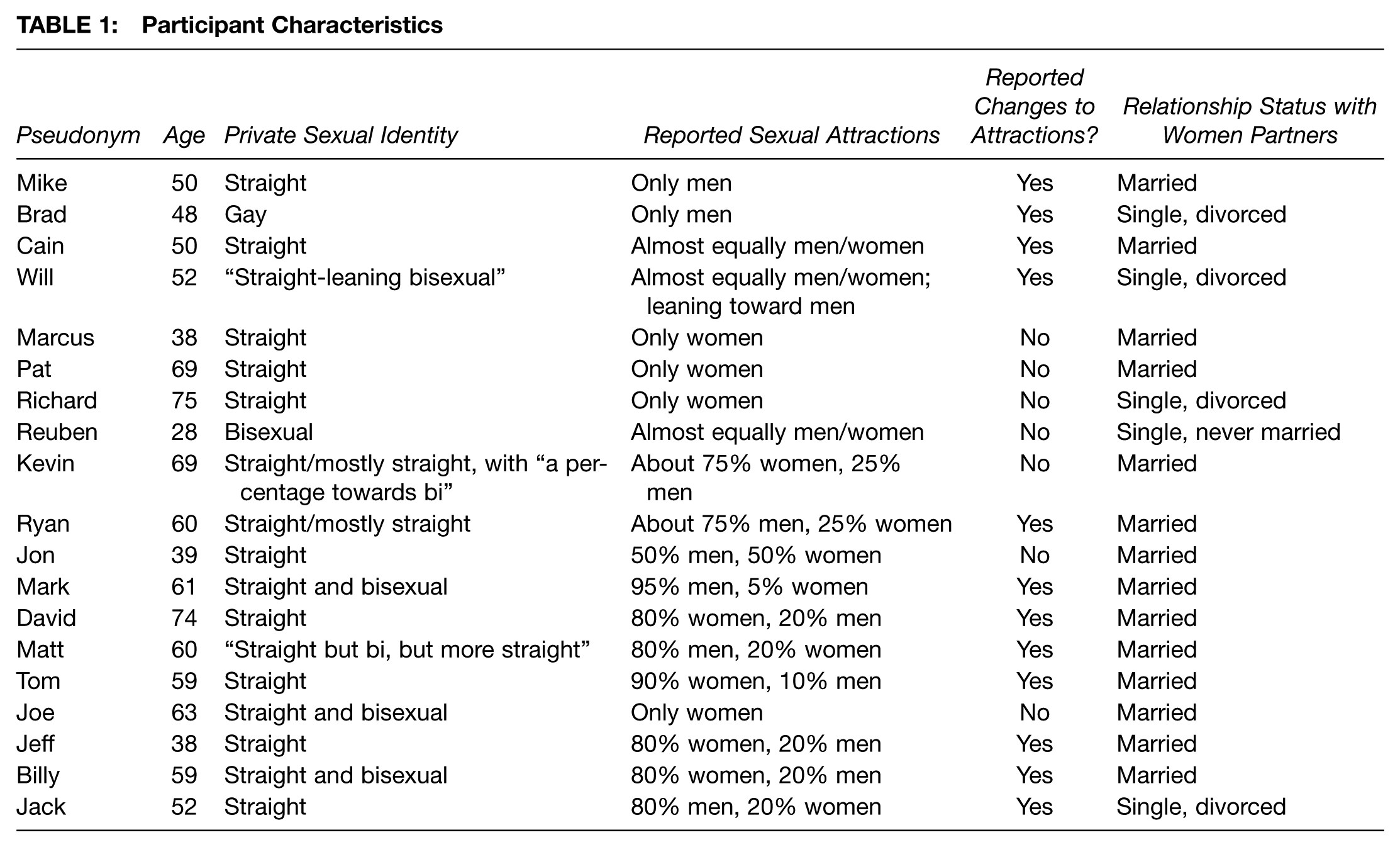
All the participants live in Missouri, Illinois, Oregon, Washington, or Idaho; these rural spaces share similarities by virtue of their social conservatism and predominant white populations (Bump 2014; United States Census Bureau 2016). All but two participants currently live in, or were raised in, a rural area. Thirteen currently live in a rural area, and 15 were raised in rural areas. By rural, I refer to an area with fewer than 25,000 residents. The only two exceptions were participants who were raised in urban areas but currently live in what I term semirural areas: cities with 25,000–60,000 residents in isolated areas of the Pacific Northwest. All the participants are white, challenging the perception of straight MSM as urban blacks on the “down low” (Ward 2015). They are skewed toward older ages with the majority over 50: 20s (1), 30s (3), 40s (1), 50s (6), 60s (6), and 70s (2). The participants have a variety of educational and occupational backgrounds, but most are middle class. One reported a doctorate as his highest degree, five a master’s, three a bachelor’s, five an associate’s, two some college, and three high school. As shown in Table 1, the sample has considerable diversity in sexual attraction. Further, although all tell others they identify as straight, 17 actually identify as straight or some variation thereof, one as gay, and one as bisexual. Thus, while all are secretive about their same-sex sex, only two are “closeted” in terms of sexual identity, as only two identify as gay or bisexual but tell others they identify as straight.
Participant Characteristics
Constructing Bud-Sex
“Strictly Masculine”: Average, Rural, Masculine Guys
All 19 participants described themselves as masculine, much like Robinson and Vidal-Ortiz’s (2013) analysis of Craigslist ads, and they did so in terms of their actions: mannerisms, behaviors, communication styles, hobbies, and skills. Through these descriptions, all framed themselves as normal, masculine men. Given the association of femininity with same-sex sexuality, subcultures of gay men may embrace or reject femininity (Hennen 2008). The men in this study, however, uniformly described themselves as masculine, thus distancing themselves from the purported relationship between same-sex sexuality and femininity.
The men’s gender self-descriptions largely conform to conventional understandings of masculinity. Brad (48) is a “T-shirt and Levi kind of guy” who is “straight-acting [and] masculine.” Jon (39) is “pretty much masculine” because “I’m a . . . straight guy that likes to hunt, fish, camp, and I raise cattle for a living.” Jack (52) shared similar sentiments: “The things I do, interests, all masculine. I like to shoot, I like to hunt. . . .” Cain (50) explained, “My demeanor may be more gentleman-like than . . . the rugged cowboy type,” but described himself as having “a type A personality” with the potential to “be kind of aggressive.” Similarly, David (74) is an “alpha male” who enjoys shooting and fishing. Richard (75) described himself “as masculine as John Wayne; I’m definitely not feminine in any way, shape, or form.” Kevin (69) noted, “I’ve always done blue-collar type work, I live in a rural area, I’m a farmer.” Will (52) leans “a lot toward masculine,” because “I can clean a deer. . . . I can catch some fish. . . . and I’m a very good handyman,” while Billy (59) enjoys “trudgin’ in the wilderness, cuttin’ firewood and throwin’ logs.” Will and Billy both conflated masculinity with heterosexuality, describing themselves as individuals no one would suspect to be attracted to men. Pat (69) similarly blurred the lines between masculinity and heterosexuality, and used rural tropes to describe himself: [V]ery masculine. 15 year collection of Playboy magazines, I don’t think gay people subscribe to Playboy. Fantasize about women, oh yes. . . . Drive a pickup . . . I like guns, I’m not good at hunting, but I like to go up in the woods and sit there and drink my half pint of Jack Daniels and act like I am hunting. I’d say very masculine. I like baseball.
Marcus (38) similarly noted, “I portray myself as very masculine. I wear jeans and boots and camouflage hats and sleeveless T-shirts, drive a truck, and like to shoot stuff.” Reuben (28) also noted rural hobbies: “I exercise, I play sports, I take part [in] what you’d call stereotypical masculine activities. I go hunting every now and then . . . things that a quote unquote manly-man would do.”
The participants’ rural locations played a large role in their self-descriptions as masculine. Eleven described themselves using elements of rurality, such as hobbies (hunting, fishing, shooting, cutting firewood), occupations (farming, ranching), ways of dressing (camo, T-shirts, and Levi jeans), or images of rugged rurality (John Wayne). Another used rural tropes (rugged cowboys) as a comparison to his own masculinity. Central to the men’s self-understanding is their rural background; they perform a rural masculinity, which they seek to reaffirm through their same-sex sexual encounters. They embody a country-masculine habitus (Desmond 2006, 393), which guides their “thoughts, tastes, and practices. It provides them with their fundamental sense of self; it structures how they understand the world around them; and it influences how they codify sameness and difference.” The participants’ rural masculinity structured their experiences and perceptions, including their sexual ones.
“Guys Like Me”: Partnering with Other Masculine, White, Non-Gay Men
The participants overwhelmingly preferred to have sex with men like themselves: masculine, white, and not gay—straight or secretly bisexual. This is a key element of bud-sex. Partnering with other men similarly privileged on several intersecting axes—gender, race, and sexual identity—allowed the participants to normalize and authenticate their sexual experiences as normatively masculine, as Ward (2015) also describes. Desires for types of sexual partners reflect culture rather than biological drives (Ward 2015). The socially constructed (and problematic) relationship between normativity and male masculinity, whiteness, and straightness shapes sexual desires such that individuals with these characteristics are often perceived as desirable sexual partners. By having sex with these types of men, the participants were able to construct and reinforce normative masculinity—despite having sex with men. Alignment with normative masculinity is especially important for men in rural areas, where it is a virtual prerequisite for social acceptance (Abelson 2014; Annes and Redlin 2012; Boulden 2001; Fellows 1998; Kazyak 2012). Other studies suggest that straight MSM prefer to hook up with men privileged on several dimensions, especially men that are masculine and straight or DL (“down low”) (Robinson and Vidal-Ortiz 2013; Reynolds 2015; Ward 2015), though no other interview study explores this.
Seventeen participants—all of those who identify as straight—stated that they prefer masculine male sexual partners, and each explained that the majority of their male sexual partners are masculine. Masculinity in sexual partners helped construct and validate their own normative masculinity. The straight participants often equated masculinity with non-gayness (heterosexuality or secretive bisexuality) or normality. As Cain said, “I’m really not drawn to what I would consider really effeminate faggot type[s],” but he does “like the masculine looking guy who maybe is more bi.” Similarly, Matt (60) explained, “If they’re too flamboyant they just turn me off,” and Jack noted, “Femininity in a man is a turn off.” Ryan (60) explained, “I’m not comfortable around femme” and “masculinity is what attracts me,” while David shared that “Femme guys don’t do anything for me at all, in fact actually I don’t care for ’em.” Jon shared, “I don’t really like flamin’ queers.” Mike (50) similarly said, “I don’t want the effeminate ones, I want the manly guys. . . . If I wanted someone that acts girlish, I got a wife at home.” Jeff (38) prefers masculinity because “I guess I perceive men who are feminine want to hang out . . . have companionship, and make it last two or three hours.”
The four participants who reported exclusive sexual attractions to women also stated a preference for normatively masculine male sexual partners, revealing the social origins of their attractions. As Marcus explained, A guy that I would consider more like me, that gets blowjobs from guys every once in a while, doesn’t do it every day. I know that there are a lot of guys out there that are like me . . . they’re manly guys, and doing manly stuff, and just happen to have oral sex with men every once in a while [chuckles]. So, that’s why I kinda prefer those types of guys. . . . It [also] seems that . . . more masculine guys wouldn’t harass me, I guess, hound me all the time, send me 1000 emails, “Hey, you want to get together today . . . hey, what about now.” And there’s a thought in my head that a more feminine or gay guy would want me to come around more.
Like Jeff, Marcus finds normative straight, masculine men like himself better sex partners than feminine and/or gay men. Echoing Mike, Richard stated, “Given a choice I prefer masculine; I don’t want a substitute woman,” and Joe (63) shared, “Feminine guys don’t interest me at all.” Preferences for masculine men both validate the participants’ own normative masculinity and reveal the socially constructed nature of sexual desires.
Similarly, the vast majority of the past and present male sexual partners of 16 participants—all except Reuben, Tom (59), and Mark—are white. Unlike many urban straight MSM who fetishize interracial sex, as Robinson and Vidal-Ortiz (2013) found with the largest proportion of their sample and Ward (2015) found with a sizable minority, the participants in this study fetishized whiteness. For most of the straight participants, racial sameness was a strategy to align themselves with normativity and, in so doing, to construct normative masculinity. Thus, whiteness is central to bud-sex, which reinforces the participants’ straightness and normative rural masculinity. Twelve participants stated that they prefer white male sexual partners, and four others explained their mostly white sexual history as happenstance. When explaining why he prefers white men, Kevin noted, “I guess because I’m white and, I guess you’d say more normal for me to be with white guys.” Marcus and Richard reported exclusive sexual attractions to women, and yet they too noted preferences for white men, indicating that attractions are not the only determinant of sexual partnering and reinforcing the social influence of sexual desires. Although Richard reported, “It’s not about the person, I’m only interested in the dick,” he also stated, “White would be my choice.” Joe shared, “The closer to white you get, Hispanic’s OK, but the further from me you get, if you get to the black side, I’m just not in.” Jeff also explained racial preferences as stemming from desiring men like himself: “Probably because I am sexually attracted to myself. . . .” David echoed, “I would lean primarily towards white guys that are more or less like me.” By choosing men like themselves—other white men—the participants normalized their encounters as straight and normatively masculine.
Of the 17 straight participants, nine reported preferences for straight or bisexual men and 13 noted that a majority of their sexual partners are straight, bisexual, and/or married to a woman. Their partners’ not-gay sexual identities—straight or secretly bisexual—are an important component of the men’s normative masculinity. The narratives of the four men with predominately straight or bisexual sexual partners who did not state a preference reveal numerous reasons: (1) They did not want to sound prejudicial; (2) rurality makes it difficult to find sexual partners, so they are at times open to gay men; (3) mostly engaging with straight or bisexual men makes meeting with gay men less threatening; and (4) their partners’ masculinity and the discreet, nonromantic nature of the encounter makes them comfortable enough to occasionally hook up with gay men. Many of the straight participants who noted preferences for straight or bisexual men did so because of perceived greater compatibility and greater confidence in discreetness. As Jeff stated, he is “basically seeking the same” kind of guy as himself. Marcus explained his preferences as a cultural fit: Straight guys, I think I identify with them more because that’s kinda, like [how] I feel myself. And bi guys, the same way. We can talk about women, there [have] been times where we’ve watched hetero porn, before we got started or whatever, so I kinda prefer that. [And] because I’m not attracted, it’s very off-putting when somebody acts gay, and I feel like a lot of gay guys, just kinda put off that gay vibe, I’ll call it, I guess, and that’s very off-putting to me.
Marcus feels more comfortable with straight or bisexual men because he dislikes a “gay vibe,” reinforcing how social factors such as culture affect sexual desires. Similarly, Tom noted choosing a bisexual man as his ideal male sexual partner because he would “kinda be closer in tune to what I am.” Joe would also choose a bisexual man “because he would be of the same mind that I am. He would understand what I’m feeling, and would respond probably similarly. So we could engage with common knowledge.” Jack noted, “He would be in the same boat as me. He would be straight, preferably married or definitely partnered up with a female, with one thing on his mind, getting his rocks off with me . . . they’re not gonna out me.” Similarly, Cain said he would not hook up with gay men, explaining, “No, I’m not out, and so, someone who is out, I’m sometimes a little bit hesitant about what they may say to others.”
That a majority of 13 straight participants’ male sexual partners are straight or secretly bisexual, despite bountiful opportunities for sex with gay and openly bisexual men on Craigslist, indicates that partnering with non-gay men is a strategy to reaffirm their own normatively masculine sense of self. It also reflects that the sexual meanings attributed to encounters are socially produced; while many gay men are also masculine and enjoy romance-free sex, most of the participants view straight or secretly bisexual partners as more desirable because of the link between normativity and non-gayness. Given the centrality of heterosexuality to normative rural masculinity, the participants were able to align themselves closer to both by selecting straight and secretly bisexual male sexual partners. While most expressed frustration about the difficulty of finding sexual partners in rural areas, they nonetheless mostly chose men who are masculine, white, and straight or secretly bisexual, underscoring the importance of these characteristics for their normative masculinity and bud-sex.
Secretive and Nonromantic: Ingredients for Bud-Sex
Consistent with other research about straight MSM (Humphreys 1970; Reynolds 2015; Ward 2015), the participants preferred secretive, nonromantic same-sex sex, key ingredients of bud-sex. They did not necessarily prefer one-time meet-ups, however; their histories with “regular” male sexual partners indicate they appreciate the benefits of a sexual friendship. Departing from content analyses, data indicate that relationships with sexual partners are not necessarily emotionless, but are rather nonromantic. Further, like Robinson and Vidal-Ortiz’s (2013) findings, the participants had a wide range of sexual preferences—all had either oral or anal sex (or both). Few, however, tied specific sex acts with masculinity or straightness. For these men, what was paramount to their masculinity was not what they did sexually, but how they did it. All 19 participants described the need for sexual encounters to be secretive, and this secrecy was tied to rurality. Rurality had both its advantages and drawbacks. On one hand, vast expanses of unpopulated land meant participants could easily find places to have secretive sex. On the other, community interconnectedness necessitated increased caution. As Pat said, “[I]n a small town everyone knows more about your business than you do. . . . I suppose in the city you don’t have to be discreet. But here in [a] small rural area, yes, you’ve gotta be discreet.” By meeting men who understood the need for secrecy—most of them straight or secretly bisexual—the participants were able to maintain their public identities. All but one participant described their same-sex sex similarly to Cain: “no strings attached.” 3 The absence of romance reframed encounters as normatively masculine and compatible with straightness. Even while avoiding romantic attachments, 13 participants currently have regulars, three others had regulars in the past, and two others would like one or are open to it. While most are open to one-time hookups, most also prefer regulars. By doing so, they reinforce their masculinity by seeking consistent partners on the same page about what sex between straight guys should constitute. This is especially important in rural areas, given that each attempt to find a new sexual partner opens the participants to potential discovery in a small pool of acquaintances.
While relationships with regulars were free of romance and deep emotional ties, they were not necessarily devoid of feeling; participants enjoyed regulars for multiple reasons: convenience, comfort, sexual compatibility, or even friendship. Pat described a typical meetup with his regular: “We talk for an hour or so, over coffee . . . then we’ll go get a blowjob and then, part our ways.” Similarly, Richard noted, “Sex is a very small part of our relationship. It’s more friends, we discuss politics . . . all sorts of shit.” Likewise, with several of his regulars Billy noted, “I go on road trips, drink beer, go down to the city [to] look at chicks, go out and eat, shoot pool, I got one friend I hike with. It normally leads to sex, but we go out and do activities other than we meet and suck.” While Kevin noted that his regular relationship “has no emotional connection at all,” it also has a friendship-like quality, as evidenced by occasional visits and sleepovers despite almost 100 miles of distance. Similarly, David noted, “If my wife’s gone for a weekend . . . I’ll go to his place and spend a night or two with him . . . we obviously do things other than sex, so yeah we go to dinner, go out and go shopping, stuff like that.” Jack explained that with his regular “we connected on Craigslist . . . [and] became good friends, in addition to havin’ sex . . . we just made a connection. . . . But there was no love at all.” Thus, bud-sex is predicated on rejecting romantic attachment and deep emotional ties, but not all emotion.
The participants enjoyed a wide range of sex acts, but few framed penetrating/being penetrated as tied to masculinity or straightness; these interpretations reaffirmed their own straightness and normative masculinity, regardless of sexual practices. Eleven both penetrated others and were penetrated in oral and/or anal sex, often with the same person, while eight either mostly penetrated or were penetrated. Of those who had anal sex more than a handful of times, five were mostly tops, four mostly bottoms, and two versatile. 4 Only three of the straight participants, plus Reuben (who identified as bisexual), tied sex positions to masculinity or straightness, yet none questioned their own masculinity or straightness, and none of the straight participants viewed the men they penetrated (if any) as not masculine because of that penetration. As Mark (61) noted, “I see it [being penetrated] as a very masculine thing. No one knows how to please a man better than another man.” Likewise, David shared, “It’s a mutual sexual satisfaction, however you get it. I don’t feel any less of a man if I’m bent over and he’s in me, at all. I just don’t.” Sex acts were overwhelmingly driven by personal preferences and physical abilities (e.g., erectile dysfunction). This indicates cultural differences in the meanings given to sexual acts, as some Mexican MSM attribute certain practices with masculinity or straightness (Cantú Jr. 2009; Carrillo and Fontdevila 2014). By rejecting stereotypical associations between masculinity and straightness, on the one hand, and sex acts involving penetrating or being penetrated, on the other, the participants reaffirmed both their straightness and normative rural masculinity.
It was not what the participants did sexually, but how they did it, that affected their perceptions of their masculinity. By maintaining secretive and romance-free same-sex sex, and interpreting sexual acts as unrelated to masculinity or straightness, they were able to act on desires in a normatively masculine way and reaffirm their normatively masculine sense of self. Collectively, these interpretations and preferences help define the type of sex they had: bud-sex. Unlike many of the Craigslist ads examined by Reynolds (2015) and Ward (2015), only three participants reported using women through pornography or conversation to secure a straight masculine sexual dynamic. Thus, men’s online posts may not always reflect what they do when they actually meet men.
No Big Deal: Extramarital Same-Sex Sex
For the 17 straight participants, a key aspect of their straightness was marriage and/or child rearing. Each currently married man indicated a desire to stay married. As they explained, sex with men either does not constitute cheating or is less threatening to their marriage than extramarital sex with women, because it is devoid of deep emotional ties. Sex with women is far more threatening to marriage, as this breaks vows and/or has the potential to involve emotional attachment. As Tom explained, “Being romantic and emotional is more cheating than just havin’ sex.” Similarly, Cain shared, “I’m not cheating on my wife. I don’t have the intention of leaving her.” Kevin echoed this: “Meetin’ up with women would be cheating on my wife. And when I meet up with guys, I justify it by sayin’ ‘well it’s only fun between me and the other guy, it’s not like I have another woman . . . ’ I’m sure she or other people would argue [with] that, but that’s just the way I feel.”
For the currently married straight men, their perceptions of their extramarital same-sex sex bolster their normative masculinity: sex with men is simply a way for them to fulfill sexual desires without affecting any other part of their lives. Four framed sex with men as not cheating in part because they no longer had sex with their wives. As Pat said, sex with men is not cheating “because part of marriage is sex, and my marriage has no sex.” Perceptions of extramarital same-sex sex as insignificant are tied to rurality: rural areas have a stronger focus on other-sex marriages than urban locales, where cohabitation and nonmonogamous relationships are often more visible (Chetty and Hendren 2015; Leonhardt and Quealy 2015). Thus, by framing same-sex extramarital sex as insignificant, the men interpret their sexual practices in ways that make them compatible with the marriages that are central to their heterosexuality and normative rural masculinity.
Aging: Not Ready to Give Up Sex
Age affected the participants’ interpretations of their sexuality and gender, both because of generational dynamics and aging itself. Fourteen participants are 50 or older and internalized heteronormativity and strict masculine norms during some of the most difficult decades to express sexual or gender non-normativity (Seidman 2002). This, combined with the lack of visibility of non-normative sexualities and gender expressions in most rural areas in the 1950s–1980s, shaped the participants’ relationship with masculinity and straightness. As Kevin shared, “I grew up in an area where that [being gay/bisexual] wasn’t an option, in a time and area both,” and Jack noted, “Back in the day when I was growing up, it was absolutely not accepted.”
Additionally, sex with men helped nine participants bolster their masculinity, despite the fact that they or their wives were experiencing age-related bodily changes that made sex more difficult. Seven explained that sex became uncomfortable or undesirable for their wives, and sex with men helped relieve sexual desires. As Ryan shared, “As physically there’s been changes to our bodies and it’s even painful for my wife to have sex, I have no problem taking care of myself with another guy.” Similarly, David explained, “I’m not getting sex at home, and I want sex,” and “older men are a lot more receptive to sex, they’re more enthusiastic,” because “senior women have kinda lost their desire to do much of anything.” Two others began having sex with men because of erectile dysfunction, which limited their ability to penetrate. As Tom described, “I’m a straight guy that has ED and doesn’t want to give up havin’ sex.” Turning to sex with men or increasing the relative frequency of sex with men was a way for each to maintain their sex lives and masculinity despite bodily changes related to aging. The centrality of sex to masculinity has been noted in other contexts, as well (e.g., Loe 2001). Lastly, 12 participants experienced profound and long-lasting changes to their sexual attractions in their 20s, 30s, 40s, 50s, or 60s, catalyzing desires for male–male sex years or decades after their other-sex marriage. Combined, these results indicate the need for life-course research on sexualities and masculinities (Diefendorf 2015) and reinforce that men as well as women have the capacity to experience sexual flexibility.
Conclusion
The results demonstrate that some rural straight men who have same-sex sex construct normative masculinity through their choice of sexual partners on the axes of masculinity, race, and sexual identity, as well as through the type of sex they prefer. By having sex mostly with other privileged men—conventionally masculine, white, and not gay—and by enjoying secretive and romance-free same-sex sex, the participants framed their encounters as straight and normatively masculine. Through complex interpretive processes, they reframed same-sex sex, usually antithetical to rural masculinities, such that it actually helped them construct normative rural masculinity. The type of same-sex sex they have is distinguishable from that of other groups of MSM: bud-sex captures their unique sexual interpretations (Silva, forthcoming), as well as their partnering preferences and the type of sex they have, and it helps construct their normative masculinity and straightness. The concept of bud-sex helps clarify that similar sex practices have different meanings across contexts and populations. Non-normative sexual practices—same-sex sex—can actually be used to reinforce normative masculinity and straightness. The results also demonstrate the flexibility of male heterosexuality over the life course, and the importance of heterosexuality to rural masculinity. Given the centrality of heterosexuality to normative masculinity in rural areas, the participants’ identification with straightness—bolstered by their interpretations of their sexual practices—reinforced their normative rural masculinity. Because normative masculinity is critical for social acceptance in rural areas, identification with heterosexuality to bolster normative masculinity was especially important. This study is one of the first to use the narratives of straight MSM themselves to explore how they understand their masculinity. It is also the first to examine this population in rural areas, reinforcing the centrality of place for how individuals perceive and experience gender and sexuality. More broadly, this study is part of a growing scholarship that points to masculinities that differ by time period, race, class, and location (Pascoe and Bridges 2016).
The participants’ narratives illustrate historical shifts to the relationship between gender and sexuality. In the late nineteenth and early twentieth centuries, many masculine men penetrated feminine men without feeling as though their masculinity or sexual identity was threatened; this is because gender and sexual practice (i.e., penetrating or being penetrated) was an organizing element for how sexuality was understood, and the concept of sexual identity was not yet widely used (Chauncey 1994). Today, the biological sex of sexual partners is the organizing element for sexuality, and for men there is a widespread perception that femininity is tied to same-sex sexuality. Thus, today, men that engage in bud-sex distance themselves from femininity and normalize their sexual encounters as masculine by partnering with other normatively masculine men.
Future research could expand on this study. Because of the difficulty of finding participants, researchers should extend the time devoted to recruitment. Additionally, urban and suburban straight men should be interviewed, as should rural men from locations outside the Midwest and Pacific Northwest, given that there are vastly different rural spaces across the United States. Further, men of other races should be interviewed to understand how their construction of their normative masculinity differs from—or is similar to—the white men in this study, especially with regards to racial partnering.
The social implications of straight masculinities open to same-sex sex are complex. On one hand, diversity within expressions of heterosexuality and masculinities demonstrate that normativity can be unintentionally challenged from within dominant identities. On the other, the participants’ masculinity reinforces inequality. All 19 participants in this study maintain straight privilege by publicly identifying as straight and keeping secret their same-sex encounters. All of the straight men avoid effeminate men, and several disparaged male effeminacy, contributing to the widespread devaluation of femininities. Moreover, 13 were married and had extramarital sex without their wife’s knowledge, underscoring their male entitlement and unwillingness to consider ethical nonmonogamy. 5 The participants enjoy marginalized sexual practices, but they are unwilling to challenge heterosexism or other forms of domination, maintaining numerous systems of inequality.
Footnotes
Acknowledgements
I would like to thank C. J. Pascoe, Sarah Diefendorf, Connor Gilroy, Kristen Barber, Matt Norton, and members of the University of Washington Gender Group for their detailed and helpful suggestions, which greatly improved the article. I would also like to thank editors Jo Reger and Amy Stone, as well as the anonymous reviewers of this article, all of whom provided feedback that greatly strengthened the manuscript.
Notes
Tony Silva is a doctoral student at the University of Oregon. His interests include sexualities, gender, rurality, and qualitative and quantitative methods. He has previously published about straight men’s same-sex sexuality in Sexualities.