







Abstract
This study extends our understanding of the positive relationship between kin-based child care support and mothers’ ability to stay in the workforce by examining why and how women seek such help. Using 100 in-depth interviews with Korean mothers, I find that although child care provided by grandmothers helps mothers maintain their employment, a mother will ask for support only when she constructs strong career aspirations and generates agreement amongst family members that she deserves support. Both of these center around the notion of who deserves to work as a mother. Mothers’ explanations of why they deserve support vary based on their educational backgrounds: less-educated mothers stress economic stability, whereas better-educated mothers emphasize the symbolic meaning of sustaining their high public status. Most mothers, however, feel the need to “prove” to themselves and to certain others that they deserve child care support. Based on these findings, I develop a theory of deservingness to explain how mothers account for their work and make decisions to seek child care support.
Motherhood affects women’s paid work (Abendroth, Huffman, and Treas 2014; Cohen and Bianchi 1999) in all post-industrial societies. Explanations include work expectations developed prior to motherhood (Damaske 2011; Davis and Greenstein 2009), workforce opportunities and constraints (Gerson 1985; Stone 2007), the amount of support from domestic partners (Hochschild and Machung 2012), and the lack of availability of formal and informal child care (Bianchi and Milkie 2010; Dimova and Wolff 2008; Haan and Wrohlich 2011; Leibowitz, Klerman, and Waite 1992). Grandmothers’ help is one of the main forms of informal child care and, particularly in East Asia, is seen as the most important resource enabling mothers to keep working (Fu 2008; Y.-S. Lee 2011; Oishi and Oshio 2006). However, because studies have predominantly focused on the static relationship between child care support and women’s employment status, the process by which mothers negotiate this key support has been a black box.
In this study, I explore the social processes by which women decide to ask for and receive child care support. Motivations behind the decision to seek kin help with child care are often assumed to be either economic or cultural: the inability to afford day care increases the need for kin-based child care, or mothers culturally prefer it. While both factors may play a role, I argue that expectations about motherhood are negotiated with families after birth and shape the process of seeking and receiving help. Kin-based child care support is often positively related to mothers’ full-time employment (Fu 2008; Leibowitz, Klerman, and Waite 1992; Oishi and Oshio 2006). How do women develop their expectations and negotiate for this support?
South Korea (hereafter Korea) is a compelling case for this study. Scholars studying Korea have argued that child care provided by grandmothers is the most important resource in helping mothers to continue working (J. Lee and Bauer 2010, 2013; Y.-S. Lee 2011). Based on 100 in-depth interviews with married mothers, I show that regardless of family background and educational attainment, most women who sought child care support did receive it, and explained that it enabled them to remain in the hypercompetitive Korean labor market. An important part of the process is constructing a legitimate reason to seek child care help. I argue that the notion of deservingness can explain why some mothers ask for child care support and some do not, even when they have similar resources (since a majority of grandmothers are non-employed) and value that care similarly. The idea of deservingness points out one of the ways in which mothers’ work decisions are strongly shaped by persistent negative views of maternal employment and by intensive motherhood ideologies. In the end, findings reveal that cultural contradictions about working mothers leave them feeling that their choices are under attack and have to be justified (Luker 1984).
Child Care Support and Mothers’ Work
Child care provided by grandparents is often an important resource for employed mothers. It is common in East Asian countries (Chu, Xie, and Yu 2011; Y.-J. Lee, Parish, and Willis 1994), some European countries (Geurts, Poortman, and Tilburg 2012; Jappens and Van Bavel 2012), and for some groups in the United States (Sarkisian and Gerstel 2004; Vandell et al. 2003). Because grandmothers are more involved in child care than grandfathers across cultures (Dimova and Wolff 2008), several studies of child care support have focused solely on grandmothers (Bowers and Myers 1999; J. Lee and Bauer 2013). However, the process of how mothers come to the decision to seek child care support from their view has been underexamined.
Motherhood Ideologies and Women’s Work
The problems that women face surrounding motherhood are often specific to their work and their identity as mothers (O’Reilly 2016). The process by which women decide to seek child care support is likely to overlap with the process of making work decisions as a mother. Thus, an important framework that helps us understand how mothers arrive at their decisions to seek child care support is the array of studies on how mothers make employment decisions (Blair-Loy 2003; Damaske 2011; Gerson 1985; Stone 2007).
The view that women should not work when their children are young remains one of the most unbending gender norms in postindustrial societies (for the United States, see Cotter, Hermsen, and Vanneman 2011; Jacobs and Gerson 2016; for East Asian countries, see Ochiai and Molony 2008; Raymo et al. 2015). Scholars argue that behind the persisting negative views lie stereotypes about the different impacts of mothers and fathers on their children (Haines, Deaux, and Lofaro 2016); gender essentialism—the notion that men and women have innately and fundamentally different interests and skills (England 2010); and the intensive motherhood ideology, which Hays (1996) defined as a logically cohesive combination of beliefs dictating that a mother must be the central caregiver who devotes copious time, energy, and material resources to her child. Building on Hays’s concept of intensive motherhood as an ideological force that “value[s] mothering methods that are child-centered and create[s] expectations that mothers should engage in childrearing without questioning the issues of efficiency or financial profitability because children are sacred and innocent beings” (1996, 54), gender scholars have been exploring how motherhood ideologies shape people’s definitions of what work is worthy and meaningful for a mother.
Institutional context and job qualities also seem central in shaping mothers’ work decisions (Damaske 2011; England 2010). Empirical trends show increasing intra-cohort variation in women’s labor market participation and wage trajectories (Cheng 2014; Damaske and Frech 2016). Although working-class white women in the United States were historically more likely to work than middle-class white women (Garey 1999), this trend has changed in recent years (England, Garcia-Beaulieu, and Ross 2004). Damaske (2011) argues that both family background and current social class matter because they influence women’s expectations about future workforce participation, the available opportunities, and the available family support. One of her central ideas is that regardless of class or racial background, women consider their work paths as taken for the family, but factors such as financial resources and job characteristics such as opportunities and schedule autonomy, make it easier for some women to keep working.
Motivation to Ask for Child Care Support
Mothers often have multiple options for child care. One frequent assumption is that structural factors, especially economic standing, shape people’s need and willingness to depend on grandmothers for child care. However, the empirical evidence is tenuous. Some studies find that higher household income increases the likelihood of kin-based support being sought and of it being provided (Y.-J. Lee and Aytac 1998; Silverstein and Waite 1993), whereas others find the opposite (Benin and Keith 1995). Other studies show no significant influence of maternal education, single parenthood, or family income on receiving grandparent care (Kim et al. 2015; Leibowitz, Klerman, and Waite 1992; Vandell et al. 2003).
The other assumption in explaining intergenerational child care support is cultural heritage or shared understanding (Chin et al. 2012; Ko and Hank 2013). J. Lee and Bauer (2013) interviewed 21 matched pairs of caregiving grandmothers and employed mothers currently receiving child care support in Korea. The authors argued that employed mothers chose a grandmother’s child care because they had prior expectations that they could rely on such care, because they perceived that they would receive considerable benefit from it, and because they trusted care provided by family. But we know little about the process of developing expectations of child care support; the study included only mothers already receiving it, not those who did not seek help in the first place or who tried but gave up.
In sum, because the literature has generally treated intergenerational child care support as a resource-pooling strategy or as a culturally expected behavior, it is not well understood how the process of seeking child care support shapes or is shaped by mothers’ expectations and decisions to work. Following feminist scholars’ argument for a gender perspective in exploring family power relations because the decisions and experience of marriage, work, and parenthood are all gendered activities within households (Ferree 1990, 870), we need to take a gender perspective on the process of asking for child care support. In particular, how do persisting negative views of maternal employment and the meanings of mothers’ work play a role in developing reasons to seek support?
Contemporary Korea
Korea is a postindustrial society in which family and work sharply conflict for women because of an intensive motherhood ideology (Ochiai and Molony 2008) and competitive workplace norms (Brinton 2001). Despite having the highest level of educational attainment among Organization for Economic Cooperation and Development (OECD) countries, Korea ranks lowest for gender equality, especially regarding the motherhood wage penalty (OECD 2012) and unequal division of labor at home. Korea’s average weekly working hours are the highest in the OECD (OECD 2017) and overwork (working more than 50 hours a week; Cha 2013) is common (Bae and Chung 1997). Of Koreans in their 30s, men spend an average of 58 minutes a day on housework and child care, while women spend five hours two minutes (Statistics Korea 2015).
Within this macro context, we see two important trends. First, Korean women show relatively low labor force participation when they are of childrearing age compared to women in other postindustrial societies. In 2014, 58 percent of Korean women in their 30s were working, compared to 92 percent of Korean men and 69 percent of U.S. women (OECD 2014). Second, of dual-earner households with young children, 43 percent receive some child care support from grandparents (Ministry of Health and Welfare 2009); the figure is 53 percent in the Seoul metropolitan area (Korean Women’s Development Institute 2015). Because of both widely shared distrust of formal day care facilities and to short hours of day cares, which do not accommodate Korea’s long working hours (J. Lee and Bauer 2013), only about 35 percent of children age two or younger are enrolled in formal child care or pre-school (OECD 2016).
In sum, Korean mothers face a sharp conflict between workplace and childrearing demands and norms of overwork; at the same time, the structural and cultural issues concerning formal child care—short hours and public distrust, respectively—affect the willingness of mothers to keep working. Within this context, roughly half of employed women leave the workforce after motherhood, and, for those who keep working, child care from grandmothers is important for staying in the workforce.
Methods
The data for this study are 100 in-depth, in-person interviews conducted in 2013 and 2015. My sample includes married mothers who lived in the Seoul metropolitan area, had at least one child younger than six, had at least a high school degree, and had worked at least one year since graduating from school. Because the research goal was to investigate the general pattern of using child care support, my standard for the number of interviewees was to recruit until I had sufficient sample diversity. I purposefully recruited mothers with different amounts of education: one-third of the sample, whom I refer to as less-educated, had completed high school or some form of two-year college; one-third (the well-educated) had a bachelor’s degree from a university other than the top three Korean universities; and one-third (the elite-educated) had a bachelor’s or advanced degree from one of the top three Korean universities. The reason for having a separate elite-educated group is, as S. Lee and Brinton (1996) showed, the prestige of a particular degree and university explains the variation in labor market experiences among well-educated Koreans. I refer to the well-educated and elite-educated collectively as better-educated in contrast with the less-educated. Also, I diversified employment trajectories and current employment status to see how mothers’ work (past and present) shapes the process of seeking child care support.
I used two sampling strategies. First, I recruited 50 mothers through a panel from Ovey, an online and smartphone application–based survey company whose clients include merchandisers, broadcasting companies, and scholars. Of the approximately 10,000 respondents that met the criteria for my study, I randomly selected 60 and ended up meeting 50 for an interview. Second, because respondents to online or app-based surveys might share unobservable characteristics, I recruited the other 50 interviewees through restricted snowball sampling from my personal ties, allowing no more than three referrals from each tie. The educational attainment level (by degree and university ranking) was the main difference in the samples from these two recruiting strategies; the Ovey sample had more less-educated mothers while the snowball sample had more elite-educated mothers who graduated from top-ranked universities.
Interviews lasted from 50 minutes to two hours; most took about 90 minutes. All interviews were structured with roughly 40 open-ended questions starting with questions about a typical day, continuing with work- and family-related questions (chronologically from high school graduation), and ending with anticipated work trajectory and plans for children. Work-related questions covered expectations, aspirations, trajectories, and experiences. Family-related topics included relationships with parents since adolescence and with parents-in-law after getting married. To understand perceptions, I asked interviewees’ thoughts on marriage, childbearing, motherhood, and mothering, and their definitions of happiness and success.
My analytic sample of 100 mothers was diverse, with different family backgrounds, occupational trajectories, and educational backgrounds. The respondents’ mean age was 35, ranging from 25 to 42. The average age at first birth was 30 years. Roughly two-thirds had one child, and on average the age of the youngest child was 2.5 years. My sample is on average highly educated compared to the population, largely because I have 38 percent of the sample in the elite-educated group to study variation based on university and degree in the well-educated group. The less-educated third of my sample included 29 high school graduates and five with two-year vocational college degrees, the well-educated third included 28 with bachelor’s degrees from nonelite universities, and the elite-educated group included 38 with bachelor’s or graduate degrees from any of the top three Korean universities.
All had at least two years’ work experience, and they had changed jobs on average twice. Women in the less-educated group typically worked as assistants or secretaries, in factories, or in the service sector. Well-educated women had diverse jobs, including flight attendant, teacher, music instructor, assistant at a law firm, and manager at a local bank. Elite-educated women had jobs such as lawyer, consultant, CEO of a start-up, and manager at a large company. Among employed mothers, including part-time and self-employed, the mean monthly wage was US$3,600. As expected from Korean time-use survey data, husbands’ participation in child care was reported to be low: on average, 30 minutes per day during weekdays.
Korea is a small country: the median drive to the grandparents’ house was one hour, the average being one hour 15 minutes. Eighteen respondents lived with their parents or in-laws and 30 lived within a 10-minute drive. In three cases, the children lived with their grandparents and the respondents visited on weekends. Two-thirds of the grandmothers had been stay-at-home mothers, their cohort having had very low labor force participation after marriage and motherhood (Statistics Korea 2014). The other one-third of the grandmothers had gone in and out of the workforce, but most were not working at the time of the interview.
Following multiple readings of the transcripts, my inductive analysis identified themes and narratives. Using Dedoose, a software for qualitative analysis, I used two stages of coding to determine which mothers had sought child care support and why and how they had decided to do so. First, I used open coding (Strauss and Corbin 1990) to organize the data into four themes: work pathways and the rationale behind work decisions; child care arrangement (from birth to the present); motivations to seek child care support; and the process of negotiating and maintaining that support. When important patterns emerged, I conducted a second round of coding with a focused coding strategy (Lofland and Lofland 2006, 202). Emergent themes included the importance of educational accomplishments and of the job’s stability and prestige; the meaning of being employed, often shaped through ongoing interactions with family members (including grandparents); and the stage of thinking about deservingness that strongly related to seeking and negotiating child care. I changed respondents’ names and several identifying characteristics to protect confidentiality.
Child Care Support and Mothers’ Continuous Employment
The mothers in my sample had two distinct work pathways. Half had continuous work pathways: since finishing school, they had never been out of the workforce longer than three months. The other half had discontinuous work pathways: they had worked during young adulthood but left or greatly reduced their paid work after having children. Few in the discontinuous pathway had returned to the workforce for part-time or irregular (contract-based) full-time jobs. Women with more education were slightly more likely to have continuous work pathways: 44 percent of the less-educated, 50 percent of the well-educated, and 58 percent of the elite-educated had experienced continuous employment.
Mothers who had discontinuous employment gave numerous reasons for leaving the workforce around childbearing age: long working hours, short-term contract positions, low pay, health concerns, housework burden, or little desire to keep working. Mothers who had continuous employment similarly had various explanations for it, but commonly they argued that child care help from the grandmothers was critical. As Table 1 shows, 88 percent of women with continuous work pathways were either receiving or had received child care support when their children were under three. A majority were receiving more than 7 hours a day, ranging from 1 to 12 hours per day. Some combined grandmothers’ child care with other forms such as day care or a nanny, while others depended solely on the grandmothers.
Daily Child Care Hours Provided by Grandmothers for Mother with Continuous Employment When There Is At Least One Child Under Three
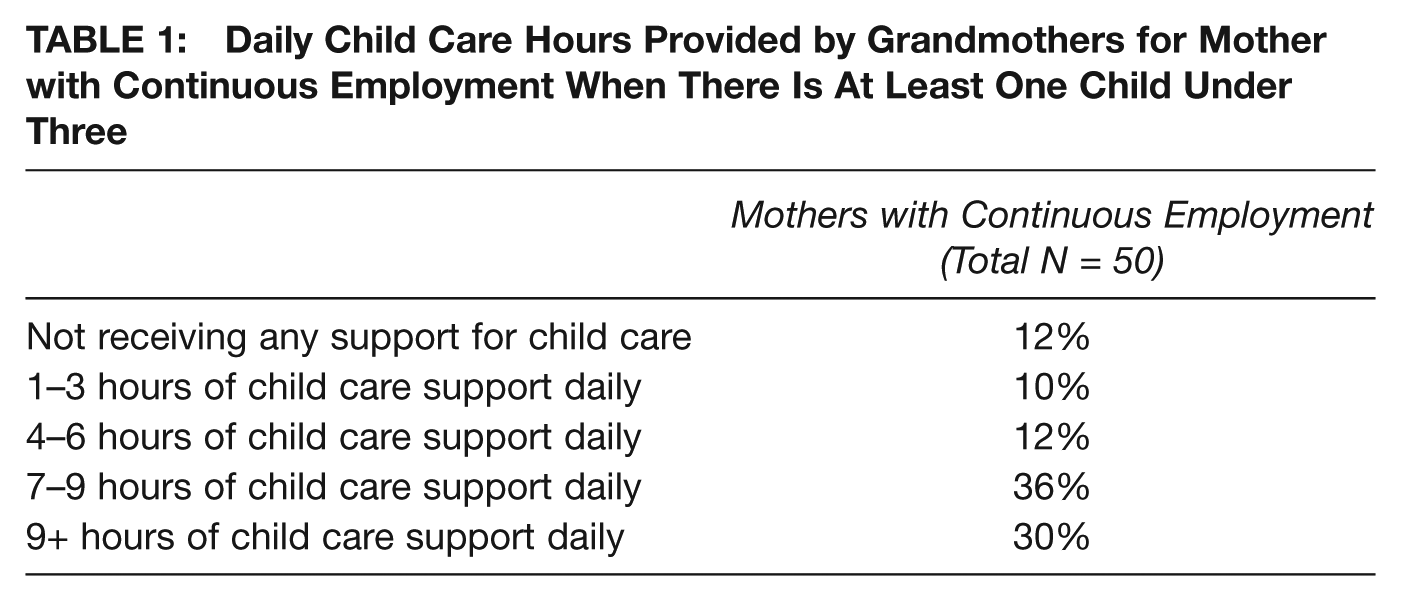
Instrumentally and emotionally, grandmothers’ child care support enabled mothers to stay in the workforce. Child care support was important instrumentally because overwork was the norm and day care hours were shorter than the average working hours. As Ari, 34-years-old, high school, explained, “Owners of day cares in my neighborhood want mothers to drop their kids off around 10 and pick them up around 4 pm. It’s hard to find a job that fits the day care hours, so if you are a working mom, you need someone for the morning and afternoon time.” Generally, long work hours for both the respondents and their husbands created an environment in which child care support was critical. As Haein, 38-years-old, well-educated, explained, “I usually work from 7 to 7 on weekdays, so I have to totally depend on multiple heroes. My mother, mother-in-law, and one home-care worker. Without them, you cannot work, period.” Her husband was not one of the heroes. In fact, most of the women in the sample emphasized that their husbands came home later than themselves. Continuously employed mothers also emphasized that child care support helped them emotionally, given their anxiety and guilt concerning formal day care. As Jiyoo, 35-years-old, elite-educated, explained, “All the news about nannies and teachers at the day care hitting children really made me anxious, so I only considered my mother or mother-in-law for child care.” Among those who ended up asking for support, 92 percent received it. However, as useful as child care support from grandmothers is to women trying to stay in the workforce, only about half of the sample sought it.
Who Deserves to Work? The Process of Asking for Help
The analysis of which, why, and how women asked for support revealed that, before asking for help and throughout the process of seeking it, women went through emotional, mental, and normative processes to find a reason to receive it. At the center of this process was how a mother and her family members—mainly the grandmothers—evaluated the meaning of the mother’s occupation by asking who deserves to work as a mother.
Mothers Who Did Not Seek Help: Failing to Find a Motivation
Those who decided not to seek child care support shared a framework of making the decision based on whether they considered their jobs worth keeping. This was a critical aspect because if a job was not good enough, mothers did not feel they deserved to ask for child care help. Both the kind of work and the status of the job played important roles when evaluating a job as worth keeping. As Haru, 34-years-old, high school, described, “Before quitting, I was a secretary at three firms. I was not accumulating skills or professional knowledge because I was conducting a simple task that anyone could do. My fourth job was likely to be a secretary at another firm and it was hard to want to keep doing the same thing.” Kyongha, 32-years-old, elite-educated, illustrated the importance of an employer’s name value when she said, “I started working at this midsize company that no one around me had heard of. I was a bit embarrassed, but I was happy because I had a job. But when I got married, it felt meaningless to stay in this company that nobody ever heard of. It was simply not worth staying.” Shinhye, 36-years-old, well-educated, echoed the importance of the status of the job: “There are women who deserve to work, especially those who are lawyers or doctors. The successful ones.”
This way of thinking about whether a job was worth keeping once becoming a mother spilled over into my interviewees’ definitions of who deserves to work as a mother and to receive child care. The aforementioned Shinhye, 36-years-old, well-educated, explains this by saying, “It is really hard to work as a mother in this country and you need a lot of help from the grandmothers. For me, there was no reason to embrace every step of persuading my mother-in-law or my mother to provide child care just to keep working at a company that isn’t even well known.” Song, 40-years-old, high school, made much the same point by describing, “I would ask, ‘Should I tell my mom that I need her help?’ Then I asked myself whether I deserve to keep working.”
Grandmothers played a salient role because they were the ones providing the child care and, for my interviewees, the process of assessing whether they deserved to work also involved interactions with multiple generations of family. Jungyeon, 32-years-old, elite-educated, recalled how it was initially hard to expect any support because, even before her pregnancy, her mother had consistently told her that her job was too ordinary to keep after becoming a mother. Other women who were not sure about their work pathways also found out, either directly or else indirectly through their husbands, that their parents or parents-in-law saw no value in their maintaining their jobs after motherhood. The accumulation of such comments was sufficiently discouraging that they did not plan to stay in the workforce. In these cases, women often identified themselves with the kinds of jobs they had held and their specific work trajectories. Only a few stressed desire—or lack of it—rather than deservingness as their main motivation to keep working. One of these was Noeul, 34-years-old, high school, who quit working when she married: “I was really tired of working for 10 years, so when I was getting married, I felt like marriage was an exit from my boring life.”
In sum, one of the main mechanisms for not choosing a continuous work pathway was the combination of becoming a mother and failing to find worth in one’s job. Because most mothers thought receiving child care support was extremely important in order to maintain their employment, the process of finding worth in one’s job involved not only making a determination on their own but also interacting with other family members, especially the grandmothers. Mothers in the sample often explained this process in terms of who deserves to work.
Mothers Who Sought Help: The Notion of Who Deserves to Work
Mothers who asked for child care support spent significant time reflecting on their career aspirations and talking with the grandmothers about working full-time as a mother. Although mothers provided a complex narrative about child care availability, time and energy, life satisfaction, and identity in explaining their decisions to work and to depend on grandmothers’ child care, beliefs about who deserves to work and to have child care support were critical in motivating them to ask for that support. The evaluation of one’s own work happened before or while seeking help. Yoonji, 30-years-old, elite-educated, was going through such a process. She explains, “I have been thinking about how to arrange things when I return to work [after maternal leave]. I questioned about my job a lot: Is it worth keeping? Is my job that important to me and to my family? Am I being greedy wanting to work? I would need to ask my mother-in-law for help. But before all that, I keep questioning about my job.” Mothers spent much time thinking about worthiness and deservingness instead of feeling entitled to work and to receive child care support. As Sodam, 30-years-old, well-educated, illustrates, one of the reasons was that taking care of an infant is extremely demanding, especially for grandmothers: Taking care of an infant is hard. When I had just had my baby, my mother came to my house to help me out, but she would have a wrist ache after holding my daughter all day. So when I was about to return to work, I had to think hard about what to do about my job and about child care. I felt like I was being selfish by depending on my aging mother, so it was really, really hard for me to ask for her support.
Despite academic beliefs that economic needs might dominate whether women depend on grandmothers’ child care, the mothers in my sample rarely cited money as the main reason for seeking child care help. Most of the women who decided to keep working felt that the income would be useful to the family, but they explained how it is beyond the issue of money. Sia, 36-years-old, high school, explained, “I earn around 2K a month and this is not a lot. However, I play an important role in my company and it is unlikely that I will get fired. These factors encouraged me to continue working.” In a different context, women with higher wages similarly did not use money as the main rationale for their decisions. This was mainly because their husbands’ incomes were often considered sufficient for the family. Jooyoung, 35-years-old, elite-educated, who earned around US$7,000 a month, explained, “I have a high-paying job, but so does my husband. Money was not an issue. Every mother feels pressure to quit unless she has a really good reason why her job is worthwhile to keep.”
In the end, mothers felt that they needed a good reason to expect child care support before they would seek it. They held themselves to a high standard in evaluating their own work and constantly asked themselves whether they deserved to work, though the specific values and logics that structured this deservingness narrative diverged based on their level of education. Furthermore, the process of negotiating child care support took different forms—smooth for some and difficult for others.
Symbolic Logic of Deserving to Work: Better-Educated Mothers
For the better-educated group, status—which university the woman had graduated from, what company she worked for, and what specific job she held—was important in finding it worthwhile (or not) to keep working after motherhood. Because elite-educated mothers saw the symbolic meaning of maintaining status as important in defining who deserves to work, they experienced a rather smooth process of child care negotiations. Well-educated mothers, on the other hand, had more persuading to do.
Elite-educated mothers who mobilized child care support reported that they chose to work continuously for the happiness of the whole family, including their family of origin. More women who had achieved high status—who had graduated from prestigious universities and/or were doctors or lawyers—expected that their parents would resent them staying home. When I asked Dahee, 27-years-old, elite-educated, about the process of leaving and reentering the workforce and her ideas about child care arrangements, she frequently mentioned what her parents would think or feel about her employment status. She said, “One of my main motivators to be a mother who works and to ask my mother for [child care] help was my parents’ expectations about my accomplishments.” When asked who would be most disappointed if she stayed home, Dahee said, “My dad will be so disappointed, almost furious. I was part of his dignity, his pride. Now he is retiring; all he talks about with his friends is where my husband and I work.” These elite-educated women were those who had excelled in school, defeated boys in competitions, attended prestigious universities, and worked at well-regarded firms. They took their parents’ and parents-in-law’s high expectations as a sign of love and support and thus tried to predict how their parents would think about their work decisions. Saerom, 31-years-old, elite-educated, also echoed this point: My parents, who run a restaurant, would be extremely upset and disappointed if I quit. Both my parents and my husband’s parents are happy with me working. It is not just [my parents]. My mother-in-law has always been so proud of me. I once thought about staying home when I was pregnant, but when I told my mother-in-law that I might quit, she was shocked and thought in the long term I would regret all the opportunities that I had given up.
Frequent conversations with parents about whose work and whose educational background made it “worthwhile” to stay in the labor market provoked respondents to reassess their own success and to strive to maintain their status.
For a few, a relatively smooth process of receiving child care support was made possible by their own mothers but not their mothers-in-law. As Hyojoo, 37-years-old, elite-educated, recalled, “My mother-in-law told me from the moment I got pregnant to stay home and focus on educating my children. My mom, on the other hand, strongly encouraged me to maintain my job. She explicitly said that she would be sad and resentful if I just stayed home and did housework after all those years of accomplishments from hard work.” Hyojoo ended up depending on her mother for child care and continued to work as an analyst in the banking industry. This exemplifies how arranging child care sometimes involved different sets of family values. In Hyojoo’s case, the question of who deserves to work went beyond a moral interpretation of who should work as a mother and was based on a judgment about which jobs are worth keeping beyond motherhood. For the elite-educated women, the prestige attached to specific jobs created the deservingness to keep working and to receive the necessary child care support.
For women with degrees from nonelite universities, securing agreement that they deserved to work and to receive child care was harder. Analysis of the process of persuasion showed that their deservingness could be contested, mainly because definitions of success and high status—easily ascribed to elite-educated mothers—were more subjective for well-educated mothers. Many of the latter felt that they were stuck between their family’s status-seeking and a traditional gender ideology that expects mothers to use their skills at home to educate their own children. Yunseo, 33-years-old, well-educated, described how the prestige of a specific job or firm helped one get beyond the traditional motherhood ideology. She explained, “You have to constantly tell your parents that you achieved something because adults like big names or brands. I work at the day care center owned by a very famous corporation and my mother-in-law often brags to her friends about where I work. People are really sensitive to names.” Some mothers, such as Soi, 37-years-old, well-educated, had to make comparisons with siblings or with other women to “prove” that keeping their jobs was worthwhile and that they deserved to be exceptions to traditional motherhood ideology. She said: Since my parents are still working, I had to ask my mother-in-law for child care help. She hesitated because she had already told my sister-in-law that she could not provide child care support. I carefully explained how hard I worked to obtain my current position and she acknowledged that I do work in a much bigger and more famous company compared to my sister-in-law, who was a secretary at a small firm. I felt bad for bringing my sister-in-law into the picture in order to persuade my mother-in-law that my job was more . . . well, more worthwhile . . . to keep, and therefore I needed her help. I persuaded her and she agreed to help out.
For most mothers who ended up seeking help, the initial step of thinking about who deserves to work as a mother was critical, and the availability of child care support was determined not strictly by grandmothers’ availability but by whether both agree that it makes sense for the daughter/daughter-in-law to keep working once she is a mother. Throughout the process, the better-educated mothers had to challenge traditional gender ideology and negative evaluations of maternal employment. Mothers who sought and received child care support were those who convinced first themselves and then at least one of the grandmothers that their employment contributed to their family’s status and was something for the whole family to be proud of.
Finding the Logic of Deserving to Work from Economic Stability: Less-Educated Mothers
Women without a college degree mainly cited economic stability as the reason to keep working after becoming mothers. As mentioned earlier, mothers rarely claimed an economic need to keep working and to seek child care support. Instead, they emphasized the motivation to continue working, which was often determined by the likelihood of being promoted and of having a stable position. Dabin, 41-years-old, high school, explained this distinction between the push factor (monetary need) and the pull factor (opportunities and stability): I have worked at this bank for more than 20 years and now I am at the managerial level. I started as a clerk, so my wage has been increasing little by little. Compared to my friends from high school who had to change jobs almost every year, my job has been more stable and at least in this company, the more years I work, the higher my position gets. I was not earning a lot in the beginning—but everyone in my family thought my job and the company were both good. So when I was asking my parents-in-law to move in [to our house] and help with child care, I explained how we have to see this as a long term issue of me being one of the two financial pillars of the household.
Bomin, 34-years-old, two-year college, also sought child care help to maintain her job. She had a different job history than Dabin yet offered a similar reasoning of earnings and job stability being the main reason that she decided not to quit after having her son, and to ask for child care help. Bomin described vividly the moment when she started her current job: I was very unlucky because all four of the companies that I worked for as a secretary went bankrupt. I rarely received my wage on time. Then, I started working at the current research center, doing similar work as before. Because this is a child development center and since the budget is pretty stable here, I always get my monthly wage on time and there is very little fear of getting fired. It was heaven and on my second week, I was pretty determined to keep this job as long as I can.
Like the mothers with a college degree, some of the less-educated mothers received child care support relatively easily, while some had to work harder for it. Hasun, 37-years-old, high school, is one of the former. Before becoming a mother, she had worked in a number of department stores. When she was pregnant, she quit her job and was planning to take a long break with vague plans to eventually return to the labor market, but her mother-in-law changed her mind. Hasun explained, “My mother-in-law said that regardless of how much one earns, the act of engaging in paid work is good because it gives economic stability to the whole family in the long run.” She opened a nail salon and her mother-in-law in turn provided child care support. Many other less-educated mothers who ended up seeking child care support also made a point of their long-term contribution to the household’s earnings. Although they would not immediately have financial problems if they stopped working, they agreed that a job that has a long-term economic payoff was worth keeping because it would eventually benefit everyone.
Sanga, 36-years-old, high school, had had three irregular contract-based jobs selling insurance. These offered no leave, so after having her first child she found a new insurance sales job. Then she sought child care help. Initially, her parents were against her working because they were embarrassed that she was going to work as a saleswoman. She explained the process of persuading them to help her out: My parents’ generation has a bad impression about this kind of job. So my mom really disliked my job at first and for some time she refused to talk to me, because she was embarrassed. When I asked her to take care of my child while I was at work, I had to promise her that if I was not doing well at work, I would quit right away.
After one year, Sanga received an award as the best salesperson of the year. She explained how her mother subsequently became her biggest supporter. She described, “I worked really hard and every day, when I come home to pick up my kid, I would brag to my mom about my performance and how I am able to help my household to be stronger financially. Slowly, she got interested in hearing how many insurance items I sold. Now she is actually a VIP client who introduces me to other people.”
In sum, for most of the mothers in my sample who ended up using child care support from grandmothers, it was necessary to persuade the grandmothers why they had to work and why they deserved child care support from their aging mothers or mothers-in-law. Forty-five of the 50 who sought child care support got it, though they used different logics to define their deservingness. For well- and elite-educated mothers, status-seeking attitudes and the value of professional success defined who deserved support; that is, the grandmothers would help only if the mother’s job was of sufficiently high status. For less-educated mothers, deservingness was premised on the economic stability that their jobs guaranteed to the household.
Conclusions
This study contributes to the literature on women’s work by adding to our knowledge of how women seek child care support and account for their work. My findings show how child care provided by grandmothers enables women to maintain continuous work pathways in a context in which overwork is normal and non-kinship child care lacks ideological and systemic support—that is, child care is neither widely trusted nor widely available. However, despite the benefit of child care support, the process by which working mothers or mothers-to-be decide to seek it is strongly shaped by persistent negative views of maternal employment and by an intensive motherhood ideology. The pressure to prearrange child care and to think about who deserves to keep working after becoming a mother falls predominantly on mothers and, in fact, the notion of deservingness dominates how they construct their work expectations and their decisions to seek intergenerational child care support.
Most of the women in my sample resembled those in other countries, including the United States, where women account for their work paths as undertaken for the family (Damaske 2011), and where cultural contradictions about working mothers leave them feeling that their choices are under attack and have to be justified (Luker 1984). Before or while seeking child care support, mothers in my sample went through an intense process of constructing meaning and identifying reasons to keep working. This stage involved identifying who deserves to receive child care support, an internal process that often begins long before the process of seeking it. Women who thought they deserved to work—which was defined by whether their jobs were worth keeping—persuaded grandmothers to provide child care support. Such a normative process of defining the worth of a job was contingent on the particular job’s quality, mainly economic stability, and prestige and on how the woman defined her contribution to a set of family members—in this case, the grandmothers.
The idea of deservingness draws our attention to the importance of a particular job’s stability, prestige, and prospective career trajectory. Existing frameworks that explain how mothers make work decisions and find meaning in maintaining their jobs emphasize the incompatibility of demands from work and family (Blair-Loy 2003; Stone 2007); aspirations for paid work, which are related to multiple factors including family background, motherhood ideology, and the opportunities and constraints that women face (Correll 2004; Hays 1996); and job quality (Damaske 2011). Extending this line of work, my findings show that a mother evaluates the worthiness of her work according to its economic stability and prestige. Who deserves to work—a central idea of this study—is not just a matter of the mother but also of the job. The question is not only whether she deserves to keep the job but whether the job itself deserves sacrifice on the part of other family members. Whether a job was worth keeping depended not only on its qualities (security, autonomy, schedule control) but also on occupational prestige and long-term financial stability.
Because different mothers face different constraints and opportunities in the workforce, this deservingness narrative was not monolithic across groups but rather contingent on educational background. For less-educated women, opportunities to accumulate professional skills and to have a financially stable job enabled them to define their jobs as worth keeping. For better-educated women, occupational prestige enabled them to define their jobs as worth keeping. The finding that mothers ground their work decisions in logics of prestige and job stability supports the ongoing demand from feminist scholarship to go beyond the “need” and “choice” rhetoric in explaining how women of different socioeconomic backgrounds account for their work (Damaske 2011).
Developing work expectations and receiving support involves people beyond the nuclear family because child care support inevitably involves multiple participants—in this study grandmothers were the main arbitrators of the decision. While the literature focuses on how family background influences women’s career aspirations and expectations until young adulthood, future studies should consider the role of extended family networks—especially when grandmothers’ child care support is salient—and elucidate the roles of the family of origin and of in-laws in how women seek child care support and develop their work expectations beyond young adulthood. The language that mothers used was for the whole family, which reflects the for the family rhetoric that Damaske (2011) found New York women using to account for their work decisions. Receiving support is a social and collective process that involves how the mother’s job is evaluated by others.
Because this study is based on mothers in heterosexual marriages, its findings may not generalize to single mothers or to mothers in same-sex partnerships. While these are extremely rare in Korea, it is important for future studies to investigate them, as they may face different constraints and different interactions with their extended families. Additionally, although my findings imply that families of origin play an important role in how women normatively construct work expectations, my interview data did not include how my interviewees’ mothers and mothers-in-law themselves perceived the situation, only how my interviewees thought they did. Some grandmothers joined the conversation after the interview and one of them stated that, for mothers, the most valuable experience is raising a child with her own hands, but she ended her statement by saying this was “unless the society needs that woman, like judges or professors.” To better understand the notion of deservingness from the standpoint of the providers of child care support rather than that of the beneficiaries, a future study could be conducted with a sample of grandmothers.
Lastly, mothers who continuously stayed in the workforce argued that child care help from grandmothers is the critical resource enabling them to do so. Yet, because the division of child care takes place among women (grandmothers and mothers) rather than among couples (husbands and wives), the gendered division of child care labor is reinforced. Ironically, although the sacrifice on the part of the older generation of women contributes substantially to helping the younger generation of women engage in paid work, the intergenerational division of child care among women reinforces traditional gender-role ideology and the patriarchal division of child care labor, as J. Lee and Bauer (2013) argued. It is important to discuss what the findings in this paper imply: not only that women have to jump the hurdle of persuading themselves and others that they deserve to work, but also that the end result if they succeed is the reproduction of the gendered division of labor. Under its state-led modernization project, Korea experienced a compressed socioeconomic development that included advancing the basic human rights of women. However, gender norms and the division of childcare remain extremely unequal.
Footnotes
Author’s Note:
I thank Mary Brinton, Alexandra Killewald, Paul Chang, Jocelyn Viterna, Sarah Damaske, Youngjoo Cha, Eunmi Mun, Joanna Pepin, Xiana Bueno-Garcia, Hyunho Park, and Juliet Zhou as well as three anonymous reviewers for their helpful feedback on earlier drafts. This research was supported by research grants from the Weatherhead Initiative on Gender Inequality at Harvard University and by a Sanhak Dissertation Completion Fellowship.

Eunsil Oh is a doctoral candidate in the Department of Sociology at Harvard University. Her research explores how gender and class shape women’s work decisions and their definitions of a worthwhile life. Another line of her work examines how a hypercompetitive workplace culture reproduces gender inequality and lowers couples’ aspirations to have children.