







Abstract
Though the invocation to be “reflexive” is widespread in feminist sociology, many questions remain about what it means to “turn back” and resituate our work—about how to engage with research subjects’ visions of the world and with our own theoretical models. Rather than a superficial rehearsal of researcher and interlocutor standpoints, I argue that “reflexivity” should help researchers theorize the social world in relational ways. To make this claim, I draw together the insights of feminist standpoint theory and Bourdieu’s reflexive sociology to lay the foundation for a renewed reflexive project that centers epistemic privilege, the idea that positions of structural exclusion provide the best resources for theorizing social power. Reflexive sociology should consider interlocutors’ experiences of exclusion and contradiction, engaging with sites of alternative knowledge and incorporating them into the object of study. This type of reflexivity provides improved resources for relational theory building. I offer support for these theoretical arguments with a historical analysis of knowledge production in the feminist anti-violence movement.
Recently, I was researching a 1980s rape case in New Bedford, Massachusetts, that I had encountered in the archives. The case is well known—and horrifying—because several men raped a woman in public, in a bar, while other men looked on and refused to intervene. 1 As I was searching for scholarly mentions of the New Bedford case, I came across a long footnote written by Loic Wacquant and Pierre Bourdieu in An Invitation to a Reflexive Sociology (Bourdieu and Wacquant 1992). Drawing on quotations from two New Bedford women who marched in support of the perpetrators—both of whom believed the victim to be at fault—the authors use the case to argue that women collude in their own domination. Wacquant writes, “The immediate agreement of a gendered habitus with a social world suffused with sexual asymmetries explains how women . . . actively defend or justify forms of aggression which victimize them, such as rape” (Bourdieu and Wacquant 1992, 172). In other words, Wacquant and Bourdieu read the rape and its aftermath as evidence that women’s gendered dispositions force them to participate in their own oppression.
I was immediately agitated by the authors’ analysis. What I already knew about New Bedford was that actually the case resulted in anti-rape activism and policy change. Certainly, the authors are right that women might participate in their domination: For example, racially and economically privileged women “get things” in the form of social or cultural capital when they do so (Hamilton et al. 2019). It’s not so much that the authors are entirely wrong, but that they—in a significant way—miss the point. While Bourdieu and Wacquant focus on the women who marched against the victim, the feminist march in support of the victim brought out 2,500 people (Vespa 1984)—a gathering that they do not mention (Figure 1).
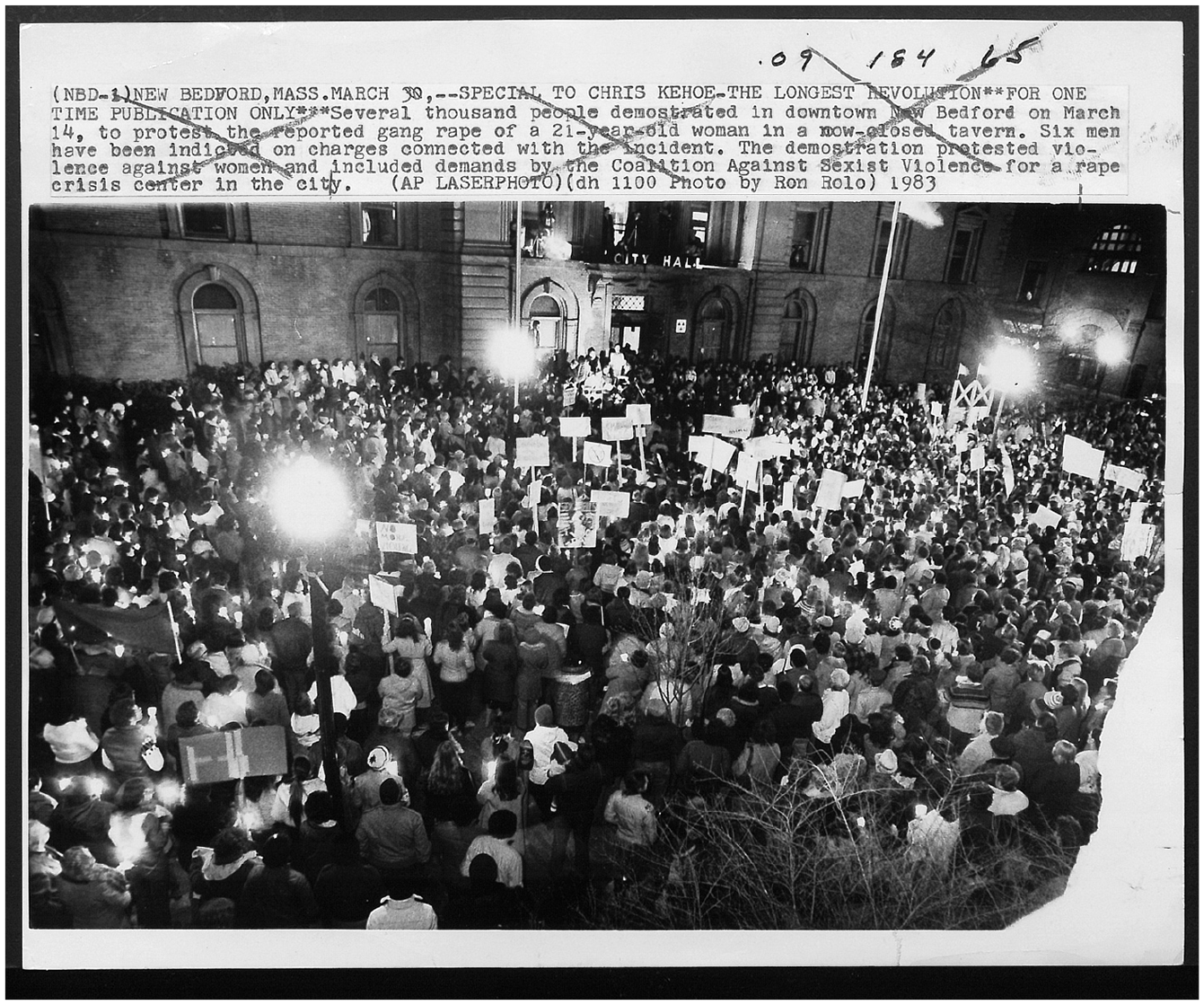
Feminist march in New Bedford, MA 1983.
Further, organizers launched a grassroots feminist coalition in the community after the incident, and the town saw its first rape crisis center founded. Oddly, Bourdieu and Wacquant read a moment of structural and symbolic transformation as one of patriarchal reproduction.
I cannot seem to forget the authors’ (mis)reading of the New Bedford story, not simply because it omits the historical context of feminist anti-rape organizing, but because it is symptomatic of a larger set of problems surrounding reflexivity and sociological explanation. The irony here is that in an otherwise brilliant text about reflexivity, Bourdieu and Wacquant suggest that women themselves are not reflexive, ignoring the new sites of feminist knowledge production generated through this event. In my view, their analysis leads us astray because Bourdieu does not grant epistemic authority to those most affected by male violence and victim blaming. He does not or cannot explain how experiences of violence and symbolic domination may yield alternative or resistant forms of knowledge. But the New Bedford case is in fact a standpoint story, wherein a rupture of consciousness occurred in a community and new symbolic stakes were pressed into the public sphere. Despite his invocation to be reflexive, Bourdieu omits actors’ own reflexivity, raising questions about what something like “reflexive sociology” should actually look like.
Questions of reflexivity ask us to consider who we should listen to and why, how to place actors’ ideas in a larger field of power, questions about our own relationship to actors’ theories of the world. Reflexivity asks us to approach our work with epistemological unease because we are always at risk of reproducing categories that reify power. For scholars of gender and sexuality, questions of reflexivity loom especially large because our research programs are often rooted in feminist commitments that seek to unseat conventional theories of power and identity. Sociologists have argued that queer methodologies, for example, should be “reflexive” at their core (Compton, Meadow, and Schilt 2018). Despite this, empirical work typically engages little with reflexivity beyond a brief statement: “I, the researcher, exhibit A and B social characteristics; my research subjects exhibit X and Y social characteristics; this could have influenced my results.” However genuine such efforts are, this style of “turning back” reads as a performative ritual rather than a serious assessment of knowledge production (Hesse-Biber 2014; O’Shaughnessy and Krogman 2012). “Reflexivity talk” has been called “self-indulgent [and] narcissistic” (Pillow 2003, 176) and an attempt at “heroic . . . self-disclosure” (Emirbayer and Desmond 2012, 581).
In my view, researchers’ self-disclosures matter—but they are limited in their ability to deal with complex epistemological problems. For example, I can make clear that I am writing a paper about reflexivity as a white, middle-class, feminist, bisexual woman currently in an elite academic position. These are signals to my audience: I have a “view from somewhere” (Haraway 1988, 590); I am positioned at the crux of multiple privileges and oppressions that shape my scholarship; my academic position allows me to “do” theory in a legitimized context; some of my identities are more salient when I’m interviewing women than when I’m reporting on archival research; my identification as a feminist anchors me to questions of reflexivity in my discipline. But these disclosures do not give me “permission” to proceed unproblematically (Pillow 2003). I have not “accomplished” reflexivity (Pillow 2003)—though I have done something. Perhaps I have acknowledged the situated character of my claims. Perhaps I have moved toward deconstructing my own authority. Possibly, though, what matters more than identity here is the “politics of location” (Lal 1996) embedded in these reflexive practices. In this article, I offer ways to think beyond (but alongside) identity-based rehearsals of reflexivity.
The call to be “reflexive” insists on many things but coheres around little, making it both “overdetermined and underdefined” (Kenway and McLeod 2004, 526). I will make the case that reflexive sociology requires far more than a simple cataloguing of identity traits and that it must consider alternative sites of knowledge production, contra Bourdieu’s analysis. Reflexive sociology, I argue, requires taking seriously one of the more maligned and forgotten claims of feminist standpoint theory: epistemic privilege. Epistemic privilege is the idea that more accurate knowledge is likely to be generated from marginal social positions (Collins 2000; Harding 1998; Sprague 2016). I aim to show that “reflexivity” is most useful when it is rooted in epistemic privilege, when it connects marginal sites of knowledge into a relational account of the world.
By centering marginal experience, epistemic privilege illuminates the boundaries and binaries that make up social life, resisting the reification of social entities as substances, “the compelling imagery of fixed entities with variable attributes” (Emirbayer 1997, 286). Following calls for ontological reflexivity (Decoteau 2017; Go 2016; Pitts-Taylor 2016), I show that epistemic privilege helps researchers assess the relations that exist in the social world (Rodríguez-Muñiz 2015). Social positions of exclusion, necessary for epistemic privilege in feminist standpoint theory, provide improved possibilities for “seeing” the social world. In fact, ontological reflexivity is precisely what feminist standpoint theory is good at, generating relational theories such as intersectionality (Collins 2000; Crenshaw 1991). In this spirit, I argue that sociologists should use epistemic privilege to build a more reflexive sociology, theorizing sites of alternative knowledge as part of the object of study. To engage reflexively with interlocutors’ understandings means treating situated knowledges as theories in their own right that can shift the researcher’s lens on the phenomenon of study (Decoteau 2017).
And yet, despite his allergy to alternative knowledge production, we cannot abandon Bourdieu: His reflexive sociology offers important tools. Bourdieu insists that reflexivity should not be about the “I,” but rather, an interrogation of the analyst’s membership in a field of knowledge. The “unconscious” of that knowledge system has to be uncovered (Bourdieu and Wacquant 1992, 40–46). From Bourdieu, we can borrow the notion that there is a larger (fielded) context of knowledge or expertise into which actors’ standpoints must be integrated. In the New Bedford case, and in the examples I explore later, that context is U.S. feminist anti-violence activism. Bourdieu teaches us that in order to understand how alternative sites of knowledge form and gain power, we must consider the social and political contexts of their mobilization.
In this article, I work toward a synthesis of theoretical positions that are typically considered antagonistic: feminist standpoint theory and Bourdieu’s reflexive sociology. In so doing, I explicitly link epistemic privilege to the project of building relational theories of power. Thus, the familiar invocation to be “reflexive” becomes a demand to center excluded knowledge and allow it to shift the object of study. In what follows, I first compare feminist standpoint theory and Bourdieu on the question of epistemic privilege and exclusion. Then, drawing from archival research on the feminist anti-violence movement, I use both feminist standpoint theory and Bourdieu to show how theorizing from the perspective of survivors has generated more relational explanations of gender-based violence. I conclude by returning to the New Bedford case and its implications for a reflexive sociology grounded in epistemic privilege.
Epistemic Privilege
Feminist Standpoint Theory
Because it is beyond the scope of this article to provide an exhaustive overview of feminist standpoint theory, I focus here on epistemic privilege. 2 Feminist epistemologists have argued that knowledge must be grounded in lived experience and that women’s experiences systematically differ from men’s (Harding and Hintikka 1983). The problem with traditional models of science is that they accept men’s partial experiences of the world as “universal.” In Nancy Hartsock’s (1983) foundational text on feminist standpoint and Marxism, she asks: What are the epistemological consequences of women’s distinct structural positions? Hartsock and others have maintained that the sexual division of labor is central to this epistemological chasm: Women occupied positions in the family as “contributors to subsistence” that allowed them different vantage points on patriarchal ideologies (Hartsock 1983, 284). Improving on the insights of Marx and Lukács, feminist standpoint theory is rooted in the idea that knowledge grows out of the relations of production (Longino 1990)—for feminists, this includes social reproduction.
However, the consciousness that emerges from this material location is not spontaneous. This is not a “female” standpoint, but a “feminist” standpoint—epistemological insights grow out of material life and political practice (Hartsock 1983). It is for this reason, Patricia Hill Collins (1997) argues, that a standpoint should never be confused with a “point of view.” Rather, a standpoint is a “site of inquiry” and a “relational achievement” (Naples 2003, 84).
Feminist standpoint theory has undergone many evolutions and is replete with disagreements, but some commitment to knowledge as structurally and relationally produced remains consistent: “The logic of preferring some standpoints over others emerges from a political analysis of the relation between knowledge and material interests” (Sprague 2001, 529). Excluded knowledge has more emancipatory potential because marginalized subjects are disinvested from the ideologies of the powerful: This is epistemic privilege. According to Dorothy Smith (1997, 397), experiences on the margins are likely to generate a new “sociological problematic.” For example, women’s experiences cannot adhere to the public–private divide and therefore call imposed binaries into question (Collins 1997; Hartsock 1983). Objective social science, according to Sandra Harding ([1991] 2016), does not require relinquishing politics or experiences but, rather, turning back on experience to expose ideological blind spots. The goal is to challenge “epistemic inequality” based on the exclusion of certain groups’ lived realities (Baca Zinn and Zambrana 2019).
Further, there is not one standpoint from which better theories are generated; rather, standpoint theory posits an iterative process that aggregates partial perspectives (Stoetzler and Yuval-Davis 2002, 315; Yuval-Davis 2012). Collins (2000) and others (Bar On 1993; Longino 1990; Sprague 2001) have insisted that standpoints are not individual and static but community-based and processual. A standpoint cannot be “held” (Sprague 2016, 78). Rather, epistemic privilege is produced by taking up an experience that falls outside the bounds of representation and generating a critical analysis (Collins 2000; Lather 2007; Nencel 2014). Finally, because subject positions are unstable and intersectional, objective knowledge is always a contingent outcome rather than a guarantee (Pitts-Taylor 2016; Stoetzler and Yuval-Davis 2002).
Feminist standpoint theory is embedded in feminist debates surrounding representation—especially questions about the “power and politics of the gaze” (Pillow 2015, 421) in qualitative research. Feminists have asked if it is possible or desirable to “represent another” (Pillow 2003, 176) and have challenged images of the researcher as a “transformative intellectual” (Lather 2007, 124)—an image in which Bourdieu is invested, as we will see. Feminists have further problematized the category of “experience” as a source of evidence (Britzman 2003, 35; Scott 1992; St. Pierre 2008, 319) that reifies the subject as “singular, knowable, and fixable” (Pillow 2003, 180) and obscures the complex articulations between experience and resistance (Scott 1992). These questions have spurred critiques of epistemic privilege.
Indeed, many feminist theorists have rejected the concept of epistemic privilege for “idealizing” marginal subjects (Bar On 1993), for making a fetish of otherness (Lal 1996), for mystifying the harms of oppression (Narayan 2004), for suggesting that marginality necessarily yields knowledge (see Go 2016; Pels 2004; Stoetzler and Yuval-Davis 2002; Yuval-Davis 2012). Susan Hekman (1997) critiqued feminist standpoint theory for failing to acknowledge that women’s standpoints are themselves power imbued. Responding to Hekman, however, Harding (1997) insisted no social positions are unproblematic, but some positions provide better theoretical tools. Collins (1997) agreed, arguing that epistemic privilege is not about “truthfulness” but about the power of a group to make its standpoint heard. Collins (1998, 8) has consistently rejected readings of epistemic privilege that grant “vision” to oppressed groups, arguing instead for partial knowledge that is collectively activated and “multiply structured” (see also Alcoff 1999).
Although some readings cast epistemic privilege as naïve, I suggest that we see epistemic privilege as a partial and potential outcome of exclusion or liminality. This reading refuses a centered, transcendent standpoint; rather, we should center nondominant knowledge and its potential for theorizing power from the experience of everyday life (Collins 2000). Thus, epistemic privilege can work to hold scholars accountable to social actors’ struggles for self-representation (Collins 2000; Pillow 2003). Further, using intersectionality as a starting point guards against the homogenizing tendencies of “women’s standpoint” by continuously decentering the privileged position and insisting on the “multiple” structuration of all standpoints (Choo and Ferree 2010; Collins 1998; Harding 1998; Hesse-Biber 2014). The empirical analysis in this article will shed light on the dangers of failing to do this decentering work.
Collective experiences of exclusion and liminality are the social conditions capable of generating epistemic privilege in feminist standpoint theory. The focus should be on what Collins (1998, 6) calls “migration experiences” between social spheres, or what Joey Sprague (2016) refers to as “crossing boundaries.” Standpoints are relationally produced and experienced. The experience of symbolic exclusion—especially as it coincides with material exploitation—is key. 3 While oppressed groups remain materially included through exploitation, they also form a constitutive outside to what can be represented or properly embodied (Butler 1990). Drawing from this imaginary allows concepts to emerge such as Collins’s “outsider-within” (2000), Smith’s “bifurcated consciousness” (1987), Anzaldúa’s “mestiza consciousness” (1987), Haraway’s “double vision” (1988), and of course DuBois’s foundational “double consciousness” ([1903] 2009). For feminist standpoint theory, exclusion is the place (or displacement) from which privileged vision is possible: This position can disinvest from symbolic reproduction and provoke critique. This dynamic of inclusion and exclusion occurs across multiple social spaces (Bar On 1993) and generates the potential for epistemic privilege.
The condition of being between—the outsider-within (Collins 2000), the border woman (Anzaldúa 1987)—therefore creates the possibility for questioning dominant knowledge (Sprague 2016). This split or doubled position allows subjects to take a strange view toward ideology, to see the contradictions between master narratives and marginal experience. The epistemic break occurs within experience. For Smith (1987), the woman academic exists between two worlds: masculine abstraction (academia) and feminine concrete existence (motherhood). Feeling alien because she does not fit either world prompts Smith to question the dichotomies of patriarchal thought. Smith’s positioning at the crux of this contradiction is epistemically privileged because the social world is replete with boundaries (Sprague 2016) that, when experienced, have the potential to disrupt ideological reproduction. According to Jayati Lal, then, “hybridity” is the prerequisite for epistemic privilege (1996; see also Decoteau 2013, 2016).
In this way, feminist standpoint theory’s approach to reflexivity requires some version of epistemic privilege: tracing how actors incorporate the contradictions between lived experience and authoritative knowledge. 4 Epistemic privilege offers a path to relational theorizing because standpoints are an “index of our relationship with the world and its unobservable causal mechanisms” (Gillman 2016, 462), generating insights into power (Decoteau 2016; see also Hemmings 2012, 150). The wager posed by epistemic privilege is that if the world is refracted through various perspectives—perspectives framed and adjusted by power—the accounts of marginalized groups are a good starting place for theorizing power.
Bourdieu’s Reflexive Sociology
In Bourdieu’s reflexive paradigm, on the other hand, it is not social actors who gain privileged knowledge of the social world but sociologists. The concept of the epistemic break is central to Bourdieu’s reflexivity, which posits a gap between practical knowledge (reasonable reason) and scientific knowledge (theoretical reason) (2000). Bourdieu argues that social facts emerge only through a rupture with common sense provided by sociological training (Bourdieu and Wacquant 1992). Still, Bourdieu’s emphasis on objective knowledge does not naïvely endorse science as trans-contextual, ahistorical reason (2000, 70). Rather, Bourdieu’s objectivity is anti-positivist and reflexive. Bourdieu asks sociology to “bend back” on itself, which includes consideration of the researchers, their theoretical models and training, and their relationship to the object of knowledge (Bourdieu and Wacquant 1992; Maton 2003). The aim is not to uncover the social location of the analyst but to understand the “social and intellectual unconscious” of the models and tools in the sociologist’s field (Bourdieu and Wacquant 1992). Scientists must (1) objectify the practical logic of actors and (2) objectify the assumptions of their own discipline.
Bourdieu’s reflexivity is implicated in his broader social theory, which posits fields and their practical logics, embodied pre-consciously by actors. What social actors “know” is shaped by the social fields in which they participate and never by a transcendent position outside those relations (Bourdieu and Wacquant 1992, 232). What actors know is really what they do: Their logics are practical. The sociologist’s task is to place actors’ logics within the power structures they conceal (Bourdieu and Wacquant 1992, 251), objectifying actors’ subjective relationships to the world (Bourdieu 2003). For Bourdieu, then, epistemic privilege cannot be found within experience, because actors do not fully recognize the field struggles in which they participate.
Still, however, it is possible for actors to achieve a kind of epistemic break in practice. Although Bourdieu posits an “immediate harmony” (2000, 29) between field and disposition, ruptures in objective conditions can provoke dissonance. Such transformations usually lie in the gap between expectations and experience: This gap may be a sense of mis-fitting produced by economic crises (Decoteau 2013) or a “surprise” in a given situation (Bourdieu 2000, 147). For Bourdieu, the epistemic “break” arises externally rather than within everyday experience. 5 Although Bourdieu would agree with a standpoint theorist such as Dorothy Smith that masculine ideologies structure everyday life, Smith (1987) would argue that women’s everyday experiences give them opportunities to see beyond patriarchal “relations of ruling,” while Bourdieu would reject the idea that the mundane activities of everyday life hold such a path to consciousness.
If feminist standpoint theory is committed to the epistemological productivity of lived experience from the margins, then Bourdieu is concerned with departing from lived experience to build anti-ideological knowledge. The strength of Bourdieu’s model is that it requires us to consider the conditions for knowledge production that are “external” to experience, including the researcher’s own assumptions. Feminist standpoint theory’s strength is that it comprehends how experience itself can prompt an epistemic break from ideology, since everyday life is always-already alienating for marginal subjects. Collective projects that emerge from marginal experiences have the potential to reveal ideology as ideology, to introduce concepts that better describe power (Gillman 2016, 472). Marginal knowledge does not typically appear in Bourdieu, much less stem from anything like a borderlands condition. 6 Despite these divergences around the source of reflexivity, both standpoint theory and Bourdieu are committed to providing objective accounts of subjective life and to the embeddedness of knowledge in power relations.
Why Epistemic Privilege Matters
Reading Bourdieu contra feminist standpoint theory reveals that for standpoint theorists, epistemic privilege is immanent in marginal experience; for Bourdieu, epistemic privilege is external to experience. Drawing from feminist standpoint theory, I argue that a robust reflexivity should (1) grant epistemic privilege to marginal standpoints and (2) integrate alternative knowledge into the object of study. Drawing from Bourdieu, I argue that a robust reflexivity should also (3) account for the larger knowledge system in which standpoints are taken up. The first two points suggest that experiences of exclusion are epistemically productive, while the third point draws from Bourdieu’s “external” conditions for reflexivity. In what follows, I use historical evidence from the feminist anti-violence movement to illustrate the utility of this synthetic reflexive framework, revealing how epistemic privilege facilitates relational theorizing.
First, allow me to clarify what I mean by “relational.” Sociologists have made the case that social reality is relational (Desmond 2014; Emirbayer 1997; Eyal 2013; Go 2016; Rodríguez-Muñiz 2015). Relational approaches re-envision social things as relations between structures, institutions, actors, and discourses. The focus is on connections rather than static entities—boundaries rather than groups (Desmond 2014) or expertise instead of experts (Eyal 2013). Gender scholars have found relational theorizing especially productive, moving away from a static, thing-like focus on sex roles to “gender” as a relational object. The contemporary norm is to think about relations of gender systems and identities, especially as they intersect with race, class, and sexuality (Bettie 2003; Collins 2000; Connell 1987). To use Smith’s formulation, “patriarchy” is better described as patriarchal “relations of ruling” (1987; Collins 1998, x).
This is also how Collins’s “Black feminist thought” works, which takes the insights of Black women’s outsider-within perspective and generates a theory of intersectionality (2000, 222). Intersectionality is a relational theory, wherein a “both/and” position provides the resources for theorizing domination as intersecting systems. “Power relations of racism and sexism gain meaning in relation to one another” (Collins and Bilge 2016, 27). This theory of power is not generated from a distant gaze, but from the “wisdom” of surviving in a subordinated group and building epistemic alliances therein (Collins 2000). Kimberlé Crenshaw’s formulation of intersectionality emerged from analyzing what she calls the “strength of shared experience” among black women (1991, 1241; Collins and Bilge 2016, 82). For Collins and Crenshaw, intersectionality is not just a different theory but a marked improvement on previous theories of power as separate and additive (see May 2014). Drawing from these insights, I argue that knowledge produced from marginal social positions has the potential to yield more relational theories because it may be disinvested from facile binaries and power-laden boundaries.
Knowledge Production in the Anti-violence Movement
In this analysis, I show that feminist anti-violence activists in the 1970s and 1980s produced relational theories of violence by granting epistemic privilege to survivors’ experiences of violence and its contradictions. My analysis is based on research on U.S. feminist anti-violence activism from the 1960s through the 2000s conducted at four archives, using primary documents. 7 Three of these archives are the central repositories for U.S. feminist anti-violence activism. They include the National Coalition Against Domestic Violence (NCADV) archive, which is not an official archive; however, I was granted access to its extensive contents for this research. The fourth collection contains the documents of the Illinois Coalition Against Domestic Violence (ICADV), providing insights into state-level organizing. The thousands of pages of documents collected across archives include articles of incorporation for organizations, meeting minutes, funding documents, speeches and statements, as well as pamphlets, flyers, and directories. Activists also collected scientific publications about domestic violence, making these archives an important repository of expert knowledge produced about intimate violence during this critical period of policy development and social change.
I coded these materials using a qualitative schema developed from multiple readings of the material. I then wrote memos about each code, focusing on activists’ discursive and practical organizing strategies. For example, the code “survivor story” was important to this analysis, and I found evidence of activists’ use of survivors’ stories to make political claims across all four archives. I connected the memos to each other, creating a “situational map” (Clarke 2005) of the movement and its epistemic strategies. “Survivor stories” connected to “federal testimonies,” which connected to “models of feminist counseling” in later years. This allowed me to trace how activists used experiential knowledge as a movement-building strategy. 8 In general, these materials expose the knowledge production strategies of one of the most transformative gender-based social movements in U.S. history. Still, there are limitations to my approach. The archive offers only select evidence, foregrounding prominent activists and organizations primarily on the east and west coasts. This type of epistemic analysis is therefore circumscribed by “what counted” as legitimate knowledge in the movement itself.
Nevertheless, my findings show that throughout the 1970s and 1980s, feminists produced relational theories of abuse that went against the grain of popular “family violence” theories. Family violence researchers depicted violence as thing-like, using a naïve kind of reflexivity that acknowledged their academic positionality but failed to reevaluate their categories of inquiry. Feminist activists, on the other hand, used women’s experiences to theorize abuse as a system or structure, exposing the public–private dichotomy as false. The anti-violence movement provided the larger political and social context into which survivors’ standpoints were then mobilized. Feminists produced relational theories by incorporating alternative sites of knowledge production into the object of study—executing a more robust reflexivity. Feminists’ relational analyses were not inevitable; rather, they were the result of making epistemic privilege the precondition for theory building. Yet these data also reveal the limits of standpoint reflexivity, since feminists continuously accepted white women’s experiences of violence as “universal” (Richie 2000). Feminists’ use of “consciousness-raising” strategies reproduced domination through an “add women of color and stir” approach, failing to transform their theories according to the experiences of women on the margins (Choo and Ferree 2010; Harding 1998).
Naïve Reflexivity: Family Violence Research
Family violence research emerged from academic departments associated with functionalist sociology and psychology, complete with National Institute of Mental Health (NIMH) funds (Kurz 1989). Family violence researchers were reflexive in their own way, and like feminists, they pushed their findings into a larger field of knowledge. However, whereas feminists used survivors’ stories to theorize violence as a web of harm across public–private spheres, family violence researchers engaged a naïve reflexivity that allowed them to imagine domestic violence only as incidents of physical violence in the home—punching, slapping, kicking, strangling. Because they relied on incident-based survey categories and positioned their findings in family systems theories, they put forth a model of abuse as a thing contained inside the family unit.
Extant explanations of the discrepancy between family violence and feminist theories suggest that family violence researchers misapprehend gender-based violence due to method (see Kimmel 2002). However, I find that epistemic privilege is actually key to understanding this discrepancy. Family violence researchers reified the public–private divide because they relied on expert categories that understood violence as incidents, rather than as power relations rooted in gendered institutions. Whereas feminists mobilized women’s accounts to theorize abuse as relations across public and private spheres, family violence researchers theorized abuse as a “private” feature of the family system, reifying the public–private distinction.
For example, since the development of family violence research in the 1970s, the Conflict Tactics Scale (CTS) has been the most popular survey instrument for measuring violence (see Johnson and Ferraro 2000; Straus 1979). Designed by Murray Straus in 1979, CTS measures domestic violence by asking about the frequency of events: How many times have you been kicked by your partner in the past year? (Johnson and Ferraro 2000; Kimmel 2002; Straus et al. 1996). The CTS helped generate a large social-scientific research infrastructure for intimate violence (Kurz 1989), important for public policy throughout the 1980s. However, the CTS also helped promote the idea that violence in the home is about discrete acts of individuals “fighting,” rather than about power imbalances.
But it was not just surveys that encouraged this characterization of domestic violence. Family violence theories posited families as “functional systems” that have misfired and need to be righted. According to an NIMH pamphlet published in 1974 (v), this research asks: “What are . . . the social and psychological pressures which lead to family dysfunctioning?” Family violence researchers used qualitative and quantitative tools to answer this question. However, they “lifted up” evidence into models of the family as a system in which individuals sometimes fight, in which conflict is borne out of systems gone awry. (In)famously, Suzanne Steinmetz, a family violence researcher, used surveys and interviews to argue that husbands were just as likely to be victimized as wives (1977). Because “the family” was the context in which acts of violence were carried out, researchers should be “objective” about gender (S. Steinmetz 1977). In researchers’ own words, “This work is concerned with violence insofar as it means a family member pushing, slapping, punching, kicking, knifing, shooting, or throwing an object at another family member” (Gelles 1972, 20). Family violence scholars privileged researcher-generated categories and intra-family models that invested in the public–private divide, separating violence in the home from larger patterns of gender-based exclusion and discrimination.
Still, family violence researchers were at least superficially reflexive about their knowledge claims. Murray Straus wrote regretfully in 2007 that his “scientific commitments” have overridden his “feminist commitments” in the name of objectivity (231). Further, these researchers participated actively in policy making and saw it as their job to push back against cultural images of the family as idyllic and peaceful (S. K. Steinmetz and Straus 1974, 6). However, they believed abuse could be captured by incident-based surveys, they were wedded to a model of the researcher as expert, and they were entrenched in functionalist family system frameworks. They did not incorporate alternative sites of knowledge into the object of study, nor did they interrogate their theoretical models. Their theories of abuse therefore retrenched the public–private divide, segregating domestic violence from other gender-based patterns of inequality.
Robust Reflexivity: Exclusion and Alternative Sites of Knowledge
Unlike family violence researchers, anti-violence activists granted epistemic privilege to survivors’ experiences, lifting those standpoints into a politicized knowledge context, in turn building relational theories of abuse that troubled the public–private divide. Feminist and family violence researchers’ divergent understandings of abuse stem from each paradigm’s distinct relationship to epistemic privilege. Three reflexive factors distinguish feminist accounts from family violence accounts: (1) women’s experiences of subjugation and erasure are foregrounded; (2) knowledge from the margins is included in the object of knowledge; (3) the larger knowledge context was one of political struggle.
In fact, though categories like “domestic violence” are associated with feminism, the activists and survivors who founded the movement opposed separating violence into “types.” Consider these retrospective notes written by the founders of Bradley-Angle House in Oregon: “We began as a reaction to violence against women, not just domestic violence, but also the violence of the bars, the streets, drugs, homophobia, the criminal justice and mental health systems, poverty, homelessness . . . these problems were all related to the social stigma of being a woman” (Graham 2009). For activists, separating violence into types that reified the public–private divide was not useful. Feminists connected “the battered woman” to “women’s condition” in general: “all women” experienced shared oppressions. 9 Activist Marian Allen wrote, “Every woman in our culture shares characteristics with the ‘battered’ woman” (n.d.). Abuse was structured by patriarchal relations.
This relational theory of violence came about through collecting and analyzing women’s experiences of abuse and concomitant exclusion from powerful institutions, linking male dominance in the home to male dominance in psychiatry and law. For example, an article published in 1976 by shelter activists established a direct link between interpersonal violence and mistreatment in institutions: “Battered by electroshock, battered with drugs that slow your body and snuff your mind” (Piercy 1976). Women’s experiences of “battering” spanned home and institutional contexts, suggesting that no such divide actually exists, that male dominance operates across “separate” spheres. Indeed, it is the connection between interpersonal and institutional violence that makes domestic violence imprisoning, trapping women between institutional silencing and intimate subjugation.
This problematization of the public–private binary exposed the violent operations of law and psychiatry, allowing feminists to target them for institutional change. For example, the New York Times reported from a battered women’s conference in 1977: “Once, while her arm was in a cast, her husband beat her, then called for a doctor who placed her in a straightjacket and had her ‘voluntarily’ admitted to a state mental institution.” Here, the constraints that women faced at home mirrored their institutional imprisonment. Feminists claimed that women’s domestic subjugation intersected with their institutional exclusion or domination (Metzger 1977). This image (Figure 2) from a feminist march claims that violence is experienced multiply, connecting physical harm to institutional degradation. Organizers sought to undo the construction of “private” violence, then, by recasting it as doubled across false borders of public and private spheres.
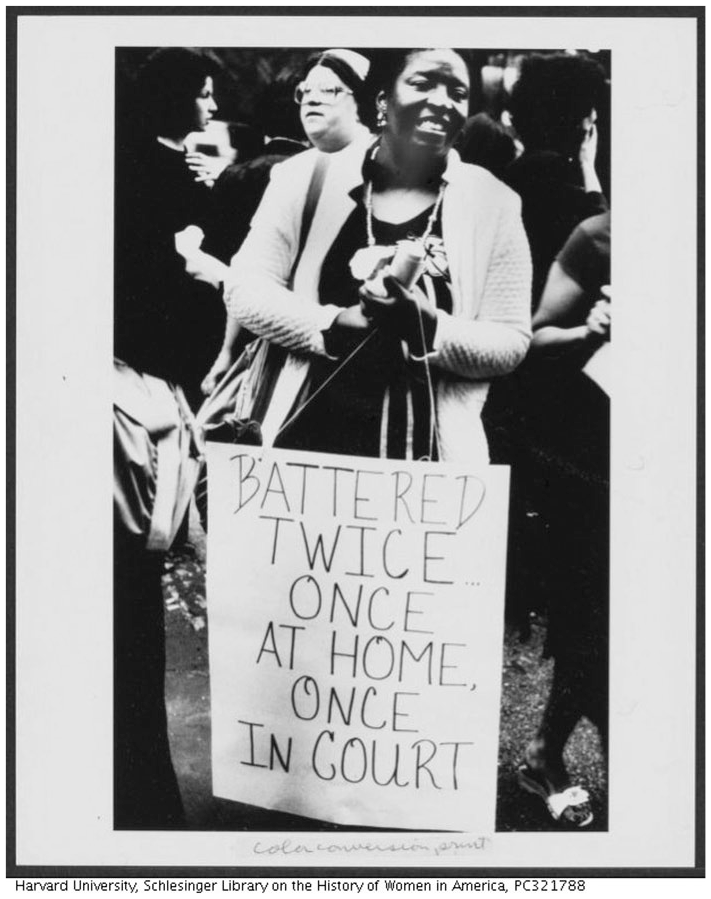
Feminist anti-violence march.
Women’s stories circulated widely among activists in the 1970s and 1980s. A report from the Michigan Women’s Commission in 1977 (84) told the following story: “My husband would hit me, dig me with his fingernails, and abuse me sexually, and the marriage counselor said this was happening because I had such a negative opinion of myself. The . . . mental health clinic . . . advised me to quit my job because maybe it would help if I stayed home.” Here, the victim establishes a connection between her husband’s violence and authorities’ dismissal of her experiences. Intimate violence is exacerbated by institutional silencing. It is this relational web of power that has defined feminist approaches to abuse.
Beginning with women’s stories of violence across the public–private divide allowed feminists to seize on the elements of symbolic exclusion and bodily subjugation that define standpoint. By forging this link, feminists were able to build models of abuse that refused a separation between intimate violence in the home and gendered exclusion in institutions. This relational approach was generated from women’s experiences of crossing public and private boundaries. Domestic violence could never be imagined as a set of discrete incidents in the home because this would have belied the reality of abuse, which survivors insisted operates across boundaries of public/private and interpersonal/institutional.
For example, in a collection of stories, survivors revealed that abuse forces women to feel like a “stranger” in society, due to social and psychic exclusions (Marecek 1983). The “stranger” exemplifies the “outsider-within” figure (Collins 2000) who is forced to inhabit a social world that excludes her—but which also offers insights into power. The volume ends with a poem about using that experience of dislocation to “rise up angry” alongside other survivors (Marecek 1983). Organizers published pamphlets such as these and brought survivors to testify to government bodies in order to build a theory of abuse that connected public and private realms. Women’s personal accounts of intimate violence came to yield more relational theories not through magic, but by being “lifted up” into political work.
The Context for Mobilizing Standpoints
The generation of these stories within the anti-violence movement allowed feminists to transform standpoints into theories of violence, shared across communities of survivors and activists. As Bourdieu insists, excavating the relations between systems of knowledge is key to reflexive theory building (see Maton 2003). Feminists situated women’s stories in a larger field of political claims making and epistemic struggle, executing both feminist standpoint theory and Bourdieusian reflexivity. Something like “women’s experiences” cannot be represented without translation (Britzman 2003; Pitt and Britzman 2003; St. Pierre 2008). Rather, generating relational theories of abuse required mobilizing survivors’ standpoints into a larger movement.
Anti-violence activists started their movement in part by challenging family violence research paradigms. In a 1980 speech, activist Susan Schechter bemoaned the fact that existing research only gave “excuses for why individual men beat up individual women.” She called for research to be “redone” by “formerly battered women, women of color, and working-class women,” explicitly advocating epistemic privilege. Feminists insisted that new research needed to center direct experiences of abuse. In a presentation to the U.S. Commission on Civil Rights in 1978 (359), activist Yolando Bako argued that only “veterans” of the movement who had “accompanied scores of women through criminal court” should be doing policy work. According to Bako, knowledge rooted in women’s experiences should be privileged, rather than knowledge that was “only theoretical.”
In an ICADV newsletter in 1982, feminists wrote about the need to implement their own research in shelters, because existing questionnaires were “biased” and relied on the “unnatural constraints of the scientific model.” Creating new research models would “free” survivors to challenge the paradigms that informed existing research. Feminists advocated epistemic privilege and promised to lift women’s stories into a larger field of knowledge. Activist Barbara Hart (1985) wrote about her efforts to get “feisty women” on the boards of academic journals in order to demand studies rooted in women’s experiences. As evidence of how this could be done, activists pointed to an article by Bonnie Carlson (1977, 457), who interviewed survivors and found that financial struggles were their biggest problem. For feminists, this finding revealed that domestic violence was not a “private” problem; rather, it was fused to larger patterns of gender-based economic discrimination. Early on, feminists recognized the need for survivors’ voices to be the basis of theorizing in a more relational way.
These efforts at standpoint theorizing also shaped political organizing strategies. NCADV (1982) required that all member agencies seek input from battered women and that NCADV committees maintain 25 percent representation of battered women. At their first meeting, organizers promised to work “with” rather than “for” battered women and asked member agencies to answer the following: “What is the nature of your organization’s decision-making structure and what role do battered women play . . . ?” (NCADV 1978b). Survivor participation formed the basis of activists’ approach to both organizing and knowledge production.
Feminists also developed models for “lifting up” survivors’ stories into abstract theoretical frameworks. For example, “Flavia’s” story was included in several early pamphlets. Flavia (1984) described her husband’s brutal abuse, as well as her attempts to seek help from authorities. All denied her help. Ultimately, Flavia was “rescued” by the experience of hearing other women’s stories in a support group. In the pamphlet, Flavia theorizes abuse as a “shattering” of reality across interpersonal and institutional realms, wherein she could only reclaim voice among other women.
It was in this kind of “consciousness-raising” setting that early theories of abuse were generated. For example, NCADV (1978a) asked members to share personal stories, which were then passed between agencies. Consciousness-raising was imperfect, however. Activists worried that these models excluded less privileged women (Walsh 1980) and that they were too psychotherapeutic (New York Radical Feminists 1973). Issues of race, class, and sexuality were often excluded—seen as distractions from “gender-based” organizing (see Richie 2000). Movement leaders’ lack of attention to intersectionality was an ongoing problem that groups like NCADV’s Women of Color Task Force fought against. 10 It was in this context that (some) women’s subjective experiences were translated into (limited) theories of abuse.
Archival evidence highlights the centrality of epistemic privilege and the critical role of a larger movement context, including its stratifications and erasures. Bourdieu’s reflexivity insists that social and political contexts (or “fields”) matter for reflexivity and relational theory building. Building from these insights, my analysis reveals that relational theories of abuse were not generated directly from women’s “experiences,” but rather, in a social movement context. Still, just because feminist theories were relational does not mean they were intersectional, since the movement itself excluded women of color, poor women, and LGBT+ people.
Conclusion
How can sociologists use the reflexive resources of epistemic privilege to build more relational theories of the social world? Reading feminist standpoint theory alongside Bourdieu suggests a series of considerations. First, sociologists should grant epistemic privilege to subjugated standpoints because ideas generated therein are more likely to provide a “sociological problematic” that is disinvested from existing categories. Second, researchers should integrate alternative sites of knowledge production into the object of knowledge itself. As Claire Decoteau (2017) argues, “seeing” with interlocutors’ meaning-making systems can expose causal mechanisms that are invisible to the researcher. My claim is that actors’ theories help elucidate a new problematic of power precisely because those theories are less invested in reproducing existing schemas. So it is not just that reflexive sociology requires taking “different” and “multiple” standpoints into account (see Go 2016), but that reflexivity requires attending to how and when alternative forms of knowledge may be better.
And third, drawing on Bourdieu, I argue that it is necessary to excavate researchers’ theoretical models and how they relate to interlocutors’ models. Grounding reflexive sociology in epistemic privilege does not require a naïve endorsement of interlocutors’ theories as true of the world, nor should it ignore processes of translation between experience and theory. Rather, sociologists must account for the larger field of epistemic struggle. Epistemic reflexivity is also, therefore, ontologically reflexive: It considers the state of things and relations in the social world as shaped by histories and relations of knowledge production.
I have worked to bring feminist standpoint theory and Bourdieu into conversation, leveraging their disagreements to improve our understanding of reflexivity. Calls to be reflexive are often executed superficially as “self-disclosures” (Pillow 2003). Working against this trend, I have shown that reflexivity can be an exercise in theoretical vigilance, providing tools for centering alternate knowledge and interrogating its contexts. Thus, through a novel analysis of feminist knowledge production in the anti-violence movement, I have connected the task of relational theorizing with the task of using standpoint to shift the object of knowledge.
For example, let us return to New Bedford, to the original piece Bourdieu cited to analyze the rape protests: Lynn Chancer’s 1987 Gender & Society article. Chancer reveals that community members did in fact hold a march in support of the perpetrators one year after the incident. Unlike Bourdieu, Chancer does not argue that the march exposes women’s complicity in their domination. Rather, for Chancer, the march exposes the intersection of ethnic oppression with victim blaming. Portuguese marchers reacted against the media’s framing of the event as a “Portuguese rape,” constructing Portuguese men as backward and violent. They saw themselves as defending their community by marching in support of the perpetrators. What we see here is a community using victim blaming to counter its public othering. A complicated moment indeed.
Chancer centers the Portuguese community’s struggle for self-representation: She positions their voices alongside feminist theories of rape in order to develop a reflexive approach for theorizing the intersection of sexual and ethnic oppression. The case cannot be understood without integrating alternative sites of knowledge—from feminist theories of rape and from the Portuguese community—into the object of study. Chancer further analyzes how feminist and Portuguese standpoints were mobilized differently in the media, creating representational inequities. She uses these findings to expand theories of rape, arguing that ethnic oppression is co-constitutive of sexual oppression. She does not treat the Portuguese protestors as innocent truth-tellers, but she does situate their standpoints in a larger political context. In so doing, she disrupts a gender-only framework for theorizing rape and builds a relational theory centered on the intersection of ethnic and sexual othering.
Rather than a reflexivity that “can only meet itself, mirrored back” (Harding 1998, 193), then, scholars should engage with alternative sites of knowledge based on lived experiences of contradiction and exclusion. This framework for reflexivity does not endorse an innocent notion that we should accept such accounts as true. Nor does it suggest that researchers must themselves embody such contradictions—though they might. My core claim is that scholarly work benefits from grounding analyses in theories of social life generated from excluded or liminal positions. This approach to reflexivity synthesizes feminist standpoint theory’s interest in marginal discourses and the knowledge/power relation while drawing from Bourdieu’s interest in the “external” conditions of possibility for reflexivity. The result is that we can mobilize epistemic privilege as a reflexive tool toward generating relational theories of the social.
Footnotes
Author’s Note:
Many thanks to Claire Decoteau, Jonah Stuart Brundage, Danielle Giffort, Kelly Underman, Laura Gillman, and Mary Shi for their generous feedback on this paper. The anonymous reviewers and the Gender & Society editors have also been incredibly helpful. A previous version of this article was presented at the American Sociological Association meetings in 2018 on the panel “Philosophy and Sociology in Conversation”—I thank Isaac Reed and Anne Marie Champagne for inviting me to participate.

Notes
Paige L. Sweet is an assistant professor of sociology at the University of Michigan. Her work focuses on gender/sexuality, gender-based violence, and the politics of health. Her book The Politics of Surviving: Domestic Violence in Traumatic Times is forthcoming with the University of California Press.