







Abstract
Research on couples’ earnings arrangements has focused on men’s and women’s (non)conformance to the male-breadwinner/female-homemaker model. By doing so, research has ignored the following: Breadwinning can be a source of stress for men; the male-breadwinner/female-homemaker model does not apply to all racial groups; and the proportion of women in an occupation may moderate the stress process associated with divergent earnings arrangements. To address factors overlooked, I applied mixed-effects models to the 1999–2017 Panel Study of Income Dynamics data to examine the internalizing (psychological distress) and externalizing (heavy drinking) responses to stress among married, non-Hispanic white and Black men and women. Greater relative earnings reduce Black women’s psychological distress and heavy drinking, but increase Black men’s heavy drinking. Among white men, greater relative earnings reduce psychological distress and demonstrate a curvilinear relationship with heavy drinking, whereas no significant pattern emerges for white women. Occupational sex composition moderates these relationships. Among Black women, greater relative earnings lower psychological distress the most for those in women-concentrated occupations, and moving from economic dependency to equal breadwinning decreases heavy drinking the most for white men in men-concentrated occupations. Findings showcase the value of an intersectional approach to capture the diverse meanings associated with earnings arrangements.
The United States has witnessed a profound change in the family economy and gender dynamics over the past decades (Van Bavel, Schwartz, and Esteve 2018). Increasing female labor force participation and attitudinal movement toward gender egalitarianism have led to increasingly more economic contributions by wives in heterosexual marriages (Van Bavel, Schwartz, and Esteve 2018). Despite these social changes, the traditional male-breadwinner/female-homemaker model, as well as its “neotraditional” variant in which wives are employed but earn significantly less than their husbands, is still widespread (Connell and Messerschmidt 2005; Moen and Roehling 2005; Townsend 2002). Given the inherent tension between women’s rising contributions to family economics and the expectation of the husband being the primary breadwinner, a growing body of studies has been conducted in response to the “new economics of marriage” (Fry and Cohn 2010). These analyses, drawing on the disconnection between cultural ideology and economic reality, provide important insights into the power dynamics of family economics. This research replicates findings from prior studies and extends existing research in three ways.
First, current conceptualization of breadwinning has focused on men’s and women’s conformance or nonconformance to the traditional or neotraditional cultural model: Inability to fulfill the breadwinning expectation is expected to take a toll on men’s well-being, and by doing so, research has largely ignored that breadwinning can be a source of stress for men (as well as for women), given the demands of the “greedy institution” of work (Coser 1974) and the pressure to maintain the breadwinner status to provide for the family. In this study, I consider the potentially nonlinear relationship between relative earnings—one’s relative share of a couple’s combined income—and stress. Second, most research ignores that the (neo)traditional breadwinning model is a historically and culturally bound ideology not relevant to many social groups. Black women’s participation in the labor force, for example, has long been necessary for their families’ survival (Collins 2009; Dow 2015; Landry 2000). Accordingly, I use an intersectional approach to capture the diverse implications of couples’ earnings arrangements for stress across intersectional groups (Collins and Bilge 2016; Crenshaw 1991; McCall 2005). This intersectional approach views race and gender 1 as intersected rather than distinct categories; Black women’s experiences, for example, may differ from those of white women. Third, the (neo)traditional breadwinning model represents only one cultural model of gender. I further incorporate the context of occupations; occupations with a preponderance of men or women are often viewed as “manly” or “womanly” jobs, which provide another way to conform to gendered norms (Risman 2004; C. L. Williams 1995) and may modify the relationship between relative earnings and stress.
Accordingly, I use the 1999–2017 Panel Study of Income Dynamics (PSID 2019) to examine two research questions. First, does one’s relative contribution to the couple’s combined earnings predict subsequent stress (operationalized as psychological distress and heavy drinking)? And to what extent are these relationships similar or different across four intersecting groups of gender and race? Neither gender nor race is binary, but I focus on white and Black (most likely cisgender) women and men in heterosexual couples for practical reasons, given the small sample sizes or lack of measures to examine other racial or gender groups. Second, is the relationship between relative earnings and stress uniform or heterogeneous across occupations with different proportions of women?
By answering these questions, this research contributes to the literature in several ways. First, research on couples’ earnings arrangements, even when drawing on data from different racial groups, has adopted white men’s and white women’s experiences as the norm. By highlighting experiences of Black women and men, I extend the research on different cultural models of womanhood and manhood (Collins 2009; Dow 2015; Landry 2000; Springer, Hankivsky, and Bates 2012). Examining the experiences of white and Black men and women brings to the fore how the taken-for-granted and built-in expectations about how lives should be lived produce inequalities in the ways men and women chart and experience their lives.
Second, whereas previous research highlighted the strains experienced by men and women when conventional gender expectations are violated (e.g., when husbands are economically dependent), I show that providing for one’s family can also have adverse effects. This finding demonstrates the need to consider relative earnings as reflecting not only husbands’ and wives’ (non)conformance to social expectations, but also the demands and stresses associated with breadwinning in a contemporary economy. Third, this study bridges separate bodies of literature—gender dynamics in the family setting and in the work setting—to yield a more holistic understanding of gender and the corresponding implications for stress.
Last, responding to the call of Pearlin and Bierman (2013), I examine two outcomes that correspond to the internalizing (psychological distress) and externalizing (heavy drinking) responses to stress, advancing a fuller understanding of stress in response to divergent earnings arrangements and occupational contexts. These two outcomes have distinct gender and race patterns. Whereas Blacks and women tend to have higher levels of nonspecific psychological distress (Barnes and Bates 2017), heavy drinking is more prevalent among whites and comparable between women and men (Boersma, Villarroel, and Vahratian 2020). 2 Understanding the social etiology of different manifestations of stress—psychological distress and heavy drinking—represents a key area for public health policy and interventions that will ultimately benefit all racial and gender groups.
Couples’ earnings arrangements: stress process theory and previous studies
Stress Process Theory
According to stress process theory, stressors—from a discrete event, a chronic exposure, or a situational context—demand attention and resources that may exceed what an individual has. Consequently, stressors can elicit discomfort and negative emotions (Pearlin and Bierman 2013), even as the manifestations of stress may be varied, such as psychological distress when turned inward or heavy drinking when turned outward (Rosenfield and Mouzon 2013).
Besides highlighting the differential manifestations of distress, stress process theory also emphasizes that the effects of stressors depend on their meaning to the person affected (Pearlin and Bierman 2013; Thoits 1991). Because meaning arises from social interactions with others and society, the same life circumstance may be evaluated differently, depending on the cultural imperatives dominant in one’s community. To capture the relevance of meaning, one approach is to compare effects of stressors across social groups guided by different social norms (Thoits 1991). If a stressor challenges one’s ability to act out the socially expected norms, well-being and health may suffer.
Previous Studies
Applying stress process theory to earnings arrangements, a central model is the male-breadwinning/female-homemaking ideology (Connell and Messerschmidt 2005; Moen and Roehling 2005; Townsend 2002). Although the economic contribution of women to their families has been rising over time (Van Bavel, Schwartz, and Esteve 2018), breadwinning women and especially economically dependent men are usually considered to occupy deviant and stressful positions given their presumed nonconformity to gendered norms (Bittman et al., 2003; Chesley 2017). Previous research indeed found negative consequences for both men and women when wives contribute significantly to household earnings. The consequences include an unequal division of housework despite women’s increased contribution to the family economy (Bittman et al., 2003; Flèche, Lepinteur, and Powdthavee 2020; Tichenor 1999), marital distress (Brennan, Barnett, and Gareis 2001; Meisenbach 2010; Tichenor 1999), domestic violence (Atkinson, Greenstein, and Lang 2005), infidelity of husbands (Munsch 2015), marital dissolution (Teachman 2010), and life dissatisfaction (Flèche, Lepinteur, and Powdthavee 2020). Other studies suggest that women’s increasing economic contributions are a net positive for wives (Blaisure and Allen 1995; Ferree 1976).
For health- and stress-related outcomes, Springer (2010) showed that being the secondary earner is harmful for the self-reported health of highest-income men, who presumably have the strongest expectation for breadwinning. Springer, Lee, and Carr (2019) also found that transitioning from husband-breadwinning to wife-breadwinning early (30s in age) or later (50s) in adulthood is harmful for a husband’s physical but not mental health. In another study, Kramer and Pak (2018) reported that both wives’ and husbands’ mental health is harmed when wives are the primary earners. Similarly, Pierce, Dahl, and Nielsen (2013) found that when wives earn more than their husbands, husbands use more erectile dysfunction medication and wives use more insomnia and anxiety medication, suggesting that a disruption in conventional breadwinning expectations can be stress-inducing. Other studies revealed gender-specific patterns or differences by parental status. Rogers and DeBoer (2001), for example, showed that increases in wives’ relative income lower husbands’ but improve wives’ well-being (also see Blaisure and Allen 1995; Ferree 1976). Leupp (2020) reported that greater relative earnings predict more depressive symptoms for mothers with childrearing demands but fewer depressive symptoms for women without children, especially among women who earn less than their spouse.
Previous investigations of relative earnings have focused largely on what divergent earnings arrangements mean to conformance or nonconformance to the male-breadwinning/female-homemaking expectation. While this line of research has generated important insights, the current study seeks to address three factors that have been overlooked.
Couples’ earnings arrangements and stress: hypotheses
Breadwinning Pressure
Previous research has overlooked the possibility that, for men, breadwinning not only provides a badge of honor but also includes the responsibility to provide enough for everyone. Therefore, even those who fulfill the male-provider cultural ideal can suffer; indeed, one recent study of young adults shows that traditional masculinity is associated with mental health problems (Coleman 2015). Given that the household relies on his income, sole-breadwinning men must work, possibly long hours, to maintain the family’s lifestyle, and leaving work is not an option (Townsend 2002). The sense of obligation associated with breadwinning, the pressure to maintain breadwinner status, and financial insecurity brought by having no or little help from spouses in earning money can lead to greater stress among sole breadwinning men. In comparison, equal breadwinning men likely derive the psychological benefit of providing while not bearing the associated stress. Combined, a man’s relative earnings are expected to relate to stress in a nonlinear pattern—higher among economically dependent and breadwinning men and lower among men who earn the equivalent of their spouse.
A nonlinear pattern may also characterize the relationship between relative earnings and stress among women. On one hand, women who are the primary earners experience the dual stress of being responsible for the family’s financial health and the work to maintain the household (Chesley 2017; Tichenor 1999). On the other hand, nonworking women, given their little negotiation power in the household and their heavy burden to care for the family (Meisenbach 2010), tend to have worse mental health compared with women who work (Frech and Damaske 2012).
Men and women may differ in the manifestations of mental health problems. When facing stressors, women tend to turn problematic feelings inward, leading to internal disorders such as psychological distress, whereas men are more likely to express problematic feelings in outward behaviors such as heavy drinking (Courtenay 2000; Rosenfield and Mouzon 2013).
Gender Ideals at the Intersection of Race and Gender
Previous research has also overlooked that the (neo)traditional breadwinning model, as a cultural definition of what makes a “good” man or a “good” woman, does not hold universally (Collins 2009; Landry 2000). To capture alternative understanding of breadwinning necessitates an intersectional approach that examines the social construction of different categories in tandem with one another (Collins and Bilge 2016; Crenshaw 1991; McCall 2005). There are few such studies, especially those that examine stress-related outcomes, even though stress process theory would benefit from an intersectional approach given that the key parameters shaping the stress process vary across intersecting groups. Rather than controlling for race, the goal is to understand how gender and race combine to provide different templates of earnings arrangements.
A growing body of literature has revealed that an ideal of male-breadwinning does not hold for racial/ethnic minorities who are simultaneously subject to racial or ethnic norms that alter the cultural definition of a “good” man or a “good” woman. The work history of minority men and women suggests that Black men do not enjoy the fatherhood premium as much as their white counterparts (Hodges and Budig 2010) and cannot earn a family wage to financially provide for a family. Coupled with the expectation that being a co-provider is a necessary condition for men to enter marriage (Lichter, McLaughlin, and Ribar 2002), equal breadwinning has long been the norm for Black married couples. Relative to white women, Black women, therefore, occupy different household economic positions and have alternative expectations about the role of work in women’s lives (Collins 2009; Landry 2000). This can be seen in Dow’s (2015) interview-based finding that a key component of being a strong Black woman is to provide financially for her family; thus, being an equal or sole breadwinner is not problematic but is to be revered. This is also borne out by the fact that families in which the wife is the sole or primary breadwinner are much more common among Blacks than whites (Winslow-Bowe 2009).
In light of the racial differences, among men, moving from economic dependency to equal breadwinning is expected to lead to a greater reduction in stress for white men than for Black men. Being able to provide allows white men to fulfill the male-provider cultural ideal, something that is likely more central to white than Black men’s self-identity given the stronger breadwinning expectation among whites. When moving from equal to sole breadwinning, white men’s stress levels may also increase to a greater extent compared with Black men, given the stress and anxiety induced due to the pressure to maintain the breadwinning status.
Among women, Black women are expected to suffer more from being economically dependent relative to white women. This is likely because the cultural model dominant in Black communities places more emphasis on women’s independence and capacity as community leaders and professionals, and a wife’s contribution has long been viewed as essential to household economy among African Americans (Collins 2009; Dow 2015; Landry 2000). Not being able to contribute economically to household economy may, therefore, come with more stress for Black than for white women. Conversely, moving from equal to sole breadwinning is expected to hurt white women more, given the dual pressure to fulfill the demands from work and family. Although studies are lacking on racial differences in how breadwinning affects the division of housework, research based on primarily white respondents showed that breadwinning either does not predict or is associated with women’s increased efforts at home (Bittman et al., 2003; Meisenbach 2010). Even if their efforts at home decrease, women feel they are not living up to gendered expectations because there is a harsher judgment for breadwinning women among whites (Chesley 2017; Meisenbach 2010). Indeed, Blacks tend to place less emphasis on the domestic expectations of wives, and Black couples on average have a more equal division of household labor (Penha-Lopes 2006).
Occupational Sex Composition as Another Gender Context
A third factor previous research has overlooked is the occupational gender context, operationalized as the proportion of women in a given occupation. Gender operates at all levels of social life (Risman 2004), with family and work being two main institutions in the contemporary organization of gender (Ridgeway 2011). Just as the male-provider expectation affirms manhood (Townsend 2002), in the occupational setting the ratio of men to women is used to define stereotypically “manly” or “womanly” jobs (C. L. Williams 1995). Admittedly, the sex composition (the representation of women and men in particular occupations) and the gender type (occupations being seen as appropriate for workers with feminine or masculine characteristics) of occupations are conceptually different (Britton 2000). Previous research nevertheless suggested strong correspondence between the share of women in an occupation and people’s beliefs about the gendered nature of occupations (Cejka and Eagly 1999; Ridgeway 2011).
That conformity to gender expectations can be achieved through multiple domains makes neutralization of deviance possible (Bittman et al., 2003), that is, divergence from gender expectations in one realm of social life may not be stressful if such deviance is neutralized by conforming to gendered expectations elsewhere. This idea follows stress process theory: The stress impact of a circumstance should be considered in context and in relation to different domains of life (Thoits 1995). Therefore, stress associated with earnings arrangements is likely heightened among those who work in a field dominated by workers of a different sex because they cannot neutralize their deviance based on either occupation or relative earnings, unlike their counterparts who work in a sex-typical field or who conform to the breadwinning expectation. For example, Schneider (2012) showed that men working in women-dominated fields spend more time on male-typed housework, whereas women in men-dominated occupations spend more time on female-typed housework, presumably to neutralize the deviance.
Given deviance neutralization, for men, the nonlinear relationship between relative earnings and stress is likely salient among men who work in women-dominated occupations. Men working in such an environment need to contribute more financially to neutralize the deviance of performing a “women’s job.” Accordingly, the decline in stress may be particularly steep when these men move from economic dependency to equal breadwinning. As the economic contribution equalizes and exceeds the contribution of their partner, the proportion of women in the occupation may not be as important given that breadwinning supports the characteristics of manhood. Because the cultural expectation to be a breadwinner is not as strong among Blacks, Black men’s stress levels may not depend as heavily on their relative earnings as white men’s, regardless of occupational contexts.
In a similar fashion, for women, deviance neutralization likely occurs when their relative earnings equalize and begin to exceed that of their partner. Whereas working in women-dominated fields would neutralize the deviance of being a breadwinner for women, deviance neutralization becomes slimmer for women working in men-dominated fields when their relative earnings increase past equal breadwinning. Therefore, as women’s relative earnings increase from equal to sole breadwinning, the stress levels may increase especially faster for women with a job typically done by a man. The moderating role of occupational sex composition is expected to be less salient among Black than white women, given Black women’s historically stronger contribution to household economy.
Data
This study draws on longitudinal data collected from married, heterosexual couples in the 1999 to 2017 waves of the PSID. The PSID sampled approximately 5,000 U.S. households in 1968 and has subsequently collected information on members of these households and their descendants annually or biennially. The PSID began collecting measures on alcohol use in 1999 and psychological distress in 2001.
To construct the analytic sample, at the couple level, I used the PSID’s marital history file to identify husbands and wives, their year of marriage, and year of divorce, if applicable (n = 38,538 for men and n = 38,607 for women, in person-years). Next, at the individual level, respondents from two cohorts are included: the Boomer cohort (born 1946–1964) and the Generation X cohort (born 1965–1984) (n = 31,007 for men and n = 31,834 for women). Following Springer, Lee, and Carr (2019), the sample is restricted to those who are married between the ages of 16 and 40 (n = 30,351 for men and n = 31,157 for women). Given the research focus on whites and Blacks, only non-Hispanic white and non-Hispanic Black respondents whose partners are of the same race are included (n = 24,420 for men and n = 25,172 for women). Last, at the person-year level, only person-year records between ages 25 and 59 years are included, to capture the prime working years (n = 21,417 for men and n = 22,113 for women). The person-year records in which respondents are divorced are removed from the analysis; these equal 2,249 and 1,946 person-years during and following divorce for men and women, respectively. Another 587 (men) and 673 (women) person-years are removed when neither partner has a paid job or when one partner is in the military. After excluding 1,946 person-years for men and 1,695 person-years for women because of missing values, the final sample consists of 13,846 person-year observations for 2,747 white women, 3,953 person-year observations for 911 Black women, 13,121 person-year observations for 2,700 white men, and 3,514 person-year observations for 847 Black men.
Measures
Outcomes
Stress is operationalized using its internalizing (psychological distress) and externalizing (heavy drinking) responses. The K6 Non-specific Psychological Distress Scale (Kessler et al., 2003) is based on six questions measuring different markers of psychological distress, including felt nervous, hopeless, restless or fidgety, worthless, depressed, and felt that everything was an effort. A sample question is “In the past 30 days, about how often did you feel nervous?” (0 = none of the time, 1 = a little of the time, 2 = some of the time, 3 = most of the time, and 4 = all of the time). Except for year 2005, the K6 scale has been collected since 2001. The cultural equivalence of K6 was tested when the scale was originally constructed, showing that the scores had “the same meaning in all major segments of society” (Kessler et al., 2002, 965). K6 is logged (to deal with skewness) and treated as a continuous variable, but examining moderate mental illness yields similar findings (results not shown but available upon request).
Heavy drinking is a dichotomous measure that identifies respondents who have on average more than one drink (for women) or more than two drinks (for men) per day; these thresholds are chosen to follow Centers for Disease Control and Prevention’s (2022) definition of heavy drinking—consuming 8 or more drinks per week for a woman or 15 or more drinks per week for a man. In 2003, the PSID changed how it recorded alcohol usage from categorical (<1, 1–2, 3–4, and ≥ 5 drinks per day) to continuous measures (how many days drinking in a year and how many drinks on the days respondents drank). To code heavy drinking, before 2003, heavy drinkers are classified as those reporting “3–4” or “≥5” drinks a day regardless of gender. Note that because the “1–2 drinks a day” category includes those having two drinks per day, the incidence of heavy drinking is slightly underestimated for women for these years. After 2003, number of days drinking is multiplied by number of drinks and then divided by 365 to determine heavy drinker status.
Focal Predictors
Relative earnings are determined by both spouses’ annual incomes. Income is a harmonized variable created by the PSID as a sum of wages, salaries, bonuses, overtime, tips, commissions, professional practice or trade, market gardening, roomers and boarders, and any income from extra jobs not reported elsewhere. Respondents who do not have a paid job when surveyed may still have a valid income value as long as they worked for part of the preceding calendar year (the time frame for income questions), although most of these respondents did have zero income and are coded as such in PSID. Based on both spouses’ incomes, a continuous variable ranging from 0 to 1 measures respondents’ contributions to couples’ combined earnings, with 0 for contributing none and 1 for contributing all of the combined earnings.
Proportion of women in a given occupation is calculated using the IPUMS-CPS (Integrated Public Use Microdata Series, Current Population Survey) data (Flood et al., 2020). To calculate these percentages, the IPUMS-CPS sample is restricted to employed workers aged 18–65 years; for each decade and each three-digit occupation, the number of women workers is divided by the total number of workers. To include respondents without a paid job, the internal moderator approach (Mirowsky 2013) is used. With this approach, the mean of occupational female percentage is used for those without a paid job, and a dichotomous variable is added to distinguish those with a paid job from those without. The sample mean is an arbitrarily chosen number; one advantage of the internal moderator approach is that results for the key variable (proportion of women in an occupation) do not vary with alternative numbers.
All models are run separately by the intersection of gender and race: non-Hispanic white women (white women for short hereafter), non-Hispanic Black women (Black women), non-Hispanic white men (white men), and non-Hispanic Black men (Black men).
Covariates
I control for covariates that have been found to correlate with the key predictors and the outcomes (Kramer and Pak 2018; Leupp 2020; Springer 2010; Winslow-Bowe 2009). Time-varying covariables are lagged by one wave to ensure temporal order, except for age, age squared, work hours, and household income (work hours and income-related measures refer to the year before the survey year, so are already lagged).
Sociodemographic and socioeconomic covariates are controlled, including age, age squared, years of schooling, adjusted household income, and occupation. Including age is important because the prevalence of wife-breadwinning families varies by life course (Winslow-Bowe 2009). Socioeconomic status, a strong predictor of stress-related outcomes, is also associated with couples’ earnings arrangements (Winslow-Bowe 2009). Respondents’ and spouses’ education are each assessed by years of schooling (0 to 17 years). Household income is the sum of respondents’, spouses’, and other household members’ (if any) taxable income and social security income. Raw household income is adjusted by inflation using the CPI-U (Consumer Price Index for Urban Consumers) to convert income into 1977 dollars, and then the log of this measure is used because of skewness. Occupation is measured as a seven-category variable including (1) managerial and professional specialty, (2) technical, sales, and administrative support, (3) service, (4) farming, forestry, and fishing, (5) precision production, craft, and repair, (6) operators, fabricators, and laborers, and (7) not working.
Given the possibility that variation by occupational sex composition is attributable to differences in other occupational characteristics, several occupation-level covariates are controlled, including the proportion of white workers, the proportion of workers who are college graduates, the proportion of part-time workers, and the average weekly earnings, all calculated using the IPUMS-CPS data.
Last, family and work characteristics are included (Flèche, Lepinteur, and Powdthavee 2020; Leupp 2020). Family-related variables include the presence of a child younger than 6 at home, number of minor children at home (top coded at 4), and whether the respondent was ever divorced. Work-related variables include both respondents’ and spouses’ work hours.
Methods
I used mixed-effects regression models to estimate the relationships between relative earnings and psychological distress or heavy drinking. Psychological distress is estimated using linear mixed-effects models, and heavy drinking, a dichotomous variable, is estimated using mixed-effects regression models with a logit link function. To account for unequal probabilities of both initial selection into the PSID sample and attrition, all analyses are weighted using the individual sample weights provided by the PSID (Sastry, Fomby, and McGonagle 2018, 582), normalized to one in each survey year. Only 10 percent of the person-year observations would be excluded due to missing values, so listwise deletion is used (Allison 2001). The mixed-effects model takes the following form:

That is, a vector of the outcome at time t for individual i is predicted by a function of relative earnings (F(REi(t–1)), linear or quadratic), a vector of time-invariant covariates (
I used two strategies to deal with reverse causality and endogeneity. First, the key predictor, relative earnings, is lagged by design because the PSID questions on earnings refer to the year before the survey. The key parameter of interest
The first step is to examine whether psychological distress and heavy drinking are predicted by relative earnings, as stated in Hypotheses 1 and 2. A linear and a quadratic model with respect to relative earnings are fitted, and BIC (Bayesian information criterion) is used to determine the best-fitting model for each gender–race group: white women, Black women, white men, and Black men (Table 2). Then, two-way interaction terms between relative earnings and occupational sex composition are added to test Hypothesis 3 (Table 3). Because significant interaction terms in logistic models can be artifacts of differences in residual variance across groups, heterogeneous choice models were used before fitting interaction models (R. Williams 2009). Results from heterogeneous choice models showed residual variances to be statistically indistinguishable by relative earnings, so estimates from conventional multilevel logistic models are reported.
Before presenting the findings, I note a few limitations of the study. First, despite examining differences by gender and race, this research does not further disaggregate by dimensions such as class, and the race category is limited to a white/Black dichotomy. The small sample size does not allow for further investigation of these dimensions, even as the power dynamics and psychosocial stressors likely differ across different classes or among non-white, non-Black racial groups. Second, despite PSID’s high response rate, attrition has been higher for low-income individuals and for men (Sastry, Fomby, and McGonagle 2018). The use of attrition-adjusted weights partially addresses this issue, but the higher attrition rate among low-income individuals likely leads to an underestimate of the stress associated with wife-breadwinning. The reason is that the wife-breadwinning arrangement is more prevalent in low-SES (socioeconomic status) families (Winslow-Bowe 2009), and the lack of resources among low-income couples may compound the stress associated with earnings arrangements. It is more difficult to assess how the higher attrition rate among men affects the findings—to the extent that the gender difference in attrition does not vary systematically by earnings arrangements, the findings may not be affected. Third, the measure of heavy drinking is subject to a recall bias and does not capture binge drinking that carries high health risks, an outcome future research can examine.
Results
Descriptive Statistics
Table 1 presents, separately by gender and race, weighted means (or percentages) and standard deviations for the variables analyzed. Because most variables are time-varying, statistics represent person-years. The score of psychological distress is significantly higher among women than men for both whites (2.98 vs. 2.41, p < .05) and Blacks (2.86 vs. 2.03, p < .05). Heavy drinking is comparable between men and women, but white women are more likely than Black women to drink heavily (5 vs. 3 percent, p < .05). Consistent with prior research (Winslow-Bowe 2009), white women contribute significantly less to couple earnings than do Black women (35 vs. 45 percent, p < .001). Women are more likely than men to work in women-dominated occupations, with average occupational proportion of women at 65 percent among white women and 63 percent among Black women; similarly, men are more likely to work in men-dominated occupations, with average occupational proportion of women at 29 percent for white men and 34 percent for Black men.
Descriptive Statistics of the Analytic Sample
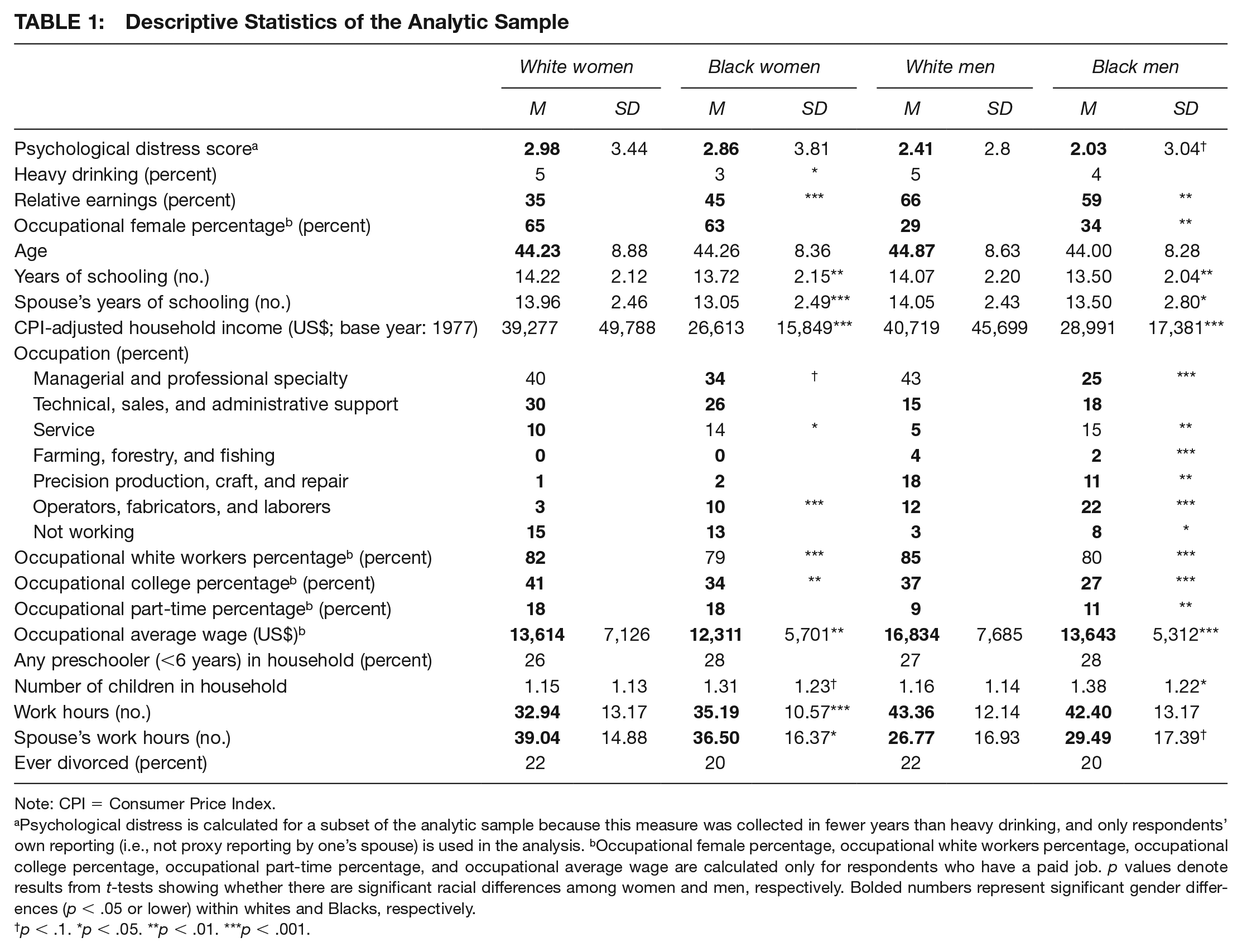
Note: CPI = Consumer Price Index.
Psychological distress is calculated for a subset of the analytic sample because this measure was collected in fewer years than heavy drinking, and only respondents’ own reporting (i.e., not proxy reporting by one’s spouse) is used in the analysis. bOccupational female percentage, occupational white workers percentage, occupational college percentage, occupational part-time percentage, and occupational average wage are calculated only for respondents who have a paid job. p values denote results from t-tests showing whether there are significant racial differences among women and men, respectively. Bolded numbers represent significant gender differences (p < .05 or lower) within whites and Blacks, respectively.
p < .1. *p < .05. **p < .01. ***p < .001.
The average age across person-years is 44 years, and the average year of schooling is around 14 years, with a slightly higher average for white men and women than for Black men and women. Household income, after adjusting for inflation, averages about $40,000 in 1977 dollars for whites and about $28,000 in 1977 dollars for Blacks. About 15 percent of white women and 13 percent of Black women did not have a paid job when surveyed, compared with 3–8 percent of men (p < .05). About one in four observations, regardless of gender or race, have at least one preschooler living at home. Men on average work considerably longer hours than do women (42–43 vs. 33–35 hours, p < .05).
Relative Earnings and Subsequent Psychological Distress or Heavy Drinking
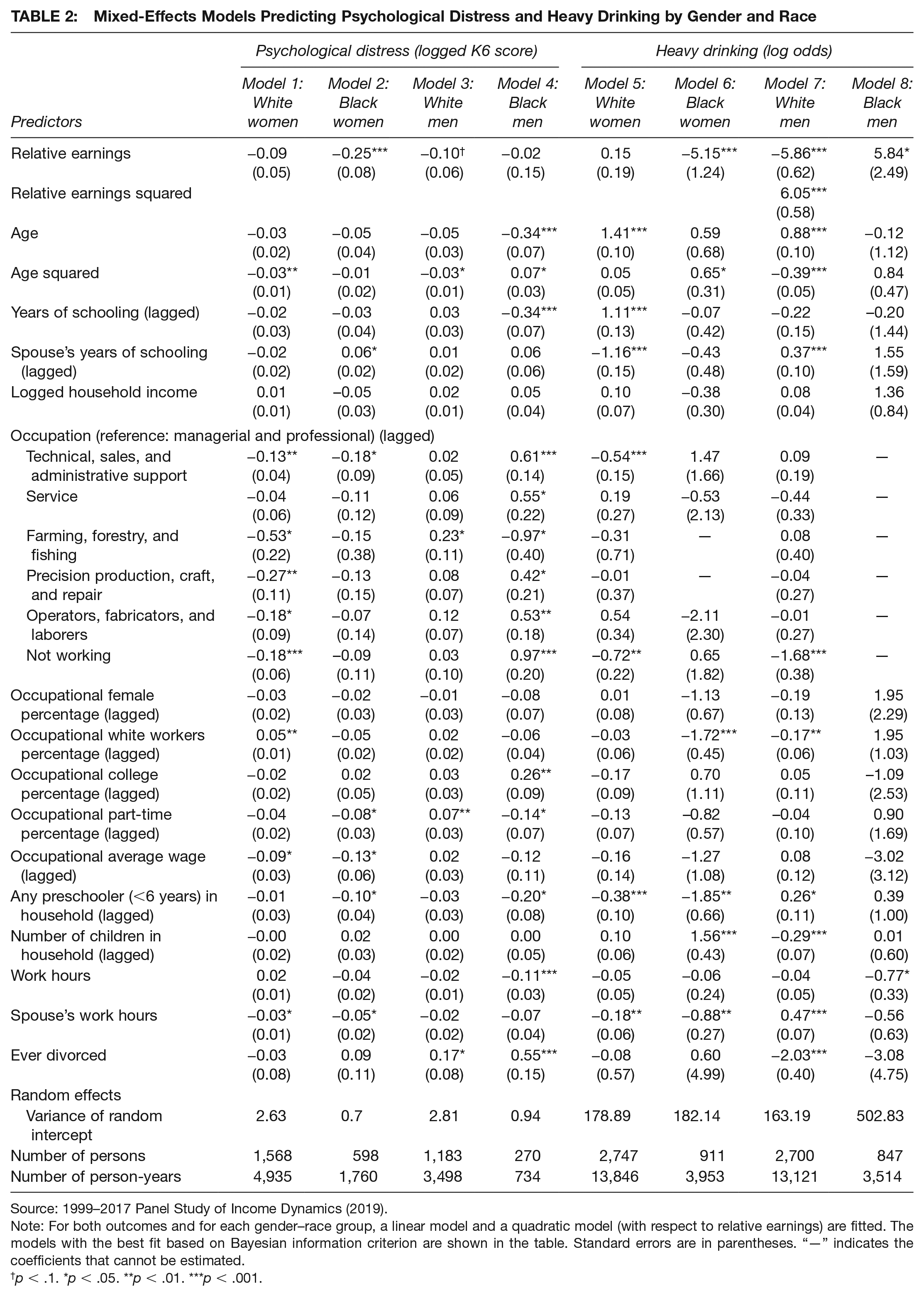
Estimates from mixed-effects regression models are presented in Table 2, separately by the intersection of gender and race. For heavy drinking, the coefficients are presented in log odds, with positive (or negative) coefficients associated with higher (or lower) odds of drinking heavily.
Mixed-Effects Models Predicting Psychological Distress and Heavy Drinking by Gender and Race
Source: 1999–2017 Panel Study of Income Dynamics (2019).
Note: For both outcomes and for each gender–race group, a linear model and a quadratic model (with respect to relative earnings) are fitted. The models with the best fit based on Bayesian information criterion are shown in the table. Standard errors are in parentheses. “—” indicates the coefficients that cannot be estimated.
p < .1. *p < .05. **p < .01. ***p < .001.
Psychological Distress
An examination of BIC (not shown in the table) across alternative specifications of relative earnings—linear and quadratic—indicates that a linear model provides the best fit for psychological distress for all four gender–race groups.
According to the linear model, relative earnings are not associated with psychological distress for white women (Model 1) or Black men (Model 4). Among Black women and white men, however, their greater relative earnings predict a lower score of psychological distress. Specifically, moving from being financially dependent (contributing 0 percent of couple earnings) to being a sole earner (contributing 100 percent of couple earnings) is expected to decrease psychological distress by 22 percent (= 1−exp(−0.25), p < .001, Model 2) for Black women and by 10 percent (= 1−exp(−0.10), p < .1, Model 3) for white men.
Heavy Drinking
For heavy drinking, BIC (not shown in the table) indicates that a linear model provides the best fit for all groups except for white men. According to the linear models, relative earnings do not predict heavy drinking for white women (Model 5), but for Black women, greater contribution to couple earnings decreases the odds of drinking heavily (−5.15, p < .001, Model 6). This negative relationship can also be seen in the estimated average marginal effect for Black women (–0.025, p < .01, Online Appendix Table A3), 3 as well as in Figure 1A, which plots the predicted probability of heavy drinking over the range of relative earnings from 0 to 1.
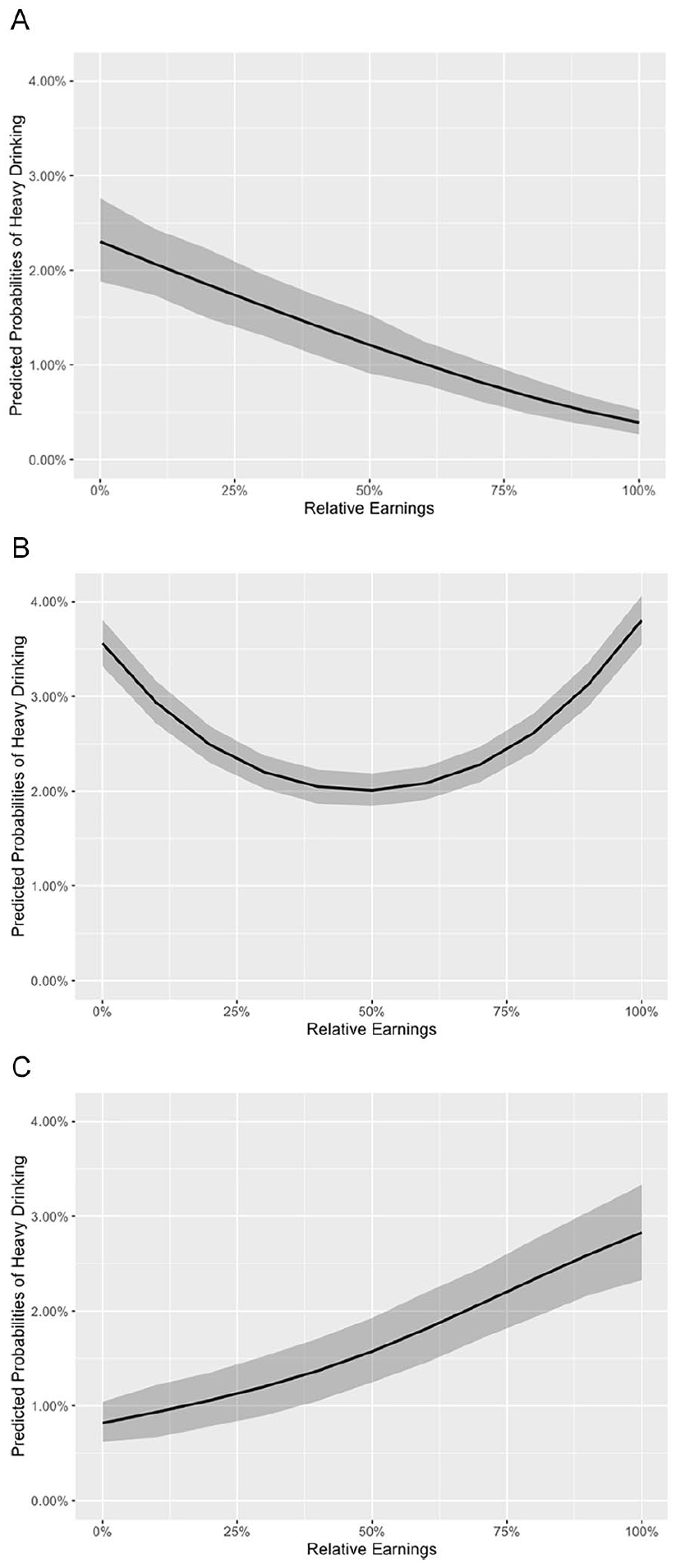
Among white men, the relationship between relative earnings and heavy drinking resembles a curvilinear shape with a turning point at approximately 50 percent (Model 7). 4 Figure 1B shows that moving from being economically dependent to approximately an equal contribution almost halves white men’s probability of drinking heavily, from 3.5 to 2 percentage points. However, as white men’s relative earnings continue to increase, their probability of drinking heavily increases from 2 to 3.8 percentage points. A different pattern emerges for Black men, for whom contributing more to couple earnings increases the odds of heavy drinking (5.84, p < .05, Model 8), as can be seen in Figure 1C.
Testing Differences Across Intersecting Groups
To examine whether the association between relative earnings and psychological distress or heavy drinking is significantly different across the four gender–race groups, I ran an interaction model using the full sample (Online Appendix Table A4). The interaction terms are not significant for psychological distress (Model 1 in Online Appendix Table A4).
For heavy drinking, two interaction models are shown given the different shapes of the relationship (linear and curvilinear) exhibited across the four groups. Modeling relative earnings as having a linear relationship with heavy drinking (Model 3 in Online Appendix Table A4) shows that greater relative earnings are associated with significantly greater reduction in the odds of heavy drinking for Black women compared with all three other groups (p < .05 for all). Modeling relative earnings as having a curvilinear relationship with heavy drinking (Model 4 in Online Appendix Table A4) shows that both the linear and quadratic terms of relative earnings are significantly different between white women and white men, between white women and Black men, between Black women and Black men, as well as between white men and Black men (p < .05 for all). To better understand how the patterns differ, splines were used in supplementary analysis (see Hook 2016; Leupp 2020). Results indicate that when comparing white men and Black men in particular, the major difference in the relationship between relative earnings and heavy drinking occurs for the 0–50 percent range—that is, when moving from economic dependency to equal breadwinning—consistent with what Figure 1B and 1C demonstrate.
Psychological Distress and Heavy Drinking at the Nexus of Relative Earnings and Occupational Sex Composition
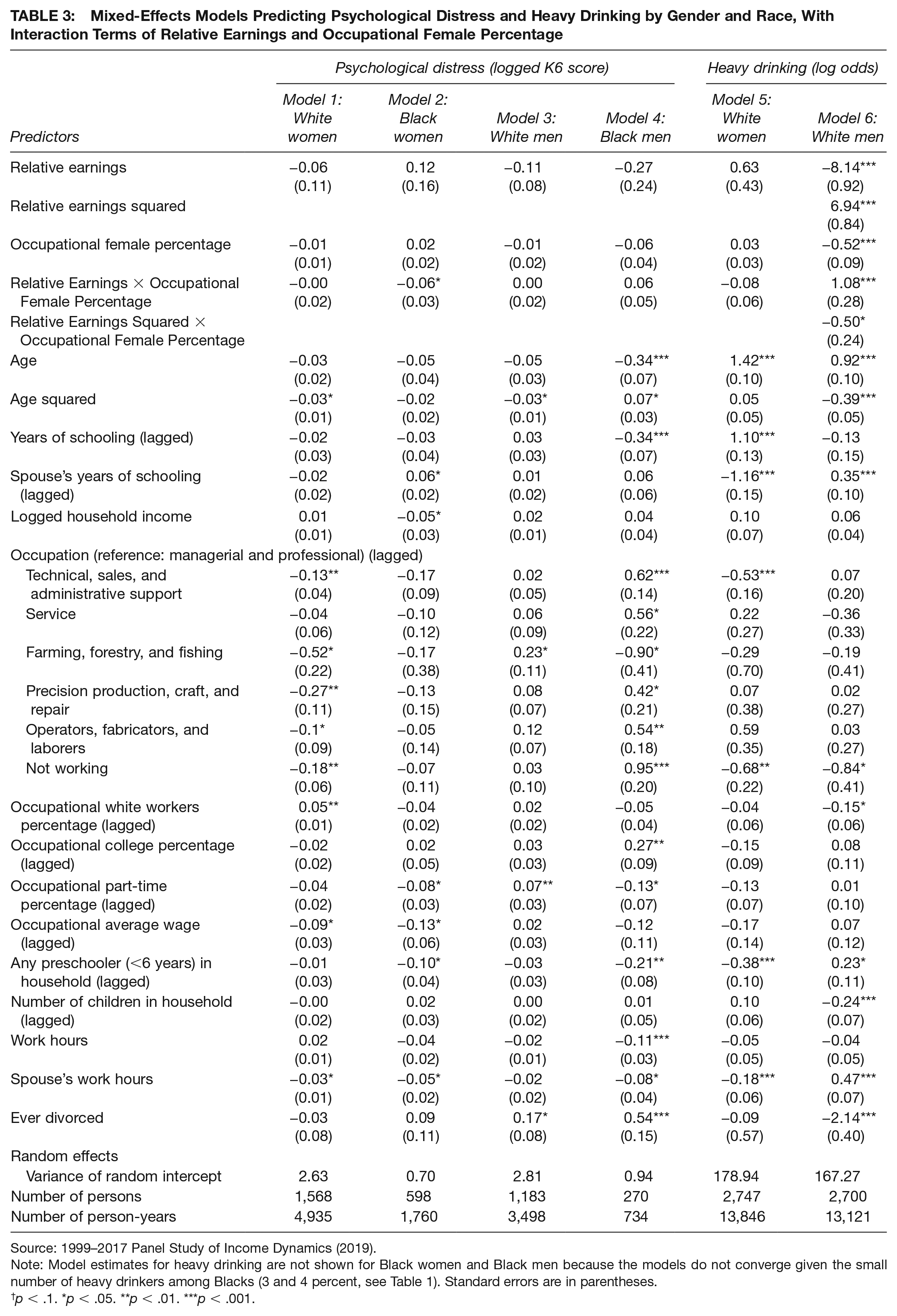
Table 3 presents models in which interaction terms are added between relative earnings and occupational female percentage to examine whether they interact to affect psychological distress or heavy drinking.
Mixed-Effects Models Predicting Psychological Distress and Heavy Drinking by Gender and Race, With Interaction Terms of Relative Earnings and Occupational Female Percentage
Source: 1999–2017 Panel Study of Income Dynamics (2019).
Note: Model estimates for heavy drinking are not shown for Black women and Black men because the models do not converge given the small number of heavy drinkers among Blacks (3 and 4 percent, see Table 1). Standard errors are in parentheses.
†p < .1. *p < .05. **p < .01. ***p < .001.
Psychological Distress
For Black but not white women, Table 3 shows that the relationship between relative earnings and psychological distress is moderated by occupational female percentage. Specifically, relative earnings do not predict psychological distress for Black women working in men-dominated occupations (main effect: 0.12, p > .05, Model 2). But this relationship turns negative when occupations have more representation of women, as indicated by the negative two-way interaction term between relative earnings and occupational female percentage (–0.06, p < .05, Model 2). Figure 2 illustrates the pattern well: The relationship between relative earnings and psychological distress is relatively flat for Black women working in men-dominated occupations (the solid line) but becomes negative for those in women-dominated occupations (the dashed line).
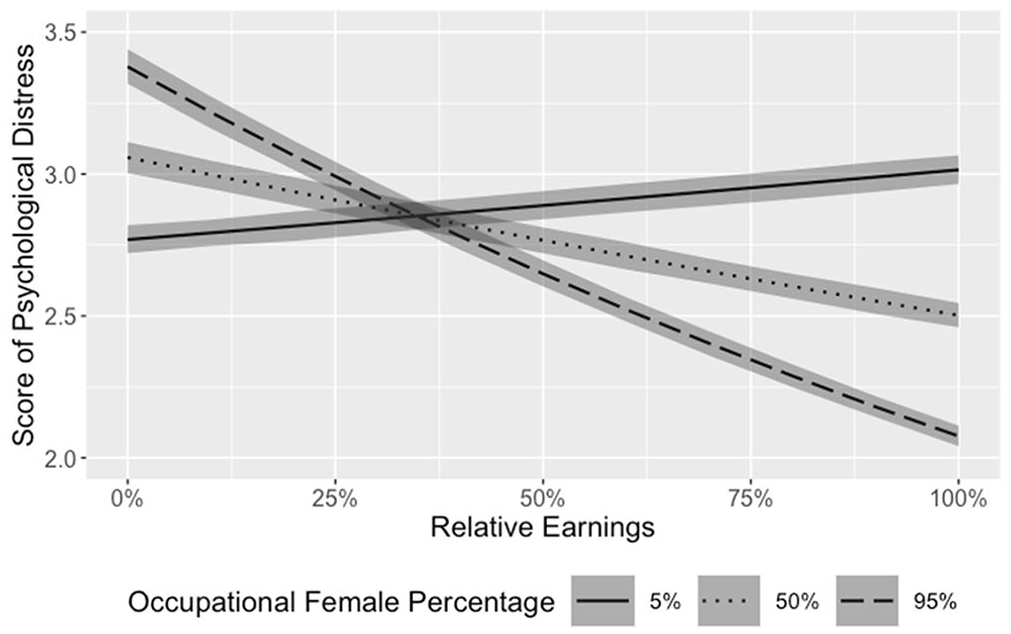
Predicted Scores of Psychological Distress by Relative Earnings and Occupational Sex Composition Among Black Women (Based on Model 2 in Table 3)
Heavy Drinking
The models for heavy drinking do not converge for Black women or Black men because of small sample sizes. For white women, occupational female percentage does not moderate the relationship between relative earnings and heavy drinking (Model 5).
Among white men (Model 6), the previously identified curvilinear relationship of relative earnings and heavy drinking varies by occupational female percentage. Figure 3 shows that occupational female percentage does not appear to modify the effect of relative earnings when white men’s relative earnings are above 50 percent. Moving from economic dependency (0 percent) to equal breadwinning (50 percent), however, halves the probability of drinking heavily—from 3.3 to 1.6 percentage points—among white men working in men-concentrated occupations (the solid line), but increases the probability of drinking heavily, from 0.6 to 1.2 percentage points, among white men working in women-concentrated occupations (the dashed line).
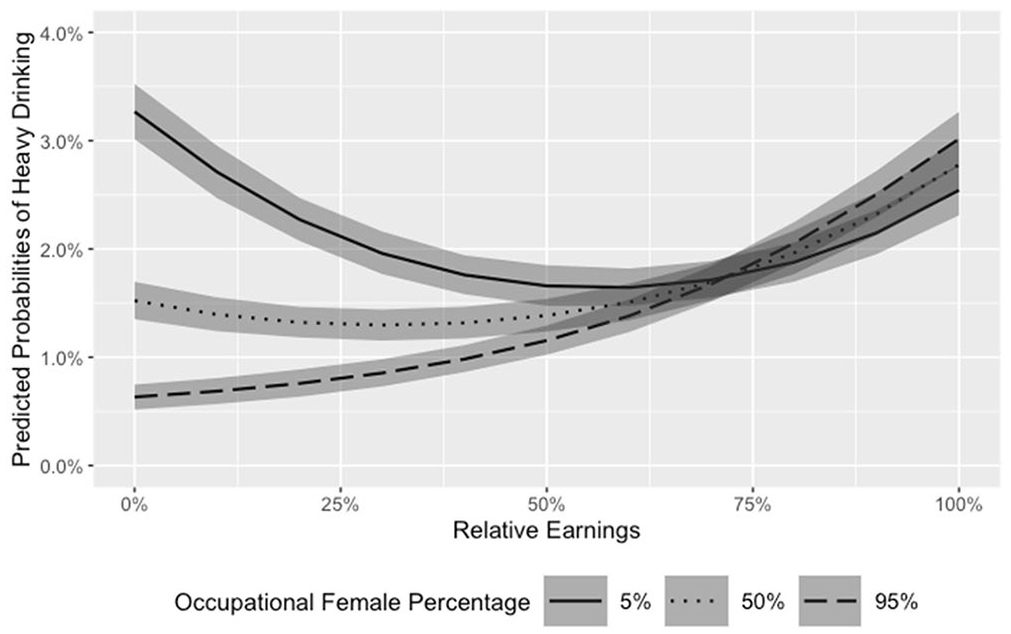
Predicted Probabilities of Heavy Drinking by Relative Earnings and Occupational Sex Composition Among White Men (Based on Model 6 in Table 3)
Testing Differences Across Intersecting Groups
To examine whether the interaction effects reported above are significantly different across gender–race groups, an interaction model is used in which relative earnings is interacted with occupational female percentage and gender–race group membership (Online Appendix Table A4). The three-way interaction terms are not significant for psychological distress (Model 2 in Online Appendix Table A4). Interactions are not tested for heavy drinking given the nonconvergent models for Blacks and the different best-fitting models between white women (linear) and white men (curvilinear).
Discussion
Women’s increasing contributions to household earnings represent a profound change in U.S. heterosexual couples’ family dynamics. Despite growing research on the consequences of couples’ earnings arrangements on marital dynamics or division of housework, the implications for stress-related outcomes have been understudied, and even less research has examined the similar or differential patterns at the intersection of gender and race. In this study, drawing on the nationally representative PSID data and using an intersectional lens, I trace the disparities in psychological distress and heavy drinking of Black and white women and men to their divergent couple earnings arrangements at home while simultaneously considering variations by occupational sex composition. Table 4 provides a summary of the findings. Overall, Hypothesis 1a predicting a nonlinear relationship between relative earnings and stress-related outcomes is not supported except for white men’s heavy drinking. Hypothesis 1b predicting gender-based manifestations of stress is largely supported. Results also provide partial support for Hypotheses 2a and 2b predicting racial differences in the relationship between relative earnings and stress, although for both women and men the racial differences are found for heavy drinking but not psychological distress. For Hypotheses 3a and 3b, results are mixed. Breadwinning predicts greater psychological distress for Black (as opposed to white) women working in men-dominated jobs, whereas moving from economic dependency to equal breadwinning decreases heavy drinking the most among white men working in men-dominated (as opposed to women-dominated) occupations. I elaborate on these findings and discuss their implications in the following.
Summary Table of Empirical Results

Note: Blank cells indicate the findings are not significant.
Among men, given the stronger male-breadwinner expectation among whites, stress on white men subsides when they move away from being economically dependent. Being able to provide—an increase of relative earnings from 0 to 50 percent—decreases psychological distress and heavy drinking. When passing the 50 percent point that signifies being a provider, however, white men’s greater contributions come with increased odds of heavy drinking (though continuingly declining psychological distress, a point I return to below). Being a primary or sole breadwinner, therefore, can be a stressful experience given the pressure to maintain the breadwinning status and family financial well-being. A somewhat different picture emerges for Black men, for whom contributing more to couples’ earnings is associated with consistently increased odds of drinking heavily. Therefore, unlike their white counterparts, moving from economic dependency to equal breadwinning increases Black men’s heavy drinking. This racial difference in heavy drinking among men who earn less than their partners suggests that the strong male-breadwinning norm among whites renders being able to provide especially stress-relieving for white men. For Black men, however, given race- and gender-based occupational segregation, greater economic contribution likely means more time spent in adverse working environments such as in manufacturing or construction. In addition, unlike Black women, Black men have long been stereotyped as scary, intimidating, and potentially violent (Smiley and Fakunle 2016), which may increase their chances of experiencing confrontation and discrimination in the workplace. Heavy drinking may have been adopted by Black men to cope with the stress.
Among women, Black women’s greater contribution to household earnings is associated with declining psychological distress and heavy drinking, and the decrease in heavy drinking is significantly steeper relative to that of all other gender–race groups. Blacks are more likely than whites to subscribe to women’s independence and to value women’s economic contribution to the family economy (Collins 2009; Landry 2000). The inability to contribute, therefore, might be perceived to be more stressful among Black women compared with white women. The null finding for white women in the relationship between relative earnings and stress is unexpected, which might indicate that white women’s economic contribution to households has become more common today.
These disparate and sometimes contrasting findings of relative earnings among white and Black women and men demonstrate the value of an intersectional approach. Breadwinning does not seem to consistently predict better or worse outcomes for all groups, suggesting that the strength and ramifications of the (neo)traditional breadwinning template, based on white men’s and white women’s experiences, are compounded by racial norms. In addition, given that many of the findings concentrate on the stress experienced by economically dependent men (especially white men) as opposed to breadwinning women, it appears the male-breadwinning expectation has been more durable than female homemaking (Sayer et al., 2011). Combined, gendered expectations and race-specific beliefs and practices define what makes a “good” man or a “good” woman, which in turn affect stress in different ways between and among women and men. Future research, especially qualitative studies, is essential for understanding the divergent meanings associated with household earnings arrangements across racial and gender groups.
This research also contributes to the literature on family economy by showing that the proportion of women in a given occupation is an important modifier. Results, however, provide mixed support for the deviance neutralization argument (Bittman et al., 2003). Supporting the neutralization thesis, for Black women breadwinning is associated with particularly lower psychological distress for those working in women- as opposed to men-concentrated occupations. Therefore, being responsible for large shares of household income can be turned into a pleasant and fulfilling experience when working in fields surrounded by more women. That the neutralization pattern emerges for Black but not white women suggests that a potentially inclusive, supportive, and friendly work environment of women-dominated fields (Taylor 2010) is more stress-relieving for breadwinning Black women, who generally are more likely to be a target of discrimination in the workplace than are white women. Future research with more detailed data is urgently needed to shed light on the psychosocial processes that link breadwinning with well-being among Black and white women working in different occupations.
For men, contrary to the deviance neutralization thesis, moving from economic dependency to equal breadwinning decreases heavy drinking the most for white men working in men-concentrated occupations. Indeed, the curvilinear relationship between relative earnings and heavy drinking among white men holds only among those working in men-dominated jobs. For white men in women-dominated fields, greater relative earnings are associated with consistently higher odds of heavy drinking. Thus, taking on tasks culturally believed to be women’s work seems especially threatening to white men as their relative earnings rise. These men may have to cope with inconsistent identities as a breadwinner and as a worker in occupations dominated by a different sex, which can lead them to drink to enact masculinity (Courtenay 2000). A selection process may also be at work: Men working in women-dominated jobs likely attach less importance to providing, thereby leading to more stress as their contributions to household earnings increase.
The mixed support for the deviance neutralization argument points to the need for future research to understand how gender enacted in different domains coalesces to affect health and stress. Does gender conformance in one domain neutralize gender deviance in another domain, or do they give rise to intrapersonal conflict and stress? Also critical to advancing this line of research is examining whether occupations dominated by men or women are indeed feminized or masculinized (Britton 2000). This is assumed in the current study given previous findings (Cejka and Eagly 1999; Ridgeway 2011), even though occupations dominated by members of one sex can be gendered in a different way. Data availability precludes investigating this important question; to explicate these alternative mechanisms and possibilities, a contextualized and intersectional stress process approach is crucial to capturing the diverse experiences of individuals at the intersections of multiple dimensions and in different occupational contexts.
This research also shows the value of examining different manifestations of stress. Results are largely consistent with the gendered patterns identified in prior research (Rosenfield and Mouzon 2013). That is, when facing stressors associated with relative earnings, women tend to show internal disorders such as psychological distress, whereas men express problematic feelings in outward behavior such as heavy drinking. One inconsistent finding is that sole-breadwinning white men, compared with their equal-breadwinning peers, drink more heavily but suffer less from psychological distress. Although a definitive explanation is impossible, examining how women and men manage stress may provide clues. Psychological distress is often associated with femininity and is frowned upon by many men, particularly white men (Rosenfield and Mouzon 2013), whereas drinking is less stigmatized and may even be adopted as a way to exhibit masculinity (Courtenay 2000). Therefore, a social desirability bias may lead breadwinning men to underreport their psychological distress to maintain the image of a strong provider. Future research with objective measures is essential to identify gendered and racial reporting patterns, and how these are related to differential manifestations of stress.
As gender continues to be recognized as a fluid concept and as numbers of same-sex couples increase, future research is needed to examine how people from different genders or same-sex couples manage couples’ relative earnings and the implications for stress. Relatedly, the sex composition of an occupation may intersect with the race composition to influence experiences on the job for women and men from diverse racial and ethnic backgrounds. An intersectional lens is also critical to understanding other social issues such as labor market participation, fertility, and marital satisfaction.
In sum, this research sheds light on how psychological distress and heavy drinking are shaped by earnings arrangements and occupational female percentage in gender and racial contexts. The importance attached to relative earnings and the related stress process will continue to change as the broader gender structures, family contexts, and occupational cultures change. As social norms that guide work and family life continue to shift, it is important to consider how patterns change for new cohorts. Thus, the implications of Black and white women’s and men’s experiences at home and in the labor market for their health and well-being are important avenues for future research and policy development.
Supplemental Material
sj-docx-1-gas-10.1177_08912432221128541 – Supplemental material for Breadwinning, Occupational Sex Composition, and Stress: Examining Psychological Distress and Heavy Drinking at the Intersection of Gender and Race
Supplemental material, sj-docx-1-gas-10.1177_08912432221128541 for Breadwinning, Occupational Sex Composition, and Stress: Examining Psychological Distress and Heavy Drinking at the Intersection of Gender and Race by Wen Fan in Gender & Society
Footnotes
Author’s Note:
I am deeply thankful to the reviewers and editorial team for the insightful comments on this article. I also thank Phyllis Moen, Yue Qian, Jeannie Shoveller, Deborah Carr, Erin Kelly, and seminar participants at the University of British Columbia School of Population and Public Health for their generous feedback on the article. This project received funding from the Boston College Research Expense Grant.

Supplemental Material
Supplemental material for this article is available online.
Notes
Wen Fan is an associate professor in the Department of Sociology at Boston College. Her research examines how large-scale social change, work environments, and family dynamics intersect to shape disparities in socioeconomic and well-being outcomes over the life course. She has an ongoing NSF project (with Phyllis Moen) on continuities, changes, and disparities in the experiences of remote and hybrid work in the time of COVID-19.
References
Supplementary Material
Please find the following supplemental material available below.
For Open Access articles published under a Creative Commons License, all supplemental material carries the same license as the article it is associated with.
For non-Open Access articles published, all supplemental material carries a non-exclusive license, and permission requests for re-use of supplemental material or any part of supplemental material shall be sent directly to the copyright owner as specified in the copyright notice associated with the article.
