







Abstract
Gender-based violence has long been a concern for feminist scholars and activists. Second-wave feminists agitated for the criminalization of violence, and more recently, feminist abolitionists have articulated the dangers and risks of relying on the criminal legal system to effectively address gender-based violence. Here we theorize the application of feminist abolitionist principles for addressing gender-based violence in the institution of sports in the United States, with the goal of addressing harm and reducing future acts of violence. After analyzing data from our unique data set, which documents gender-based violence in college and professional sports and tracks noncarceral sanctions imposed by professional leagues, teams, and colleges, our analysis reveals few consequences for perpetrators coupled with relatively high rates of serial abuse. Despite failures in the implementation of these noncarceral sanctions, we theorize the potential of sport organizations to intervene in and prevent gender-based violence in ways that advance feminist abolitionist goals.
Regarding the emotional impact, I personally struggle more with my feelings towards the enabler than the abuser. The abuser became the bad guy the second he acted. The enabler, when faced with the choice between right and wrong, chose wrong. To me, that is arguably more betraying than the act itself. (Division One, female,
1
track and field athlete)
Gender-based violence takes place in every institution in the United States (Hattery and Smith 2019), but one of the places it is most visible is in the institution of sport. Nearly every day, another athlete, coach, or staff member is accused of sexual violence or intimate partner violence (IPV) or child sexual abuse. Yet even after allegations are levied and investigations are completed, athletes continue to play, and coaches continue to coach. As our analysis will reveal, many continue to perpetrate acts of gender-based violence because they are not held accountable by the institutions they play for or are employed by, thus extending the impact of their harm.
Abolitionist movements have a long history, and after many years of criminalizing responses to gender-based violence, in the early 2010s scholars such as Beth Richie (2012) began to challenge the reliance on criminal legal system responses, which are rooted in a foundation of white supremacy (Alexander 2010; Hattery and Smith 2021, 2023), to address gender-based violence. In actuality, the criminalization of gender-based violence has brought little in the way of “justice” for victims/survivors either, especially women with marginalized racial/ethnic identities. They have also been criminalized by the system ostensibly intended to help them (Goodmark 2023; S. L. Miller 2005; Richie 2012).
Our research offers an application of feminist abolitionist approaches to effectively address gender-based violence in the context of the United States through the case study of SportsWorld, a term coined by Smith to refer to a multibillion-dollar industry that encompasses teams and franchises, stadiums, broadcast rights, and more (Smith 2014). Although SportsWorld is a global phenomenon, our paper focuses specifically on professional sports leagues in the United States: Men’s National Basketball Association (MNBA), National Hockey League (NHL), National Football League (NFL), Major League Baseball (MLB), and college sports governed by the National Collegiate Athletic Association (NCAA). We choose the institution of SportsWorld as the case for study for three distinct reasons: (1) The rates of gender-based violence are significant, at least as high as in other institutions and the wider U.S. society; (2) cases of gender-based violence in SportsWorld are considered to be in the “public interest” and thus garner media attention; and (3) the official disciplinary policies of the leagues that include sanctions for players and coaches who violate team or league rules, including perpetrating gender-based violence, are publicly available on league websites and can be examined. In short, organizations are groups with rules, SportsWorld is a group with rules that are public. Thus, SportsWorld is not only unique compared with other institutions of study (e.g., religious institutions, higher education, and government) but also ideal for this particular theoretical argument. Taken together, then, the distinctive features of SportsWorld allow us to document cases from the accusation through the sanction, if any, in ways that are not possible in other institutions of this size.
The data for this study come from a data set that catalogs more than 400 cases of gender-based violence in SportsWorld. The analysis that informs our argument centers on the consequences administered by the professional leagues (NFL, MNBA, MLB, and NHL) and the NCAA in cases of gender-based violence perpetrated by athletes, coaches, and staff. We extend the explanation that Sailofsky posits: that rates of gender-based violence remain extremely high in SportsWorld because perpetrators—be they athletes, coaches, or staff—are rarely held accountable (Sailofsky and Shor 2022), often because of the value they provide to a team (Sailofsky 2023); and when they are held accountable, it is only after the accusations against them extend beyond one or two, often numbering in the double and even triple digits. By exploring the potential role institutions can play in delivering both extralegal consequences for abusers and justice to victims/survivors, this paper advances the application of the feminist abolitionist frame.
Literature Review
Gender-based violence is an epidemic and poses, according to the World Health Organization and the Centers for Disease Control and Prevention, one of the most pressing threats to public health and safety (Leemis et al. 2022). Globally, between 30 and 50 percent of girls and women experience some form of gender-based violence (World Health Organization 2021). In the United States, one in four women, one in seven boys, and one in 33 men have experienced sexual violence. Nearly half (41 percent) of women and 25 percent of men have experienced physical violence in the context of an intimate relationship, and rates are highest among those with marginalized identities, including Black and Indigenous women and members of the LGBTQ+ community (Leemis et al. 2022). IPV is now the leading cause of femicide in the United States, accounting for 67 percent of all homicides of women (Hattery and Smith 2016; Leemis et al. 2022).
Gender-based violence is a term used to focus our attention on the fact that certain forms of violence, specifically sexual and IPV, are gendered. There is some renewed debate among feminist scholars about the terms gender-based violence and violence against women. For example, Messner (2016) argues that there is power in adopting the term gender-based violence because it comprises violence perpetrated not only against women but also against boys, gay men, and other members of LGBTQ+ communities. At the same time, he raises concerns that replacing “violence against women” with “gender-based violence” may decenter women (Messner 2016). Situated in this debate, we choose to use gender-based violence rather than violence against women. We do so primarily because, as Messner (2016) argues, it allows us to focus the conversation on the fact that the perpetrator—and not just the victim/survivor—has a gender and it is typically a man. In addition, using gender-based violence is a constant reminder that the most important predictor of who will be a victim is gender, and the most important predictor of who will be the perpetrator is also gender. Framed by this conceptualization, our data include any act of violence consistent with this concept, including sexual violence and IPV, sexual harassment, and stalking. Because the focus of our paper is theorizing responses to gender-based violence, rather than demographic differences in the experiences of gender-based violence, we include all the data in our analysis, regardless of the gender or sexuality of the abuser or victim/survivor, and tailor recommendations to address all forms of gender-based violence in SportsWorld.
Feminist Perspectives on Gender-Based Violence
Feminist theories of gender-based violence are ideally situated to interrogate all forms of gender-based violence because they frame gender-based violence as a form of structural violence rooted in heteropatriarchy (De Coster and Heimer 2021; Hattery 2022; MacKinnon 1991; Messner 1990; Monterrosa and Hattery 2023; Sweet 2021). As Messner (2016, 9) argues: The feminist naming of violence against women as a social issue was nothing short of a radical paradigm shift. Foundational to this shift was the assertion that men who rape or hit women are not isolated individuals, deviating from some normal form of masculinity. Rather, feminists reframed men’s violence against women as over-conformity with a culturally honored definition of masculinity that rewarded the successful use of violence to achieve domination over others. [emphasis ours]
The feminist consciousness-raising movements of the 1970s and 1980s single-handedly brought widespread attention to the idea that domestic abuse and rape were in fact violence (Bumiller 2008; Sweet 2021). Despite this, scholars, activists, and agents of the criminal legal system continue to struggle to convince the larger public as well as system actors that gender-based violence causes harm. For example, the late Bobby Knight, long-time coach of the Indiana University men’s basketball team once proclaimed, “I think that if rape is inevitable, relax and enjoy it” (Moran 1988). As a result of views like this, second-wave feminist theorists and activists such as Catharine MacKinnon (1991) and Andrea Dworkin (1981) worked to criminalize gender-based violence. Subsequently, the 1990s and early 2000s mark the first time in U.S. history that gender-based violence was addressed through criminal legal response; criminal codes were modified to designate domestic violence as a crime, and rape statutes were expanded to include nonpenetrative sexual violence and the marital rape exemption was removed (Bumiller 2008; MacKinnon 1991; Sweet 2021). As Goodmark (2023, 8) details, the Violence Against Women Act (VAWA), passed in 1996, was hailed as a landmark victory for both acknowledging the prevalence and threat of gender-based violence and for the funds it earmarked for rape crisis centers, “battered women’s” shelters, and even rape prevention and intervention offices on college campuses.
This victory, however, came at a price. As a result of criminalizing gender-based violence, victims/survivors themselves often have been criminalized, and billions of dollars have been funneled into law enforcement and carceral approaches to addressing gender-based violence, further strengthening the reach of the criminal legal system and prison industrial complex (Goodmark 2023; Monterrosa 2023; Richie 2012). If criminalizing gender-based violence was once seen as a strategy for providing justice for the victims/survivors and consequences for the perpetrator, it is now viewed by feminist abolitionists as an approach that does not meet either of these goals; in the end, it causes more harm to victims/survivors than it brings justice.
Feminist Abolitionist Perspectives on Gender-Based Violence
In the U.S. context, abolitionism originates in the anti-slavery movement (Quarles 1969). As the carceral state swelled during the 1970s and 1980s, the movement was transformed into one that specifically advocated for the abolition of prisons (Davis 2003; Gilmore 2007). Moreover, scholars and activists have taken up this moniker to call for the abolition of solitary confinement (Hattery and Smith 2023; Rudes, Magnuson, and Hattery 2022). And though the abolitionist argument has been around for decades (Davis 1983), only recently has this framework been theorized with regard to gender-based violence (Goodmark 2023; S. L. Miller 2005; Richie 2012).
Despite tensions between many second-wave feminists who advocated for criminalization (sometimes referred to as “carceral feminists”; see Bernstein 2007) and feminist abolitionists, both can agree that reliance on the criminal legal system to address gender-based violence has been disappointing. For example, rates of prosecution, conviction, and incarceration, particularly in cases of sexual violence, remain extremely low, whereas rates of gender-based violence remain persistently high (Department of Justice 2020).
The authors and filmmakers of the documentary The Hunting Ground, Dick and Ziering (2016, 125-126), offer an argument as to why reliance on the criminal legal system is not only ineffective, but philosophically flawed: One of the key insights of feminist scholarship in the last thirty years is the recognition that the state is reliant on the subordination of its citizens for its very power. In return, the state is supposed to protect us and ensure our liberty and equality, but often fails because our inequality and lack of freedom come from differences in social power, not from differences in our formal legal standing before the law. [emphasis ours]
Recognizing this inherent problem with the criminal legal system, coupled with their research and practical experience working with criminalized victims/survivors of gender-based violence, feminists began to theorize an abolitionist approach (see especially Goodmark 2023). Leading scholars argue that in addition to criminalizing victims/survivors, the criminal legal system does not adequately intervene in or prevent future acts of gender-based violence (Davis et al. 2022; Goodmark 2023; S. L. Miller 2005; Richie 2012). It is well documented that mandatory arrest laws that gained popularity in the 1980s and 1990s have increased rather than decreased IPV and often result in the victim/survivor herself being arrested and detained (Derr, Hattery, and Smith 2024; Desmond, Papachristos, and Kirk 2016; Goodmark 2023; S. L. Miller 2005). Along with the overall decline in educational programming in jails and prisons, even when programming does exist in carceral spaces, there is little evidence that “batterer intervention programs,” as they are still referred to, show any decrease in the use of violence (Goodmark 2023). As Monterrosa (2021, 2023) details, when abusers are incarcerated and then return home, they bring the trauma and impact of their incarceration back into the intimate relationships—a phenomenon Monterrosa (2023) calls “intimate carceral violence.”
Feminist abolitionist perspectives seek not so much to reform the carceral state but rather to dismantle it and replace it with noncarceral alternatives; they center both decriminalization and decarceration as strategies for reducing the overarching reach of the carceral state. Instead of focusing funds on strategies that fuel mass incarceration, feminist abolitionists including Davis (1983), Richie (2012), and Goodmark (2023) propose redirecting funds away from the carceral state and toward prevention strategies that reduce violence by preventing it from happening in the first place. These strategies can include investing heavily in education, employment training, social welfare programs, and economic development (Goodmark 2023). Along with this greater investment in communities, feminist abolitionists promote strategies that center the victims’/survivors’ needs and emphasize safety and accountability. One critique of feminist abolitionist frameworks is that they often do not provide a clear set of guidelines for managing violent crimes, including gender-based violence (Stahly-Butts and Akbar 2022), therefore highlighting the need for theorizing the implementation of feminist abolitionist principles in real-world settings. Our paper theorizes a real-world application of feminist abolitionist principles using SportsWorld as the descriptive case study.
The Descriptive Case Study: SportsWorld
SportsWorld is an institution worthy of critical inquiry (Bourdieu 1988; Lipsyte 1975) and is often overlooked in mainstream sociological analyses because it is believed to be just a leisure activity (Malcolm 2012; Washington and Karen 2001). According to the late TV sports broadcaster Howard Cosell (1985), sports were considered by many to be nothing more than society’s toy department. Yet SportsWorld is a social institution that impacts millions of lives every day, and with this comes the infiltration of broader societal issues. Particularly, and like other social institutions (e.g., military, fraternities, and prison), sports are not gender neutral; and assuming that sport is gender neutral reinforces sport as a purely masculine domain (Acker 1990; Hattery and Smith 2019). SportsWorld is an institution rooted in white supremacy, patriarchy, heteronormativity, and discourses that value hypermasculinity (Carrington 2013; Curry 1991; McCray 2015; Messner and Bozada-Deas 2009; Spaaij, Farquharson, and Marjoribanks 2015). For those reasons, it is not immune to gender-based violence.
Institutions are gendered organizations (Acker 1990); thus, not only will gender-based violence be present, but institutions will protect themselves by ignoring it, dismissing it, and failing to act when it occurs (Bedera 2024; Hattery and Smith 2019). In fact, it is the gendered organizational structure, more than the presence of men as individual actors, that ensures the persistence of gender-based violence as a tool for maintaining gender segregation (Hattery 2022). However, there is a correlation between the level of gender segregation in an institution and reports of gender-based violence, as illustrated by analysis of the various branches of the military (Hattery and Smith 2019).
Although many other institutions could have been selected for this case study and analysis, we chose SportsWorld for several distinct reasons: (1) Rates of gender-based violence are high across the entire institution of sports (youth, high school, college, and professional); (2) gender-based violence is systemic (often perpetrated by several members of the same team or organization); (3) sports teams are among the most highly gender-segregated spaces, even more so than other institutions that have high rates of gender-based violence, such as the military; and (4) the institution of sport has a variety of governing bodies, particularly at the college and professional ranks, with internal misconduct systems that can vigorously protect members who are accused. Finally, unlike any other similar institution with similar institutional structures, including a college campus, the military, the government, or a Fortune 500 company, because of the high-profile, public nature of SportsWorld and the notoriety of its players and coaches, cases of gender-based violence are often newsworthy and publicly available, and thus can be sourced.
Although some findings are mixed (see McCray 2015), numerous studies have found that rates of gender-based violence in SportsWorld are often higher than rates in the wider population (Benedict and Klein 1997; Leal, Gertz, and Piquero 2015; Young et al. 2017). This is not unusual, as SportsWorld quite literally prioritizes and emphasizes violence and aggression. Women athletes are not immune to this either as they are also situated in this environment (Gill 2007). Although significantly smaller in number, there are instances of women athlete gender-based violence perpetration—for example, in the case of former professional soccer player, Hope Solo, who physically assaulted her nephew (Burton 2014). In the realm of professional sports, research conducted by Morris (2014) revealed that the most common crimes for which men in the NFL are arrested are sexual violence (38 percent) and IPV (55 percent). On college campuses, as denoted in the Chronicle of Higher Education (Heller 2023), gender-based violence by athletes, coaches, and staff has an outsized impact, both in terms of injury to victims and financially as well, relative to all other groups (Martin 2016). Moreover, according to Crosset, McDonald, and Benedict (1996, 174): Male college student-athletes, compared to the rest of the male student population, are responsible for more than their share of the reported battering and sexual assault complaints to judicial affairs offices on the campuses of 10 Division I institutions [studied].
Gender-based violence on college campuses is often not limited to individual acts by individual players but signals a systemic problem in which an entire sports organization is complicit. For example, at Baylor University, between 2011 and 2014, 31 football players were accused of rape by 52 different victims. This resulted in the university hiring the consulting firm Pepper Hamilton to identify the myriad institutional structures that condoned this culture of violence (New 2017).
Gender-based violence in sports is systemic for a variety of reasons that have been documented and theorized, including its often hypermasculine culture and relative gender segregation (Hattery and Smith 2019; Martin 2016; Messner 1990, 2016; Smith 2014). Acts of gender-based violence, as Jewkes (2002, 1426–27) notes, provide a pathway for men to exercise, demonstrate, and reclaim power where “women are also defined as appropriate vehicles for reconfirmation of male power. Violence against women is a demonstration of male power juxtaposed against the lesser power of women.” Gender-based violence is not just a consequence of power, but is a tool for maintaining it; and this is especially the case in institutions, such as SportsWorld, which are highly gender-segregated (Hattery 2022). In these highly segregated spaces, gendered power is further distilled as it combines with other forms of power, including wealth and social status. Consequently, when an athlete is accused of an act of gender-based violence, the administration will close ranks to protect not just the athlete, but the gendered power of the institution. As Bedera (2024, 32) argues: Universities are also gendered organizations . . . that regularly prioritize men and men’s organizations (e.g., men’s athletics teams, male-dominated majors) over women . . . Accordingly, holding a (male) perpetrator accountable can threaten universities’ patriarchal traditions (e.g., allowing a star football player to compete).
SportsWorld is also distinctive and appropriate as a case study example because, in contrast to other institutions that have high rates of gender-based violence, it has governing bodies, policies, and the power to implement sanctions for rules violations involving gender-based violence—even though these policies are rarely engaged unless the cases are so appalling that they bring shame to the organization (Hattery 2022; Hattery and Smith 2019; Sailofsky 2023; Sailofsky and Shor 2022). Moreover, largely because of and in response to high-profile cases (e.g., Ray Rice), the professional leagues make their personal conduct policies public and available on their websites. Although gender-based violence is happening all around us, gathering data on reports, accusations, and adjudication, in higher education, for example, would require filing Freedom of Information Act (FOIA) request to obtain official documents. The fact that cases involving members of SportsWorld garner media attention allows us to find them more easily and to document them. This is different from other institutions of sociological inquiry: Most cases of gender-based violence in the corporate world, higher education, and even the government rarely rise to the level of public knowledge, nor are they documented on social media unless the accused is unusually visible or the case is particularly egregious. Thus, SportsWorld provides an inimitable descriptive case study in which to theorize the application of feminist abolitionist approaches to addressing gender-based violence at the institutional level.
Methods
We built a unique database to catalog instances of gender-based violence in SportsWorld. Specifically, we compiled data on cases in which athletes were accused of perpetrating gender-based violence, as well as cases in which coaches and staff were accused of abusing athletes or using their professional positions to abuse members of the public, as in the case of Jerry Sandusky at Pennsylvania State University. Although we include some athletes who are citizens of or play in other countries, the focus of our database is sport franchises (professional leagues and the NCAA) in the United States. The concept of the database began in 2007, when one of the authors became interested in the ways in which the structures of SportsWorld shaped the high prevalence of gender-based violence. In 2021, with the proper resources and personnel, the authors began to systematically build a comprehensive database.
The database catalogs cases of gender-based violence that involve actors in SportsWorld that come into public view through popular media. To continuously identify cases and update the database, several of the authors set “alerts” and regularly monitor news accounts as well as social media posts on Twitter and Instagram. Once a case has been identified, members of the research team scour news sources and scholarly articles for mentions of the case, and summaries are created and inserted into the database. Taking media reports as the starting point for identifying cases results in the database skewing more recent, though older cases are added when they receive scholarly or media attention. This may occur because of an event such as the player receiving an award, watching a record be surpassed, or even dying, all of which trigger renewed media discussion of their off-field behavior.
Data for this paper include incidents of gender-based violence perpetrated by athletes, coaches, or athletic staff members across professional and collegiate sports (n = 428). Although a small number of cases in the database pre-date 2007, as noted, because of the data collection strategies, most cases indexed took place after 2010. Each case cataloged includes the name, race, ethnicity, and gender of the perpetrator, date of the event, the sport they play or coach, the organization they play or work for, the type of violence, the accused’s relationship to the victim, the number of victims, the organizational response (if there was one), whether they were charged or convicted, and if they continued to play or coach after the case was reported and investigated.
The database is not an attempt to catalog every case of gender-based violence occurring in SportsWorld. That would be impossible because many more cases of gender-based violence occur than are officially reported, and even fewer make it into mainstream media. Therefore, the database cannot be used to establish the prevalence of gender-based violence relative to other populations, nor can it be used to make broad generalizations to wider populations. That said, analysis of the database can identify patterns, such as the distribution of cases by status (athlete, coach, staff), rank (professional versus college), and sport. The database can also be used, as we do in this paper, to analyze empirical data to theorize about gender-based violence—in this case, to illustrate how sanctions, which are one form of noncarceral consequences, are enacted across leagues and impact recidivism. Statistical analysis such as descriptive statistics, frequencies, cross-tabulations, and analysis of variance (ANOVA) were utilized in order to identify relationships across categories of variables, including sport played, professional or college, and so on.
Findings
When we examined the demographics of the individuals in our database (see Figure 1), we found that overall, 93.7 percent of perpetrators are athletes and 4.4 percent are coaches or athletic staff. Nearly all perpetrators are men (98.4 percent), and 83.9 percent were actively playing on a team during the time period in which they were accused of committing acts of gender-based violence, whereas 16.1 percent were retired at the time. A majority (87.9 percent) of perpetrators play/ed at the professional level, and 11.7 percent are or were collegiate athletes or coaches at the time they perpetrated the violence. Notably, half (51.4 percent) of perpetrators in the database play/ed football (both at the professional and collegiate level), followed by basketball (17.5 percent), baseball (11.2 percent), boxing (4.0 percent), hockey (2.1 percent), and 12 other sports (10.0 percent).
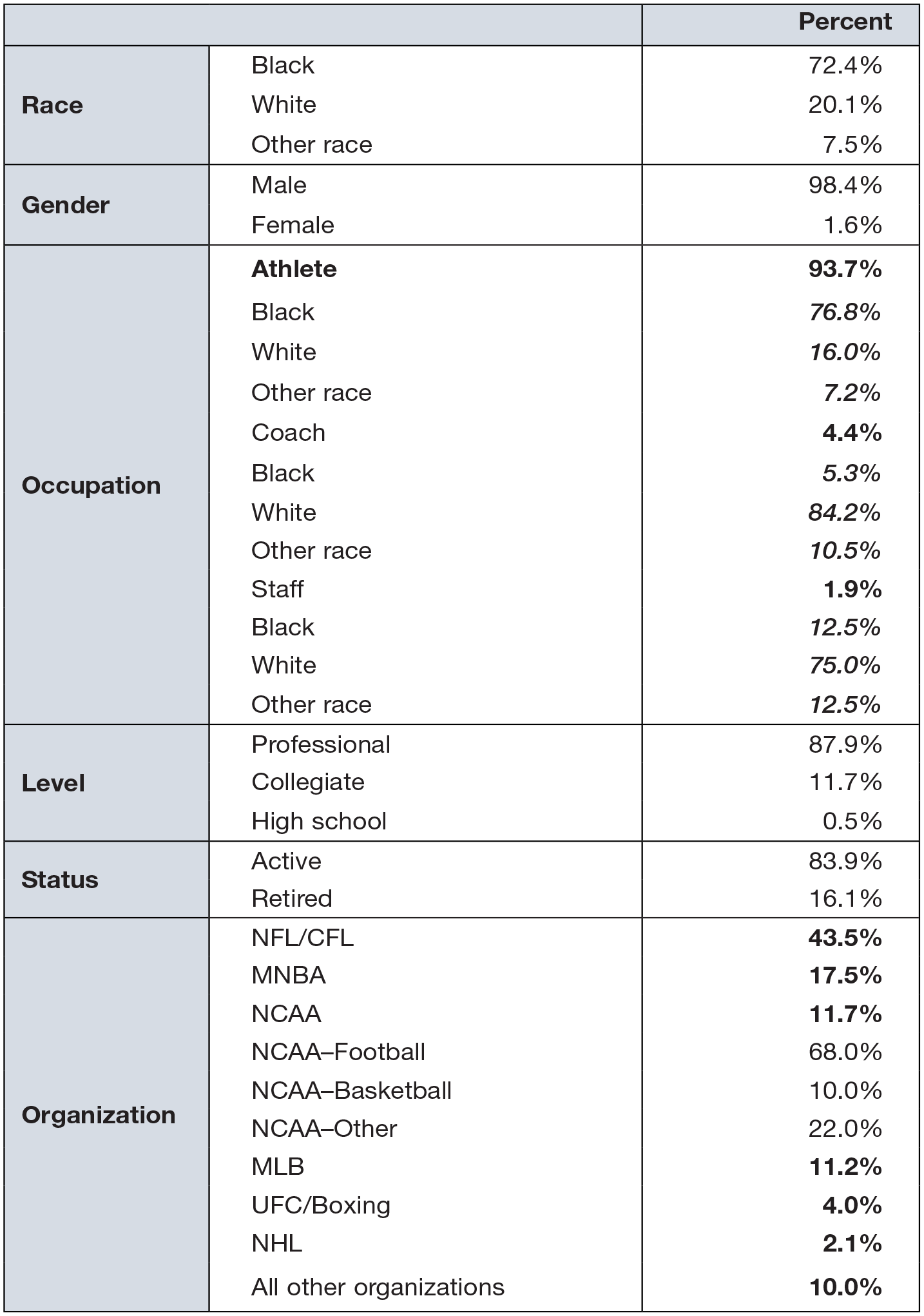
Demographics of Perpetrators of Gender-Based Violence (N = 428)
When we examined the data on victims/survivors (see Figure 2), we found that half (50.0 percent) of the victims are the perpetrators’ current girlfriend, fiancée, or wife, and 16.2 percent of victims/survivors are the perpetrators’ child/children, mother of their child, or their former girlfriend, fiancée, or wife. The most common form of gender-based violence by accused athletes or coaches is IPV (51.6 percent), followed by sexual assault (22.2 percent), assault (19.9 percent), rape (1.9 percent), murder (1.2 percent), and four other types of gender-based violence (3.3 percent): sexual harassment, indecent exposure, verbal abuse, or kidnapping.
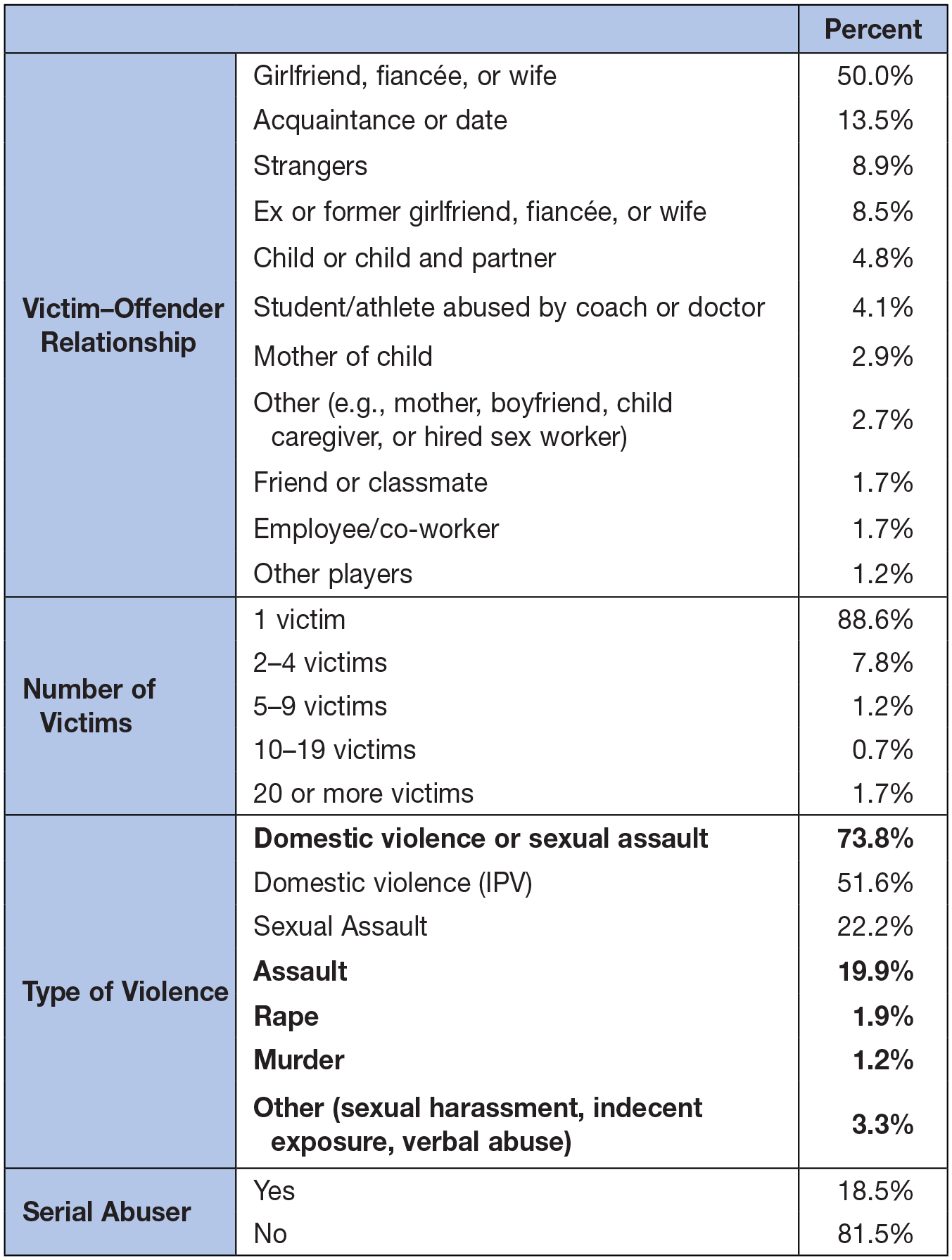
Victims of Gender-Based Violence (N = 414)
As shown in Figure 3, overall, the vast majority of those accused were charged (76.2 percent), and of those charged, almost half (48.6 percent) were convicted in criminal court. In terms of nonlegal consequences, which are central to our argument, our analysis revealed that in half of the cases (49.2 percent), no action was taken by the team or league. When action was taken by the team or league, the most common consequence for those accused was a suspension (23 percent) followed by 18.3 percent who were released from the team. Moreover, in more than three-fourths of the cases (82.6 percent), regardless of whether the perpetrator was charged, arrested, or convicted, the accused athlete, coach, or staff member was allowed to continue to work or compete either for the same or another team. This includes individuals who remained on their current team as well as those who transferred, were traded, or began working with another team. Furthermore, some perpetrators cataloged in the database are serial abusers: 18.5 percent of athletes, coaches, or doctors in our database were arrested more than once for acts of gender-based violence.
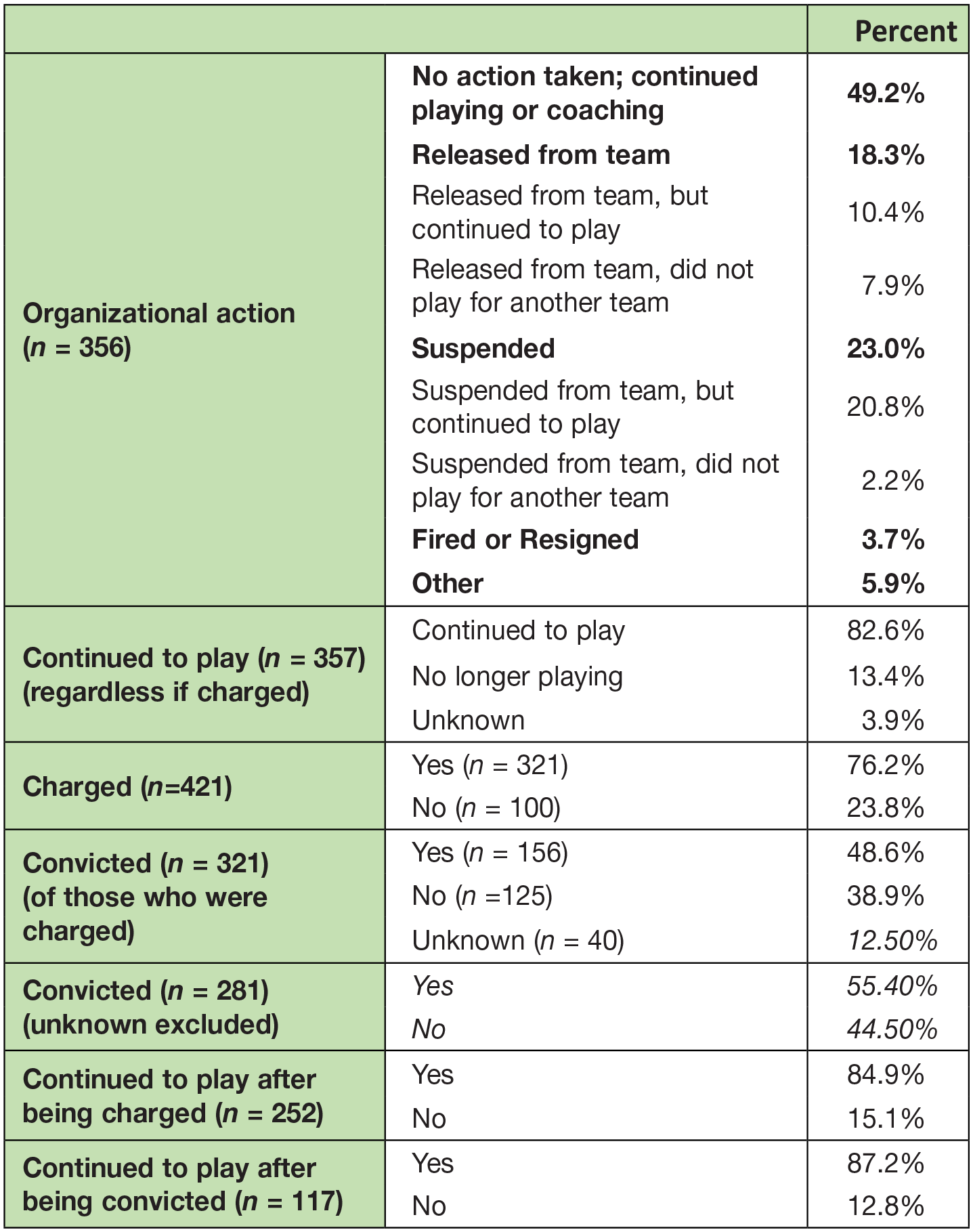
Organizational and Legal Outcomes among Perpetrators of Gender-Based Violence
Discussion
As the analysis of the database reveals, though athletes across the major sports perpetrate a great deal of gender-based violence, they rarely, if ever, face any meaningful consequences. We begin our discussion by exploring the current context of addressing gender-based violence extralegally.
One concern about the database that has been raised by reviewers and in conference presentations is that the data are culled from publicly available credible news accounts and are not limited to cases that involve a criminal conviction. Scholars of wrongful conviction and exoneration (Hattery and Smith 2021; Westervelt and Humphrey 2001) document that people can be, and are, wrongly accused, convicted, and incarcerated every day. We do not want our work, as feminist abolitionists caution, to grow the size or reach of the carceral state (Goodmark 2023), especially when it negatively impacts victims/survivors through intimate carceral violence (Monterrosa 2021, 2023). Certainly, we are not advocating a vigilante society whereby any person can make a false or unsubstantiated accusation that results in significant consequences for the accused. However, despite myths about women making false accusations of sexual violence or IPV, false reporting rates fall in the range of 2–8 percent, entirely consistent with false accusation rates for all other crimes (Dick and Ziering 2016). In fact, as Banet-Weiser and Higgins (2023) argue, the problem is not so much whether an accusation is true or false, but rather the degree to which the victim/survivor is able to make her believability legible.
As is evidenced by the cases of victims/survivors that Dick and Ziering (2016) feature in their examination of sexual violence on college campuses, as well as in high-profile cases such as the rape of Chanel Miller by Stanford swimmer Brock Turner (C. Miller 2019), many victims/survivors have found some form of justice through civil proceedings. This may include monetary settlements and/or stipulations regarding policy implementation and training. Furthermore, noncriminal sanctions, including civil monetary settlements, employment disciplinary proceedings, and college misconduct processes, are often preferred routes for victims/survivors because they do not require a criminal conviction and rely on “preponderance of the evidence” standards rather than the “beyond a reasonable doubt” requirement that is used in the criminal legal system (Cantalupo 2009).
In addition, even though they are often still re-traumatizing, extralegal hearing processes are not public, because their outcomes are often protected by nondisclosure agreements. Extralegal hearing processes also often incorporate not just restitution but also restorative justice practices. This was the case for both Kathy Redmond, who founded
Feminist Abolitionist Approaches to Addressing Gender-Based Violence
Any feminist abolitionist approach should begin by centering the victim/survivor—specifically, how they understand the harm that has been done to them and what justice means for them (Herman 2023). Renowned psychologist and trauma expert Judith Herman’s recent book, Truth and Repair (2023), brings together more than five decades of research that she has conducted with victims/survivors of gender-based violence. In this book, she focuses on a simple question: What does justice look like for victims/survivors? First and foremost, she finds that nearly every victim/survivor she interviewed wanted to be heard, to be believed, and to protect others from experiencing the same violence they had endured. Few wanted revenge or punishment. Most victims/survivors wanted their perpetrator to face some sort of consequence that both prevented future violence and acknowledged the harm that had been done to them.
Although Herman advocates primarily for noncriminal legal responses to gender-based violence, she does argue that one of the biggest challenges is to get those who perpetrate harm to see their actions as harmful. Thus, perpetrators are often not only reluctant to engage in restorative justice approaches, but unsuitable for them. In her words (Herman 2023, 106): Survivors are justifiably suspicious of the idea of forgiving their assailants. Because we know that abusers are often contrite afterwards. They say they’re sorry. They say they’ll change. They say it will never happen again . . . apologies and expressions of remorse, even if apparently sincere in the moment, can be among the most effective methods that abusers employ to keep their victims under their control.
Therefore, as with any process designed to address harm, caution must be exercised to ensure that it does not further victimize the survivor. And though we are not privy to the behind-the-scenes coordination of the decision by the Baltimore Ravens to honor Ray Rice as a “Legend of the Game” on New Year’s Eve 2023, for his efforts to “work on himself” and not allow domestic violence to be his legacy, as Herman’s quotation suggests, we urge caution. The concerns Herman (2023) raises illustrate the challenges to applying feminist abolitionist approaches to addressing gender-based violence in any setting, including SportsWorld. Therefore, we devote the remainder of the paper to exploring potential approaches to addressing gender-based violence specifically in SportsWorld.
Feminist Abolitionist Proposals for Addressing Gender-Based Violence in SportsWorld
For some victims/survivors, a meaningful consequence might mean a public acknowledgment that harm was done. This act alone would be in stark contrast to what most receive now, which is denial that any harm took place (Banet-Weiser and Higgins 2023; C. Miller 2019). Others might desire a restorative justice process, which could include counseling and treatment for both parties, individually and together (Herman 2023). It is reasonable to assume that for both victims/survivors and those who harm, therapy and treatment may take considerable time. It is also not unreasonable to consider requiring the person who perpetrated the abuse and/or the institution that protected them to pay for the therapy and treatment for the victim/survivor, and also for the victim’s time off work and/or school. Similarly, to fully participate in counseling and treatment, someone who perpetrated abuse may also need to take time away from work and/or school, and a suspension might be one way to ensure that the proper therapy and treatment are the player’s top priority. These are all examples of consequences that are consistent with a feminist abolitionist framework.
Feminist abolitionist approaches acknowledge that the community may play a role in managing consequences. As this applies to SportsWorld, depending on the nature and severity of the harm, and in consultation with the victim/survivor, a perpetrator of abuse may need to be removed, at least temporarily, from a community, including a college or university campus or a franchise/team at the professional level. These measures may be necessary to keep a community safe, but they can also be a part of a plan of consequences. When considering consequences, not only is it important to center the experiences and preferences of the victim/survivor but also to keep in mind that attending college or playing a sport are privileges. People who violate cultural norms and harm members of the community may not be entitled to the privilege of representing the team or community on the field of play. Community accountability may require a period of suspension from organizational activities.
Finally, Banet-Weiser and Higgins’ (2023) research on social media offers critical insight into the role that social media can play as a form of accountability outside the criminal legal system. Some of the cases indexed in the database are derived in part from social media posts by victims/survivors. In this way, the database can serve as an accountability measure, especially when it incorporates the voices of victims/survivors. At a minimum, as Banet-Weiser and Higgins (2023) argue, believability is both socially contested and an essential element of victims/survivors taking control of their narrative; including their stories in the database is one small gesture toward believability. We now shift to more explicit ways to address gender-based violence on college and university campuses as well as professional leagues.
Feminist Abolitionist Approaches to Addressing Gender-Based Violence on College and University Campuses
As a result of a series of high-profile cases, tragedies, lawsuits, and public sentiment since the early 2000s, college and university campuses, under the guidance of the United States Department of Education, are now required to have policies and procedures in place to address gender-based violence on campus. These policies include the Clery Act and sexual misconduct policies that ensure that campuses comply with Title IX. Although Title IX policies were developed ostensibly to address gender inequality in higher education and, beginning in the 2010s, were identified as an avenue for addressing sexual violence on college campuses, the data on the consequences from Title IX investigations indicate that they rarely bring justice for survivors (Dick and Ziering 2016). Bedera’s (2024, 37) qualitative research signals the reasons why Title IX has, thus far, been less than satisfactory for victims/survivors in its implementation: Administrators dismissed the notion that Title IX investigations mattered for survivors. Instead, they suggested that all reports fit into one of two categories: (1) women’s overly emotional misinterpretations of a sexual encounter that did not merit university intervention, or (2) violence so severe that no university action could reverse a survivor’s life-long trauma. As a result, administrators rationalized that refusing to sanction perpetrators of sexual violence was moral—they could do nothing to help a survivor, but they could protect a perpetrator’s education.
Both Bedera (2024) and Cantalupo (2009) offer specific recommendations, including standardizing access to legal representation among the parties and protecting the victim/survivor from direct questioning by the respondent, for aligning existing Title IX policies and practices with feminist abolitionist frameworks. Title IX policies and procedures are only one piece of the puzzle. The NCAA, as the governing body of college athletics, has conduct policies that contain provisions for sanctioning behavior both on and off the field/court/ice for a variety of rules violations. But as our analysis in Figure 3 reveals, they are rarely if ever utilized. Further, beginning in approximately 2018, the NCAA removed barriers and limitations on athletes transferring between schools, including allowing them to compete without a waiting period or having their athletic eligibility negatively impacted (McCormick and McCormick 2008; Reese 2023). When athletes transfer it effectively stops the Title IX process because the policy does not allow for an accusation or sanction to transfer along with the athlete.
For all its shortcomings, Title IX processes hold the potential for the kinds of consequences and justice envisioned by many feminist abolitionists, including Goodmark (2023) and Herman (2023). The consequences for those found responsible are oriented toward student learning and “teachable” moments—for example, assigning students to take a course or volunteer with a local organization focused on gender-based violence. Moreover, many campuses are experimenting with restorative justice approaches as well. However, for these existing policies to be effective in SportsWorld, the NCAA must recognize and adhere to Title IX processes and sanctions applied. In cases that involve collegiate athletes, this may require a waiting period before athletes can begin practice and play after transferring. In addition, we recommend that, like the database we designed, the NCAA should require and facilitate information sharing among coaches and athletic administrators with regard to allegations of collegiate athlete–, coach-, and staff-perpetrated gender-based violence. Doing so might have prevented cases like those of Jerry Sandusky at Pennsylvania State University and Larry Nassar at Michigan State University. These approaches have the potential to interrupt gender-based violence and prevent future harm. They also serve to acknowledge that harm was done, thus delivering some modicum of justice for victims/survivors.
Feminist Abolitionist Approaches to Addressing Gender-Based Violence in Professional Sports
Although there is no comparable policy to Title IX in professional sports, several professional sport leagues, such as the NFL, MNBA, and MLB, have personal conduct policies that explicitly prohibit a variety of behaviors, including doping and gender-based violence. Similar to college athletics, professional athletes, coaches, and staff are regularly sanctioned for violating all kinds of league policies. For example, Serena Williams was fined in the 2018 U.S. Open tournament for protesting a call by a referee or umpire. In addition, former NFL quarterback Colin Kaepernick was effectively banned from the NFL for protesting the playing of the National Anthem during the pre-game festivities, an action he hoped would amplify the voices of the Black Lives Matter movement (Smith et al. 2023). Clearly, professional leagues are willing to impose extralegal consequences, and in some cases, these are quite significant, including suspension and even expulsion from the league.
Yet, as the analysis of the cases in our database makes clear, to date these kinds of sanctions have never been used in any significant way to address gender-based violence in SportsWorld (see Figure 3). Only rarely are athletes, coaches, or team doctors who perpetrate gender-based violence sanctioned according to professional league policies. For example, Mike Clevinger, who pitches for the Chicago White Sox, was accused of strangling the mother of his child. Despite having a clear policy for sanctions in cases of IPV, MLB officials investigated the allegations, and ultimately the sanction imposed, which included “evaluation” rather than suspension, was one Clevinger and the commissioner of MLB mutually agreed to MLB (2023). This confirms the findings of Sailofsky (2024, 10) whose research with professional sport “administrators” revealed “that a player’s talent level and/or productivity as a performer is important to how criminal behaviours are evaluated.” In other words, Clevinger’s athletic ability and contribution as a player prevail over his actions as a perpetrator of gender-based violence, and that is something quite literally reinforced by the MLB and commissioner’s inclusion of Clevinger in the decision. Thus, we argue that all the leagues, including the NFL, MLB, MNBA, and NHL, and all other major sport governing bodies, first enforce the policies they already have.
Feminist abolitionist approaches encourage us to think even further outside the carceral box (Goodmark 2023). Among those Herman (2023) interviewed were victims/survivors of the Catholic Church child sex abuse scandal. Interviewees in her research acknowledged their own need for support as well as a desire for the person who harmed them to “get better.” Their insights as to what justice meant for them could be applied to SportsWorld as well. Incorporating victims/survivors into the process has the potential to create more justice for those harmed (Herman 2023). We also argue, second, that professional leagues and sport governing bodies revise their personal conduct policies and procedures to center and incorporate victims/survivors into the process.
As is the case in the child sex abuse scandal in the Catholic Church (Herman 2023) victims/survivors of gender-based violence in SportsWorld should not have to sue the person who harmed them to receive monetary compensation that addresses the harm they experienced. Rather, we recommend shifting the onus of responsibility from the individual to the institution. For example, funds for a survivor’s continued medical needs, including mental health, lost wages and/or tuition, and assistance in getting on their feet should be readily available to them, their families, and children without hassle or public disclosure. The burden of securing and managing these funds should be the responsibility of the institution (the league, college) and not the individual. Funds should also be designated by professional leagues and colleges for research to develop better intervention and training programs for preventing gender-based violence. Then, those prevention and treatment programs should be readily available, and required, for athletes, coaches, and staff who are accused of any form of gender-based violence. Finally, if a league fines a player or suspends them with or without pay as a consequence of violating the domestic violence policy, the salary should continue to be made available to the family who depends upon the salary to meet their daily needs. In addition, if the league imposes a fine on the accused player or coach, the money collected should be used to fund resources for victims/survivors in the local community where the accused plays. In some cases, the size of the fines would replace a shelter’s reliance on VAWA, thus disconnecting the support of survivors from the criminal legal system.
This is our position as abolitionists.
Conclusion: Theorizing Feminist Abolitionist Approaches To Addressing Gender-Based Violence
This paper contributes to theory building in two distinct areas: gender-based violence studies and abolition. As noted, criminalizing gender-based violence was viewed by the feminists of the 1970s and 1980s as an acknowledgment of harm. Thus, those who advocate for carceral feminist approaches may resist embracing all the contours of the feminist abolitionist approach (Bernstein 2007). Decades of research have demonstrated that criminalizing gender-based violence has not necessarily translated into diminishing harm. In fact, feminist abolitionists point out that the harm is great, but we have been limited in our thinking about how to address it without utilizing the criminal legal system. We also point to the fact that the criminal legal system, which was founded on a belief that women are not full citizens, was never built to address forms of harm that disproportionately impact women and that are perpetrated disproportionately by men—nor can we expect it to. Thus, applying feminist abolitionist approaches to specific cases of gender-based violence contributes to the theoretical debates (see Hattery 2022) that surround intervention and prevention strategies for lowering rates of gender-based violence in the United States, if not globally.
Second, employing a feminist abolitionist framework to the case study of SportsWorld, and specifically analyzing the cases compiled in the database we constructed, offers an opportunity to theorize the application of feminist abolitionist approaches and their promise of offering specific practices to center the experiences of victims/survivors, mitigate harm, and prevent future violence. These same kinds of challenges present themselves outside of SportsWorld as well: on college campuses, in workplaces and houses of worship, and even in our homes and families. What we learn from applying a feminist abolitionist approach to addressing gender-based violence in SportsWorld has the potential to open space for imagining these same kinds of approaches in other social institutions that we inhabit. For example, just as some workplaces require that an employee arrested for driving under the influence report that to their human resources (HRs) department, our analysis recommends that workplace policies surrounding accusations of gender-based violence be audited and revised appropriately. And, in cases in which an organization suspends an employee for accusations of gender-based violence, we recommend that they invest the sum of the suspended salary into research and local organizations addressing gender-based violence. Imagine if NBC had done this when Matt Lauer was fired or if the Weinstein Company had taken this approach when Harvey Weinstein was accused and convicted. Not only would it have been a form of accountability, but it would have had an impact on both intervention and prevention, thus contributing to an overall decline in rates of gender-based violence.
As feminist abolitionists who care deeply about gender-based violence, we have endeavored in this article to use the case of SportsWorld to link theory to potential action. It is praxis that will make abolition a reality.
Footnotes
Authors’ note:
The authors thank the anonymous reviewers for their feedback.
Notes
Katie Mirance is a doctoral candidate in the Department of Sociology and Criminal Justice at the University of Delaware and a research assistant for the Center for the Study & Prevention of Gender-Based Violence. She is interested in gender, sociology of sport, feminist criminology, and gender-based violence.
Katelyn E. Foltz is a doctoral candidate in the Department of Sociology at the University of Maryland-College Park and a researcher at the University of Delaware’s Center for the Study & Prevention of Gender-Based Violence. Her research interests include gender-based violence, race, masculinity, and sport.
Angela J. Hattery, PhD, is a professor of Women & Gender Studies and co-Director of the Center for the Study & Prevention of Gender-Based Violence at the University of Delaware. She is the author of 12 books, including three that interrogate various forms of gender-based violence. To read more about her: 
Marissa Kiss, PhD, is a Postdoctoral Research Fellow at the Institute for Immigration Research (IIR) at George Mason University. Dr. Kiss earned her doctorate in sociology at George Mason University in 2020. Her dissertation, “Baseball: The (Inter) National Pastime,” examined immigrant Major League Baseball players and immigration policy.
Earl Smith, PhD, is Rubin Distinguished Professor of American Ethnic Studies & Sociology, Emeritus, at Wake Forest University. Currently, he is a Professor of Women & Gender Studies at the University of Delaware. Smith is the author of Race, Sport, and American Dream and Sociology of Sport and Social Theory. His most recent book is Way Down in the Hole: Race, Intimacy, and the Reproduction of Racial Ideologies in Solitary Confinement.