







Abstract
Unequal credit in academic collaboration has long been understood through the Matthew effect—more credit is given to already famous coauthors. The Matilda effect posits that women receive less credit than men, assumed to be riding collaborators’ coattails. Analyzing 62 interviews that center women faculty of color contrasted with three same-rank colleagues (white women, men of color, and white men), we theorize the Maya effect: how unequal crediting for collaborative work is inseparable from both racialized and gendered oppression. The Maya effect theorizes not just the authorship end point, but also how inequalities arise in crediting output, illustrating how each stage of collaboration operates in gendered and racialized ways. Our narrative data holistically illustrate racialized and gendered patterns in collaboration at the stages of finding collaborators, maintaining collaboration, and crediting output of collaboration. We see racialized gender disparities in who can enter collaborations without fear of mistreatment, in silencing of ideas, and in how unequal crediting arises within ongoing research team interactions. The Maya effect is necessary to understand the meanings and mechanisms of inequality in collaborative work, and ultimately in whose knowledge is produced.
Plain Language Summary
In research and academic work, not everyone gets equal credit when working in teams. For a long time, experts have explained this using two ideas: the Matthew Effect, where famous or high-status people get more credit than they deserve, and the Matilda Effect, where women often get less credit and are overlooked in collaborations. This study looks deeper by focusing on the experiences of women faculty of color in universities. We interviewed 62 women of color and compared their stories with those of white women, men of color, and white men in similar academic positions. From these interviews, we developed a new concept: the Maya Effect. The Maya Effect shows how both race and gender together affect how credit is shared in research teams. Women of color often face unique challenges in collaborations, such as having their contributions ignored, being excluded from important decisions, or having to constantly prove their value. Unlike older theories that focus mostly on status or gender, the Maya Effect highlights how racial and gender inequalities work together. It also shows that these issues aren’t just about final credit, but about ongoing interactions within research teams. To truly understand inequality in science and academia, we need to move beyond the Matthew and Matilda effects. The Maya Effect helps us see how race and gender shape who gets to collaborate, who gets listened to, and who gets credit.
You may write me down in history
With your bitter, twisted lies,
You may trod me in the very dirt
But still, like dust, I’ll rise.
Collaboration among scientists bolsters careers and pushes the boundaries of science, but also collides with the individualistic, gendered, and racialized academic context. A case in point is one of the most central concepts in the sociological study of collaboration, Robert K. Merton’s (1968) “Matthew effect.” The Matthew effect posits that previously successful scientific collaborators get credit for works at the expense of lesser-known coauthors. Merton’s (1968) Science article has been cited more than 12,000 times, yet, ironically, the cumulative advantage concept in the Matthew effect reflects the uncredited work of Merton’s collaborator (and wife) Harriet Zuckerman. 1 Merton’s own (1988, footnote 2) admission makes this clear: “It is now belatedly evident to me that I drew upon the interview and other materials of the Zuckerman study to such an extent that, clearly, the paper should have appeared under joint authorship.” Academic individualism fosters the Matthew effect (including among the concept’s creators) and remains durable in today’s neoliberal university. Incentives for tenure and promotion remain decoupled from collective rewards that might better support collaboration (Blair-Loy and Cech 2022; Shore and Wright 2000).
It is not coincidental that Merton’s uncredited collaborator was a woman. Higher education is both gendered and racialized in ways that systematically disadvantage many women and faculty of color (Bird 2011; Britton 2017; Melaku and Beeman 2023). The theoretical contributions of women, especially scholars of color, are continually excluded and repressed by “mainstream” science (Hoang 2022; Kozlowski et al. 2024; Vásquez 2024). Gendered scientific structures often treat women faculty as riding on collaborators’ coattails, systematically denying women credit for their ideas, subsuming them under men coauthors through what Margaret Rossiter (1993) called the “Matilda effect.”
Yet the Matilda effect further misses how gender intersects with racialized oppression (Collins 2022; Luna and Pirtle 2022) to shape collaboration in academic science. Drawing from Black feminist thought and honoring critical scholar Maya Angelou, we argue for the Maya effect as an antidote to the colorblind and gender-obscuring Matthew effect. We develop a holistic and intersectional theory of collaboration—identifying how faculty members from minoritized groups are not only less credited after publication but also charting how they end up less involved in collaborations and experience exclusionary gendered and racialized interactions within collaborations.
Our qualitative interview study captures narratives about processes throughout the collaboration lifespan, linking individual experiences to intersecting inequality structures within the gendered–racialized organization of academia. Much research identifies quantifiable collaboration outcomes at the individual level highlighting disadvantages for women faculty, but less work unpacks how collaboration unfolds qualitatively via interactive processes (Bozeman, Fay, and Slade 2013; Sacco 2020). Our study is, to our knowledge, the first to delve into how gendered and racialized inequalities are baked into collaboration at all phases—not just publication credit. We analyze faculty narratives about three stages: (1) developing collaborations, (2) engaging in teamwork, and (3) seeing work credited in publication and personnel processes. We find that each stage of collaboration reflects the gendered and racialized organization of higher education. Although some research explores collaboration dynamics by gender, much less focuses on race and its intersection with gender (Gaughan, Melkers, and Welch 2018). Yet these dynamics are critical to understanding career outcomes for scientists and, by extension, what scientific knowledge is produced.
We analyze the accounts of 62 faculty members from different STEM departments in the same research-intensive university, based on a sample that includes four faculty members from the same department and rank: a woman of color, a man of color, a white woman, and a white man. This comparison allows us to focus on how race and gender condition collaboration, while still comparing faculty at the same career stages and in the same workplace and discipline. We find that women of color and white women STEM faculty have some parallel collaboration experiences, including being allocated more work and receiving less credit for their contributions. However, research collaboration is particularly marginalizing and exploitative for women of color.
We make several contributions. First, whereas the Matthew effect predicts that everyone seeks to work with high-status scientists, we show how women of color instead prioritize trust over status, expending extra effort to secure respectful collaborators. Second, whereas the Matthew effect characterizes unequal credit as originating during publication, we show that interactions among a collaborative team long before publication reflect gendered–racialized inequalities. High-status team members discount or ignore the ideas of women faculty of color. Third, in closer examination of the crediting stage of collaboration, where the Matthew effect assumes that junior coauthors of high-status scientists willingly wait their turn to accumulate career advantages and age into recognition, we observe gendered–racialized outcomes for women faculty of color across their entire careers. At all faculty ranks, women of color report having their ideas stolen or being pressured to over-credit coauthors who did little work. Women of color learn to protect themselves by carefully documenting their efforts or collaborating only with people they know and trust, at times avoiding collaboration, exacerbating the tenuousness of their research networks, and limiting scientific success.
We did not expect the stages of collaboration to operate in such different ways, demonstrating the insidiousness of gendered and racialized advantages as they vary along the life course of scientific relationships. We did not set out to study collaboration in stages and had no tips from the literature to do so. Instead, these findings, and our conceptualization of the Maya effect, emerged inductively from our qualitative data analysis. The Maya effect is the cumulative gendered and racialized disadvantages across different stages of research collaboration that contribute to intersectional inequalities in academia. Analyzing the Maya effect also reveals how women of color faculty resist oppressive collaborations.
Universities as Gendered and Racialized Organizations
The literature does help us understand universities as gendered and racialized organizations that confer work, prestige, and rewards unequally by gender and race (Acker 1990; Bird 2011; Britton 2017; Ray 2019). Organizations distribute power through structures of hierarchical authority, resource distributions, policies, and normative practices that have gendered and racialized implications (Britton 2000, 2017; Wingfield 2019). Workers who do not fit racialized or gendered expectations for particular jobs tend to be disadvantaged and tokenized, including women in professions such as law, healthcare, and finance (Melaku 2019; Neely 2022; Wingfield 2019). Power in universities is concentrated among white men, and in academic science, white and Asian senior men are accorded greater status than other groups (Ridgeway 2011). Women of all racial backgrounds are underrepresented among faculty, and Black, Latine, and Indigenous women of color are significantly underrepresented and barred from full participation in academia (Melaku and Beeman 2023; Zambrana 2018). 2 Women of color represent a statistical minority in most STEM disciplines and are less likely than white women or men of any racial group to be awarded tenure (Lisnic, Zajicek, and Morimoto 2019). The representation gaps of women and faculty of color widen at each successive rank (Gaughan 2023).
Internal organizational mechanisms including interactional norms, workplace cultures, job sorting, and supervisory practices actively maintain and reproduce inequalities by race, gender, and class (Ray 2019; Wingfield and Chavez 2020; Wooten and Couloute 2017). Within universities, inequitable work allocations, exclusion from networks, and hostile interactions including gender-based and sexual harassment contribute to a “chilly climate” for women faculty (Britton 2017; Hall and Sandler 1982). Faculty evaluation criteria rest on narrow indicators of academic excellence that are gendered and racialized (Gonzales, Martinez, and Ordu 2014), perpetuating a masculine ideal worker norm that assumes faculty members are fully devoted to their work with no other responsibilities (Blair-Loy and Cech 2022).
Women faculty of color experience interlocking effects of race and gender bias in the academic workplace, evidenced by their high mentoring and service demands, the devaluation of their scholarly contributions, their authority challenged by students, and incidents of blatant racism (Collins 2022; Misra et al. 2021; Settles et al. 2021). A few studies suggest that women faculty of color adopt certain strategies. For example, Black women faculty engage in emotion management to contend with racialized classroom dynamics where their authority and intellectual capabilities are regularly challenged by white students (Harlow 2003). Often lacking career support in their departments and universities, women of color will seek external, communal, and group-based mentorship (Aparicio 1999), including through professional associations, continued relationships from graduate school, and “counterspaces” that validate their experiences (Martínez-Carrillo 2019).
These studies importantly illustrate the intersecting role of race and gender in shaping individual faculty workplace experiences and career strategies but rarely attend to gendered–racialized organizational structures (Wingfield and Chavez 2020). Whereas others have demonstrated how gender in professional settings privileges men in terms of mentorship and sponsorship (Luhr 2024; Neely 2022), we focus on research collaboration as a case to explore how these interactions drive gendered and racialized inequalities for women of color and white women faculty. Organizational structures, culture, interactions, and procedures are mutually reinforcing, and workers make, reflect, and assume gendered and racialized meanings that reinforce gendered and racialized rules and hierarchies (Acker 2006; Ray 2019; Wingfield and Chavez 2020). By examining the structure of research collaboration, including our novel focus on the stages of collaboration, we link individual experiences to structures of power and inequality in academia.
The Gendered Nature of Collaboration
Research collaboration is an institutionalized expectation and norm in academia, especially in STEM fields that increasingly rely on the cooperation of specialized people and research teams (Bozeman and Corley 2004; Leahey 2016). Research collaboration is also a key academic work structure and involves a set of relationships that might be built around, for example, a prominent funding opportunity or shared research questions. Inclusion in research teams not only increases productivity through coauthorship opportunities (Lee and Bozeman 2005) but also provides social capital from teamwork, mentors, and networks and results in economic capital such as funding, equipment, instruments, and lab space (Fox 2008). Collaborative papers are typically more visible than sole-authored papers, usually placed in higher-impact journals and garner more citations (Frickel, Albert, and Prainsack 2017). Credit and authorship weigh heavily in individual faculty performance evaluations, but crediting research outputs is closely tied with status in academic science, as suggested by the Matthew effect (Merton 1968). Assigning credit is a decision-making process with remarkably inconsistent practices and norms (Fox and Nikivincze 2021).
The gender frame underlying universities, especially presumptions of men’s greater status and competence, shapes and biases collaborations to create barriers for women faculty (Ridgeway 2011). Margaret Rossiter (1993) coined the Matilda effect as a corollary to Merton’s (1968) Matthew effect, describing the systematic undervaluing of women’s contributions to science, naming it after Matilda Gage, an unrecognized sociologist who wrote about women inventors in the 1800s. Women scientists have been ignored, denied credit, and dropped from publications through entrenched biases in scientific recognition (Rossiter 1993). Whereas Merton focused on the accumulation of advantages for top scientists, Rossiter shifts attention to women “have-nots” in scientific history.
Empirical work confirms the Matilda effect and highlights disadvantages for women faculty in collaboration compared with men, visible through coauthorships that measure credit (Abramo, D’Angelo, and Murgia 2013; Araújo et al. 2017; Gaughan, Melkers, and Welch 2018). Women’s contributions remain difficult to discern, as women today are more likely to be listed as coauthors but are less likely to be the prestigious first or last author on a paper (West et al. 2013). In some cases, women perform most of the work but are listed as only contributing authors (Larivière et al. 2013). In others, women’s contributions are erased, and they are left off as coauthors despite ample contributions (Vásquez 2024).
Bibliometric studies have produced crucial knowledge about collaborative output but miss the unfolding social dynamics or interactive processes in different stages constituting collaborations, like those that arose in our data—including the initiation and maintenance of collaborations. Access to collaboration and research funds remains heavily influenced by informal, men-dominated networks (Gaughan, Melkers, and Welch 2018). Women STEM faculty tend to be less connected than men, including in their departments, or have lower-status ties (Abramo, D’Angelo, and Murgia 2013; Miller and Roksa 2020). Women are more likely to collaborate with other women and less likely to engage in international collaborations compared with men colleagues (Bozeman and Corley 2004; Zippel 2017).
A handful of studies reveal the “dark side” of collaboration (Bozeman, Fay, and Slade 2013), including the erosion of trust between collaborators (Shrum, Chompalov, and Genuth 2001) and questionable practices resulting in failed collaborations (Sacco 2020). Evidence of chilly climates suggests barriers for women and faculty of color to participating in research collaborations (Britton 2017; Miller and Roksa 2020). As a key component of the structure of academic work, collaboration must be considered as part of cumulative disadvantage in the academy, contributing to racialized and gendered variations in tenure and promotion, pay, work satisfaction, and patterns of inclusion and exclusion (Sugimoto and Larivière 2023).
From Matthew and Matilda to Maya
Less is known about how race shapes research collaboration. Most scholarship on research collaboration lacks an intersectional perspective focused on Black, Latine, and Indigenous women of color scientists (but see Gaughan, Melkers, and Welch 2018; Miller and Roksa 2020), in part due to a focus on bibliometric approaches and citation counts that are rarely disaggregated by race and gender (Bozeman, Fay, and Slade 2013; Kozlowski et al. 2024). Scientists of color have smaller networks than white scientists and more low-status ties (Mehra, Kilduff, and Brass 1998). Some Black scientists express isolation, feeling unwelcome in scientific networks, and a lack of shared research interests with white scientists (Brown et al. 2013). Freeman and Huang (2015) show that scientists often coauthor with collaborators sharing similar ethnic backgrounds, which benefits scientists from dominant groups. 3 Empirical studies on how collaboration experiences contribute to intersectional gender and race inequalities in science are needed to close this knowledge gap.
To understand and address organizational inequalities, we must consider race and gender together (Alegria 2019; Collins 2022; Melaku and Beeman 2023). We offer the Maya effect as a replacement to both Matthew and Matilda effects, shifting attention by centering the experiences of women faculty of color in the gendered–racialized structure of unfolding collaborative relationships. Merton’s generic cumulative advantage model focuses on career stage and relationship to a famous mentor, without considering the broader racialized and gendered organization of academic science. Our data show that this understanding of cumulative advantage is incomplete. Unequal credit for collaborative work cannot be understood without narratives across the full range of how faculty experience research collaboration.
Our novel approach examines the life span of collaborations to provide a deeper understanding of how racialized and gendered processes unfold at different moments in knowledge production to create cumulative disadvantage. Investigating faculty narratives about navigating interpersonal dynamics in each stage of collaboration allows us to theorize how routine mechanisms—including (1) developing collaborative relationships, (2) engaging in collaborative research, and (3) ensuring credit for collaborative work—shape how faculty experience universities as workplaces by gender and race. We foreground collaboration experiences of women faculty of color in STEM, comparing their accounts with those of white women as well as with white men and men of color colleagues.
Our findings show that analyzing different stages of collaboration is an important step for linking individual experiences to structures of power and inequality in the academy. Identifying interactive decision-making processes leading to the breakdown of collaborations allows us to see how gendered–racialized processes shape scientific career trajectories and the course of science. The Maya effect reveals how research collaboration disproportionately inhibits the careers of women faculty of color, reproduces intersectional power structures in the academy, and accumulates dis/advantage in different ways at different collaboration stages. In recognizing collaborations as key to full inclusion into academic life, we conclude that efforts at creating equitable collaborations are key to the retention and success of women in STEM, especially women of color faculty.
Data and Methods
The second author, an Asian American woman, conducted semi-structured interviews with 62 faculty members in 14 STEM departments at one research-intensive, public university in the United States. STEM includes math and computer science, engineering, physical sciences, earth sciences, biological sciences, and social sciences. 4 Our purposive sampling targeted four faculty members from the same department and same rank, differing by race and gender. We interviewed women of color (n = 17), and then we matched men of color (n = 14), white women (n = 15), and white men (n = 15), and white nonbinary (n = 1).
About 35 percent of STEM faculty at the institution are women, 8 percent are from underrepresented groups, and 17 percent are Asian. Using website contact information, we approached the most junior woman of color in each STEM department, because we were interested in understanding the perspectives of faculty who may feel more vulnerable. We sent one follow-up email if we did not receive a response and then contacted the next most junior woman of color in the department. At the selected research-intensive university, every department had at least one woman of color. Our goal was not to develop a sample that represents all STEM faculty but, instead, one that allows us to understand how race and gender condition STEM faculty experiences by comparing faculty at similar career stages and in the same fields. In selecting faculty of color, we prioritized Black and Latine scholars but also include Asian scholars. 5 In our sample, men faculty of color include more Asian faculty, whereas the women faculty of color are more likely to be Black or Latine; we note the specific racial group in presenting interview data. Our response rate was 61 percent. The interviewer is active in faculty of color communities, which likely helped develop rapport, particularly with women of color in the sample.
Initial interviews were conducted in the respondents’ offices or, in two cases, another campus location suggested by the respondent. For two men of color, four white women, and all white men respondents, interviews were conducted via Zoom, due to the pandemic. Interviews ranged from 40 to 75 min, with most averaging 1 hr. In all but three instances, we audiotaped and transcribed interviews with permission. In these three cases, the interviewer took detailed notes and transcribed them the same day. We give all respondents pseudonyms and exclude identifying details to protect confidentiality.
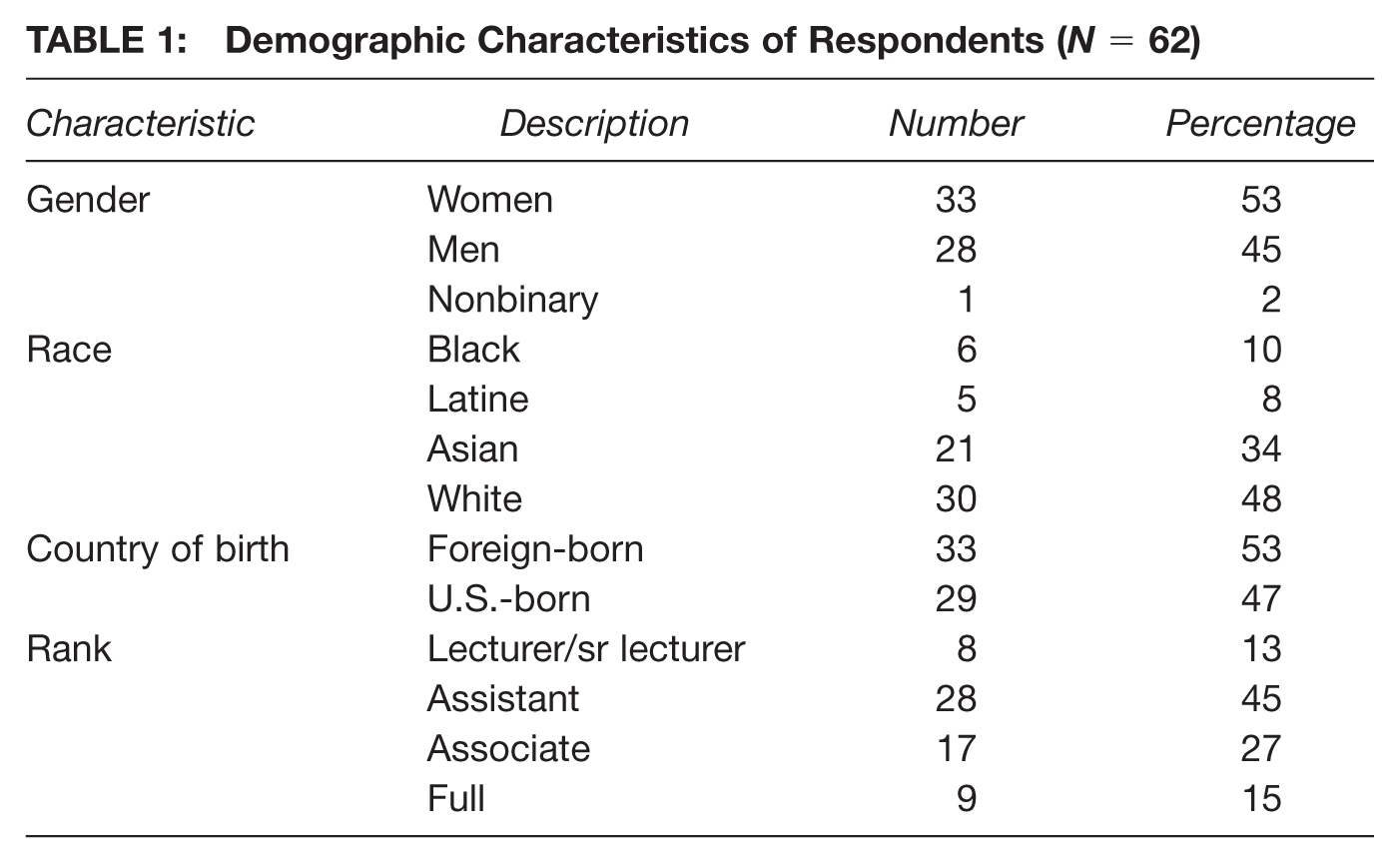
Table 1 summarizes the sample. About half of the sample are women, Black, Indigenous, people of color (BIPOC) and foreign-born. Most participants are assistant professors or recently tenured associate professors, although we also include professors and non–tenure-track lecturers in permanent, benefited positions. Occasionally, one member of a department would be a slightly different rank (e.g., recently promoted associate professor with advanced assistants). By interviewing four people from the same department and rank, we can consider how faculty race and gender shape careers without worrying that, for example, women or faculty of color are at earlier career stages or in different fields from white men.
Demographic Characteristics of Respondents (N = 62)
Interviews focused on experiences with research collaboration, feelings of inclusion and experiences of collegial mentoring in their departments, and their experiences with decision making, such as hiring or promotions. We followed semi-open coding techniques to identify narratives for how respondents approached and navigated collaborations. All respondents noted that collaboration is an essential part of their discipline. Three key moments of collaboration emerged as pivotal in narratives: how respondents develop research collaborations, challenges they face in collaboration, and how collaboration is credited. We were alert to how field, rank, race, gender, and nationality shape these accounts. Rank and field played a smaller role in the variations we saw, which was unexpected. Race, gender, and sometimes nationality operate more powerfully.
Findings
Collaboration disproportionately inhibits the careers of women faculty of color through three stages of research collaboration: (1) developing collaborations, (2) navigating challenges in collaborative relationships, and (3) crediting collaborations. Within each collaboration stage, we identify gendered and racialized mechanisms of inequality by contrasting the experiences of men with white women and women of color.
Developing Collaborations
Faculty see career benefits of collaboration, with most emphasizing that productivity is easier with teams, describing how collaborations build networks and recognition necessary for promotion. Tiana, a Black, foreign-born woman, explains: “It can progress really quickly. You know, you have this angst about your own writing but if you have to lay out the draft for other people to see, it kind of gets rid of some hang-ups very quickly.” Bernadette, a white woman, pulls in junior colleagues on projects to lessen her workload: “Those things are kind of a win-win, really, because they get a publication out of it, and I don’t have to do all the work.”
Faculty describe differential opportunities and motivations to develop successful collaborations. Men typically rattled off names of collaborators, starting with graduate school advisors, and later faculty colleagues. Adam, a white man, describes how his “esteemed” collaborators provided him with both mentorship and publications, noting: “As any early career researcher usually has.” White men emphasize “luck” in developing collaborations. Kurt, whose mentor set him up with collaborators, says, “Frankly, I showed up in academia, I had no idea how to behave. Like I lucked out. I caught a break, and someone saw it and was like, ‘Do this, do this, do this’ and I would do it.” Asian, Black, and Latino men also see collaboration as key to their experience. Maurice, who is Black, says, “I think graduate school by definition is a collaboration.” Diego, who is Latino, describes how his career “has been very collaborative since the beginning of my postdoc.” Min-ho, an Asian man, started collaborating almost immediately as part of his training: “The advisor would give you a few projects to start with, and then I kind of slowly developed my own interest, and then it becomes kind of a joint project.”
Men across races typically approach collaborations with an eye to the scientific connections between research programs, rather than personal relationships. Eighteen of 28 men emphasized science driving collaborations. Min-ho noted that “I think the real key is . . . genuine interest in the question.” Lucas, a Latino scientist, agrees: “It’s based on the interest.” Men report building personal relationships with their collaborators, but they prioritize overlap in scientific questions or methodologies.
White women describe developing collaborations early in their careers, with 11 of the 15 white women working alongside mentors; however, these tend to be more of a mixed bag, with some, like Doris, vaguely describing her graduate school experiences as “not ideal,” or Olivia, who says, “There was not a really good fit.” Molly says that collaboration in her natural science field is “almost necessary,” but she had difficulty locating collaborators throughout her training: “Undergrad, no. Grad school, no. Postdoc, no.” Others had more positive experiences, including Jane, who collaborated as an undergraduate with a “super generous” senior faculty member who later wrote a letter for her tenure file. Eva collaborated with “fantastic” peers, with collaboration “built into the culture” of the lab, and Carol collaborated with her mentors long after finishing graduate school, saying they continued “cheerleading” her work. Key is that many white women developed collaborations early, and those with more negative experiences saw those relationships as learning moments. White women report more variation in developing relationships than the men but still relate successes.
Similar to men, some white women describe developing collaborations strictly over the science. Nine of the 15 white women respondents had collaborated with people they did not previously know, with varying levels of success. Tracey says, It’s combination of both [science and personality]. First of all, you want somebody who knows a lot more than you do about a subject . . . you build a team that way. But the other thing is you have to be on a level playing field where it is a true collaboration.
Finding this “true collaboration” can be challenging because women are not necessarily treated as bringing skills to mixed-gender teams. Courtney has cold-called potential collaborators several times with mixed results. She describes some of her attempts as “horrific,” and says, “Some of the outcomes have been so bad—people using me, you know, rather than wanting to collaborate.” But she also notes that “There’s one exception and it was a cold call when I first got here . . . [he] is just wonderful to work with.” Jane describes stressful collaborations with people she did not know well. Since getting tenure, she stepped away from collaborations motivated strictly by scientific overlap while “dialing up partnerships where there’s vague technical overlap but . . . we work really well together.” She says “Learning from the bad things, I think, has helped me become a little bit better.” White women report investing in collaborations where synergistic work styles may outweigh simple intellectual overlap. This decision may reflect lessons learned from less successful collaborations.
Women of color, on the other hand, faced challenges in developing effective collaborations, especially after graduate school. Like the white women, most (14 of the 18) Asian, Latine, and Black women developed collaborative relationships in graduate school, describing communities of scholars focused on similar research questions. Gabby, a Black woman, continues to collaborate with mentors because they “are probably the most closely related in terms of the work I’m currently doing.” Many describe developing collaborations as faculty as requiring substantial work. For example, Leyla, who identifies as a racial “minority,” strategically decided to coauthor with someone who made a very small contribution to the paper—but bridged a key connection with an established scholar. Yang, who is Asian, invites people she meets at conferences to give a seminar in her department and, during their visit, “We start talking about some proposal ideas.”
For some women, these strategies pay off. Xiaolu, an Asian woman, describes herself as “naïve” regarding finding collaborators, typically chatting with other junior faculty at conferences. Yet she struck gold when she approached a senior white man who gave an exciting conference talk: “And he turned out to be this incredibly supportive person. . . . And we’ve since collaborated on a number of grants and papers. . . . No one else has given me the amount of support that he did.” While Xiaolu appreciates her collaborator, she wishes she had learned about developing collaborations during her graduate training. Alexis, a Black woman, centers her strategy on giving regular research talks: “The more I talked to people, the more they know about me.” Although she’s met many people, “only a small percentage turned into actual [research] money or papers.” White women describe being included in the culture of collaboration, even if the results of those collaborations are mixed. Women of color describe exerting more effort to develop collaborations compared with other groups.
More than half of the Asian and Asian American women describe connecting primarily over science. Mel describes finding collaborators as through “skill complementarity.” Yet the five Black women are more likely to emphasize the importance of getting to know someone before embarking on a collaboration, with only one Black woman, Kerri, pursuing a collaboration based primarily on science because her advisor pushed her: “He really encouraged me to go to initiate. So, we did get a nice publication out of it.” Kerri trusted her advisor’s judgment, and the collaboration wound up being useful. While collaborations can lead to productivity, they can also be draining if they do not go smoothly. Many Black, Latine, and Asian women in this study state that they must know collaborators ahead of time but had trouble articulating why. In answering these questions, they spoke cautiously, holding eye contact with the interviewer, suggesting that they wanted to be sure they were understood correctly, describing the importance of “personality” and “trust.”
Kerri describes experiences with colleagues who are not respectful, noting that “I think they just might not know they’re doing it, but they are doing it.” While she does not explicitly connect this experience to her race and gender, she emphasizes that “In my case, I have certain criteria that I know to look for . . . because I don’t want to feel, yeah . . . [trails off, meeting the interviewers’ eyes with a nod].” Hiromi, who is Asian, prefers to collaborate with people she already knows, saying that “personality and working style is so important,” but she will work with someone a friend has “vouched” for in terms of collegiality and approach. Jasmine, who is Black, similarly notes that developing collaborations seems to work better with people she knows. Many of her collaborations include peers. Yet, as she describes, You do have to have conversations because this matters to people’s careers, you know, like, who’s doing what on this project, who is, if you’re doing more, are you first author? . . . Things you don’t necessarily want to have to start off talking about, but you have to get clear.
Jasmine emphasizes the importance of having clear conversations about how the collaboration will work before it takes off, so there are no unpleasant surprises. Eleven of the 18 women of color brought up questions of trust.
Two key insights emerge from narratives of developing collaborations. First, faculty experience differential access to developing successful collaborations, with women of color the most constrained. Second, while science plays a role in choosing collaborators, many women of color, particularly Black women, express that knowing collaborators beforehand is important to ensuring smooth and respectful collaborations.
Challenges in Maintaining Collaboration
Collaborations present challenges, including issues of time, logistics, and interpersonal dynamics. Lacking time to nurture collaboration is a common theme. Collaborations tend to dissolve when team members do not devote enough attention to the project. Yet gender and race intersect and shape interactional processes underlying collaboration challenges.
Harish, an Asian man, says collaborations inherently take longer: “I need time to sit down with my colleagues and play with ideas and to read and to sort of develop analyses.” Steve, a white man, observes that when he takes on too many collaborations, “I end up having a lot of work to do that’s hard to deliver on in a timely fashion.” And Chyou, an Asian woman, argues that certain mechanisms keep collaborations moving, such as a jointly funded project requiring reporting; otherwise, researchers may have “other things going on in their pile, and they are working on those.” Another issue shared among all faculty is managing logistics. Many faculty members note scheduling conflicts as a key reason collaboration falls apart.
Women faculty often expand their discussion of challenges to describe relationship difficulties that, in some cases, are painful to recollect, using words like “sour,” “awful,” “difficult,” and “frustrating.” Women, especially untenured women, describe being treated like students by men collaborators and being assigned more administrative, traditionally feminized tasks. Scarlett, who is white, describes being “left with a lot of the burden of the work,” and Alexis, who is Black, also describes “workload” issues, with collaborators expecting her to carry out an unfair amount of work. Emilia, a Latina, observes how her collaborators expect “things to happen naturally, magically,” like expecting her to send email reminders of deadlines, saying “Some days it’s like, ‘You have a calendar like I do.’”
These dynamics can have negative career consequences for women, such as when Jane, a white woman, had a collaborator holding backing publications to wait for another paper to be published first: “The feedback I got . . . [which] sums up the whole collaboration was, ‘Your tenure is not as important as this research.’” Jane attributes this to being “more junior, and I suspect, but I’m not certain, that I’m also a woman.” Such interactions disempower women.
While women are more likely than men to recount interpersonal collaboration challenges, race and nationality intersect with gender to shape collaboration dynamics among women. Some foreign-born women, both white and of color, voice that their intellectual contributions are not always respected within research groups. Katie, who is foreign-born and white, says she tried to collaborate early in her career, but “People just took my ideas and ran with them.” In describing why she hesitated in asserting herself, she notes, “That also has to do with nationality. I have no doubt about it.” Yang, a foreign-born Asian woman, suggests that people do not always recognize her ideas: “I get sensitive that especially if I propose the same idea, but they say, ‘Let it go,’ but if it’s somebody more senior proposing the same [idea] everybody is like, ‘Yeah, that’s so good.’” When asked if this is just about seniority, she explains that she doesn’t think so: I feel gender and nationality might be more important. . . . Everybody is talking while I say that and not listening, and when I’m done [the group] moves on without . . . really considering what I just said . . . so I wouldn’t think that rank matters.
Yang describes the silencing being linked to her gender and nationality. Leyla, also foreign-born, describes difficult interactional processes in not having her voice heard by collaborators: They invite you to be a collaborator, but they treat you like [a] student. It’s like, they don’t even listen to you. . . . And every time you bring your opinion, they’re like, “No, no, this is not a focus on you.” Two months later, [the team goes] back to the argument that you made.
The lack of respect can have material consequences, such as when a project takes longer to complete.
Leyla describes one collaboration where it appears her postdoc advisor gave her draft paper to another student, who then published the argument. Her advisor claimed that her male peer “independently worked on this paper.” While Leyla argues that such a coincidence was unlikely, there was no way to gain credit for her contributions or find allies given her postdoc sponsor’s importance: “But I mean, it’s very, very tough to be a minority. And a lot of [the] time you don’t know how to open up, who to trust.” While Leyla knew the relationship was unhealthy, she continued working with her sponsor who, ironically, would discourage her from discussing her research with visiting scholars, saying “Don’t share your ideas . . . they’re going to publish it sooner.” Leyla has learned the hard way that some scientists may steal your ideas; yet given her lower rank, nationality, and minority status, she has little recourse.
Hiromi similarly expected to be co-corresponding author on a collaborative project as a graduate student, but another student sent out the paper as corresponding author without checking in with the team. Her advisor did not help, suggesting that she “deal with it.” She notes, “Looking back, I should have argued,” but “People from some particular culture may feel uncomfortable to argue.” Hiromi thinks her position as a foreign-born Asian woman made it more difficult to assert her contribution to the project.
Finally, some women of color faculty members describe collaborations that broke down in ways that suggest racialized stereotyping. Tiana, who is Black, describes “frictions” with a collaborator, who voiced expectations that were impossible to meet. Tiana felt that her white postdoctoral sponsor blurred lines between them, at times being more friendly, and at others pulling rank: I realized that there was something off when one day she wrote me this really stream of consciousness email that in a professional setting is highly inappropriate. . . . she kind of somehow expected me to know what she needed without telling me.
Tiana worked hard to respond to her sponsor’s dissatisfaction without sinking the collaboration. Her collaborator then made several impossible-to-fulfill requests, calling on “stereotypes of an angry Black woman,” which frustrated Tiana, who tried to address her collaborator’s concerns calmly and professionally “in a way that wasn’t super confrontational.” This lack of respect made Tiana feel “less invested” in the relationship.
While collaboration issues are true for any researcher, in our sample some challenges appear to reflect both race and gender. Women respondents often report challenging collaboration dynamics, particularly with more senior men who treat them as research assistants. Lack of respect from collaborators was another key interactional dynamic for women of color, present in four of the five accounts of Black women in our sample; the only other Black woman respondent, Jasmine, described the importance of collaborating with those she already knows, to ensure that everything is “clear.” Furthermore, many foreign-born respondents express concern that their intellectual contributions may not be fully heard or may even be confiscated by other researchers.
Counting Collaboration
While faculty received mixed messages on how collaborative work is “counted” in personnel processes, nearly everyone recognizes the need for a balance between independent and collaborative work to earn tenure and promotion. But gender and race biases in evaluation processes complicate these competing expectations. White men repeatedly express confidence in meeting expectations to produce independent research. For example, when asked if he has concerns about his collaborations counting in formal reviews, Scott says “I never had this worry, actually.” He continues, I don’t, I certainly don’t feel like a collaborative paper doesn’t count—it totally does count. I’ve never been worried about that. . . . I’ve never considered this effect to say “Oh, but maybe I should actually only work on stuff on my own.” I never had this concern.
Scott never second-guesses collaborative projects. Noah thinks collaboration is valued “nearly the same” as independent work, and Mark says evaluating collaboration is “standard business.” Some Asian men respondents are similarly unconcerned about their collaborative research, like Harish, who says, “If you collaborated, it was not held against you.” Zhang, an Asian man, is also confident because he independently developed a tool used in collaborative work, making his contributions clear: “I can provide a tool that nobody else can, I have a unique contribution.” Yet there are exceptions. Delun, also an Asian man, feels that being treated like a scientific tool minimizes his contributions: Some people . . . maybe they will think I am a tool, right? And so, if they think I am a tool, then I will refuse to do more for them. Some people will work with me with more respect. And then in that case, I am willing to walk the extra mile.
Thus, even among Asian men, there are differences in experience.
Women are more concerned than men about receiving credit for their inputs to collaborative research, especially to those assessing them. Courtney, who is white, explicitly describes how gender biases shapes how collaborations are counted: Women who are in a collaboration are there because we’re weak, and we need collaborators; men who are in collaboration are there because they’re brilliant and needed. [laughs] How do you fight that? You know, I don’t know how to fight that.
Doris, also white, notes that despite collaboration becoming “pretty normal” in her field, “I think there’s some empirical studies that show that women who collaborate get less credit for the paper than their male collaborators.” Sarah, also white, was struck by the fact that two women she had met who had collaborated with their husbands had to defend and document their contributions in much greater detail, saying “Women might be asked to say more forcefully that they are the sort of leading agent in the work.” Molly, who is white, flatly says, “Well, it’s true that men will get more credit.” Molly has seen this gender dynamic play out in tenure and promotion reviews, with women needing “lots more independent money and papers,” explaining “If you’re female, [collaborations] would definitely count less.” Women learn they must be extra careful in balancing independent and collaborative scholarship because of gender biases that give men more credit.
Black, Latine, and Asian women describe intentional approaches to ensure that their collaborative projects are adequately “counted” in personnel processes. Jasmine describes the importance of ensuring at the outset that appropriate credit will be given for project contributions by team members. Kerri feels that collaborations are more likely to get “counted” when she clearly indicates her specific contribution to a project, such as technical know-how. Kerri notes, What I’ve been told . . . is that I should not be afraid to collaborate, because the department [understands] . . . that it would give me visibility and enable me to start off the program . . . as long as you’re able to explain what input I had in that collaboration.
Here, Kerri echoes Zhang’s sentiment above about specifying unique contributions. Alexis also suggests that each person must document, clearly, their effort in the project “to get the appropriate amount of credit.” And Hiromi agrees: “What I learned is everything should be documented.” As Alexis, Kerri, and Hiromi explain, clear documentation of one’s role in collaborations ensures receiving credit for those contributions. Yet except for Zhang, men did not express the importance of documenting their role.
Several women note the importance of being careful when collaborating with more senior colleagues because external reviewers might assume the senior person is the intellectual leader (a kind of on-the-ground acknowledgment of the Matthew effect). Sarah points out: “There is some concern about, particularly, collaborations with people who are more senior than you, because then there are questions about how much of it is your work versus how much is their input and thinking?” Yang is untenured and values collaborative research but has pursued single-PI–funded grants to make her independent contributions clear. Mel did not avoid collaborating on grants pre-tenure, but avoided co-PI roles to clarify that she was the intellectual leader. Hiromi notes that “It’s real tricky for young faculty to collaborate with senior faculty. Because it’s great that, you know, we can collaborate, but there is a possibility that . . . my name can just disappear somewhere.” 6 While collaborating with a senior scholar can help gain a foothold in the field, it may work against researchers from lower-status groups in academic science.
Amita, an Asian woman, notes that “I think there’s a lot of unconscious bias. . . . I don’t think it’s so pernicious that it’s intentional, but it’s unconscious bias.” When asked whether she thinks race and gender might play into how collaborations are recognized, Jasmine points to a study that shows when a woman and a man coauthor, the study is more likely to be attributed to the man even when the woman is listed as first or corresponding author. She explains, I definitely think there’s some something gendered about it. . . . I’m not familiar with any research that shows anything to do with race, but my gut is that there’s also a component. . . . My feeling is that you are discounted more as an author. Or I would be as a Black female, unless I specifically had, you know, documentation from my coauthors, this person did this. Prove it.
Jasmine suggests that she may have to do more to “prove” her role in collaboration since she is a Black woman.
Men tended to attribute differences in crediting collaboration to rank than gender or race, reflecting the Matthew effect, and expressed little concern for how their contributions are assessed. When asked directly if gender or race affect crediting collaborations, Frank, a white man, says “I haven’t seen it.” Some men faculty from underrepresented groups are more attentive to the racialized and gendered power dynamics in evaluations of collaboration, validating the concerns of women of color. Wyatt, who is white and identifies as queer, believes faculty identities shape how collaborations are evaluated: “I definitely think yes, those things matter,” noting: “I imagine, you know, if I was a queer person of color, a queer woman of color,” he may not have had the “good fortune” to access prestigious collaborations. Wyatt recalls “borderline” tenure cases lacking such collaborations, which he attributes to women and faculty of color not having equal access to collaboration opportunities.
Scholars today must meet expectations of senior colleagues and external reviewers for a mix of independent and collaborative work, but gender and race further complicate these expectations. Although collaboration is central to their disciplines, women must be careful about ensuring they receive credit for collaborations. Additionally, Black, Latine, and Asian women recognize that race and gender may bias how collaborative work is read—with women of color less likely to be given the benefit of the doubt.
Discussion and Conclusion
Nearly 60 years ago, Merton (1968) recognized how academic individualism fosters the Matthew effect, with cumulative advantage burnishing recognition for previously successful scientists. The Matthew effect remains durable today, but the individualized organization of academia is both gendered and racialized in ways that systematically disadvantage women faculty and faculty of color (Acker 2006; Melaku and Beeman 2023; Ray 2019). Rossiter (1993) identified the gendered scientific structures shaping collaboration in her development of the Matilda effect, demonstrating how women’s contributions are denied or misappropriated by “mainstream” science. We further this work by establishing the Maya effect, showing how sexism intersects with racialized oppression to bias not only credit but also collaboration practices.
We focus holistically on the stages of collaboration, with a qualitative sample of faculty at the same rank and in the same department who differ by race and gender. To analyze how collaboration is simultaneously gendered and racialized, we draw on gendered and racialized organizations theory (Acker 2006; Ray 2019; Wingfield and Chavez 2020; Wooten and Couloute 2017), linking individual experiences of collaboration to intersecting inequality structures within the gendered–racialized organization of academia. We foreground the experiences of Black, Latine, and Asian women faculty to illustrate the racialized gender disparities in who can enter collaborations without fear of mistreatment, how ideas are silenced, and how unequal crediting arises within ongoing research team interactions.
We first find that gender and race affect faculty members’ ability to develop collaborations, beginning early in careers. White and Asian men typically engaged in collaboration in graduate school, benefiting from their position at the top of the gendered–racialized status hierarchy of academic science, casting them as ideal scientists and worthy collaborators. Collaborative relationships in graduate school are more tenuous for women, particularly for women of color. While the Matthew effect predicts that everyone seeks to work with high-status scientists, our data show how women of color instead prioritize trust over status, expending extra effort to locate respectful collaborators.
Second, while the Matthew effect describes unequal credit during the public communication of science (publication and other quantifiable outputs), our data show how gender and race operate within ongoing interactions among teams. Women of color experience ongoing incidents of their ideas being discounted, ignored, or appropriated by high-status team members. Women of all races, especially untenured women, describe being treated like “research assistants” by men, assigned administrative tasks. Task allocations reflect gendered–racialized hierarchies and assumptions (Ray 2019), with women of color disproportionately reporting assignment to lower-status tasks. Perhaps unsurprisingly, the five Black women in our study have the most fraught stories of being disrespected and are cautious about engaging in collaboration.
Finally, gendered and racialized processes show up in crediting collaborative work. The Matthew effect emphasizes rank, assuming that junior coauthors working with high-status, senior scientists understand waiting their turn to accumulate advantage. We observe racialized–gendered outcomes for women of color faculty at all career stages, including having their ideas stolen or being pressured to over-credit coauthors who made few contributions. The foreign-born women of color in this study are most likely to present examples of having their intellectual work inappropriately claimed by collaborators or supervisors. While collaborating with a senior scholar can help gain a foothold in the field, it may work against researchers from minoritized groups in academic science. Women of all races note needing to document their work to ensure they receive credit, while expressing worry about how their work may not be credited due to interlocking race and gender biases, including in tenure and promotion evaluations. Assumptions about skill are often linked to organizational hierarchies, with lower-status actors—in this case, women of color—more likely to describe collaborators’ perceiving them as incompetent.
Together, these routine processes make up the Maya effect—the cumulative gendered and racialized disadvantages across all stages of collaboration that contribute to intersectional inequalities in academia. Collaboration is increasingly required for scientific innovation, but academic individualism prevails in evaluation policies that typically reward sole-authored work published in mainstream journals and discipline-focused contributions (Blair-Loy and Cech 2022; Leahey 2016; Shore and Wright 2000). These conflicting organizational values especially hurt women faculty of color, who often value interdisciplinary, collaborative research that might take longer or be published in less mainstream outlets (Settles et al. 2021). Research collaboration can facilitate faculty meeting ideal worker expectations by augmenting output, including better journal placements and higher citation counts (Fox and Nikivincze 2021; Frickel, Albert, and Prainsack 2017). Yet from the earliest career stages, men respondents have more opportunities to coauthor and collaborate, while at later stages, women—especially women of color—must be cautious in engaging in collaborative work, both because of the potential for being treated disrespectfully, and for not being credited for their contributions. As a result, women of color are less engaged in collaborative research, which substantially hampers their research programs and career progression.
To date, sociological scholarship on collaboration has typically focused on coauthorship (Abramo, D’Angelo, and Murgia 2013; Frickel, Albert, and Prainsack 2017; Larivière et al. 2013), featuring successful collaborations while inevitably missing the social-relational dynamics that scaffold collaboration outcomes, including negative experiences (Bozeman, Fay, and Slade 2013; Sacco 2020). Studies of collaboration inequality foreground gender differences in activities and outcomes (Abramo, D’Angelo, and Murgia 2013; Larivière et al. 2013; Zippel 2017), but lack an intersectional perspective focused on Black, Latine, and Indigenous women of color scientists (Gaughan, Melkers, and Welch 2018; Kozlowski et al. 2024). We have demonstrated how white women and women of color’s narratives of collaboration in STEM highlight racialized and gendered career consequences.
In navigating the Maya effect, women of color faculty appear aware of potential racialized and gendered processes working against them and develop strategies to resist oppression in collaboration. One strategy is to establish collaborations with people they trust, or who have been vouched for by reliable mentors. Women of color also take steps to document their contributions explicitly, and several indicate the importance of pursuing independent scholarship in addition to collaborations. While such strategies allow women of color to navigate their marginalization and build careers, they represent additional forms of gendered–racialized labor contributing to persistent inequalities in academia. Our sample is based on full-time faculty women who persist in academic careers. The situation might be even worse for women of color who exited academia due to isolation or mistreatment in non-collaborative environments, or who are slotted in part-time and contingent positions (Jayakumar et al. 2009; Melaku and Beeman 2023).
Increasing diversity and inclusion in STEM fields is often paramount to many universities (Zambrana 2018), yet progress cannot happen without understanding systemic barriers that faculty of color and white women face. Academic job expectations reproduce gendered–racialized inequalities, and faculty who do not fit expectations are disadvantaged, marginalized, and exploited (Gaughan 2023; Lisnic, Zajicek, and Morimoto 2019). Organizational interventions may offset the need for women of color’s extra strategizing. Universities can train faculty members in equitable practices for collaborative work, including ensuring fair distributions of labor and equitable interactions with diverse collaborators, documenting contributions consistently, and training evaluators to more fairly credit collaborations.
The essential problem remains of insidious racialized and gendered biases that women of color and white women navigate daily across organizational contexts, so changing organizational routines is key. While our case focuses on research collaborations in universities, it further contributes to sociological understanding of inequalities in a range of occupations and organizations, especially those involving teamwork and focused on reputation. Through our unique research design, which explores the experiences of co-workers who share departments and rank, but differ by race and gender, we better understand how race and gender differences are reinscribed in organizations (Acker 2006; Ray 2019; Wingfield 2019). Organizational practices assumed to be gender- and race-neutral, such as developing potential collaborations, are imbued with gendered and racialized inequality structures. While the most pressing concern might be how women of color are less likely to be credited for their work, it is important to understand how, at every juncture in their collaborations, they face disparagement and disadvantage relative to colleagues in their same department and career stage. But still, like Maya, they rise.
Footnotes
Authors’ note:
The authors thank Anna Branch, Donald Tomaskovic-Devey, Timothy Sacco, and Kathrin Zippel for their thoughtful comments and suggestions on previous versions of this paper. Additional thanks to members of the Relational Inequalities Group at the University of Massachusetts, Amherst, for their engagement and feedback. This study received ethical approval from the University of Massachusetts, Amherst IRB (approval #731) on November 15, 2019. Informed consent was obtained verbally before participation. Nonessential identifying details have been omitted. The authors declared no potential conflicts of interest with respect to the research, authorship, and/or publication of this article. This project received funding from the National Science Foundation ADVANCE-IT Award #1824090/#2136150. The findings and opinions presented do not necessarily represent those of NSF.

Notes
Ethel Mickey is an assistant professor of sociology at California State University, San Bernardino. Her research spans the areas of workplace inequalities, organizations, gender, and intersectionality, with a focus on innovation industries.
Joya Misra is distinguished professor of sociology and public policy at the University of Massachusetts, Amherst. She studies the intersectional inequalities affecting workers, as well as workplace and societal policies that can mitigate these inequalities.
Laurel Smith-Doerr is Provost professor at University of Massachusetts, Amherst. Her scholarship investigates the organization of science and technology in order to understand how knowledge production can serve people more broadly.
Ember Skye Kane-Lee is a research manager in the Donahue Institute’s Economic and Public Policy unit at the University of Massachusetts, Amherst. Their research explores gendered and racial inequalities within organizations.