







Abstract
Previous studies have demonstrated that clusterin (CLU), which is also known as apolipoprotein J, is involved in the pathogenesis of Alzheimer disease (AD). In this study, we investigated the association between rs2279590, rs11136000, and rs9331888 single-nucleotide polymorphisms (SNPs) in CLU and apolipoprotein E (APOE) genotypes in a cohort of Turkish patients with late-onset AD (LOAD). There were 183 patients with LOAD and 154 healthy controls included in the study. The CLU and APOE polymorphisms were genotyped using the LightSNiP assay. The “GG” genotype of rs9331888 was significantly more frequent in patients with LOAD. The “CC” genotype of the SNP was significantly more frequent in controls. The rs9331888 “GG” genotype in patients and the “CC” genotype in controls were significantly higher in non-∊4 allele carriers of APOE. The haplotype analysis showed the CLU “GCG” haplotype was a risk haplotype. Our findings indicate the rs9331888 SNP of CLU is associated with LOAD independent of APOE.
Introduction
Alzheimer disease (AD) is a progressive and complex neurodegenerative disorder and is the most common form of dementia in elderly patients. 1 Alzheimer disease is pathologically characterized by the presence of extracellular senile plaques consisting of aggregated amyloid β (Aβ) peptide and intracellular neurofibrillary tangles composed of hyperphosphorylated tau. 2 The sporadic form of the disease has no clear genetic contribution. However, the familial forms of AD are associated with autosomal dominant mutations in presenilin 1, presenilin 2, and amyloid precursor protein genes. 3 Alzheimer disease is divided into 2 subtypes based on the age of onset: early-onset AD (EOAD, <65) and late-onset AD (LOAD, ≥65). Both EOAD and LOAD occur in patients with different genetic backgrounds. 4 Although the apolipoprotein E (APOE) ∊4 allele is the most significant genetic risk factor identified for LOAD, large-scale genome-wide association studies (GWAS) indicated additional risk genes including the clusterin (CLU) gene. 5
Clusterin is also known as apolipoprotein J (ApoJ) and is a multifunctional lipoprotein expressed in almost all mammalian tissues. However, the expression levels are highest in the brain, ovary, testis, and liver. 6 The association between clusterin and AD was first suggested due to the elevated clusterin messenger RNA (mRNA) levels in hippocampal samples from patients with AD. 7 Additional studies reported that clusterin binds to soluble Aβ peptides in cerebrospinal fluid (CSF). 8 It was also shown that clusterin could prevent aggregation of Aβ peptides 9 and is involved in Aβ clearance. 10 Moreover, the clusterin protein level in CSF was found to be significantly increased in patients with AD. 11,12
The results of 2 large-scale GWAS identified significant associations between CLU and AD. These studies showed rs2279590, rs11136000, and rs9331888 single-nucleotide polymorphisms (SNPs) in CLU are associated with AD. 13,14 The association studies between CLU polymorphisms and AD were performed in several populations. 15 –19 Additional investigations are needed to clarify the effect of CLU SNPs in AD due to the contradictory results obtained in prior studies. Therefore, we investigated the association between APOE polymorphisms and CLU SNPs (rs2279590, rs11136000, and rs9331888) in a cohort of Turkish patients with LOAD.
Methods
Patient and Control Samples
In the study, 183 patients with LOAD (age at onset ≥ 65, mean age: 76.5 ± 6.13, age between 65 and 94 years) and 154 age-matched controls (mean age: 75.4 ± 7.03, age between 65 and 88 years) free from any neurodegenerative disorders were included. Patients were clinically diagnosed according to McKhann 1984 criteria at Istanbul University, Cerrahpasa Faculty of Medicine, Department of Geropsychiatry and Istanbul Faculty of Medicine, Department of Neurology, Behavioral Neurology and Movement Disorders Unit. None of the patients and healthy individuals had a family history of dementia. Mini-Mental State Examination (MMSE) was performed in all controls, and individuals who had scored 28 and above were included in the study.
Participants were treated according to ethical principles of World Medical Association’s Declaration of Helsinki. Written and signed informed consents were obtained from both patients and healthy controls who participated in the study. The study was approved by the Ethics Committee of Istanbul University.
Genotyping
DNA was extracted from peripheral blood samples of individuals using QIAamp DNA Mini Kit (Cat. No. 51304, QIAGEN, Germany). Genotypes of APOE and rs1113600, rs2279590, and rs9331888 polymorphisms of CLU were determined by real-time polymerase chain reaction (PCR) method using Simple Probes and LightCycler FastStart DNA Master HybProbe Kit (Cat. No. 03003248001, Roche Diagnostics, Germany) with a LightCycler 480 Instrument II (Roche Diagnostics). As simple probe, LightSNiP (Tib MolBiol, Germany) and LightMix Kit ApoE C112R R158C (Cat. No. 40-0445-16, Tib MolBiol, Germany) were used for CLU and APOE genes, respectively. Melting curve analyses were performed for genotyping.
LightSnip assay is a technique based on PCR amplification. This technique involves the simple probes that are oligonucleotides labeled with a fluorophore and are designed for the region of interest. When a simple probe hybridizes to its target sequence, it emits more fluorescence than it does when it is not hybridized. The hybridization is analyzed by melting curve analysis. Mismatches reduce the melting temperature. The differences in melting temperatures enable the detection of different alleles, which in turn enable the detection of genotypes.
Statistical Analysis
Statistical analyses were performed by SPSS 17.0 software. The distributions of alleles and genotypes of CLU SNPs and APOE and also comparison of genotypes of CLU SNPs and APOE alleles were analyzed with chi-square test. All data were given as mean ± standard deviation; P values lower than .05 were considered statistically significant. An exact test for Hardy-Weinberg Equilibrium (HWE) was also performed. Retrospective power analysis was performed.
The CLU haplotype analysis was performed by Haploview 4.2 software with chromosome positions of each SNP. Chromosome position of rs2279590 is 27456253, rs11136000 is 27464519, and rs9331888 is 27468862.
Results
Genotype Data
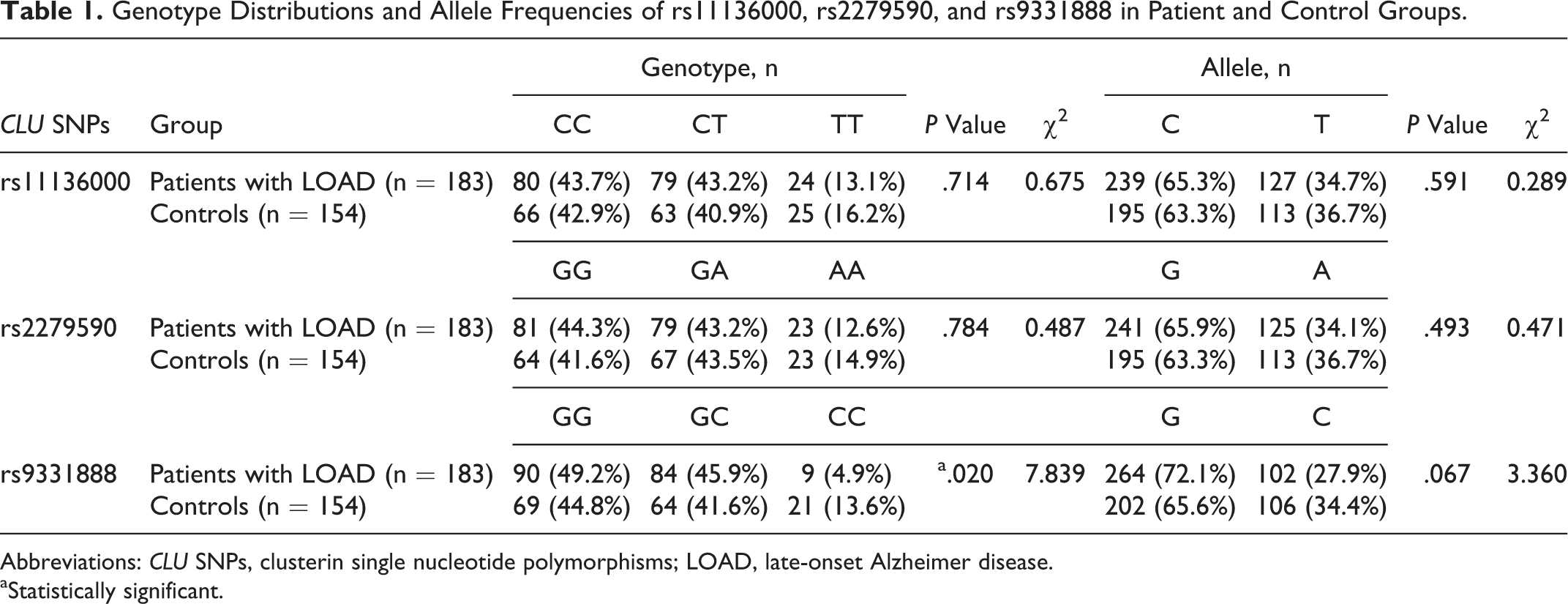
The healthy control alleles for all polymorphisms were in HWE. The genotype distributions and allele frequencies of CLU SNPs in patients and healthy controls are shown in Table 1.
Genotype Distributions and Allele Frequencies of rs11136000, rs2279590, and rs9331888 in Patient and Control Groups.
Abbreviations: CLU SNPs, clusterin single nucleotide polymorphisms; LOAD, late-onset Alzheimer disease.
aStatistically significant.
There were no significant differences in the distributions of the rs11136000 and rs2279590 genotypes between patients and controls (P = .714 and P = .784, respectively). There was no significant difference in the frequencies of rs11136000 and rs2279590 alleles between patients and controls (P = .591 and P = .493, respectively). The “GG” genotype of rs9331888 was significantly more frequent in patients, and the “CC” genotype was significantly more frequent in controls (P = .020). The allelic distribution of rs9331888 suggested the “G” allele was more frequent in patients and the “C” allele was more frequent in controls. However, the distribution was nearly significant (P = .067).
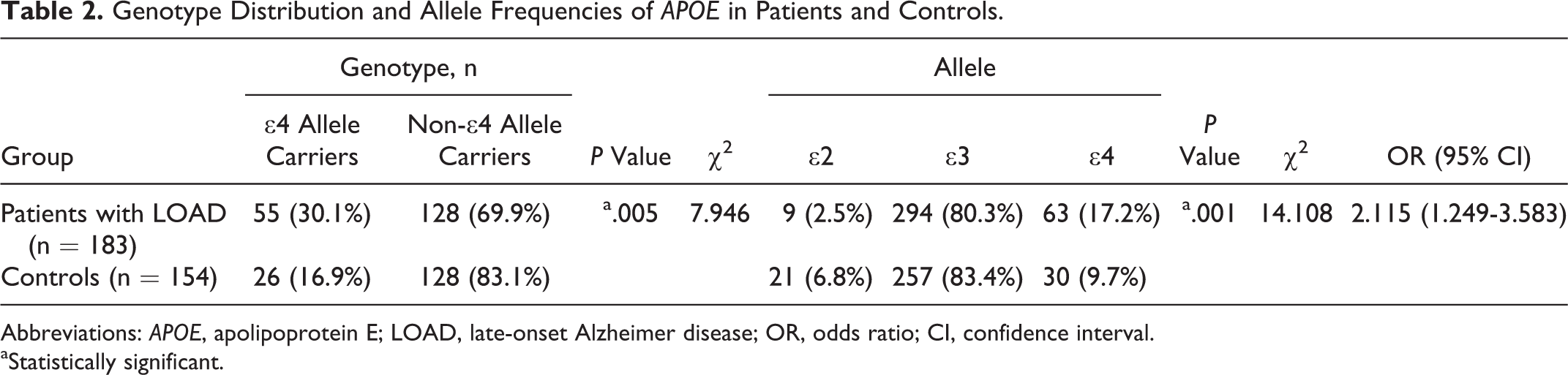
The distribution of APOE genotypes was evaluated based on the presence of at least 1 copy of the ∊4 allele in carriers. The results showed the ∊4 allele carriers were more frequent in the patient group, and the noncarriers were more frequent in the control group (P = .005). The allelic distribution of APOE indicated the ∊2 allele in controls and ∊4 allele in patients were significantly higher (P = .001). Additionally, the ∊4 allele increased risk by 2.1-fold (odds ratio = 2.115; 95% confidence interval = 1.249-3.583). The genotype distributions and allele frequencies of APOE in the patient and control groups are shown in Table 2.
Genotype Distribution and Allele Frequencies of APOE in Patients and Controls.
Abbreviations: APOE, apolipoprotein E; LOAD, late-onset Alzheimer disease; OR, odds ratio; CI, confidence interval.
aStatistically significant.
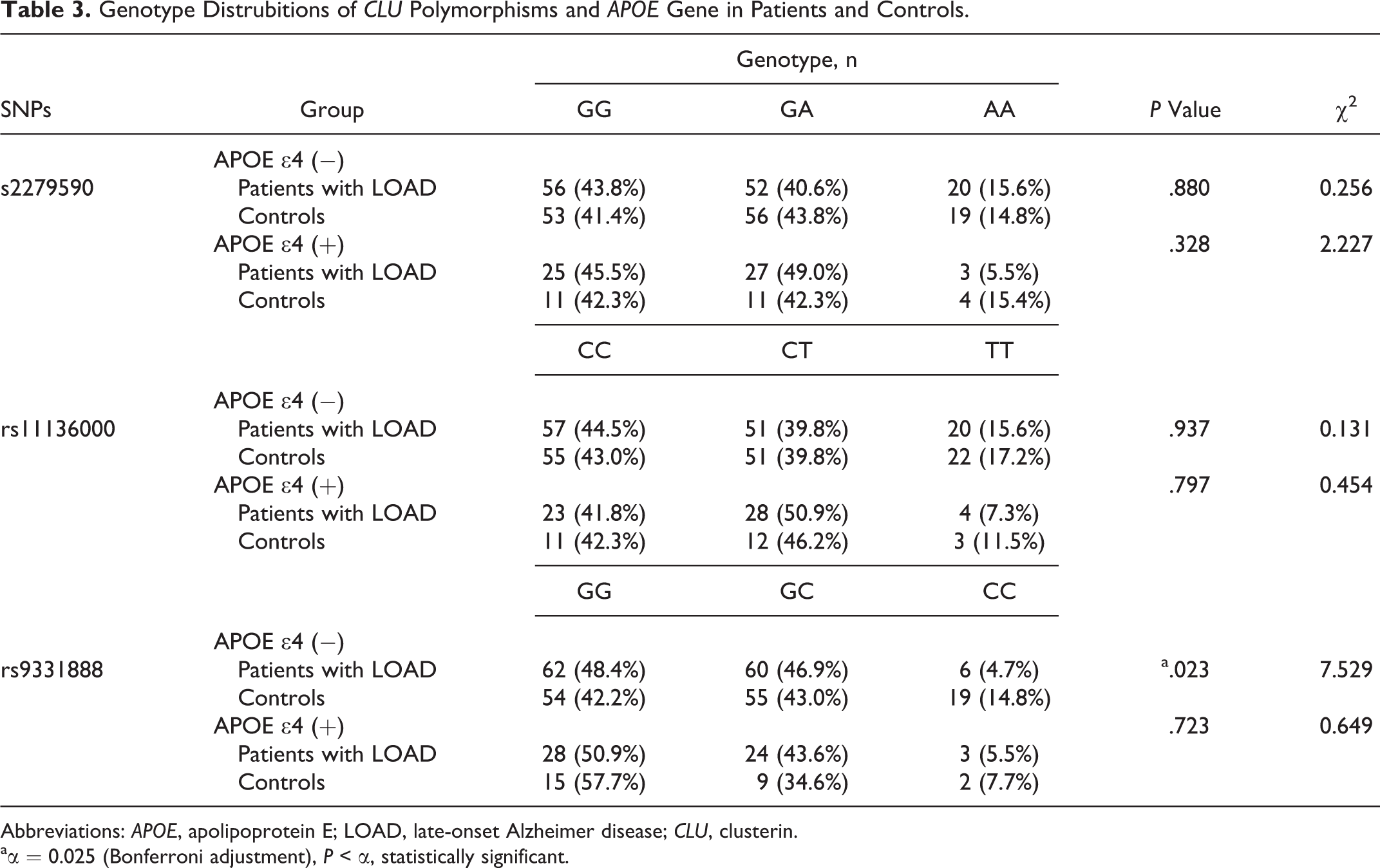
We also examined the possible association between CLU and APOE by comparing the genotypes of CLU SNPs with respect to the presence of the APOE ∊4 allele. The results showed the rs933188 genotype distributions were associated with the APOE ∊4 allele. Furthermore, the GG genotype was more frequent in patients who are non-∊4 allele carriers. The CC genotype was more frequent in the controls who are non-∊4 allele carriers (P = .023). There was no difference in the rs9331888 genotype distribution of ∊4 allele carriers between controls and patients with AD (P = .723). The polymorphism distributions for the CLU and APOE genes in patients and controls are reported in Table 3. Retrospective power analysis indicated the power of study to be 64%.
Genotype Distrubitions of CLU Polymorphisms and APOE Gene in Patients and Controls.
Abbreviations: APOE, apolipoprotein E; LOAD, late-onset Alzheimer disease; CLU, clusterin.
aα = 0.025 (Bonferroni adjustment), P < α, statistically significant.
Haplotype Data
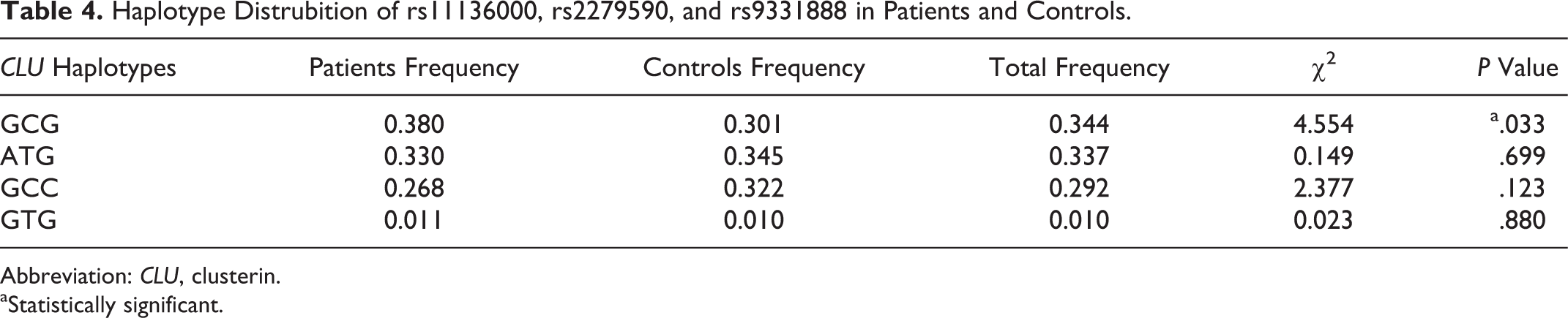
The patient and control groups were compared for the CLU haplotypes. The results showed GCG haplotype was significantly more frequent in the patients (P = .033; Table 4). Three SNPs of CLU showed strong pattern of linkage disequilibrium (LD). The LD between the 3 SNPs is shown in Figure 1.
Haplotype Distrubition of rs11136000, rs2279590, and rs9331888 in Patients and Controls.
Abbreviation: CLU, clusterin.
aStatistically significant.
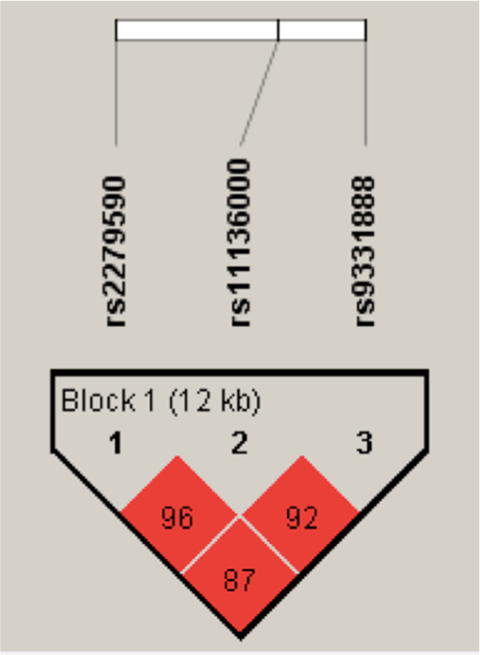
Pairwise linkage disequilibrium (LD) plot for examined clusterin single-nucleotide polymorphisms (CLU SNPs). The chromosome positions of each SNP taken as reference. Chromosome position of rs2279590 is 27456253, rs11136000 is 27464519, and rs9331888 is 27468862. The figure was created by Haploview 4.2 software.
Discussion
The CLU gene is located on human chromosome 8p21-p12. It is organized into 9 exons and encodes a protein called clusterin, which is also known as ApoJ. 20 CLU has been implicated in various biological processes including apoptosis, lipid transportation, complement regulation, DNA repair, and the clearance of cellular debris. 21 CLU has several properties associated with the pathology of AD. The protein binds to Aβ peptides and fibrils to prevent aggregation. The protein is also involved in Aβ clearance via binding to megalin receptors and increasing endocytosis by glial cells. CLU also functions as a complement inhibitor and can suppress the neuroinflammation found in AD. 22
Two large-scale GWAS identified 3 SNPs of the CLU gene that were associated with AD risk. The study by Lambert et al found the rs2279590, rs11136000, and rs9331888 polymorphisms of CLU had a strong association with AD. 13 In the same year, the study by Harold et al indicated that rs11136000 is significantly associated with AD. 14 Another GWAS by Seshadri et al replicated the association between rs11136000 and AD. 23 The CLU polymorphisms were tested in several populations. However, the association between CLU polymorphisms and AD is still controversial due to the conflicting results.
The association between rs11136000 and rs2279590 SNPs with late-onset AD was confirmed in several cohorts. 19,24 –26 However, several studies failed to show this association. 15,18,27 –29 In our study, there were no significant differences in genotype and allele distributions between patients and controls for rs11136000 and rs2279590. We observed there was a significant association between rs9331888 and LOAD. Additionally, we found the frequency of the GG genotype was significantly higher in patients. The CC genotype was significantly higher in controls. These results were consistent with the study by Yu et al. 15 Our results indicated the GG genotype of rs9331888 might increase the tendency of developing AD. However, the CC genotype might have a protective effect on AD. We also identified the GCG haplotype as a risk haplotype. Although our analysis indicate a haplotype block for CLU SNPs, the association of the disease was observed with only rs9331888 genotypes. The individuals with the same genotypes could generate different haplotypes depending on the heterozygosity. Given that the situation might arise due to heterozygosity in 2 or 3 loci of CLU SNPs in an individual (corresponding to 40% of controls and 43% of patients in our sample).
The comparison of rs9331888 in the patient and control groups with respect to the APOE ∊4 allele indicated that the GG genotype increases the risk of AD in non-∊4 allele carrier patients and the CC genotype protects against AD in non-∊4 allele carrier controls.
There are 3 transcriptional isoforms of the human CLU gene termed isoform 1, isoform 2, and isoform 3 (GenBank accession numbers NM_001831.2, NM_203339.1, and NM_001171138.1, respectively) according to GenBank. 30 Szymanski et al indicated that rs9331888 is located in exon 1 of isoform 2 and suggested this variant is directly responsible for transcript regulation by alternative splicing. The authors also showed the G allele of rs9331888 increased the levels of transcript isoform 2 (NM_203339). This finding suggests the related SNP might disrupt the balance of CLU transcripts. 31 The study by Xing et al showed clusterin mRNA and plasma clusterin levels were elevated in patients with AD. The result suggests the G allele of rs9331888 is correlated with low levels of clusterin mRNA and plasma clusterin in an allele dose-dependent manner in both the control and the patient groups. The authors also observed that higher plasma clusterin levels and clusterin mRNA levels were correlated with lower MMSE, which indicated that higher clusterin levels are associated with more severe disease. 32
Although the genetic studies indicate there is an association between the variants of CLU and LOAD, it is not clear how CLU variants affect AD development. Our results showed CLU variant rs9331888 may a have genetic association with AD risk. The association between APOE and the rs9331888 SNP in CLU indicates that CLU might have a role in development of AD independent of APOE. It is important to note that further investigations in different populations are necessary to define the potential effect of CLU on AD pathogenesis.
Footnotes
Declaration of Conflicting Interests
The author(s) declared no potential conflicts of interest with respect to the research, authorship, and/or publication of this article.
Funding
The author(s) disclosed receipt of the following financial support for the research, authorship, and/or publication of this article: This study was supported by The Research Fund of Istanbul University, Project number: 32402.