







Abstract
Objectives:
Theory of Mind (ToM), the ability to understand other people’s mental states, is essential in everyday social interactions. The relationship between cognitive domains and ToM impairment in Parkinson disease (PD) has been receiving growing attention with ambiguous findings. The objective of the current study was to ascertain which cognitive domain predicts understanding of intentions and the impact of PD-specific clinical measures on ToM performance. A secondary aim was to evaluate whether cognitive impairment mediates the relationship between severity of illness and ToM impairment.
Methods:
Fifty-one nondemented patients with idiopathic PD, ranging from early to advanced stages, were enrolled. A comprehensive neurocognitive battery and 2 ToM tasks (Hinting Task and Comic Strip Task) were administered during the patients’ best “on” medication state.
Results:
Only the task of measuring working memory capacity was significantly associated with both ToM tasks (Hinting Task Spearman rank correlation [rs] = 0.309, P ≤ .05; Comic Strip Task rs = 0.595, P ≤ .01). Patients with more progressed disease and higher doses of dopaminergic medication performed significantly worse in the Comic Strip Task. Based on the mediation analysis, relationship between the severity of the illness and understanding of intentions was mediated by cognitive flexibility.
Conclusion:
In PD, understanding of intentions is related to neurocognition, with working memory and cognitive flexibility playing a crucial role. The severity of PD predicts ToM performance.
Introduction
Parkinson disease (PD) is the second most common age-related neurodegenerative disease after Alzheimer disease. It is typically characterized by its motor features, but distinct nonmotor features are also an important part of its clinical manifestation. Cognitive deficit appears to be one of the most prevalent nonmotor symptoms 1 and is subcortical in its nature. Impairment in a single domain is more common than impairment in multiple domains, and within a single domain, nonamnestic impairment is more common than isolated amnestic deficits. 2 In the case of nonamnestic single-domain impairment, we observe mostly a high proportion of visuospatial and executive deficits, which are reflected in problem-solving and working memory tasks. Attentional executive dysfunction is common in most patients with PD with mild cognitive impairment (MCI), and up to half of these patients may also experience visuospatial and free-recall memory problems, while memory/learning and language remain relatively unaffected. 3
Another important part of cognitive processes that have been extensively studied is social cognition. Successful social interactions are dependent on quick and accurate inferences about the mental states of social partners. 4 Understanding other people’s intention and beliefs, referred to as Theory of Mind (ToM), 5,6 is considered as one of the core aspects of social cognition. Deficits in social cognition are typical for neurodevelopmental disorders such as autism, but are also considered as a symptom of severe psychiatric disorders such as schizophrenia. 7 The importance of social cognition has been highlighted in recent studies supporting its important role in everyday social functioning. 8 The current neurobiological models of ToM distinguish the cognitive and affective components. 9 The cognitive component is responsible for the representation of beliefs and desires. The affective component serves for understanding others’ emotional states. Theory of Mind is mediated by large neural networks, including the ventromedial prefrontal cortex, sulcus temporalis superior, temporo-parietal junction, temporal pole, and amygdala. 9,10 In patients with PD, both components (cognitive and affective) seem to be impaired, 11 although the cognitive component of ToM seems to be more compromised than the affective one. 12
There are also other conceptualisztions of social cognition that are based on the distinction between automatic versus effortful processing of social stimuli. The first is associated with the mirror neuron system and the second is associated with the mentalizing network in the brain. 13 Typical behavioral ToM tasks can be considered as measures of mentalizing systems, thus highly dependent on intact cognitive processes.
Understanding the social intentions of other people is another important aspect of social cognition, which has received little attention in studies with patients with PD. The mirror neuron system is important for immediate and more automatic intentions, whereas the mentalizing system is involved in the decoding of long-term goals. These processes co-occur and are reweighing based on the context of intentions and the goal of the concrete social interaction. 14
Social cognition abilities are closely related to motor functions, which are a priori impaired in patients with PD. A recent review article by Eddy et al 15 highlighted 2 relevant mechanisms of this interplay. In the early stage of the disease, a “simulation route” is probably more applicable in which patients are failing to connect observed movement with emotional states via deficient self-activation of unique motor codes. In more advanced stages, the “template matching route” might be impaired, that is, patients have problems with identifying correct templates of bodily movement visual representations with appropriate internal states. However, the relationship between motor functions and social cognition remains to be elucidated further.
Performance on the cognitive ToM tasks is related to an intact function of the prefrontal cortex, and thus, frontostriatal dysfunction in PD can explain observed ToM deficits even in early stages of the disease. 16 Cognitive ToM abilities are associated with overall cognitive performance and verbal fluency irrespective of motor symptom lateralization. 17 Bodden et al, 18 on the other hand, did not find the relationship between executive dysfunction and cognitive ToM impairment. Nevertheless, there are still inconsistencies about the nature of relationships between cognitive impairment and ToM deficits in PD.
In this research, we utilized 2 tasks measuring understanding of intentions. Understanding of intention is part of the cognitive ToM. Selected tasks differ in presentation modality (visual vs verbal) and have not been used extensively in patients with PD, thus providing new insights into the nature of cognitive ToM impairment. The principal aim was to analyze which cognitive domains predict cognitive ToM in PD. We expected that severity of cognitive impairment will predict performance on ToM tasks. A secondary aim was to analyze whether motor symptom progression predicts ToM ability and if this relationship is mediated by the severity of cognitive impairment.
Materials and Methods
Sample
Fifty-one patients with idiopathic PD based on the UK Brain Bank Criteria 19 from the Outpatient Clinic of Second Department of Neurology, University Hospital Bratislava, participated in the study. Patients were on stable medication within the past month and had no comorbid disease that could interfere with task performance. All patients were examined in their best “on” state after taking their usual morning dose of antiparkinsonian medication. Four patients were “drug-naive,” that is, not taking any antiparkinsonian medication when examined. Nevertheless, the levodopa responsivity was confirmed in subsequent follow-up examinations. Levodopa equivalent daily doses (LEDDs) were estimated according to the standard protocol. 20 The motor examination part of Movement Disorder Society-Unified Parkinson Disease Rating Scale (MDS-UPDRS part III) and Hoehn and Yahr (H&Y) stages was examined by an experienced movement disorder specialist before the neuropsychological assessment. The presence or absence of dementia was established through a comprehensive clinical interview and clinical examination conducted by an experienced psychiatrist, using the standard measuring instruments for cognitive performance—the Montreal Cognitive Assessment (MoCA) and for overall everyday functioning—the Instrumental Activities of Daily Living Scale. 21 Descriptive statistics for demographic variables and clinical characteristics are presented in Table 1.
Demographic and Clinical Characteristics.
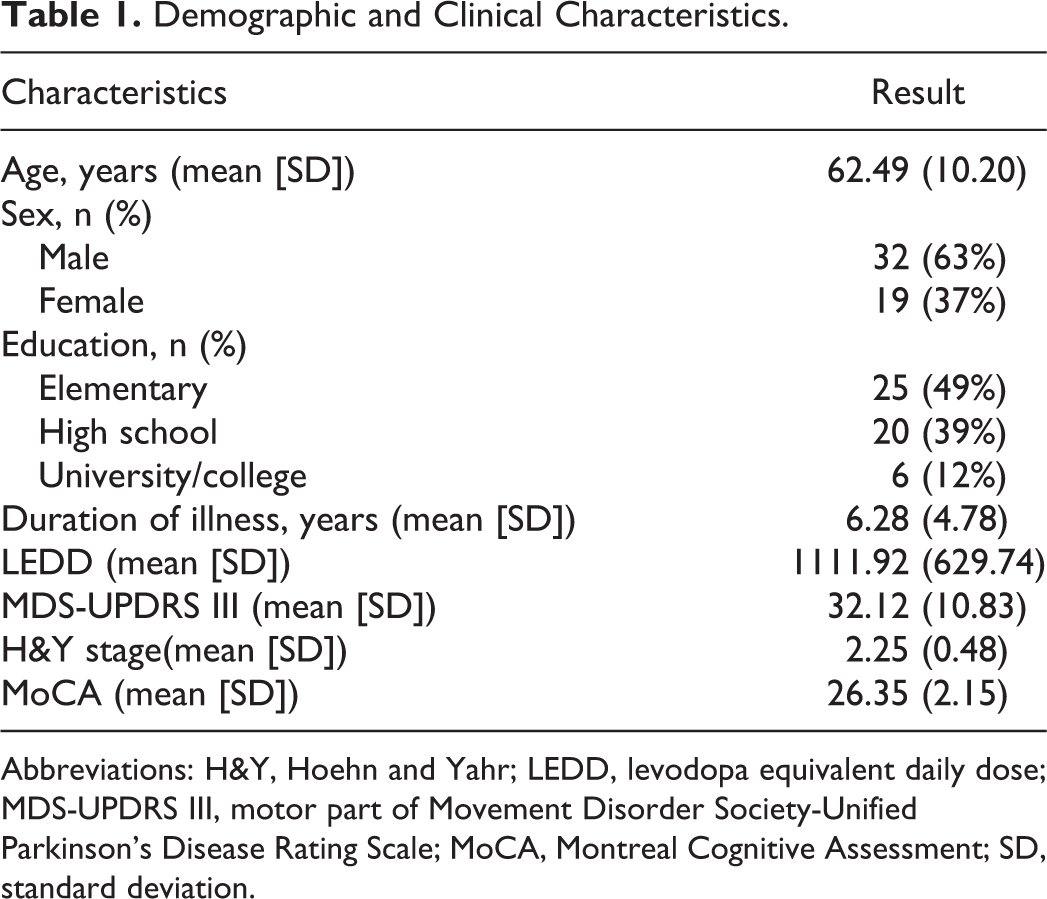
Abbreviations: H&Y, Hoehn and Yahr; LEDD, levodopa equivalent daily dose; MDS-UPDRS III, motor part of Movement Disorder Society-Unified Parkinson’s Disease Rating Scale; MoCA, Montreal Cognitive Assessment; SD, standard deviation.
Measures
Comic Strip Task
The Comic Strip Task consisted of 14 comic strips presented to the participants on A3 format sheets. 22 All participants were exposed to the strips in the same order. Each comic represents a short story comprising 3 pictures. The participants have to choose the correct picture among the 3 which is a logical end of the story (for illustration, see Figure 1). For a correct answer, it is necessary to infer the actor’s intentions. The total number of points ranges from 0 to 14. A higher score indicates better performance.
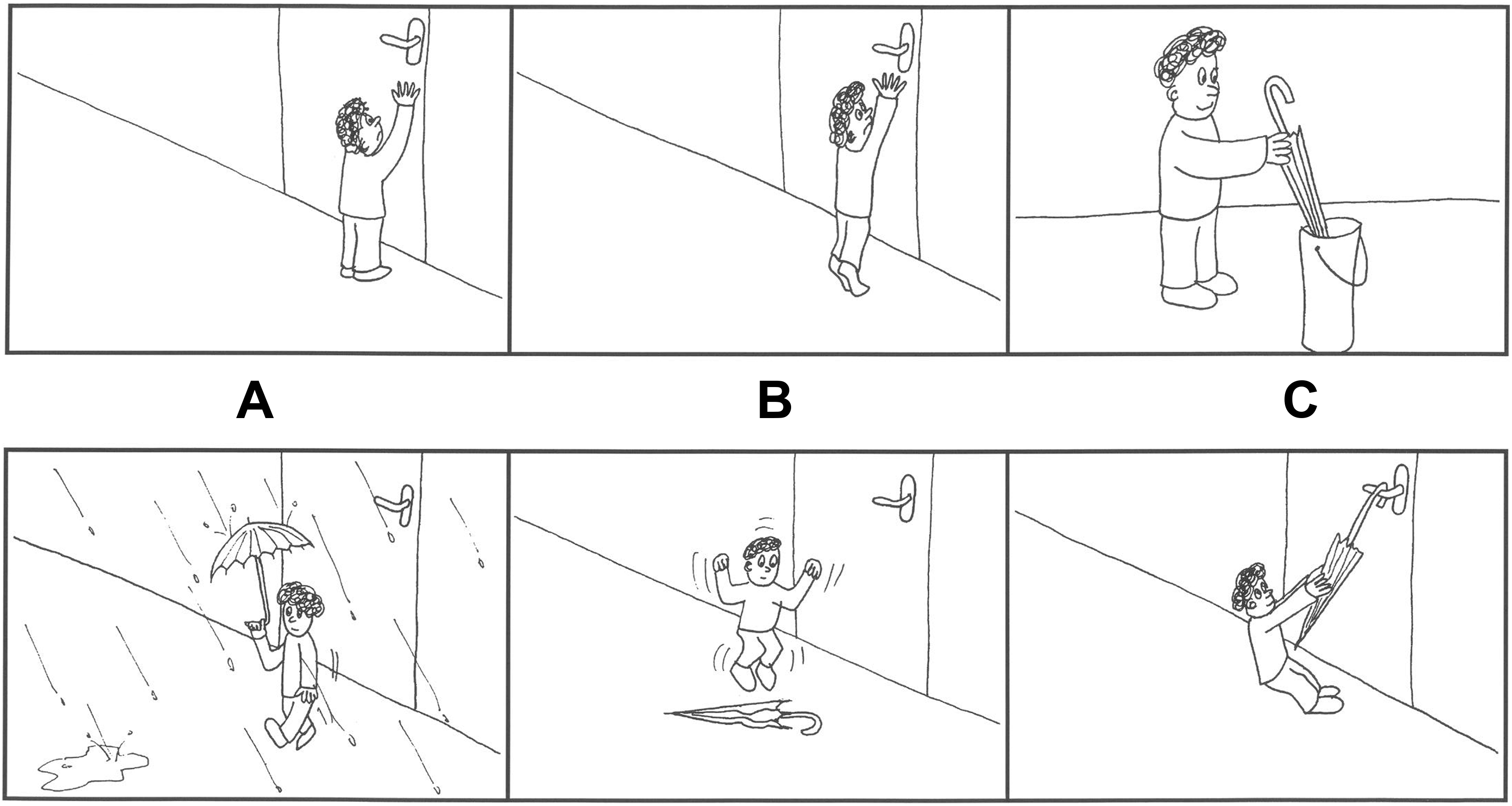
Example of Comic Strip Task (Brunet et al, 2000). The top 3 pictures represent the story and the bottom 3 pictures are the proposed answers. The correct answer is the picture on the right.
Hinting Task
The Hinting Task consisted of 10 short vignettes which were read to the participant followed by questions about the intentions of the actor. 23 For example, Paul has to go to an interview and he is running late. While he is cleaning his shoes, he says to his wife, Jane: I want to wear that blue shirt, but it is very creased. If needed, vignettes were read 2 times. The aim of the task is to infer the indirect meaning behind utterances. Each correct answer is awarded 2 points. After a literal or “don’t know” answer, a hint (Paul goes on to say: It’s in the ironing basket.) is provided to the participant and then 1 point is awarded for a correct answer. The total number of points ranges from 0 to 20. This task was successfully used in patients with schizophrenia and has been selected as part of a specialized battery for social cognition assessment. 24 A higher score indicates better performance. The Hinting Task was selected due to sound psychometric properties and associations with functional outcome in patients with schizophrenia. 25 In contrast with the Comic Strip Task, it assesses a different aspect of understanding of intentions. Hinting Task evaluates a pragmatic aspect of language and Comic Strip measures understanding of intentions in planned action.
Neurocognitive battery
The neurocognitive battery consisted of several standardized neuropsychological tests covering a broad range of cognitive functions. Verbal learning and verbal memory were assessed using the Rey Auditory Verbal Learning Test (AVLT). 26 Visual memory was assessed using delayed recall of the Rey Complex Figure. 27 Visuospatial abilities were evaluated using a copy of the Rey Complex Figure. Processing speed was assessed using the Trail Making Test part A (TMT-A) and the Stroop-Color. 28 Letter-Number Sequencing 29 was used for the assessment of verbal working memory capacity. Cognitive flexibility was evaluated using the Trail Making Test part B (TMT-B). 30 Inhibition and sensitivity to interference were assessed using the Stroop Test-Color Words. Executive and linguistic abilities were assessed using phonemic (K, N, and P) and semantic (Animals) fluency tasks. 26 All tasks were administered in the paper-pencil format.
Missing Data
Descriptive statistics and correlation coefficients were calculated using different sample sizes because of missing data from some patients: Stroop (n = 1), Trail Making Test (n = 1), Rey Complex Figure (n = 3), Letter-Number Sequencing (n = 1), Hinting Task (n = 1), and Comic Strip Task (n = 5). The reasons for missing data were usually visuospatial difficulties and thus patients were not able to solve tasks with strong visual demands.
Statistical Analyses
SPSS version 22 was used for statistical analyses. In the first phase of analysis, data were screened for normality assumption violations using the Shapiro-Wilk test. Due to violations of normality assumption, nonparametric Spearman rank correlation (rs) was used in the correlation analysis. Correlational analysis was followed by regression analysis with the aim of identification of the most important set of neurocognitive predictors of ToM. Due to the sample size and number of predictors, the StepWise method was used to find the most parsimonious and stable model. The magnitude of the indirect effect of cognitive impairment on the relationship between the severity of the illness and ToM was assessed by mediation analysis.
The significance of the indirect effect was tested using a bootstrapping method on 5000 samples. SPSS macro PROCESS 31 was used for mediation analysis.
Research Ethics
The study protocol was approved by the ethics committee of the University Hospital Bratislava. Before testing, all patients provided informed consent.
Results
Descriptive statistics for neurocognitive and ToM measures are presented in Table 2. Twenty-one patients (41.2%) had scores lower than 26 on MoCA, and based on this strict criterion they can be considered as patients with possible MCI. 32
Descriptive Statistics for ToM and Neurocognitive Tasks.
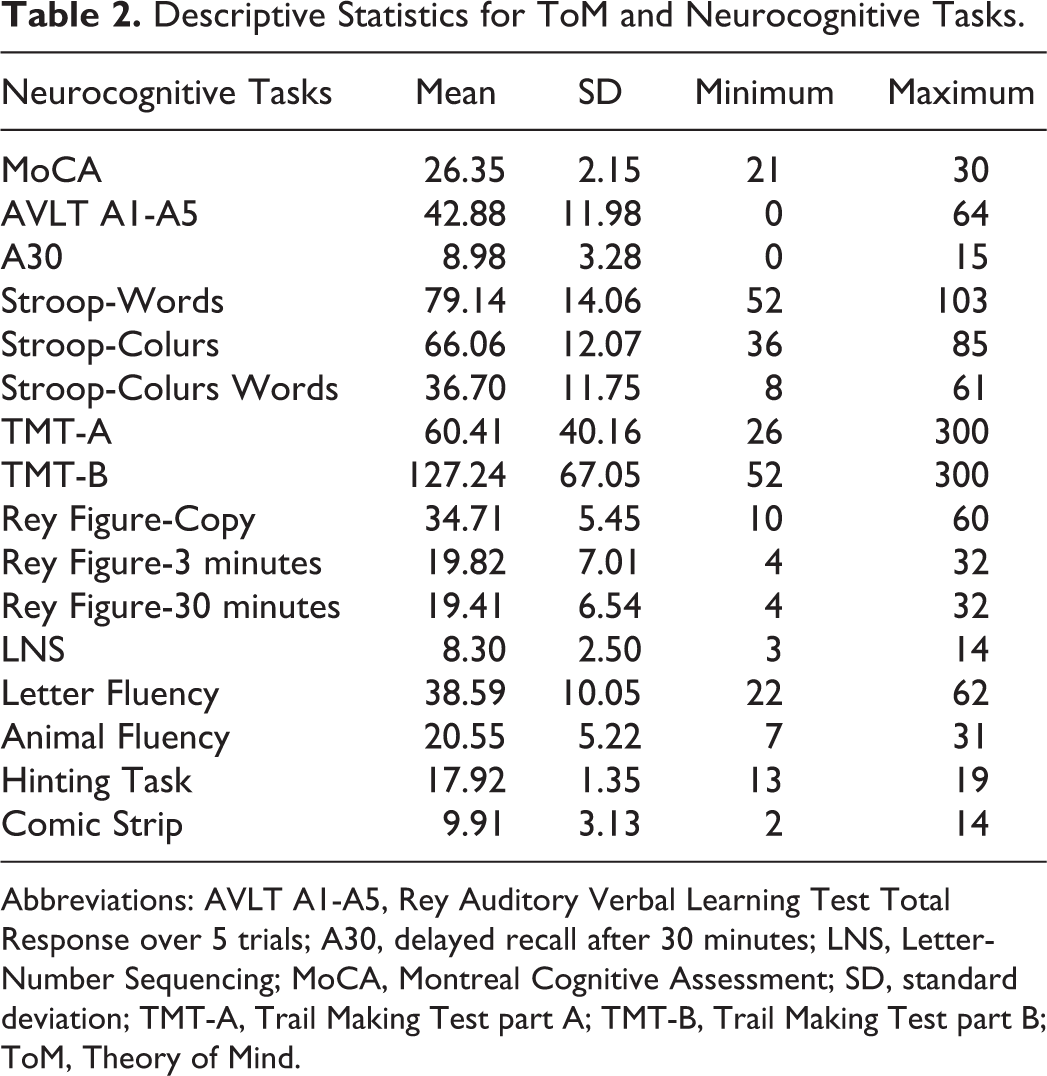
Abbreviations: AVLT A1-A5, Rey Auditory Verbal Learning Test Total Response over 5 trials; A30, delayed recall after 30 minutes; LNS, Letter-Number Sequencing; MoCA, Montreal Cognitive Assessment; SD, standard deviation; TMT-A, Trail Making Test part A; TMT-B, Trail Making Test part B; ToM, Theory of Mind.
Relationships With Clinical Variables
Duration of illness was not related to ToM task performance (Hinting Task: rs = −0.128, P = .376; Comic Strip Task: rs = −0.161, P = .285). We found no association between the Hinting Task and age (rs = −0.198, P = .167), UPDRS-III (rs = −0.140, P = .332), H&Y stage (rs = −0.015, P = .920), and LEDD (rs = 0.038, P = .794). Comic Strip was significantly associated with age (rs = −0.437, P = .002), H&Y stage (rs = −0.405, P = 0.005), UPDRS-III (rs = −0.389, P = .008), and with LEDD (rs = −0.291, P = .05).
Relationships With Neurocognition
The correlation between the Hinting Task and Comic Strip was not significant (rs = 0.135, P = .373). Both ToM tasks were significantly associated with the total MoCA score (Hinting Task: rs = 0.347, P = .014; Comic Strip: rs = 0.428, P = .003). The Hinting Task was moderately associated only with Letter-Number Sequencing (rs = 0.309, P = .029). The Comic Strip Task was moderately to strongly associated with all parts of the neurocognitive battery (rs ranged from −0.379 to 0.595, Ps < .01). All correlation coefficients are presented in Table 3.
Correlation Matrix Between ToM Tasks and Neurocognitive Measures.
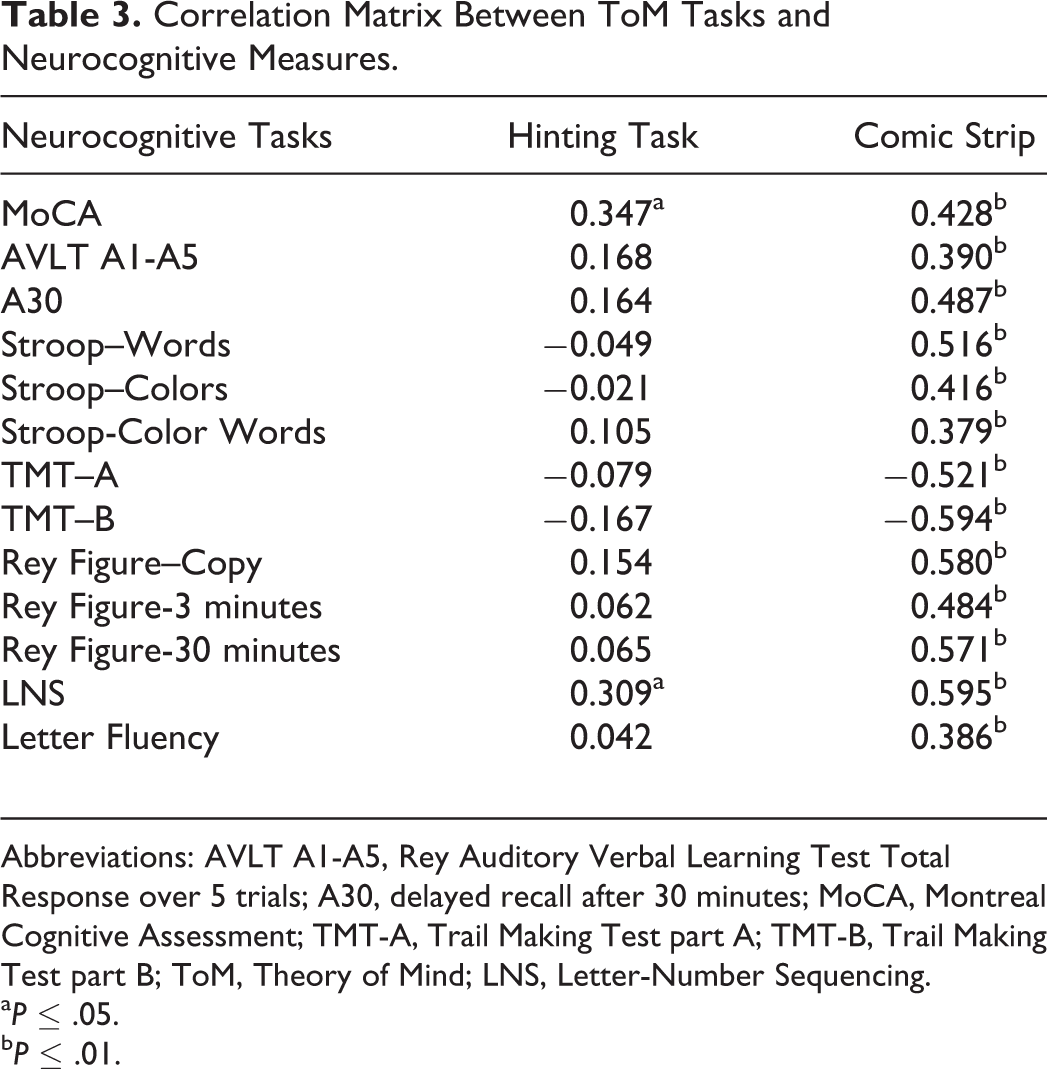
Abbreviations: AVLT A1-A5, Rey Auditory Verbal Learning Test Total Response over 5 trials; A30, delayed recall after 30 minutes; MoCA, Montreal Cognitive Assessment; TMT-A, Trail Making Test part A; TMT-B, Trail Making Test part B; ToM, Theory of Mind; LNS, Letter-Number Sequencing.
aP ≤ .05.
bP ≤ .01.
We utilized 2 regression models with those predictor variables that were significant at P < .05 in bivariate analysis. We decided not to include MoCA because it measures general cognitive ability. Only predictor of the Hinting Task was LNS (β = .345, P = .014) and it explained 12% variability of scores, F(1, 48) = 6.486, P = .014, adj-R 2 = 0.101. In the model with Comic Strip as dependent variable, StepWise procedure identified TMT-B (β = −.407, P = .005) and LNS (β = .339, P = .017) as significant predictors explaining 42.3% of variability, F(1, 42) = 15.379, P < .001, adj-R2 = 0.395.
Mediation Analysis
Based on the correlation analysis, we identified TMT-B as the only potential mediator of the relationship between the H&Y stage and the Comic Strip score. The indirect effect of executive functions on the relationship between the H&Y stage and the Comic Strip score was tested using a bootstrapping procedure on 5000 samples using SPSS Macro PROCESS. 31 The completely standardized indirect effect 33 was used as a measure of effect size (ES). Bootstrapping was used owing to recent evidence favoring this approach for mediation analysis. 34 The Comic Strip score was the dependent variable in the model. The H&Y stage was the independent variable and the time to complete TMT-B was included in the model as a mediator (see Figure 2).
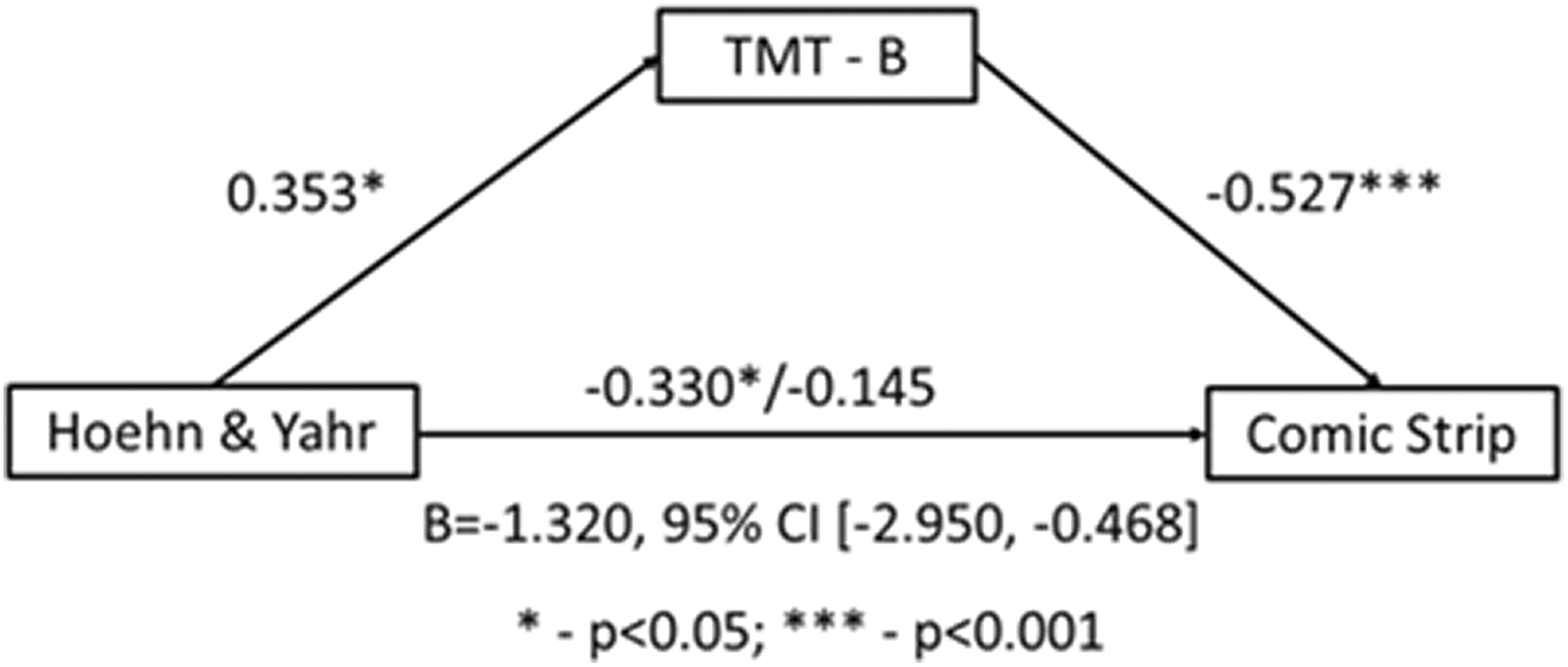
Scheme of mediation between Hoehn and Yahr stage, Trail Making Test part B (TMT-B), and the Comic Strip Task.
Owing to missing data on Comic Strip or TMT, the mediation model was tested on the sample of 45 patients. The results showed that the H&Y stage was a significant predictor of TMT-B results (β = .353, P = .013) and that the TMT-B significantly predicted performance in the Comic Strip (β = −.527, P ≤ .01). The H&Y stage was a significant predictor of the Comic Strip score (β = −.330, P = .025), but not after controlling for the mediator (TMT-B; β = −.145, P = .283). The significance of the indirect effect was tested using a bootstrapping method on 5000 samples. These results indicated a significant indirect effect (B = −1.320, 95% confidence interval, −2.950 to −0.468). The standardized indirect effect was ES = −0.198, 95% confidence interval −0.400 to −0.071.
Discussion
Our study provided further evidence that understanding of intentions (cognitive ToM) in PD is dependent on intact neurocognitive functions. Working memory and cognitive flexibility were the strongest predictors associated with cognitive ToM deficit. We found that understanding of indirect utterances from speech (Hinting Task) was less dependent on intact neurocognitive abilities than the task involving ordering of picture stories (Comic Strip).
Letter-Number Sequencing, a measure of verbal working memory, was uniquely associated with performance in both ToM tests. Working memory is crucial for temporary handling of information and the elaboration of cognitive strategies 35 that are of great importance in the cognitive processes of day-to-day life. Previous research has shown that working memory is affected in PD 36 and that working memory performance is related to ToM impairment. 37 Working memory also seems to be significantly influenced by dopaminergic pathways in PD, whereas levodopa ameliorates the deficit. 38 We would expect visuospatial skills to be important only in affective ToM (to recognize emotional expressions and configural processing of faces), 39 but interestingly, our results also showed the involvement of mentalizing in the cognitive aspect. This could be explained by the importance of visuospatial skills for analysis of stimuli in the Comic Strip Task. Nevertheless, Diez-Cirarda and colleagues 40 suggested that impaired ToM in PD cannot be understood as a mere consequence of cognitive dysfunction. Based on different neural correlates of ToM and cognitive functions, they propose cognition as a possible confounding factor of ToM. To test this hypothesis, patients with PD and healthy controls matched for neurocognitive performance are needed. If these groups differ, this could be considered as evidence of impairment in ToM per se, not a consequence of the cognitive decline in various neurocognitive domains.
It has been repeatedly shown that language functions in patients with PD are compromised even in patients without major cognitive impairment. 41 Patients with PD have problems with comprehension of syntactically complex sentences. 42 Therefore, we must also consider that these deficits in receptive language functions could influence how patients with PD interpret the test instructions and how they respond to the Hinting Task.
Our data have shown that the deficit in the Comic Strip Task is associated with disease severity and higher motor scores based on the motor part of MDS-UPDRS. This finding further supports the link between motor functions and ToM performance, with special focus on the understanding of intentions. Disease severity and motor impairment can influence ToM performance “directly” because of the more progressed neurodegeneration of strategic cognitive ToM structures, especially dorsal striatum and the projections to the mirror neuron system. It has been postulated that the mirror movement circuitries receive important input from the basal ganglia 43,44 ; thus, considering PD as a basal ganglia disorder, it can be an important neuroanatomical correlate of impaired ToM abilities. Future studies should also analyze differences in processing intentions and beliefs in PD. The mirror neuron system is probably used for understanding intentions based on actions, but beliefs are more abstract, therefore, probably mediated by other neuroanatomical structures. 45 There is also a possible “indirect” impact of motor symptom severity that can interfere with performance in ToM tasks, for example, patients with more rigidity and bradykinesia can be significantly slower in showing the correct response. The Comic Strip Task was also correlated with higher doses of dopaminergic treatment. Patients with more severe disease are on higher doses of dopamine replacement therapy, which could explain the worsening of ToM performance in patients with a higher LEDD. It is very likely that dopamine plays a pivotal role in ToM performance, which is illustrated by sociocognitive deficits in other disorders connected with dopamine dysfunction such as schizophrenia, Tourette syndrome, and Huntington disease. 15,45 Nevertheless, there is still a controversial effect of dopaminergic treatment on cognition that must be taken into consideration. On one hand, levodopa treatment has a beneficial effect on executive functions, including attention, set-shifting, working memory, and planning, 46 -48 but on the other hand, excessive dopamine doses have a harmful effect on reward-based control of behavior tasks such as decision-making under ambiguity 49 which is an integral part of the Comic Strip Task.
As shown in our mediation analysis, the relationship between the severity of illness and ToM is mediated by TMT-B. Trail Making Test is a complex task reflecting a comprehensive variety of cognitive processes, including attention, working memory, visual scanning, sequencing and shifting, cognitive flexibility, and motor speed. If a more advanced disease has a negative impact on ToM performance, it is also going to have a similar effect on TMT-B performance, resulting in cognitive inflexibility, which subsequently also impairs ToM ability. Our results support the idea that impairment in ToM represents a consequence of cognitive decline measured by TMT more than overall severity of motor symptoms as shown in previous research. 50 In longitudinal studies assessing the individual domain-specific cognitive, decline in the course of PD memory and especially visuospatial abilities significantly worsen over time. 51 We assume that the deficit of visual scanning is playing a preponderant role in the mediation between ToM ability (in Comic Strip) and disease severity, which is also supported with a strong correlation between Comic Strip and Rey Figure performance.
We did not find associations between our ToM tasks. Hinting Task evaluates a pragmatic aspect of the language (understanding intention from indirect speech) and Comic Strip measures understanding of intentions in planned action. We think that one reason for the absence of relationships can be low variability in the Hinting Task in PD. Comic Strip performance was strongly related to neurocognitive measures, and it seems that is more sensitive to ToM impairment in PD.
The main limitation of this study is the absence of a control group. We were not able to evaluate the severity of ToM impairment in our sample and normative data from representative samples for both used tasks are not available. The healthy control group is necessary for testing whether ToM deficits are present even after controlling for cognitive impairment. Control group would enable to test whether ToM performance is similarly related to cognitive functions in PD and healthy population. A second limitation is the absence of a larger ToM battery that would enable us to evaluate both cognitive and affective ToM impairment. The absence of significant relationships of the Hinting Task to some executive function measures could be partially explained by the small sample size and therefore a lack of statistical power and lower variability in scores. The results could also be potentially skewed owing to the non-normal distribution of patients toward more advanced stages with regard to disease severity. Another possible explanation can be that the Hinting Task is more strongly related to intact language processes in PD.
Some of our patients had visuospatial difficulties that could influence the performance on Comic Strip Task because they were not able to process visual stimuli correctly. On the other hand, visuospatial deficits are common in PD-MCI and thus can be considered as a clinical manifestation of disease. 3
Theory of Mind and emotion recognition are the most studied aspects of social cognition. Future studies in PD should utilize a variety of sociocognitive tasks that measure processes such as social judgments, social perception, and sociocognitive biases.
We found that understanding of intentions in PD is associated with the severity of neurocognitive impairment. The severity of illness also predicted performance in ToM tasks. The results of our study revealed that this relationship is mediated by impairment in cognitive flexibility. The field of social cognition in PD needs to be investigated further because it significantly impacts the social functioning and quality of life of patients and, especially, their caregivers. 52
Footnotes
Acknowledgments
We would like to thank our patients for their participation in this study.
Authorship
Zuzana Kosutzka, MD, PhD, and Maria Kralova, MD, PhD, share first authorship.
Declaration of Conflicting Interests
The author(s) declared no potential conflicts of interest with respect to the research, authorship, and/or publication of this article.
Funding
The author(s) received no financial support for the research, authorship, and/or publication of this article: This study was supported by the Slovak Research and Development Agency (APVV 15-0155) and by the Comenius University Grant for Young Researchers (UK/283/2017).
