






Abstract
Background:
It is well known that age-related hearing loss (ARHL) is strongly associated with dementia. Different hypotheses have been considered to explain this link, including sensorial deprivation, the reduction in cognitive reserve, and the presence of shared pathological pathways (microvascular damage of the brain).
Aims:
We carried out a study of the audiological and neuropsychological characteristics of a sample of hearing impaired but cognitively healthy individuals (HIH). The aim of our study was to carefully outline the neuropsychological profile of the patients in order to verify whether hearing loss correlated with deficits in specific cognitive domains.
Results:
Episodic memory is affected by the presence of hearing loss, while semantic competences, syntactic, and grammar skills seem not to be affected. Furthermore, some audiological features linked to the intelligibility of spoken words can predict the presence of executive dysfunction; the same does not apply to memory impairment.
Conclusion:
In HIH, executive functions are widely employed in maintaining an acceptable level of comprehension of spoken language; consequently, other cognitive domains and instrumental abilities in HIH are not properly supported. Thus, it is arguable that programs of hearing rehabilitation for HIH could restore the allocation of attentional resources to the functioning of other cognitive domains.
Keywords
Introduction
In recent decades, increased life expectancy and the general aging of the world’s population has led to a growing interest in aging-related diseases. The annual incidence of Alzheimer disease (AD) is 1% in individuals aged between 60 and 70 years, compared to 16% to 18% of individuals aged ≥85 years, 1 and this represents a public health priority. 2 At present, no pharmacological treatments are available to prevent the onset of AD, but clinical research is focused on identifying and preventing some of the risk factors. Unfortunately, the most important risk factors for AD—such as age, family history, and heredity—are not treatable, but others—such as diet, physical exercise, lifestyle, and some age-related conditions linked to late-life cognitive decline—are considered modifiable. 3 One of the potentially modifiable risk factors for cognitive decline in the elderly individuals is sensorial deprivation, specifically age-related hearing loss (ARHL). 4
Age-related hearing loss (also known as presbycusis) is the most common hearing disorder and a major cause of chronic disability in older age. 4 Hearing loss affects approximately one-third of adults aged between 61 and 70 years and more than 80% of those older than 85 years. 5 Age-related hearing loss can cause difficulty in speech comprehension thereby compromising communication. 6 Hearing impairment can have psychological, physical, and social consequences. 6,7 In the early stages, ARHL typically affects the audibility of higher frequencies (6000-8000 Hz) and interferes with normal speech comprehension in both quiet and noisy conditions. 6
The first report about the connection between ARHL and dementia dates back to 1964. 8 In recent years, case–control, 8 -15 cross-sectional, 9 -15,16 -21 and longitudinal population-based studies, 22,23,24 -30 carried out globally, have confirmed that auditory dysfunction is associated with impairment in various cognitive domains, accelerated cognitive decline, incipient cognitive impairment, and dementia. Most studies showed a connection between peripheral ARHL and cognitive decline.
The aim of this work was to study the pattern of cognitive decline in a sample of patients affected by ARHL, believed to be representative of a much larger population. In particular, we wished to focus on the neuropsychological characteristics of a sample of cognitively healthy individuals affected by ARHL. We aimed to identify which components of the audiological deficit correlate more with cognitive deficit.
Specifically, the study was aimed at investigating (1) the differences between the neuropsychological profile of these individuals and that of an age-matched normoacoustic control group. (2) The analysis of the linguistic profile of patients with hearing impairment, in order to verify how hearing loss affects verbal communication. When the semantic and lexical system works well, spoken words are more easily recognized within a meaningful context, rather than when they are spoken separately, out of context. Our linguistic battery can detect if verbal comprehension is affected at sublexical, lexical, or semantic level. (3) How, in a sample of patients affected by mild to moderate hearing loss, neuropsychological, linguistic, and audiological impairments are linked.
Methods
Patients
The sample comprised 42 treatment-naive patients who were older than 60 years and had self-referred to the Audiology Service of the Institute of Otolaryngology between September 2014 and September 2016 for subjective auditory impairment. The patients selected to be included in the study had no prior neurological diseases based on anamnestic interview and neurological examination. They also had no prior ear diseases (such as, chronic otitis, cholesteatoma, or conductive hearing loss), no psychiatric illnesses, no history of alcohol or substance abuse, and no previous head trauma. They all had an education level of ≥8 years, and they all presented mild, moderate postlingual sensorineural hearing loss. After an initial audiological visit, all the sample patients underwent further examination; none of them had ever used hearing aids before enrolling in the study.
Exclusion criteria included the presence of subjective cognitive decline (according to Jessen Criteria) 31 or memory disorders already under investigation and even the awareness of any form of age-related cognitive decline at the time of enrollment.
We further enrolled an age-matched control group of 40 healthy controls (HCs) who were not cognitively impaired (Mini-Mental State Examination [MMSE] 32 > 24/30) and who had not reported any difficulty in speech comprehension and communication.
All participants completed both the audiological and the neuropsychological evaluations described subsequently. The study was approved by the Ethical Committee of the Catholic University, and all patients gave their written informed consent to participate in the study.
The 3 groups did not differ in their level of education. The median age of patients affected by moderate hearing loss (MHL) was overall found to be slightly but not significantly higher. Upon general evaluation, as expected, patients with MHL were found to be more impaired in the pure tone audiometry and showed significantly poorer performance in the MMSE than the HCs but were not significantly different from patients with mild hearing loss (mHL; Table 1).
Demographic Characteristics Among the 3 Groups of ARHL and Normal Acoustic Subjects.
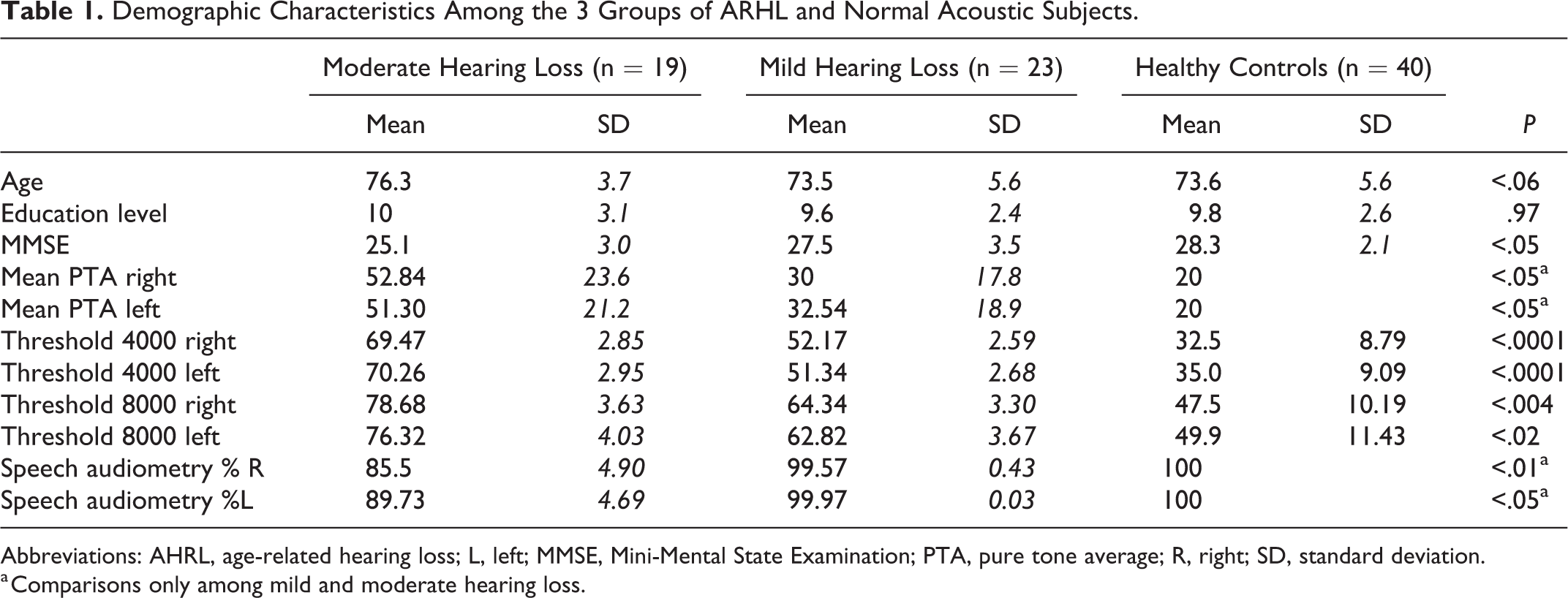
Abbreviations: AHRL, age-related hearing loss; L, left; MMSE, Mini-Mental State Examination; PTA, pure tone average; R, right; SD, standard deviation.
a Comparisons only among mild and moderate hearing loss.
Audiological Evaluation
Pure tone audiometry
All participants underwent pure tone audiometry following standard procedures to evaluate the “degree” and “type” of hearing loss. The test was performed in a sound-proof booth; both ears were separately tested to obtain air conduction hearing threshold in the audiometric frequency range of 125 to 8000 Hz and bone conduction threshold in the frequency range of 250 to 4000 Hz. Pure 2-second pulsed tones were used with a 1-second interval to avoid habit phenomena.
Above the hearing threshold obtained by air conduction (ie, the passage of sound through the external and middle ear before it reaches the cochlea) and at a normal sound level of 20 dB HL, the type of hearing loss was defined as conductive, sensorineural, or mixed on the basis of air and bone conduction audiometric threshold (Guidelines for Manual Pure-Tone Threshold Audiometry, 2005). The degree of hearing function is defined by the pure tone average (PTA) thresholds, including frequencies of 500, 1000, 2000, and 4000 Hz (PTA: 0.5-4 kHz). Hearing loss referred to the average threshold in the frequency range of 500 to 4000 Hz (PTA) and was ranked as follows: mild HL when PTA was 21 to 40 dB HL, moderate HL with PTA ranging between 41 and 70 dB HL, severe HL with PTA between 71 and 95 dB HL, and profound HL with PTA worse than 95 dB HL.
Otoscopy, tympanometry (which measures the tympanic membrane’s response to changes in pressure), and the acoustic reflex threshold (performed by eliciting the contraction of the stapedius muscle in response to stimuli at different frequencies and intensities) provided further objective data about hearing function and were performed on all our patients. Forty-two patients were found to be affected by bilateral sensorineural hearing loss and were recruited according to the inclusion criteria.
The study population was then divided into 2 subgroups on the basis of the degree of hearing loss:
– The first group consisted of 23 patients affected by mHL, with mean PTA threshold of 30 dB in the right ear and 32.54 dB in the left ear.
– The second group consisted of 19 patients affected by MHL with mean PTA threshold of 52.84 dB in the right ear and 51.30 dB in the left ear.
Audiological data collected for the control group showed a hearing threshold within normal limits in the frequency range of 500 to 4000 Hz except for 6 to 8 KHz.
Speech audiometry
Speech audiometry was performed using lists of bisyllabic words; each list consisted of 20 words selected to obtain the best phonemic balance. 33 Lists were monaurally administered via earphones using a prerecorded female voice, at increasing 10-dB steps above the speech detection threshold, to gage the articulation function. 34 The maximum speech discrimination score (percentage of correct word identification; about 20 dB above the speech reception threshold) was calculated for each ear in all patients. 35
Neuropsychological Evaluation
All patients underwent an extensive neuropsychological test battery, including the MMSE and other tests exploring various cognitive domains.
Memory test: Rey’s auditory verbal learning test (RAVLT): immediate and 15-minute delayed recall of 15 high-frequency semantically unrelated words and successive recognition of the 15 RAVLT words among 30 distractors after another 15 minutes. 36 Digit span forwards and digit span backwards.
Attention tasks: The Multiple Feature Target Cancellation (MFTC) is a demanding test of visual attention that requires the identification and cancellation of 13 targets arrayed in a random way among 67 distractors. 37
Constructional praxis: Free copy of 3 geometrical figures and copy of the same figures with landmarks traced on the sheet.
Language: The phonological word fluency task requires the production of as many words as possible beginning with a given letter (F, A, S) in a given time. The semantic word fluency task requires the production of as many words as possible belonging to 2 semantic categories in a given time. 38 Patients also undertook a comprehensive language examination partially derived by the Battery for the Analysis of Language in Aphasic patients 39 in order to explore difficulty in phonological, lexical, and syntactic competences. Specifically, patients underwent a phonemic discrimination test in which they were asked to recognize if a pair of phonemes spoken aloud by the examiner were similar or not; bi- and trisyllabic word repetition; mono-, bi-, and trisyllabic nonwords repetition; repetition of meaningful sentences; and mono-, bi-, and trisyllabic nonwords writing. Lexical semantic impairment was explored by means of a lexical decision task in which patients were asked to recognize, both aurally and visually, if the examiner presented a word or a nonword. Auditory and visual comprehensions of nouns and verbs were explored through tasks that involved matching spoken or written words to sample pictures. At syntactic level, patients underwent an auditory and visual grammar examination to determine grammatical accuracy and an auditory sentence comprehension test in which patients were read a sentence and then were presented with 2 alternative pictures and asked to choose a match.
General intelligence tasks: Raven’s colored matrices, which is a well-known test of visual spatial intelligence.
Executive task: Stroop color word test, short form, 40 which is a measure of the effect of interference on performance of a color identification task. This test seems to be particularly suitable to assess frontal lobe damage.
During the execution of each verbal task, patients were advised to inform examiners immediately if they encountered any problems in understanding verbal instructions and verbal content, in order to allow for potential repetition of the tasks.
Statistical Analysis
Group comparisons for continuous variables were carried out by means of t tests or analyses of variance with post hoc Tukey tests. Frequency comparisons were conducted by means of Yates χ2, applying Fischer exact test when required. Since one of the aims of the present study was to assess whether selected audiological variables could predict the presence of cognitive impairment, multiple regression analysis was carried out in order to observe which audiological variables correlate with specific neuropsychological tasks. Patients were then categorized as normal or impaired in 3 specific cognitive domains (memory, linguistic, and executive functions). Patients were considered globally cognitively compromised if they had MMSE performance
Tests Exploring Specific Cognitive Domains.
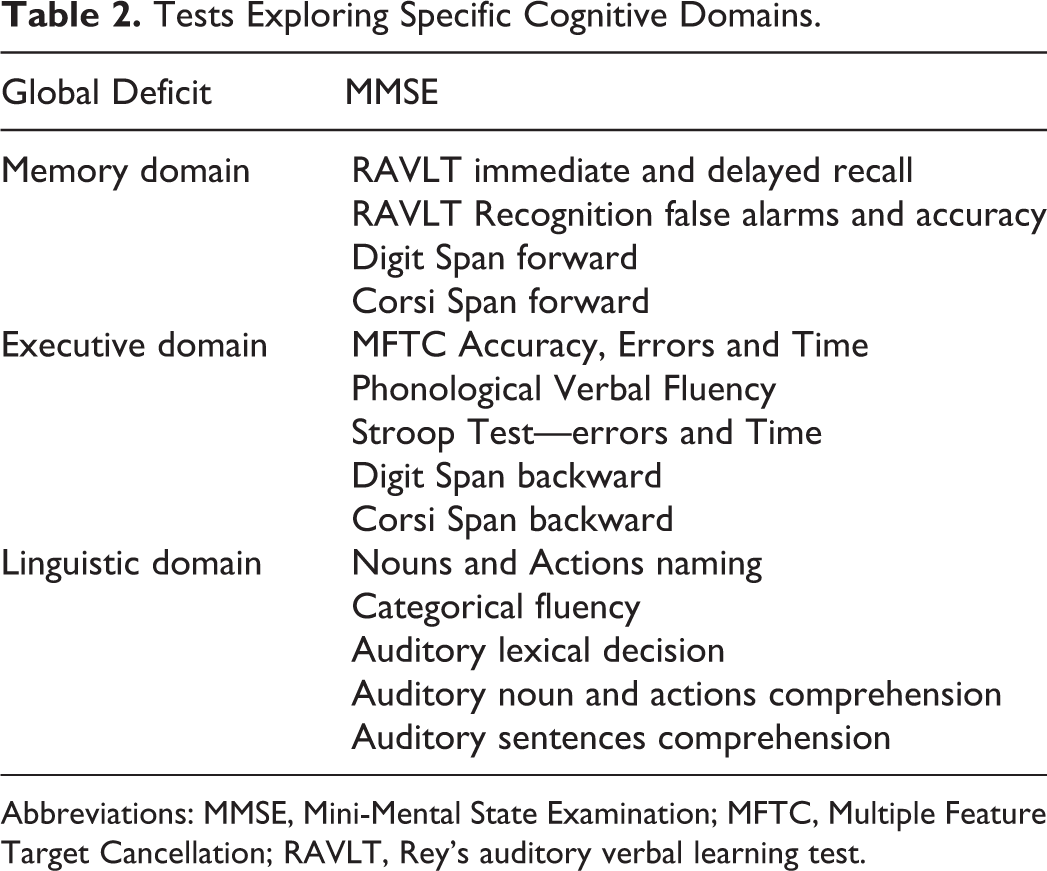
Abbreviations: MMSE, Mini-Mental State Examination; MFTC, Multiple Feature Target Cancellation; RAVLT, Rey’s auditory verbal learning test.
Logistic regression analysis was carried out: audiological variables were set as independent variables, and the presence of an impairment in each cognitive domain was considered a censoring variable.
Results
Neuropsychological Comparisons
Neuropsychological performances between patients with hearing impairment and HCs were treated by means of a 1-way multivariate analysis of variance (MANOVA). Overall, there was significant difference in the neuropsychological performance of the 3 groups (Wilks λ = 0.33325, F40, 114 = 2.0870, P = .001). The univariate comparisons between each task and the post hoc comparisons carried out among the 3 groups by means of Tukey test for unequal sample size have shown significant differences (Table 3). At the RAVLT-immediate recall, the MHL group scored lower than the other 2 groups; patients with mHL also did not perform as well as the HCs. In the RAVLT-delayed recall, no difference was found between the performances of both MHL and mHL groups, but both hearing impaired groups did not perform as well as the HCs like the statistics shown (Table 3). Differences among groups were also noted in attention and mental control tasks. In particular, patients with MHL raised more false alarms in the visual attention-demanding task (MFTC) than the other 2 groups. No differences were found between patients with mHL and HCs in the same task. Finally, a significant difference was found in tasks of semantic competence (Oral naming of Nouns and Actions), where patients with both MHL and mHL did not perform as well as HCs.
Comparisons of Mean Scores on Several Cognitive Domains Among Patients With Hearing Loss and Healthy Controls.
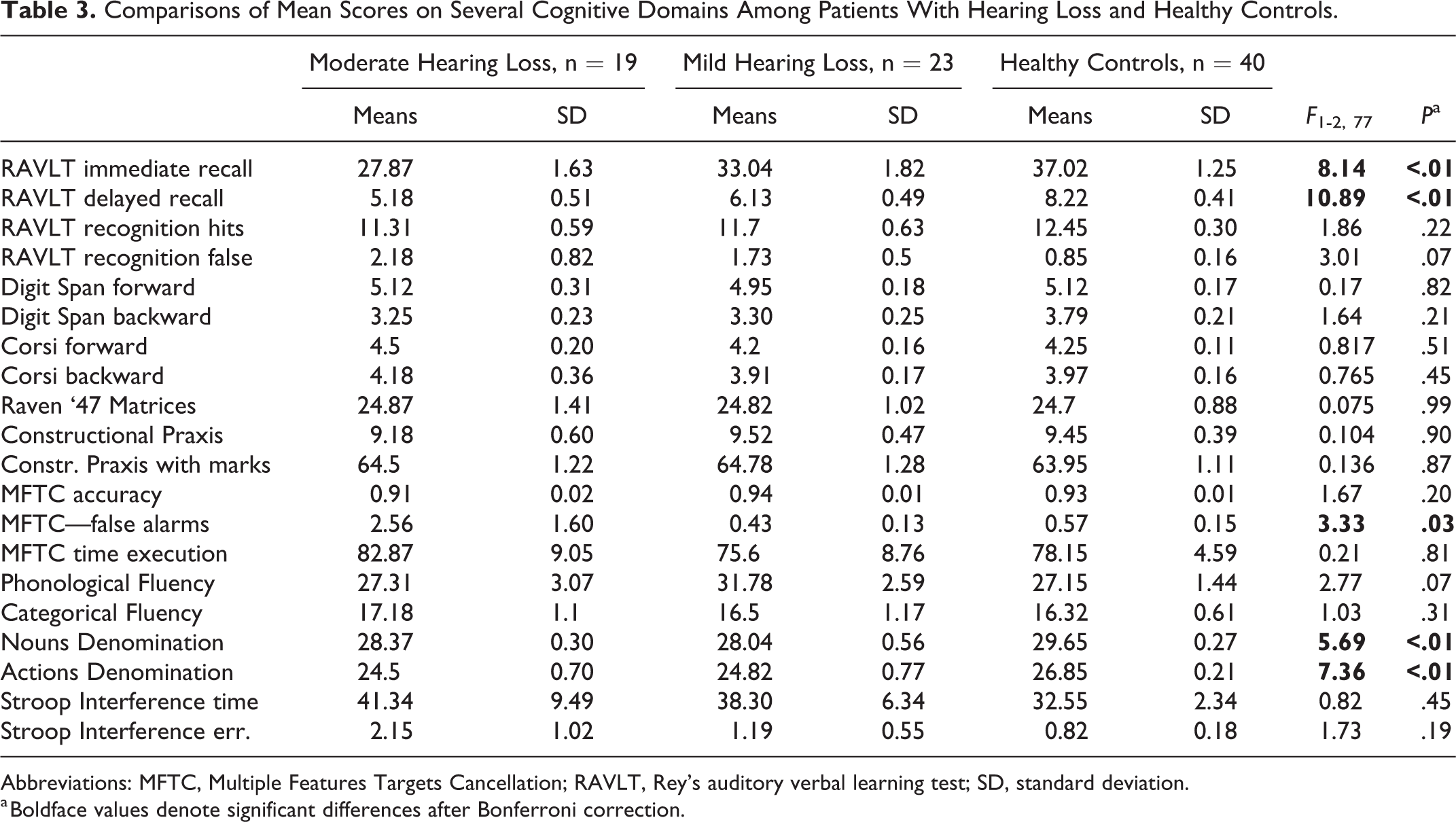
Abbreviations: MFTC, Multiple Features Targets Cancellation; RAVLT, Rey’s auditory verbal learning test; SD, standard deviation.
a Boldface values denote significant differences after Bonferroni correction.
Subsequently, we considered some memory markers that would help us better understand the amnestic disturbances of the patients affected by hearing loss. We have extracted some markers applying a fine-grained analysis to RAVLT. We considered the Primacy Effect that is the ratio between the 5 words at the beginning and the other words of the RAVLT list; the Recency Effect that is the ratio between the last 5 words and the other words of the RAVLT list; the Learning score calculated as the difference between the number of recalled words in the fourth and fifth series and the recalled words in the first and second series; and finally the Forgetting score computed as the ratio between delayed recall and the sum/2 of the words recalled in the fourth and fifth series.
One-way MANOVA of the 3 groups of patients was carried out. The general analysis showed a meaningful effect for the group factor (Wilks λ = 321802, F8, 26, P = <.0001), thus indicating an overall significant difference among the 3 groups according to the markers mentioned earlier (Primacy Effect, Recency Effect, Learning score, and Forgetting score). The study of the univariate specific effects for each single neuropsychological marker showed significant difference in Learning score among the 3 groups of patients (P < .001). The study of specific effects has shown that HCs perform better than patients with both MHL and mHL. Moreover, the 2 hearing impaired groups differ significantly between them (P < .01). Patients with both MHL and mHL were significantly impaired compared to HCs in Forgetting score. The Recency effect was also more pronounced in both groups with hearing impairment compared to the HCs (P > .002), while the performances on Primacy effect showed nonsignificant differences between the 2 groups with hearing impairment and the HCs (Table 4).
Comparisons Among Some Neuropsychological Markers of Verbal Memory Derived by the RAVLT.
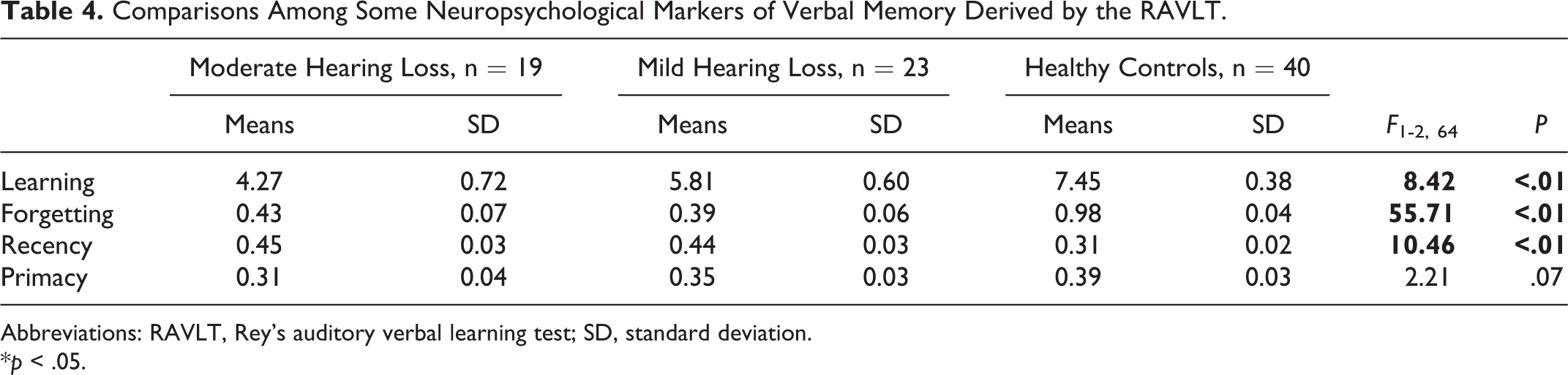
Abbreviations: RAVLT, Rey’s auditory verbal learning test; SD, standard deviation.
*p < .05.
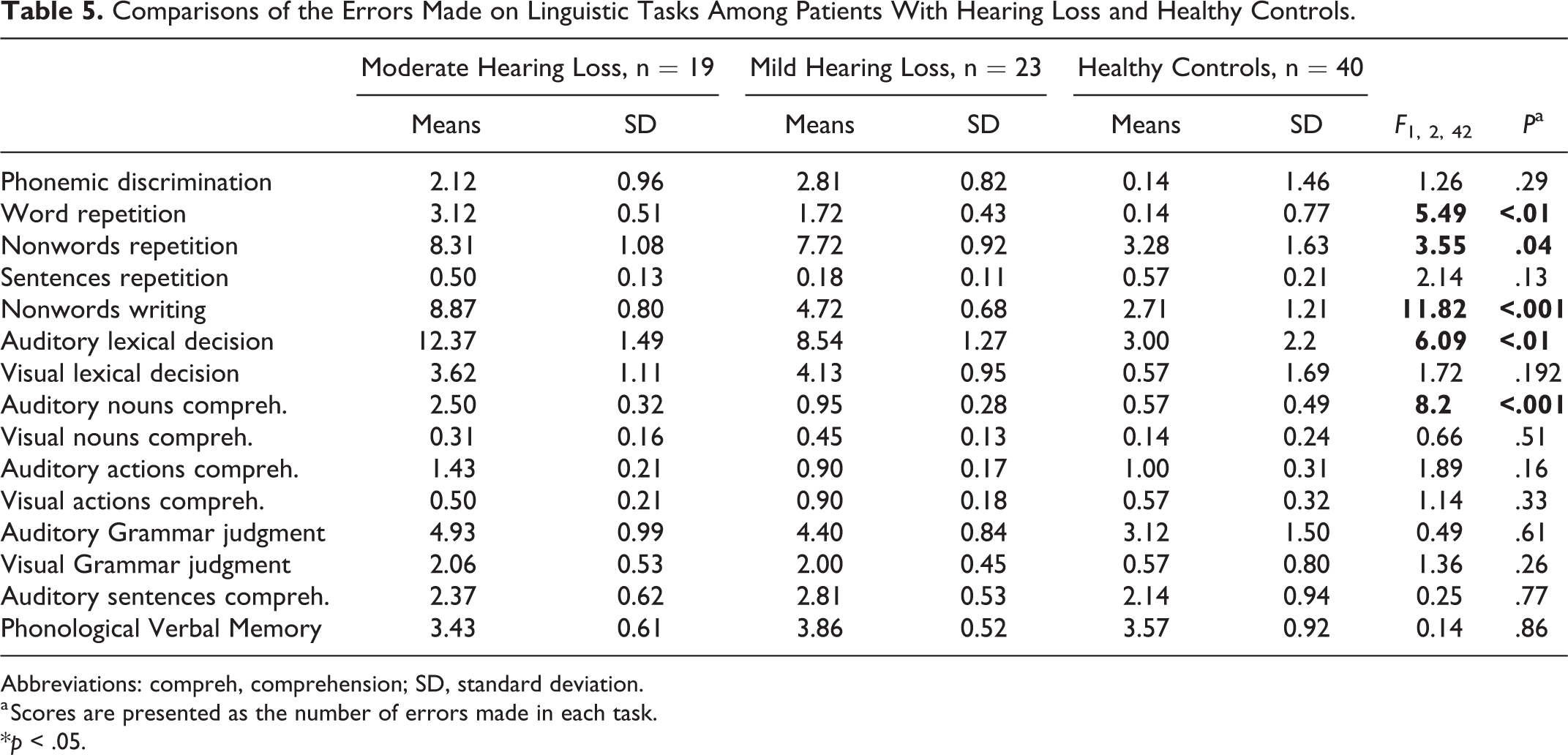
Since the auditory system mainly subserves the linguistic cognitive domain, a detailed analysis of linguistic functions was carried out in order to better explore differences in linguistic tasks and the verbal attainments of patients with hearing impairment (Table 5). The general analysis highlights a significant effect of the group factor signaling a statistically significant difference in the overall pattern of linguistic performance among the 3 groups (Wilks λ 0.144517, F30-56 3.04362, P < .001). The study of the univariate effects carried out on every single test showed that in the “words repetition test,” performance of patients with MHL was significantly poorer (P < .05) than that of patients with mHL who in turn did not perform as well as the HCs (P < .05). In transcoding tasks, patients with MHL and mHL did not differ from one another, but both were substantially worse than the HCs in the nonword repetition test (P < .04), while in the no-word writing task the performance of patients with MHL was much worse (P < .001) than that of patients with mHL who in turn were worse than the HCs (P < .005). In 2 lexical tasks (auditory lexical decision and auditory understanding of names), performances of patients with MHL were notably poorer (P < .01) than those of patients with mHL who only slightly differed from the HC (P < .05).
Comparisons of the Errors Made on Linguistic Tasks Among Patients With Hearing Loss and Healthy Controls.
Abbreviations: compreh, comprehension; SD, standard deviation.
a Scores are presented as the number of errors made in each task.
*p < .05.
Audiometric Factors Related to Cognitive Impairment
In order to explore how auditory impairment modulates cognitive impairment and to detect which, among the audiological measures, can be predictive of cognitive impairment, the data were treated by means of logistic regression analysis. As audiological variables, we considered some measures of audibility (mean right/left PTA and threshold at different frequencies) and some measures of intelligibility (maximum % of correct answers at speech audiometry).
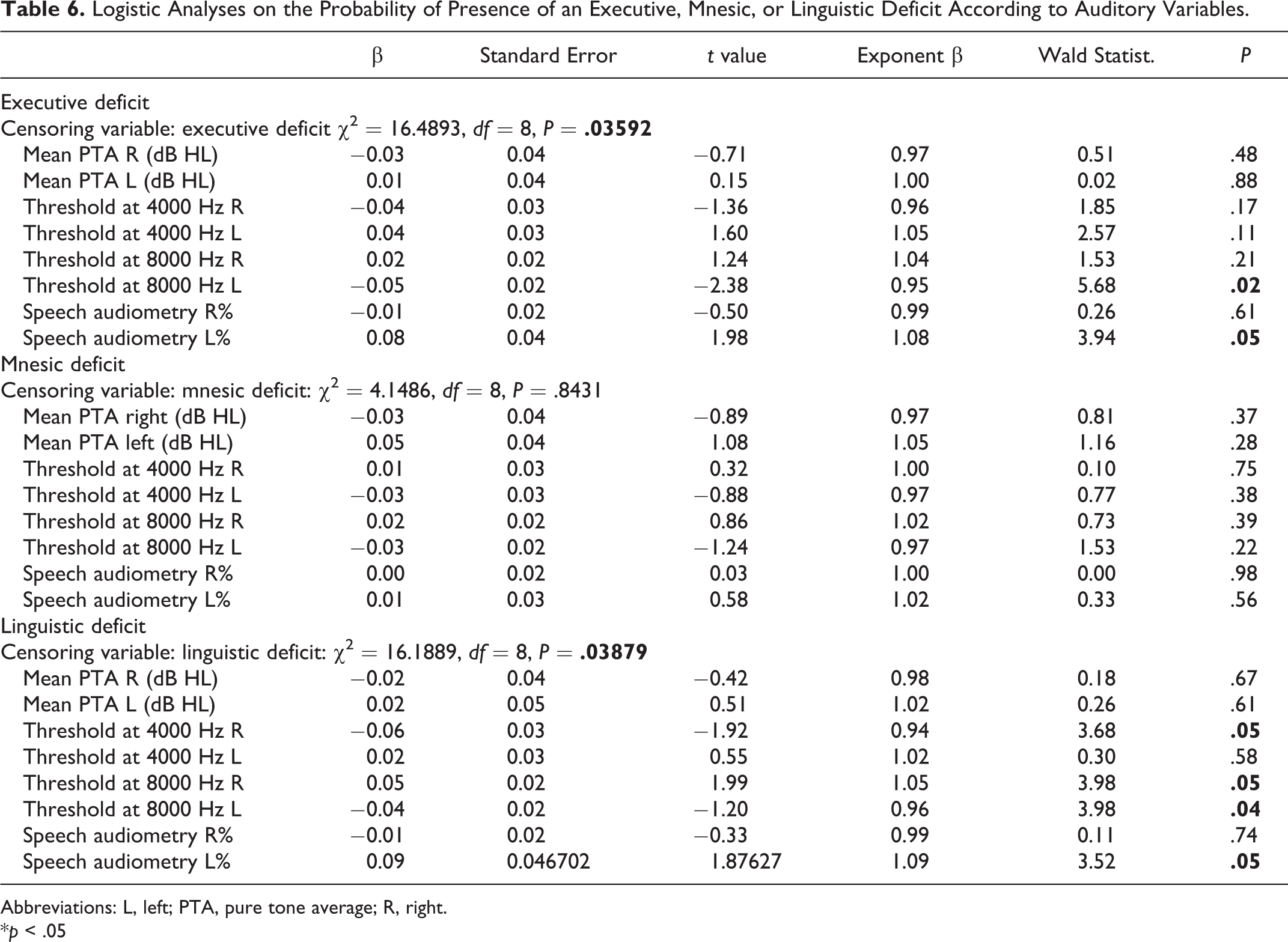
Logistic regression analysis was carried out contrasting separately the presence of a mnesic, dysexecutive, linguistic, or global cognitive deficit (see Table 2) according to the audiological parameters. We carried out a proportional hazard Cox regression model, where the audiological variables were set as dependent variables, and the presence of impairments in specific cognitive domains were set as censoring variables. Age was considered as an independent variable that could influence the performances.
Global cognitive deficit was found in 4 patients; considering the sample, such a low incidence does not make the logistical regression analysis significantly reliable. In contrast, the presence of executive deficit was observed in 8 patients, the presence of linguistic deficit in 15 patients, and finally the presence of mnesic deficit was found in 14 patients.
The analysis (see Table 6) showed that auditory variables included in the model are able to significantly predict executive deficit (χ2 = 16.4893, df = 8, P = .035) and linguistic deficit (χ2 = 16.1889, df = 8, P = .038) but not mnesic deficit (χ2 = 4.1486, df = 8, P = .843). In particular, executive deficit was predicted by the ear threshold at 8000 Hz (Wald 5.675, P < .018) and a speech-tone dissociation (Wald 3.9400, P < .049) in the left ear. Linguistic deficit was predicted by the right and left ear threshold at 8000 Hz (Wald 3.9775, P = .046 and Wald 3.981, P =.0459); a tendency toward a significance was also found for the right ear threshold at 4000 Hz (Wald 3.675; P = .055) and for the left speech audiometry (Wald 3.520; P = .051).
Logistic Analyses on the Probability of Presence of an Executive, Mnesic, or Linguistic Deficit According to Auditory Variables.
Abbreviations: L, left; PTA, pure tone average; R, right.
*p < .05
Discussion
Our results contribute to the literature examining the association between hearing loss and cognition. In summary, our data show that patients with hearing impairment did not perform as well as normoacoustic individuals in memory tasks (RAVLT immediate and delayed recall) and in learning tasks. Additionally, patients with hearing impairment showed higher Recency effect and rate of forgetting. They were also impaired in attentional tasks (MFTC), linguistic tasks exploring word and nonword repetitions, and single-word auditory comprehension. Our logistic regression analysis has identified some audiological variables (as threshold at 8000 Hz and speech audiometry) that can predict the presence of executive and linguistic impairment. Previous studies 19,20 have shown a correlation between ARHL and memory and between ARHL and executive functions. In the Baltimore Longitudinal Study of Aging, 21 Lin and colleagues analyzed the cognitive profile of 347 cognitively nondemented patients with hearing impairment by linear regression, pointing out that patients performed poorly at MMSE and episodic memory tests (Free and Cued Selective Reminding Test-delayed recall) and in executive tests (Trail Making test part B and Stroop test).
The same author also described an association between auditory deficit and poor performance in nonverbal tests for executive functions (Digit Symbol Substitution Test) in 605 patients with hearing impairment. 19
In a Ronnberg study of 160 people utilizing hearing aids, the auditory deficit was correlated with episodic and semantic memory loss. 20 However, while episodic memory was assessed by a test such as RAVLT and by a sentence recall test, semantic memory was evaluated with a word-generation test on phonological criterion, which is generally considered more suitable for the assessment of executive functions than the assessment of the semantic system.
In our study, we wanted to explore whether some aspects of memory and language were more specifically linked to hearing loss than others by studying some qualitative aspects of memory and of the sublexical system, which has not been fully explored in previous articles. In particular, our findings highlight that some aspects of the memory process are more deeply impacted than others by ARHL. As expected, patients with hearing impairment show worse performances in long-term memory (RAVLT immediate and delayed recall) as well as scoring lower than HCs in Learning, which can be linked to an impairment of the mechanism involved in the input process necessary to record new memory tracks. Surprisingly, we also found a higher Forgetting score and Recency effect compared to HCs, which supports the hypothesis that the impairment in memory performances in ARHL is not only limited to the sensorial deficit, which would disturb the encoding level of information processing, but also to the mechanism of storage and retrieval of new information.
The mechanisms involved are probably linked to a weakened postprocessing of learned information. In fact, patients with ARHL seem to show a defective consolidation of memory track due to an efficiency loss of the postauditory lexical processes that cause a weak semantic processing of new data. Our findings are in keeping with data from Ronnberg et al 20 who found that patients with ARHL overall failed to improve performance in both episodic and semantic long-term memory tasks.
Examining the linguistic profile, our data show different performance in patients with ARHL versus HCs only in transcoding tasks for nonword or single context-free words (in which there were only phonological mistakes). These results are in keeping with the fundamental principles regarding perception: The higher the probability of occurrence of a stimulus, the less sensory information will be needed for its correct recognition. 41 For spoken words, it means that a single word is more detectable in a meaningful context than alone. This phenomenon is particularly appreciable in patients with hearing impairment. In our sample, the activation of the semantic–lexical system can compensate for auditory deficits. Nevertheless, the effect of hearing loss on linguistic comprehension probably does not impact on-line (real-time) spoken word comprehension but affects memory processes. On the RAVLT’s 15-word learning task, phonological information implicitly unlocks the lexicon by matching extracted phonological input with stored phonological representations in semantic long-term memory (LTM). Confounding conditions prevail in patients with ARHL, hence the probability of a mismatch between input and stored phonological representations increases. Such mismatch leads to a difficulty in lexical access and consequently less information is encoded into episodic LTM. According to Ronnberg et al hypothesis, 20,42 this in turn leads to an increasing disuse of episodic LTM, which is compensated by the increased functioning of working memory systems. A greater use of attentive and executive resources can therefore be expected in patients with AHRL since, to compensate for the loss of LTM, they come to rely on the working memory processes that require a greater use of attentional resources. This phenomenon can affect performance in other executive tasks as well. As a matter of fact, we have observed that the audiological variables do not predict the presence of mnesic impairment, but they are able to predict executive impairment in patients with MHL and mHL. This result does not mean that ARHL does not interfere with memory functions but rather that memory processes in these patients are more attention demanding and involve the allocation of more attentional resources.
Two alternative explanations could account for these findings: The first is that many measures of central auditory functioning (Synthetic Sentence Identification 43 and Dichotic Digit Test 44 ) and cognitive tests of executive functions (MFTC, Stroop Color Test, and Word Test) explore similar dimensions of executive control (ie, behavioral inhibition). Consequently, audiological variables can predict the presence of a prevalent central auditory-processing deficit. A second hypothesis is that working memory declines with age and has limited capacity. In our sample, the presence of auditory deficits requires the use of additional cognitive (strategic and attentional) resources for hearing comprehension; the same resources are inevitably subtracted from other cognitive processes. The strain affects working memory and reduces its functioning. The effect is more apparent in tasks requiring greater executive control. In other words, regardless of the verbal or nonverbal material used, the patient’s attentional resources are predominantly, and automatically, allocated to the processing and postprocessing mechanisms for hearing by reducing the resources usually allocated to nonverbal cognitive functions.
In our regression logistic analysis, we also considered a linguistic deficit, interpreted as an impairment of speech comprehension at lexical–semantic level. Linguistic impairment was found in 8 patients; the audiological variables predicting the linguistic deficit were the thresholds of spoken language (6-8000 Hz) and some degrees of intelligibility. These data support our previous hypothesis that the linguistic impairment is grounded in the mismatch between input and stored phonological representations and the difficulty in lexical access tools. In other words, patients with hearing impairment can experience a linguistic impairment if their audiological deficit compromises correct lexical access.
Our data reinforce and deepen previous findings presented in the literature, highlighting the existence of a correlation between hearing impairment and cognitive functioning; they are also in agreement with Lin’s papers, 19,20 which emphasize the close relationship between hearing functions and executive abilities. We found that the linguistic difficulties in patients with AHRL are mainly related to attentional and executive efforts in real-time language comprehension as speculated also in the Stewart and Wingfield study. 45 On the other hand, we know that linguistic abilities—and in particular language comprehension—typically remain well preserved in normal aging, despite a general decline in cognitive functions. 46 In our opinion, this is partly due to the static neural mechanism of compensation that leads to an expansion of the neural language network 47,48 and partly to the functional mechanism of compensation that mainly involves executive functions and the attention system. 49
In summary, we could hypothesize a 2-way interaction between the 2 aspects starting from the so-called frontal hypothesis of normal aging; according to this theory, the decline in executive functions related to the frontal lobes (in particular the PFC) would account for cognitive modification during aging. Therefore, hearing loss, by diverting attention-resources toward the auditory processes, would weaken the executive control over other cognitive processes; at the same time, the physiological decline in executive functions (Attractive Resources and Arousal) brought on by age would exacerbate, in a vicious circle, the effect of hearing loss on other instrumental cognitive functions (memory, praxis, and language).
In line with this theory of a dynamic adaptive system, sensory loss in the elderly individuals could constitute a risk factor in antedating or worsening physiological and pathological cognitive decline. From such perspective, the examination of hearing loss has an important role in determining the rate of decline in various cognitive functions and could differentiate good aging from a pathological one.
Although the patients were widely studied from an audiological and neuropsychological point of view, and despite the rather solid findings observed, there are some limitations to our work. Our sample was rather small, and the number of events observed was limited. Thus, our results need to be confirmed in a larger study sample. Furthermore, additional investigation should be devoted in the future to the role of central auditory functions in order to confirm if the presence of a central auditory-processing deficit can be irrefutably linked to postprocessing executive dysfunction in patients with hearing impairment.
Footnotes
Declaration of Conflicting Interests
The author(s) declared no potential conflicts of interest with respect to the research, authorship, and/or publication of this article.
Funding
The author(s) received no financial support for the research, authorship, and/or publication of this article.
