







Abstract
Objective:
Apathy is a common phenomenon in late-life depression and is associated with poor outcomes. Apathy is often unrecognized in older depressed adults, and efficacious treatment options are lacking. This review provides a systematic review of the neuroanatomical abnormalities associated with apathy in late-life depression. In addition, the review summarizes the neuroimaging findings from studies of neurodegenerative and focal brain injury conditions that frequently present with apathy. The goal is to elucidate cerebral network abnormalities that give rise to apathy in older adults with mood disturbances and to inform future treatment targets.
Method:
Systematic literature review.
Results:
The few studies that have directly examined the neuroanatomical abnormalities of apathy in late-life depression suggest disturbances in the anterior cingulate cortex, insula, orbital and dorsal prefrontal cortex, striatum, and limbic structures (ie, amygdala, thalamus, and hippocampus). Studies examining the neuroanatomical correlates of apathy in other aging populations are consistent with the pattern observed in late-life depression.
Conclusions:
Apathy in late-life depression appears to be accompanied by neuroanatomical abnormalities in the salience and reward networks. These network findings are consistent with that observed in individuals presenting with apathy in other aging-related conditions. These findings may inform future treatments that target apathy.
Introduction
Apathy is common in older adults with depression. 1 –5 An estimated 75% of older, community-dwelling adults with depression have comorbid apathy, which stands in contrast to the 25% of their nondepressed counterparts. 4 The prevalence of apathy increases with age 2,6 such that individuals with late-life depression are more likely to have comorbid apathy than middle-aged adults with depression. 7 Among those with late-life depression, the severity of depressive symptoms is higher in those with comorbid apathy than in those without apathy. 7 –9
Across psychiatric and neurologic conditions, apathy is associated with increased functional impairment, unemployment, and decreased quality of life. 2,6,10 –12 Individuals with apathy have higher frequencies of cognitive impairment, cognitive decline, and dementia, as well as other neuropsychiatric symptoms and medical comorbidities compared to their nonapathetic counterparts. 11,13 –15 Apathetic individuals are less likely to be compliant with and respond to treatment for comorbid illnesses, 16 –18 and apathy is associated with more frequent hospital admissions and higher mortality. 11,13
Individuals with late-life depression and apathy are less likely to respond to antidepressant treatment than depressed older adults without apathy. 8,19,20 Paradoxically, selective serotonin uptake inhibitors (SSRIs), 21 the first line of treatment for depression, may exacerbate symptoms of apathy. 21 –24 In clinical practice, apathy and depression are rarely distinguished. The typical approach to managing apathy symptoms continues to be the same as the treatment for depression, 22,25 The elucidation of the specific neuroanatomical abnormalities underlying apathy in older depressed adults may inform the selection and/or development of more effective treatments. Thus, this article provides a systematic review of the literature focused on the neuroanatomical correlates of apathy in late-life depression.
Apathy: An Evolving Concept
Apathy is defined as a decrease in self-motivated, goal-directed activity. 26,27 Characteristic of apathy is a lack of the action-inducing experience of “wanting,” which can be contrasted to the more immediate and passive experience of hedonistic “liking” that is often associated with anhedonia. 28 –31 Although individuals with apathy are capable of experiencing pleasure when engaging in enjoyable activities, there is a paucity in the intrinsic motivation that drives individuals to actively pursue these enjoyable activities. 28 –31 As a result, apathetic individuals often become inactive, at times even neglecting their most basic needs. 32
For an individual to experience intrinsic motivation and engage in self-initiated, goal-directed activity, the efficient completion of several affective, cognitive, and behavioral processes is required. Sensory inputs must be integrated with information about emotional states and memories of prior events. Valence must then be attributed to this information in order to determine the desirability of attaining a certain goal, after which a plan of action must be formulated, initiated, and maintained until the goal has been achieved. 33 Intrinsically motivated action may require the ability to trade-off benefits and costs of exerting effort to attain a goal, sustain motivation throughout a sequence of behaviors intended to result in accomplishment of the goal, and monitor the eventual value of having attained the goal. 34
Although apathy was originally viewed as a single dimension of behavior that existed only as a symptom of other neuropsychiatric disorders, it has more recently been conceptualized as a clinically distinct syndrome that may encompass affective, cognitive, and behavioral disturbances. The main affective disturbance associated with apathy is emotional indifference or blunting. Cognitively, apathy can present as an inability to formulate or sequence a purposeful plan of action. On the behavioral level, apathy can result in an inability to initiate the targeted behaviors that are necessary for attaining a goal. 35,36 These complex processes are associated with neural networks comprised of structures within the prefrontal cortex, basal ganglia, and limbic system. 22,37,38
Methods
We reviewed studies that relied on neuroimaging techniques to examine neuroanatomical characteristics of apathy across various disease states, including late-life depression and other neurological conditions in which symptoms of apathy commonly occur. We used the computerized database of PubMed to identify studies that examine the neural basis of apathy. Search terms used to identify studies were ((apathy) AND (imaging OR neuroimaging OR computerized tomography OR CT OR magnetic resonance OR MRI OR positron emission tomography OR PET OR single photon emission computed tomography OR SPECT)). Reviews included in the search results were examined for additional studies. We included only studies that used a scale to quantify apathy. This included freestanding measures of apathy, as well as individual items that quantify apathy as part of a rating scale that measures a broader construct. We did not include studies that examined constructs that are often considered closely related to apathy, such as social withdrawal, decreased functional independence, fatigue, and anhedonia.
Results
Neuroanatomical Abnormalities of Apathy in Late-Life Depression
Few studies to date have examined the neuroanatomical correlates of apathy in late-life depression (see Table 1). A comparison of resting-state functional connectivity (rsFC) in older depressed adults with and without apathy revealed an association between apathy and connectivity between structures involved in reward processing. 39 Compared to nonapathetic individuals, those with apathy had decreased rsFC between the nucleus accumbens and the amygdala, caudate, putamen, globus pallidus, and thalamus. Decreased rsFC was also found between the dorsal anterior cingulate cortex (dACC) and the superior, middle, and inferior frontal gyruses, right superior parietal region, and ventrolateral prefrontal cortex (VLPFC). Increased rsFC was found between the nucleus accumbens (NAcc), dACC, and dorsomedial prefrontal cortex, as well as between the dACC and the insula, orbitofrontal cortex (OFC), and middle frontal gyrus. In the same sample, apathy was associated with decreased connectivity within and between structures involved in the salience network, 40 including the anterior insula and the dACC, and reward-related and limbic structures including the NAcc, caudate nucleus, thalamus, amygdala, hippocampus, and posterior parietal cortex. In addition, increased rsFC was found between the anterior insula and the dorsolateral prefrontal cortex (DLPFC), posterior cingulate, and precuneus in those with apathy when compared to their nonapathetic counterparts. Additionally, abnormalities in the bilateral uncinate fasciculus distinguish controls from depressed individuals with apathy. 8
Details of Studies Included in Review.
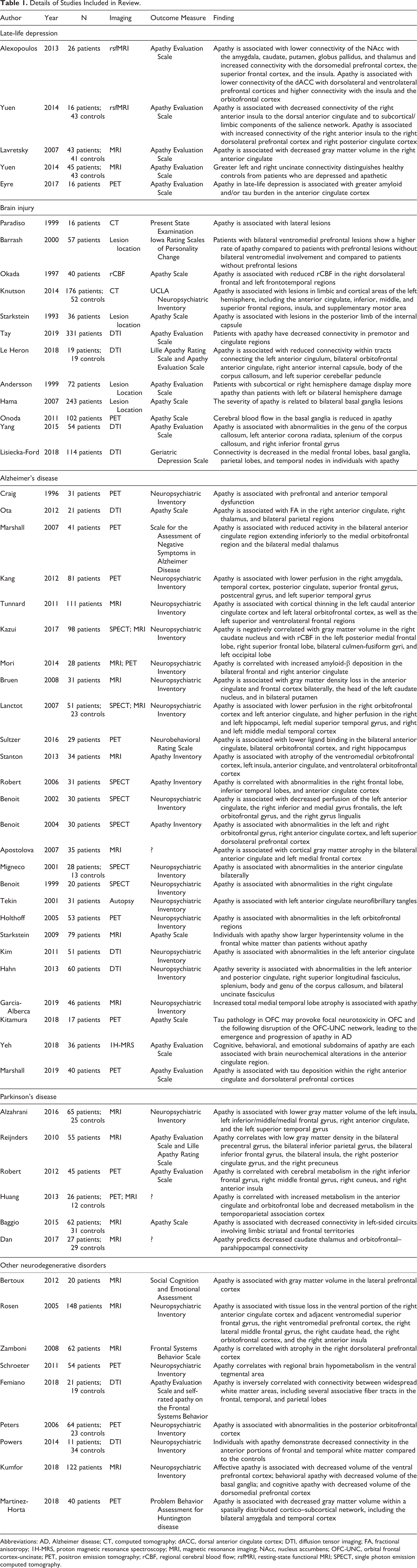
Abbreviations: AD, Alzheimer disease; CT, computed tomography; dACC, dorsal anterior cingulate cortex; DTI, diffusion tensor imaging; FA, fractional anisotropy; 1H-MRS, proton magnetic resonance spectroscopy; MRI, magnetic resonance imaging; NAcc, nucleus accumbens; OFC-UNC, orbital frontal cortex-uncinate; PET, positron emission tomography; rCBF, regional cerebral blood flow; rsfMRI, resting-state functional MRI; SPECT, single photon emission computed tomography.
In addition to network abnormalities as assessed by functional connectivity studies, morphometric and other structural abnormalities have been investigated. A magnetic resonance imaging (MRI) study of older depressed adults with apathy revealed an association between apathy severity and decreased gray matter volume of the right anterior cingulate cortex after controlling for age and sex. 41,42 In addition, in vivo analysis in older, nondemented adults with depression demonstrated an association between apathy severity and amyloid and tau deposition in the ACC. 43 Thus, disturbances in frontostriatal and limbic networks, particularly within the reward and salience networks, may contribute to apathy in older depressed adults.
Neuroanatomical Abnormalities of Apathy in Brain Injury and Aging-Related Populations
Apathy is common in clinical syndromes other than late-life depression, raising the question of whether or not similar neuroanatomical abnormalities may also underlie the expression of apathy symptoms in these syndromes. A review of the literature suggests that in individuals with focal brain lesions and neurodegenerative disorders, neuroanatomical structures associated with apathy are similar to those seen in individuals with late-life depression. Importantly, these associations are independent of cognitive impairment, 44 –46 age, 45 depressed mood, 46,47 education, 46 and sex. 45
Brain Injury, Stroke, and Small Vessel Disease
Apathy is common in individuals with focal damage to the frontal lobe, although structural specificity is equivocal (see Table 1). In one study, apathy was found to occur more frequently in individuals with lateral frontal lobe lesions, as opposed to those with lesions in the medial frontal lobe. 48 In contrast, others found that individuals with ventromedial lesions of the frontal lobe were more likely to have apathy than individuals with lesions in other areas of the frontal lobe. 49 In individuals with traumatic brain injury, associations exist between apathy and lesions in a variety of left hemisphere structures, including the ACC, frontal cortex, insula, and supplementary motor area. 50 However, another study demonstrated an association between apathy and right hemisphere damage, whereas no association between left hemisphere and bilateral hemispheric damage was found. 51 In poststroke individuals, apathy is associated with lower cerebral blood flow in the right DLPFC and the left frontotemporal region 52 as well as the genu of the corpus callosum, left anterior corona radiata, splenium of the corpus callosum, and right inferior frontal gyrus. 53 Apathy is also associated with cerebrovascular lesions in the posterior limb of the internal capsule. 6 Individuals with cerebral small vessel disease and apathy demonstrate disruption of several structural networks, including parietal–premotor, frontostriatal, and occipitotemporal connections. 54 Similarly, connectivity is decreased in the medial frontal lobes, basal ganglia, parietal lobe, and temporal lobe in individuals with cerebral small vessel disease and apathy. 55 Apathy in individuals with cerebral autosomal dominant arteriopathy with subcortical infarcts and leukoencephalopathy is associated with significantly reduced connectivity in the ACC, orbitofrontal anterior cingulate white matter tracts, right anterior internal capsule, body of the corpus callosum, and left superior cerebellar peduncle. 56 Associations between apathy and stroke lesions in subcortical regions, including the basal ganglia, have also been documented. 57,58
Alzheimer Disease
In patients with Alzheimer disease and apathy, structural and functional abnormalities are commonly reported (see Table 1). Several imaging studies implicate the OFC in the clinical presentation of apathy symptoms in individuals with Alzheimer disease. 46,59 –67 Other cortical structures implicated include frontal lobe areas such as the inferior frontal gyrus, 64 medial frontal gyrus, 62,64,68 superior frontal gyrus, 63,69 and VLPFC 69 and anterior cingulate cortex. 70,71 Within the ACC, imaging abnormalities have been found in both the anterior 45 –47,59 –65,68,69,72 –75 and posterior 76 regions. Subcortical structures associated with apathy in individuals with Alzheimer disease include the amygdala, 76 hippocampus, 59,60 thalamus, 45,46 caudate nucleus, 73,77 and putamen. 73 Several studies have also identified imaging abnormalities in the insula. 44,59,61,76,78 While the temporal, 44,59,76,79 parietal, 45 and occipital lobes 77 may also play a role in apathy of Alzheimer disease, there is an overall paucity of evidence supporting a role of these regions.
Postmortem studies of patients with Alzheimer disease lend further support to DLPFC and ACC involvement in apathy. For example, apathy is more common in those with neurofibrillary tangles in the left ACC than it is in those with predominant Alzheimer disease pathology in other areas. 43,80 In addition, in vivo analysis demonstrates an association between apathy severity and tau deposition in the ACC and DLPFC, 81 as well as amyloid-β deposition throughout the bilateral frontal cortex and right ACC. 63
Parkinson Disease
Apathy is one of the most common neuropsychiatric symptoms in Parkinson disease. 82,83 The severity of apathy among these patients is related to abnormalities in several regions common to apathy in late-life depression (see Table 1). Patients with Parkinson disease and apathy have decreased frontal cortex gray matter volume when compared to patients without apathy. 82,84,85 Severity of apathy is associated with decreased cerebral metabolism in the right middle frontal gyrus and inferior frontal gyrus 86 and increased cerebral metabolism in the OFC. 87 Apathy in Parkinson disease predicts decreased caudate–thalamus and orbitofrontal–parahippocampal connectivity. 88 Lower gray matter volume is also found in the superior temporal gyrus, 82 precentral gyrus of individuals, 85 and inferior parietal gyrus 85 of individuals with Parkinson disease and apathy when compared to their nonapathetic counterparts. Decreased metabolism in the temporoparietal association cortex is associated with increased apathy in Parkinson disease. 87 Abnormalities involving the insula are associated with increased apathy severity in Parkinson disease. 82,85,86 Apathy in Parkinson’s disease is also associated with increased cerebral metabolism and lower gray matter volume in the ACC, 82,87 posterior cingulate gyrus, 85 right precuneus, 85 and right cuneus. 86 Resting-state functional MRI reveals decreased connectivity within the striatum and between the striatum and VLPFC brain regions in patients with apathy and Parkinson disease. 89
Other Neurodegenerative Disorders
Apathy is a common symptom in other neurodegenerative disorders, particularly those affecting salience and reward systems (see Table 1). In individuals with behavioral variant frontotemporal dementia, severity of apathy is inversely correlated with gray matter volume in the lateral prefrontal cortex, 90 right DLPFC, 91 posterior OFC, 92 and uncinate fasciculus. 93 In a population of individuals with a variety of dementia diagnoses, apathy was associated with decreased volume of the right ACC, ventromedial superior frontal gyrus, right ventromedial prefrontal cortex, right lateral middle frontal gyrus, right caudate head, right OFC, and right anterior insula 94 and with decreased metabolism in the ventral tegmentum. 95 Similarly, in a population of individuals with a variety of dementia diagnoses, apathy was associated with decreased volume of the ventral prefrontal cortex, basal ganglia, and dorsomedial prefrontal cortex. 96 Apathy is recognized as a common behavioral change in amyotrophic lateral sclerosis, with demonstrated involvement of widespread white matter areas, including several associative fiber tracts in the frontal, temporal, and parietal lobes. 97 Apathy is also considered the most prevalent and characteristic neuropsychiatric feature of Huntington disease, 98 a population in which apathy has been found to be associated with decreased gray matter within a spatially distributed cortico–subcortical network, with major compromise of the bilateral amygdala and temporal cortex. 98
Summary
Taken together, studies examining neuroanatomical abnormalities in apathy consistently reveal involvement of prefrontal structures, most notably the ACC and OFC. 34 Abnormalities in the insula, dorsal striatum, and limbic system (ie, thalamus, amygdala, and hippocampus) are also common in individuals with apathy. 34 Although some studies also report associations between apathy and abnormalities in the temporal, parietal, and occipital lobes, these findings are less prevalent than findings implicating aforementioned brain regions.
The neuroanatomical abnormalities involved in apathy contribute to a variety of emotional, cognitive, and behavioral impairments. 99 The overlap between neuroanatomical regions involved in different aspects of the apathy construct suggests that apathy results from a generalized inability to control the integration of sensory inputs with emotional cues and memories, which is required to cultivate intrinsic motivation and maintain goal-directed activity. 27,37,38,100,101
Neuroanatomical Abnormalities From a Network Perspective
Although our literature review reveals involvement of a number of cortical and subcortical brain regions in apathy across disease states, some brain regions are more consistently implicated than others. Given the prominence of involvement of the ACC, OFC, insula, dorsal striatum, and limbic system in apathy, 34 key contenders for network disturbances in apathy include the reward and salience network (Figure 1).
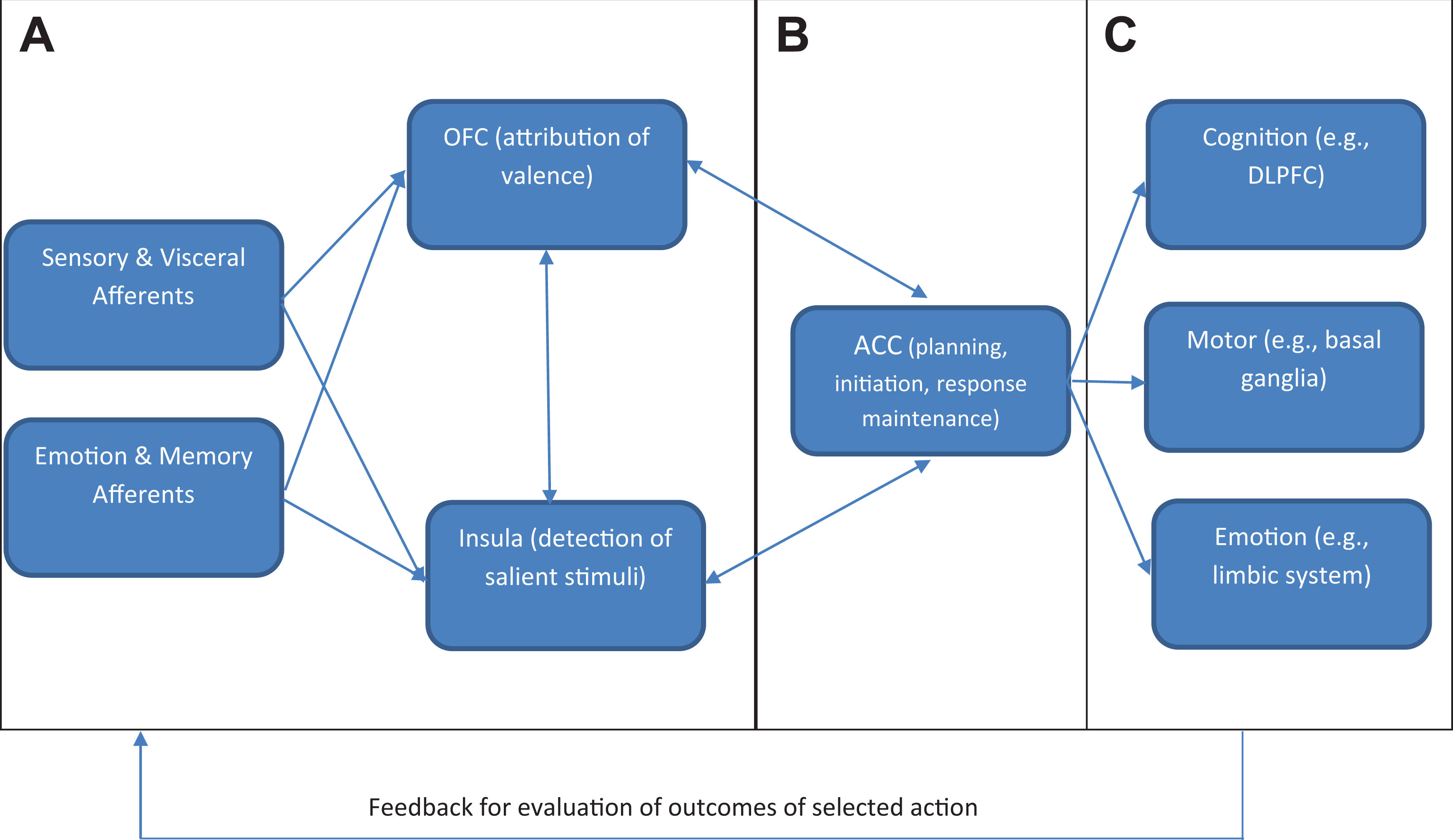
Neuroanatomic model of motivation and goal-directed behavior relevant to apathy. A, Sensory and emotional/contextual inputs from both internal states and the environment activate the orbitofrontal cortex (OFC) which attributes valence to the inputs; in parallel, the insula integrates information and distills salience. B, The anterior cingulate cortex (ACC) receives input from both the insula and the OFC regarding valence and salience, and the ACC coordinates an actionable plan to initiate or maintain goal-directed behavior. C, Activation of relevant cortices (ie, frontal, subcortical, and limbic) by the ACC results in appropriate cognitive, motor, and emotion output toward goal-directed action. Abnormalities in the functioning of OFC/ACC (reward network) and/or the insula/ACC (salience network) are thought to underlie the symptom of apathy. Dysfunction within these networks influences action planning and selection (B) as well as evaluative functions related to salience and reward-based learning (A).
The reward network consists of a complex network of cortical and subcortical structures. 33,102 While subcortical structures are involved in attaining goals that satisfy basic needs, cortical structures (ie, OFC and ACC) are more strongly associated with the abstract motivators that lose their intrinsic value in individuals with apathy, such as money, power, or challenge. 33 The OFC is generally considered to mediate the evaluation of potential rewards and losses. 33,102 The OFC integrates sensory information, emotions, and memories in order to create models of reward-based cause and effect. 103,104 Damage to the OFC impairs the learning and forgetting of associations between inherently neutral stimuli, and rewards and losses. 103 Furthermore, individuals with damage to the OFC are less emotionally reactive to reinforcing stimuli and have difficulty evaluating whether their choices have positive or negative outcomes. 105,106 This, in turn, leads to an inability to predict future rewards and losses, resulting in the lack of motivation that characterizes apathy. 27,107 The ACC is involved in error detection and conflict monitoring 108 –112 ; in the context of the reward network, the ACC detects conflicts that may impede the attainment of a rewarding goal, computes and initiates the most favorable solution by activating other brain networks, and monitors the outcome of an implemented solution. 113 –115 With regard to apathy, abnormalities in the ACC may result in an impaired ability to detect conflict and implement solutions when task-irrelevant events interfere with goal-directed activity.
The salience network mediates stimulus-driven, bottom-up control of attention 116 by identifying stimuli that are “infrequent in space or time, or have learned or instinctive biological importance, including those that are pleasurable and rewarding, self-relevant, or emotionally engaging.” 116 –118 The insula and dorsal ACC are key nodes in the salience network, whereas smaller roles are attributed to the amygdala, ventral striatum, and substantia nigra. 116,118 In the context of the salience network, the dorsal ACC monitors for salient stimuli that conflict with goal-directed action. 119 –123 Upon detection of conflict, the dorsal ACC is thought to evaluate potential rewards and losses associated with that conflict, determine whether or not a change in strategy is beneficial, and initiate the most favorable solution by activating other brain networks, such as the cognitive control network and motor system. 119 –123 The insula serves to identify stimuli that are relevant for goal-directed activity among the myriad of internal and external inputs that compete for attention at any given moment. 116 The anterior insula receives communications regarding interoceptive states from sensory areas and consolidates this input with information regarding the external environment, emotional states, and memories to identify salient stimuli. 124 –127
Structures within the reward and salience networks are connected by dopaminergic mesolimbic and mesocortical pathways. While dopamine is historically considered to be associated with reward processing in general, more recent studies suggest that dopamine is specifically involved in the modulation of reward anticipation that is impaired in apathy (ie, “wanting”), as opposed to a more immediate hedonistic experience that is associated with anhedonia (ie, “liking”). 128,129 Indeed, studies examining the role of dopamine in apathy have consistently found associations between decreased activity in dopaminergic systems and increased apathy. 130 –132 Dopaminergic abnormalities within the reward and salience networks may therefore be associated with an impaired attribution of motivational valence to stimuli, which in turn may underlie the clinical expression of apathy symptoms. 133
Treatment Implications
Pharmacological Treatment
Thus far, the examination of apathy as a transdiagnostic symptom has supported the role of reward and salience networks in the clinical expression of apathy, thereby implicating a crucial role for the dopaminergic system. 133 Support for the involvement of the dopaminergic system in apathy comes from studies in neurodegenerative disorders. In Alzheimer disease, dopaminergic abnormalities at both the receptor and neurotransmitter level are associated with the clinical expression of apathy. 130 Individuals with Alzheimer disease and Lewy body dementia exhibit increased apathy with lower dopamine transporter levels in the striatum, suggesting that apathy may be specifically associated with loss of dopaminergic neurons in this brain region. 131 Apathetic individuals with Parkinson disease have less dopamine uptake in the striatum than their nonapathetic counterparts, most notably in the right caudate. 132 Thus, findings across aging-related illnesses suggest that apathy is consistently associated with decreased activity in dopaminergic systems. 113
The possible involvement of the dopaminergic system may also explain the poor response of apathy symptoms to SSRI treatment. There is an intricate balance between monoaminergic neurotransmitters, such that serotonin has an inhibitory effect on dopaminergic activity in the frontal lobe and striatum. Thus, the increase in serotonin that results from SSRI treatment may lead to a decrease in dopamine transmission, 134 thereby preventing remission of apathy symptoms or even exacerbating these symptoms. 5,32 –34
Despite evidence implicating reduced dopamine in the expression of apathy, clinical trials of dopamine agonist treatment are limited but promising. In a case study of a woman in a 3-year vegetative state, recovery occurred after treatment with amantadine. 135 In a more recent case study of an individual with depression and seizure disorder, significant improvement in apathy symptoms was noted with aripiprazole treatment, but not with carbamazepine, sertraline, and topiramate. In a case study on the use of ropinirole in an individual who developed apathy after a cerebral infarction in the prefrontal cortex, improvement was seen in “verbal output and spontaneity in daily life” following treatment, and this was associated with an increase in blood flow in the prefrontal cortex and basal ganglia. 136 In another case study, successful treatment of apathy was reported using modafinil in an older adult with depression and mild neurocognitive disorder. 137 In a placebo-controlled case study of an individual with traumatic brain injury, apathy symptoms improved with amantadine treatment. 138 Improvement in apathy severity has also been reported following treatment with bromocriptine, studied primarily in traumatic brain injury and poststroke individuals. 139 –141 Significant improvement in mental status was noted with amantadine therapy in 3 patients in whom autopsy subsequently showed Alzheimer disease. 142 In a 12-week randomized controlled trial examining a dopamine agonist (piribedil) for the treatment of apathy in individuals with Parkinson disease, piribedil improved apathy by 34.6% versus 3.2% in those treated with placebo. 143 Methylphenidate and d-amphetamine have been examined in a wide range of neurologic disorders, including Alzheimer disease, stroke, Wilson disease, and HIV-related dementia, and have been shown to decrease apathy as well as a multitude of related symptoms, including social withdrawal, decreased physical activity, decreased attention to personal hygiene, and lack of independence in activities of daily life. 99,144 –146
In addition to dopaminergic agents, the use of acetylcholinesterase inhibitors is also of interest for the treatment of apathy given that dopamine depletion may be alleviated by an increase in acetylcholine. 147 A meta-analysis of randomized controlled trials concluded that metrifonate decreased apathy severity in individuals with Alzheimer disease. 148 Tacrine 149 and donepezil 150 may also ameliorate apathy symptoms in individuals with Alzheimer disease. Apathy is effectively treated with rivastigmine in individuals with Parkinson disease 151 and Lewy Body dementia. 152 Finally, the combination of donepezil with choline alphoscerate, a cholinergic precursor, is more effective than donepezil alone for reducing symptoms of apathy in individuals with Alzheimer disease. 153 Thus, several studies examining the use of medication to increase acetylcholine availability indicate that these medications may be helpful for alleviating apathy symptoms in individuals with neurodegenerative disorders.
In summary, given the implication of reward and salience networks in the transdiagnostic presentation of apathy, dopaminergic systems may underlie the clinical expression of this syndrome. Lack of response to SSRI treatments that decrease dopamine levels suggests that dopamine agonist treatments may be beneficial. There is indeed strong, though limited data supporting the use of dopamine-enhancing agents for the treatment of apathy. These agents include not only medications that directly increase dopaminergic activity but also agents that indirectly affect dopamine transmission, such as acetylcholinesterase inhibitors. Further examination of these pharmacological approaches is particularly relevant to the treatment of apathy in late-life depression, as SSRIs, the current first line of treatment in these individuals, may actually exacerbate apathy, despite improving other depressive symptoms.
Nonpharmacological Treatments
Nonpharmacological interventions, including psychotherapy and neuromodulation, may augment pharmacological treatment of apathy, thereby improving overall treatment efficacy, allowing faster response to treatment, and decreasing reoccurrence of symptoms. 154 There is also mounting evidence that nonpharmacological interventions alone may be sufficient to successfully treat apathy in some individuals. 154
In individuals with dementia, psychotherapeutic interventions, particularly those with a behavioral activation component, have demonstrated efficacy for the treatment of apathy. 155 One study augmenting donepezil treatment for apathy in Alzheimer disease with social behavioral activation (eg, engaging in a social cognitive communication program) found a greater improvement with a combined treatment approach than with donepezil alone. 156 In nursing home residents with apathy and dementia, effects of a multidisciplinary program combining activating strategies, psychotherapy, and medication effectively decreased apathy symptoms. However, the greatest benefit came from the behavioral activation component of this program. 23 As a stand-alone intervention, providing reminiscence therapy within the context of a socially stimulating group setting effectively treats apathy in individuals with dementia, 157 but not when provided as an individual therapy. 158 Other psychotherapeutic interventions with demonstrated efficacy for apathy in individuals with dementia include multisensory stimulation, 159 –161 activity therapy, 158 cognitive stimulation therapy, 162 music therapy, 163 art therapy, 164 exercise, 165 combined music therapy, art therapy, and exercise, 166 and combined cognitive stimulation, physical activity, and socialization. 167 Given that behavioral activation is the common factor across these interventions, psychotherapeutic approaches with an activating component appear to be most effective for the treatment of apathy and may be of extra benefit when provided in conjunction with medication.
In addition to psychotherapeutic approaches, neuromodulation has also been examined as a possible treatment strategy for apathy. In a pilot study, 145 treatment with repetitive transcranial magnetic stimulation showed improvement in apathy symptoms in older adults with Alzheimer disease, which was attributed to an increase in dopamine transmission. In contrast, a randomized controlled trial examining the treatment of apathy in Alzheimer disease with transcranial direct current stimulation to the left DLPFC did not reveal any significant treatment effects. 168
In late-life depression, there are currently no studies examining nonpharmacological interventions for the treatment of apathy. However, problem-solving therapy 169 and reward exposure 170 effectively treat depression in older adults and may also ameliorate motivational symptoms in these individuals. Both interventions contain a behavioral activation component, which has demonstrated efficacy for the treatment of apathy in individuals with dementia. 155 Further, trials of cognitive remediation that directly target reward and salience networks may also be beneficial for the treatment of apathy in late-life depression. 171
Although investigations into the neuroanatomical targets of nonpharmacological treatments for apathy are lacking, data regarding the neural effects of treatment with behavioral activation therapy in depression may guide future studies. Positive response to this treatment modality in depressed individuals is linked to reward and salience network functioning. In one study, improvement in depressive symptoms following behavioral activation therapy was predicted by pretreatment connectivity of the right insula and the right middle temporal gyrus, as well as pretreatment connectivity of the left intraparietal sulcus and the OFC. 172 Further, behavioral activation increases activity in the subgenual cingulate, DLPFC, and medial orbital prefrontal cortex in response to exposure to a rewarding stimulus 173 in depressed patients. Thus, despite encouraging findings supporting behavioral activation in targeting neural networks implicated in apathy, more investigations are necessary to isolate neural treatment targets.
In conclusion, although nonpharmacological treatments of apathy are less well developed than medication approaches, early findings suggest that behavioral activation and repetitive transcranial magnetic stimulation may both hold promise as augmentative or stand-alone therapies. More research is necessary to further develop and validate nonpharmacological treatments of apathy, particularly in late-life depression.
Conclusions
Apathy is common in late-life depression 8 and is associated with a number of adverse outcomes above and beyond those associated with the depressive illness. 2,6,10 –12 Apathy nonetheless remains broadly overlooked and undertreated in these individuals. 22 Indeed, the etiological substrates of apathy in late-life depression remain poorly understood, and little is known about its optimal treatment. Although there is a growing body of literature examining the neuroanatomical substrates of apathy in a wide range of neurologic disorders, the results of the current review emphasize the need for further exploration of apathy as a treatment paradigm, particularly in late-life depression. Studies examining the neuroanatomy of apathy in older depressed adults suggest involvement of the frontostriatal and limbic pathways. These findings are supported by studies examining the neuroanatomical abnormalities associated with apathy in other populations, with particularly strong support for the involvement of the OFC and ACC. These findings point to involvement of networks such as the reward and salience networks, thereby suggesting a possible role of dopamine deficiency in the clinical expression of apathy. This is of particular importance in late-life depression, whereby the first line of treatment with SSRIs may in fact exacerbate apathy symptoms.
Treatment trials are needed to examine the efficacy of dopaminergic agents in older depressed adults whose apathy symptoms do not respond to SSRI medication. In addition, nonpharmacological interventions may be advantageous as they are often less invasive, may have less side effects than medications, and may augment the role of pharmacotherapy in the treatment of apathy. Promising nonpharmacological interventions include behavioral activation and repetitive transcranial magnetic stimulation. Further examination of these findings in older depressed adults will be an important step toward the development and implementation of more effective treatments for apathy in late-life depression.
Footnotes
Declaration of Conflicting Interests
The author(s) declared no potential conflicts of interest with respect to the research, authorship, and/or publication of this article.
Funding
The author(s) received no financial support for the research, authorship, and/or publication of this article.
